

In honor of Dr Seuss (Theodor Geisel’s) birthday (March 2), I thought I’d share a couple of his early, political works.
Thomas J. Mertz
In honor of Dr Seuss (Theodor Geisel’s) birthday (March 2), I thought I’d share a couple of his early, political works.
Thomas J. Mertz
Filed under Best Practices, education, Gimme Some Truth
From MYFOX 35, Orlando.
This weekend thousands of Florida parents, teachers, students, administrators and community members took part in militant “Make Our Schools A Priority” protests against cuts in education.
The big event was the rally in Orlando reported in the video above (more here), but smaller actions have been held around the state, some of which included legislators in attendance (examples here and here).
The economic situation, tax collections, the state budget and local school budgets are all in dire circumstances. Some of this is detailed on the Channel13, Central Florida web site. A couple of examples:
Brevard County:
MONEY:
- The district is facing an $80 million reduction next year if the funding picture doesn’t change. Already $101.4 million has been struck from the $1.2 billion budget since July 2007.
WHAT’S BEEN DONE:
- Brevard has lost about 1,770 students since October, so some teaching jobs could be eliminated.
- They’ve already made some cuts to busing, especially summer busing programs.
- Departments such as facilities have lost about 20 percent of their staff through attrition. This likely will continue.
- School Board Members slashed their salaries by more than 6 percent.
- Brevard Federation of Teachers accepted a two-year salary freeze for teachers and service staff.
WHAT COULD HAPPEN:
- Superintendent Richard DiPatri is asking all district employees to consider a pay cut.
- 946 positions – or 9 percent – have been identified to be eliminated if the district needs to trim $80 million from budget.
- Potential layoffs include 378 teachers and more than 550 staff members, including administrators, bus drivers, office clerks and custodians.
- Freshman and junior varsity sports could be cut.
Marion County:
MONEY:
- Based on a 16% reduction, funding shortfall totals $44 million.
WHAT’S BEEN DONE:
- 2008-2009 School year:
- Marion School District did not renew contracts with 522 first- and second-year teachers for next year
- Froze all open positions
- Implemented 4-day summer work week and consolidated summer program locations
- Eliminated Truancy Center and district-funded field trips
- Cut 49 positions from business operations staff
WHAT COULD HAPPEN:
- Further reduce district and school staff and support services
- Reorganize and/or reduce number of schools
- Reduce salaries for district and 12-month employees
- More cuts expected in transportation
I like the militancy, the mass actions and even the confrontational tone. I sincerely believe that although things are nowhere near as bad in Wisconsin that after 15 years of annual cuts in educational opportunities we also have a crisis in school funding. I worry that polite advocacy fails to communicate the reality of that crisis.
A Saturday, March 21 meeting of the Wisconsin Joint Finance Committee will be held at Miller Park. This would be a great time to turn out some numbers for education and comprehensive education finance reform.
Back in Florida, the Legislature returns for a budget session on Tuesday facing a $700 million shortfall. Governor Charlie Crist is scheduled to give his “State of the State” address on that day.
Hat tip to Sherman Dorn for making me aware of the goings on in Florida.
For more on school finance in Florida, see the National Access Network state page.
Thomas J. Mertz
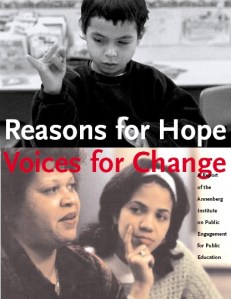
Click on image for this report and other community engagement resources from the Annenberg Institute
As Robert Godfrey noted recently, The Madison Metropolitan School District has been remiss in sending Board of Education agenda updates to those of us who have requested them. No agendas for the Monday, March 2 meetings reached my mailbox (it is on the web site and I’ve posted it here). The last agenda I received was for December 1, 2008. By my count that makes seven sets of meetings in a row without agendas being sent.
I believe that the elected and appointed leadership of MMSD are sincere in their expressed desires for more and better community engagement. Yet I am confounded by the continued lack of attention to details like this.
Some portion of the community responded to the offer of regular Board of Education agendas and updates via email, indicating a great degree of interest and engagement. Instead of satisfying this interest and building on this engagement, the district has only sporadically fulfilled their promise.
In discussions of community engagement, I’ve heard some (not all) Board members give sneering comments about seeing and hearing from the same people week after week. I’m one of those people and I can tell the Board that by treating those already engaged in this manner — belittling our interest, neglecting to send the requested agendas, failing to respond to emails… –, you give others little or no reason to engage.
Here are some simple, off the top of my head suggestions to improve communication and engagement.
I want to applaud the initiatives to improve communication like assigning Board members to sets of schools, holding more meetings in more locations and even the new governance structure that all-but-guarantees at least one week between an item being introduced via a committee and that item being voted on by the Board as a whole. These are good, but they are no substitute for taking care of the most basic things. I want my agendas.
Clarification – Whenever I have made specific requests to MMSD staff for information, they have been great about responding and providing that information (if possible) in a timely fashion. This isn’t about that, it is about the list advertised at the top of the Current Agendas page: “You can get BOE Agendas delivered directly to your e-mail inbox“ and more generally about communication and openness.
Thomas J. Mertz
Filed under Best Practices, education, Local News, Uncategorized
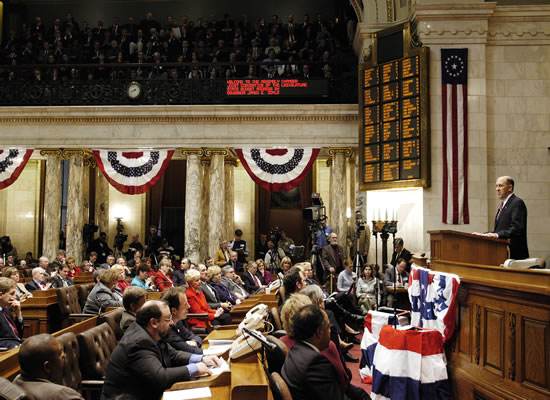
I’ve been doing searches for a second “Broken System, Broken Record” Quotes of the Day (look for it soon) and came across the text of Governor Doyle’s 2003 “State of the State” speech (his first). He doesn’t use the phrase “broken system,” but he does say some things worth rereading.
It is time to reform the way Wisconsin funds our children’s education. That is why tonight I am announcing that I will form a Governors Task Force on Education Financing.
This is too important of an issue to squeeze it into a budget proposal or devise a new plan in just a few weeks.
To do it right we need to do two things. First, all views must be represented. Parents, taxpayers, teachers, community leaders. Urban districts, rural districts. Wealthy areas, poorer areas.
Second, the meetings must be open, in full view of the public.
That Task Force was formed and produced some good work. Since June of 2004, that work has gathered dust.
I’m often hard on Governor Doyle in relation to his support for education. I’ll acknowledge that he has been a friend to education in many ways and deserves credit and thanks for that. What he has not been (in my opinion) is the champion for education that we need.
Doyle has done very well in protecting the schools from the worst of the potential cuts under a system that all but guarantees some cuts and some property tax increases; he’s tried to keep the state’s 2/3 funding commitment viable, he’s worked for increases in SAGE and Special Education funding and succeeded in making these programs slightly less underfunded. All this is good.
What he hasn’t done (unless you count the recent trial balloon, which may be a good sign) is followed up his statement form 2003: “It is time to reform the way Wisconsin funds our children’s education.” That statement was true in 2003; after six years of annual cuts to educational opportunities of 1% to 2% it is even more true today. I hope that we will soon see Governor Doyle act on this truth and be the champion he could and should be.
Thomas J. Mertz
Filed under "education finance", Accountability, Best Practices, Budget, education, finance, Local News, School Finance
In the documents for agenda of the Common Council/District Liaison Committee is the most complete version of the strategic planning documents I have seen. Worth reviewing. Also, what looks to be the same things on this page, in parts.
No time for analysis this morning, except to note that there is almost nothing directly or indirectly about financial planning and to say that I am not clear what the next steps will be.
I also thought it might be useful to compare with some earlier things.
Mission, Vision, Priorities and Beliefs
Thomas J. Mertz
Filed under Best Practices, education, Equity, Local News
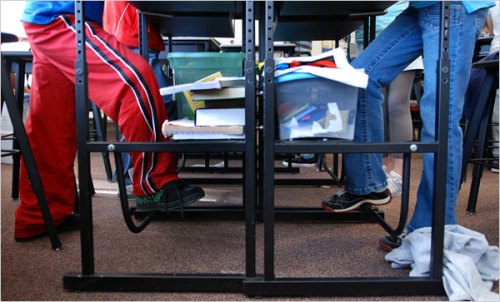
Ben Garvin for The New York Times
An interesting piece in the Times this morning really got my wife Iris quite excited, a new way to imagine the classroom setting. A good friend of hers had written her thesis on this very idea when they were studying to be physical therapists. I hope that Madison schools will continue to remain focussed on “all” approaches to quality learning in the classroom.
The stand-up desks come with swinging footrests, and with adjustable stools allowing children to switch between sitting and standing as their moods dictate.
“At least you can wiggle when you want to,” said Sarah Langer, 12.With multiple classrooms filled with stand-up desks, Marine Elementary finds itself at the leading edge of an idea that experts say continues to gain momentum in education: that furniture should be considered as seriously as instruction, particularly given the rise in childhood obesity and the decline in physical education and recess.
Teachers in Minnesota and Wisconsin say they know from experience that the desks help give children the flexibility they need to expend energy and, at the same time, focus better on their work rather than focusing on how to keep still.
Researchers should soon know whether they can confirm those calorie-burning and scholastic benefits. Two studies under way at the University of Minnesota are using data collected from Ms. Brown’s classroom and others in Minnesota and Wisconsin that are using the new desks. The pupils being studied are monitored while using traditional desks as well, and the researchers are looking for differences in physical activity and academic achievement.
Robert Godfrey
Filed under AMPS, Best Practices, education, Uncategorized
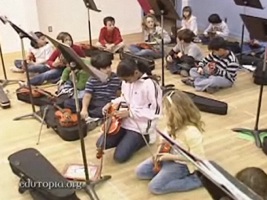
Here’s a delightful piece about public elementary schools in Tucson, Arizona where arts are integrated into every “academic” subject, from math to social studies. For example, first graders write their own operas and fourth graders learn science by playing the violin.
A sweeping initiative in the Tucson Unified School District to improve student achievement through an interdisciplinary curriculum that fuses the arts and academic subjects. The project, Opening Minds Through the Arts, is built on brain-based learning theories and research into children’s neurological development.
And some interesting results.
In the first three years, the nonprofit research firm WestEd tracked the OMA schools along with demographically matched controls: All six schools had high percentages of low-income students, English-language learners, and children of transient families. OMA students significantly outscored their counterparts in reading, math, and writing, and although the benefits held across all ethnicities, Hispanic students, in particular, made substantial gains in writing.
WestEd also found that teachers in OMA schools did better than their peers on every indicator, including lesson planning and design, arts-integrated instruction, and the creative use of varied learning activities. Today, 40 of Tucson’s more than 70 elementary schools have at least some elements of OMA. Pilot projects are under way at 4 of the district’s 20 middle schools.
Corbett, a Title I school with about 600 students, was one of the original OMA sites, and the program initially met resistance there. Teachers worried about sacrificing precious minutes in an already jammed day to music or dance, recalls Principal Joyce Dillon. “Now they say, ‘It’s so completely related to what we’re teaching. I never want to give it up.'”
Robert Godfrey
Filed under AMPS, Best Practices, education, National News
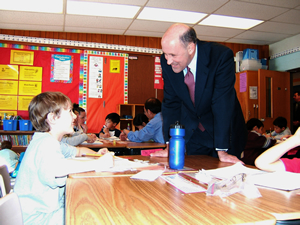
Doyle should have used this trying time as an opportunity to push for bold change that normally would be too difficult or sweeping to accomplish.
Doyle could have overhauled how the state pays for public education, for example. Instead, he says he’ll work on that after the budget is approved — something he’s said before without much follow-through. (links added)
Wisconsin State Journal, “Wisconsin Gov. Jim Doyle’s Band-Aid of a state budget plays it safe and jacks up taxes, yet it gets some priorities right.”
There is much in the WSJ editorial I do not agree with — and there is much in the Governor’s budget proposal that is good (more later) — but the paper is absolutely right that the budget proposal was a missed opportunity to move desperately needed school finance reform forward.
Thomas J. Mertz

Click here for a pdf of the full update. Table of contents below.
School-funding update
- Governor gets involved in school-funding reform discussion
- Governor’s budget helps schools keep their heads above water
- Funding reform effort gaining steam around the state
- WAES doing good work, but needs your financial support
- Two new members join WAES; 11 renew memberships
- HOPE plan making rounds of Legislature again this session
- New study shows benefits to Wisconsin of combined reporting
- Norman talks school-funding reform on Milwaukee Public Radio
- School-funding reform news from around Wisconsin
- Get involved in budget process at WCCF 2009 Advocacy Camp
- Help WAES correct e-mail update glitch
- School-funding reform calendar
The Wisconsin Alliance for Excellent Schools (WAES) is a statewide, independent, membership-based organization of educators, school board members, students, parents, community leaders, researchers, citizens, and community activists whose lone goal is the comprehensive reform of Wisconsin’s school-funding system. If you would like more information about the organization — or on becoming part of WAES — contact Tom Beebe at 920-650-0525 or tbeebe@excellentschools.org
Thomas J. Mertz
Filed under "education finance", Budget, education, finance, Local News, Referenda, referendum, School Finance, Take Action, Uncategorized
 Fund a Classroom Project in Madison
 AMPS
AMPS 