NCLB News

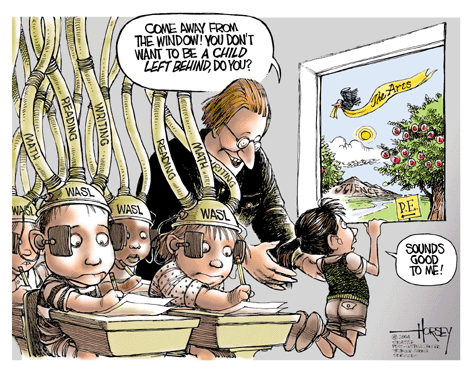
nclb-cartoon.gif

I’m going to start trying to post regularly on No Child Left Behind.  This is the first (or second) collection of links and excerpts.

Education Secretary Margaret Spellings was before the House Appropriations Committee recently.  The Chronicle of Higher Education reported on the session.

Democrats were harsh, with Rep. Jesse L. Jackson Jr. of Illinois calling the administration’s budget priorities “a bunch of garbage,” and Rep. Rosa L. DeLauro of Connecticut saying she was glad today was the last time she had to hear Ms. Spellings defend the president’s priorities. But Republicans were barely kinder, with Rep. John E. Peterson of Pennsylvania saying the administration’s budget “puts a zero priority on technical education,” and Rep. Dennis R. Rehberg of Montana accusing Ms. Spellings of neglecting American Indians. “I don’t know what you guys are smoking over there,” Mr. Rehberg told Ms. Spellings, “but it just ain’t working.”

The United Church of Christ has some wonderful anti-NCLB resources.  I think my favorite is Ten Moral Concerns in the No Child Left Behind Act.

1. While it is a civic responsibility to insist that schools do a better job of educating every child, we must also recognize that undermining support for public schooling threatens our democracy. The No Child Left Behind Act sets an impossibly high bar—that every single student will be proficient in reading and math by 2014. We fear that this law will discredit public educationwhen it becomes clear that schools cannot possibly realize this utopian ideal.

6. The No Child Left Behind Act blames schools and teachers for many challenges that are neither of their making nor within their capacity to change. The test score focus obscures the importance of the quality of the relationship between the child and teacher. Sincere, often heroic efforts of teachers are made invisible. While the goals of the law are important—to proclaim that every child can learn, to challenge every child to dream of a bright future, and to prepare all children to contribute to society—educators also need financial and community support to accomplish these goals.

7. The relentless focus on testing basic skills in the No Child Left Behind Act diminishes attention to the hu­manities, the social studies, the arts, and child and adolescent development. While education should cover basic skills in reading and math, the educational process should aspire to far more. We believe education should help all children develop their gifts and realize their promise—intellectually physically, socially, and ethically. The No Child Left Behind Act treats children as products to be tested, measured and made more uniform.

9. The No Child Left Behind Act exacerbates racial and economic segregation in metropolitan areas by rating homogeneous, wealthier school districts as excellent, while labeling urban districts with far more subgroups and more complex demands made by the law as “in need of improvement.” Such labeling of schools and districts encourages families with means to move to wealthy, homogeneous school districts.

The Center on Education Policy has issued a new report on the curriculumn narrowing which has resulted from the high stakes testing in math and reading.

Among the districts that reported both increasing time for ELA or math and reducing time in other subjects, 72%indicated that they reduced time by a total of at least 75 minutes per week for one or more of these other subjects. For example, more than half (53%) of these districts cut instructional time by at least 75 minutes per week in social studies, and the same percentage (53%) cut time by at least 75 minutes per week in science.

Some news on the “opt out” front (states, districts, schools and students considering refusing to comply with the law).  Virginia is on the edge of leaving NCLB behind (hat tip to Jim Horn at Schools Matter).  The Carol Stream (IL) Elementary District 93 has decided not to force children who don’t speak and read English to take tests writen for  English speakers (this is a violation of the law…another tip of the hat to Jim Horn is in order).

District 93 officials say they’re willing to break the law this spring to shield students from the frustration and humiliation of taking an exam not designed for them.

“The board believes it’s appropriate to do that,” District 93 Superintendent Henry Gmitro said. “While there may be consequences for the adults in the organization, we shouldn’t ask kids to be tested on things they haven’t been taught.”

Illinois dropped the test that was designed for English learners this fall, after the U.S. Department of Education made a final ruling that the test wasn’t an adequate measure of state learning standards. The old test was written in simpler English.

As a stopgap measure, English learners will take standard assessments with some special accommodations, such as extended time and audio recordings, while Illinois develops a test that will meet federal guidelines.

Locally, the Wisconsin Peace & Justice Network  is asking people to identify alternate uses for the money that is being spent on the Iraq war.  According to their figures, Madison taxpayers have contributed about $300 million.  After fully funding free quality early child education and restoring MMSD’s cost to continue cuts of the last few years, I would suggest Madison opt out of NCLB at a cost of about $5 million per year.  We can dream.

Last, I’ve added a new blog to the Resources page: the NEA’s NCLB – It’s Time for a Change!.  Check it out.

Thomas J. Mertz

Leave a comment

Filed under "education finance", Accountability, Best Practices, education, Elections, Equity, finance, National News, nclb, No Child Left Behind

Quote of the Day

lines.jpg

No boundary changes ever occur without fear, or frustration. That’s what happens when you live in a growing city. Arguments that folks moved to a specific neighborhood for a specific school are weak at best. We cannot afford a school for every neighborhood, and we have to address over-crowding as well as school equity as it relates to children of low income families.

SP-EYE: Keeping an EYE on the Sun Prairie School District

Our neighbors in Sun Prairie are dealing with similar issues in redrawing school boundaries.  Clean and easy attendance area redistrictings are exceedingly rare, add issues of racial, linguistic and economic diversity and there is sure to be conflict.  That’s the nature of the beast.

The MMSD West-side boundaries are on the agenda for Monday, March 3, 2008.

Related items:

“Moving the Lines,” Jason H. Silverman.

“Planning for Equity,” Kelley D. Carey.

“Planning for Integration,” Kelley D. Carey.

Sun Prairie Area School District Boundary Task Force (District Home Page).

More student moves loom in Sun Prairie (Capital Times).

Sun Prairie Parents Weigh In On School Boundary Changes (Channel 3000).

Sun Prairie schools still in a deadlock (Capital Times).

Opposition voiced to boundary changes (Sun Prairie Star).

MMSD New Elementary School page (with boundary proposals).

Parents Upset Over Plan F Recommendation (WKOW).

School Board panel recommends significant changes (Capital Times).

Cheryl Rebholz: Toki Middle School responses unfair (letter to the editor).

Thomas J. Mertz

Leave a comment

Filed under AMPS, Best Practices, education, Equity, Local News, Quote of the Day, Uncategorized

(Now?) Talking about Boundaries and Diversity, 2008 Style

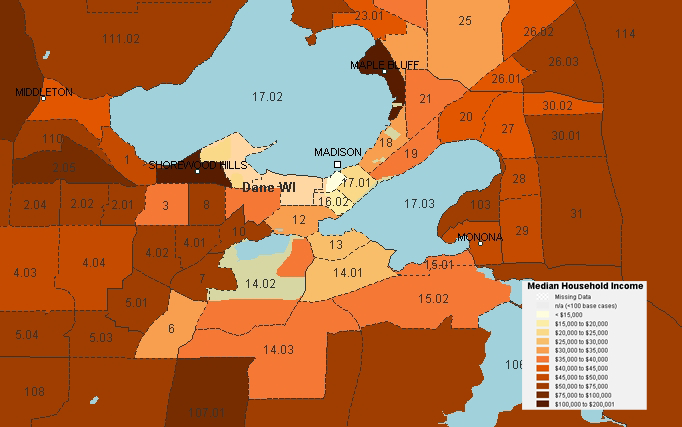
2000-census1.jpg

This is a quick update on the earlier post “(Not?) Talking about Diversity and Boundaries, 2008 Style.” The good news is that it appears that some people have at least started talking. Susan Troller’s article in today’s Capital Times has some good quotes from three Board of Education members. Everything they say is fine and (at least) one addresses resistance to diversity head on:

School Board member Carol Carstensen, who chairs the long range planning committee, said she has been very troubled by the tone of many of the e-mails she and other board members have been getting regarding the proposed changes.

“It’s dramatized for me the significant gap we have in our community,” she said.

“It’s very troubling that we are increasingly separating ourselves and that there are parents who are saying they will not allow their children the experience of going to school with ‘those children,'” she said.

Lucy Mathiak offered a reminder that test scores aren’t everything:

“The performance and the test scores simply don’t warrant this kind of reaction,” she said, adding that hearsay, not actual experience, is fueling a gap between perception and reality at many low income schools.

Along with Beth Moss, Mathiak and Carstensen put things in perspective and reminded the community that perceptions and realities of schools can be changed and that active involved community members are the key:

“My children attended East, and I know how painful it is to have the school your kids attend labeled as some kind of loser ghetto school,” she [Mathiak]said.

“My kids came out of their school experiences as well-educated for life success as I could possibly hope,” she added.

Beth Moss, who is the third member of the long-range planning committee, and who has children who attend Jefferson, said a school’s reputation can change quickly.

“Last year I was sitting with a group of very irate parents who were extremely concerned about school safety, violence and bullying at Jefferson,” she said.

“We talked about it, and some changes were made, but I do find it kind of ironic that now Jefferson is seen as some kind of nirvana,” she said.

“The reality is that no school is perfect,” Carstensen said. “If you don’t like something, do what so many parents have done. Work at it, and change it.”

I’m glad to hear this from our Board members.

The many comments on the Capital Times story show others talking directly about the difficult issues of race, class and diversity. Not everything said there is constructive, but I do think that airing this is better than pretending it doesn’t exist.

Another good sign is the use of language and concepts from the Equity Task Force work at the Long Range Planning forum last week. The notes are posted here. Even though the Board has not directly addressed that portion of the Task Force recommendations, the idea that Madison needs to take affirmative steps to create and maintain schools with reasonably balanced socio economic characteristics (and that schools with low poverty numbers are as unacceptable as schools with high poverty numbers) seems to be gaining currency with some. More good news.

And on a non-local note, Mica Pollock, the author of Colormute: Race Talk Dilemmas in an American School and editor of Everyday Antiracism: Getting Real About Race in School (discussed in the previous post), will be participating in an on-line chat hosted by EducationWeek.org. the chat will be on February 27, but they are taking questions now. More info here.

Thomas J. Mertz

Leave a comment

Filed under AMPS, Best Practices, education, Equity, Local News, Uncategorized

AMPS Clean Up

brooms-jlm.jpg

When we moved the site to a new platform and server about a month ago, many of the internal links stopped working.  We’ve been doing a little clean up here and there, but nothing systematic.  You can help.  When you come across a link that doesn’t work, please use the comments for that post to let us know.  We’ll get it fixed.

 Thanks.

Thomas J. Mertz

Leave a comment

Filed under AMPS

Referenda Roundup

check-yes2.jpg

There were fourteen referenda on the ballot last Tuesday (more here on the campaigns), six passed and eight failed.  There will be at least fifty-eight referenda on the ballot April 1, 2008.  Madison should have an operating referendum on the November ballot.  Last year over one hundred districts went to referendum.

Is this any way to fund our schools?  Read below and decide for yourself.

Auburndale

Question 1: Operating, recurring, $160,000/year —  Failed 772-600.

Question 2:  Funding unfunded retirement benefits, nonrecurring (4 year), $250,000/year — Failed 926-455 (this is going to be  a problem for many districts in the years to come).

Question 3: School Improvements (physical plant), nonrecurring (4 year) $215,000/year — Failed 704-681

From the Wausau Daily Herald

“I don’t know what other solutions are out there,” said Raab, adding that the board has been looking at potential budget cuts, but “I just don’t know how deep we can go.”

Superintendent Gerald Eichman said the district must do a better job informing the community of its needs and the state’s school funding formula when asking for another referendum.

School districts say they have built-in deficits because fixed costs, such as teacher’s salaries and benefits, rise faster than the state increases revenue limits…

“We’re going to be able to survive next year,” he [Superintendent Gerald Eichman] said. “It’s going to get exponentially worse each year after because of the increasing costs.”

Darlington Community

One Question: Operating, nonrecurring (4 year), $700,000/year — Passed 748-724.

From the Monroe Times:

District Administrator Joseph Galle, who was out of the district Wednesday, previously said the money is needed for general day-to-day operational expenses, such as heating fuel, electricity and paying staff salaries and benefits…

Galle cited a growing gap between state funding and district expenses and a decline in state aid due to declining enrollment as reasons for a referendum.

Kenosha

Question 1: Operating and maintenance of new high school with academies, recurring, $2,427,00/year — Passed 16,255-12,387.

Question 2: Issue debt for new high school construction, $52,500,000 — Passed 17,341-11,701

From KenoshaNews.com:

“I am so ecstatic,” said Bradford Principal Sue Savaglio-Jarvis as the final votes came in. “I think all through this process it was going to pass. I’m so happy the community saw this was important for student learning. It’s a relief because we see an end to the overcrowding coming, and we can start giving kids more opportunities that they don’t have right now.”

Marshfield

One Question: Operating, nonrecurring (5 years), $2,000,000 the first year, $2,500,000 the second, $3,000,000 the remaining years — Passed 5,893-4,683.

From the Marshfield News Herald:

“I really have to applaud the voters for coming through loud and clear with a pro-education message,” said John Adam Kruse, chairman of the Yes Committee. “By maintaining our great public schools, we will continue to be a community that people will want to raise their children in.”

Merrill Area

One Question: Operating, recurring, $930,000 the first year, $995,000 the second year amd $990,000 the third year — Failed 5,116-2,049.

From the Wausau Daily Herald:

 Staff losses at the schools will increase some class sizes and reduce individual instruction. Less support staff will mean that more responsibilities will fall on teachers, said Gerald Beyer, principal of Prairie River Middle School.

“From the building-level principal perspective, these cuts are real,” he said.

More on cuts in Merrill here and this video

Oconto Falls

One Question: Issue debt for athletic field improvements, $4,970,000, Failed 1,698-1,580.

Rio Community

Operating and maintenance, nonrecurring, $295,000 the first year, $415,000 the second year and $560,000 the third year (3 year), Failed 501-483.

From the Portage Daily Register:

[School Board member Don] Shippert said if the board decides to pursue the same referendum again, there are only 18 people left to convince. He also said he understands that living on a fixed income and being retired is difficult, because he is in the same situation.

“I hope there would be a feeling of community support for the younger generation. There should be a commitment that each generation has to the next,” Shippert said.

Thorpe

One Question: Issue debt for Ag/Tech shop addition, $490,000, Passed 661-494.

This is the happy ending to a heartbreaking story.   A similar referendum had failed by one vote in 2007.  This time the community, led by the Future Farmers of America Alumni, came together to pass the referendum.  Communities like Thorpe struggle to keep population and jobs.  Investing in effective agricultural and technical education can help keep these communities and our state strong.  Thorp’s agricultural education program is one of the fastest growing in Wisconsin, now they will have the facilities they need.  Good work.

Waterloo

One Question: Issue debt for new boiler, Passed 1,082-334.

From the Watertown Daily Times:

Without voter approval to exceed the state-imposed revenue caps, the board would have had to cut educational programs to pay for a new boiler. Revenue caps limit the amount of money a school district can raise through the property tax levy. The project is nothing the district can do within its budget officials have said.

Wausaukee

One Question: Operating and maintenance, nonrecurring, $1,115,000 the first year, $1,000,000 the last three (4 year), Failed 1,334-394.

From the Peshtigo Times:

The school district has been facing budget shortfalls of more than $354,000 a year. Its once healthy general fund balance is now projected to be over $700,000 in the negative by the end of the 2009-2010 school year if nothing changes. The specter of closing the school looms on the horizon…

Trustee Jeff Townsend hoped people would realize the damage loss of the school would cause to the village economy. The real solution, he suggested, “is to get more students.” He said people need to sit down as professionals and figure out how to improve the schools so parents will move to Wausaukee because they want their kids attending school there…

Trustee Rosie Figas asked Gerbers what his group was doing to influence the state to change its school funding formula. Gerbers said the 48 “northern lake districts” in the state are all facing the same financial problems. He said members of their group met several times with Sen. Roger Breske, but the northern districts don’t have enough votes to force change in Madison. He said Crivitz is in almost the same position as Wausaukee, only a little behind. “They’ll be where we are next year,” he predicted.

Woodruff-Arbor Vitae

One Question: Operating, recurring, $689,500 the first year, $125,000 more the second year and $70,000 more the third (exceed revenue caps $880,000 each subsequent year), Failed 1,014-924.

From WJFW:

[District Administrator Susan] Treb says, “We have to consider what’s going on and be realistic about the broken system we currently have for funding public schools.” (and video)

Thomas J.  Mertz

Leave a comment

Filed under "education finance", AMPS, Budget, education, Elections, finance, Referenda, School Finance, Uncategorized

NCLB Action

We haven’t posted much on No Child Left Behind lately.  Time to remedy that.

The reauthorization/reform are still pending, but don’t appear likely in this election year (see also here).  I don’t know if that is good news or bad news.  A straight re-authorization would be very bad news, but a better federal education policy (and less high stakes testing, less money for charters and vouchers, more money for underfunded mandates, more realistic accommodations and exclusions of special education students and English language learners for all testing) would be welcome, whatever the name.

I have to thank Madison teacher Gary L. Stout for prompting me on this post (and to add the Collaborative for Academic, Social, and Emotional Learning to the AMPS Resources page — check it out).  Gary, along with David Wasserman (see here and here, on AMPS) has been doing his best to get out a teacher’s perspective on the damage the law is doing to our schools and children.  Here is an excerpt from his site on NCLB (check out the Social, Emotional, and Academic Learning in Kindergarten material too, it is well worth the time if you care about early education).

Developmentally Appropriate Practices

If a person is truly knowledgeable about what constitutes Developmentally Appropriate Practices (DAP) for our school age children it is inconceivable that they support NCLB.

The concept of Developmentally Appropriate Practices are the cornerstone of what is good for our children in all schools. You will never, ever see the two phrases NCLB and DAP in the same sentence in any credible professional educational journal, never, ever. The more a person studies and works in teaching the more a person sees how developmentally inappropriate NCLB really is.

NCLB is the most destructive, vindictive piece of federal legislation ever passed. It is a deliberate assault on public education. It is a disease that is presently in every classroom, every day. It starts in kindergarten classrooms by undermining all aspects of Developmentally Appropriate Practices. It continues on through the grades and stops in High School when it lures, misleads, misinforms, and recruits our students into the all too real prospects of death or maiming. It is a tribute to the existing presidential administration
and their success at destruction and manipulation. NCLB is an all encompassing cancer that needs to be stopped.

The whole essay is here, including good quotes from our Board of Education members.  One more excerpt on what we can do: Take Action!

What Can We Do?

It is easy to be critical of NCLB. The challenging part is addressing the question of what can we do to change things?

1. We need to unite and get politically active locally and nationally to eliminate NCLB or change it drastically. The problem is that political change is slow. We as a nation have been taking steps backward in the education of our children for five years now. We will continue going backwards on a daily basis as long as NCLB exists as it is today.

2. It is critical for Wisconsin to change the way our public schools are funded. The elimination of revenue caps and the use of property taxes as a major way to fund public schools has got to change.

3. Third, we need to educate many of our co-workers, parents, and the voting public as to the truth about how our schools are being deliberately set up for failure and how our schools are presently failing on a daily basis to meet even the basic needs of all our children
There are also at least three things we can do immediately as a progressive and accountable school district.

1. Stop the one dimensional focus on academic learning and teach to the whole child. We need to teach and give every child the opportunity to grow socially, emotionally, physically, and creatively as well as academically.

In March 2003 I addressed a Madison school board committee suggesting that our school districts emphasis on testing and academic learning at the expense of social, emotional, physical and creative learning was developmentally inappropriate. Since then our approach to teaching to the whole child as become even more one dimensional with the developmentally inappropriate mandates of NCLB.

2. Change the focus of the Madison summer school program. Instead of using behavioral issues as a deterrent to getting into the program, children with behavioral issues should be the first to be enrolled. The public needs to know that when a classroom has just one socially
inappropriate child, that child takes educational opportunities away from every child in the classroom. Social development is similar to reading and math development. They need to be taught every day, in every classroom, at every grade level.

3. We need to remember Rosa Parks and say no to NCLB. Our school district should be commended for having the courage to say no to the Reading First program. Lets have the courage to say no to NCLB. As a community lets find ways to fund our schools without having the George Orwell effect tied to federal dollars.

I’ll add one more.  The Board of Education Communications Committee is planning forums on various topics.  I think the NCLB Act should be one of them.  If you agree, let them know.

Here are some of my other favorite anti-NCLB resources:

The Educator Roundtable (with petition).

Susanohanian.org (with a compilation of NCLB Outrages).

No NCLB.org

Thomas J. Mertz

Leave a comment

Filed under Accountability, Best Practices, Budget, Elections, Equity, finance, Gimme Some Truth, Local News, National News, nclb, No Child Left Behind, School Finance, Take Action, Uncategorized

We are not alone #19

bubble_nebula.jpg

Many, many referenda on the ballot in Wisconsin today.  Due to the TIF windfall, Madison escaped this round.  A large operating referendum is almost certain for November.

With that in mind, here are links and (very few) excerpts on today’s school referenda votes.

Unified tries to sway voters

Marshfield (links to many stories)

Students Support Marshfield Referendum

“”I think there’s a lot of people who don’t understand how big of an impact these extracurriculars have on our school lives. Like, I’m really into drama and band and I write for the school newspaper. All of those are going to be cut if this doesn’t pass.”

Marshfield School District Needs $2 Million Referendum

Support city school referendum to save education options

“My little sister can’t wait until she is in fifth grade and is able to join band, but that might not even happen. Why would they take away the foundation of the question “What do you want to be when you grow up” I loathe the fact that most people don’t even know or care what’s going on! People also, I feel, are being scared away by the thought of a raise in taxes, but the raise is a small price to pay for your/my future. What about the teachers that might be laid off because of this? Do you have any advice/help?”

Local School District Putting Multi-Million Dollar Referendum on the Ballot

“I’m not sitting here saying the football program will be cut,” Sally Sarnstrom said. “But it’s like any system. When you just keep reducing it, it just isn’t as effective.”

‘Dismantling’ would follow referendum’s failure

“Without the referendum, the district likely would cut four staff positions at its elementary schools and eliminate German from the curriculum at Prairie River Middle School next school year, officials said.

Future cuts would include reduced funding for special education and technology and additional teacher positions.

“The appropriate term to use now is dismantling,” Superintendent Sally Sarnstrom said, implying that the district has no room left to downsize. “”

Merrill voters will consider $2.9 million school measure

Spend the money, although it hurts

“The number of staff eliminated is almost staggering since 2001-2002.”

Oconto Falls Outdoor Facilities Referendum

Rio Schools to go to referendum in February

“After squeezing every penny from its 2004 referendum, the Rio Community School Board hopes that its diligence will convince residents to pass another ballot initiative in February.

“There is no room to cut anymore, and we have been very honest with the community about that,” said Doug Shippert, school board member. “In the past we have made cuts with staff and courses, but you can only make so many reductions. And the community knows we have made good fiscal decisions in the past.”

Thorpe referendum info

Thorpe referendum literature from the Future Farmers of America Alumni (this one broke my heart) 

Waterloo referendum newsletter

Arbor Vitae-Woodruff referendum powerpoint

Arbor Vitae-Woodruff Referendum

AV-W board approves referendum

I’ve said it before, this insanity has to stop.  It is long past time to fix the school finance system in this state.

Thomas J. Mertz

Leave a comment

Filed under "education finance", Best Practices, Budget, education, Elections, finance, Pope-Roberts/Breske Resolution, Referenda, School Finance, Uncategorized, We Are Not Alone

Everybody Wins!

gold-stars2.jpg

“We’re a Winner,” Curtis Mayfield (listen).The Madison Board of Education voted tonight (7-0) to change the schedules of Board and Committee meetings for the next three months instead of moving non-agenda public comments to the end of meetings.

Open and convenient access for the public has been preserved, the Board has a schedule that they believe will allow them to be more productive and efficient.  Everybody wins.

Many thanks to all who expressed concerns, lent support or offered suggestions

Thomas J. Mertz

Leave a comment

Filed under AMPS, Best Practices, education, Local News, Take Action, Uncategorized

Paul Soglin on Merit Pay

wedge.gif

 Paul Soglin has a good post up on some problems with merit pay and related issues.

Time Magazine Gets An ‘F’ on Merit Pay for Teachers

The line, “It’s hard to argue against the notion of rewarding the best teachers for doing a good job.” in the Time Magazine article, How To Make Great Teachers jumped out at me.

It is very easy to make the argument.

There is a false assumption, an unarticulated premise, that workers, particularly teachers, perform better if they are financially rewarded with additional compensation.

We all work to make a living. We do better work for a variety of reasons. Actually most people do better work when motivated by pride in their job, not additional compensation.  That is why educators recognize that the most successful schools are the ones where the principal motivates the entire faculty to work as a team. 

If any kind of financial incentive is given, it should be to the entire faculty, not to individuals.

The Time article needs examination in other areas:

  • We never forget our best teachers – those who imbued us with a deeper understanding or an enduring passion… Wrong. I did not like Mrs. Gertz and frankly, I do not think she liked me. My sixth grade teacher was most unpleasant, especially when it came to adjectives and adverbs. She taught me how to write, she was not what I would call a great teacher. But she did her job.
  • …the nation will need to recruit an additional 2.8 million over the next eight years…Finding and keeping high-quality teachers are key to America’s competitiveness as a nation. The solution is not a merit pay system; the solution is recognizing the value of educators and paying them what they could make in the private sector.
  • Research suggests that a good teacher is the single most important factor in boosting achievement, more important than class size, the dollars spent per student or the quality of textbooks and materials. I am not sure which is most important, but the studies I read indicate that the quality of the faculty, the amount spent on education, which is reflected in class size, and parental involvement are the three major factors.
  • Why do teachers bail? One of the biggest reasons is pay. U.S. public-school teachers earn an average annual salary of less than $48,000, and they start off at an average of about $32,000…And there’s evidence that the best and brightest are the first to leave.  Hello, Wisconsin Manufacturers & Commerce (WMC), are you listening?
  • It’s too soon to say if ProComp (an incentive pay system) will raise achievement in Denver, but a pilot study found that students of teachers who enrolled on a trial basis performed better on standardized tests than other students. Great, but do the kids who performed better on the standardized test learn anything?  Now we have teachers teaching for the test,’ not teaching so that the kids learn to think.

Nate at Proletariat had some good thoughts about collaberation and merit pay a while back.

 Governor Jim Doyle and Barack Obama both support merit pay. Hillary Clinton does not.  More on presidential candidates and education here and here.


Thomas J. Metz

Leave a comment

Filed under AMPS, Best Practices, Contracts, Elections

Democracy and Efficiency (part II)

ito13.jpg

On Monday February 18 the public will get a chance to speak to the the Board of Education about the proposal to move public appearances on non agenda items to the end of meetings. I implore all interested members of the public, pro and con, to attend on Monday and make your voices heard. The meeting will be in the Doyle Building auditorium. It starts at 5:00, but the public hearing on the proposal is on the agenda after the report of the Citizens [School] Naming Committee report. I would guess this will be after 5:30.

In an earlier postI promised to offer some constructive suggestions on this proposal and the broad matter of balancing the desire for public participation with the desire for efficiency. I realize that these are not exactly the same “problems” Board President Arlene Silviera identified — “The issue is that the Board would like to focus on its business at a more reasonable hour in order to make good decisions for the children of the district” — but I think they are close enough.

When searching for solutions, it is essential to begin by demonstrating that the “problem” actually exists and if it does the next step is to assess how serious it is.

Here are the Board priorities for the year:

– Develop specific, measurable goals regarding strategic priorities

– Attendance, dropouts, truancy, expulsions, bullying

– Equity discussion – follow through/implementation

– Hiring a new Superintendent

– Considering/weighing options for a possible referendum

I don’t know everything that the Board has done, but based on what I do know and can find I’d like to go through these one by one and assess the progress.

Develop specific, measurable goals regarding strategic priorities

The Performance and Achievement Committee developed and forwarded to the Board a “Strategic Plan Accountability Matrix,” It was approved on November 11 . I believe that this is a partial fulfillment of this priority. The matrix isn’t posted on the district web site so I can’t be sure, but this appears to be related to the ongoing work of the district and Board moving toward implementing value added analysis (a blessing, but a mixed blessing in my opinion, see here, here and here, to start). The strategic priorities should also play some role in the Board’s equity work.

Attendance, dropouts, truancy, expulsions, bullying

After much work, the expulsions policy has been revised. I can’t find much on the others ( code of conduct revision here), but again the equity work should touch on them. Another partial fulfillment.

Equity discussion – follow through/implementation

One meeting devoted largely to Equity where progress was made and a second (at the end of a night made long by on-topic public appearances at the Long Range Planning Committee and other matters), where not much was accomplished. I have many things to say about process the Board has pursued with their equity work (some here), but this is not the place to go into that. I would put this in the “barely started” category.

Hiring a new Superintendent

This is huge and was hugely time consuming. They did a very good job throughout the process and ended up with a fine choice.

Considering/weighing options for a possible referendum

They started this in a timely manner, made some progress but because of the TIF windfall it ended up being “the referendum that wasn’t.”

I think this is a pretty impressive record of accomplishments. Add to it revising the school naming policy, beginning West side boundary discussions, settling the MTI teacher contract, beginning work on community forums and partnerships, as well as other initiatives that are under my radar; and weathering the storms of consolidation and budget reconsideration, General Vang Pao, and private school busing and it looks to me like a fairly successful term. I am skeptical that this record indicates a problem that rises to the level of requiring what I consider the drastic action of making it more difficult (however slightly) for the public to communicate with the Board. Obviously some Board members disagree or it wouldn’t have come up.

Although skeptical, I’ll stipulate that there is a problem, that the Board has been unable to give sufficient attention to their work and priorities. The next step should be to evaluate a range of solutions. The Board produced one “solution” and did little in the way of evaluating its’ effectiveness.

I hope to have documentation of how much time was spent on off-topic public appearances before Monday. Having sat through many meetings, watched video of others and reviewed minutes of even more, my initial impression is that the vast majority of off-topic public appearances this term have been about the school consolidation/budget reconsideration, the General Vang Pao school naming, private school busing and Military ads/recruiting. At least the first two of these are exceptional situations and concern problems of the Board’s own making. Some might say this describes the others also. My point is that week in and week out, year in and year out, off-topic public testimony does not seem to consume all that much time or energy.

In all these cases and more, I believe that the community, the district and the Board have all benefited from the opportunities for open public input. If there is to be any new limit, I would like it to be time based instead of topical. For example, if there are more than 15 registrants, limit of speakers for two minutes.

Any assessment of time or energy spent on off-topic public appearances only makes sense in the context of a comparative assessment of time spent on other tasks. I don’t have documentation on this either, but it seems the Board spends an inordinate amount of time with housekeeping matters, paying bills and and taking other actions that are required by law. The obvious solution is to use a consent agenda, to bundle these matters into a single vote. This has come up twice (that I know of) in Board discussions; once here and the second time during the discussion of the public input “problem.” Despite the efforts of some Board members, it has never appeared on an agenda. It is a reform that makes sense.

I am only going to make one more suggestion here, and this only deals indirectly with efficiency, but I think it would enhance communication and democracy and may induce fewer people to use Board meeting time with public input. Board members should hold office hours. One of the problems with the rituals of public input and the black hole of emailing or writing elected officials is that the public often feels they are not being listened to. I know Board members also have public phone numbers, but calling them seems like such an imposition. Office hours would allow dialogue between Board members and the public — something, for legal and other reasons, sorely lacking at Board meetings. Carol Carstensen used do do something like this in her home by hosting regular open houses, but these raised legal issues that led to their demise. What I am proposing is that Board members rotate and that each week at a designated time one or two be available for appointments or walk in meetings. I really think this would help.

Communication is a two-way street and the public is not without fault in the communication problems that exist. John Dewey wrote:

All communication is like art. It may be fairly said, therefore, that any social arrangement that remains vitally social, or vitally shared, is educative to those who participate in it. Only when it becomes cast in a mold and runs in a routine way does it lose its educative power. “

Too often the public input sessions — both on and off topic — consist of all parties going through the motions. With this in mind, I offer some initial tips on giving effective, communicative public input:

  • Be informed and accurate.
  • Know what can or cannot be done, but also don’t lose sight of and do communicate your dreams for the future.
  • Be polite and respectful (this one can be hard, but at least keep it civil).
  • Don’t rehash old history. Past conflicts and mistakes should be used sparingly and only to point ways forward.
  • Offer realistic alternatives.
  • Try to see the “big picture” and demonstrate that you do.
  • Remember that the School board’s primary focus and reason for being is to improve student achievement for all children
  • Use personal stories, but don’t make it personal, tie them to larger concerns.
  • Thank the elected officials for past and future things.
  • Don’t criticize the people, criticize their actions (or inaction).
  • Sustain involvement. Elected officials have more respect for people who stick around and keep working.
  • Look for common ground, but if it isn’t there be straight forward about that.
  • Don’t make threats.
  • Don’t complain about taxes unless that is the one focus of your testimony.

As usual, this is too long, so I’ll leave it at this. Your suggestions on effective input, Board efficiency or anything else are welcome. Just leave a comment.

Thomas J. Mertz

1 Comment

Filed under Accountability, AMPS, Best Practices, Local News, Take Action, Uncategorized