I’m really excited about this event. Things are coming together. Here are the basics:
What: Public Forum featuring all candidates for Madison Board of Education. When: Sunday February 21, 2010; 1:30 to 3:30 PM. Where: JC Wright Middle School, 1717 Fish Hatchery Rd. Madison, WI. Sponsor: Progressive Dane.
On Sunday, February 21, voters in the Madison Metropolitan School District will have their first opportunity to hear and question the School Board candidates on the ballot in the April 6 election. Unopposed incumbents Beth Moss and Maya Cole will begin with short statements on their service and why they are seeking re-election. Next the candidates for Seat 4, James Howard and Tom Farley, will answer questions from Progressive Dane and the audience. Madison District 12 Alder and member of the Board of Education – Common Council Liaison Committee Satya Rhodes-Conway will serve as the moderator.
The more people and the more diverse people who attend and offer questions, the better, so help spread the word. Invite your friends and neighbors; print the flyer at the top and post it at work (smaller handbills here)…spread the word.
I’m just finding the time to post this on the Monday February 8, meeting (preview of that meeting here). To be honest, it wasn’t a very exciting meeting. Most of the real work was done the previous week, when they met as Committees.
Almost everything on the agenda passed 6-0 (Lucy Mathiak, absent) with no discussion. A few things deserve a little comment.
It looks like there will be something of a restart on the La Follette area planning. The Board voted to use technology and other things for 2010-11. The timeline for the restart was given as “6-9 months.” I hope the 9 instead of the 6. Johnny Winston Jr also suggested that the Board be involved in the initial phases, the Board and administration agreed and I think that is good. Overall a good way to move forward on something that was looking like a big mess.
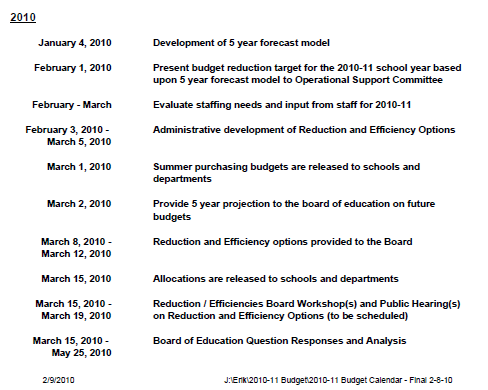
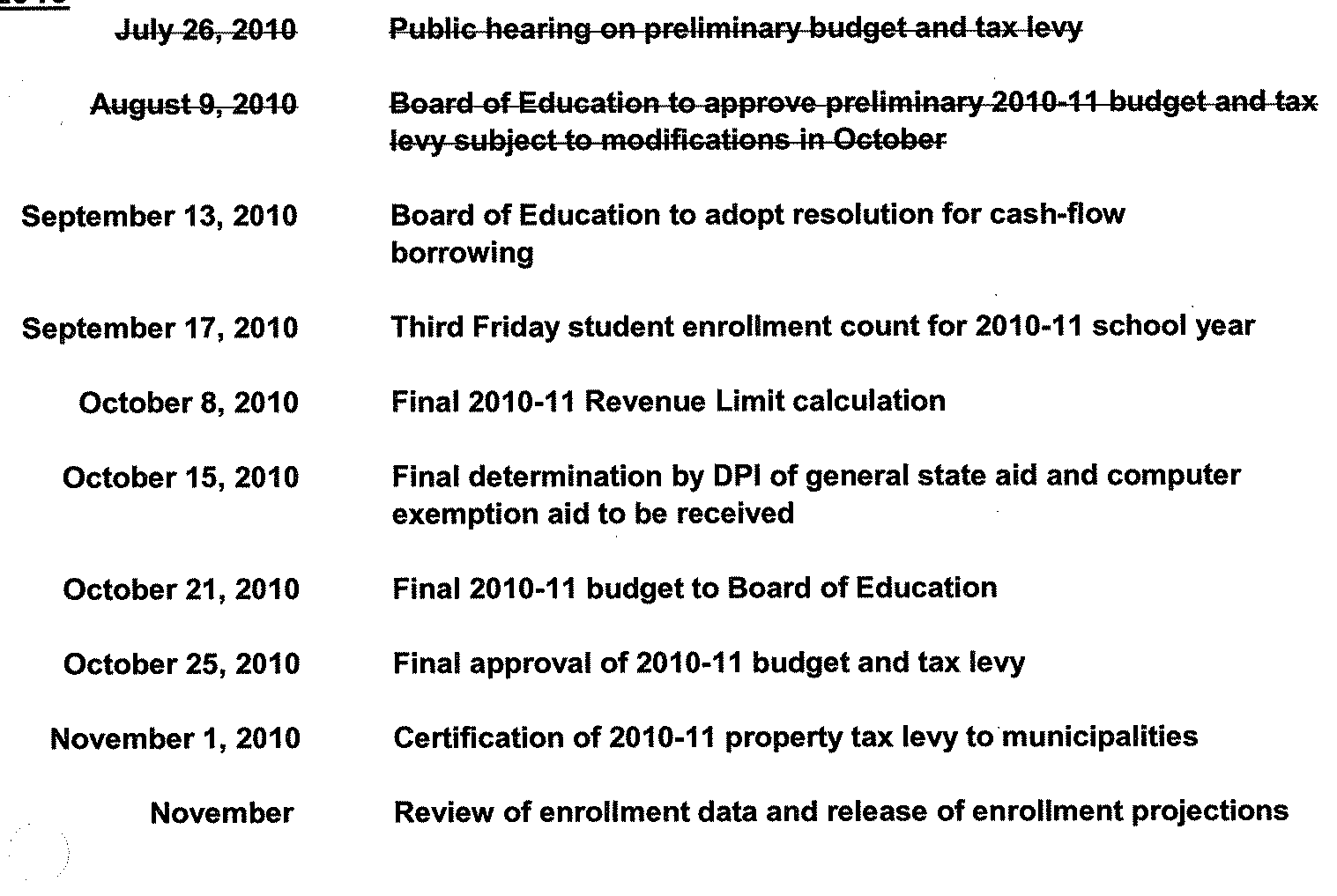
The new Budget timeline was approved (see Gayle Worland’s Wisconsin State Journal story for more). So there is now a plan for how to consider $30 million in cuts. The only big change was that personnel cuts and other cuts will be taken together. Here it is:
Some things to note. First, the May 3-7 meeting where the Board approves reductions will be the first meeting for either James Howard or Tom Farley (see here for info on the February 21 Progressive Dane Candidate Forum). Second, the state mandated budget hearings will be odd this year due to the timing. At that point the Board can add things back, but no real cuts are possible. I would really like that hearing to occur at a time when everything is still on the table. I am also somewhat bothered that the Budget Book comes out after the Public Engagement sessions.
I did hear some good things from the Board and the administration about how this will be be done. They seem committed to gathering as much information as possible, sharing that information with the public, trying to work from some common principles and as much as possible avoiding rancor. It won’t be easy. There will be a lot of pressure from the anti-tax crowd to cut and a lot of pressure from others not to cut specific things. Going into this I do think it is important to keep in mind that the current situation cannot be attributed to local mismanagement. This is a state created problem. If you are going to get mad about the school funding situation, get mad at the state officials.
One other thing I’d like to say is that there have been some positive things done on things like 4K and the Strategic Plan where a real work on defining and implementing a vision for improving educational opportunities has been started and I hope that does not get lost in all this. The Board Members have expressed similar hopes.
On the Retirement Refinance and 4K funding the Board went with option 2B, smaller overall savings but more front loaded. I believe the vote was 5-1, with Marj Passman favoring 5A.
Sam Dillon of the New York Times has been doing some good reporting on the carrot/stick financing strategies of the Dept. of Educaction in the vortex of shrunken state budgets, stimulus money about to dry up in 2010 and Arne Duncan’s Race to the Top (RttT) funding proposal.
In a piece from January 18th, Dillon quoted Nevada’s school superintendent Keith W. Rheault, who noted that Nevada educators had initially grumbled about the RttT program but quieted their criticisms once their state’s tax revenues plummeted last year.
“When you’re starving and somebody puts food in your mouth, it’s amazing what states will do,” Mr. Rheault said.
It was obvious that any opposition was not going to derail efforts by about 40 states to compete in the first part of a two-stage competition (7 will also file for second stage applications later). This, despite the fact that many of those states had to perform last-minute legislative changes to make their proposals more in line with Dept. of Education guidelines. A big effort, for example, was made in many states to accomodate the mandate that raised the number of chartered schools or expanded the pool of students who are eligible to attend them. As well, both California and Wisconsin repealed their laws that banned the linking of student achievement data to teachers; one day, in Wisconsin’s case, after Mr. Obama’s visit to Madison.
But in their efforts to jockey for desperately needed cash, ostensibly to become a leader in education “reform,” critics have suggested that the various state’s inabilities to pay current bills should make everyone skeptical of their capacity to take on any such new initiatives. As a report noted , in the case of Illinois, if the state were to succeed in receiving RttT funding, “it might not have the ability to finance the long-term costs of any new programs once the federal money has been spent.”
“Not too long ago,” Ms. Slowik said, “everyone was encouraged to get early-childhood programs going, but then the funding wasn’t there.”
“Then you come along and have Race to The Top, and say you’re going to give your all and put extra things on,” she added. “There’s a feeling in the education community that these are expectations some know they can’t meet.”
With Illinois, for example, already coping with $1 billion in arrears to schools, and having already used $1 billion in federal stimulus money to plug a major hole in the state’s education budget, this represents a precarious tightrope to be walking on indeed.
Some educators are skeptical that the state can meet even its current obligations for education financing, let alone support new Race to the Top initiatives.
“Not in the current financial situation — absolutely not,” said Kenneth Cull, superintendent of District 69 in Skokie and Morton Grove. “They put too much borrowing and Band-Aids on basic education. They can’t do that forever. That’s why there is really a crisis right upon us.”
Sam Dillon’s piece today explored the “funding cliff” faced by many of the nation’s schools as they begin to use up the $100 billion that Congress included in the stimulus law last year to help schools cushion the impact of the recession.
New studies show that many states will spend all or nearly all that is left between now and the end of this school term.
With state and local tax revenues still in decline, the end of the federal money will leave big holes in education budgets from Massachusetts and Florida to California and Washington, experts said.
“States are going to face a huge problem because they’ll have to find some way to replace these billions, either with cuts to their K-12 systems or by finding alternative revenues,” said Bruce Baker, an education professor at Rutgers University.
The stimulus program “was the largest one-time infusion of federal education dollars to states and districts in the nation’s history.”
While states were warned by Sec. Duncan and others to not spend the money in ways that could lead to damaging budget holes once the federal money ended, most took to heart the other message, to stimulate the economy by saving, or creating, some 250,000 education jobs. In short, many states used the balance of their money for 2009-10 school year leaving little or no money available for 2010-11. Wisconsin was one of 20 states that said when applying for their stabilization funds that they would spend the entirety of the endowment through the 2008-10 school years. Many states ended up spending a considerable amount of their Title 1 funds to save jobs that previously would have been paid through state and local funding that were about to be dissolved due to cuts in that funding.
Yet another train wreck hurtling down the tracks for education. Who is left to turn to for answers of how the bleeding of public education will be staunched?
Week two of the agenda rundown experiment. The big important things are the La Follette Area attendance info (now including East Area and West Area) and the Budget Timeline.
As explained in the first post in this series, the Madison Metropolitan School district Board of Education first sees most agenda items when meeting in committee and then meets the following week as the Board of Education to reconsider and take action. Last week was a committee week and this week is a Board week. I’m not going to repeat the commentary from last week — I suggest reading that post if you haven’t already —, but will give some updates — big updates on the La Follette Area assignments, ones that stretch into the West and East Areas — and add a few things. There are also some new items to cover (and one In missed).
The Board will meet at 5:00 PM in closed session to consider an extension of Superintendent Dan Nerad’s contract and student disciplinary matters. The contract extension will be voted on at the open meeting.
The open meeting will begin at 6:00 Pm, Monday February 8, 2010, Doyle Administration Bldg. 545 W. Dayton Street Madison, WI 53703 in the Auditorium. There will be public appearances at the beginning. Like almost all Board meetings, these will be carried by MMSD-TV. Here it is.
BOARD PRESIDENT’S ANNOUNCEMENTS AND REPORTS
The Foundation for Madison’s Public Schools Employee Giving Campaign is underway
The Great Lakes Higher Education Corporation calls for applicants for its College Access Champion Award for teachers
Eleven Madison students have qualified as Presidential Scholar Finalists
The Schools of Hope 5th Annual Multicultural dinner will be held on March 3, 2010
SUPERINTENDENT’S ANNOUNCEMENTS AND REPORTS
*A Proposed Board Policy Modification regarding Public Appearances at School Board Meetings (Board Policy 1222)—Appendix LLL-8-26.
Two minor changes. One specifically bars people from ceding time to other people. All speakers are allotted 3 minutes, so this says that you can’t get a group of 10 and have one person speak for a half hour. The other encourages people who have written testimony to summarize and submit. Last time there were proposed changes, I protested vociferously.
These seem reasonable, but I do have two observations. Even worse than last time, these changes will be voted on with little or no opportunity for the public to weigh in. The first hint was the posting of the agenda after 5:00 PM on Friday and the vote is Monday….if you wonder why people feel alienated from the district, consider what it says to change the way public input is taken without giving the public a real chance to have their say. Second, it would seem to me that A) These have not been big problems in the past and the B) The administration should have much more important things to do than mess around with this (like the Equity Report, which has now been informally promised for March, 21 months late and right in the middle of the budget mess).
I said a lot about this last week, so I’m just going to offer a video on the use of Value Added in teacher compensation from Prof. Daniel Willingham and two semi related links on “standards” and “accountability.” Here is the video:
This comes with a recommended timeline and process that begins with hiring a consultant, continues with further outside services and ends with a report.
OK, I will repeat some things. I think the Core Measures are pretty good and it doesn’t look like there will be much more than conceptual guidance from the Strategic Plan process come budget time. This is good, bad and inevitable. Next year there will be some data on the Core Measures and other things, but this data will not give easy answers (see more here). I generally think this is good, data shouldn’t “drive.” The bad is that some will feel that it is a promise betrayed and tat it would be nice if there were easy answers, whether from data or elsewhere.
There was a lot of dissatisfaction with this at last week’s meeting, much of it for reasons similar to those I expressed. Here and elsewhere it was very heartening to hear Board Members cite Equity principals from the policy and event some concepts from the Equity Task Force that did not make it directly and explicitly into the policy. Lucy Mathiak deserves special mention and praise.
The two big equity things here are technology allocations and attendance assignments. The one real plan brought forward last week involved moving 155 students with 115 of those being low income. That’s 74% of the kids moved (the low income % for the area is 55%). Most of the low income students involved are from the Moorland and that area was to be split between two schools. No resident of that area serves on the committee. They had no voice in the recommendation to move their children. I say again, is it any wonder people feel alienated from the district.
We now have plans 17-24 (last week we only had plan 14). It isn’t clear if these have been reviewed by the committee. It is clear that there has been no opportunity for community input on these yet.
Plan 17 moves Nuestro Mundo to Lowell. I like that at least they are “thinking outside the attendance area.” Does next to nothing for socioeconomic disparities. About 1,100 students would change schools in this plan (that’s a lot); about 600 are low income. I don’t believe the Lowell (or any East Area school communities have been privy to this process).
Plan 18 is labeled “Balance Low Income” and it does that, greatly narrowing the disparities. 728 students would be reassigned of whom 342 are low income.
Plan 19 is “Pair Lowell Emerson, Move Nuestro Mundo.” Obviously this would mean huge changes for Lowell, Emerson and Nuestro Mundo. Not the kind of thing you rush into and unfortunately we seem to now be at the rush stage (unless they do another year of band aids). 1,078 students are reassigned; 653 low income. Overall, little or no change in income disparities among schools.
Plan 20 goes into the East and West Areas. In general I like the district-wide approach for exploring options, but you have to do these things transparently, publicly and with all parties at the table. This hasn’t happened. None of it.
On the table in addition to La Follette area schools are, Franklin-Randall, Marquette-Lapham, Emerson and Lowell. Some minimal changes to income disparity (with Franklin-Randall — one of the lowest low income school communities in the district — in the mix, I would have hoped for more, like maybe keep the Bay View kids in the pair and move some non-low income areas to the Lincoln-Midvale pair). 492 students are reassigned, 272 low income (quick note, I have not been listing English Language Learner numbers because availability of services can shape decision-making in ways that I’m not clear on).
Plan 21 is similar to Plan 20, with a choice component and some tweaks. It too involves moving Bay View from Franklin-Randall to Marquette-Lapham, current Allis students would go to Franklin-Randall, some Marquette-Lapham to Emerson and some Kennedy to Elvehjem. 242 stdenst involeved; 163 low income. Again, little change in low income disparities.
Plan 22 moves Schenk students to Emerson and Lowell and Nuestro Mundo to Schenk. 573 students involved; 387 low income; no real change in disparities (I’m tired of writing that).
Plan 23 moves Whitehorse to Sennett, Nuestro Mundo to the Whitehorse/Schenk Building. That looks like closing a Middle School to me. 893 students moved; 511 low income, no real changes in disparities.
Plan 24 is all within the La Follette Area. 166 students moved; 96 low income, some, but no much change in the disparities.
To be honest, I have only glanced at these plans, but I plan to study them and hope others will do the same.
There is no nice way to say this, but Supt. Dan Nerad has made a mess of the process part of his first Boundary change. It hasn’t been transparent, it hasn’t addressed equity, it hasn’t been thorough, it hasn’t been public and now that these matters are starting to be considered, the timeline is out the window. Any way you look at it this is going to be happening in the middle of an ugly budget season, unless there is a restart. That did not have to happen. The results may end up being very good, but much work is left to be done and the first steps were bad.
One last thing is that with the probable budget cuts, class size will surely be on the table (along with the allocation of SAGE contracts). I see no awareness of this in the planning and projections. Another mistake.
My summation thus far is first too little; now too much, too late and all too top down.
It isn’t clear at all what the next steps are. I think there needs to be tweaks to get through next year (if the class size stuff with the budget doesn’t take care of that) and a post-budget restart. Not a continuation, but a restart; everybody possibly involved at the table, very public, very transparent.
I missed this in last week’s agenda post. About $10,000 million over 4 years. For next year $700,000 comes from the last year of the referendum, which means mostly local tax dollars and $500,ooo each year comes from general operating budget (more local tax dollars). The rest is ARRA and other dedicated outside sources (including a Microsoft settlement!).
This is good stuff that needs to be done. There are other good things that also need to be done. We are going to find it difficult to do all the good things that need to be done.
I want also point out that Lucy Mathiak again raised issues of equity in the priorities and allocations. The answer was that all schools would be taken care of. A good answer, maybe not the best…the best would have been that we have prioritized some of our neediest schools.
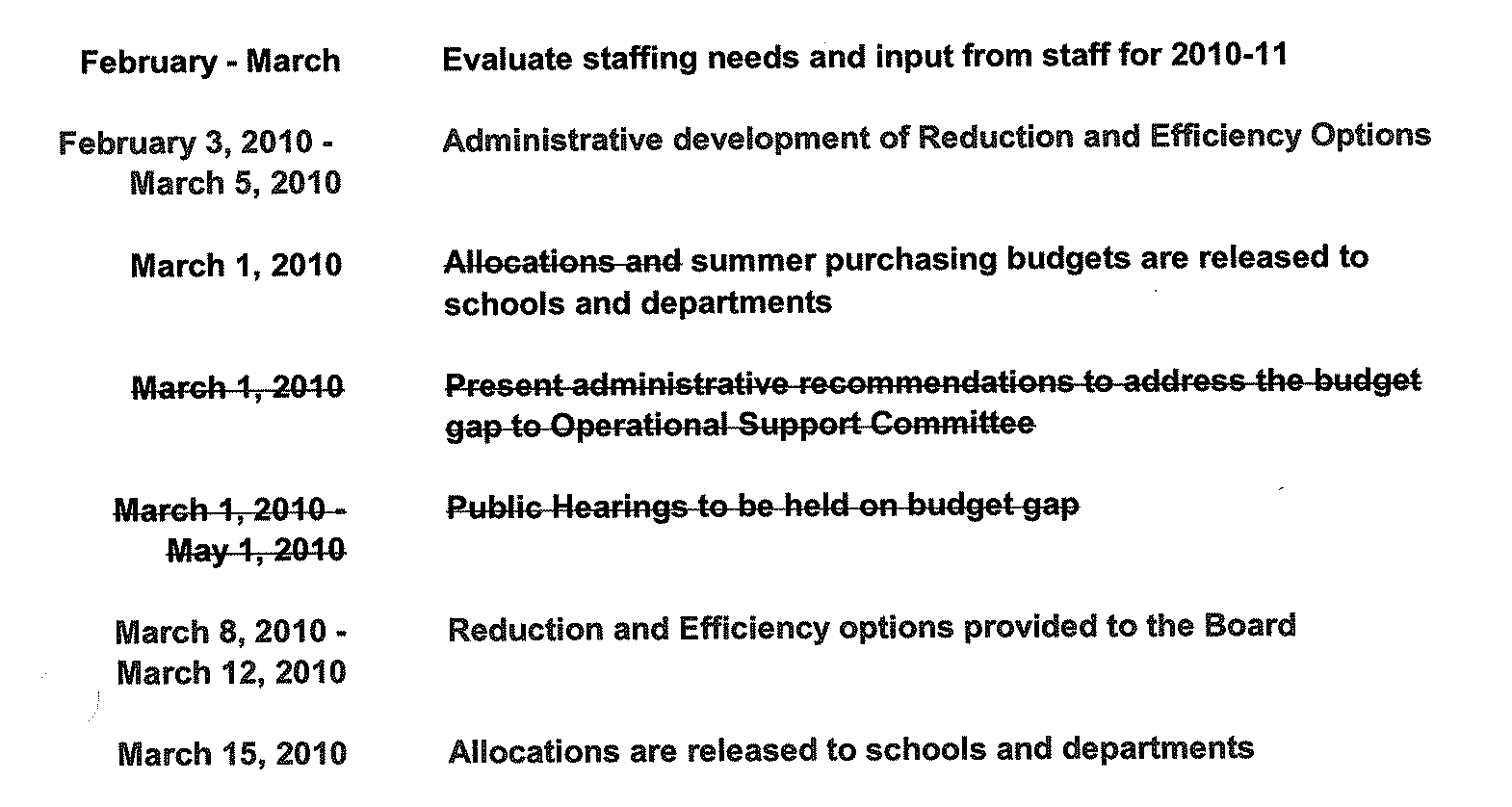
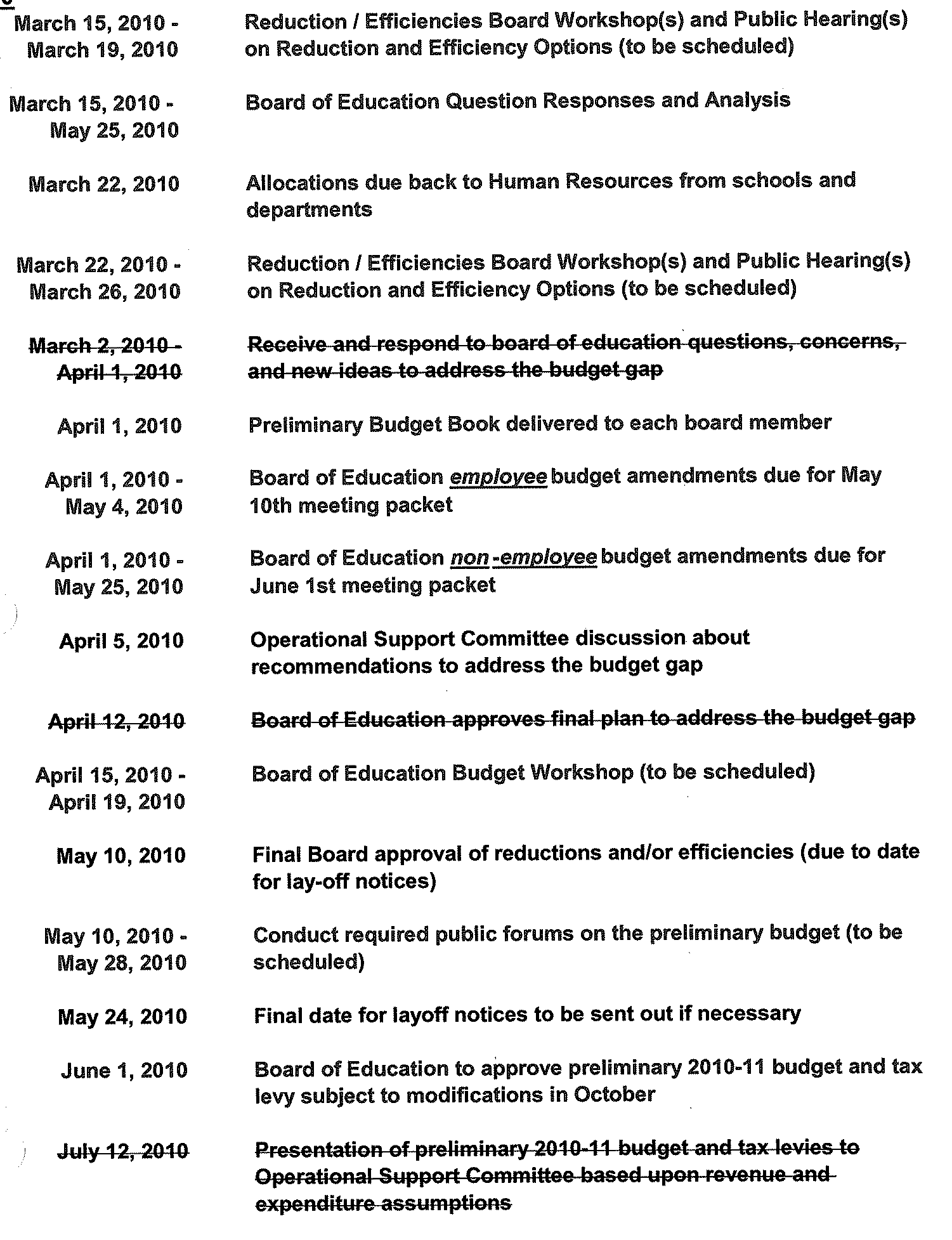
Here is the proposed remaining schedule. It may be changed Monday by the Board, it may change for other reasons as things go forward. Sorry about the multiple images, it was the quickest way to include it in the post itself and I think that this is important enough to justify the aesthetic issues.
I’m not seeing much public outreach in the first phases, and I can’t help but notice that both “final Board approval of reductions” and layoff notices go out prior to the mandated public hearing. I don’t like it as policy and I don’t think Madison will like it as reality. At best, the meetings prior will be filled with very confused and angry public testimony. The anger is inevitable, but the confusion can be minimized if things are done right and the timing of the public input can be such that it maximizes consideration and interferes minimally with Board’s efficiency. I don’t see those with this schedule.
This is very bad and different budget. The revenue authority is there to keep cuts to a minimum, but the reductions in state aid mean doing that brings property tax increases that are hard to swallow. Consequently there will be up to $25 million in cuts on the table and likely cuts made in the $5 to $10 million range (this is guess work on my part). The results will not be good, but the process can be.
There was some good discussion last week about how to structure this and the balance between maximize savings and when that savings will do the most good. I expect that to continue this Monday. Hard choices and complex matters.
This allows Baird to consult with the district, do the bond/debt issues and bid on the bond/debt issues. I can see what is in it for Baird, not sure what is in it for us, unless the increased competition of one more potential bidder gets us better rates.
I’ll repeat that I think Dan Nerad more than deserves a renewal (yes I criticize, but the job is hard and criticism doesn’t mean I don’t like and respect him). I’ll also repeat that I think a pay freeze should at least be considered. And I’ll add that I would like to see at least portions of the Superintendent evaluation attached to this and discussed with this (I may well have missed it, but I don’t recall much public on that).
Also graduations and HS Equivalency Diplomas, Playground sign, Cooperative Gymnastics and Hockey Teams, Server Upgrade, the allocations for the Desktop Instructional Technology Purchases and theScholastic System 44 (reading remediation) Pilot Project and grants and donations.
I have no idea what this is about. I guess it can’t hurt to review, but it doesn’t seem pressing. With the district’s role in TIF’s some lobbying rules might be in order.
That’s all folks. Heck of a lot for one meeting. Diverse, complex and important work for the Board.
Last week one Board member thanked me for doing this. After saying you are welcome, I told him I thought that since most of this week’s agenda paralleled last week’s it would be an easy week for me to get the post done. I was wrong. Many changes that needed attention and explication. I hope next week is easy.
The Department of Public Instruction nominated our high school based on the category, “dramatically improving schools with at least 40 percent of our students coming from disadvantaged backgrounds.” In analyzing our data at the federal level, the federal review team moved our high school from this category to the category, “schools in the top 10% in their state with at least 40% of students from disadvantaged backgrounds.” We are extremely proud of our students’ scholastic performance which led to the selection of our high school as a 2009 National Blue Ribbon School.
Dooley is right to be proud of the students, the staff and the community.
Wausaukee is a classic “small but necessary” district that is squeezed by the state finance system. The Wisconsin Alliance for Excellent Schools (WAES) has long fought for reforms that recognize the diverse circumstances of districts, schools and students in targeting educational investments. As a result, Wisconsin now has a (too) small “Sparsity Aid” (Wausaukee got about $39,000 this year). Progress, but not enough and other state actions have undercut the good of this reform. In particular the decreases in state aid have brought schools around the state to the brink of crisis (Wausaukee lost about 15% in state aid, over $100,000 in total).
Wausaukee was able to pass a referendum in 2008, but the cuts in state aid and the consequent raises in property taxes make that very difficult now. Madison was also able to pass a referendum in 2008, but last year they they lost 15% in state aid didn’t tax to the max and next year — when they will again lose 15% — they will likely tax well below the limit. Here are the figures for state aid to Madison Schools for the last seven years ( from Asst. Supt. Erik Kass via Board Member Ed Hughes):
2004-05 – $50,064,391
2005-06 – $58,996,880
2006-07 – $56,984,763
2007-08 – $57,301,616
2008-09 – $60,743,743
2009-10 – $51,513,826
2010-11 – $43,761,093 (projected)
The old problems are still around — costs and allowed revenues not aligned, mandates underfunded, diversity not accounted for… — but there is also a new/old problem and that is that property taxes are becoming unsustainable. The last time that happened, the state stepped up by pledging to provide 2/3 of educational investments. In his first budget Governor Jim Doyle walked away from the pledge and it has been downhill ever since, reaching new lows with the 2009-11 budget (Doyle’s last). This is why the Penny for Kids revenues are necessary. Click the link and sign the petition.
I want to write more happy stories about education in Wisconsin, like this one started out to be. Wausaukee and other districts are doing great things and that work needs to be celebrated and to continue and expand. Till the continuance and expansion become real state priorities, I guess I’m stuck doing the jeremiads and calls to action.
[corrected material crossed out; new material in italics, update at bottom]
Wisconsin Superintendent of Public Instruction has officially embraced a policy of starving Milwaukee Public Schools into submission by exercising his power to withhold Federal funds from the district.
MADISON — State Superintendent Tony Evers issued a statement regarding the notice he signed today that will allow him to use his authority to withhold or direct federal funds allocated to Milwaukee Public Schools.
“As the State Superintendent of Public Instruction, I have a legal responsibility to the children of Milwaukee. Today, I issued a notice that will allow me to speed up change in the Milwaukee Public Schools (MPS) through the use of my authority regarding federal funds. Using the only tool allowed under state law, I am acting to ensure federal funds are used effectively to improve MPS.
“No one can or should be satisfied with the current progress in MPS to improve. I look forward to full cooperation to implement all required changes, with an increased sense of urgency, as I continue to work with MPS leaders.”
Evers had previously sought the power to — unilaterally and with no defined criteria — declare any district “in need of improvement,” issue directives on almost all aspects governance and education and “withhold state aid from any school district that fails to comply to the state superintendent’s satisfaction with any of the above directives.” That effort, Assembly Bill 534, failed.
Bribing Milwaukee into submission with uncertain Race to the Top funding also failed. The carrot is gone now, what is left is starvation and the stick.
The last thing Milwaukee needs is more program cuts. Just this week, the lack of resources led the distinct to discontinue SAGE class size reduction in 11 schools. Federal dollars total about 18% of the MPS budget, Title I — the funds targeted for poor children in play here — probably about 2/3 or more of that, call it over 12%(I’m not sure if Evers can also withhold the ARRA flow-through “state stabilization funds that his buddy Jim Doyle and others dishonestly tried to spin as “state aid”). It isn’t clear what Evers is going to do and how he is going to do that with by cutting 18%a significant portion of the budget.
At this time there are no details, no plan, just the starvation.
The lack of plan is foolish anyway you look at it. From a policy point of view, there is no policy to look at. From a political point of view, no positive case for the action is being made, no “this has to happen,” only “this can”t go on.” That’s not the way to win over the undecided or convince anyone that this isn’t a political stunt.
There may be a good case to make that this is a reasonable and justified action, but the case has not been made. That case would require more than the “No one can or should be satisfied with the current progress in MPS” in the Press Release, it would entail a detailed documentation of how MPS has failed in the Corrective Actions and why Evers thinks that withholding this money will produce better results. My guess is that we will see some of this in the coming weeks.
Without a governance or educational case being made, this looks like a political stunt.
Since Evers has been linked at the hip to Doyle and Mayor/Gubernatorial candidate Tom Barrett on MPS issues, one calculation may be that Barrett will win votes outside of Milwaukee based on this. I wouldn’t count on that off-setting the votes lost in Milwaukee or those lost around the state from people who actually know a thing or two about education. My first reaction is that Barrett just lost the election. Probably an over-reaction (really too early to tell), but not an outrageous conclusion.
The timing is bad too. Unless this is direct reaction to the Superintendent hire, it makes no sense to not give Gregory Thornton a chance to at least get settled. It certainly makes his job more difficult, if not impossible
It is ironic that the standards invoked (and required by statute ) are the NCLB Adequate Yearly Progress standards that Superintendent Evers has never been a fan of. When power overcomes sense, any tool at hand looks good.
Update: Evers says the statement to MPS is about the district’s failure to improve in specific areas which are spelled out in the notice, and NOT about mayoral control, and that my attempt to connect the two in this post was “reprehensible.”
Good to have that information, but if you haven’t made the case on education and governance — and they haven’t — then it seems reasonable for people to speculate about political reasons (I did, not Mayoral Control directly, but politics).
Under the circumstances “reprehensible” seems much too strong.
Whatever the combination of motives, for good and ill, politics will be part of this.
Gretchen Schuldt at Blogging MPS has a nice roundup (better than this one and she will no doubt be following developments more closely then AMPS, put her on the must-read list).
At last night’s Madison Board of Education meeting (preview here) more details were given about the 2010-11 Budget situation. There was some small good news and some large bad news. The small good news is that because of savings and efficiencies, the gap between allowed revenues and projected costs has been reduced from about $2.8 milli0n to about $1.2 million and that the search for savings continues. The bad news is that due to the interaction between a broken school finance system and cuts in state aid to schools, Madison will be facing property tax hikes in the range of $312 on the average home if they tax to the max and more likely a combination of huge cuts and large property tax increases.
This is an difficult and unfortunate balancing act the Board must do because our state officials have not done the difficult work of reforming state school finance or finding better revenue sources. To learn more and help push the state officials to do the job they promised to do (both in their campaigns and when they took their oaths of office), check these links: Wisconsin Alliance for Excellent Schools, Penny for Kids, School Finance Network and the AMPS “Take Action” page.
Next Monday, February 8, the process and time-line for choosing from among bad choices will be on the Board agenda. If you have any ideas or thoughts, be sure to let them know: board@madison.k12.wi.us.
I was unable to attend the meeting and would be remiss if I didn’t thank those MMSD staff people who very helpfully sent me copies of the documents linked here (after I requested them). Thank you!









 AMPS
AMPS 