Category Archives: Accountability

Wisconsin State Superintendent Forum Video

Here is a video from the State Superintendent of Public Instruction forum hosted on February 12 by the Wisconsin Council of Religious and Independent Schools.

There hasn’t been much media coverage on this important race and most of the candidates cannot afford extensive campaigns.  Please take this opportunity to see and hear Todd Price, Rose Fernandez, Lowell Holtz, Tony Evers and Van Mobley.

I think that once you learn about the candidates, you will join me in supporting Todd Price.

Vote February 17th!

Update

I just found these links: The League of Women Voters guide and Q&As from the Appleton Post Crescent.

Thomas J. Mertz

1 Comment

Filed under "education finance", Accountability, Best Practices, Budget, education, Elections, Equity, finance, Local News, nclb, No Child Left Behind, School Finance, Take Action

Todd Price for State Superintendent

img_2654_2

I hope to find the time to do a fuller analysis and endorsement, but meanwhile here is my letter to the editor version.

As State Superintendent of Public Instruction Todd Price will be the uncompromising advocate for our students and our schools that Wisconsin needs.

Each day that we continue to accept reasons to resist change is a day that Wisconsin’s commitment to excellence in public education is in jeopardy.  Our way of funding education is broken.  Merrill has laid off 10% of their staff; failed referenda this Spring in Appleton, Salem and elsewhere would bring larger class sizes; Holmen and other districts can no longer afford to participate in the proven but underfunded Student Guaranty in Education (SAGE) class size reduction program; Madison gutted locally funded class size reductions two years ago and there is no official talk of restoring them.  Todd Price is committed to fixing this broken system not finding excuses to preserve the status quo.

On school finance; testing and accountability; green, sustainable schools; proactive school climate and safety, the failures of No Child Left Behind; and other pressing school matters, Todd Price is the only candidate who will work to find and implement solutions immediately.  The future can’t wait.  Vote for Todd Price.

Here is a message from Todd’s campaign telling how you can help:

We’re lucky to have such a viable candidate running for Wisconsin State Superintendent of Schools in the February 17th election. The campaign needs your help to get Todd Price elected! Visit Todd’s website.

Here is what you can do:

***Donate! Because of the wonders of the internet money can be transmitted, and used on web advertisements very quickly. . If we can raise enough in the next week, we qualify for $98,000 of State Election Fund dollars! Every dollar helps.

***Invite your friends to join the Facebook group and post it to your profile by going to the group page and clicking Share+ on the right-hand side and select Post to Profile.

***Write a letter to the editor.

***Part of an organization that will endorse Todd? Let us know at: Contact@toddprice.org

***Oh yeah, vote for Todd Price February 17th!

An AP wire story speculated that turnout might “barely break double digits,” so every little bit of help could be the difference in a crowded primary. So please help if you can.

Thomas J.  Mertz

Leave a comment

Filed under "education finance", Accountability, Best Practices, Budget, education, Elections, finance, Local News, nclb, No Child Left Behind, Referenda, referendum, School Finance, Take Action

Education in Doyle’s “State of the State” — The Road to Ruin

GOV Gov-6

I’m having some trouble understanding what Governor Jim Doyle meant to communicate about education and education finance in his State of the State speech.

There was at least one good thought on the topic, I’ll give him that:

A second grader is not going to be able to come back when the economy is better and pick up where she left off if we fail her today. An older person can not check out of a nursing home and come back in a few years. There are basic needs our state has always met, and just as our predecessors met them in the most difficult times, we have a responsibility to meet them today. yesterday.

But there was also a rephrasing of his new oxymoronic slogan:  “Staying even is the new increase.”  I wonder how that formulation would be scored on a WKCE Reading or Math test?

To make matters worse, after stating that schools are among his top priorities and mislabeling the effective cuts of stable dollar funding as an increase, he continued:

And I am not going to say education funding is off limits. But I will not allow cuts that ruin the quality of our classrooms (emphasis added).

This is the new standard — anything short of “ruin” is OK.  Talk about setting the bar low.  Remember when we used to talk about quality education for all.  I do.

Hell, I remember when Doyle did:

It means fixing our broken system of school funding, and making an ironclad guarantee to every Wisconsin child that this state will give you a good start in life a quality education that enables you to succeed in tomorrow’s economy.

Governor Jim Doyle, 2002 victory speech

It gets worse.

Doyle apparently still sees a need for school finance reform, but his prescriptions are out of whack, or maybe just whack.

We can change school funding in a way that encourages the hiring and retention of good teachers, provides for high standards and encourages efficiencies in our school districts. We can take these steps to make sure our kids get a great education.

The first sounds like “merit pay,” which means asking cash strapped school districts to spend more on (some) teachers.  Explaining how “high standards” will fix school funding is beyond me (and I would guess beyond Doyle to0).  This brings us to the vaunted efficiencies.

For 15 years Wisconsin districts have sought and found efficiencies in order to balance budgets under  broken system based on a structural gap between mandated costs and allowed revenues.  Any reader of AMPS should know that in most districts the vast majority of potential savings via efficiencies has been long exhausted and that for years the cuts have been harming, if not ruining “the quality of our classrooms.”

If you want further evidence, just look at the operating referenda scheduled for this Spring and what districts are asking for.

  • Bowler, Herman, Loyal, Medford, Reedsville , Siren and Waupun aren’t very specific, only asking something like Siren’s “sustaining operating expenses with which to maintain the current level of operations.
  • Waupun also asks for funds  “for non-recurring purposes consisting of acquiring educational resources including textbooks and classroom support materials.”
  • Ripon also wants to fund “replacing textbooks” and in addition for “updating curriculum, updating technology, performing maintenance and replacing vehicles.”
  • Middleton-Cross Plains wants funds for “acquisition of instructional materials and instructional technology” and “operating expenses of a new elementary school.”
  • Salem’s ask is clear: “for non-recurring purposes which would prevent further cuts to student’s educational opportunities and prevent an increase in class sizes.”

Books, class size, technology, maintenance…As a state we should do everything in our power to make sure that these basic educational expenses are met.  We don’t.

Governor Doyle knows that and his two-faced “prioritizing” of education while doing nothing to fix a system he himself has called broken is leading us down the road to ruin.

While on the topic of leadership I want to add that the Wisconsin Association of School Boards and Superintendent of Public Instruction candidate Tony Evers both praised Doyle’s remarks on education.   I know all about catching more flies with honey than vinegar, but I think that in this case those who have spent too long in the royal court can no longer even tell when the emperor has no clothes.  Or maybe they can tell, but just won’t.

Thomas J. Mertz

Leave a comment

Filed under "education finance", Accountability, Best Practices, Budget, education, Elections, finance, Local News, Referenda, referendum, School Finance

Quotes of the Day — Accountability

19rothstein5151

The federal No Child Left Behind Act has succeeded in highlighting the poor math and reading skills of disadvantaged children. But on balance, the law has done more harm than good because it has terribly distorted the school curriculum. Modest modifications cannot correct this distortion. Designing a better accountability policy will take time. We cannot and should not abandon school accountability, but it’s time to go back to the drawing board to get accountability right…

Designing a new accountability system will take time and care, because the problems are daunting. Observations of student behavior are not as reliable as standardized tests of basic skills, so we will have to accept that it is better to imperfectly measure a broad set of outcomes than to perfectly measure a narrow set. We will have to resolve contradictory national convictions that schools should teach citizenship and character, but not inquire about students’ (and parents’) personal opinions. To avoid new distortions, we’ll need to make tough decisions about how to weight the measurement of the many goals of education.

Richard Rothstein, “Getting Accountability Right,” Education Week.

These quotes and the commentary were directed at NCLB reform, but I think they are also applicable to the MMSD Strategic Planning process that begins next week and want to note that Todd Price is the only candidate for State Superintendent of Public Instruction who is voicing similar ideas about the failings of NCLB and the need for more than adjustments.

Related at eduwonkette (and a hat tip); and from the Annenberg Institute, “Beyond Test Scores: Leading Indicators for Education” (many other great resources at the Annenberg site).

Thomas J. Mertz

Leave a comment

Filed under Accountability, Best Practices, Elections, National News, nclb, No Child Left Behind

MMSD Math Task Force Report, Thoughts on Teacher Preparation

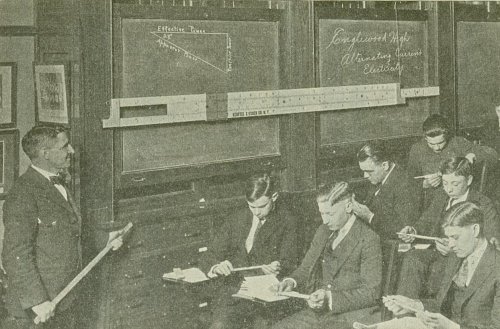
From the International Slide Rule Museum

From the International Slide Rule Museum (click on image to visit).

In anticipation of next week’s public discusions of the Mathematics Task Force Report, I’ve been dipping into parts of that document.  So far, the section I’ve looked closest at  — Teacher Preparation — is pretty disappointing.  It isn’t that I disagree or agree with the conclusions (I don’t have much of an opinion), it is that the work is superficial and read closely provides little or no support for either the assertions made or the recommendations.

The introductory section on “information concerning recommendations from research reports and professional organizations for the mathematical preparation of middle school mathematics teacher” is generally fine and the review of requirements and programs in Wisconsin and neighboring states is also adequate.  However, it is worth noting that even this part of the report begins with an untested assumption that the middle schools are the proper area of focus.  Additionally  as one researcher observed “what counts as subject matter knowledge and how it relates to student achievement remains inadequately specified.”    In other words, we don’t know what what teachers should know to  improve achievement (the MMSD report indirectly touches on complexities of defining what teachers should know but does not acknowledge how thin the research base linking teacher preparation to achievement is).

Where the report is lacking is in the assessment of the appliabicality of this material to MMSD.  This is done in only the most cursory manner.

The main recommendations on teacher preparation — prioritizing “hiring middle school mathematics teachers who have advanced preparation in mathematics” (later clarified to mean “completing mathematics coursework that focuses on enhancing teachers’ understanding of the mathematical content that they teach“) and providing “increased opportunities for middle school mathematics teachers to enhance their knowledge of mathematics for teaching middle school but also require participation by more (if not all) middle school mathematics teachers” —  seem reasonable.  The real question is how much of a priority should these be, how pressing is the need.

There isn’t much here that helps answer that question.

As far as I can tell the recommendations and analysis are mostly a simplified version of the Conference Board of the Mathematical Sciences (CBMS) 2001 report The Mathematical Education of Teacher applied to MMSD without any real consideration of the situation in Madison.

This is most obvious in the use of “middle grades” to mean grades 5-8, when MMS middle schools are grades 6-8.  Therefore, the recommendations, which are focused on the “middle grades,” are not aligned with how Madison defines the middle grades.  You’d think that at some point, someone would have said “Let’s make this fit Madison and use their definition.”  They didn’t and instead stuck with what is the arbitrary definition used in the CBMS (for the arbitrariness of this definition, see Chapter 4, footnote one of the CBMS report).

In and of itself, this isn’t a big deal.  However, it is illustrative of a larger problem.  The whole teacher preparation section is an exercise in forcing Madison into preconceived ideas about what is wrong with and what needs to be done about Math education, with little attention given to assessing what is wrong with and what needs to be done with Math education in Madison.  That many of the ideas appear to be supported more by belief than evidence compounds the problem.

Taking a cue from the popular simplistic international comparisons induced crisis mentality, (for  example see the multiple citations of this report, which despite looking only at the coincidence of teacher preparation differences  and TIMMS score differences  —  think of all the other possible reasons for the achievement differences  —  says it is “premature” to “make recommendations to change the nature of US middle school teacher preparation in mathematics.”), in the introductory section, in support of the lead recommendation the MMSD report asserts  ‘The adequacy of teacher preparation is a significant problem that cannot be solved without a substantial investment in mathematics content-based professional development and a change in hiring priorities at the district level.”  There is almost no evidence offered to support this assertion.

In the teacher preparation section a caveat is added:  “it is questionable whether most of the MMSD middle school mathematics teachers possess the depth of mathematical knowledge required for effectively teaching middle school mathematics .” (emphasis added, there are many caveats in this section).

“Questionable” isn’t good enough in these days of scarce resources.

Despite an extensive survey of teachers, the only attempt to assess the mathematical knowledge and training of our teacher corps is a simple counting of those who have been certified by DPI in the subject area.  One recommendation of the report is that the certification process needs to be expanded and improved, so the report itself recognizes the inadequacy of that measure.  Moreover, certification in subject areas confers no advantages under the current teacher contract, so it is very possible that additional MMSD teachers meet the certification requirements but have not bothered to go through the process.

Certification is a much less important than knowledge.  Any agenda concerning teacher preparation should begin with the recommendation that MMSD find out how prepared our teachers are, if they know the things that research shows make them better teachers, improve achievement.  Pretty simple.

I would suggest starting with the materials being developed by the Learning Mathematics for Teaching Project at the University of Michigan or a similar inventory.  Let’s find out what our teachers know and don’t know before deciding that the solution involves teachers who know more.  Our teachers may be lacking or they may not.  Until that question is answered, the task force recommendations are unsupported and unsupportable.

As a former task force member, I am sympathetic to the constraints of the work, but this task force had grant money, professional consultants and other resources that set the bar higher.  Under these circumstances, the section on teacher preparation is woefully inadequate and disappointing.

One last clarification, I have not looked at the other sections of the report extensively and my criticisms of this section may not be indicative of the report as a whole.

Thomas J. Mertz

6 Comments

Filed under Accountability, Best Practices, education, Local News, Uncategorized

Arne Duncan, Secretary of Education

arne-duncan

Just links.  My own thoughts are much like teacherken’s (below).   I’ll add that the charters/merit pay agenda does not make me happy but balance that by saying that at least the merit pay pilot in Chicago included peer evaluations along with test scores.

The New York Times, Schools Chief From Chicago Is Obama’s Choice for Education.

teacherken, Arne Duncan as Sec Ed – it could have been worse.

Alexander Russo, District299: The Chicago Schools Blog, Duncan Pros and Cons.

Greg Palast, Obama’s “Way-to-Go, Brownie!” Moment?.

Education Week, Duncan is Obama’s Education Secretary Pick.

Good discussions in the comments at all but the NYT.

Thomas J, Mertz

Leave a comment

Filed under Accountability, Arne Duncan, Best Practices, education, Elections, National News, nclb, No Child Left Behind

Why would anyone listen to these people?

Whitney Tilson - Working to bring the magic of the market to education

Whitney Tilson - Working to bring the magic of the market to education

I was reading this New York Times article (Uncertainty on Obama Education Plans) and this got my attention:

One former Teach for America official who has been outspoken is Whitney Tilson, a New York mutual fund manager.

In a recent blog entry, Mr. Tilson said of Dr. Darling-Hammond, “She’s influential, clever and (while she does her best to hide it) an enemy of genuine reform.”

Mr. Tilson is on the board of Democrats for Education Reform, a political action committee based in New York.

Mr. Tilson is a top tier education DINO. He advocates an anti-Union, data and test driven version of  “accountability” based on a market, business, privatization model (see here for more on this mindset).

His expertise is based on a short stint in the classroom via Teach for America and his “success” in the financial industry.

I thought it would be good to examine that “success.”

According to the latest available report from  Tilson Mutual Funds (dated April 30, 2008, well before the current meltdown), one of the funds he controls underperformed in comparison to both the Dow Jones Wilshire 500 and the S&P Total return indices both in the prior year and since its inception.  In fact, this fund lost 10.03% of value after taxes .  You would have done better stashing your money in an old sock than investing in this fund.

The other fund did a bit better, losing only 4.44% of value after taxes and outperforming the Dow Jones, but not the S&P.  The old sock would still have been a better choice.

The year to date on one fund is -23.48%; on the other it is -45.19%.  That old sock is looking better and better.

Tilson isn’t even good at his “day job.”

Why would anyone listen to these people on education?  Why would anyone think that “market driven education reform” as pushed by the very people who profited while creating our financial crisis was a good idea?

I don’t get it.

Thomas J. Mertz

3 Comments

Filed under "education finance", Accountability, Best Practices, education, finance, National News, nclb, No Child Left Behind, School Finance

Education Tweak, #2

edtweak2

Click on image for pdf

The fun continues.

Thomas J. Mertz

Leave a comment

Filed under Accountability, Best Practices, education, Elections, Gimme Some Truth, National News, nclb, No Child Left Behind

The Wrong Frame, The Frame of the (Center) Right

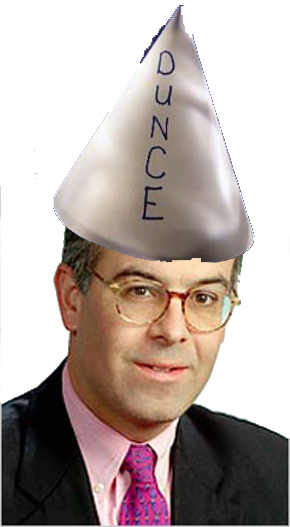
brooks-dunce

There is a lot of buzz on David Brook’s latest column and its topic — Obama’s pick for Secretary of Education and the direction of education policy in his administration (weigh in on the latter here).  Many of the buzzers, like Brooks, simplemindedly frame the choice as between choosing a “reformer” and choosing a stalwart defender of the status quo (in Brooks’ case  the latter is described as “teachers’ unions and the members of the Ed School establishment, who emphasize greater funding, smaller class sizes and superficial reforms”).

We’ve seen this in Madison before — the subtle “reformers as good guys,” others as uncaring, self interested or misguided defenders of a failed system.  It wasn’t accurate or useful then and it isn’t now.

Much of the current discourse is derived from what Marion Brady in 2001 identified as a the narrowing of reform to “introducing market forces” via “standards and accountability” and the definition of standards and accountability as  standardized testing and blaming teachers (and teacher unions), with a little privatization in the mix.

If it isn’t obvious to you how wrong and destructive this is, click the link and read what Brady had to say.

For myself, I’ll just hit a few very quick points.  First, market forces aren’t what they’ve cracked up to be (pun intended).  Second, the way to improve teaching is not by attacking teachers, teacher trainers and teacher unions…none of them are going away and all them are interested in improvement.  Greater funding and smaller classes are not superficial, just look at the research or ask a teacher  — oh yeah Brooks has dismissed the knowledge of researchers and teachers, pretty clever of him.  Last, this crisis mentality is throwing the baby out with the bathwater.  We have many great schools and teachers, a system that works for most and desperately needs to be improved in order to work for all.  I don’t see Brooks calling for Socialism or Communism as a fix for a financial and industrial system that is obviously broken; why call for radical changes in an education system that isn’t broken?

A couple of links:  Jim Horn’s take at Schools Matter and Bob Somerby at the Daily Howler on this column and related failings in education reporting (scroll down).

Thomas J.  Mertz

4 Comments

Filed under "education finance", Accountability, Arne Duncan, Best Practices, education, Gimme Some Truth, National News, School Finance

No need to know? (updated)

blank-pages

Update: The strategic planning proposal has been posted here (thanks Barb).  No time to go into depth right now, except to say that it appears to follow what was done in Green Bay fairly closely, even recommending the same facilitator (Supt. Keith Marty of Menomonee Falls).

On the agenda for the Monday, December 1, 2008 MMSD Board of Education Meeting is an action item asking for approval of a proposed “structure and timeline for the MMSD strategic planning process,” and authorization for the “the Superintendent to pursue the key steps for implementation.”  This could be a big deal, I don’t know.  Short of contacting Board members or administrators or staff, there is no way to know.

There is public comment at the meeting Monday.  However, any comment on this proposal would be rushed because the proposal is not posted on the web and at best the public may be able to get a copy some time Monday.

I would guess the Board has seen and commented on versions of the proposal, but it has not been on an official agenda, nor has it been discussed at a public meeting.

This is no way to begin strategic planning that is supposed to include the larger community.  How can we be included if we don’t even know what is going on?

In messages to the community, Board President Arlene Silveira has promised that the strategic planning process would “include strong community input.”  Maybe that will come later.  So far there has been no effort to inform the public of anything of substance and on Monday they are scheduled to vote.

The “structure and timeline” might not be a big deal, it might be simple housekeeping  — no way to know — but if it is important, and they are serious about involving the community, they should slow things down, share the knowledge, ask for input…and involve the public from the very start.

Thomas J. Mertz

2 Comments

Filed under Accountability, Best Practices, education, Local News