Category Archives: Accountability

The Charter Choice in Madison and the Nation

schoolbudgets

On Monday, March 9, 2008 The MMSD Board of Education will consider an application from the Nuestro Mundo community to begin the process of chartering a dual language immersion secondary school.

Although the application is very impressive and Nuestro Mundo appears to be a good and well run school, I urge the Board to turn away this effort to expand charters in Madison.  MMSD is initiating an elementary  non charter dual language immersion program and there is talk of a non charter dual language middle school also.  I believe that this is the the better path.

In an editorial today the Wisconsin State Journal puts forth self contradicting nonsense in favor of the charter proposal.  In a letter to that paper last week, Nuestro Mundo parent Judith Kujoth employed questionable and unsupported assertions of causality to advocate for the middle school proposal.  I’m just going to hit the low lights.

The editorial begins:

Madison needs to get past its outdated phobia of charter schools.

Charter schools are not a threat to public schools here or anywhere else in Wisconsin (emphasis added).

Later in the editorial they note the President Obama has pledged to double the Federal money for charters and note that the group hopes to get $1.1 million in Federal planning grants.  It doesn’t take a genius to figure out that Obama’s funding of charters, like that of George W. Bush, will divert money from traditional public schools.  That $1.1 million that they hope to get is $1.1 million that isn’t and won’t be available for our underfunded district schools.  Yes, charters are a threat.  An insidious threat, because regardless of the merits of a particular proposal or the drawbacks of charters as a policy choice, cash strapped state and local decision makers are easily seduced by the promise of this money.

The editorial continues:

They are an exciting addition and asset to public schools — a potential source of innovation, higher student achievement and millions in federal grants.

And when charter schools do succeed at something new, their formula for success can be replicated at traditional schools to help all students (emphases added).

This is exactly what has happened in Madison.  Nuestro Mundo pioneered dual language immersion, the district saw good things happening and they are now in the process of “replicating.”

Apparently the State Journal doesn’t really believe this because later they opine:

The School Board should reward their success by opening the door to a charter middle school. Instead, too many board members seem bent on keeping any dual-language middle school within the framework of a traditional school.

So it isn’t about what is best for the district and the students at all, it is about “rewarding” certain people.  This goes to the heart of one big problem with charters:  They divide; they Balkanize.

What is good for the district as a whole and most children can easily get lost when well organized charter groups advocate tirelessnessly for their “rewards.”  This is true at the state and national levels also.  This is another way that charters threaten public education.

Even the most optimistic charter advocates must recognize that there is no realistic scenario where most children will not be in traditional public schools.  The Board’s job is to do what is best for all children; in practice they must make the utilitarian calculations about what is best for most children and that means doing everything they can to strengthen the district schools most children will attend.  This may include limited charters for purposes of innovation and to address persistent problems, but it certainly does not include “rewarding” anyone at the expense of the district as a whole.

Kujoth covered  much of the same shakey ground as the State Journal, so I’m only going to touch on one paragraph in her letter that caught my attention.

Creating a charter school will have many benefits. The law affords charters greater flexibility to create curricula and measure progress. Students in these schools often have higher rates of achievement because educators have flexibility to design teaching methods that appeal to the needs of each student and to change modalities when they aren’t working without being constrained by traditional district practices (emphasis added).

Note the “often” before “higher rates of achievement. ”  In fact there is no consistent evidence that students in charters have any higher achievement, the best evidence is that achievement is about the same or slightly lower than in traditional schools.

I’m skeptical of standardized tests as a measure of achievement, but it worth noting that Nuestro Mundo students have performed below the levels of students in other MMSD and Wisconsin schools and that this difference is more pronounced for low income students (chart from DPI)
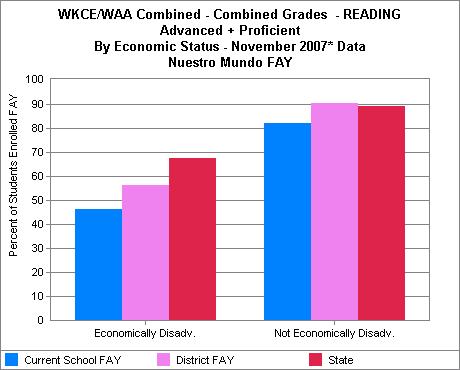
ns-read-w-state-and-district-cft0308_1848031bb

In the next sentence, also with no evidence what so ever, she asserts the cause for this nonexistent achievement gain to be the “flexibility to design teaching methods that appeal to the needs of each student and to change modalities when they aren’t working.”  Since some charters, KIPP for instance,  are infamous for their inflexibility (and resultant push outs of students), this is a laughable generalization about charters.

The last line, the final assertion that “traditional district practices constrain flexibility is also counter to my experience as an MMSD parent.  The teachers my children have had — good and bad — have been very flexible in their teaching.  Even if my experience is not typical and the constraints on flexibility are a real problem isn’t the answer to work to free all teachers from these constraints, not set up a charter where only some children benefit from flexibility?

If these represent the best case for the new charter proposal, the Board should have an easy time rejecting it, unless political pressure holds sway.  I urge the Board to do what is right, not what might be popular.

In the spirit of honesty, I must state that my older son attends James C. Wright Middle School, a charter, if in name only.  At an earlier point in the history of the school, charter status may have been important.  In the years that I know about, Wright functions as a district specialty school, not a charter in any meaningful way.  I would a support a change in status for Wright to reflect this reality.

Thomas J. Mertz

2 Comments

Filed under "education finance", Accountability, Best Practices, education, Equity, Gimme Some Truth, Local News, Uncategorized

Education Tweak #9

Click on image for pdf.

Click on image for pdf.

All the Education Tweaks can be found at http://edtweak.org/.

Thomas J. Mertz

Leave a comment

Filed under Accountability, Best Practices, Gimme Some Truth, National News

Out of the Loop or I Still Want My Agendas

moebius

Since the Madison Metropolitan School District has essentially stopped sending agendas to those who have requested them*, I try to make a habit of checking the “Current Agendas” and “Board of Education Calendar” pages. I usually do this on Friday, because that is when the agendas for the following week are generally posted.

I looked today and was surprised to see that there had been Strategic Planning Curriculum Action Team meeting yesterday (pdf of page as of 11:50 AM, 3-6-09). This meeting was not listed on the Calendar page (pdf of page as of 11:50AM, 3-6-09). Nor is it listed on the Strategic Planning page (pdf of page as of 11:59 AM, 3-6-09).

In fact there is no description of, membership list or other reference to the appointment of a “Strategic Planning Curriculum Action Team” anywhere that I can find on the MMSD site. We don’t know who picked the team or who is on the team.

It sounds as if the work is important, too important to take place outside the attention of the public.

The strategic priority addressed by the Curriculum Action Team is the identification of solutions that will revolutionize the educational model to engage and support all students in a comprehensive participatory educational experience defined by rigorous, culturally-relevant and accelerated learning opportunities where authentic assessment is paired with flexible instruction.

Prior to the November referendum we were told over and over again about how important, inclusive and open the Strategic Planning Process would be, how this was a key part of the “partnership” between the public and the district. It sounded real good.

I was in the loop then. Now, along with the almost everyone else, I’m out of the loop.

* Clarification – Whenever I have made specific requests to MMSD staff for information, they have been great about responding and providing that information (if possible) in a timely fashion.  This isn’t about that, it is about the list advertised at the top of the Current Agenda page “You can get BOE Agendas delivered directly to your e-mail inbox” and more generally about communication and openness.

Thomas J. Mertz

Leave a comment

Filed under Accountability, Best Practices, education, Local News, Uncategorized

Jim Doyle, “State of the State,” 2003

journal_media_file_getasp

I’ve been doing searches for a second “Broken System, Broken Record” Quotes of the Day (look for it soon) and came across the text of Governor Doyle’s 2003 “State of the State” speech (his first).  He doesn’t use the phrase “broken system,” but he does say some things worth rereading.

It is time to reform the way Wisconsin funds our children’s education. That is why tonight I am announcing that I will form a Governors Task Force on Education Financing.

This is too important of an issue to squeeze it into a budget proposal or devise a new plan in just a few weeks.

To do it right we need to do two things. First, all views must be represented. Parents, taxpayers, teachers, community leaders. Urban districts, rural districts. Wealthy areas, poorer areas.

Second, the meetings must be open, in full view of the public.

That Task Force was formed and produced some good work.  Since June of 2004, that work has gathered dust.

I’m often hard on Governor Doyle in relation to his support for education.  I’ll acknowledge that he has been a friend to education in many ways and deserves credit and thanks for that.  What he has not been (in my opinion) is the champion for education that we need.

Doyle has done very well in protecting the schools from the worst of the potential cuts under a system that all but guarantees some cuts and some property tax increases; he’s tried to keep the state’s 2/3 funding commitment viable, he’s worked for increases in SAGE and Special Education funding and succeeded in making these programs slightly less underfunded.  All this is good.

What he hasn’t done (unless you count the recent trial balloon, which may be  a good sign) is  followed up his statement form 2003: “It is time to reform the way Wisconsin funds our children’s education.” That statement was true in 2003; after six years of annual cuts to educational opportunities of 1% to 2% it is even more true today.  I hope that we will soon see Governor Doyle act on this truth and be the champion he could and should be.

Thomas J. Mertz

Leave a comment

Filed under "education finance", Accountability, Best Practices, Budget, education, finance, Local News, School Finance

Gov. Jim Doyle – “Should have….Could have”

doyle-class-journal_media_file_getasp

Doyle should have used this trying time as an opportunity to push for bold change that normally would be too difficult or sweeping to accomplish.

Doyle could have overhauled how the state pays for public education, for example. Instead, he says he’ll work on that after the budget is approved — something he’s said before without much follow-through. (links added)

Wisconsin State Journal, “Wisconsin Gov. Jim Doyle’s Band-Aid of a state budget plays it safe and jacks up taxes, yet it gets some priorities right.”

There is much in the WSJ editorial I do not agree with —  and there is much in the Governor’s budget proposal that is good (more later) —  but the paper is absolutely right that the budget proposal was a missed opportunity to move desperately needed school finance reform forward.

Thomas J. Mertz

Leave a comment

Filed under "education finance", Accountability, Best Practices, education, Elections, finance, Local News, School Finance

Education Tweak #8

Click on image for pdf.

Click on image for pdf.

All the Education Tweaks can be found here.

Thomas J. Mertz

Leave a comment

Filed under Accountability, Best Practices, Gimme Some Truth, National News, nclb, No Child Left Behind

And they all shined on . . .

headwork_garden2

A couple of days ago, NPR had a feature on All Things Considered that was quite intriguing.

One county in Virginia has found a new way to reach taxpayers: an automated phone system calls thousands of residents and asks them to participate in school board meetings.

It has proven successful.

It can be tough to attract an audience for local government meetings. School boards and city councils cannot compete with prime-time TV, cable and the Internet. So, some cities are trying to bring the meetings to the people by phone.

The piece highlights the difficulties people have in making evening school board meetings and how one of the most basic technologies is offering citizens the chance to  “vote” on proposal’s and to register their opinions. Could this be a solution for Madison, especially during crucial budgeting meetings?

And while were on the subject of communication, I wonder why the last two meeting agendas have not been emailed to MMSD agenda subscribers and why several “special board meetings” from November still do not have minutes posted?

Robert Godfrey

Leave a comment

Filed under Accountability, AMPS, Best Practices, National News

Quote of the Day — Stunning Illogic and False Hope from the New York Times

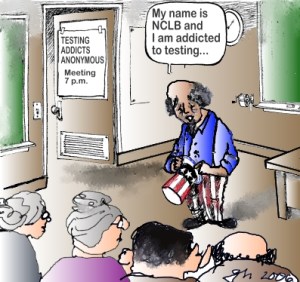
Click the image for more NCLB cartoons.

Click the image for more NCLB cartoons.

The Bush administration allowed states to phony-up statistics on everything from graduation rates to student achievement to teacher training and state education standards. As a result, the country has yet to reach not only the goals that were clearly laid out in the law but also farsighted education reforms dating to the mid-1990s. (emphasis added)

New York Times, “A New Day for School Reform,” editorial, February 21, 2009.

There may be some truth to the cause and effect on teacher training, but the implied idea that the failures of No Child Left Behind are due to  setting standards (curricular and Adequate Yearly Progress) too low is illogical and reinforces multiple flaws in the NCLB.

Some asides at this point.  I want to be clear that communicating high expectations to students in all contexts while giving them the support they need to meet those expectations is good policy.  Changing state standards and cut scores at best comprises a very, very small part of this concept and at worst leads to shaming and other counterproductive punishments.  Better — not necessarily higher — curricular standards do have a place in reform.

First, standards in practice mean standardized tests and standardized tests are very limited as assessments and even more limited as a means of improving education.  To be fair, there is some language in the stimulus package (the subject of the quoted editorial) that may induce a move away from standardized tests (see below).

Second, and most importantly, the whole notion that lax standards are the biggest problem in education defies logic and the historical record.

In terms of logic, just ask yourself if the way to improve archery scores is to use smaller targets.  If they can’t hit the larger target, how will they hit a smaller target?

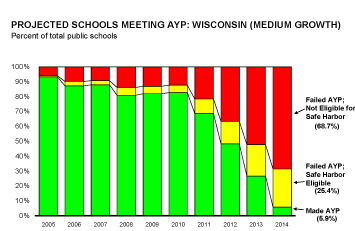
As to the history, here is the data for Wisconsin under the current system:

Year # Schools Failed AYP # Districts Failed AYP
2007-8 153 4
2006-7 92 2
2005-6 87 1
2004-5 49 1

This graphic tells us about the history and projected future (more here).

From “The Impact of the Adequate Yearly Progress Requirement of the Federal No Child Left Behind Act on the Great Lakes Region,” a study released by the Great Lakes Center for Educational Research and the Education Policy Studies Laboratory at Arizona State University.

The current standards have resulted in clear trend of increasing failure to meet those standards, a trend that is projected to increase with current standards.

Some quotes from “How Feasible is Adequate Yearly Progress (AYP)? Simulations of School AYP “Uniform Averaging” and “Safe Harbor” under the No Child Left Behind Act” by Jaekyung Lee may help clarify.

It does not appear to be feasible for many schools across the nation to meet the current AYP target within its given 12-year timeline. It is not realistic to expect schools to make unreasonably large achievement gains compared with what they did in the past. Many schools are doomed to fail unless drastic actions are taken to modify the course of the NCLB AYP policy or slow its pace. (emphasis added)

When a majority of schools fail, there will not be enough model sites for benchmarking nor enough resources for capacity building and interventions. This situation can raise a challenging question to the policymakers: is it school or policy that is really failing? There is a potential threat to the validity of the NCLB school accountability policy ultimately if such prevailing school failure occurs as an artifact of policy mandates with unrealistically high expectations that were not based on scientific research and empirical evidence. (emphasis added)

An identified problem with NCLB is that standards are unrealistically high, the New York Times’ solution, raise the standards.  Stunning illogic.

This is the kind of “harder is better” mentality reflected in the Pangloss Index and expected from people like the Walton and Bradley Foundation funded  Thomas B. Fordham Institute, not “the paper of record.”

Later in the editorial, the assessment reform potential of the stimulus bill is touted:

States will also be required to improve academic standards as well as the notoriously weak tests now used to measure achievement — replacing, for instance, the pervasive fill-in-the-bubble tests with advanced assessments that better measure writing and thinking.

This seems to be a gross overstatement.  Here are the relevant parts of the stimulus bill:

(4) STANDARDS AND ASSESSMENTS.-The State-
(A) will enhance the quality of the academic assessments
it administers pursuant to section 1111(b)(3) of the
ESEA (20 U.S.C. 6311(b)(3)) through activities such as
those described in section 6112(a) of such Act (20 U.S.C.
7301a(a));
(B) will comply with the requirements of paragraphs
(3)(C)(ix) and (6) of section 1111(b) of the ESEA (20 U.S.C.
6311(b)) and section 612(a)(16) of the IDEA (20 U.S.C.
1412(a)(16)) related to the inclusion of children with disabilities
and limited English proficient students in State
assessments, the development of valid and reliable assessments
for those students, and the provision of accommodations
that enable their participation in State assessments;
and
(C) will take steps to improve State academic content
standards and student academic achievement standards
consistent with section 6401(e)(1)(9)(A)(ii) of the America
COMPETES Act.

A and C  send us to the two prior acts, with vague “such as” language in A.  Here is the section cited in A:

(1) To enable States (or consortia of States) to collaborate with institutions of higher education, other research institutions, or other organizations to improve the quality, validity, and reliability of State academic assessments beyond the requirements for such assessments described in section 1111(b)(3).

(2) To measure student academic achievement using multiple measures of student academic achievement from multiple sources.

(3) To chart student progress over time.

(4) To evaluate student academic achievement through the development of comprehensive academic assessment instruments, such as performance and technology-based academic assessments.

and the section cited in C:

(ii) identifying and making changes that need to
be made to a State’s secondary school graduation
requirements, academic content standards, academic
achievement standards, and assessments preceding
graduation from secondary school in order to align
the requirements, standards, and assessments with
the knowledge and skills necessary for success in academic
credit-bearing coursework in postsecondary education,
in the 21st century workforce, and in the Armed
Forces without the need for remediation;

I certainly don’t see a requirement to end “fill-in-the-bubble tests” here.  I see some good but weak language opening the door to multiple assessments, some possibility of better assessments in general and buzz words about the “21st century workforce.”  I also have not seen anything in Wisconsin’s plans for the stimulus money that indicates that the WKCE will be gone anytime soon (since the contract requires two-year notice be given, I don’t see that long awaited day being pushed up).

This editorial is unfortunately typical of the confusion on education policy in our media and consequently in our society.  Education policy can be confusing.  This makes the role of the press even more critical and the failures of logic and accuracy like those in the Times editorial more damaging.

Thomas J. Mertz

2 Comments

Filed under Accountability, Best Practices, education, Gimme Some Truth, National News, nclb, No Child Left Behind, Quote of the Day, Uncategorized

The Man With a “Plan”

94575

After greeting the School Finance Network (SFN) plan with little better than contempt and offering a budget proposal that at best slows the bleeding in school finance (after 15 years of steady blood loss), Wisconsin Governor Jim Doyle has previewed his own “plan” for fixing school funding.  It may be a good starting point for talking (not as good a starting point as SFN’s work), but I don’t think contains the answers to the financial and other struggles of our schools and I don’t like the way it only provides the  resources needed to “improve student performance” (which unfortunately will likely be defined by the flawed and limited WKCE) to those districts that meet criteria that have nothing to do with education.

Like many policy proposals these days, it uses rewards and punishments, carrots and sticks.  The reward is an opportunity to escape from the revenue caps, to no longer have to cut 1%-2% of educational programing annually.  The punishment is to continue under the system that has eaten away at our schools, limited our students’ opportunities and put our state’s future in danger for the past 15 years.

The rewards are tied to the following ill-defined (at this point) policies:

• Join together for the purposes of negotiating union contracts

• Make employees use the state health plan unless the school district already has a plan that is cheaper

• Require schools to agree to a list of practices that would improve student performance

• Provide compensation for teachers that better reflects the needs of individual schools such as those in rural districts that struggle to attract teachers for some subjects

I’m going to leave the contracts, compensation and health insurance aside for now in order to say a few words about #3, the “best practices.”

Doyle cited the work of Alan Odden as the basis for the kind of practices he has in mind.  The Wisconsin School Finance Adequacy Initiative Final Report for 2007 has some good ideas about “best practices” based on research  and good estimates of the costs of these practices, also based on research.   Some of the things in the Odden report are stronger than others and some would be difficult for many districts, but small classes, formative assessments used wisely, teacher coaches, staff development are all good ideas.

What Odden and SFN both propose is funding these practices for all schools.  Doyle seems think that access to best practices should be a reward available only to those who get all their ducks in order. I guess the New “New Wisconsin Promise” will be “A Quality Education for Every Child Who Lives in District that Joined with Other Districts to Negotiate Contracts and Limit Health Care Costs.”

I want to make it clear that neither Odden nor SFN wants to simply give the schools more money to do whatever they want (although both do show proper respect for the  professional knowledge of our state’s educators).  Both include means of targeting money to research based programs and both also propose “accountability” evaluations.

There are ways to target money toward best practices but still make the resources available to all schools  (the Student Achievement Gaurentee in Education — SAGE — program is a partial example).  You can do categorical aids which can only be spent in certain ways,  you can do grants, you can do reimbursements.  Instead, Doyle ties the resources for best educational practices to his ideas of the best financial and policy (and probably political) practices.  As education policy, this makes no sense.

We’ve had 15 years in Wisconsin under a system of school finance that is based on the politics of tax policies, not education.  As a nation, with No Child Left Behind we’ve been punishing schools instead of helping them.

If Doyle’s plan moves forward, I sincerely hope that education is put first and that the stick punishment is put away;  that the very good ideas about funding promising educational practices are enacted in a manner that will reach all districts, all schools, and all students in Wisconsin.

Thomas J. Mertz

2 Comments

Filed under "education finance", Accountability, Best Practices, Budget, Contracts, education, finance, Local News, nclb, No Child Left Behind, School Finance

Vote Today! – Today’s School Votes

Today’s election is very important.  Wisconsin will decide which two candidates for State Superintendent of Public Instruction will be on the April ballot; districts around the state have significant referendum questions and there are a couple of local Aldermanic races in Madison where there are candidates who I think deserve support (there are also some other primaries for judges and Board of Education and other Aldermanic races around the state).  The projected turnout is only 6%-10%, so your vote may make the difference.

First and foremost, Todd Price is the clear choice for State Superintendent.   Price has a thorough understanding of the difference quality public education can make in the lives of individuals, the health of our communities and the future of our state.  He also has correctly diagnosed and offered solutions to the problems of our state school finance system, our testing regimen, NCLB and more.  Most importantly, Todd Price has brought an urgency to this race that others lack.   We don’t need another state superintendent who accepts the continued erosion of our schools under a broken state finance system, underfunded programs for our highest need students and the misplaced priorities of NCLB and WKCE.  We need a State Superintendent who will challenge our governor, our legislators and our local school officials to do better.  Todd Price will be that State Superintendent.  Vote for Todd Price.

There are nine referenda in six districts on the ballot today.  The districts are Appleton, Clinton,  Highland,  Salem, Siren and Waupun.  I don’t have time this morning to fully explore these measures (if possible, I will add some links later), but essential things like preserving smaller class size (Appleton and Siren), investing in sustainable energy (Clinton), keeping neighborhood schools open (Waupun), paying for books, technology and other learning materials and avoiding further programing cuts will be decided.  I hope they all pass.

I am going to offer some quotes from a Todd Price press release and interview on these measures and the system that has led 151 referenda votes since January 1, 2008, most simply to preserve  or limit cuts to current programs, maintain or upgrade facilities, or build needed schools.

Price characterizes the need for these votes as “a regrettable symptom of a school finance system that has been harming our students, our communities, and our state for far too long.”…

“Referenda are band aids, temporary fixes. Our districts keep asking for more band aids just to stop the bleeding. It is time to address the real problem; it is time to fix Wisconsin’s broken school finance system.”…

“These campaigns to provide an adequate education for all children divide communities and distract from the essential task of working together for the education of all children,” Price explains. “One neighborhood is pitted against another, people on fixed incomes who can’t afford tax increases but know education is important are frustrated, educators and boards of education spend too much time trying to pass referenda instead of working to improve education; parents and concerned community members end up volunteering on campaigns instead of in the classrooms.”…

Racine Unified is a good example. The district struggles on an annual basis to balance its budget without making significant cuts to programs or going to referendum for extra money. It’s led to a contentious relationship between the district and the public, left schools in disrepair and resulted in relatively poor student performance.

Last, voters in Madison District 2 need to keep one of our city’s most Progressive and hardest working Alders in office — vote for Brenda Konkel.  In District 8, newcomer Katrina Flores is the best choice and as a grad student in the School of Education a sure friend to the schools.

Thomas J. Mertz

Leave a comment

Filed under "education finance", Accountability, Best Practices, education, Elections, finance, Local News, nclb, No Child Left Behind, Referenda, referendum, School Finance, Take Action, Uncategorized