Gayle Worland Matthew DeFour in the Wisconsin Sate Journal has the story, there is a new timeline pushing implementation back to 2012-13, an extended input process, some backgorund, a more detailed rational and much more for the proposed Madison Metropolitan School District High School Curricular Reforms (now apparently officially dubbed Career and College Readiness).
The new document only indirectly presents the Dual Pathways proposal (Executive Summary here), but does refer to the initial roll-out as “difficult. It does assert (in boldface type):
Our Theory of Action, process and end goals have not changed, but how we articulate this work has become more explicit, transparent and responsive.
I don’t know how to read this. Obviously the process has changed (if nothing else it is longer). It is hard to know what to make of the idea that what went wrong was not the process, but that they didn’t “articulate” things in a manner that was sufficiently “explicit, transparent and responsive.” I understand the explicit, but if transparency and responsiveness are confined to articulation, I think they’ve missed the point and are stuck in the top-down mentality that is a death sentence for any education reform.
Here is the “Theory of Action” (from the Executive Summary):
As indicated elsewhere in the new document, it appears that he ACT standards (and the EPAS), tthe AP requirements and the Common Core Standards will remain at the center of the reforms. There are a lot of “if/thens” in this, some of which I buy and some of which are difficult to accept. I’d like to see these all of these assertions of causality examined, but apparently that is not part of the plan.
As to the goals, you can’t argue with increased achievement for all students.
Despite my parsing here, I think there is much that is good here. The rationale (with data) is necessary (I’d like to see data going back some years, but that may be just me). The next steps include a variety of committees of district and school staff and despite the defensive assertion that the process hasn’t changed, these committees appear to have real potential for shaping the result.
I don’t see any direct role parents and community members except through the Parent Council and “A specially created business and community council that will meet on a quarterly basis to provide feedback.” As I have noted before, the Parent Council is too large to be a functioning deliberative body and I’m guessing the “business and community council” will be similarly designed for one-way “articulation” not meaningful policy input (I’m not even going to get started on what is wrong with privileging “business” in this manner).
There are no committees or Councils for students with the Student Senate only mentioned in the context of the previously held forum. Lessons not learned.
Perhaps to take care of this, the district has set up a feedback page. Use it, to offer your thoughts.
It also needs to be noted that none of this — not the Dual Pathways, not the new timeline and process — has ever appeared on a Board of Education agenda. Either the Board is out-of the-loop or the basic principles of open governance have been forgotten.
Here is the new timeline:
2010-2011 Including Summer: Planning Year
District-wide K-12 curricular alignment process to occur with the following results:
Established k-12 scope and sequence in all four core content areas.
Essential Understandings, knowledge and skills established K-12.
High School curricular alignment completed in all four core content areas with established course offerings, sequences and essential understandings, knowledge and skills.
Establish initial offerings for consistent accelerated courses to be offered 2011-12.
Establish scaffolds and supports to be provided district-wide.
Plan for Professional Development implementation developed for implementation 2011-12.Implement the EPAS EXPLORE Assessment with all 8th and 9th grade students.
2011-12: Readiness for Implementation
Comprehensive budget aligned to the plan and recommended for approval, November 2011.
Comprehensive professional development plan implemented for staff across all four comprehensive high schools to fully implement recommendations set forth by district committees from 2010-11.
Implement initial accelerated offerings across all four comprehensive high schools.
Finalize course offerings and descriptions for including in 2012-13 course catalogs.
Implement the EPAS EXPLORE and PLAN Assessment with all 8th, 9th and 10th grade students.
2012-13: Implementation
Implement consistent course offerings in all four core content areas with options for both acceleration and scaffolding and supports.
I’m going to close by pasting something I put near the top of my first post on this:
Before I delve into the mess and the proposal, I think it is important to say that despite huge and inexcusable problems with the process, many unanswered questions and some real things of concern; there are some good things in the proposal. One part near the heart of the plan in particular is something I’ve been pushing for years: open access to advanced classes and programs with supports. In the language of the proposal:
Pathways open to all students. Students are originally identified by Advanced Placement requirements and other suggested guidelines such as EXPLORE /PLAN scores, GPA, past MS/HS performance and MS/HS Recommendation. however, all students would be able to enroll. Students not meeting suggested guidelines but wanting to enroll would receive additional supports (tutoring, skill development classes, AVID, etc.) to ensure success. (emphasis added and I would like to see it added in the implementation).
Right now there are great and at times irrational barriers in place. These need to go. I hope this does not get lost as the mess is cleaned up.
I still think those basic ideas of removing barriers of access and providing sufficient supports are essential. I fully support the extended process, more openness and responsiveness throughout the process, but would like to see those barriers come down and supports go up as soon as possible. There is no reason to wait another year on this portion.
There are thousands of reasons to keep Russ Feingold in the Senate. Hundreds of these have to do with him being one of the few voices of sanity who has gone against the Washington consensus on top down Education Policy based on underfunded sham accountability and “market forces.”
“NCLB has hamstrung state and local decision-making by establishing a federal accountability system that measures and punishes our students and our schools based on, among other things, annual high-stakes standardized testing,” Feingold said. “This is the wrong approach, and the groundswell of opposition to the NCLB – from parents, educators, and administrators alike – shows just how flawed it is.”
Then go to his campaign site and sign on to help help re-elect Russ. If you can’t fit volunteering into your schedule, hit the phone and email and Facebook and whatever else to contact everyone you know in Wisconsin and remind them how important it is to keep Russ Feingold in the Senate.
For inspiration, here is one more commercial from 1992 (amazing how little the issues have changed).
Before I delve into the mess and the proposal, I think it is important to say that despite huge and inexcusable problems with the process, many unanswered questions and some real things of concern; there are some good things in the proposal. One part near the heart of the plan in particular is something I’ve been pushing for years: open access to advanced classes and programs with supports. In the language of the proposal:
Pathways open to all students. Students are originally identified by Advanced Placement requirements and other suggested guidelines such as EXPLORE /PLAN scores, GPA, past MS/HS performance and MS/HS Recommendation. however, all students would be able to enroll. Students not meeting suggested guidelines but wanting to enroll would receive additional supports (tutoring, skill development classes, AVID, etc.) to ensure success. (emphasis added and I would like to see it added in the implementation).
Right now there are great and at times irrational barriers in place. These need to go. I hope this does not get lost as the mess is cleaned up.
This is in four sections: The Mess; What Next?; The Plan: Unanswered Questions and Causes for Concern; and Final Thought.
The Mess
The exact size and shape of the mess — like so much else with this — aren’t clear. You can gauge for yourself by visiting the Facebook pages “Save Our Future- Madison West High” and “Walk-Out Against MMSD High School Reform.” I heard reports that 200 or more students met at lunch yesterday and likely the number will be greater today. The fact that students care and want to do something is great. I’m sure that Administrators and Board Members have also heard from parents and teachers.
Then there is this video:
It is great to hear the passion and desire to be part of the process; it is sad to realize that they feel they have been shut out.
As far as I can tell the proximate cause of the student reaction at West was confused and incomplete information relayed by teachers. The ultimate cause is that this has been drafted and communicated in what seems to be a rushed and top-down manner.
Note the “seems to be.” Much of this has been in the works — at least indirectly — for a long time and there have been some opportunities for input and collaboration along the way (see the High School Initiatives presentation from earlier this year).
So while this doesn’t come out of nowhere, it has also been rushed out in a manner and form that leave much to be desired. Extensive changes of this sort need to be considered and revised in an open, inclusive, deliberate process. To do otherwise misses opportunities for improvement and creates distrust instead of buy-in from those most affected.
At least one Board Member is saying that “the proposed curricular changes are not related to the DPI complaint re. failure to comply with state law on TAG programming.” You can parse that statement carefully and maybe say it is true because things have been in the works prior to the TAG complaint, but it is equally true that the the timing and failed roll out were a reaction to the complaint. To deny or not acknowledge the relationship to the TAG complaint in how this was “finalized” and presented (not conceived) only exacerbates the distrust that is perhaps the biggest mess of all.
You don’t have to take my word on this being rushed and incomplete, just look at some of the early items in the plan that have dates attached: “Plan communicated to all stakeholders in September” with a variety of information to be compiled in September to support the communications. This communication didn’t happen in September and if the supporting information has been prepared, it has not been shared. If it has been prepared and not shared there is much more wrong here than a rushed time-line, there is a basic lack of understanding of communications principles.
There may also be a basic misunderstanding of policy formation principles at work. Part of that communication item for September reads:
Develop data-based rationale for reforming the MMSD high school curriculum providing both an accelerated pathway and a preparatory pathway.
I’m going to be nice and assume that the intent here was to say “Develop a presentation of the data-based rationale…,” because otherwise our self-styled “data -driven” district is making policies and then creating “data-based ratuonale(s)” after the fact. Let’s chalk this up to the rush job.
What Next ?
Hard to say what will come next. There may or may not be a protest walkout at West on Friday. There may or not be a crisis communication strategy from the administration [there is, see the update at the top]. There may or may not be an attempt to go beyond crisis communication and initiate a more open and extensive collaborative process (I’d like that).
The Board of Education will see this on an agenda in some form I have heard (not confirmed) that this will be the first week of November. What form isn’t clear. They may be asked to approve the proposal or they may may simply receive or reject a report. I hope it is the former.
I also want to note that how this comes before the Board matters not only in terms of democratic governance, but because the new Communication Plan protocols require certain things — such as equity and budget analyses — with some Administrative proposals. These are not part of the materials circulating.
My guess is that whatever happens in the coming weeks, at least part of the time-line is out-the-window. Supporting work will be ongoing, but I’d be surprised if the scheduled significant changes to Language Arts and Mathematics are fully implemented in 2011-12. I’ve been surprised before.
In the meantime, effective involvement is crucial. Let the Board know your concerns (board@madison.k12.wi.us). Let Superintendent Nerad know too (dnerad@madison.k12.wi.us). Before voicing an opinion, it is good to do some study and get your facts straight and concerns clear. Keep and eye on the Board agendas (and this space) to see when it comes up and in what form. At every juncture, ask for a chance to be part of the process. If asking doesn’t work, demand.
The Plan: Unanswered Questions and Causes for Concern
From reviewing the proposal itself, a read of postings elsewhere, conversations and emails — with and from students, teachers, parents, Board of Education Members and administrators — some issues have stood out as things that I believe need further attention. What I’m offering here isn’t comprehensive or thorough, but introductory.
Before proceeding I want to again emphasize that the commitment to open access with supports is a huge and positive step (and note that it may be possible that this could be accomplished without the radical changes being proposed).
Pathways, Tracking and Ability Grouping:
I have supported the inclusive model for English 9 & 10 and 9th & 1oth grade Social Studies. I have also thought that real embedded honors would have improved the model. Some of the positive aspects of this will be lost if the new proposal is implemented. There will be two “pathways” and this will almost certainly mean an increase in segregation by race, language and income. I don’t like this.
Despite this inclusive portion of the existing West program, you’d be a fool to believe that segregation and something like tracking aren’t already part of the West reality. I’ll go further and say that I sincerely doubt that in the foreseeable future these will be eliminated.
So the questions become ones about the extent and nature of the segregation or groupings.
Willis D. Hawley makes a useful distinction between tracking and “ability grouping” (read Pathways) based on student movement among the tracks (or programs) and warns that “Ability grouping often turns into tracking.” This, along with the demographics of the pathways would need close monitoring and if there is great segregation with little or no movement, actions should be taken to remedy.
The existence of “embedded honors in the Preparatory Pathway is supposed to facilitate movement. I have serious doubts about that.
Doubts based in part on the fact that the access to the Accelerated Pathway is supposed to be open. This also needs to be monitored and special attention needs to be paid to informal ways that students are discouraged from challenging themselves and the availability of appropriate supports for success.
In general I don’t like the wholesale adoption of any standards, whether from an advocacy group (like the Common Core or for that matter the NACG Standards incorporated in the TAG Plan) or from an organization like the ACT or the College Board (AP), with supporting things for sale (an issue with the Common Core too). MMSD – and other districts — should pick, chose and adapt what is appropriate for local circumstances.
Advanced Placement is a little different. There are real concerns about a “cookie cutter” approach stifling creativity and breadth in teaching and learning. These and other issues have led some districts — including Scarsdale, NY — to abandon AP. There is a growing consensus that the rapid expansion of AP is problematic (for balance see here). Was any of this part of drafting of this plan?
In defense of expanded AP, it does provide an external measure of achievement and it does give students a head start on college. Like so much else, some good and some not so good.
Trade Offs: Electives, Budget and Schedules:
Because of budget and schedule constraints this proposal cannot be implemented without other things being cut. You can’t add support services without either increasing expenditures or eliminating something else. Teachers and students only have time for so many classes, if they are taking new AP classes, they won’t be taking existing offerings. So far there has been no clear statement of what these other things might be.
The rumors were that electives in some form were due to be cut. I have this response from a senior administrator:
This is not true. We are adding Advanced Placement courses in the four content areas. They will be open access courses and may be taken or an elective may be taken. For example Advanced Placement offers only two English courses. We require 4 years of English. This leaves room for elective choices
How much room, both in terms of budget and schedules remains to be seen. I think it is clear that many favored electives will be retained.
I’m not going to give my full Wisconsin and MMSD school funding rap, but I will ask those new to this to visit Penny for Kids, sign the petition, share it with friends, join the Facebook group…get involved.
Where Did This Come From?
As noted above, this has been in the works as part of a series of High School Initiatives. The immediate model for much of it is Hersey High School in Arlington Heights Illinois. Arlington Heights is not Madison and Hersey is not West. One statistic stands out — Hersey has a poverty rate of 7% or 8%, West’s is 35%. A quick review of the Evaluation and Policy Research page at Hersey shows that while the concerns and issues overlap, they are also very different. The review also showed some very questionable choices in what data is presented and how it is presented. Maybe more on this later.
Final Thought:
At the top, I called this mess inexcusable. I see this as a failure of leadership. Couldn’t they anticipate this reaction? Didn’t they read Susan Troller’s “branding” piece? Don’t they now that successful reform requires buy-in? This looks rushed and reactive, not considered and confident. I know lots of very good work has gone into this, but that work is in danger of being lost due to some key failures.
With this in mind, I renew my call for the evaluation of Superintendent Dan Nerad to be made public. Part of restoring confidence has to be sharing with the public what the Board of Education thinks is is going well and what the Board thinks could use improvement. I know at this moment many in the West community have some definite ideas about these matters (positive and negative…I see successes as well as failures).
There is an interesting exchange between Board Members Lucy Mathiak and Ed Hughes in the comments of the School Information System blog, revealing some conflict among Madison Metropolitan School District Board of Education members. I don’t want to get into the particulars or take sides, but I will say that although in the recent past I’ve thought that the Board has been too reluctant to express and explore disagreements in public — either among themselves or with the administration — I don’t think this instance is very healthy or productive.
What I think is even more unproductive is the is that the Board has issued no public documentation concerning the Superintendent’s evaluation. Here it appears any disagreements or issues will not be aired in public. Reviewing the exchange between Hughes and Mathiak, much of this is about Board/Superintendent/Administration relations. This is the elephant in the room.
Some of the first steps of this overdue evaluation (Dan Nerad has been here for over two years, there was no evaluation the first year) were done in public, but once the actual evaluation started everything moved behind closed doors. At Monday’s meeting Superintendent Nerad spoke of the evaluation in the past tense. This is the first public indication that the evaluation has been completed. I’ve been able to confirm that it is indeed finished.
I don’t have the time this morning to dig out all the statutes, policies and contracts that may be applicable to making all or part of the evaluation public and really don’t think these matter. If both parties agree, any or all of the evaluation can be shared with the community. That’s what matters.
Superintendent Nerad and the Board have spoken often about transparency and accountability. Without a public evaluation of the Superintendent, this is all empty rhetoric.
There is a simple line of accountability that is broken when the evaluation is not made public. The voters select the Board. The Board selects the Superintendent, sets policy and evaluates the Superintendent’s performance in implementing those policies. If the Board will not demonstrate to the public how they are holding the Superintendent accountable, then the voters have no basis for judging the performance of the Board in this most crucial area. There is no transparency and no real accountability.
This idea is at least partially reflected in what I believe are the approved guidelines for the evaluation which call for a public summary (approved 9/21/2009, note the “draft stamp” but I can’t find any revisions anywhere):
I am waiting for that summary. We all should be waiting and if it does not come we should be demanding.
Note: For a while, I’m going to be illustrating the “On the Agenda” posts with various graphs documenting achievement gaps in MMSD as revealed by the admittedly flawed and limited WSAS/WKCE results. I think regular reminders may do some good.
The new Board Ad-Hoc Committee on Equity and Decision-Making will hold their first meeting at 5:00 PM in the Doyle Bldg, Rm 103. The agenda revolves around committee goals. There will be public appearances and if you have concerns about equity related things, I’d suggest getting their attention near the start of their work. These could include anything from staffing, to class-size, to achievement gaps, to budgets, to curricula, to… for an idea of what the scope of this committee includes, check the Equity Policy and the work of Equity Task Force (as well as the Equity Report from earlier this year).
One new thing before the Committee is an update on equity work. This partially updates the appendices of the rejected March version of the report, which linked district initiatives to portions of the Strategic Plan and Equity Task Force recommendations. I thought this was the best part of the March version, but it didn’t make it into the final. Good to see it back.
What isn’t good is how much remains to be done.
This will be followed by the full Board meeting at 6:00 PM in the Doyle Bdg Auditorium. There are public appearances scheduled and it can be assumed that both this meeting and the Equity meeting will be carried on MMSD-TV. A note to people not familiar with Board procedures, all public testimony is at the start of the meeting and you have to register by the time they begin.
I’m not going to do the whole agenda this week, but just hit the highlights in approximate order of interest.
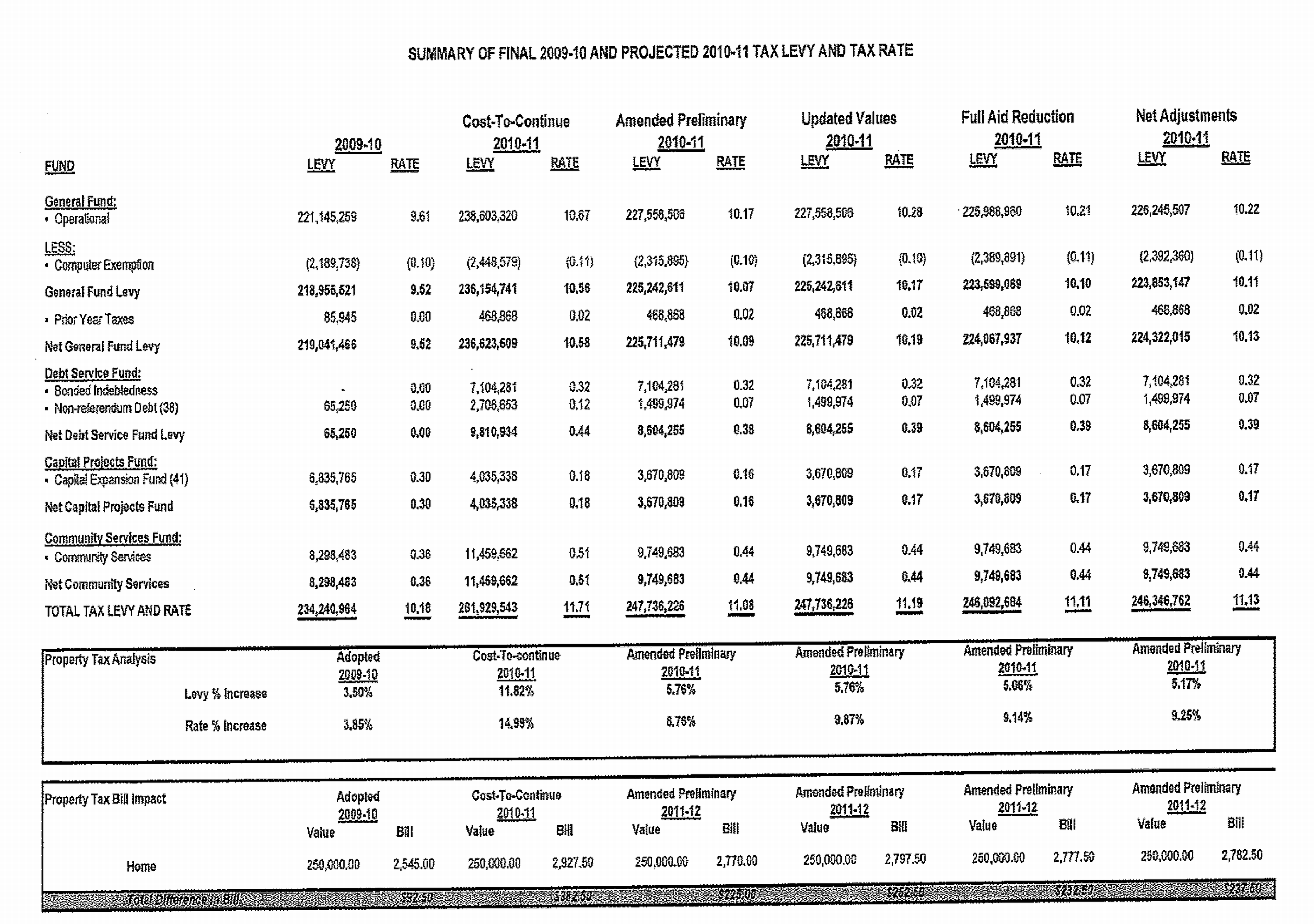
I’d put the Budget Update at the top of my personal list of agenda items. Bad news and good news with a net bad news of a larger increase in the mil rate (from 11.08 to 11.13) and slightly bigger hit to property owners likely (Penny for Kids would help!)
Among the news here is anticipated decrease of $442,501 in state Special Education Categorical aids, and an anticipated increase of $1,569, 546 in state equalization aid from the amounts budgeted in the Spring. Unfortunately the increase in equalization is related to a decrease in property values, meaning that although the total levy will be smaller, the base for that levy is smaller also and the increased equalization only partially covers the difference (Penny for Kids is needed!). There are lots of moving pieces locally — including property values in the district — and statewide that contribute to these adjustments. One of the biggest pieces is the “Third Friday” student count certification. If we are lucky, that number will be previewed at the meeting Monday. None of this is final till the end of October when the tax levy is passed.
On a related and positive note, the district did save $185,954 in short term borrowing costs.
These are combined here in a projected tax levy scenarios I think the last is the most likely.
I don’t like the $250,00 “average home” calculations, but the levy increase expressed in that way is $237.50, or $12.50 more than projected in the Spring ((Penny for Kids! Now more than ever).
And then there is the fund balance. It increased by $5.1 million in 2009-10. MMSD needs to have an open and thorough discussion of fund balance policies and practices (I’ve said this before). In the last three years the fund balance has increased by about $20 million, almost doubling. This is good and bad, but what is all bad is that it has happened without the Board directly addressing the choices being made. This money was collected to educate the children of our district and we (the people it was collected from) deserve to know if building equity at this level is the way it can best be used in the service of education.
Last in the update is “Budget Tracking Table” with big and unexplained changes in the ARRA lines (these may be covered in this previous ARRA update. Nothing on the EduJobs money (my guess is that it will be used for 2011-12 in MMSD).
Next in order of import is the Revised Code of Conduct. It looks like this might finally get done. I haven’t followed all the details, but I do like the Phoenix/Abeyance model as an alternative to expulsions.
It is kind of insider stuff, but I find the the evolution of the Superintendent’/Board of Education Communication Plan fascinating. This is a new iteration and with each version it seems to get more detailed and more exacting. I applaud the effort to clarify roles and expectations, but find it disconcerting that all concerned feel it needs to be spelled out this thoroughly. To me that indicates trust, faith and yes “communication” are not where they should be. Maybe I’m reading too much into this; maybe I’m just more comfortable with improvisational give-and-take.
Last item I’m going to cover (and the last item on the agenda) is the Legislative Liaison Report. Three things here.
First is the recent Resolution passed by the Dane County Board calling for school finance reform (press release here). This got some nice coverage from Neil Heinen on Channel 3000, in the Sun Prairie Star and maybe elsewhere. I worked on this with Supervisor Melissa Sargent and want to give a big thank you to her and the other Supervisors and the Board of Education and community members who supported the Resolution. Look for more Resolutions of this sort around the state in the coming months. As Neil Heinen said “Thanks to the Dane County Board, the voice for school funding reform just got louder.”
Next is Superintendent Tony Evers State of Education address. The big news here is no news on the Fair Funding Framework. For logistical and other reasons, there will be no further details till after the November elections. I’ll leave the “other” alone and note that there will be updated numbers to work with after October 15 aid certifications and the logistical reasons have legitimacy.
Last is a Penny for Kids update. Not 100% sure what this will be, but I will take this opportunity to put on my Wisconsin Alliance for Excellent Schools Board member hat and thank MMSD for actively supporting this campaign.
One more meeting. Ad-Hoc Hiring and Diversity on Tuesday, noon, at JC Wright Middle School. Another goal setting agenda and no linked documents. For some background see this report from September 2009. Staff diversity at all levels remains an issue. I hope that those working and agitating on minority teacher matters realize that this is a national problem and that long term solutions involving improving minority education, higher education opportunities, early recruitment into education fields and supports to achieve professional status are where the real solutions to teaching staff diversity lay. The district’s efforts can and should be improved in the short term (and not just with teachers, the clerical staff numbers are a disgrace), but only very limited improvements should be expected in the diversity of MMSD teaching staff.
Note: For a while, I’m going to be illustrating the “On the Agenda” posts with various graphs documenting achievement gaps in MMSD as revealed by the admittedly flawed and limited WSAS/WKCE results. I think regular reminders may do some good.
Time for the Metropolitan School District Board of Education to get down to some serious work. Past time.
I had high hopes that this would be a productive Summer for improving education and the governance of education in MMSD, but with 1/3 of their term complete this Board hasn’t given the public much to see. I phrased that carefully because the one thing they have been working on is the Superintendent evaluation and all that has taken place behind closed doors, so the public hasn’t seen anything (yet, I hope). More on the Superintendent evaluation below.
Two meetings this week; one open to the public and the other another closed session on the Superintendent evaluation. The open meeting is 5:00 Monday, August 30 at the Lowell Center, 610 Langdon Street, Madison, WI, Room 118. Note that this location means that there will be no broadcast or video record of the meeting via MMSD-TV. The closed meeting is Tuesday at 5:00, Room 103 or the Doyle Building.
The open meeting is billed as a “Workshop,” so no public testimony invited.
The first item is the approval of numerous minutes of previous meetings: October 23, October 26, 2009; February 22, March 15, April 5, May 10, June 1, June 21, June 23, and June 28, 2010.
Next comes:
Standing Committees of the School Board: Review of experience to date under the standing committee structure established by Board Policy 1031 and appointment of standing committee chairs and discuss various options.
The current structure — described in the linked policy — was put in place at the request of Superintendent Dan Nerad.
This and other items on the agenda closely resemble the items on the June 21 Workshop meeting. That meeting was about goal setting for the year and also included a discussion of committee structure.
I attended that meeting, but lost my notes in a hard drive failure. My memory is that some progress was made on setting goals, but there was much work left to do. My memory on the committee structure issue was that 5 of the 6 members with experience under the current structure desired changes, that there was interest in aligning the committees with the non-existent goals and that nothing was decided.
All this has been hanging there since June 21. Without goals and a committees, the Summer has largely been wasted.
The next couple of items are also about Board duties and schedules:
3.Designating appointments/representatives and review of time commitments, expectations, roles/responsibilities in connection with:
a) The School Board Member liaisons to MMSD
schools/programs under Board Policy 1041;
b) School Board Member liaisons to community groups
implementing specific MMSD-supported initiatives; and
c) MMSD Board/School representation to various
organizations, associations, boards, committees, etc. as
described under Board Policy 1041
4.School Board and Board Committee meeting schedule and meeting structure through the first semester of the 2010-2011 school term, including identifying potential needs for public input/listening sessions, any ad hoc committees, etc.
I’m not clear on what all these committees, programs, organizations…are, or whether any of this is new (I like the idea of new, semi-formal relationships with community organizations).
After these they will consider revisions of the ethics policy. There was a draft circulated at some meeting and I have it on file (I may try to dig it up and scan), but having seen it I’m not at all clear what they are trying to accomplish or why this has become a priority.
Last up, is “Next Steps for Future Board Development Meetings and Topics.’ Board development is good and important, but with only 2/3 of the term left I hate to see too much time and energy devoted to Board Development.
I keep coming back to this. Every year about 1/3 of the time and energy is devoted to budget matters, that leaves 2/3 to try to make things better. Put it another way; it is September, budget season starts in January. Past time to get to work.
This just leaves the closed meeting on the Superintendent evaluation. Not much to add to what I wrote here. My big point is that almost all of this process should be public. I will repost the links to things that are public:
Note: For a while, I’m going to be illustrating the “On the Agenda” posts with various graphs documenting gaps in MMSD. This one is from the Equity Report, which is on the agenda.
After an unplanned break from blogging, I’m going to ease back in with a partial run down of this week’s Board of Education agenda.
There are two meetings on Monday August 9, an Executive (closed) session at 5:00 PM in Doyle RM 103 and an open session in the Auditorium at 6:00 (plus an exchange of proposals on the Security Assistant contract on Friday). The agendas for the first (and last) are here. Unfortunately the link to the open meeting agendais broken (fixed now). A Board member scanned a copy for me and I’ve uploaded that (the hyperlinks don’t work, but you can get to the documents by pasting the appendix designation after http://boeweb.madison.k12.wi.us/files/boe/Appx, for example MM 2-8 becomes http://boeweb.madison.k12.wi.us/files/boe/Appx 2-8.pdf).
The big item of public interest on the closed session agenda is the Superintendent Evaluation. It is perfectly legal to do this in a closed session, but I don’t think it is good policy. Voters have only the Board to hold accountable and the Board has chosen to funnel most or all administrative accountability into the Superintendency. The public can’t make an informed judgment on the Board when this process takes place behind closed doors.
In the two plus years Dan Nerad has headed MMSD, I haven’t seen a single document reflecting the Board’s assessment of his job performance and public discussions on this topic have been rare, indirect and partial.
If you are interested in the terms and process of the evaluation, there are some public documents.
Q: How do you receive feedback based on your performance?
A: One of the things that is in some ways unique… is that I report to the Board of Education. I have seven bosses, and they do an evaluation process of me… I’m a big believer in self-assessment, so part of my evaluation will be to self-assess. I’m also a believer in what’s called 360-degree feedback, where you get feedback from others involved in the organization, so part of it will involve that… So ultimately it does come down to the Board of Education with multiple kinds of inputs that evaluate my performance.
Sounds good, but having 360-degree visibility would be better.
I’m running late on this, so the only thing from the open meeting I want to highlight is the “Annual” Equity Report (annual is in quotes because the policy requiring an annual report was passed in June of 2008 and this is the first report — a previous atempt from earlier this year was sent back for revision — I wonder if any of this came up in the Superintendent Evaluation?).
You can read more about my hopes and wishes for the Report in this post and this one too.
In terms of information provided, this version is an improvement over the first attempt. That said, there is still room for improvement (both with the report and in achieving equity) and there is at least one thing about the first version I like better.
What I liked about the first version was that it attempted to identify district initiatives that addressed the recommendations of the Equity Task Force. This isn’t required, but it was nice and useful.
The current version uses selected equity-related Strategic Plan measures more than the Equity Task Force work. In this way it serves as a preview of what can be expected with the Strategic Plan reports.
I’m withholding most judgment until I have a chance to hear the presentation and the reactions of the Board, but there are some things I do want to note.
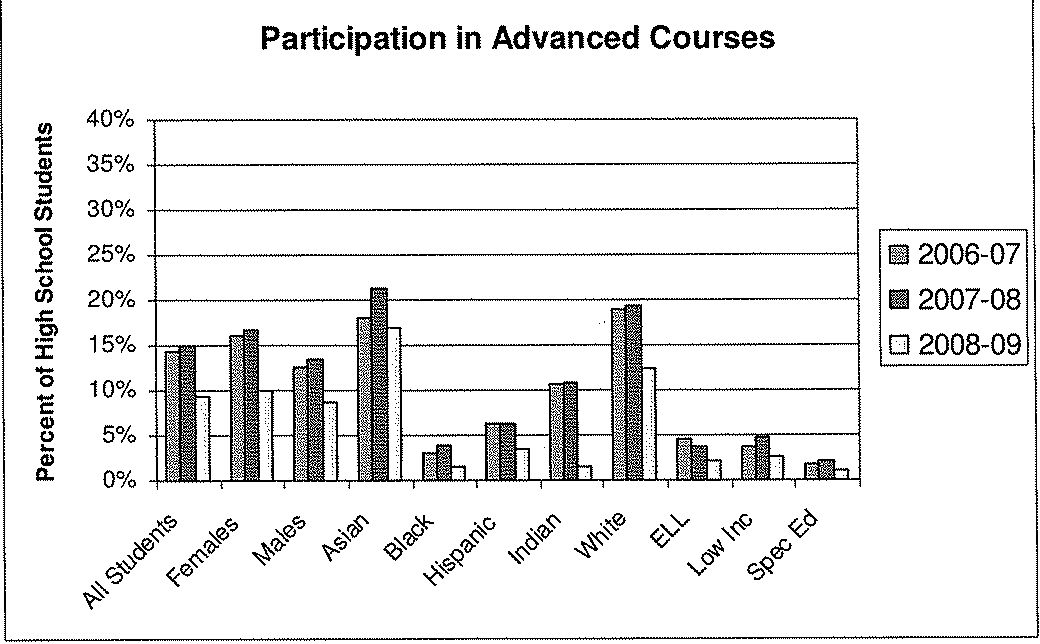
Might as well start with the graph at the top. Pretty disturbing. The Equity Task Force thought that expanded access to advance programs was of the highest importance and this indicates that the number of high school students taking advanced courses is declining and the diversity of those students is not markedly improving.
Two notes before going deeper on this. First, “advanced courses” isn’t defined and second, the graph without data makes it very hard to know what is happening with the demographics.
What is worse is the Report simply says “the reason for the decline is unclear” and moves on. That isn’t good enough. The purpose of having this report is to raise red flags so that inequities and bad trends get attention and action. Noting the lack of clarity of causality isn’t going to reverse this trend.
The other thing that really bothered me was the note that the Report isn’t “applicable” to “Budget Implications.” This appears to be pro forma, but resource allocations are central to the concept of equity advanced by the Task Force and reflected in the district Policy. Quoting from the Policy:
Achieving equity often requires an unequal distribution of resources and services in response to the unequal distribution of needs and educational barriers.
How can you have report on Equity that reflects this assertion and has no budgetary application?
Other things to note:
More presentations of data by school would be good.
The extensive use of climate surveys is a good idea (these are broken down by school), but I’d like to see school level demographic breakdowns here.
I want to get this up, so I’m leaving it at this for now.
We were told we have to offset every damn dime of [new teacher spending]. Well, it ain’t easy to find offsets, and with all due respect to the administration their first suggestion for offsets was to cut food stamps. Now they were careful not to make an official budget request, because they didn’t want to take the political heat for it, but that was the first trial balloon they sent down here. … Their line of argument was, well, the cost of food relative to what we thought it would be has come down, so people on food stamps are getting a pretty good deal in comparison to what we thought they were going to get. Well isn’t that nice. Some poor bastard is going to get a break for a change.
Can’t cut the military, can’t raise taxes on the rich and corporations, need to bail out Wall Street; Race to the Top’s destructive policies are popular with the Newt Gingrich’s we want to apeal to…let’s cut food stamps.
The answer to the titular question is “lower than a pregnant snake’s belly.”
Madison Metropolitan School Board Member Ed Hughes has a new blog up and if you care about accuracy in discussions of the district it is a must read (unfortunately many don’t care).
The majority of the initial entries are on the maintenance issues raised in Susan Troller’s recent Cap Times article and the reactions to that article. There is also a nice piece on the disappearance of the traditional special section in the State Journal recognizing the top area scholars (a section I too enjoyed but also viewed as an annual reminder of our achievement gaps) and a post that notes how the use of the mythical $250,000 house as the basis for property tax comparisons obscures the fact that despite consecutive annual cuts in state aid of 15%, the district-wide tax increase is only 5.76 (as compared to MATC’s 8.94% increase).
This a really good start and I’m glad Ed Hughes is doing this.
Two pieces of unsolicited advice: First, give us more links, especially when referencing district documents; number two is harder and something I struggle with, but be careful about assuming what your readership knows and when in doubt err on the side of providing more background.
Note: For a while, I’m going to be illustrating the “On the Agenda” posts with various graphs documenting achievement gaps in MMSD as revealed by the admittedly flawed and limited WSAS/WKCE results. I think regular reminders may do some good. Note also that despite recent progress, 32 point gap remains between children in poverty and those more economically secure.
A busy and important week for the Madison Metropolitan School District Board of Education (all meetings listed here, the only agenda document posted).
The important meeting is tonight’s (June 21). This has been called a “retreat” and an organizational meeting. Apparently this calls for a change of venue; they will be meeting at 5:00 PM, Lowell Center, 610 Langdon Street, Room 118. Among other things, this almost certainly means that meeting will not e carried by MMSD-TV. There are no public appearances.
Four items on the agenda and no linked documents in the original.
1. Presentation on Parliamentary Procedure
2. Goal-setting workshop surrounding best practices on the work of effective school boards, establishing MMSD-specific goals and mutual expectations to guide the processes by which the School Board accomplishes its work; and identifying specific areas of focus and priorities for the work of the School Board in 2010-2011.
3. Draft Board Ethics Policies (draft revisions to Board Policies 1540 and 9000)
4. Next Steps for Future Board Development Meetings and Topics
What this is all about is what the Board wants to do in the next year and how they intend to go about doing it. I’ve heard rumors a Five Year Budget project (with a Committee of Board members being formed), a Committee Restructuring, desires to reform the annual Budget Process (Yeah!), and Ethics policies designed limit conflict in public meetings.
I really hate that matters of such import will discussed and perhaps decided without any direct input from the public. Maybe, just maybe “stakeholders” would have something to contribute to setting the goals for the Board and the district and maybe interested citizens might have some ideas about how things could be better accomplished. When things are done in this manner it is hard to take seriously the Board and district’s expressed desires for community engagement.
Other meetings This week:
Tuesday, June 22 MMSD Building Services, 4711 Pflaum Road, Large Conference Room
1:00 p.m.
Collective Bargaining – Exchange of Proposals
Initial exchange of proposals and supporting rationale for such proposals in regard to collective bargaining negotiations regarding the Local 60-Custodial Collective Bargaining Unit, held as a public meeting pursuant to Wis. Stat. §111.70(4)(cm).
Wednesday, June 23, Doyle Administration Bldg.,545 W. Dayton St., Room 103
5:00 p.m.
Special Board of Education Meeting (agenda items 1 and 2 in Open Session)
1. Approval of Minutes dated June 7, 2010
2. Proposed contracts between Google, Inc. and MMSD for the provision of “Google Apps” education edition, including but not limited to “Google Docs” and “Gmail” electronic mail system functionality and services, and for the provision of email archiving functionality and services
Special Board of Education Meeting Continued in Closed Session
3. Review of and Receipt of Advice from Counsel regarding Disciplinary Proceedings and Decisions involving Individual Students, Including a Request for Reconsideration of a School Board Disciplinary Order, pursuant to Wis. Stat. §§19.85(1)(a), (f), and (g); and 118.125 and/or
120.13(1)(e)
4. Employment Matter (the closed session agenda items noticed under this heading shall be begin and be taken up by the Board no earlier than 6 p.m.):
a.Consideration of proposals, if any, to resolve a pending personnel matter involving the contract of an individual employee within a bargaining unit, pursuant to Wis. Stat. §§ 19.82(1) and 19.85(1)(c)
b. A private conference concerning the renewal or nonrenewal of a teaching contract, pursuant to Wis. Stat. §§ 19.85(1)(b) and (c); 19.82(1); and 118.22(3)
c. Deliberations and determination of action to be taken with respect to the renewal or nonrenewal of a teaching contract, pursuant to Wis. Stat. §§ 19.85(1)(b) and (c); and 118.22(2)
5. Adjournment or, if necessary, motion to continue the meeting in open session for the purpose specified under item 6, below.
Special Meeting of the Board of Education Continued in Open Session (if necessary) immediately following the conclusion of the closed session agenda
6. Determination of action to be taken with respect to the renewal or nonrenewal of a teaching contract.
7.Adjournment


 As indicated elsewhere in the new document, it appears that he ACT standards (and the EPAS), tthe AP requirements and the Common Core Standards will remain at the center of the reforms. There are a lot of “if/thens” in this, some of which I buy and some of which are difficult to accept. I’d like to see these all of these assertions of causality examined, but apparently that is not part of the plan.