Category Archives: Accountability

Rep. Bernier Tries to Get Cute (and Fails).

Phony Democratic Primary Candidates are apparently only the beginning, the GOP has now moved on to insincere revenue legislation.

First term Republican Representative Kathy Bernier is circulating phony legislation proposing an income tax check-off to fund shared revenue, medical assistance, and K-12 education.

You can read the bill here.

In the plea for co-sponsors Bernier explains her “thinking”:

Over the last few months, and years, we have heard certain portions of the population advocate for raising taxes as a means to fund these programs. This gives those people that feel they have the ability to pay more in taxes to do so without mandating that burden on those who cannot afford it.

Cute, huh?  Not.

At a listening session back in April, things got ugly for Bernier.  On that occasion and probably others,  people told Bernier to increase taxes (in April there were also loud complaints about corporate tax breaks).

Voluntary check-offs are not taxes.  Taxation involves legal obligations and the power to enforce those obligations.  For all the lovers of the US Constitution and the historically minded, one of the biggest reasons that the founding generation replaced the Articles of Confederation was because that document did not include the power to tax, only to ask for voluntary donations from the states.  The distinction is important.

While on the topic of distinctions that are lost on Rep. Bernier, the LRB lists “the endangered resources program. .. a veterans trust fund, prostate cancer research, multiple sclerosis programs, a fire fighters memorial, Second Harvest food banks, and a breast cancer research program, and to provide a donation to a professional football stadium district” as items that currently receive fund via check-offs.  As worthy as these might be, they are hardly the kind of Constitutionally mandated or essential programs as shared revenue, medical assistance, and K-12 education.

Rep. Bernier and her fellow partisans should stop playing games, stop trying to be cute and get to work on real revenue reform that includes real tax increases.  Penny for Kids would be a great start.  After that, there are plenty of ideas in the Institute for Wisconsin’s Future’s updated Catalog of Tax Reform Options for Wisconsin.  Not cute either, but what the state needs.

Thomas J. Mertz

Leave a comment

Filed under "education finance", Accountability, education, finance, Gimme Some Truth, Local News, Pennies for Kids, School Finance, Scott Walker, Uncategorized

Scary and Wrong — The Ends of Education

No, AMPS isn’t taking advertisements,  I just wanted to point out how ridiculous the idea expressed in this one is. And note it isn’t just the Iowa Assessments, MMSD has bought the ACT/EPASS/EXPLORE program based on the same pitch.

” College and Career Readiness” as “revealed” by standardized tests starting in 6th grade.  Is this the end of education in that  goal and yard stick are test based ” College and Career Readiness”?  If so then it is the end of education for citizenship and  full and rich life.

Caveat — I know that some good can come from monitoring where students are in relation to where they will/should be going.

Thomas J. Mertz

Leave a comment

Filed under Accountability, Best Practices, education, Gimme Some Truth, Local News, National News

Meet The Billionaires Who Are Trying To Privatize Our Schools And Kill Public Education

For most of you reading this, dear advocates of public education, none of this that I am about to mention will be very new information for you. But given Sam Dillon’s report on the front page of the New York Times today, I think perhaps momentum is building in reexamining the emerging role of the wealthy in this country in re-writing the assumptions of what public education is, and should be in the future. This post was also prompted by an excellent piece by our own Ruth Conniff, writing in the Isthmus this week.

Dillon has performed a yeoman’s task of putting together, in a short article, the convoluted inter-workings of the Bill Gates education philanthropy’s strategy for overhauling the nation’s education policies. In some cases the Gates Foundation is immediately engaged in financing educators to offering direct challenges to teacher unions on such issues as the seniority system and and the use of student test scores to evaluate teachers. In other cases, Mr. Gates has actually created entirely new advocacy groups, while at the same time financially supporting many Washington education analysts with contacts with journalists, even giving grants to some media organizations.

“It’s Orwellian in the sense that through this vast funding they start to control even how we tacitly think about the problems facing public education,” said Bruce Fuller, an education professor at the University of California, Berkeley, who said he received no financing from the foundation.

“It’s easier to name which groups Gates doesn’t support than to list all of those they do, because it’s just so overwhelming,” noted Ken Libby, a graduate student who has pored over the foundation’s tax filings as part of his academic work.

The impact of the foundation’s role in education policy is immense. Dillon reported that it had developed and promoted common core academic standards that have been adopted in 45 states in recent months.

While the foundation has nominally supported the AFT and the NEA, it was also a supporter of a campaign focused on the “Waiting for Superman” film, a piece of agit-prop that was quite critical of the AFT head, Randi Weingarten. Two other Gates-financed groups, Educators for Excellence and Teach Plus, are focussed on giving non-union voices to newer teachers.

In Wisconsin, as Ruth Conniff has so eloquently stated:

There is something horribly fascinating about watching Wisconsin Republicans discuss their plans for our state’s school system.

First, they swing the bloody ax:

  • The biggest budget cuts to our public schools in state history, nearly $900 million. Kerchunk.
  • A bill to create a statewide system of charter schools whose authorizing board is appointed by Scott Walker and the Fitzgeralds, and which will funnel resources out of local schools and into cheapo online academies. Kerchunk.
  • Lifting income caps on private-school vouchers so taxpayers foot the bill to send middle- and upper-income families’ kids to private school. Kerchunk.

and then goes on to document the slow drip-drip of multiple camel noses under the tent, as local authority is usurped and for-profit charters and vouchers begin to gather size and influence within the system from a slow trot to a gallop, balkanizing and dismembering public education as we currently know it.

Despite the public outcry and some nervous chatter from the sidelines from some Republicans, as Conniff as so astutely pointed out,

… this is a sideshow. As Wisconsinites are becoming increasingly aware, the real money in state politics is streaming in from a nationally financed campaign to destroy public schools and privatize education. Olsen’s second-biggest individual contributor, according to the Wisconsin Democracy Campaign data, is Richard Sharp of the Richmond, Va.-based Alliance for School Choice.

The American Federation for Children, which hosted Walker in Washington, D.C., is a spin-off of the Michigan-based group All Children Matter, which has poured millions into phony issue ads in state legislative races and been the defendant in multiple campaign-finance lawsuits, including one here in Wisconsin.

Both groups were founded by Michigan billionaires Dick and Betsy DeVos, who brought Walker out to be a star speaker in Washington.

While he was there, Walker gave a shout-out to disgraced former Assembly Speaker Scott Jensen, who now works for the American Federation for Children, along with Brian Pleva, who used to run the powerful Republican Assembly Campaign Committee here in Wisconsin.

Meanwhile, James Bender, former chief of staff for now-Assembly Speaker Jeff Fitzgerald, is now a lobbyist for School Choice Wisconsin.

In fact, school choice groups are poised to become the single most powerful lobby group in the state, edging out bankers and realtors; who would thought such a thing was possible just a few short years ago?

As a new report by Think Progress’ Zaid Jilani has pointed out, Wisconsin is, of course, not alone in being inundated with billionaire’s money to undermine, undercut and to privatize public education.

For over 45 years vouchers were up for a vote in states 25 times, and were rejected by voters 24 of those times. As I noted a couple of years ago on AMPS, these same set of billionaires that Jilani cited (he noted that the American Federation for Children alone spent $820,000 in Wisconsin during the last election) have the money and the organizational power to reach their ultimate goal, unless we begin to stop them in their tracks.

Jilani noted that:

While the goals of the figures in this movement are varied, their assault on our public education system is one and the same. Joseph Bast, the president and CEO of the Heartland Institute, explained his own thinking about vouchers once, saying, “The complete privatization of schooling might be desirable, but this objective is politically impossible for the time being. Vouchers are a type of reform that is possible now, and would put us on the path to further privatization.” It’s up to Americans to protect their schools, teachers, kids, and communities from that fate.

Robert Godfrey

3 Comments

Filed under "education finance", Accountability, Best Practices, Gimme Some Truth, National News, School Finance, We Are Not Alone

Senate Bill 95 Testimony

Sisyphus 1, by Davor, click on image for more.

The Lyres, “Don’t Give It up Now” (click to listen or download).

Thank you for this opportunity to testify on Senate Bill 95.

Due to time limitations  — both the time allotted here and the very, very short time between the release of the Bill on Friday and the scheduling of this hearing for today  — I will be confining myself to only two of the topics covered in this wide ranging measure.  Those are the dilution of the Student Achievement Guaranty in Education (SAGE) and the use of student standardized test scores  as a determinant of educator employment conditions.  I will note that I believe every section of this Bill should be thoroughly sifted and winnowed.

Before directly addressing the proposals on SAGE and the use of student standardized test scores, I’d like to say a few things about the broader trend in educational thinking and policy in Wisconsin.

Not too long ago Senator Olson chaired a Special Committee on Review of State School Aid Formula.  I sat though most of the meetings of that committee.  Although little came of it, there was a sense of optimism and ambition in the work of that committee, a sense that we can and should do better.    This spirit was captured in the title of the presentation by Professor Alan Odden “Moving From Good to Great in Wisconsin:  Funding Schools Adequately and Doubling Student Performance,” (paper of the same title here) .  It should be added that Doctor Sarah Archibald, who is anow dvising Senator Olson, was part of that work.

Almost no one is seeking greatness any more.  At best people are seeking to push the limits of “doing more with less;” at worst there is an unspoken acceptance that the children of today and tomorrow will not have the the breadth and quality of educational opportunities that their older brothers and sisters were provided.    Things like physical education for all children are now  apparently luxury we cannot afford and so you have before you a Bill which eliminates that requirement.   Maybe this one policy change isn’t the most important, but it wouldn’t be before you if academic subjects, arts education, technical education, agricultural education and in fact the entire curriculum weren’t threatened in districts around the state.   How sad that it has come to eliminating physical education requirements in order to at least partially fund other educational offering.

There are better ways.  The Special Committee Senator Olson chaired heard about some of them, others have have been put forth since then.  I happen to believe that revenue reform needs to be part of the answer, but the recent revised revenue projections provide a way halt the decline without altering the tax structure.  Joint Finance leadership has indicated they won’t consider this.  Perhaps they could be convinced otherwise, perhaps members of this committee could remind them of the responsibility of  each generation to give the next the tools to create a better future.

The proposed “flexibility” for SAGE is like the Phys Ed proposal, in that it is a step backward, only it is worse.  SAGE  is Wisconsin’s only state program targeted for children in poverty and this is crucial,  legally, educationaly and as a matter of social justice.

In the Vincent v. Voight  decision the Wisconsin Supreme Court noted that “Poverty undisputedly leads to distinct learning problems” and identified addressing these problems as part of the test of the constitutionality of a school finance system.

Odden and Archibald  — like every other proposal for reforming education finance in Wisconsin  —  followed this lead,  proposing 30%+ additional resources for free and reduced lunch students .  In a similar manner the School Finance Network  proposed a broader and genuinely more flexible poverty categorical aid to improve educational equity and outcomes.   Allowing districts to partially opt out, improves nothing.  It simply denies more children in poverty the benefits of a a successful program.

SAGE isn’t perfect, but the results have been good.   The research by the Value Added Research Center is worth reviewing to get at the details, but the results have been convincing enough that Odden and Archibald included it in their strategies for doubling achievement,  recommending that “schools be resourced for class sizes of 15 for grades K-3 and 25 for grades 4-12.”

Even scholars who are generally skeptical about the efficiency of class size reductions recognize that the effects are more pronounced for children in poverty.  One of the prime functions of our public schools is to break the cycle of inequality by providing opportunities.  We haven’t come close to doing this.  Instead of limiting access to these opportunities, as SB 95 does, we should be looking to expand access by fully funding.

Since education reform proposals originating in Florida seem to be popular with some these days, I’ll close this section  by noting that state class sizes in kindergarten through 3d grade are Constitutionally limited to 18 students (22 4th through 8th and 25 in High School).  If every young student in Florida can have the benefits of a class limited to 18, I would hope that Wisconsin could at very least not make it easier to take these benefits away from our economically disadvantaged students.

On the expanding the use of standardized tests in relation to teacher employment I’ll be brief.

First, the test that is in place is the WKCE and consensus is that the WKCE is deeply flawed as a measure of student learning, much less teacher effectiveness (something it is not designed to measure) .  It is my understanding that the earliest we will have a new assessment is 2014, which means that the earliest we would have multiple years of data to work with is 2016.  So even if you accept that these new assessments will be  appropriate tools to measure student learning and teacher effectiveness — which I do not — for at least the next 5 years SB 95 ties educator employment conditions  to WKCE results.  How can this be a good idea?

More generally, I’ll again turn to Professor Odden (I don’t believe Doctor Archibald was part of this project).  He wrote: “Merit plans in education have conceptual, strategic, technical, and political shortcomings” and advised against trying them till other options– such as knowledge and skills based systems had been exhausted.  Conceptual because of the collaborative nature of teaching and learning.  Strategic because they target the extremes instead of seeking to improve teaching across the board.  Technically because of the impossibility of designing a plan that equitably covers all teachers in all subjects in all grades in all schools….. And politically, because most educators will oppose them, creating hostility that undermines organizational unity.

I could elaborate on this list and add to it.   Almost every scholar who does not have a vested interest in standardized tests and their application is skeptical of their application to the evaluation of teachers.   This skepticism includes value added analysis.  Scholars across the spectrum,  including  the The Economic Policy Institute, The National Academies, Math for America, The Brown Center at Brookings, the Rand Corporation,  and even The American Enterprise Institute have cautioned against or rejected the use of standardized test based value added models for high stakes decision making.

Instituting a standardized test based teacher evaluations will require devoting more resources — time and money — to tests, testing and the analysis of these tests.  A recent decision in Charlotte-Mecklenburg North Carolina captures the absurd state of education policy-making.  The Charlotte Observer reports:

Next week CMS will launch trial versions of 52 new tests, including an exam for kids as young as kindergarteners who must be tested one-on-one. The tests will be used to evaluate teachers, as the budget shrinks and officials prepare to lay off faculty.

52 new tests, so they can figure out which teachers to lay off in order to do the least harm.

In closing I offer a quote from a School Superintendent in Pennsylvania, where similar “mandate relief “legislation is under consideration:

“This does not promote education, it simply promotes laying off more educators,… these so-called mandate reliefs are just more smoke and mirrors.”

Much of SB 95 is about presenting the illusion of helping schools and students and distracting from the reality that our state is abandoning our commitment to providing every student a quality education.    It is time to leave the the smoke and mirrors and get back to working for greatness.

Thomas J. Mertz

1 Comment

Filed under "education finance", Accountability, Best Practices, Budget, Contracts, education, Equity, finance, Gimme Some Truth, Local News, National News, School Finance, Scott Walker, Take Action, Uncategorized

“Flexibility” = Decline = Ugly

Remember warnings about your face getting stuck in some ugly expression? I think the champions of “flexibility” in Wisconsin and elsewhere need loud and repeated warnings that their “flexibility” in educational policy (along with privatization, cuts in funding, destruction of local control…) in fact constitutes a possibly permanent acceptance of declining educational quality  and is an ugly betrayal of our traditions and our responsibility to our children.  They are bending our schools out of shape and our children will be stuck with it.

Here is the latest iteration from the Chairs of the Assembly and Senate Education Committees (it is being fast tracked and will be the subject of a hearing in the Assembly Education Committee on Monday May 16).:

TO: Legislative Colleagues

FROM: Representative Steve Kestell & Senator Luther Olsen

DATE: May 12, 2011

RE: Co Sponsorship – K-12 Mandate Relief Legislation

We are introducing legislation to provide public schools more flexibility and mandate relief in several areas: 

  • In the semester in which a student is a participant in a high school sport, that sport can count as the student’s phy ed credit.
  • Explicitly authorizes a school district to contract for a variety of services, including orientation and mobility training, educational interpreters, audiologists, speech therapists, pupil transition services, and any services approved by the state superintendent of public instruction; and makes the costs of such a contract eligible for special education aid.
  • Under current law DPI must prorate state aid payments to school districts for transportation costs if the amount appropriated does not cover all eligible costs. Under this bill, if funds remain after DPI pays all approved claims, DPI must distribute the balance to school districts on a prorated basis.
  • Current law allows a school district to use up to 25 percent of the moneys it receives from the common school fund in a fiscal year to purchase school library computers and related software. This bill eliminates the 25 percent limit.
  • This bill allows a school board to use the results of standardized examinations to evaluate teachers without the presence of the conditions described in current law.  Under current law, the results of standardized examinations may not be used to discharge, suspend, or formally discipline a teacher or as the reason for the nonrenewal of a teacher’s contract.  This bill provides that the results of standardized examinations may not be used as the sole reason to discharge, suspend, or formally discipline a teacher or as the sole reason for the nonrenewal of a teacher’s contract. 
  • This bill eliminates the requirement that no more than 200 teaching days be scheduled in the regular day school period in any school year for Milwaukee Public Schools. 
  • This bill permits SAGE flexibility for a school board that has entered into or renewed a SAGE contract to choose not to comply with the class size limitation requirements in one or more grades covered by the contract in one or more schools in the school district and in one or more years of the contract term.  Offering this flexibility will help maintain SAGE in schools that might otherwise be forced to drop out of the program for financial reasons. 
  • This bill authorizes a school board to refuse to enroll a pupil during the term of the pupil’s expulsion from a public school in another state if the grounds for the pupil’s expulsion would have been grounds for expulsion in this state.  
  • This bill permits a school district to use such law enforcement records as the sole basis for taking action against a pupil under the district’s athletic code. 
  • This bill provides that, in years in which a November general election is held, the school levy certification date is moved from November 6 to November 10.

An LRB copy of the legislation will follow.

The deadline for co-sponsorship is TOMORROW Friday, May 13 at Noon. Please contact Representative Kestell’s office at 6-8530 or Senator Olsen’s office at 6-0751 to be added as a co-sponsor, or reply to this e-mail to sign onto the bill.

Some of these are OK — allowing  a longer school year in Milwaukee, some transportation adjustments, even the school levy certification date change appears to be about a real issue with scheduling referenda.  Others are ugly.

Number 1 appears to be a way to limit the need for Phys Ed classes and teachers.  Number 2 brings the privatization mania into the public schools.  Number 4, like the ARRA shifts from investments in people and books to investments in technology.

I think number 7 is the biggest betrayal here and the most telling example of the acceptance of decline.  The SAGE class size reduction targeted to early grade children in poverty is just about the only source of state education funds that recognizes and addresses economic inequality.  It has been underfunded for years, placing a burden on local districts to make up the difference.  Last session the Democrats — in the name of flexibility — raised the class size limits.  Now the Republicans want to add more “flexibility” allowing districts to ration class size reductions year-to-year and grade-to-grade.   Now we are saying to poor children that we can’t do for you what we know is right, what we did for your older brothers and sisters.  Can we at least get a “sorry’?

Of course the biggest betrayals and sources of decline overall are the pending Biennial Budget’s  reduction of state school aid by $843 Million in combination with a hard 0% growth  cap on the power of school boards to generate revenues.

Like with SAGE, this backwards trend began with the Democrats.  It was Governor Jim Doyle who in his first term dumped the 2/3 state support guarantee.   It was Democrats who in the last Biennial Budget cut general school aids by about $300 Million.  And all of this against a backdrop of 17 years of bi-partisan refusal to fix a broken school funding system which even when “fully funded” required annual cuts to programs and services in most districts.

The thing about going backwards is that simply getting back to the starting point becomes harder and harder and returning to a forward direction almost impossible.    After the last Biennial Budget UW Public Budgets Scholar Andrew Reschovsky did some calculations  on how much it would take to return state school aid to the growth levels of the previous decade. If Wisconsin wanted to completely offset the cuts done in 2009-11 it would require $1,552.4 Million in additional state aid; to simply return to the old trend line without making up for the cuts would take $664.4 Million in additional state aid.

Suck in reverse.  Decline is the new new normal; almost nobody is talking about getting back to where we were and even fewer are trying to move the state forward (the Wisconsin Alliance for Excellent Schools — WAES —  is just about the only consistent voice reminding people of the possibility of a truly better way).

We’ve heard a lot from Governor Walker and the Republicans about how we need to cut budgets in order to not burden our children with public debts and deficits (they absolutely refuse to consider revenue reforms which could address these).    But their supposed concern for the  next generation doesn’t extend to providing them the same level  of educational opportunities that their older brothers and sisters had.   This, like “flexibility” is a betrayal.  They don’t care about our children’s future; they care about dismantling the public sector.

Walker is also big on “tools” except when it comes to giving our children the tools they need to be prosperous and successful.

Just this week, they have made it clear that their program goes beyond “no new taxes” when  despite pleas from WAES, the Wisconsin Association of School Boards State Superintendent Tony Evers and others, they refused to consider the use of any of the projected revenue increases to diminish cuts to education (and here).  They seem to be happily stuck in reverse, in decline.

There is one piece here that I need to touch on before closing and that’s number 5, the expanded use of standardized tests for teacher evaluation, discipline, suspension, nonrenewal,  and dismissal.    I’ve written about what’s wrong with this many times before (see here  and and the video here posted by Robert Godfrey).  There is so much more to say, but for now I’ll just quote a recent column from  John Ewing, president of Math for America (read the whole thing!).

Making policy decisions on the basis of value-added models has the potential to do even more harm than browbeating teachers. If we decide whether alternative certification is better than regular certification, whether nationally board certified teachers are better than randomly selected ones, whether small schools are better than large, or whether a new curriculum is better than an old by using a flawed measure of success, we almost surely will end up making bad decisions that affect education for decades to come.

That last line about sums it up with this whole “flexibility” package: “bad decisions that affect education for decades to come.”  Stuck with ugly.

Thomas J. Mertz.

4 Comments

Filed under "education finance", Accountability, Best Practices, Budget, Contracts, education, finance, Gimme Some Truth, Local News, National News, School Finance, Scott Walker, Uncategorized

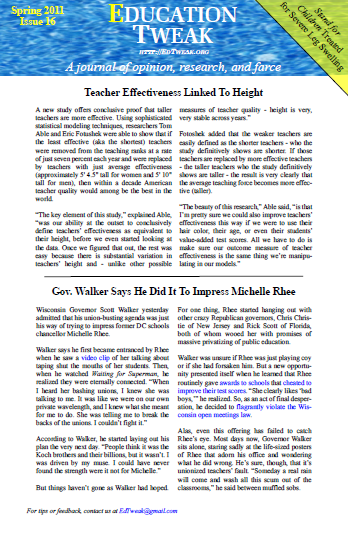
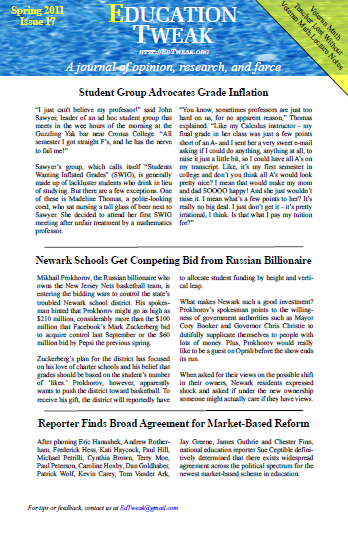
Two EdTweaks for the Price of One (free)

Click on image for pdf.

Click on image for pdf.

I am easing back into blogging and what better way to start than with not one, but two new issues from our friends at EdTweak.

Thomas J.  Mertz

Leave a comment

Filed under "education finance", Accountability, AMPS, Arne Duncan, Best Practices, education, Gimme Some Truth, Local News, National News, Scott Walker

Save the Dates

Wednesday April 20, 10:30 AM, “A Better Way”  School Funding Alternatives Press Conference

FOR IMMEDIATE RELEASE: April 19, 2011
Parents, Religious and Education Leaders Call for Balanced Approach in Budgeting for Public Education.
MADISON, Wis. – A broad coalition of parents, student advocates, religious leaders and educators has come together to call on the Wisconsin Legislature to take a more balanced approach to the state budget process.
To make their voices heard, the group’s members will hold a press conference that will detail how the budget will impact people from a wide variety of perspectives. The event will be held in the Senate Parlor of the State Capitol Building. WHAT: Press conference featuring parents, students, teachers and advocates, who will speak about how the state budget will impact them and their local schools and students. The event will also outline options the Legislature and governor should consider before making massive cuts to education.

  • WHEN: Wednesday, April 20, 2011, 10:30 a.m.
  • WHERE: Senate Parlor, State Capitol Building, Madison
  • WHO: The event will feature a number of speakers, including:

• MC: Julie Underwood is dean of the University of Wisconsin-
Madison School of Education

• Nancy Holmlund is president of WISDOM, a network of 145
congregations representing 17 denominations across Wisconsin that
work together to promote fairness and the common good

• Beth LaBell is a parent and member of the Paris Vote YES
Committee, a group that promotes the Paris School District

• Terri Raatz is mom to three little boys, the oldest of whom, Patrick, is
seven years old and has autism

• Jasmine Alinder is the founder of I Love My Public Schools, a group
of concerned Wisconsin parents who are fighting for the rights of
children to have a quality public education

• Danielle Barbian is a senior at Hamilton High School in Sussex and
president of the Wisconsin Association of School Councils

• Kim Hoffman is a music teacher at Stone Bank Elementary School in
Waukesha County and member of the Wisconsin National Guard

WHY: The proposed state budget includes over $1.7 billion in cuts to education over the next two years, while increasing spending over $600 million for corporate tax breaks and transportation projects. The result will mean program cuts, fewer opportunities for students and increased class sizes.

“Road Map to a Better Way” from The Wisconsin Alliance for Excellent Schools (WAES).

Thursday April 21,  Noon — On the Airwaves — WORT 89.9 FM.

I’ll be on A Public Affair with Allen Ruff discussing “the state of public education, the assault upon it and what we can do.”  Listen and call in:  256-2001.

Thursday, April 28, 6:45-8:45West High Roundtables Conversation

Thursday, April 28, 6:45-8:45, in the West High Cafenasium

Calling All Parents, Students, Teachers!

Excerpt from the April 2011 PTSO Regent Reporter article:

Our school, like every other school across our state, will
likely be confronted with some major changes in the near future.  The
events of this school year at West have shown us the importance and
the power of joining together and sharing our voices, so that we can
all be heard.

Now, in the face of potentially drastic cutbacks, it is more crucial
than ever that we identify the issues, concerns and decisions that we
need to explore as a community, and then establish the lines of
communication through which we can all effectively contribute to the
decision-making process, which helps to ensure inclusive input of all
affected stakeholders.

These issues will be the focus of our West Roundtables gathering,
scheduled for Thursday, April 28th, 6:45 p.m. in the Cafenasium.

We can be best prepared to protect the interest of our school by being
informed of the concerns and needs of all, and we can only accomplish
this if we have a system in place that facilitates a free exchange of
ideas.

Please save the date Thursday, April 28th, to attend this important
event.

Sponsored by West’s PTSO & the West Cares Group

[Spanish Language version]

Thomas J. Mertz

Leave a comment

Filed under "education finance", Accountability, Best Practices, Budget, education, finance, Local News, Pennies for Kids, School Finance, Scott Walker, Take Action, Uncategorized

My Letter on Senate Bill 22

Members of the Senate Education Committee

My name is Thomas J. Mertz.  I have been active in Madison and statewide working for adequate educational funding and equitable educational policies.  Like many I see much in Senate Bill 22 that will exacerbate the underfunding of the district schools which will continue to be the source of educational opportunities for the overwhelming majority of Wisconsin’s students, and much that will create greater inequities in access to opportunities.  The future of our children and our state depend on investments in education.  That this is happening after 17 years under a deeply flawed school funding system and at a time when districts face unprecedented cuts in both state funding and local revenue authority is particularly alarming.

However this is not where I want to focus attention here.  I am also a historian of education.  It is from this perspective, as well as the perspectives of a parent, citizen and activist that I urge you to reject those aspects of Senate Bill 22 which undermine Wisconsin’s long traditions of non-partisan local control

Our state Constitution states “The supervision of public instruction shall be vested in a state superintendent and such other officers as the legislature shall direct.”  Our supreme court has ruled that other officers created by the legislature may not be given powers equal to or greater than the superintendent.    The Constitution also specifies that the Superintendent be elected “at the same time and in the same manner as members of the supreme court.”  This clause and statutes related to the election of the Superintendent and Boards of Education, as well as those covering  those wonderful exercises in direct democracy,  School Meetings, are part of a long and careful tradition of separating the governance of education from partisan politics.  In 1885, In an an attempt to further  separate the political sphere of  school governance,  Wisconsin went so far as to grant women a limited suffrage, confined to “school matters.”

The creation of a politically appointed Charter School Authorizing Board and Executive Director, with powers and responsibilities rivaling those of the State Superintendent is a heedless and needless break from these traditions.   Schools are inherently political, yet Wisconsin’s Superintendents and Board of Education have an admirable record of finding common ground and advancing the common good.  Handing control of K-12 schools to people chosen by party leaders introduces a great potential that in decision-making, other than the common good will  become primary.

This Board also represents a break from the tradition of local control of education.  It opens the door for “sponsors” and the “operators” they contract with to set up networks of schools with limited state oversight and answerable primarily to distant entities.  It cannot be forgotten that the resources at the disposal of these entities will be resources not available to the local and locally elected school board.

Schools and school districts define communities; the charter networks enabled by SB 22 threaten local decision-making and the already precarious financial viability of districts.  In urban, suburban, small town and rural Wisconsin he health and economic prospects of communities are tied to the strength of our schools.

Schools are also defined by their communities.  Through their locally elected Boards of Education and in school meetings, citizens are collectively involved in choosing programs and personnel, in setting priorities and debating budgets, in building facilities and — these days much too often —  closing schools.

These ties will be gone with networks of charter schools authorized by a partisan state board and operated by out-of-state corporations.

There are many other aspects of SB 22 that I would like to discuss, but I’ll close by reminding you that in Wisconsin we have some very good public schools and some that need improvement.  We also have some very good charter schools and some that need improvement.   Local control of charter authorizing is working.  The best evidence is that charters are generally no better than district schools and often not as good.   They are not in and of themselves “the answer” to our educational problems and in many ways are a distraction from improving the education for the 90%+ of students who will continue in district schools.  Don’t let enthusiasm for “choice” and ill-defined “innovation” seduce you into abandoning our traditions, our communities and our schools.

Thomas J. Mertz

For more information, see Public Schools for the Public Good and the Facebook Group, “Stop the Charter School Bill.”

12 Comments

Filed under "education finance", Accountability, Best Practices, Budget, education, Equity, finance, Local News, School Finance, Scott Walker, Uncategorized

Dane County Parent Organizing Meeting set for this Sunday

Parents in Dane County have scheduled an event to update the public on Governor Scott Walkers’ devastating cuts to their children’s educational opportunities and to plan what they can do, together, to form advocacy groups and work for a better way. The event follows closely on the heels of a similar meeting in Greenfield, March 5, that saw over 400 people come together to plan the next step.

March 27, members of the Dane County School Board Consortium and WAES will host a community meeting — “The Future of Public Education and A Call to Action” — at the Monona Grove High School Commons, 4400 Monona Drive, Monona. The hoped-for outcomes of the event, which runs from 3 to 4:40 p.m., include an increased understanding of school funding in Wisconsin, alternatives to cuts in funding, and formation of community advocacy groups. For more information, call 608-217-5938 or go to here.

Robert Godfrey

3 Comments

Filed under "education finance", Accountability, Budget, Scott Walker, Take Action, We Are Not Alone

Changes at the High Schools a Done Deal?, An Open Letter

Photo WKOW

I’m running for Common Council and shouldn’t be spending time on this, but the issues are very important to me, so I’m doing it, but as short and sweet as I can.

The issues are the  failure of the MMSD Administration to follow basic practices of open inclusive governance and the implementation of segregative policies.

Below (and here) is an open letter drafted and signed by 18 West High parents on Friday 1/7/2010.  Understanding the letter requires some background and context.  The background  — along with the latest news and some final thoughts –follows.

Background:

On October 15 2010 hundreds of West Students protested proposed changes in our High Schools and their exclusion from the decision-making on these changes.  Subsequently, the proposal was renamed “(Dual Pathways” is in the dustbin of history) and vague statements about a more open and inclusive process were made (AMPS posts on this here, here, here and here).

After a contentious parent meeting at West on these proposals, a group of parents who wanted to have some say in the reforms  began meeting and emailing.  It is important to note that the views of this group on the various aspect of the reforms are diverse, but all wanted to be part of an open process (I strongly favor some aspects and oppose others, see the links to AMPS posts above).  Only some members of this group signed the letter.

Last Thursday these matters appeared on the Board of Education agenda for the first time.  It was a workshop meeting — no public testimony —  and nothing was slated for action.   Not all supporting  materials were linked to that agenda.  I’m not going to do a blow-by-blow of the meeting.

The important development was that it was revealed that the changes in high school structures for English and Social Studies at West and Memorial — the changes the prompted the protest (uploaded here, I don’t believe this document has ever been posted by MMSD) would appear in the handbooks for 2011-12 that had to go to the printer on Tuesday January 11.  Remember, this information was not public prior to the meeting and there was no way for the Board to act on it.  This is what prompted the letter.

At the meeting some Board Members suggested delaying the implementation.  Since the meeting there has been communication between Board Members and between Board Members  and the Administration (note: I said “between” not “among,” which would be a clear violation of open meetings statutes).

Latest News:

I have been informed that the result of this “process” is that  the planned changes, the segrative changes,  will appear in the course catalog that is sent to the printer on Tuesday.

Final Thoughts:

This is no way to run a school district and it is certainly no way to institute a reform that to be successful requires the confidence and support of parents, students and teachers.   If you don’t like this, let the Board and Supt Dan Nerad know (board@madison.k12.wi.us; dnerad@madison.k12.wi.us).

In conclusion, I want to reiterate that I support much of the reform package and believe in the sincerity of the motives of those behind it.

Thomas J. Mertz

Leave a comment

Filed under Accountability, Best Practices, education, Gimme Some Truth, Local News, Uncategorized