Category Archives: Accountability

Coming Transformations

Credit: Computer Vision Laboratory, Columbia University

I want start off with one of the most egregious aspects of a horribly underfunded public school system and what acts of desperations that can ensue, followed by some “respectable” examples of education reform percolating around the country and ending with the next big “shining object” that will command our full attention here in Wisconsin shortly, whether we like it or not.

We begin with Charlotte Hill’s recent reporting at the change.org site that highlighted a distressing development; four inner-city schools in Detroit are “partnering” with Walmart

to offer a course in job-readiness. Student participants earn school credit while learning how to hold down one of the superstore’s infamously low-paying positions. When the bell rings at 3:30, off the students go to their new entry-level jobs, where they work for minimal pay.

Their public school system, like the majority in the country, are struggling. They need money. Enter Walmart, licking their chops to come in and fill the breach. And in their world, students will be conditioned to accept a work environment that is “notorious for its low wages, discriminatory [in its] treatment of female employees, mass lay-offs and refusal to acknowledge, much less support, employee unions,” says Hill. 29 schools were closed this past fall, with 40 more due to be shuttered in the coming year – “financial need — not educational integrity — is driving the decision.”

At the end of the day, Walmart is the true winner in this partnership. Hill reported that

According to the Department of Labor, “Employees under 20 years of age may be paid $4.25 per hour during their first 90 consecutive calendar days of employment with an employer.” From my calculations, 11 weeks of training amounts to just under 90 days of employment. Looks like whichever Walmart executive made the decision to partner with Detroit schools was just living by the corporation’s own slogan: “Save money. Live better.”

As Alex DiBranco pointed out:

The real message goes more like: Your educational system has failed you. Because of mass class inequities, you will not be offered opportunities to succeed in life. In fact, we’ve so given up on you, that even though you still come to school, we’re going to turn school into training on how to hold down the worst job possible and suffer all sorts of labor abuses. Just in case you’ve made it to your teenage years without realizing this, know the world doesn’t care about you, and you might as well give up on your dreams now.

Proposals for enormous changes in the school system have always been a feature during times of economic crisis, but you have to stop and catch your breath at times when some of the more “throw the baby out with the bathwater” schemes get a serious airing from our self-appointed “out of the box” thinkers on education “reform,” or, as one of our local school board candidates would prefer, “transformation.” Take for example Utah state senator, Chris Buttars. He has introduced a bill that would eliminate 12th grade in all public schools in his state, saving, according to Buttars, $60 million dollars from a state shortfall of $700 million. You might say to yourself that such a large hatchet would appear to have a fairly minimal impact on such a large deficit, and would therefore be dismissed out of hand, but you would be wrong. Eight other states are contemplating similar moves. It also wouldn’t probably surprise you to learn that the Gates Foundation is providing the initial planning grant to get this initiative off the ground. And while the impetus for having a so-called board exam system in which students must achieve some core competencies, instead of seat time in a classroom, has some laudatory elements to it, the larger gorilla in the room is that it will take an enormous amount of one-time stimulus money just to get this initiative off the ground in these handful of states.

A question I continue to ask is: why, in all these reports on new initiatives for “reform” (or if you like “transformation”), is it rarely mentioned or raised as a concern, the issue of how these initiatives will be paid for in a long term, sustained way?

Getting back to the actual students who are at the center of this maelstrom of education innovation, as Jessica Shiller has noted:

Seems like the students that would benefit most from having public school for longer would get left out in the cold. Graduating in 11th grade and having to look for a job in a dismal market is not much of an option. Going to community college or a vocational program could offer more, but with graduation rates pretty low, around 25% — to the point that the Gates Foundation is getting involved to help community colleges do better by their students — this also doesn’t seem like a suitable substitute for a full high school education.

Students who don’t do well early in high school might be left with dead-end options. At least if those students have a couple more years, they can try and improve their grades for college, but under these grade elimination plans, there is no room for that. Young people will be sorted into vocational and college-bound tracks at age 15. No more messing around kids: decisions about your futures will be made very early on in life. So much for the late bloomer.

It is rumored that shortly the beautiful minds behind the Wisconsin Way initiative, will finally roll out their plan, one that will have been already largely crafted in the minds of its corporate interests from the get go when they first held their state-wide forums a couple of years ago. It is likely that the fait accompli plan will contain much that is good, some that seems “sensible,” inducing the pundits to skim past the troubling parts in their embrace of “transformations.” For an excellent primer on the Wisconsin Way, please reread the warning signs that Thomas Mertz was writing about already 2 1/2 years ago.  Also, look for his excellent coverage of this roll out/fall out to come.

Meanwhile, it doesn’t take great creative thinking to know that the oxygen will be largely sucked out of all the hard work of analyses and stakeholder development that WAES has been engaged in for over a decade and its more recent Pennies for Kids initiative. Perhaps, when the chips are comfortably resting on the ground for a while, some parts or aspects of actual education finance/tax reform will get a hearing. But as we’ve seen in the past, nothing gets done in an election year. Sadly, the struggle for real finance reform, will continue for a long time to come.

Robert Godfrey

2 Comments

Filed under "education finance", Accountability, AMPS, Best Practices, Budget, education, Elections, finance, Gimme Some Truth, Local News, National News, Pennies for Kids, School Finance, We Are Not Alone

MMSD Board of Education Wrap Up (3/1/2010)

Christo, "Package," 1963, fabric, twine, wire in painted wooden box

Only time for a quick wrap up of the Board of Education meeting.  See here for what was “On the Agenda.”

The big and good news — from my perspective — is that the Board asked that portions of the Equity Report be redone, along the lines of and for reasons similar to those decribed here.   They were nicer about it than I was, but at times those of us on the outside need to be direct and passionate in order to get attention and communicate how strongly we feel.  The revamped report is due in June.  The High School Initiatives has been moved to June (post-budget) also.  I still plan to post on some Equity Report related things in the very near future.

At one point Marj Passman termed the weak portions of the report “Data, data, data and no conclusions.”  I’d differ a little and say that one big problem was selected data points, no full data sets and no conclusions/analysis.   This was true with both the achievement measures and most of the resource distribution information (with the notable exception of the programmatic resources).

Two other good things came out of the discussion.  First, Lucy Mathiak asked that administrative proposals have attached in addition to a fiscal note some Equity assessment.  The Equity Task Force had talked about “Equity Impact Statements” being required, but did not use that language.  Instead we included this:

Concluding Statement

Abide by these equity guidelines when considering new and evaluating or implementing existing policies and programs.

and some related things.  This didn’t make it directly into the policy, but for the last couple of years it has been done informally via Board questions and discussions.  Now it will be more formalized.  This led Maya Cole to ask that the administration prepare a template for proposals and reports incorporating this and other ideas that have continually been of concern.  Apparently that is already in the works.  Progress both in terms of efficiency (answer the questions before asked) and the culture of governance.

Two of the other two items that got the most attention were budget related:  The Five-Year Financial Outlook to include Projected Budget Gaps and Tax Impacts and MSCR Proposed Budget Reductions and Efficiencies for 2010-11; (the third is the Reorganization, which is also indirectly budget related).

Much of the discussion of the Budget gaps was Board members clarifying their understandings of the nature and sources of the budget shortfall.  The discussion ended with Board President Arlene Silviera asking for an explanation in three sentences or less and using the word “gap” only once.  Susan Troller has a piece in the Cap Times where Supt. Nerad and others give it a shot (much more than three sentences and I counted seven “gaps” in the body).   “Tax Gap” seems to be one possible short hand.  Here is an excerpt:

What’s commonly been defined as the district’s budget gap in the past — the difference between the cost to continue existing programs and salaries and what the district is allowed to tax under state revenue caps — is actually $1.2 million. That’s the amount the district would still have to cut if the board were willing to tax to the maximum amount allowed under the state revenue limits. But if you add in the drop in revenue from the state — about $17 million for the 2010-2011 budget — it’s a loss of $18.2 million.

It’s fair to ask then, what makes up the other $11.6 million that the administration calls the $29.8 million 2010-2011 budget gap? In a rather unorthodox manner, Nerad and company are including two other figures: $4 million in levying authority the district was granted through the 2008 referendum and $7.6 million in levying authority within the revenue limit formula.

Confused? You’re not alone. It’s got many folks scratching their heads. But the bottom line is this: Although the district has the authority to raise property taxes up to $312 on an average $250,000 home, it’s unlikely the board would want to reap that amount of revenue ($11.6 million) from increased taxes. Large property tax hikes — never popular — are particularly painful in the current economy.

Pretty good job.  I’ll post my versions —  long (all the gory details) and short (three sentences, one “gap”) —  later this week.  I’ve put pieces of this up before in different contexts, for three examples see:  No to the Max: The New Trend in School District Tax Levies? from last September, February 16, 2010 Wisconsin Referendum Votes, and parts of Buzzsaw Time — Wisconsin School Budget Roundup.  By-the-way, it would be good if AMPS readers could add some facts and sanity to the comments on the Cap Times story!

The MSCR proposal did not get a good reception.  There was a sense from some that much of what was included was there in an attempt to scare the Board off from any MSCR cuts.   There were also differences among the Board members on what the district’s responsibilities are in terms of recreational and adult activities and how these relate to overall budget priorities, with most Board Members uncertain as to their position.  Part of the distaste for the proposed cuts was that many of these cuts were in areas that are closest to the educational work of the district.  The Equity issues were certainly present, particularly in regard to cuts to programing at high poverty schools and fee raises for Youth programs.

This was an initial set of proposals and the Board asked for a redo here also.  New MSCR cuts and efficiencies will come back  during the budget process and will be finalized along with the rest of the budget in the next two months.  My impression is that many of the efficiencies (staff changes mostly) will remain, as will most of the Youth Fee increases and waiver cuts, that some programs will be restored and that adult Fees will be increased more in the revision.  That was my read of the room.

This is good time for a reminder about the Budget time-line.  Board members will get about $30 million in cut options from the Administration on Thursday and then the fun really gets rolling.  Here is the full time-line again:

I urge the district to make all information — cut options, Board questions, administrative responses, new projections, … — publicly accessible on the website in as close to real time as possible.  In other words, if the Board gets the options this Thursday, so should the public; if the Board gets an answer to a question on Saturday, so should the public.

There was lots of time devoted to the Reorganization (memo, revised appendix one, appendix two) and to be honest after all that discussion, I’m still not clear on many things. I’ll admit to not being clear on how many things work now, I know that many of the “how will this look/work?” questions can only be answered after implementation, but it is clear that there are many aspects where decisions have not been made yet and the vision isn’t clear.  If you want to spin that nice, call it flexibility.

My impression is that this is driven by a combination of big concepts (most good, some not so good), slotting existing staff where they will be better, budget savings (which apparently were not part of the original concept but are now) and change for the sake of change.  All of these are reasonable (I don’t like the last, but it isn’t unreasonable).  The result is something less than elegant.

The financial, contractual and job posting aspects got much attention in the Q&A.  The “savings” are as described here, some of the issues around the new “Teacher Leaders” have not been resolved but only two positions changes will require new job postings.

There was much concern about the relationship between existing professional development personnel and resources and the new structure.  It seems departmental/disciplinary budget lines will remain, but the new structure will coordinate among them via the “Clusters” and other means.  It seems.  July is the planned start of the changes.

On the big concepts, Supt. Nerad cited Atlanta and the University of Washington numerous times, so I’m going to close this part with some links to that work.

Atlanta’s Hall Says ‘Flipping the Script’ Has Transformed the Schools.

School Reform Teams and Flipping the Script in the Atlanta Public Schools: Creating a Customer-focused Culture in the Delivery of Services from the Central Office to the Schools.

A Marathon, Not a Sprint: Ten Years of Reform and Growth in Atlanta Public Schools.

Honig, M.I. (2009). No small thing: School district central office bureaucracies and the implementation of New Small Autonomous Schools Initiatives. American Educational Research Journal 46(2), 387-422.

Start at the Top: How Central Office Reform Is Improving Student Achievement (webcast).

Honig, M.I. (2008). District central offices as learning organizations: How sociocultural and organizational learning theories elaborate district central office administrators’ participation in teaching and learning improvement efforts. American Journal of Education, 114, 627-664.

Probably more on this later as I dig into the linked material and follow the trails.

I almost forgot the Badger Rock Charter School Planning Grant Application.  Some new financial information was presented.  This is a very together group.  Impressive.  They will certainly get Board approval for the planning grant application, but some issues do remain.  The grant approval is not the same approval for the school.  I’d say the odds are in favor of that too, but you never know.

Thomas J. Mertz

Leave a comment

Filed under "education finance", Accountability, Best Practices, Budget, Contracts, education, Equity, finance, Local News, School Finance, Uncategorized

The Move to Digital

A couple of days ago, Governor Jim Doyle announced a grant from the American Reinvestment and Recovery Act to improve the state’s telecommunications network. The goal of the award is to bring fiber optic broadband to 380 Wisconsin communities.  The $28.7 million BadgerNet project will expand infrastructure for rural schools and libraries, via phone lines, throughout the State.

Access to the Internet in the U.S. is about as common as having cable TV. Unfortunately, it’s still a luxury many families cannot afford.  The ongoing cuts in work hours and benefits, or loss of a job altogether, is of course tragic. For many of us, access to technology is something we tend to take for granted. In our increasingly technology-dependent age, access to a computer and the Internet is becoming quite essential. But many of our low-income families cannot afford a computer or Internet access in their home. Many low-income families are fighting hard just to maintain basic living standards.  With education becoming more dependent on the Internet, it’s even more critical that we level the playing field for all students and families.

But, as Mike Ivey of the Cap Times pointed out in his story this week, the reality is that Madison’s poverty rate is climbing — rising nine times faster than the rate of other U.S. cities, according to a new report from the liberal-leaning Brookings Institution, cited by Ivey. Since 2000, the poverty rate (defined as a family of four with an income under $21,800) in Madison has jumped from 15 percent to 17.7 percent. That’s one in every six residents. One of every two students in the Madison Metropolitan School District is now considered “low income” using the free and reduced lunch standard. In 1990, just one in five Madison school kids qualified.  According to the American Community Survey, an annual estimate from the Census Bureau, Madison added nearly 8,400 residents living below the poverty line between 2000 and 2008, a 29 percent increase.  Ivey cited the report’s prediction that “Madison will likely see its poverty rate jump another 1.1 percent this year, surpassing the average poverty rate for the 95 largest U.S. cities.”

In addition to BadgerNet, our school district is also trying to improve the various schools’ access to the internet and to better define its uses as a communication tool.  This access needs to be extended to the families of the students it services.  Jeff Richgels at the Cap Times reported yesterday that due to cost and a lack of digital literacy, over a third of the country does not have high-speed Internet access in the home (defined as non dial-up service).  Broadcasting & Cable reported on an FCC consumer survey that found that “more than a third of the non-adopters (28 million adults) said they don’t have broadband because the price of service is too high (15%); they can’t afford a computer; installation costs are too high (10%); or they don’t want a long-term service contract (9%). According to the survey, the average monthly broadband bill is $41.”

A recent story done by WKOW pointed to the conundrum, “a hard copy of the monthly school news letter is becoming less common these days. That’s one reason why Madison School leaders say they need to change with the times, and find new ways to communicate with parents and community members.”

MMSD posts plenty of information online in the form of press releases, a monthly newsletter, and a video of school-related interest.  They also have Infinite Campus so that parents can keep in touch with what is going on with their child.  Infinite Campus is a district-wide student information system designed to manage attendance, grades, schedules, test scores, and other information about the students in the MMSD.  The Parent Portal is a confidential and secure Web site where you can get current information about your child’s school attendance and grades.   E-mail hyperlinks facilitate communication with classroom teachers. In addition, schools post important information on the home page, such as events, notices, etc,. Attendance information is also available. The Parent Portal allows report cards to be viewed online and printed.

My concern is that in our move to a more online world, we are ignoring a large amount of low income and minority families that do not have an email address.  One example of this came to mind recently. Every year, MMSD asks parents to voice their opinions about the “climate” or feeling at their children’s schools.  They use the survey results to assist with the school improvement planning process.  This survey is available on the MMSD website although, it seems it was never sent out as a press release or included in the MMSD newsletter. The School Climate Survey was sent to the parent’s email address list as generated by each individual school. Surprisingly, this list is apparently not very comprehensive; two of our PTO officers were not on the list, despite having filled out the forms at registration and regularly receive emails from school personnel.

I hope that computers and the internet become as inexpensive as televisions and basic cable service.  Until they are affordable, MMSD cannot rely on the Public Library to be the way for low income families or minority families to access the internet and communicate with their children’s school district.

Jackie Woodruff

(Editor’s Note: We apologize for not crediting Mike Ivey’s fantastic reporting in this post in an earlier iteration posted yesterday)

2 Comments

Filed under "education finance", Accountability, Best Practices, Uncategorized

The Fix Is In

Bob Herbert of the New York Times has been doing an admirable job of outlining the human costs of our neglected infrastructure in his weekly columns. On Saturday he highlighted the conditions in schools throughout the country. And while he noted that getting the nation’s schools up to date is a huge undertaking, it represents only a small part of the overall infrastructure challenge we face as a nation. While highlighting a school in Pennsylvania built in 1861, with asbestos encrusted walls and dodgy electrical wiring, he noted the difficulty in getting good data on the physical condition of the country’s schools.

Lawrence Summers, President Obama’s chief economic adviser, has said that 75 percent of the public schools have structural deficiencies and 25 percent have problems with their ventilation systems.

But how to pay for this? Herbert made the point that:

right now there are not enough people at the higher echelons of government trying to figure out the best ways to raise the enormous amounts of money that will be required, and the most responsible ways of spending that money. And there are not enough leaders explaining to the public how heavy this lift will be, and why it is so necessary, and what sacrifices will be required to get the job properly done.

Suggestions have included such institutions as a national infrastructure or regional infrastructure banks that “would allocate public funds and also leverage private capital for the most important projects.” His larger point was that top governmental leaders should be seeking all kinds of solutions that are both solid and creative, while quickly implementing the best of them.

Which brings us to this next item, one with twist and turns not completely understandable at this point, but certainly not held up by people like myself as a model of how to “get the job properly done” — to use Herbert’s words.

Diane Ravitch, an intellectual on education policy, difficult to pigeonhole politically (appointed to public office by both G.H.W. Bush and Clinton), but best described as an independent, co-writes a blog with Deborah Meier that some of our readers may be familiar with called “Bridging Differences.” This past week she highlighted a possibly disturbing development in the Race to the Top  competition program of the Department of Education, that dangles $4.3 billion to the states with a possible $1.3 billion to follow. Ravitch’s critique suggests that this competition is not run by pragmatists, but rather by ideologues who are led by the Bill Gates Foundation.

If this election had been held five years ago, the department would be insisting on small schools, but because Gates has already tried and discarded that approach, the department is promoting the new Gates remedies: charter schools, privatization, and evaluating teachers by student test scores.

Two of the top lieutenants of the Gates Foundation were placed in charge of the competition by Secretary Arne Duncan. Both have backgrounds as leaders in organisations dedicated to creating privately managed schools that operate with public money.

So, why should it be surprising that the Race to the Top reflects the priorities of the NewSchools Venture Fund (charter schools) and of the Gates Foundation (teacher evaluations by test scores)?

But here’s where the weirdness of this story enters.

Marc Dean Millot, a writer on education policy and someone who has not been overly critical of charter schools and their “education entrepreneurs” in the past, was contracted for 6 months to write on the Scholastic blog, “This Week in Education.” Millot had the temerity to pose some questions about those conflicts of interest at the Department of Education and had asked Sec. Duncan to nick this issue in the bud quickly.

I have now heard the same thing from three independent credible sources — the fix is in on the U.S. Department of Education’s competitive grants, in particular Race to the Top (RTTT) and Investing in Innovation (I3). Secretary Duncan needs to head this off now, by admitting that he and his team have potential conflicts of interests with regard to their roles in grant making, recognizing that those conflicts are widely perceived by potential grantees, and explaining how grant decisions will be insulated from interference by the department’s political appointees.

For his troubles, he was immediately sacked and the offending post removed. Fortunately, nothing is completely lost on the internet and you can read a cached version of his “Connect the Dots” piece here.

Even more chilling is Diane Ravitch’s predictions for the future, regardless of whether Secretary Duncan cleans up this apparent conflict of interest.

As hundreds and possibly thousands more charter schools open, we will see many financial and political scandals. We will see corrupt politicians and investors putting their hands into the cashbox. We will see corrupt deals where public school space is handed over to entrepreneurs who have made contributions to the politicians making the decisions. We will see many more charter operators pulling in $400,000-500,000 a year for their role, not as principals, but as “rainmakers” who build warm relationships with politicians and investors.

When someday we trace back how large segments of our public school system were privatized and how so many millions of public dollars ended up in the pockets of high-flying speculators instead of being used to reduce class size, repair buildings, and improve teacher quality, we will look to the origins of the Race to the Top and to the interlocking group of foundations, politicians, and entrepreneurs who created it.

We indeed are entering another chapter in the deepening decline in support for public education. Our looming deficit in Madison is just one example of many across the country. What we shouldn’t have to battle so vigourously is our elected and unelected “advocates.” Sadly, this also includes some of our own friends in the state capital.

Robert Godfrey

Leave a comment

Filed under "education finance", Accountability, AMPS, Arne Duncan, Best Practices, Gimme Some Truth, National News, nclb, We Are Not Alone

WISC EDITORIAL — THE PUBLIC’S SCHOOLS/ UNSUSTAINABLE BUDGETS

I need to add the The Wisconsin Alliance for Excellent Schools “stepped up” a long time ago and and is urging a step a Penny for Kids.  State officials talk the talk, but they need to walk the walk.  Sign on with WAES and Penny for Kids to remind them.

Thomas J. Mertz

Leave a comment

Filed under "education finance", Accountability, Budget, education, finance, Gimme Some Truth, Local News, Pennies for Kids, School Finance, Take Action, Uncategorized

On the Agenda, MMSD Board of Education, Week of February 15, 2010 — Closed Session

The main Madison Metropolitan School District Board of Education meeting this week will be in closed session.  There are some other Board related meetings this week that are open.  The full notice of all the meetings is here.

Here is what the closed session notice says:

Monday, February 15
5:00 p.m.
Special Board of Education Meeting in Executive Session

  1. Renewal or Non-Renewal of the Contracts of Individual Employees pursuant to Wis. Stat. §§19.85(1)(c) and 118.24
  2. Potential Reorganization within the District Affecting Individuals’ Employment and Employment Contracts, including Extensions or Non-extensions of said Contracts, pursuant to Wis. Stat. §§19.85(1)(c)
  3. Adjournment

There are very specific statutorily  required procedures for renewal/non renewal deliberations and a closed session is part of them (a non-renewed employee may request a subsequent public hearing).

I’m not sure on the closed session “potential reorganization” discussion as a legal matter or as policy.  Not feeling qualified to offer much more than my doubts on the legal issues, I’ll stick to policy, where everyone is qualified to offer an opinion (ain’t America grand?).

There are two parts to the policy issue.

The first is whether all discussions of a potential district reorganization should be had in public.  I think they should.  I think the public should know what our employees and our elected officials are saying about the current organization and how it might be improved.  I always side on more openness.

The second is whether decisions about the structure of an organization of the size and complexity and MMSD should be based on the skills, knowledge, competencies and incompetencies of current employees.  I think the answer is no.  If these are not part of the decision-making , then there is no reason (certainly no legal justification) for a closed session.

Employees come and go and can be let go  (in Wisconsin administrator contracts are limited to two years);  the district goes on.  Plugging individuals in or unplugging them is not a long-range organizational strategy.  Decide what works from a structural point of view and then find the people for the slots.   If current employees don’t fit the slots, they should not be renewed, but defining the slots should be prior, separate and public.  Even worse is designing the slot to fit an individual’s skill set.  The individual will not be there forever and then the organization has an unfillable hole.

So I’d like an open session on reorganization, hope that nothing substantive of the reorganization is discussed in closed session and understand the need for closed sessions on employees.  Maybe I’m just curious about the reorganization.

For the other meetings, on Tuesday at noon there is a meeting of the ad hoc Board Committee on revising the Ethics Policy (nothing linked the week, but this from last week); on Wednesday at 8:00 AM the School Food Initiative Committee will discuss ‘”Lunch Lessons” covering all aspects of MMSD food service”  (I can’t find any official reference to this group except this from the week of January 25 meeting notice); and on Thursday at 1:30 (at building services on Plaum Rd), the 4-Year-Old Kindergarten Subcommittee on Curriculum will meet.  The first thing on the agenda for the last is “Open Meetings Laws,” and that’s a good thing.  N o info on the sub-committee, but the main 4K page is here and the Advisory Council page  is here (with only the January 26 minutes posted, although they have been meeting for over a year).  I do want to note that the times and/or locations of these meetings are not the most accessible.  That will happen sometimes but you want it kept to a minimum.

I guess the theme this week was open governance, open meetings and open records.  I’m glad to make that the theme, these are essential to democracy.

One good thing about the school governance schedule this week  is that everyone can make time to attend the Progressive Dane School Board Candidate Forum, Sunday February 21, 1:30 PM at JC Wright Middle School, 1717 Fish Hatchery Rd. (info, fliers to print and post, and more, here).  See you there!

Thomas J. Mertz

Leave a comment

Filed under Accountability, Best Practices, education, Elections, Local News, Uncategorized

A Starving Impulse

Sam Dillon of the New York Times has been doing some good reporting on the carrot/stick financing strategies of the Dept. of Educaction in the vortex of shrunken state budgets, stimulus money about to dry up in 2010 and Arne Duncan’s Race to the Top (RttT) funding proposal.

In a piece from January 18th, Dillon quoted Nevada’s school superintendent Keith W. Rheault, who noted that Nevada educators had initially grumbled about the RttT program but quieted their criticisms once their state’s tax revenues plummeted last year.

“When you’re starving and somebody puts food in your mouth, it’s amazing what states will do,” Mr. Rheault said.

It was obvious that any opposition was not going to derail efforts by about 40 states to compete in the first part of a two-stage competition (7 will also file for second stage applications later). This, despite the fact that many of those states had to perform last-minute legislative changes to make their proposals more in line with Dept. of Education guidelines. A big effort, for example, was made in many states to accomodate the mandate that raised the number of chartered schools or expanded the pool of students who are eligible to attend them. As well, both California and Wisconsin repealed their laws that banned the linking of student achievement data to teachers; one day, in Wisconsin’s case, after Mr. Obama’s visit to Madison.

But in their efforts to jockey for desperately needed cash, ostensibly to become a leader in education “reform,” critics have suggested that the various state’s inabilities to pay current bills should make everyone skeptical of their capacity to take on any such new initiatives. As a report noted , in the case of Illinois, if the state were to succeed in receiving RttT funding, “it might not have the ability to finance the long-term costs of any new programs once the federal money has been spent.”

“Not too long ago,” Ms. Slowik said, “everyone was encouraged to get early-childhood programs going,  but then the funding wasn’t there.”

“Then you come along and have Race to The Top, and say you’re going to give your all and put extra things on,” she added. “There’s a feeling in the education community that these are expectations some know they can’t meet.”

With Illinois, for example, already coping with $1 billion in arrears to schools, and having already used $1 billion in federal stimulus money to plug a major hole in the state’s education budget, this represents a precarious tightrope to be walking on indeed.

Some educators are skeptical that the state can meet even its current obligations for education financing, let alone support new Race to the Top initiatives.

“Not in the current financial situation — absolutely not,” said Kenneth Cull, superintendent of District 69 in Skokie and Morton Grove. “They put too much borrowing and Band-Aids on basic education. They can’t do that forever. That’s why there is really a crisis right upon us.”

Sam Dillon’s piece today explored the “funding cliff” faced by many of the nation’s schools as they begin to use up the  $100 billion that Congress included in the stimulus law last year to help schools cushion the impact of the recession.

New studies show that many states will spend all or nearly all that is left between now and the end of this school term.

With state and local tax revenues still in decline, the end of the federal money will leave big holes in education budgets from Massachusetts and Florida to California and Washington, experts said.

“States are going to face a huge problem because they’ll have to find some way to replace these billions, either with cuts to their K-12 systems or by finding alternative revenues,” said Bruce Baker, an education professor at Rutgers University.

The stimulus program “was the largest one-time infusion of federal education dollars to states and districts in the nation’s history.”

While states were warned by Sec. Duncan and others to not spend the money in ways that could lead to damaging budget holes once the federal money ended, most took to heart the other message, to stimulate the economy by saving, or creating, some 250,000 education jobs. In short, many states used the balance of their money for 2009-10 school year leaving little or no money available for 2010-11. Wisconsin was one of 20 states that said when applying for their stabilization funds that they would spend the entirety of the endowment through the 2008-10 school years. Many states ended up spending a considerable amount of their Title 1 funds to save jobs that previously would have been paid through state and local funding that were about to be dissolved due to cuts in that funding.

Yet another train wreck hurtling down the tracks for education. Who is left to turn to for answers of how the bleeding of public education will be staunched?

Robert Godfrey

Leave a comment

Filed under "education finance", Accountability, AMPS, Arne Duncan, Budget, finance, Gimme Some Truth, School Finance, We Are Not Alone

Starve them into submission (with some corrections and an update)

[corrected material crossed out; new material in italics, update at bottom]

Wisconsin Superintendent of Public Instruction has officially embraced a policy of starving Milwaukee Public Schools into submission by exercising his power to withhold Federal funds from the district.

Here is the Press Release in it’s entirety (official notice here).

Evers issues notice to Milwaukee Public Schools

MADISON — State Superintendent Tony Evers issued a statement regarding the notice he signed today that will allow him to use his authority to withhold or direct federal funds allocated to Milwaukee Public Schools.

“As the State Superintendent of Public Instruction, I have a legal responsibility to the children of Milwaukee. Today, I issued a notice that will allow me to speed up change in the Milwaukee Public Schools (MPS) through the use of my authority regarding federal funds. Using the only tool allowed under state law, I am acting to ensure federal funds are used effectively to improve MPS.

“No one can or should be satisfied with the current progress in MPS to improve. I look forward to full cooperation to implement all required changes, with an increased sense of urgency, as I continue to work with MPS leaders.”

Evers had previously sought the power to  — unilaterally and  with no defined criteria —  declare any district “in need of improvement,” issue directives on almost all aspects governance and education and “withhold state aid from any school district that fails to comply to the state superintendent’s satisfaction with any of the above directives.”  That effort, Assembly Bill 534, failed.

Bribing Milwaukee into submission with uncertain Race to the Top funding also failed.  The carrot is gone now, what is left is starvation and the stick.

The last thing Milwaukee needs is more program cuts.  Just this week, the lack of resources led the distinct to discontinue SAGE class size reduction in 11 schools.  Federal dollars total about 18% of the MPS budget, Title I  — the funds targeted for poor children in play here — probably about 2/3 or more of that, call it over 12% (I’m not sure if Evers can also withhold the ARRA flow-through “state stabilization funds that his buddy Jim Doyle and others dishonestly tried to spin as “state aid”).  It isn’t clear what Evers is going to do and how he is going to do that with by cutting 18% a significant portion of the budget.

At this time there are no details, no plan, just the starvation.

Although not referenced in either the notice or the Press Release, there is a “Corrective Action Plan” that was issued in 2008 and a draft and  update from 2009.  Here is the report on the response by the Milwaukee Public Schools (I will post more relevant documents as I find them).

The lack of plan is foolish anyway you look at it.  From a policy point of view, there is no policy to look at.  From a political point of view, no positive case for the action is being made, no “this has to happen,” only “this can”t go on.”  That’s not the way to win over the undecided or convince anyone that this isn’t a political stunt.

There may be a good case to make that this is a reasonable and justified action, but the case has not been made.  That case would require more than the “No one can or should be satisfied with the current progress in MPS” in the Press Release, it would entail a detailed documentation of how MPS has failed in the Corrective Actions and why Evers thinks that withholding this money will produce better results.  My guess is that we will see some of this in the coming weeks.

Without a governance or educational case being made, this looks like a political stunt.

Since Evers has been linked at the hip to Doyle and Mayor/Gubernatorial candidate Tom Barrett on MPS issues, one calculation may be that Barrett will win votes outside of Milwaukee based on this.  I wouldn’t count on that off-setting the votes lost in Milwaukee or those lost around the state from people who actually know a thing or two about education.  My first reaction is that Barrett just lost the election.  Probably an over-reaction (really too early to tell), but not an outrageous conclusion.

The timing is bad too.  Unless this is direct reaction to the Superintendent hire, it makes no sense to not give Gregory Thornton a chance to at least get settled.  It certainly makes his job more difficult, if not impossible

It is ironic that the standards invoked (and required by statute ) are the NCLB Adequate Yearly Progress standards that Superintendent Evers has never been a fan of.   When power overcomes sense, any tool at hand looks good.

This kind of  bullying  was (mostly)  not part of what candidate Tony Evers promisedMany of us thought better of him, or at very least that he understood that a lack of adequate resources was part of the problem, not the way to a solution.  Time for second thoughts.

Update:

Wisconsin Radio Network had a story linking this to the Mayoral Control fight that brought a reaction from Tony Evers:

Update: Evers says the statement to MPS is about the district’s failure to improve in specific areas which are spelled out in the notice, and NOT about mayoral control, and that my attempt to connect the two in this post was “reprehensible.”

Good to have that information, but if you haven’t made the case on education and governance — and they haven’t —  then it seems reasonable for people to speculate about political reasons (I did, not Mayoral Control directly, but politics).

Under the circumstances “reprehensible” seems much too strong.

Whatever the combination of motives, for good and ill, politics will be part of this.

Responses from the MPS Board and Supt. William Andrekopoulos are linked here.

Update #2

Just some links.

Bob Hague at Wisconsin Radio Network has his full interviews with Evers and Andrekopoulos up here.  Worth a listen.

The main Journal Sentinel story is here.

Michael Mathias at Pundit Nation has a long and interesting post.

Gretchen Schuldt at Blogging MPS has a nice roundup (better than this one and she will no doubt be following developments more closely then AMPS, put her on the must-read list).

Thomas J. Mertz

1 Comment

Filed under "education finance", Accountability, Best Practices, Budget, education, Elections, finance, Gimme Some Truth, Local News, National News, nclb, No Child Left Behind, Uncategorized

On the Agenda — MMSD Board of Education, February 1, 2010

Taking my cue from Brenda Konkel, I’m going to try an experiment in posting the Madison Metropolitan School District meeting agenda items, with some comments, observations and questions.   I can’t promise to do this every week, but will try.

The Weekly Notice of Meetings is here and occasions my first comment.  I’m really glad to see the La Follette Area Long Range Planning Group (LFALRPG) and the Superintendent’s Human Relations Advisory Committee noticed for a change.  The first has been meeting since November 2009 (according to this from elsewhere on the agendas) and the second has been in existence for close to a decade (maybe longer).  This is the first time that I know of that they have been noticed.   It is my semi-informed opinion that because the Board has been only indirectly involved with them, they fall into a legal gray area with open meetings statutes (see the note at the bottom of this post for more).  I’m glad the district has moved to respect the spirit of the law.  Still some room to go though, there are no linked materials for either and the materials for the LFALRPG posted elsewhere are woefully incomplete (more on that below).

The post-Superintendent Dan Nerad changes in governance have the Board meeting as committees one week and the as the Board the next week.  In theory the discussions from the first week inform revisions and votes on action items the next week.  Things that don’t require action seem to get fit in here and there with little rhyme or reason.  The good thing about this is that action items are introduced and available to the public at least a week before the final vote.  The bad things include  long meetings and exhausted Board members because of the expectation that all Board be part of all steps of all items.  Items late in the agendas often receive little or no scrutiny.  For example, I don’t think there was any substantive discussion of the Strategic Plan Core Measures at either the last committee meeting or the last Board meeting where they were on agendas.

This is a Committee Meeting week.  The will begin meeting at 5:00 Pm, Monday February 1, 2010, Doyle Administration Bldg. 545 W. Dayton Street Madison, WI 53703 Room 103.  There will be public appearances at the beginning of the first Committee meeting.   Like almost all Board meetings, these will be carried by MMSD-TV.

Student Achievement and Performance Monitoring Committee is first up.  The format for this experiment is agenda items in bold, linked to materials, followed by comments (where I have comments).  Those that I think are most important are in italics.

Student Achievement Data: Value Added Analysis (Report Only).

This is a big waste.  A waste of time and effort by the people who did the work, a waste of money for the people who paid for it (you and me), a waste of the Board’s time to listen to the presentation and a waste of my time in having gone through the report.

I’ve written about the problems and limits of Value Added Analysis (VAA) before and nothing here improves my assessment of the utility of this tool, especially in Madison where differences among schools are small and the whole approach obscures the achievement gaps we all know should be given attention.  To change my mind about VAA, I would need evidence that it is making reasonable and effective contributions to policy and resource decisions; the only reasonable and effective decisions this supports is dumping Value Added and reallocating the resources.

This isn’t the time or place for a full treatment of the issues, so just an introduction.  First some general things.

The first general thing is the old “garbage in, garbage out.”  This analysis is based on the WKCE and no matter how you tart the test results up with fancy number crunching, they are still (close to) rotten at the core.

The second is that a claimed “strength” of the version of Value Added MMSD  uses is the  renorming of expected achievement gains based on demographics in order to better compare how the schools are doing with children from very different backgrounds.  These are good numbers to have, but this approach also serves to hide achievement gaps and to some degree institutionalizes low expectations.  For example, if you dig down into the report for the coefficients used to renorm (page 19 for example), you can see that for purposes of the analysis an African American 4th grade student, receiving free lunch is expected to gain 10.22 fewer points  per year on the WKCE than a non African American, non free lunch student.  Two points: 1.  The gaps should be highlighted, not obscured; 2. It might be useful to know if these disparities are similar at all of our schools, a matter that the report is silent on (although in schools with small numbers of a particular demographic the confidence intervals would be so large that the analysis would likely be of little use).

This second is of particular interest because the big take away from the report is that Madison’s schools are all doing about the same according to the average renormed student gains.  In the 2006-8 reading analysis on 7 elementary schools have 95% confidence intervals where any portion falls outside of a narrow +/- 5 point range; the middle schools’ confidence intervals are all comfortably within that range.   If I read correctly these are WKCE scale score points and looking over the DPI material on that topic (and here), this range is narrow.  To confuse matters more, there are no clear trends that I can see from the 2005-7 to the 2006-8.  This means that it is hard to say that one school is (according to these measures) doing consistently better than others.

Let’s pretend that there were significant differences (which there aren’t) and that these differences persisted over time (which they don’t appear to have).  For this observation to be of use in formulating policy, you would need to be able to make a confident assertion of causality.  With the multitude of variables at play in each and every classroom and school, this is almost impossible.  School X got a new principal and a grant for Cultural Relevance — the VAA scores went down — is it the principal or the grant programs? or something else? School Y has an active PTO and a four new teachers — the VAA scores went up — thanks to the PTO?, the new teachers?, or something else?  You get the idea.

I’m glad to know that by these VAA measures our schools are relatively consistent but am highly skeptical that this “insight” is worth the time, effort and money it took to gain it.  Last word is that sadly, President Obabma, Secretary of Education Arne Duncan and State Superintendent Tony Evers do not publicly share my skepticism and have enshrined Value Added type things at the center of the Race to the Top, especially for teacher compensation (where the teacher contact numbers are smaller and the confidence interval larger).

Update on Fine Arts Task Force Recommendations (Report Only)

(See below for the finances) Not much here, some incremental progress on items identified for incremental progress.  The two big things that were part of this Task Force’s ask were better and more remunerative  community partnerships and a long range commitment for district funding.  A little on the partnerships here, nothing  much on h0w remunerative they are and the long term local district funding commitment ain’t gonna happen as long as state aid keeps getting slashed and Wisconsin’s broken school finance system isn’t fixed.  Insert obligatory Wisconsin Alliance for Excellent Schools and Penny for Kids links.

Summer School Report and Recommendations.

Looks like some good work done in the past will continue with some tweaking.  The minority and low income percentages are astounding.  There is certainly a need there, but it should be recognized that recommendations to participate in the remediation programs come very late in the year when many non-low income families have already placed deposits for other activities.  One interesting note is that last Summer’s 8th to 9th grade transition program did not happen due to lack of enrollment.

Usage of the Infinite Campus Electronic Student Information System.

My take away is that use of this potentially valuable communication tool varies widely from teacher to teacher and by school, isn’t anywhere near as high as it could be and declined with the Middle School shift to Standards Based reporting.  Parent use is also relatively small and there are big racial and income related disparities in use.  Same is true (if less so) with student users.

Evaluation of District Reading Programs.

This is in response to the discussion that occurred with the Reading Recovery Report.   Looks generally fine, but I question hiring the Hanover Research Council to do a preliminary glorified literature/research  review (unless we are already a member in which case we’ve already paid for it, there is no cost listed) and would like to see a target price range for the actual evaluation at this point, rather than when the RFP is being drafted.

I also think it is again appropriate to post these 1949  words from the Madison Superintendent Phillip Falk

There is no one “best” method of teaching children to read. Almost every known method, technique, or device is utilized as needed – experience, phonetic, word, sentence, story, meaningful drill or practice – not in isolation, but in an approach to a particular problem of a particular group or of a particular child.

Five-Year Education for Employment Report.

This plan affirms the commitment to and the actions of school communities to: prepare elementary and secondary students for future employment; ensure technological literacy; promote lifelong learning; encourage good citizenship; advance collaboration among business, industry, labor, post-secondary schools, and school districts; and establish a role for public schools in the workforce and economic development of Wisconsin.

This is required by the state every 5 years.

Consent Items.

The only thing of interest here is the Evaluation of Learning Materials Committee purchasing adoptions.  One of these days I have to figure out the allocations and cycle on this because every time I review one of these it seems like one school is getting huge amounts and the others very little.  There may be equity related issues with these purchase patterns.  This week’s big buyer is Hawthorne.  It is also interesting to see what is being purchased.  The highlight this time is 2 “Feels Real Baby Dolls” for Falk.

On to the Planning and Development Committee.

MMSD Strategic Plan Mid-Year Report.

Some progress.  I like the Core Measures, especially the attention given to the demographics of students in advanced programs.  I also worry that the community appears to no longer be involved and all the work is being done by staff.  This leads directly to my continuing dissatisfaction with the Community Engagement measures (I have been told by an administrator that they see a need to improve these also).  It doesn’t look there will be much budget guidance this year from the Strategic Plan process, except in the most abstract ways.

La Follette Area Schools Long Range Planning Recommendations to address the Facility/Enrollment and Programmatic Needs of these Schools.

With previous similar work there have been open, public processes with multiple options laid out for all to consider.  This group has been meeting since November and this is the first time I’ve seen anything; what I’ve seeing isn’t much.  Combined with the disappearance of the community from the Strategic Planning work  it makes me wonder how much of Superintendent Dan Nerad’s talk of transparency and community involvement is just lip service.  Some recent things (like the meeting notices mentioned at the top) are a good sign, but the record in whole isn’t very good.

I should note that “Community Meetings” are mentioned in the document, but when they happened (before or after the appointment of the group) isn’t clear.

There is only minimal information about enrollment projections (more can be found here) next to nothing about transport costs and it appears that only one plan involving changing attendance areas is being considered at this point.  It is labeled “Plan 15,” so I assume there were others at some point.  You could say that it is early in the process (I think it is, but am not sure), but to me that means there should more information and more options, not less and fewer.

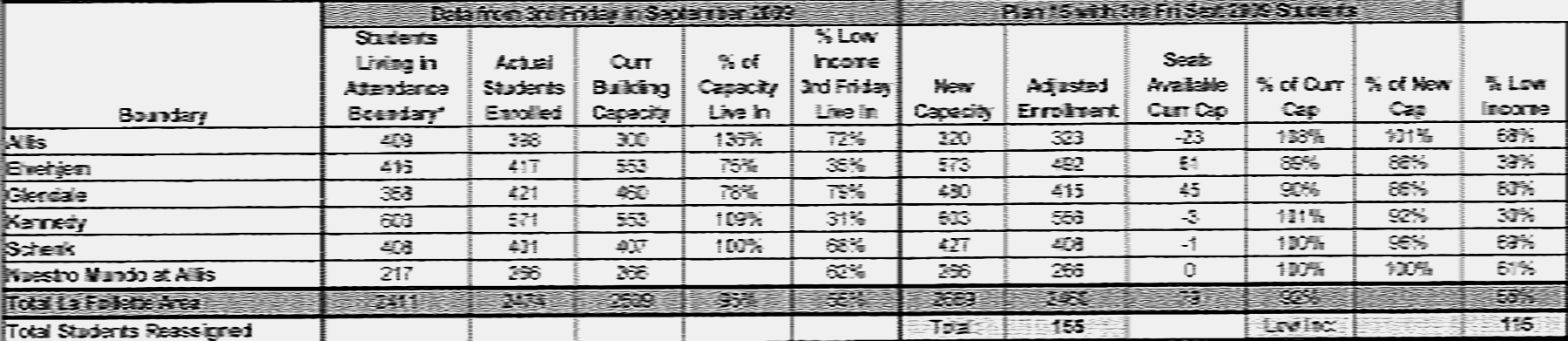
“Income Disparity Among the Schools” is one of the three “Issues to Address” in the charge, but neither Plan 15 nor anything else in this document seems to address this issue.  Here is the analysis of Plan 15 (there are no analyses for the other “options”:

Note that under this option income disparity is in some ways worse.  Not responsive to the charge at all.

For earlier posts on the need for proactive policies on socio-economic diversity see here, here,  and here and this not on AMPS, but linked in an post here.  A brief summation of my position is that overwhelming research shows that poor children do better in schools where the percentage in poverty is neither too high nor too low and that an essential part of the mission of public education is bringing people together.

Proposal for Naming Book Room at Stephens Elementary School under Board Policy 6701.

It sounds like Angie Zimmerman was well deserving of this honor.

Attachment of Three Parcels of Property located off of Sugar Maple Lane to the MMSD under Wis. Stat. §117.13.

From Middleton-Cross Plains, near Olsen School.

Two Committees down, one to go.  Much done, much left to do.  Put yourself in the place of a Board Member and think about how productive you would be for the remaining work.

Time for the Operational Support Committee.

2010-11 Projected Budget Gap, Tax Impact, and Efficiencies to Address the Gap and a later agenda item 2010-2011 MMSD Budget Development Timeline and Process (these are separated on the agenda because the latter is an “action item” and the former is not).

The big change with the Timeline is that the Preliminary Budget and statutorily required Public Hearing are pushed to July.  I can certainly see some advantages with this, give all the state uncertainties and the fact that the old timeline put new Board members right into their most difficult tasks.  I do worry that July is not a good time for public attention or involvement.  Perhaps countering that is another good sign that the administration is getting more real about public engagement, throughout March and April there are Public Hearings scheduled.

The Projections document is confusing.  It references a financial forecast prepared with PMA, but no copy of that is included.  It promises departmentally identified efficiencies, but most are listed as TBA.  In the title the “Tax Impact” is metioned, but there is no real information about the tax impact, only a promise to provide information about the “tax impact” of the “budget gap….no later than Monday’s Board of Education Committee Meeting.”

The problem with this is that most of the tax impact is not due to the “budget gap” but the lack of state support.   To put it another way, the budget gap is one symptom of a broken state finance system that requires most districts to find some combination of cuts and efficiencies each and every year; the tax impact is another symptom of this broken system that has been aggravated by the cuts in state support.

Insert obligatory Wisconsin Alliance for Excellent Schools and Penny for Kids links along with discretionary School Finance Network link.

What is here is the first estimate of the size of cuts and efficiencies needed:  $2,825,693.  Not chicken change, but it could be worse.  On the tax impact, I’m hearing that if MMSD taxes to the max it could mean over $300 and perhaps as much as $400 more  for the average home owner.  That’s what happens when state aid is cut by 15%.

Here are those links again: Wisconsin Alliance for Excellent Schools, Penny for Kids, School Finance Network and the AMPS “Take Action” page.

I also don’t see any real discussion of how the Fund Balances might be used in this budgeting.  Back in October, the discussion and development of a Fund Balance Policy was promised for January 2010 and it has not happened (more on this here).  This leads directly to the next items.

Structuring the borrowing of funds in connection with the refinancing of the district’s WRS unfunded pension liability and, potentially, to assist with funding the implementation of Four-Year-Old Kindergarten and Authorizing the Assistant Superintendent of Business Services, on behalf of the Board, to grant written permission to allow Robert W. Baird & Co. to both: (1) serve as financial advisor to the District in connection with district borrowing via notes, bonds, or other obligations; and (2) submit competitive bids seeking to purchase such notes, bonds, or other obligations, with said authority to expire on the earlier of the date of future Board action or June 30, 2011.

I’ll readily admit that I don’t understand the 4 year Old Kindergarten financing as well as a I’d like to.  I’ve also missed some of the presentations and discussions, so some of my questions and concerns may have already been raised and addressed.

Here is how I think it is supposed to work.  Because of the three year rolling average of student numbers that is used to determine the revenue limits, the first two years require substantial support from outside the regular revenue sources (or cuts elsewhere).  In Madison, the combination of the Community Plan and the high per pupil revenue limit lead to a projected future where 4K generates more in the way of revenue potential than it uses (lots of assumptions about state revenue limit growth there and ultimate costs and the escalation of those costs, but that’s what they are saying).

Based on this the administration is recommending that the district use the WRS liability refinance to in effect borrow the start up costs and then pay them back from projected excess future revenue authority.  I want to start by saying  yes , in general the refinance of the WRS liability is a good idea but how the savings of that refinance should be used I am less clear on.  If the only choices are those in the document, the “Fully Combined” option seems best, but I’m not satisfied that these should be the only options.

The whole borrowing bothers me because borrowed money has to be paid back  (it may not technically be borrowing because it is being done as a refinance, but the reality is that using this for 4K means that debt payments in the future will be higher — unless I’ve read this all wrong).  For the 2009-10 budget, MMSD shifted almost $6 million in debt to future budgets.  This is a pattern I don’t like, especially at a time when the district Fund Balances are higher than they have been in years.  I would like to see the a full discussion of the costs and benefits of using the Fund Balances vs borrowing before this plan is approved.  That was supposed to happen, but it doesn’t look like it will.

I’m also not clear why — when we have a state system that does not provide resources for cost to continue budgets in most areas — we are not talking about using the projected 4K excess to limit future cuts in other programs.   If the Fund Balance were used, this would be possible.

I want to repeat that I’m not clear on much of this and acknowledge that my ideas about using the Fund Balances might not make financial sense, but it seems to me that those options should be on the table.

Proposal for a Welcome Center and Educational Credit Union Branch at La Follette High School.

I can see good things about this, but have three worries: 1)Doing this in one or two high schools doesn’t seem right — all or none; 2)We are giving a business access to our students; 3)It looks like it will cost the district about $100,000.  I would like to hear these issues raised.

It is recommended that the Board approve all three applications pursuant to the terms of the Administrators’ Retirement Plan.

Principals Howard Fried (Crestwood), Maty Hyde (Lindbergh) and Linda Kailin (Muir) along with a reminder that Asst. Sup Steve Hartley is also retiring.  I don’t know  the others but will miss Steve’s professionalism and friendliness.   I also worry about the district’s ability to fill senior positions, last I checked too many were still “interim.”

Consideration of approval of a one-year extension of Daniel Nerad’s employment contract as Superintendent of Schools as contemplated under Section 2.02 of the Contract, said extension to result in a new two-year contract commencing on July 1, 2010 and expiring on June 30, 2012.

In Wisconsin, administrators are limited to two-year contracts, which means rolling renewals.  After 18 months, I think Supt Nerad has more than earned a renewal; I’m not so sure about a raise at this time, the symbolism of  a freeze would send a good message at a time when family and district budgets are tight.

Approval of Bills.

Purchases and Contracts.

Playground sign, Cooperative Gymnastics and Hockey Teams, Server Upgrade and some items that deserve a little attention.

The allocations for the Desktop Instructional Technology Purchases (about $200,000) are not detailed in the posted materials.  Like all resource allocations there are equity implications and I would like to see these made part of the proposal and the discussion.

With the Scholastic System 44 Pilot Project we appear to be doing a new reading remediation in advance of  the study discussed above which is intended to guide future initiatives.  With the study pending, it seems wrong to commit to a new initiative.

Fine Arts Task Force budget amendment.

(See above for the Report) Some changes  from the original plans for the $100,000.  I do like the “Arts Equity Purchase” aspect (just two week’s ago I enjoyed a concert at my son’s school featuring instruments purchased by the PTO, other PTOs cannot afford things like that).  I’m not sure how this will sit with the Task Force members and would like to hear their thoughts (not that I’d necassirly agree with them, but good to hear).

Other Financial Transactions

Grants and donations and more evidence that grants and donations create inequities.  With that observation, a few words of praise for the Foundation for Madison Public Schools are in order.  That organization seeks to structure their work in a way that minimizes inequities.

Human Resource Transactions

New hires and shifts.

Whew, that was exhausting.  Again, think about the Board Members and the prep time they put in and the need to balance all these issues in one lengthy meeting.

For those who found something worth paying attention to here, attend or watch the meeting, drop the Board a note (board@madison.k12.wi.us) and remember that votes on “action items” will not occur until February 8.

Thomas J. Mertz

Leave a comment

Filed under "education finance", Accountability, Best Practices, Budget, education, Equity, finance, Gimme Some Truth, Local News, Pennies for Kids, School Finance, Take Action, Uncategorized

MMSD State of the District — Communication and Equity

[I neglected to look earlier, “State of the District” presentation was linked off the Board agenda.  It can be found here.]

On Monday, January 25, 2010, 5:30 PM,  at JC Wright Middle School (1717 Fish Hatchery) Madison Metropolitan School District Superintendent Dan Nerad will give a “State of the District” presentation.  It will also be broad and narrowcast on MMSD-TV.  I’m very interested in what will be said.  I’ve been told that among other things it will include updates on the work in response to the Math and Fine Arts Task Forces and will belatedly (by one year and eight months) fulfill the annual reporting requirements of the district’s Equity Policy.  I’m especially interested in that.

Before getting to equity, I want to say a few things about communications.  I think all recognize that the “State of the District” presentation is an exercise in public relations.  How effective an exercise will be seen after Monday, but part of public relations with things like this is the outreach that was done in advance, the hype.  I have to say that I’d give the Public Information department a  C on their advance work.

On the plus side, a press release was issued on January 13; I think I saw it mentioned in the State Journal (but can’t find it on line); an email announcement was sent to PTOs, community groups and other “stakeholders” last Friday, January 15.

There is lots on the minus side.

Besides the note in the paper, I haven’t seen any other advance news coverage.  Maybe there will be something over the weekend, but having Supt. Nerad make the rounds of radio and television giving a tantalizing preview would have increased interest.  Maybe some of that will happen over the weekend and on Monday.

The presentation is not mentioned on the district home page (capture, 1-22-09, 8:32 PM),  nor on any of the pages that link directly to the home page.  That includes, MMSD today, the district’s main newsletter.  These are important points of contact.  In a related matter, MMSD-TV and Fine Arts have Facebook presences but the district does not.

I subscribe the the Board of Education and district announcements, served on a Task Force, Co-Chaired Community and Schools Together (CAST) through two successful referendum campaigns, and maintain this blog; yet was not included in January 15 email distribution list.  I did get an announcement from the district today.  It doesn’t take much to realize that someone like me should be considered a “stakeholder” for announcement purposes.

Too many things on the minus side and none of them are all that difficult to address.

I’ve said so much in other posts about equity, the work of the Equity Task Force and the reporting requirements in the policy that I’m going to keep this brief (there is a much more detailed post on what I would like to see in the required Report here).

The Equity Task Force began our work on February 1, 2006, almost four years ago (for those who track these things, all our meetings were noticed and all our records were public).  We were charged with “making recommendations for an equity policy including: (1) a definition of equity, (2) a statement of the District’s commitment to equity, and (3) guidelines for implementation.”  The process was difficult and sometimes frustrating.   In April of 2007, we finalized our report and it was presented to the Board of Education.  In the following year the Board held a series of meetings primarily devoted to equity and on June 2, 2008 they enacted a new Equity Policy, partially based on some of the recommendations of the Task Force (some other recommendations were discussed and not included, still others were never discussed).

That policy required an annual Equity Report (as noted previously, well over a year has gone by and there has been no Report):

Reporting

Administration will report on an annual basis to the Board of Education the extent of progress on specific measures in eliminating gaps in access, opportunities and achievement.

Administration will develop an annual report that will provide data on the distribution of staff, financial, and programmatic resources across all schools.

These are the things I will be looking for in the “State of the District.”  Forgive me if I am skeptical that these can be covered properly or sufficiently in the context of the “State of the District” presentation.  Information like this needs to be thoroughly examined in an interactive process.  The Board needs to be active participants in evaluating progress and the lack of progress. This will not happen to any great degree next Monday; I hope that it does in the coming months.

The Equity process has been a long one.  Many good people have put in lots of work to increase equity in our schools.  The policy the Board enacted was designed to assess and facilitate further work.  Although the equity work continues in some fashion via the Strategic Plan and other initiatives (and is perhaps undermined by some other recent initiatives), I think it is wrong to abandon the direct work that the Task Force was part of.  It is also against spirit of the Board Policy to not have  an annual Equity Report that does justice to the reporting requirements.

Thomas J. Mertz

Leave a comment

Filed under Accountability, Best Practices, education, Equity, Local News, Uncategorized