Category Archives: Accountability

Ain’t that Special? — Doyle Calls Legislative Session (Updated)

Louise Max, 'Blue Plate Special" (click image for more).

Lame Duck, pretend “Friend of Education” Governor Jim Doyle has called a special legislative session to consider his Race to the Top lottery inspired Mayoral Control proposal and the insane proposal to give the State Superintendent the power to take control of any district for any reason he deems sufficient.  The executive order is here; press release here.

The Wisconsin Sate Journal is reporting that Democratic leaders in both the Senate and the Assembly are not enthusiastic.

However, Senator Jeff Plale is in the bag.

Ed Garvey hits the right notes in his reaction.

The timing of this special session will limit public input on the proposal to limit public input (Kafkaesque?),  With that in mind,  I’m posting some public comment.  Here are two videos from a recent anti-Mayoral Control protest:

For much more, see this recent roundup on AMPS.

Update

Representatives Grigsby and Colon also issued press releases.  I liked this from Grigsby:

At this point, it goes without saying that the governor’s proposed mayoral takeover is not the only option for reforming Milwaukee Public Schools. I am working to ensure that the “RACE for Success” receives consideration at any Special Session in which mayoral takeover is pushed upon the legislature. Of course, I would prefer that any legislation related to the future of MPS go through the normal legislative process, a process which would ensure public input, but Governor Doyle seems intent on avoiding that opportunity. Any legislation on the future of Milwaukee Public Schools deserves a public hearing, but both proposals for education reform should be heard if the legislature enters into a Special Session.

Thomas J. Mertz

Leave a comment

Filed under Accountability, Arne Duncan, education, Local News, Uncategorized

Mayoral Control Links and Thoughts

I haven’t had much time to blog lately and the items are piling up, so it is time to catch up a little.  Here are some links to and comments on some relatively recent items on Mayoral control.

From the Chicago Tribune, Chicago school board begins 2nd internal investigation.”

Chicago Mayor Richard Daley’s handpicked Board President has committed suicide, his handpicked Board is under investigation for misuse of funds for the second time and has refused to release documents requested by the media.  That’s good management and open governance Chicago style.  That’s the model that Arne Duncan and Jim Doyle want to bring to Wisconsin.

Advocates for Mayoral control keep telling us that the change increases accountability by giving ultimate responsibility to a single elected individual –  the Mayor.  I have yet to hear of an instance or see a poll that indicates any Mayor in a Mayoral control district’s election has been decided by their management of the schools; I know that Mayor Daley will continue to be re-elected no matter what happens with the schools.   That’s not accountability.

A lot is happening with the resistance to mayoral control in Milwaukee.  Here’s a video on some of it:

Henry Hamilton of the NAACP Executive Committee and Christine Neumann-Ortiz — executive director of Voces de la Frontera — had a good recent column in the Journal-Sentinel: “In takeover, your vote silenced.”

Friend of AMPS and former candidate for State Superintendent Todd Allan Price has a long piece at CounterPunch that is worth the time: “Milwaukeeans vs. the Privatization Pandemic: Milwaukee League Comes to the Defense of Public Schools.”

Todd and I also co-wrote a Jerry Bracey inspired piece for FightingBob that includes some things on Mayoral control: “Bracey’s last stand

Dominique Paul Noth’s lengthy “Barrett’s ‘cynical’ decision puts city Dems in bind” at the Milwaukee Area Labor Council is also worth the time spent.

Meanwhile the education DINO elite insider organization Democrats for Education Reform (DEF) has opened a Wisconsin office staffed by political lifer, convicted thief (see the Wisconsin State Journal, August 20, 2002), former strip club and school voucher PR flack Katy Venskus.

Alan J. Borsuk has a post up contrasting a recent DER event with the unanimous testimony against mayoral control at a recent public hearing.

Borsuk also covered Mayoral control researcher turned advocate Kenneth K. Wong’s recent visit to the state.  At the event and in the interview on WPT’s “Here and Now” below Wong offers a lot of double talk about elections and accountability, simplistically equating higher turnout at Mayoral elections with greater accountability on education matters.  This is only true if education is a decisive issue, otherwise it is nonsense.

Vodpod videos no longer available.
I think this quote from the Borsuck piece is revealing on how much Wong cares about keeping the public in public education:

It is best to have public support for mayoral control, he said, but it can still work even if it’s passed over major opposition.

“Nothing is easy,” he said. As for Milwaukee, he said, “It has to happen fast. . . . They should make it effective January 1.”

This crisis mentality is dangerous, especially when we are talking about a reform that by Wong’s own calculations will have a minimal impact on education in Milwaukee.  In his book The Education Mayor the achievement gap between Milwaukee and the rest of the state is pegged at 2.4 standard deviations; his research shows that “strong” mayoral control has produced gains of .2 to .33 standard deviations.  Accepting his data and the causality, that means that the best case Mayoral control scenario leaves Milwaukee students over 2 standard deviations behind the state.  As Wong himself states, “This is not a silver bullet.” So why the hurry?

In a not unrelated matter, people concerned about accountability should be talking about DINO Reform poster girl and DC Superintendent Michelle Rhee’s effort to intervene in an Inspector General’s investigation of her fiance, the charter school operator and now Mayor of Sacramento, Kevin Johnson.  The IG was subsequently fired by the accountability loving Obama administration.  Links here and here.

Thomas J. Mertz

Leave a comment

Filed under Accountability, Arne Duncan, education, Gimme Some Truth, Local News, National News, Uncategorized

Equity Report — Tired of Waiting

Salvador Dali, "The disintegration of the persistence of memory" (click for more information)

The Kinks, “Tired of Waiting for You” (click to listen or download).

It has been almost 18 months since the Madison Metropolitan School District Board of Education enacted a new Equity Policy (policy here, minutes here, video here).  The policy included the requirement that:

Administration will report on an annual basis to the Board of Education the extent of progress on specific measures in eliminating gaps in access, opportunities and achievement.

Administration will develop an annual report that will provide data on the distribution of staff, financial, and programmatic resources across all schools.

19 months.  No report.  I’m tired of waiting.

In the Strategic Plan and the Talented and Gifted Plan, much has been made of the reporting requirements.  Some good things were included in these requirements.  I hope they decide to follow their own rules on these, unlike they have on the Equity Policy.

Much more on what I think the Equity reporting should include here.

Thomas J. Mertz

1 Comment

Filed under Accountability, Best Practices, education, Equity, Local News, Uncategorized

It’s Time to Stand Up for Our Schools

For over a decade, the state’s proportion of the cost of quality education in Wisconsin has declined leading to staff lay-offs, larger class sizes, cuts in programs and services, and rising property taxes. As part of the last biennial budget, things actually got worse when, in an unprecedented move, state aid was cut.

Our school-funding system is in crisis, and that crisis is leading to less education in our schools and higher property taxes on our homes. It is time to say, “Enough is enough.” We need to reinvest in our public schools as soon as possible to stop the loss of revenue and then follow through on our promise of comprehensive change in the funding system.

The Wisconsin Alliance for Excellent Schools (WAES) is asking State Government to raise Wisconsin’s sales tax by one penny. “A Penny for Kids” will put about $850 million a year toward saving programs and services in our schools and holding the line on property tax increases. It only makes sense.

You can be involved in this important effort by going to the “A Penny for Kids” website and signing the petition to tell your elected officials you want them to do the right thing. Once you have signed, make sure you share this e-mail with as many organizations and groups as possible because the more people who sign, the more power we have to make sure lawmakers do the right thing for our children and our communities. Or, if your organization has its own website, Facebook page, or other networking site, make sure to include a link to www.apennyforkids.org.

Robert Godfrey

Leave a comment

Filed under "education finance", Accountability, AMPS, Budget, Pennies for Kids, School Finance, Take Action

The Cost of Commitment

Commitment

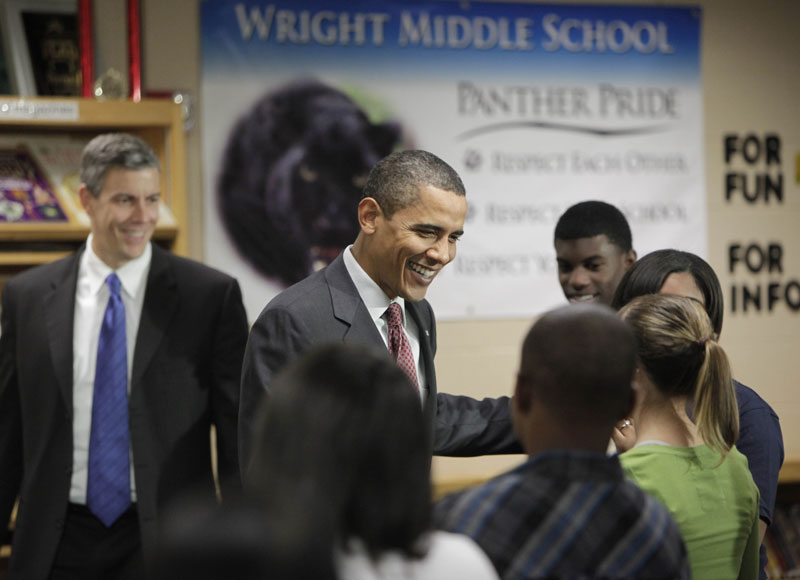
President Obama gave a speech at Wright Middle School in Madison today (text here) outlining his education reform initiative for the nation’s schools, called “Race to the Top,” sometimes referred to by some of his critics as the “Race off the Cliff.”

As Thomas Mertz has pointed out earlier, the amount of funds being discussed here for Wisconsin are relatively meager.

Make no mistake that this is cake, a treat, not life-sustaining bread.  The amount being discussed for Wisconsin is $80 million and this relative pittance would all be targeted for specific programs and when the $80 million is gone, Wisconsin would be stuck with more things that we can no longer afford.

So what type of reform would we be getting in this initiative, along with the modest dollars to come our way, and what would we be giving up in return? That was the crux of a letter sent yesterday by State Senator Mark Miller, chair of the Joint Committee on Finance, to Secretary Arne Duncan. He is worried like others in similar policy positions, that with all the current economic challenges out there blowing huge holes in states’ budgets across the country, that:

We do not have the fiscal resilience to sustain another long-term financial commitment based on the mere possibility that we may be awarded one-time federal dollars in the future. Once these proposed educational policy and fiscal changes are enacted into law, Wisconsin legislators and taxpayers will be responsible for the accompanying financial commitment regardless of the outcome of Wisconsin’s Race to the Top application. This promise to fund new requirements without the promise of federal dollars puts at risk other social safety net programs that rely on adequate state funding to operate.

He cited the example of costs associated with the implementation of a “Children’s Zone” in Wisconsin based upon a model developed for Harlem that could ultimately have ongoing costs to Wisconsin of more than $400 million. If you make such financial and policy commitments you must be able to have some good assurances that you can continue to pay for them. He likens the exercise in not knowing how the grant dollars will be allocated and for how long, to a gambler “trying to draw to an inside straight.”

The National Academy of Sciences recently issued a report offering recommendations on how to revise the funding guidelines and regulations of Obama/Duncan’s $4.35 billion “Race to the Top” grant program, and is well worth a read. Interestingly, the report all but neglects to mention charter schools, which are a major component of RTtT. You can read something I wrote on that subject the other day, here.

In a press release for the Academy’s study, they applauded the step of encouraging states to create systems of linking data on student achievement to teachers, since, as they noted, it is essential to conducting research about the best ways of evaluating teachers.

One way of evaluating teachers, currently the subject of intense interest and research, are value-added approaches, which typically compare a student’s scores going into a grade with his or her scores coming out of it, in order to assess how much “value” a year with a particular teacher added to the student’s educational experience.  The report expresses concern that the department’s proposed regulations place excessive emphasis on value-added approaches.  Too little research has been done on these methods’ validity to base high-stakes decisions about teachers on them.  A student’s scores may be affected by many factors other than a teacher — his or her motivation, for example, or the amount of parental support — and value-added techniques have not yet found a good way to account for these other elements.

The report also cautioned against the use of the National Assessment of Educational Progress (NAEP), a federal assessment instrument. While effective at monitoring broad trends, it will not be able to detect the type of specific effects of the targeted interventions that the RTtT hopes to fund. This infatuation with data can lead reformers, philanthropists (case in point, Bill Gates’ team up with RTtT-type initiatives) and bureaucrats to become unquestioning supporters of using test scores as indicators of real learning and teaching. As the study pointed out:

The choice of appropriate assessments for use in instructional improvement systems is critical. Because of the extensive focus on large-scale, high-stakes, summative tests, policy makers and educators sometimes mistakenly believe that such tests are appropriate to use to provide rapid feedback to guide instruction. This is not the case.

The report also urged caution when trying to apply such a blunt instrument towards making international comparisons.

We note that the difficulties that arise in comparing test results from different states apply even more strongly for comparing test results from different countries.

They conclude the report with a reiterated point, “careful evaluation of this spending should not be seen as optional; it is likely to be the only way that this substantial investment in educational innovation can have a lasting impact on the U.S. education system.”

And in another side note related to federal education financing, the Obama administration’s latest and most detailed information yet on the jobs created by the stimulus, noted that of the 640,239 jobs recipients claimed to have created or saved so far, more than half — 325,000 — were in education. Most were teachers’ jobs that states said were saved when stimulus money averted a need for layoffs.

Robert Godfrey

Leave a comment

Filed under "education finance", Accountability, AMPS, Arne Duncan, Best Practices, finance, Gimme Some Truth, National News, No Child Left Behind, Uncategorized, We Are Not Alone

Obama at JC Wright, Quick Take

c1e82cf6-c97e-11de-a2ef-001cc4c03286.image

I spent the early part of the day at the Books not Bombs action with about 250 others and then went home to watch President Obama’s  speech at James C. Wright Middle School in Madison on television (transcript, here).  Here are some reactions.

The inspirational message, especially the words directed at students and parents was very good.   He was utterly right about the need to seize opportunities, value and support leaning and the importance teachers and parents working to have children internalize pride in academic achievement.  One of the best teachers my children have had  moved our son from racing to get his work done as fast as possible to completing assignments in a way that he could be proud of. Thanks Mr. Waters and thanks President Obama for this message.

He was also very good about the need to make education central to our national agenda.  A little too much about the economic aspects and too little about building an engaged citizenry for my taste, but good to hear.

As many speakers at the Books not Bombs made clear, this is not happening and as I observed in an earlier post the desperation of states for Race to the Top funds is ample evidence that we are not investing in education as we should.

This raises a basic contradiction between the rhetoric in the policies:  If education is as essential to our nation’s present strength and future well being as President Obama says it is, why must states compete for one-time grants to fund only a portion of the needed investments?  What about the states that don’t get grants, are their futures less crucial, are their children less deserving of educational opportunities.?

If we can spend $4 billion a week to keep the military in distant countries we should be able to fully fund the education of every child in every state.  When we spend billions on bombs, we shouldn’t have to ask for Pennies for Kids.

There were also some contradictions within the four core ideas behind Race to the Top that the President delineated.  Again, he was absolutely correct about the need for better assessments (I have doubts about the role of national standards in this process, but that is another issue), however Race to the Top is built expanded use of the inadequate assessments we have now.  Linking teacher pay to flawed tests doesn’t make sense.  Let’s work to create real, balanced and useful assessments first and then discuss what we should do with them.  Prioritizing data collection has similar problems.  We can have the best system for collecting and analyzing data, but if the data is bad to begin with, what is the point?  The old computer programmer phrase comes to mind: Garbage In, Garbage Out.  Obama is right that our current state assessments are near garbage; I just don’t understand how he can know that and still want to expand their use as the basis for decision-making.

It also bothered me that the President seemed to paint a picture of teacher’s currently making no use of assessments or feedback in shaping their teaching.  Every teacher uses many forms of feedback everyday; they see the looks on children’s faces and change their mode of explanation or offer words of encouragement; they grade homework and know what they did well and what they need to do differently; they evaluate exams and decide how to move forward.  This is basic to teaching and happened long before there was any talk of standardized tests and longitudinal data systems and will continue to happen whether the Race to the Top agenda is enacted or not.

President Obama is also correct about the need to attract to and keep the best in our classrooms.  My opinion is that the way to do this is to respect them as professionals, listen to them and not dictate reforms from above.  Recognize that perhaps the teacher who spends hours with students every day might have a better grasp of what is needed and a deeper understanding student progress than anything that will show up in a Value Added Analysis.   It isn’t that I think the data and analysis is useless, it is that I fear that by elevating data above humans we will shut our ears to those whose voices need to be heard and we will make teaching a less attractive vocation.  I’m looking for a better balance.

In his confident words about expanding the use of data and other things, I believe that President Obama grossly overstated and in places mis-stated what the research indicates.  A good example of this is the idea of school turnarounds.  In Chicago, now Secretary of Education Arne Duncan pursued an aggressive school shutdown and turnaround policy.  Through Race to the Top he is trying to nationalize it.  Well, the first research is in and it doesn’t look good.  Here is what the New York Times said:

Secretary of Education Arne Duncan presided over the closing of dozens of failing schools when he was chief executive of the Chicago public schools from 2001 until last December. In his new post, he has drawn on those experiences, putting school turnaround efforts at the center of the nation’s education reform agenda.

Now a study by researchers at the University of Chicago concludes that most students in schools that closed in the first five years of Mr. Duncan’s tenure in Chicago saw little benefit.

“Most students who transferred out of closing schools re-enrolled in schools that were academically weak,” says the report, which was done by the university’s Consortium on Chicago School Research.

Furthermore, the disruptions of routines in schools scheduled to be closed appeared to hurt student learning in the months after the closing was announced, the researchers found.

There is much more of interest on “turnarounds” in this week’s National Journal experts blog.

On this and many other aspects of Race to the Top,  from linking teacher pay to test scores to charter school expansion, solid research often contradicts the claims of this administration.  At best the jury is still out on the reforms they are pushing; at worst the evidence is that enacting much of their program will make things worse.

I share the President’s desire for every child to have access to full and rich educational opportunities, to move the United States toward a culture that values teaching and learning.  I worry his plan for making this happen will move us  further from realizing these ideals.

Time to go help our younger son with his homework.

Thomas J. Mertz

2 Comments

Filed under "education finance", Accountability, Arne Duncan, Best Practices, Budget, education, Local News, National News, School Finance, Uncategorized

Reform Is In The Air

reform1832

Mike Rose at Truthdig has noted that following the extensive and unprecedented federal reach of No Child Left Behind, the Obama administration is attempting to extend this iniative further by putting some some serious money behind a number of education initiatives that invite states and districts to compete for federal dollars. In the K-12 education world, they want, in part, to stimulate better state standards and tests, including the better measurement of teacher effectiveness, while turning around failing schools. One way they want to accomplish this is through an increase in the number of charter schools. At the same time, a third initiative wants to spark innovation and scale up the best of local academic programs.

As Mr. Rose acknowledges, this is a moment of real promise for American education, from kindergarten through college. But he also sounds a note of caution.

Reform is in the air. But within many of these reforms are the seeds of their undoing.

He pointed out that the Education Department has put a lot of stock in charter schools as “engines of innovation,” while noting, importantly, that DOE will not consider a state’s funding proposal if that state has a cap on charters.

Yet a number of research studies — the most recent from Stanford — demonstrate that charter schools, on average, are no better or worse than the regular public schools around them. To be sure, some charters are sites of fresh ideas and robust education, but so are magnet schools, and, lest we forget, so are our regular public schools, ones with strong leadership and a critical mass of good teachers. For the “reformers’” however, charter schools are the recipients of the highest accolades, the rest – not so much.

The Stanford University study shattered the myth of charter school superiority. According to Stanford’s Center for Research on Education Outcomes, students at only 17 percent of charter schools do better on math and reading tests than their demographic peers in regular public schools. Thirty-seven percent do worse, while 46 percent of charter school kids, almost half, perform at approximately the same level as their traditional public school counterparts.

The author of the report concludes:

This study shows that we’ve got a 2-to-1 margin of bad charters to good charters.

The results are especially significant, given that charter schools have built-in advantages – starting with parents that are engaged enough in their children’s education to put them there, in the first place. Yet the actual outcomes, in most cases, fail to live up to the hype.

President Obama and his administration are committed to charter schools. In no small part this policy is driven by Education Secretary Arne Duncan, who was a cheerleader for charters when he ran the Chicago school system, and has threatened to withhold federal education money from the 10 states that don’t yet have charter schools and the 26 other states that put limits on enrollment in charters. Such raw coercion, especially given the results of the Stanford study, seems strongly misguided. This comes in spite of the acknowledgement of the Stanford study on the part of Sec. Duncan, which, he suggests, merely points to the need for greater vigilance. “Charter authorizers need to do a better job of holding schools accountable.”

This administration has said that charter schools are key to educational “reform,” and provide “competition” for traditional schools. But that’s utter nonsense if the educational outcomes are no better, and in many cases worse, than in the regular public schools.

Speaking of “holding [charter] schools accountable,” one would of thought that that was a central argument for the need for charter schools in the first place, an institution free of those ill-principled and wretched teacher unions. Unionized teachers are blamed for much of the ills of education; it’s not a reasoned argument, but a matter of faith – and political prejudice. Charter schools are not private (at least not entirely, if you consider they are chartered by the state), but they are the privatizers’ foot in the door, a wedge issue to demonize unions. And that third leg of the reform movement, so to speak, measurement of teacher effectiveness, is also front and center (see the latest continued plea from the Wisconsin State Journal).

One approach being piloted in a number of education systems around the country is by the non-profit Hope Street Group, and developed by a team of teachers across the U.S., who have proposed recommendations for a smarter evaluation system, imploying more ‘objective’ measures of student achievement, ones that aim to attract and retain teachers, and put America’s schools back on top internationally.

“Policy 2.0: Using Open Innovation to Reform Teacher Evaluation Systems” suggests that in K-12 education, any teacher evaluation system should have the input of teachers and administrators and not solely come from researchers and policymakers. Their specific recommendations include the suggestion that evaluation systems should be frequently revised, that teaching advocates need to be involved in this process, and that any in-class observations for assessment must be done by teachers with sufficient experience.

Lets hope the coming “seeds of change” are not broadcasted, with great hope, onto marginal soil. There is too much at stake for education in this new century.

Robert Godfrey

Leave a comment

Filed under Accountability, AMPS, Arne Duncan, Best Practices, Gimme Some Truth, nclb, No Child Left Behind, Uncategorized, We Are Not Alone

Education: Dressed & Ready for Stimulation

Photograph by David Wahl

Photograph by David Wahl

The National Access Network has highlighted the U.S. Department of Educations (USDOE) Office of the Inspector General’s report that has raised concerns over states’ use of stimulus funds.

The American Renewal and Recovery Act (ARRA) statute requires states to provide several assurances, including commitments to fund K-12 and higher education at least at FY 2006 levels and to promote reform in four areas, in order to receive these monies. The report noted however, that several states have capitalized on the flexibility of the funding requirements, to use stimulus funds to supplant rather than supplement education budgets. On AMPS we have highlighted this same issue for Wisconsin on a number of occasions, see here and here.

The department’s report contended that it has made an effort to close some funding loopholes by including funding maintenance as a consideration for awarding the so-called “Race to the Top” funds.

Equity advocates, however, have argued that this provision does not do enough, as the guidelines focus on proportional levels of funding rather than absolute figures. That is, the regulations leave the door open for states to cut the total budget from year-to-year and remain competitive applicants.

As the Access Network has noted:

The information the states have submitted raises serious questions about whether the stated purposes of the Act – stabilizing education funding, facilitating the continuation of equity and adequacy formula adjustments and promoting education reforms to boost student achievement – are being met. The goal of boosting student achievement is to be promoted through commitments from each state to promote four essential areas of reform: 1) improving teacher effectiveness; 2) making progress toward college and career-ready standards and rigorous assessments; 3) enhancing data systems to track educational practice; and 4) improving achievement in low-performing schools.

Only the first of these three goals appears to have been achieved. Virtually all of the states have stabilized their funding levels for FY 2010 at the previous years level, with the application of the federal stimulus funds. (In many instances, however, this flat funding will nevertheless result in substantial cuts in educational services since mandatory cost increases will not be covered.)

In the vastly underfunded state education systems throughout the country, stabilizing funding levels may have been

unduly emphasized at the expense of the equity and reform goals of the ARRA, as some states apparently increased their anticipated education deficits upon learning that substantial federal funding for education was in the offing, in order to limit planned cuts in other areas of the budget. Although some officials might argue that such maneuvers represented prudent budget planning, from the perspective the intent of the ARRA and the constitutional pre-eminence given to education in most state constitutions, such maneuvers clearly raise serious legal issues.

A number of advocates for educational equity have called on the DOE to require states to fund low performing schools at adequate levels. The way the current regulations are drafted, only one provision has a focus on this kind of funding. The Campaign for Educational Equity for example, has proposed a requirement that states need to provide data that shows to what extent the proportion of each state’s budget devoted to education for FY 2009 either increased, decreased or remained the same compared to FY 2008. The assumption is that those states who have maintained or increased educational funding during the last fiscal year would receive some favorable consideration in the review process for doing so. But additionally, the campaign has argued that any reform conditions that seek to assist struggling schools should include specifically the various resources identified through adequacy case law that are deemed necessary comprehensive services for students from poverty backgrounds. Further, they’ve advocated for the DOE to require states to increase their total and per pupil state and local revenues that meet the average levels of all states, or if the state is more affluent, then maintain their current funding levels. That requirement would also include states having to allocate higher levels of funding to school districts with higher levels of poverty. The DOE is meant to issue final guidelines quite shortly and grant applications will then be due and phase 1 monies will be distrubuted in early 2010.

Exactly where Wisconsin is on the supplanting vs. supplementing continuum remains to be seen. A report card from this July of each state can be found here. We’ll keep you posted.

Robert Godfrey

Leave a comment

Filed under "education finance", Accountability, AMPS, Arne Duncan, Best Practices, Budget, Equity, finance, National News, School Finance, We Are Not Alone

Gerald Bracey Will be Missed

Sad news for anyone concerned with honesty and accuracy in education research and reporting, Jerry Bracey has died unexpectedly.

No news reports, but did get a confirmation from Susan Ohanian.

Jerry fought the good fight, with the Education Disinformation Detection and Reporting Agency (EDDRA), on the Huffington Post, in books, articles, columns, calls and notes to editors and reporters, anywhere and anytime that education research was being misused and abused or was simply badly done.

I never met Jerry, but I’ve been a participant in his EDDRA Yahoo Group and have exchanged private messages.  He was combative, friendly and good humored, with a passion for truth and the power of knowledge and education.

One thing that always impressed me was the depth and breadth of his knowledge.   He could always call up and cite relevant reports and articles, new and old,  with apparent ease.  That can’t be replaced.

He will be missed.

Some links to other blogs noting this loss.

DairyStateDad.

EdWonk.

Mike Klonsky’s Small Talk.

Education Notes OnLine.

Giving Jerry the last word (he always seemed to want it), his Nine Myths About Public Schools.

Nine Myths About Public Schools

None of this will likely strike you as particularly new, but it might be good to have a bunch of myths lined up and debunked all in one place.

  1. The schools were to blame for letting the Russians get into space first. Granddaddy of all slanders and a great illustration of the absolute nuttiness with which people talk about education.
    Sputnik, the first man-made satellite to orbit the earth, launched on October 4, 1957. On September 20, 1956, Werner von Braun’s Army Ballistic Missile Agency launched a 4-stage Jupiter C rocket from Cape Canaveral. After the first 3 stages fired, the rocket was 832 miles in the air and traveling at 13,000 miles an hour. The 4th stage could have easily bumped something into orbit. The 4th stage was filled with sand. There were a number of reasons for this including the fact that the Eisenhower administration was determined to keep its weapons rocket program and its space exploration project separate and von Braun’s rocket was clearly a weapon. Its primary intent was to incinerate Russian cities with nuclear warheads. Ike worried how the Russians might react. His Assistant Defense Secretary Donald Quarles actually said “the Russians did us a favor” because they established the precedent that deep space was free and international.Most US engineers in the space program in 1957 would have graduated high school in the 1930s, but in the media, the schools of the 1950s took the hit for Sputnik. Ike was quite puzzled by this.
  2. Schools alone can close the achievement gap. This is codified in the disaster known as No Child Left Behind. Most of the differences come from family and community variables and many out-of-school factors, especially summer loss. Some studies have found that poor children enter school behind their middle class peers, learn as much during the year and then lose it over the summer. They fall farther and farther behind and schools are blamed. Middle class and affluent kids do not show summer loss.
  3. Money doesn’t matter. Tell this to wealthy districts. Money clearly affects changes in achievement although levels of achievement are more influenced by the variables just mentioned. Most studies are short term and look only at test scores, a very foolish mistake. Economists David Card and Alan Krueger also found investments in school show a payoff in terms of long-term earnings of graduates.
  4. The United States is losing its competitive edge. China and India ARE Rising. As economies collapsed all around it, China’s economy grew a remarkable 7% last year. On just humanitarian grounds, we should not wish China and India to remain poor forever, but the more they grow the more money they have to buy stuff from us. As China and India prosper, we prosper. The World Economic Forum and the Institute for Management Development have consistently ranked the U. S. economy as the most competitive in the world. Education is only one part of multi-factor systems in rankings. WEF is especially keen on innovation. Our obsession with testing makes testing a great instrument for destroying creativity.
  5. The U. S. has a shortage of scientists, mathematicians and engineers. This was a myth started oddly enough by the National Science Foundation in the 1980s in a study with assumptions so absurd the study was never published, but the myth lingers on. In fact, Hal Salzman of the Urban Institute and Lindsay Lowell of Georgetown University found that we have three newly minted scientists and engineers who are permanent residents or native citizens for every newly minted job. Within 2 years, 65% of them were no longer in scientific or engineering fields. That proportion might have fallen during the current debacle when people are more likely to hang on to a job even if they hate it. An article in the September 18 Wall Street Journal reported that before the economy collapsed, 30% of the graduates of MIT–MIT–headed directly into finance.
  6. Merit pay for teachers will improve performance. Bebchuk & Fried Pay Without Performance. Adams, Heywood & Rothstein, Teachers, Performance Pay, and Accountability. Bonus pay is concentrated in finance, insurance, and real estate. In most of private sector hard to determine and often leads to corruption and gaming the system. Campbell’s Law: “The more any quantitative social indicator is used for social decision making, the more subject it will be to corruption pressures and the more apt it will be to distort the social processes it is intended to monitor.”
  7. The fastest growing jobs are all high-tech and require postsecondary education. “Postsecondary education” is a weasel word. A majority of the fastest growing jobs do, in fact, require some kind of postsecondary training. But, according to the Bureau of Labor Statistics, they account for very few jobs. It’s the Walmarts and Macdonald’s of America that generate the jobs. According to the BLS, the job of retail sales accounts for more jobs than the top ten fastest growing jobs combined.
  8. Test scores are related to economic competitiveness. We do well on international comparisons of reading, pretty good on one international comparison of math and science, and not so good on another math/science comparison. But these comparisons are based on the countries’ average scores and average scores don’t mean much. The Organization for Economic Cooperating and Development, the producer of the math science comparison in which we do worst has pointed out that in science the U. S. has 25% of all the highest scoring students in the entire world, at least the world as defined by the 60 countries that participate in the tests. Finland might have the highest scores, but that only gives them 2,000 warm bodies compared to the U. S. figure of 67,000. It’s the high scorers who are most likely to become leaders and innovators. Only four nations have a higher proportion of researchers per 1000 fulltime employees, Sweden, Finland, New Zealand and Japan. Only Finland is much above the U. S.  Consider Japan, the economic juggernaut of the 1980’s. It kids score well on tests and people made a causal link between scores and Japan’s economy. But Japan’s economy has been in the doldrums for almost a whole generation. Its kids still ace tests.
  9. Education itself produces jobs. President Obama and Secretary of Education Duncan have both linked any economic recovery to school improvement. This is nonsense. There are parts of India where thousands of educated people compete for a single relatively low-level white-collar job. Some of you might recall that in the 1970’s many sociologists and commentators worried that America was becoming TOO educated, that they would be bored by the work available

Thomas J. Mertz

1 Comment

Filed under Accountability, Best Practices, education, Gimme Some Truth, National News

Recipe for Disaster(s), Or the Wisconsin Democrats’ Fall Agenda

I just read the release and memo on the Democratic agenda for the Fall legislative session.  The agenda is  a recipe for disasters.

The disaster that matters to most of us in the state is already in progress as school districts cut programs and services while raising property taxes at rates that have not been seen for years (read this report from Kenosha, look at Rhinelander); as municipalities trim essential services, cut investments that would lead to recovery and growth while also raising property taxes  and fees (here is the latest from Eau Claire); and counties axe public safety and  safety net programs, close nursing homes and like everybody else, raise property taxes and fees (here is a recent report on Dane County).  This Fall budget season is bad; the 2010-11 will be worse if there isn’t bolder action from the state.

The disaster that probably matters most to the Democratic leadership will come in the 2010 elections.  Their vulnerable members will lose if all they bring back to the voters is window dressing campaign finance reforms and tougher drunk driving laws (this isn’t quite fair, some of  the agenda is good — Green Jobs in particular –,  but it is not anywhere near sufficient to meet the crises we are facing).  Even the Democrats in “safe seats” (like in Madison) may well find themselves surprised by challengers from the left who demand better and bolder action.

I don’t care what their polling says, they need to take their heads out of the sand and look around at what is happening with the schools, with the counties, with the cities and most of all with the families they claim to be “Standing Up” for.  They need to look beyond November 2010 and act in the long term interests of our still great state.  Mostly they need to recognize that the revenue and budgeting assumptions they have been working from cannot be sustained.

Some realize this.  Representative Cory Mason is proposing a jobs program funded by higher taxes on those earning over $1 million annually.  A “Save Our Services” campaign has started, seeking to fund essential services via an expanded sales tax base (info on the October 1 Madison rally here).  Last night the Madison Metropolitan School District Board of Education voted unanimously in support of a resolution calling for a sales tax increase dedicated to school funding.  This idea is the focus of a “Pennies for Kids” campaign that the Wisconsin Alliance for Excellent Schools is in the process of initiating (this is just beginning, stay tuned).

Many of us would like to see even broader changes in our state’s taxation, budgeting and investment policies, but something has to be done to meet the crisis and these are good steps.  the Institute for Wisconsin’s Future and Wisconsin Council on Children and Families Catalog of Tax Reform Options for Wisconsin is still the best place to begin thinking about revamping the entire system in order to achieve adequacy, equity and sustainability.

If the Democrats stick with their “do little or nothing” agenda, the crises will grow all around the state and come back to hit them hard in November 2010.  When that happens they will have no one to blame but themselves.  With power comes responsibility, with failure of effort and accomplishment comes accountability.

One closing observation:  There is nothing in the Democratic agenda about Governor Jim Doyle’s “Scramble for the Crumbs”/ Race to the Top package.  I hope this indicates that many in the party are too smart to sell what is left of  their souls for a lottery ticket in a rigged game where the payoff is one-time funding far below the needs of our schools ($80 million is what I hear).

Thomas J. Mertz

2 Comments

Filed under "education finance", Accountability, Budget, education, Elections, finance, Gimme Some Truth, Local News, Uncategorized