Category Archives: AMPS

Referenda Roundup

check-yes2.jpg

There were fourteen referenda on the ballot last Tuesday (more here on the campaigns), six passed and eight failed.  There will be at least fifty-eight referenda on the ballot April 1, 2008.  Madison should have an operating referendum on the November ballot.  Last year over one hundred districts went to referendum.

Is this any way to fund our schools?  Read below and decide for yourself.

Auburndale

Question 1: Operating, recurring, $160,000/year —  Failed 772-600.

Question 2:  Funding unfunded retirement benefits, nonrecurring (4 year), $250,000/year — Failed 926-455 (this is going to be  a problem for many districts in the years to come).

Question 3: School Improvements (physical plant), nonrecurring (4 year) $215,000/year — Failed 704-681

From the Wausau Daily Herald

“I don’t know what other solutions are out there,” said Raab, adding that the board has been looking at potential budget cuts, but “I just don’t know how deep we can go.”

Superintendent Gerald Eichman said the district must do a better job informing the community of its needs and the state’s school funding formula when asking for another referendum.

School districts say they have built-in deficits because fixed costs, such as teacher’s salaries and benefits, rise faster than the state increases revenue limits…

“We’re going to be able to survive next year,” he [Superintendent Gerald Eichman] said. “It’s going to get exponentially worse each year after because of the increasing costs.”

Darlington Community

One Question: Operating, nonrecurring (4 year), $700,000/year — Passed 748-724.

From the Monroe Times:

District Administrator Joseph Galle, who was out of the district Wednesday, previously said the money is needed for general day-to-day operational expenses, such as heating fuel, electricity and paying staff salaries and benefits…

Galle cited a growing gap between state funding and district expenses and a decline in state aid due to declining enrollment as reasons for a referendum.

Kenosha

Question 1: Operating and maintenance of new high school with academies, recurring, $2,427,00/year — Passed 16,255-12,387.

Question 2: Issue debt for new high school construction, $52,500,000 — Passed 17,341-11,701

From KenoshaNews.com:

“I am so ecstatic,” said Bradford Principal Sue Savaglio-Jarvis as the final votes came in. “I think all through this process it was going to pass. I’m so happy the community saw this was important for student learning. It’s a relief because we see an end to the overcrowding coming, and we can start giving kids more opportunities that they don’t have right now.”

Marshfield

One Question: Operating, nonrecurring (5 years), $2,000,000 the first year, $2,500,000 the second, $3,000,000 the remaining years — Passed 5,893-4,683.

From the Marshfield News Herald:

“I really have to applaud the voters for coming through loud and clear with a pro-education message,” said John Adam Kruse, chairman of the Yes Committee. “By maintaining our great public schools, we will continue to be a community that people will want to raise their children in.”

Merrill Area

One Question: Operating, recurring, $930,000 the first year, $995,000 the second year amd $990,000 the third year — Failed 5,116-2,049.

From the Wausau Daily Herald:

 Staff losses at the schools will increase some class sizes and reduce individual instruction. Less support staff will mean that more responsibilities will fall on teachers, said Gerald Beyer, principal of Prairie River Middle School.

“From the building-level principal perspective, these cuts are real,” he said.

More on cuts in Merrill here and this video

Oconto Falls

One Question: Issue debt for athletic field improvements, $4,970,000, Failed 1,698-1,580.

Rio Community

Operating and maintenance, nonrecurring, $295,000 the first year, $415,000 the second year and $560,000 the third year (3 year), Failed 501-483.

From the Portage Daily Register:

[School Board member Don] Shippert said if the board decides to pursue the same referendum again, there are only 18 people left to convince. He also said he understands that living on a fixed income and being retired is difficult, because he is in the same situation.

“I hope there would be a feeling of community support for the younger generation. There should be a commitment that each generation has to the next,” Shippert said.

Thorpe

One Question: Issue debt for Ag/Tech shop addition, $490,000, Passed 661-494.

This is the happy ending to a heartbreaking story.   A similar referendum had failed by one vote in 2007.  This time the community, led by the Future Farmers of America Alumni, came together to pass the referendum.  Communities like Thorpe struggle to keep population and jobs.  Investing in effective agricultural and technical education can help keep these communities and our state strong.  Thorp’s agricultural education program is one of the fastest growing in Wisconsin, now they will have the facilities they need.  Good work.

Waterloo

One Question: Issue debt for new boiler, Passed 1,082-334.

From the Watertown Daily Times:

Without voter approval to exceed the state-imposed revenue caps, the board would have had to cut educational programs to pay for a new boiler. Revenue caps limit the amount of money a school district can raise through the property tax levy. The project is nothing the district can do within its budget officials have said.

Wausaukee

One Question: Operating and maintenance, nonrecurring, $1,115,000 the first year, $1,000,000 the last three (4 year), Failed 1,334-394.

From the Peshtigo Times:

The school district has been facing budget shortfalls of more than $354,000 a year. Its once healthy general fund balance is now projected to be over $700,000 in the negative by the end of the 2009-2010 school year if nothing changes. The specter of closing the school looms on the horizon…

Trustee Jeff Townsend hoped people would realize the damage loss of the school would cause to the village economy. The real solution, he suggested, “is to get more students.” He said people need to sit down as professionals and figure out how to improve the schools so parents will move to Wausaukee because they want their kids attending school there…

Trustee Rosie Figas asked Gerbers what his group was doing to influence the state to change its school funding formula. Gerbers said the 48 “northern lake districts” in the state are all facing the same financial problems. He said members of their group met several times with Sen. Roger Breske, but the northern districts don’t have enough votes to force change in Madison. He said Crivitz is in almost the same position as Wausaukee, only a little behind. “They’ll be where we are next year,” he predicted.

Woodruff-Arbor Vitae

One Question: Operating, recurring, $689,500 the first year, $125,000 more the second year and $70,000 more the third (exceed revenue caps $880,000 each subsequent year), Failed 1,014-924.

From WJFW:

[District Administrator Susan] Treb says, “We have to consider what’s going on and be realistic about the broken system we currently have for funding public schools.” (and video)

Thomas J.  Mertz

Leave a comment

Filed under "education finance", AMPS, Budget, education, Elections, finance, Referenda, School Finance, Uncategorized

Everybody Wins!

gold-stars2.jpg

“We’re a Winner,” Curtis Mayfield (listen).The Madison Board of Education voted tonight (7-0) to change the schedules of Board and Committee meetings for the next three months instead of moving non-agenda public comments to the end of meetings.

Open and convenient access for the public has been preserved, the Board has a schedule that they believe will allow them to be more productive and efficient.  Everybody wins.

Many thanks to all who expressed concerns, lent support or offered suggestions

Thomas J. Mertz

Leave a comment

Filed under AMPS, Best Practices, education, Local News, Take Action, Uncategorized

Paul Soglin on Merit Pay

wedge.gif

 Paul Soglin has a good post up on some problems with merit pay and related issues.

Time Magazine Gets An ‘F’ on Merit Pay for Teachers

The line, “It’s hard to argue against the notion of rewarding the best teachers for doing a good job.” in the Time Magazine article, How To Make Great Teachers jumped out at me.

It is very easy to make the argument.

There is a false assumption, an unarticulated premise, that workers, particularly teachers, perform better if they are financially rewarded with additional compensation.

We all work to make a living. We do better work for a variety of reasons. Actually most people do better work when motivated by pride in their job, not additional compensation.  That is why educators recognize that the most successful schools are the ones where the principal motivates the entire faculty to work as a team. 

If any kind of financial incentive is given, it should be to the entire faculty, not to individuals.

The Time article needs examination in other areas:

  • We never forget our best teachers – those who imbued us with a deeper understanding or an enduring passion… Wrong. I did not like Mrs. Gertz and frankly, I do not think she liked me. My sixth grade teacher was most unpleasant, especially when it came to adjectives and adverbs. She taught me how to write, she was not what I would call a great teacher. But she did her job.
  • …the nation will need to recruit an additional 2.8 million over the next eight years…Finding and keeping high-quality teachers are key to America’s competitiveness as a nation. The solution is not a merit pay system; the solution is recognizing the value of educators and paying them what they could make in the private sector.
  • Research suggests that a good teacher is the single most important factor in boosting achievement, more important than class size, the dollars spent per student or the quality of textbooks and materials. I am not sure which is most important, but the studies I read indicate that the quality of the faculty, the amount spent on education, which is reflected in class size, and parental involvement are the three major factors.
  • Why do teachers bail? One of the biggest reasons is pay. U.S. public-school teachers earn an average annual salary of less than $48,000, and they start off at an average of about $32,000…And there’s evidence that the best and brightest are the first to leave.  Hello, Wisconsin Manufacturers & Commerce (WMC), are you listening?
  • It’s too soon to say if ProComp (an incentive pay system) will raise achievement in Denver, but a pilot study found that students of teachers who enrolled on a trial basis performed better on standardized tests than other students. Great, but do the kids who performed better on the standardized test learn anything?  Now we have teachers teaching for the test,’ not teaching so that the kids learn to think.

Nate at Proletariat had some good thoughts about collaberation and merit pay a while back.

 Governor Jim Doyle and Barack Obama both support merit pay. Hillary Clinton does not.  More on presidential candidates and education here and here.


Thomas J. Metz

Leave a comment

Filed under AMPS, Best Practices, Contracts, Elections

Democracy and Efficiency (part II)

ito13.jpg

On Monday February 18 the public will get a chance to speak to the the Board of Education about the proposal to move public appearances on non agenda items to the end of meetings. I implore all interested members of the public, pro and con, to attend on Monday and make your voices heard. The meeting will be in the Doyle Building auditorium. It starts at 5:00, but the public hearing on the proposal is on the agenda after the report of the Citizens [School] Naming Committee report. I would guess this will be after 5:30.

In an earlier postI promised to offer some constructive suggestions on this proposal and the broad matter of balancing the desire for public participation with the desire for efficiency. I realize that these are not exactly the same “problems” Board President Arlene Silviera identified — “The issue is that the Board would like to focus on its business at a more reasonable hour in order to make good decisions for the children of the district” — but I think they are close enough.

When searching for solutions, it is essential to begin by demonstrating that the “problem” actually exists and if it does the next step is to assess how serious it is.

Here are the Board priorities for the year:

– Develop specific, measurable goals regarding strategic priorities

– Attendance, dropouts, truancy, expulsions, bullying

– Equity discussion – follow through/implementation

– Hiring a new Superintendent

– Considering/weighing options for a possible referendum

I don’t know everything that the Board has done, but based on what I do know and can find I’d like to go through these one by one and assess the progress.

Develop specific, measurable goals regarding strategic priorities

The Performance and Achievement Committee developed and forwarded to the Board a “Strategic Plan Accountability Matrix,” It was approved on November 11 . I believe that this is a partial fulfillment of this priority. The matrix isn’t posted on the district web site so I can’t be sure, but this appears to be related to the ongoing work of the district and Board moving toward implementing value added analysis (a blessing, but a mixed blessing in my opinion, see here, here and here, to start). The strategic priorities should also play some role in the Board’s equity work.

Attendance, dropouts, truancy, expulsions, bullying

After much work, the expulsions policy has been revised. I can’t find much on the others ( code of conduct revision here), but again the equity work should touch on them. Another partial fulfillment.

Equity discussion – follow through/implementation

One meeting devoted largely to Equity where progress was made and a second (at the end of a night made long by on-topic public appearances at the Long Range Planning Committee and other matters), where not much was accomplished. I have many things to say about process the Board has pursued with their equity work (some here), but this is not the place to go into that. I would put this in the “barely started” category.

Hiring a new Superintendent

This is huge and was hugely time consuming. They did a very good job throughout the process and ended up with a fine choice.

Considering/weighing options for a possible referendum

They started this in a timely manner, made some progress but because of the TIF windfall it ended up being “the referendum that wasn’t.”

I think this is a pretty impressive record of accomplishments. Add to it revising the school naming policy, beginning West side boundary discussions, settling the MTI teacher contract, beginning work on community forums and partnerships, as well as other initiatives that are under my radar; and weathering the storms of consolidation and budget reconsideration, General Vang Pao, and private school busing and it looks to me like a fairly successful term. I am skeptical that this record indicates a problem that rises to the level of requiring what I consider the drastic action of making it more difficult (however slightly) for the public to communicate with the Board. Obviously some Board members disagree or it wouldn’t have come up.

Although skeptical, I’ll stipulate that there is a problem, that the Board has been unable to give sufficient attention to their work and priorities. The next step should be to evaluate a range of solutions. The Board produced one “solution” and did little in the way of evaluating its’ effectiveness.

I hope to have documentation of how much time was spent on off-topic public appearances before Monday. Having sat through many meetings, watched video of others and reviewed minutes of even more, my initial impression is that the vast majority of off-topic public appearances this term have been about the school consolidation/budget reconsideration, the General Vang Pao school naming, private school busing and Military ads/recruiting. At least the first two of these are exceptional situations and concern problems of the Board’s own making. Some might say this describes the others also. My point is that week in and week out, year in and year out, off-topic public testimony does not seem to consume all that much time or energy.

In all these cases and more, I believe that the community, the district and the Board have all benefited from the opportunities for open public input. If there is to be any new limit, I would like it to be time based instead of topical. For example, if there are more than 15 registrants, limit of speakers for two minutes.

Any assessment of time or energy spent on off-topic public appearances only makes sense in the context of a comparative assessment of time spent on other tasks. I don’t have documentation on this either, but it seems the Board spends an inordinate amount of time with housekeeping matters, paying bills and and taking other actions that are required by law. The obvious solution is to use a consent agenda, to bundle these matters into a single vote. This has come up twice (that I know of) in Board discussions; once here and the second time during the discussion of the public input “problem.” Despite the efforts of some Board members, it has never appeared on an agenda. It is a reform that makes sense.

I am only going to make one more suggestion here, and this only deals indirectly with efficiency, but I think it would enhance communication and democracy and may induce fewer people to use Board meeting time with public input. Board members should hold office hours. One of the problems with the rituals of public input and the black hole of emailing or writing elected officials is that the public often feels they are not being listened to. I know Board members also have public phone numbers, but calling them seems like such an imposition. Office hours would allow dialogue between Board members and the public — something, for legal and other reasons, sorely lacking at Board meetings. Carol Carstensen used do do something like this in her home by hosting regular open houses, but these raised legal issues that led to their demise. What I am proposing is that Board members rotate and that each week at a designated time one or two be available for appointments or walk in meetings. I really think this would help.

Communication is a two-way street and the public is not without fault in the communication problems that exist. John Dewey wrote:

All communication is like art. It may be fairly said, therefore, that any social arrangement that remains vitally social, or vitally shared, is educative to those who participate in it. Only when it becomes cast in a mold and runs in a routine way does it lose its educative power. “

Too often the public input sessions — both on and off topic — consist of all parties going through the motions. With this in mind, I offer some initial tips on giving effective, communicative public input:

  • Be informed and accurate.
  • Know what can or cannot be done, but also don’t lose sight of and do communicate your dreams for the future.
  • Be polite and respectful (this one can be hard, but at least keep it civil).
  • Don’t rehash old history. Past conflicts and mistakes should be used sparingly and only to point ways forward.
  • Offer realistic alternatives.
  • Try to see the “big picture” and demonstrate that you do.
  • Remember that the School board’s primary focus and reason for being is to improve student achievement for all children
  • Use personal stories, but don’t make it personal, tie them to larger concerns.
  • Thank the elected officials for past and future things.
  • Don’t criticize the people, criticize their actions (or inaction).
  • Sustain involvement. Elected officials have more respect for people who stick around and keep working.
  • Look for common ground, but if it isn’t there be straight forward about that.
  • Don’t make threats.
  • Don’t complain about taxes unless that is the one focus of your testimony.

As usual, this is too long, so I’ll leave it at this. Your suggestions on effective input, Board efficiency or anything else are welcome. Just leave a comment.

Thomas J. Mertz

1 Comment

Filed under Accountability, AMPS, Best Practices, Local News, Take Action, Uncategorized

Democracy and Efficiency (part I)

what-threatens-democracy-2.jpg

The Madison School Board has drawn fire from Progressive Dane for a proposed policy change regarding public appearances.

The change would limit public commentary preceding school board meetings to agenda items. Individuals who want to speak on issues that are not part of the agenda would be required to speak after the business portion of the meeting was complete….

[Board of Education President, Arlene] Silveira objected to characterizing the change as an effort to limit public discussion or input.

“That is simply not true. This has been a discussion about trying to find a solution to a problem in getting the work done we were elected to do. Under this proposal, people can certainly speak on non-agenda items, just not before we begin our business meetings,” she said.

Susan Troller Capital Times, February 9, 2008 (emphasis added)

We need to move beyond the unsupportable assertions that the proposed public appearances policy revision does not limit public input (however slightly) and start asking if the new limits are an acceptable trade-off for increased efficiency.

In democratic governance there is almost always a trade-off between efficiency and democracy. More participatory structures tend to be less efficient (there are some ways of gaining efficiency that have little impact on participation and some ways of enhancing participation that have little impact on efficiency; I will touch on some of these in part II). This extends beyond opportunities for the public to vote, petition or make our voice heard to questions of balance concerning the proper breadth or shape of the responsibilities claimed by or ceded to the public, elected officials and appointed professional administrators. Among democratic systems, the least democratic structures give the most responsibility and power to those at the farthest remove from the public, professional administrators.

In school governance at one end of the spectrum would be the annual school meeting, which vested comprehensive powers in the voters who attended. At the other end would probably be the mayoral appointed superintendents given sweeping powers (Michelle Rhee in Washington DC is a recent example).

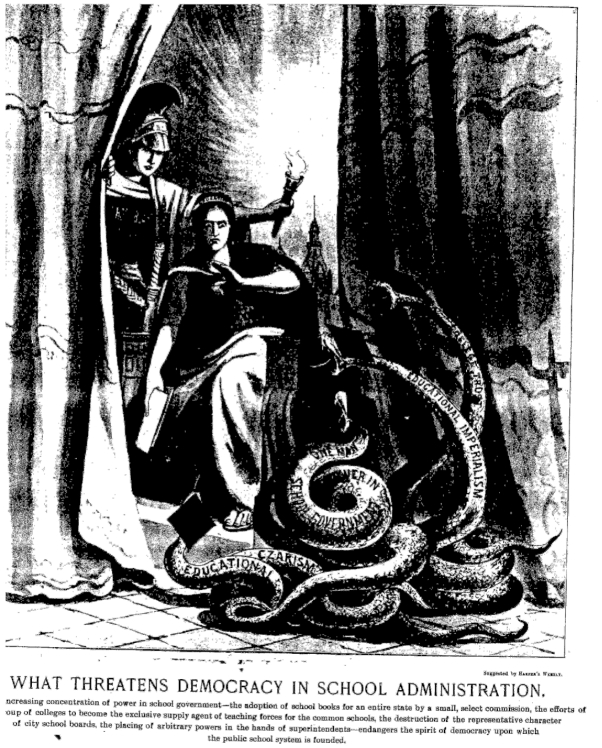
These have been live issues since at least the Progressive Era. In that period those who favored efficiency over democracy, often called “administrative progressives,” mostly triumphed, creating what historian David Tyack called “The One Best System.” Most of the histories of these conflicts focus on the winners. As a historian and an activist I have always been more attracted to their opponents, unstable coalitions of intellectuals (John Dewey for one), women’s groups, unions, Populists, Socialists, teachers, and partisan politicians who resisted what William George Bruce (Milwaukee Democratic politician – who opposed partisan politics in school governance, these coalitions were very unstable and strange –, school board member and founder of the American School Board Journal) called “Educational Czarism.” They had their victories too.

Almost everyone involved had some claim to the label “progressive.” This points to a dilemma in progressivism, then and now. Progressives have faith that politics and government can work for the common good and in order to accomplish this — to advance the common good — government must be efficient. Progressives with a democratic orientation also value democratic structures and wide participation, which make efficiency harder to achieve. This is the dilemma presented by the proposed limit on public appearances concerning non-agenda items.

The conflicts over school governance were and are entwined with conflicts over the purposes of schooling. For the most part Progressive Ea efficiency advocates emphasized the role of the schools in training workers and their opponents were more concerned with education for personal growth and citizenship. This is a gross oversimplification in that both sides favored some form of industrial or vocational education and the conflicts were about who would control it (some of the administrative progressives were happy to have private industry directly in charge) and what forms it would take (manual training was viewed as promoting personal development while vocational education was often seen as an effort to recreate inequalities in the name of “social efficiency”). Still, I think it is important to bring up as a reminder that the structures of education are related to what is taught, constituting a hidden curriculum. The lesson of limiting public appearances is that to some degree the priorities of the Board of Education take precedence over the concerns of the public. This has to be part of the discussion too.

Historically the structures and aims of education in Madison have had a relatively good balance between efficiency and democracy. I would like to see it stay that way.

As I said earlier, I would like to see this proposal set aside and have the Board and the public together tackle the broad questions of balance between efficiency and public participation. I’ve got some specific suggestions that will be included in part II of this post (as soon as I find the time to draft that…need to work on my own efficiency). I am going to close this post with some outlines of what I am talking about.

I would like to see a wider consideration of Board practices, some documentation about how much time has been spent on various tasks (including but not limited to off topic public testimony) and a variety of solutions evaluated, solutions that address “problems” confined to what the Board does as well as solutions involving the public perhaps changing our behavior too.

Whatever the results, I think that this has to be an issue that Board engages the public on. I am very glad that there now will be an opportunity for the public the weigh in on February 18, prior to the vote. That is a start, but however the vote goes, the larger dilemmas of democracy and efficiency aren’t going to go away. Rejecting the proposal could lead to constructive cooperation and creative solutions, enacting it will exacerbate distrust and resentments.


Thomas J. Mertz

For further reading:

David B. Tyack, The One Best System: A History of American Urban Education.

William J. Reese, Power and the Promise of School Reform: Grass Roots Movements During the Progressive Era.

Raymond E. Callahan, Education and the Cult of Efficiency.

Robert B. Westbrook, John Dewey and American Democracy.

2 Comments

Filed under Accountability, AMPS, Best Practices, education, Local News, Take Action

(Not?) Talking about Diversity and Boundaries, 2008 Style

educational_seperation_in_the_us_prior_to_brown_map-copy.jpg

tends3.jpg

low-income.jpg

With the new school opening on the West side, Madison again must confront the competing interests and ideals involved in redrawing school attendance boundaries. The district has produced four plans (more may be in the works, or the existing ones may be tweaked). At a long and unusually non-confrontational meeting Monday (1/28/2008), concerned community members presented their views.

The guidelines used to create these plans include seven non-prioritized criteria, only one of which addresses diversity:

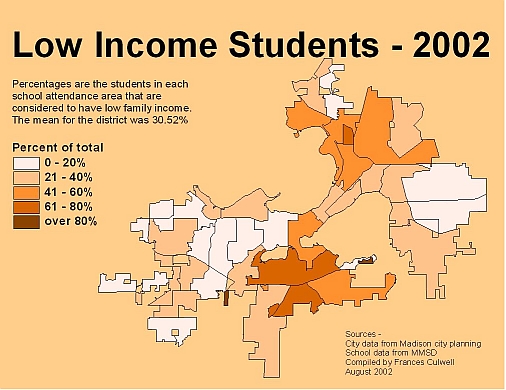
Every attempt will be made to avoid creating schools with high concentrations of low-income families.

It should be noted that this gives no guidance about schools with high concentrations of high-income families.

The Equity Task Force asked the Board to consider having racial, linguistic and/or economic diversity figure more prominently in this and related processes. The Board has taken no action on this.

What role race and linguistic considerations can play in drawing school boundaries is an open constitutional question. In the recent Louisville and Seattle case, Justice Joseph Kennedy’s partial concurrence rejected the plurality’s contention that these could not play any direct role:

School boards may pursue the goal of bringing together students of diverse backgrounds and races through other means, including strategic site selection of new schools; drawing attendance zones with general recognition of the demographics of neighborhoods; allocating resources for special programs; recruiting students and faculty in a targeted fashion; and tracking enrollments, performance, and other statistics by race.

Many consider Kennedy’s to be the “controlling opinion” in that without his vote the court would have been evenly split.

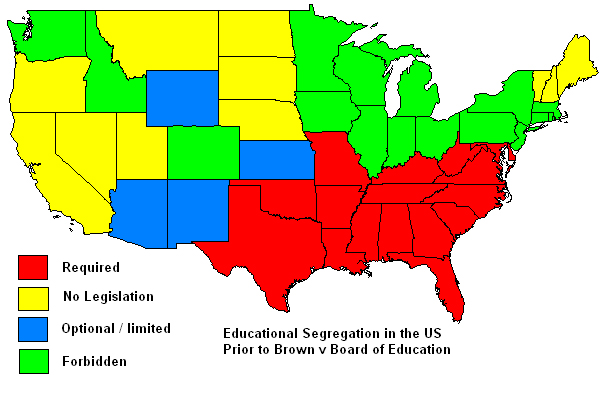
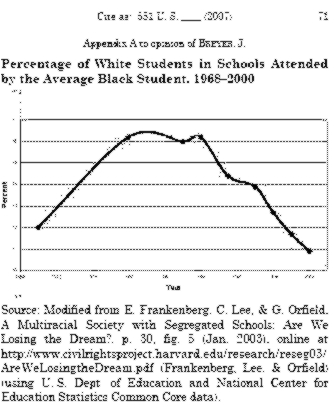
Nationally the trend toward re-segregation (however you measure it) continues. This trend can be seen in the graph above (from Justice Breyer’s dissent in the same case). A recent article in the Christian Science Monitor documents and explores the continued growth of what Gary Orfield calls “apartheid schools” (those with 90% or more minority enrollment). As the article notes, some do not have a problem with this happening, others are less sanguine:

“I don’t think that the education that you get hinges on the color of the person sitting next to you in the classroom,” [Roger] Clegg [president of the (Bradley Foundation funded) Center for Equal Opportunity in Falls Church, Va.] says. “What educators should focus on is improving schools.”

That sounds great in theory, say some experts, but the fact is that segregated schools tend to be highly correlated with such things as school performance and the ability to attract teachers.

“Once you separate kids spacially from more privileged kids, they tend to not get the same things,” says Amy Stuart Wells, an education professor at Columbia University’s Teachers College in New York. “And we need to start thinking about how a school that’s racially isolated can be preparing students for this global society we live in.”

I agree with Wells, both in terms of resource allocations and in terms of the lessons being taught or not taught by segregated learning environments.

Things aren’t that bad in most of Madison, but without a conscious effort to directly confront the issues they will be. As a friend reminded me today. the attention given to test performance data — measures that highly correlate with economic status — have induced some families to judge schools by simplistic measures and avoid those that aren’t “performing.” Often the schools being shunned are good schools with high percentages of students who are poor. In terms of resources, MMSD does what it can to direct resources to those schools with high needs, but the school finance system in general and the underfunding of Title I, Special Education, Bi-Lingual Education, SAGE and a host of other programs make this more difficult each year.

When I start to talk like this, to suggest being more proactive on issues of diversity, many are quick to remind me of the dangers of “becoming like Milwaukee,” meaning a district or city that has been largely abandoned by the middle and upper classes because they believe the schools no longer serve their children. There is no question that the growth in low income and minority students will keep some people from sending thie children to Madison Schools and that under the revenue caps this will have an adverse effect on the all the children in the district. There is also no question that prioritizing the needs of our neediest will exacerbate this. I think that is a price we should be willing to pay.

I am also well aware that dealing with these matters quietly and indirectly is easier for school officials, elected and appointed. Avoiding controversy and pretending differences (of status and opinion) don’t exist is always easier. For the most part MMSD has done a very good, if relatively quiet and indirect job of addressing diversity. I don’t think that is sufficient. I think being loud and direct at times is important.

In a recent Education Week there was a review of a new book, Everyday Antiracism: Getting Real About Race in School, by Mica Pollock. The book offers 65 essays by scholars “who offer advice for educators on recognizing when everyday classroom practices exacerbate racial inequalities and on becoming more constructively conscious and open about race.” In an earlier book, Pollock had coined the term “Colormuteness,” to denote the reluctance to talk about race directly. What Pollack is championing for the classroom, I am urging for the wider public sphere and not just for color or race, but other dimensions of inequality as well.

I was at a meeting last night where the talk turned to the responsibility of communities like Madison to demonstrate that diverse public schools (along with other progressive social policies) can and do work. The idea is that we need to serve as a counter example for those who would throw up their hands and say segregation and inequality are too intractable, or want to privatize schools and services because they have given up on public institutions. Madison has the resources and the communal will to do this and I believe many of us, quietly and indirectly, try. Quietly and indirectly isn’t good enough to meet this responsibility. Quietly and indirectly sends the message that we aren’t confident that we are right and able. We need to be loud and proud, we need to confront and demand and be relentless.

Kind of a long trip from the current West side boundary discussion. To bring it back around, in that context I would like MMSD to say, “yes we do seek diverse schools because we believe that in 1,000 ways diverse schools help combat inequality and segregated schools reinforce inequality. Creating opportunities and combating inequality are central to our mission.” More generally, I would like all associated with the schools to enact policies (including those proposed by the Equity Task Force) and follow practices (including those proposed by the Equity Task Force) that are proudly proactive on matters of racial, linguistic, economic and other inequalities. Last, I’d like us all to talk about this, not around it.

Thomas J. Mertz

wellbehavedwomenseldom.jpg

1 Comment

Filed under AMPS, Best Practices, Equity, Local News, Take Action, Uncategorized

UW Instruction expert: Don’t delay school entry

kindergartners.jpg

UW researcher Beth Graue suggests that if you are thinking that it might be better to delay your child’s entry into kindergarten for another year, don’t.

If you have reservations about whether your son or daughter is ready for kindergarten, you’re not alone. Many parents agonize over concerns that their child might be among the youngest or smallest in the class. They often wrestle with doubts about their child’s social, emotional or academic readiness.

Her research has found that delaying entry — called “academic redshirting,” after the college sports practice of deferring eligibility for freshmen players — has few positive effects. Children who are older when they start kindergarten might experience initial academic and social advantages, but those generally disappear by the end of third grade. Meanwhile, “redshirts” have higher–than–expected placement in special education and more social, emotional and disciplinary problems.

“Readiness is a relative thing,” she says. “There are some kids who always color outside the lines, and that extra year will just make them bigger, not necessarily more ready.”

She has found that parents are less likely to delay entry for girls with fall birthdays, and these girls tend to do well. When entry is delayed, the consequences are similar, regardless of gender.

“We will always have some kids who are more or less ready, no matter what the cut–off date is,” says Graue.

Parents delay entry for a variety of reasons – most often for social, emotional, physical and biological concerns. They are usually trying to avoid something, such as their kid being the last picked for kickball.

Middle–class parents are more likely to be familiar with redshirting as a strategy from reading parenting magazines and blogs. These families are also better able to provide an enriching home environment. Working–class parents tend to want their kids in school sooner.

Here are a few tips from Graue on preparing your child to start school:

  • Reading to your child every day is the best foundation you can provide.
  • Make the most out of everyday tasks. For instance, having your child set the table with one fork at every place teaches such concepts of one-to-one correspondence and how to follow directions.
  • Give your child lots of play time with peers to practice in cooperating with others.
  • Tour the kindergarten your child will be attending; a prepared child will be more confident.

And yet, there has never been a moments doubt in our minds as parents that our younger daughter has benefited immensely by holding back her start into kindergarten. She seems to be right in the “sweet spot” of where she should be academic-wise and emotionally, seemingly well adjusted for her grade level. A tough one to call. The axiom that all children are different never seemed more apropos.

Robert Godfrey

Leave a comment

Filed under AMPS, Best Practices

We are not alone #18

alone2.jpg

Today’s entry in this series is about the Weston School District. Many of you may recall the tragic school shooting there in 2006. What I remember most from the news reports and conversations with people who knew the district, was how the community came together and found strength. They need that strength now.

Like Florence a couple of years ago and maybe Park Falls in the near future the insanity of our state finance system has the Weston district considering dissolution.

It looks like the future existence of the district hinges on an April 1 operating referendum vote. Some excerpts from three Reedsburg Times-Press articles tell the story (here and here and here).

Weston budget critically low

CAZENOVIA-The Weston school district faces another great challenge. If the school cannot solve its financial crisis, the district could be forced to disband, sending Weston’s students to one of its neighboring school districts, which include Reedsburg, River Valley, Ithaca, Wonewoc-Union Center, Hillsboro and Richland. This has happened to other districts in the state that were unable to overcome deficits.

Weston District Administrator Tom Andres and former district administrator Terry Milfred gave a presentation on this crisis to about 70 residents in the school library on an extremely foggy Monday evening. The presentation showcased the district’s current deficit and the larger ones projected each following year in the future that could bankrupt the school by the 2009-10. Without serious cuts or a cash influx, Weston’s administration projects the district’s fund balance to be more than $1.5 million in the red by the 2011-12 school year….

Both Andres and Milfred blame the state’s funding formula and revenue limits, established in 1993, for forcing the district to consider an operational tax funding referendum.

“The general fund goes up and down but typically costs go up,” Milfred said, noting that the cost of utilities has skyrocketed recently. “The legislature anticipated that we might have these kind of problems so they set up the option of having a local referendum. The problem with that is people are used to a referendum for a building or a roof. If people see a referendum for operation, they wonder what’s going on.”

Andres said the predicament has left the school few options.

“If you look at the numbers, you see what happens if we don’t,” he told the audience. “But before we make that step, what does this district want to do?”

Andres has put forward eliminating his own position as another option to cut costs. Andres, a former superintendent and guidance counselor, came out of retirement to help Weston after the 2006 school shooting and was eventually hired as district administrator…

“What we’re going to do is have one administrator for the entire district. That would cut back on some of the expenses going toward administration,” he said before encouraging audience members to air their views…

Support for a referendum

Several audience members spoke out in favor stopping cuts and passing a referendum.

“You are the custodian of the future generation. You shouldn’t be cutting anything,” Roderick Baker, a Cazenovia resident, said. “Somehow we’re going to have to bite the bullet to pay for their education. You know what’s going to hit the fan, and we’re going to have the ante up and pay the bill.”

Bob Smith agreed, saying that the inequality of the school funding system was the culprit.

“The rich schools get the money, the poor school districts don’t. This school district is dying a death of 1,000 cuts,” Smith said. “I have a firm opinion that the future of our country is in our children. There’s no reason why this district or any other district in Wisconsin can’t afford a good system. You need to go to referendum obviously to make up for the lost funds.”

Mitzi Hizel, who lives in the Weston district but works for the Reedsburg School District, said the money not invested in education might be lost on other expense.

“You can invest in kids now or we can pay for it in another way” she said. “It could be public defenders, the prison system and welfare.”

Weston voting on referendum Monday

Three options

The committee looked over three referendum options, but will recommend only one to the board. The district administration projects that the first two, one with allowing $390,000 additional property tax revenue each year and the second starting at $225,000 and rising to $400,000 over four years, will only sustain the district until the 2011-12 school year.

“Real bare minimum, doesn’t get us out of trouble for very long,” Andres characterized them. “Can we break out even so that at the end we don’t ask for more?”

So the committee is recommending a third option, which will raise the mill rate to 12.25 per $1,000 for the next two school years and then keep the mill rate pegged at 12 for the future.

“I don’t think we’re going to satisfy everyone, but I think that’s the best middle ground,” Tim Fichtel, a school board member, said.

Administration projects this will keep the school’s budget in the black at least five years, so the district will not have to return to voters for another operational referendum soon.

“That does keep the books and equipment in the budget year after year,” Kathy Stoltz, Weston’s business manager, said.

After having enough to get by the first two years, eventually this option will give the district some breathing room…

Unless a referendum passes, the district makes severe cuts or the state reforms its school funding formula, Weston will be bankrupt by the 2009-10 school year. The Department of Instruction would likely partition Weston among its neighbors, a fate met by other Wisconsin school districts unable to overcome their deficits.

Weston voters face referendum

CAZENOVIA-Voters in the Weston School District will have a tax limit referendum to vote on this spring. The School Board decided unanimously Monday to ask voters to OK an increased mill rate to keep the district’s finances solvent….

Although it was presented with four options, the board approved the committee’s recommended version of the referendum, in which the mill rate rises from 9.1 per $1,000 of assessed value to 12.25 for the next two years and then levels off at 12. According to the district administration’s forecast, this fourth option will stave off deficits despite continuing enrollment decline.

The first two options would result in a negative fund balance by the 2011-12 school year and the third option would leave only $711 in the district’s fund balance by that year.

“I think on this scenario four, we’ve got our tails covered. We can’t go over that, but we can go less,” Norman Klingaman, a board member, said. “Scenario four gets us what we need but is fiscally responsible.”

If approved the referendum would raise $1.88 million over four years. In the first two years, an owner of a $125,000 home would pay an extra $393.75 per year. In the third and fourth year, that total would dip to $362.50.

Board members especially liked the predictability of the mill rate, including Tim Fichtel and Stan Dugenske.

“Farmers can then budget in a long range,” Dugenske said. “Security is a good draw.”

A lot at stake

Assuming no change is made to the state’s school funding formula and the board does not begin making significant cuts again over the next few years, the administration predicts the district will have both a deficit and a negative fund balance by the 2009-10 school year. This pattern would continue until the district’s fund balance goes into the red by more than $1.5 million in 2011-12.

Meanwhile, our distinguished Governor Jim Doyle continues to all but ignore the obvious failings of school finance in the Wisconsin, instead using his State of the State speech to promote unfunded mandates for third year high school math and science and an undefined merit pay plan for teachers. I am sure the people of the Weston District will welcome his bold action.

Thomas J. Mertz

Leave a comment

Filed under AMPS, Budget, Referenda, School Finance, We Are Not Alone

AMPS not Dead

Technical and other issues have kept AMPS stagnant recently.  Look for a new look (or new looks, we are going to be playing with that) and new posts very soon.

Thomas J. Mertz

1 Comment

Filed under AMPS

They only want to help our schools

mcd-reportcard120507.jpg

Ad Age has a report out on a move by McDonald’s to pick up the printing costs for report cards.
A Happy Meal coupon is included on the card’s cover. “With 27,000 elementary school kids taking their report-card jackets home to be signed three or four times a year, that’s less than 2 cents per impression.”

I guess healthy food advocates can pay for their own report cards.

Robert Godfrey

Leave a comment

Filed under AMPS, Best Practices, Budget, National News, Quote of the Day