Category Archives: AMPS

Quotes of the Day

From the Wisconsin Center for Education Research report:

Educational equity issues within the school district [MMSD] are the source of much public controversy, with a relatively small but vocal parent community that is advocating for directing greater resources toward meeting the needs of high achieving students. This has slowed efforts to implement strong academic equity initiatives, particularly at the middle and early high school levels.

From Matthew Yglesias:

The rhetoric of No Child Left Behind is, I think, an appealing one. The idea is that, well, no child should be left behind. It’s an essentially egalitarian aspiration — the school system should try to do well for the hardest to teach kids, included ones coming from difficult backgrounds and ones who simply for whatever reason have a hard time with school. The idea of “gifted” programs is basically the reverse vision — that the school system should focus on the easiest cases and push them to the highest level of achievement possible.

There’s not a stark either/or choice between the hard cases and the easy cases, but at some level you do need to make a decision about priorities. Insofar as we’re serious about educational equality, that will to some extent involve shortchanging the best and the brightest. Insofar as we’re serious about taking the most talented as far as they can go, that will involve shortchanging equity. The former strikes me as more desirable than the latter, especially for people who want to think of themselves as being on the left.

From Michael Bérubé:

If we as a society are going to make decisions concerning prioritizing scarce educational resources, it makes sense to me, for us to consider what kind of output we desire. Do we want to, for example, maximize the number of future American Nobel prize winners and enjoy the fruits of the breakthroughs that our most gifted can achieve, or do we want to maximize the educational level of the median American worker? Both results have great value, and if we were to quantify them in terms of dollars, I’m not sure which one would prove to be of greater value to society. But I think these are the questions we should be discussing. And that devoting our resources to maximizing the future opportunities of our least educationally apt children for the sake of doing so, without examining the costs, is fuzzy-headed. Which may or may not be a liberal value. But as liberals we do acknowledge that society is not just a collection of disparate competitive individual maximizers, but that we live in a community where cooperation is also an important value. And that maximizing the strength and resources of that community is itself a liberal value.

The National Access Network just reported that “the United States now has the highest relative childhood poverty rate among developed countries.” When the test scores of white American students are reported separately and compared to the test scores of students in developed countries, the United States ranks third highest. In contrast, if Hispanic and African American test scores are compared to the same international scores, the United States ranks last and next to last. It noted that “the authors of a 2001 Wisconsin study concluded that a weighting of 3.4 times the base cost for education was needed for poverty students to reach state standards.” In a new paper on class size reduction efforts, research found that “Wisconsin SAGE class-size reduction experiments showed positive effects on student performance, especially for disadvantaged students.” Economists estimate that reduction efforts targeting disadvantaged schools nationally would cost about $2 billion, and as the evidence shows, it would reap many benefits.

Robert Godfrey

2 Comments

Filed under "education finance", AMPS, Best Practices, education, Equity, finance, Gimme Some Truth, No Child Left Behind, Quote of the Day

Channeling lucre to power

The Wisconsin Democracy Campaign today released it’s analysis of large individual campaign contributions that state lawmakers received in 2007 from donors living outside Wisconsin. For pure shamelessness, the top givers, not too surprisingly, were supporters of using public money for private schooling – a total of $41,825. The take away message – vigilance.

School voucher supporters contributed $1 of every $5 in large individual campaign contributions state policymakers accepted from special interests outside Wisconsin in 2007, a Wisconsin Democracy Campaign review shows.

The leading pro-school-voucher supporters were among the top overall out-of-state donors in 2007 (see Table 2), including Jim and Lynne Walton of Bentonville, Arkansas and Christy Walton of Jackson, Wyoming whose families own Wal-Mart at $15,800; Richard Sharp, of Richmond, Virginia, a retired Circuit City executive at $9,450; and Dick and Betsy DeVos, of Grand Rapids, Michigan whose family founded Amway at $6,150.

The Democracy Campaign noted that:

Milwaukee’s school choice program spends about $120 million a year in state tax dollars to let about 18,500 children attend private religious and nonsectarian schools rather than Milwaukee Public Schools.

The top recipients of out-of-state pro-voucher campaign cash were Darling at $7,175 followed by the Republican Assembly Campaign Committee at $4,550, Republican Senator Dan Kapanke at $2,500, Huebsch at $2,350 and Democratic Representative Jason Fields at $2,300.

In addition to direct contributions to Wisconsin candidates over the past several years, All Children Matter, a Michigan-based pro-voucher group that has political action committees in several states, has spent more than $1.5 million in the 2004 and 2006 elections on phony, negative issue ads, most of which had nothing to do with the school choice issue. Some of their activities drew a complaint pending before the state Government Accountability Board that accuses All Children Matter of laundering $90,000 in corporate contributions through its Virginia PAC which later sent $35,000 to an All Children Matter PAC in Wisconsin to spend on negative electioneering in some 2006 legislative races. The complaint also said the Virginia PAC was not registered in Wisconsin when it transferred the money.

All Children Matter’s Virginia and Ohio PACs were recently fined a total of $5.2 million for similar activity in the 2006 Ohio elections.

For a good history of All Children Matter, Dick DeVos and Howie Rich, check out the Sandlapper’s Diary.

Robert Godfrey

Leave a comment

Filed under AMPS, Gimme Some Truth, School Finance

Primary Sources

My students have an exercise based on primary sources due soon. It seemed like a good idea to post some here.

It is hereby declared to be the policy of the commonwealth to encourage all school committees to adopt as educational objectives the promotion of racial balance and the correction of existing racial imbalance in the public schools. The prevention or elimination of racial imbalance shall be an objective in all decisions involving the drawing or altering of school attendance lines and the selection of new school sites.

An Act providing for the Elimination of Racial Imbalance in the Public Schools, Massachusetts, 1965

George Wallace 1968 television ad, from The Living Room Candidate.

Richard Nixon 1972 television ad, from The Living Room Candidate.

.

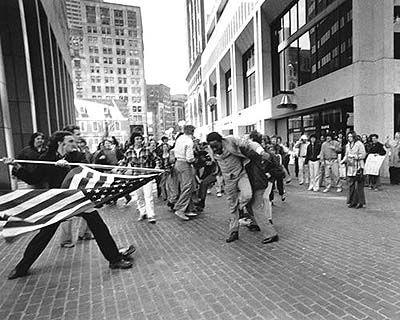
“Soiling Old Glory” Louis P. Masur (Boston anti-busing protest, 1976)

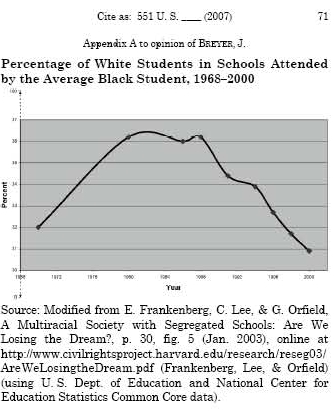
From Justice Stephen Breyer’s dissent in Parents Involved in Community Schools v Seattle School District (2007).

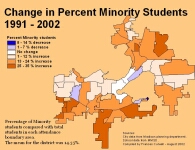
From MMSD, click image for power point (I wish they would update these).

And bonus links to recent blog entries on school desegregation from Sherman Dorn and Eduwonkette

Thomas J. Mertz

Leave a comment

Filed under AMPS, Best Practices, education, Equity, National News, Uncategorized

Pass the Hatchet

“Let me chop it, let me chop it”

Roger and the Gypsies – Pass the Hatchet (listen)

Marc Eisen of the Isthmus has checked in again on the Madison Schools with a column titled “When Policy Trumps Results.” This time the target of his ill informed scribblings is the equity work of the district, particularly the Equity Task Force, of which I was a member. It is a hatchet job.

Mr. Eisen gets his facts wrong, misreads or misrepresents task force documents and at no point engages with the content of the task force’s work. We offered the Board ideas for policies and practices that we thought would help produce and assess results. You would never know that reading Mr. Eisen’s column. Despite the title, all he seems to care about is style.

In return, I’m going to wield the axe. I’m going to go paragraph by paragraph to highlight the low level of knowledge and effort Eisen displays and the ultimate emptiness of his critique, hitting some other things along the way (quotes from Mr. Eisen in italics). Mr. Eisen’s column probably does not deserve this much attention. However the power of the press is such that often when uncorrected, “the legend becomes fact.” I believe equity work in our school district is too important to allow that to happen. Let’s get started.

Much to its credit, the Madison school board has mostly ignored the March 2007 recommendations of the district’s Equity Task Force.

This is simply wrong. On April 21 the Board of Education moved forward on equity, asking the Administration for a redraft of a working document based largely on the report of the task force. Over the last year — in discussions over budgets, school closings, boundaries, discipline and expulsions and more — Board members have explicitly and implicitly employed the work of the Task Force. I wish the Board had more extensively and more directly worked through the Report in public meetings, but the record shows they haven’t ignored it.

This earnest but unhelpful committee delved into the abstractions of what distinguishes “equity” from “equality,” how the board might commit to equity and what esoteric guidelines could measure that commitment.

Yes we were an earnest bunch. Who else would volunteer their time for a year and a half?

I’m no judge of how helpful we were/are, but I do know that Board members (of all stripes), administrators, and teachers have all termed the work of the task force “helpful.” In a manner typical of Isthmus coverage of school issues, rather than talk to those involved — the people who the task force sought to help –, Eisen simply asserts his own opinion.

As to “abstractions of what distinguishes ‘equity’ from ‘equality,'” I am not sure what Report Mr. Eisen read, but there is nothing resembling this in the Final Report. The word equality appears only once in a simple statement that “equity and equality, though closely related, are not the same.” We did discuss this among ourselves and discuss it when we met with community groups, because we wanted to be clear that equity cannot be achieved via a “one size fits all” version of equality.

We were asked by the Board of Education to give them a definition of equity, a statement of commitment and guidelines for implementation. Mr. Eisen labels these last two “esoteric.” This seems to me to be a poor word choice. The vast majority of these portions of the Task Force Report are written in plain language, there is a minimum of education speak; it is very accessible. Click the link and judge for yourself. We also sought to ground the strategies by preparing a responsibility chart and giving examples of how success might be measured.

This points to another basic misunderstanding of Mr. Eisen’s. The guidelines in the report are “guidelines for implementation,” clearly labeled as such and make no mention of measuring commitment or anything else. Because we shared Mr. Eisen’s desire for results we went beyond our charge to include a statement on “Monitoring and Evaluating Outcomes,” emphasized accountability in the statement of commitment and included in the appendices the notes on measuring success. These are separate and distinct for the guidelines.

It is worth noting that a number of the guidelines for implementation are things that Mr. Eisen has advocated for in the past (and even advocates in the column under discussion). Some examples from the Report (linked to works of Mr. Eisen with similar ideas)

I honestly don’t know what to make of Mr Eisen’s wholesale dismissal of the task force in light of these and other shared beliefs. There may be a clue in his next paragraph.

If you are already slipping into catatonia from the meaningless rattle of words, that’s understandable. This is stuff that appeals to progressive professors at the UW-Madison School of Education and to graduate students who aspire to become progressive professors at the UW-Madison School of Education.

Before speculating on Mr. Eisen’s agenda, I can’t resist pointing out the “meaningless rattle of words” inducing catatonia can only be those of Mr. Eisen because the only words quoted from the task force to this point are “equity” and “equality.’ In addition to being a poor reader and a lazy researcher, Mr. Eisen is either a perceptive self critic or a very bad writer/editor.

Once past this revealing gaffe, Mr. Eisen indulges in a favorite sport of the neo-conservatives, ridiculing “progressives” and academics (more below). I’m a proud progressive. While I share some of this skepticism toward academics, I think Mr. Eisen’s brush is much too broad.

“Equity,” the committee announced in its report to the board, “involves opportunity; access; elimination of barriers; distribution of resources; protection of specific groups; recognition and acceptance of differences” and marches on for another 75 words in an act of faux definition.

Two important things here. First, Mr. Eisen does not quote the definition itself, only the introductory material. Second, he has no specific criticisms of any of the ideas the task force sought to include in the definition, only general ridicule and dismissal. For the record, here is the definition we suggested to the Board:

Equity assures full access to opportunities for each MMSD student to achieve educational excellence and social responsibility.

In a sense Mr. Eisen is correct that this is a faux definition. We avoided saying what equity is, settling on trying to say what equity does, to put the focus on results

The more it seeks to explain itself, the more suspect the whole equity endeavor becomes. As someone who sat through a meeting at East High last year where the task force’s work was explained to baffled parents (we filled out a survey that asked, “What does the definition of equity mean to you?”) and who then watched a poorly attended forum discuss the task force’s findings at Centro Hispano on April 3, all I can ask is:

What is it about progressives and their penchant to champion programs on the basis of their rhetorical gloss rather than their success, or at least their prospects for success?

I was one of the presenters at the East High meeting and attended the forum at Centro Hispano. The purpose of the East High meeting was not to explain the task force work, but to get feedback. At that and other venues we received some very useful feedback. I didn’t take a survey about who was “baffled” and who wasn’t, but my memory is that once we got past who we were and what we wanted from them, the parents were interested and engaged. I just dug up a couple of emails from parents who were there and neither indicates any bafflement. I don’t doubt that Mr. Eisen was baffled, but I do question his unsupported assertion that the others in attendance were.

As to the meeting at Centro Hispano, the forum was organized by a charter school advocacy group, only one Equity Task Force member was involved, at least two of the invited panelists were not familiar with the task force’s work (although the announcement said a task force member would be on the panel, to my knowledge none were invited), the Task Force Report was apparently attached to the invitations but discussing the work of the task force was not on the announced agenda and only came up in passing. Mr. Eisen’s characterization is misleading.

The question Mr. Eisen asks seems to be the crux of his complaints. He reads the recommendations of the task force as mere rhetoric and sees nothing that offers “prospects for success.” Here we differ. I see much that I think will add to the success of the district, but beyond that I find it sad and confusing that Mr. Eisen can read the Report and find nothing of use — even in areas where he is in agreement with the recommendations — and can only respond with a nonsensical criticism (disguised as a question) of those easy strawmen “progressives.” For the record, the task force was a relatively diverse group and I have doubts about how many members could accurately be called progressives. I don’t care, but if Mr. Eisen is going to label people, maybe he should learn something about them first.

The Madison schools face a real problem in the achievement gap that separates white students from minority students, poor students from middle-class students.

I can’t think of a bigger challenge for this community than to get these kids up to grade level before they get lost in the hormones and peer pressure of middle and high school.

These are the kids who drop out, who lack the skills to hold jobs, who run the risks of drugs and alcohol, who break the law, who shatter neighborhood comity, who get busted.

I agree with most of this. The only thing I’d add is that we can’t ignore those students who are already in middle and high school and behind. Here and elsewhere Mr. Eisen appears to have given up on these students.

Call me naive, but I think most Madisonians are prepared to give these troubled kids extra help. They might volunteer their own time in the Schools of Hope program to tutor struggling readers. They might support raising taxes to fund four-year-old kindergarten or other programs designed to rescue kids from a dreadful fate.

This point needs to be emphasized. Madisonians aren’t afraid to tax themselves. They just want good services in return and know that their money isn’t being wasted.

Yes, I will call you naive, or at least somewhat naive.

Schools of Hope has been a great success. The community involvement has been heartening, the results impressive, but gaps remain and both involvement and progress seem to have plateaued. Again, the task force recognized the importance of community involvement as one part of the answer.

The task force also called for universal quality early childhood education. Unfortunately this is one part of the Report the Board of Education has ignored. After the Centro Hispano meeting I had a long talk with Mr. Eisen. Most of it was about how shoddy the Isthmus coverage of school issues is, but at one point he challenged me by asking (something like) “Why aren’t you advocating for four-year-old kindergarten?” I answered that I was and that the task force had also. I explained to him that in private conversations with multiple Board members I had asked them to consider a referendum on 4K, that just that evening I had brought the matter up with a Board member and that thus far they had not shared his optimism and have been reluctant to move in this direction.

I’m going to keep trying to get a referendum on 4K because it is the right thing to do, but I understand their reluctance and am also not optimistic. There is a pressing need for an operating referendum — without a successful referendum the district in 2009-10 will face $5-$10 million in cuts from the same service budget — and this has to be the first priority. Multiple measures on a referendum ballot invite a split vote, making it more difficult to pass any. I’d like to at least try for 4K and hope to convince at least four Board members. I hope Mr. Eisen continues to advocate for 4K.

I’m not terribly optimistic about an operating referendum vote either. Mr. Eisen blithely declares that “Madisonians aren’t afraid to tax themselves. They just want good services in return and know that their money isn’t being wasted.” Maybe Mr. Eisen believes that our schools waste money and don’t provide good services (if so, I’d be happy to go round for round with him on these matters), because the last time MMSD asked Madisonians to tax themselves to preserve programs and services, the measure lost by almost 11%. I also want to point out that making the case for any referendum, a 4K referendum in particular is going to involve citing the expertise of those progressive education professors that Mr. Eisen doesn’t like, the work of Progressive Dane and other progressive organizations and the votes of many progressives. It does not make sense to dismiss and alienate these people.

But I can’t for the life of me see them rallying around a pompous and abstruse equity policy, especially one that reads like it was formulated by the UW Department of Leftwing Social Engineering. (Example: “Equity will come about when we raise a generation of children tolerant of differences and engaged in their democracy to stop the processes leading to inequity.”)

Again Mr. Eisen’s reading skills seem to have failed him. The quoted passage is not from the body of Task Force Report, nor the draft policy but an excerpt from public comments included in the appendices. At best this is irresponsible; at worst it is dishonest. I ask readers to judge pomposity and abtuseness themselves and note that again Mr. Eisen says nothing about the substance of the task force’s work, only the style. If anything it appears that Mr. Eisen is the one obsessed with matters of rhetoric to exclusion of content.

The issue of public response is a real, if secondary, one. The primary job of the task force was to report to the Board of Education. This was not a campaign document. That said, we did recognize that a commitment to equity could either enhance or detract from perceptions of the district and that the success of all things related to public schools require public support. It was our hope that the community would recognize that our recommendations addressed important matters in a positive ways.

There is some evidence that Mr. Eisen is wrong in general about Madisonians rallying around equity. The East Area Parent Teacher Organization and the Northside Planning Council have been using equity as a rallying point for years and have had some success in generating Board and public interest.

The school board, after a suitable 14-month delay, should politely shelve the task force’s recommendations when it finally gets around to voting on them in May.

As the comments on Mr Eisen’s opening paragraph indicated, it is much too late for that.

Equity can be honored in principle, but in practice the board needs to be laser-focused on the practicalities of closing the achievement gap.

So much more wrong here. First there is the implication that raising achievement can be accomplished via a laser focus, when common sense and research agree that academic success depends on multiple factors and no single initiative can promise results for most (much less all) students. There is the related implication that MMSD has been neither focused nor successful in raising achievement. Both of these are relative and subjective, but again I disagree and again Mr. Eisen offers no evidence in support of his position. Most significantly Mr. Eisen does not identify what that focus would entail. The task force offered specific recommendations, Mr. Eisen does not.

Mr. Eisen has been on record in opposition to one initiative of demonstrated utility in raising the achievement of those in the middle and at the bottom and supported by the task force: heterogeneous or mixed ability classrooms. Maybe his desire for a laser focus is a desire to make sure that his children and the children of his peers aren’t part of the effort to improve the achievement of poor children.

Too often Madison’s libs and progs devote themselves to elaborate exercises in policy-making as if policy is an end in itself.

I can only speak to the case of the Equity Task Force, but in that case I can say without fear of contradiction that none of us saw policy as an end in itself, but as a means to an end. We knew words in a policy book without action are useless and actions without results are a wasted effort. Many of us are and have been involved at the school, district and state level working for better policy, actions and results.

Here I’m going to get a little earnest. It was an honor to serve with my fellow Equity Task Force members. They are people who care deeply about making our schools work for all students and have repeatedly demonstrated their commitment by volunteering their time. I’m proud of our work and proud to have come to know you all.

Most of the rest of the article is about Inclusionary Zoning (I hope Brenda Konkel or someone more familiar with that issue weighs in), but one further reference to education deserves attention.

This failure has only exacerbated the school board’s challenge in dealing with the achievement gap. The research is crystal clear: Kids in high-poverty schools fare far worse academically than poor kids attending middle-class schools.

This is exactly why policy matters. The current policy and practices of the district say nothing about economic segregation in classrooms and are relatively weak in school assignment (see here). The task force recommended that the administration annually report to the Board any schools or classrooms that significantly diverge from the overall socio-economic makeup of the district and offer actions to address this segregation. Mr Eisen may have a better way to deal with this issue. He offers none beyond Mayor Cieslewicz’s ill conceived “share the poverty” proposal. My thoughts on that will have to wait for another day, but simple numbers show that even if this is wildly successful and 2,000 children in poverty move to other districts, MMSD will still be at close to 40% free and reduced lunch. History shows that those children will remain geographically concentrated. Whatever the solution, it will involve policy.

This is all very frustrating. Many people read the Isthmus and few people pay much attention to school issues that do not directly impact them. Mr. Eisen’s latest “effort” is one of many examples of that newspaper’s confidently criticizing the schools and the Board of Education with little regard for logic or truth. It is all about posturing, style over substance. Nowhere in his column does Mr. Eisen discuss any of the policy recommendations of the task force. Nowhere. There is a certain irony in that Mr. Eisen’s supposed concern for results is manifested exclusively as a critique of style.

Bob Somerby at The Daily Howler has extensively documented how the national press does the same thing — from falsely labeling Al Gore a congenital liar to constant references to of John McCain’s “straight shooter” image — they endlessly repeat falsehoods or focus on the trivial; ignoring important matters in order to create amusing fictions. The people working to make our schools better, the children and the public deserve better.

Thomas J. Mertz

1 Comment

Filed under AMPS, Best Practices, Equity, Gimme Some Truth, Local News, Referenda, Take Action, Uncategorized

We Are Not Alone #20

At the April 4 th press conference for the release of the MMSD administration’s proposed budget — at the prompting of the press — the “R-Word” (referendum) was discussed. Since the one time Tax Incremental Finance District disbursement saved Madison from the annual rituals of cuts and conflict this year (and gave Art Rainwater the fitting farewell gift of an opportunity to make his last budget a true “cost to continue” budget), referendum talk was the headline in the Capital Times and the State Journal:

Referendum talk is back for schools
Susan Troller

A gaping $9.2 million hole in the Madison school district’s 2009-2010 budget will likely be stirring talk of a referendum as soon as the city’s new schools superintendent, Dan Nerad, takes office at the beginning of July.

By Andy Hall

Madison school officials soon will begin considering whether to ask voters for additional money to head off a potentially “catastrophic ” $9.2 million budget gap for the 2009-10 school year.

We are not alone.

41 Wisconsin school districts had 61 referenda on the ballot April 1st; 33 of these were for basic operating or maintenance expenses (the remainder were to authorize debt for capital projects).

As the State Journal recently editorialized, these referenda are a manifestation of the “no win situation” districts face due to the “system for financing public schools that essentially requires most schools to spend at a faster rate than they are allowed to raise revenue.”

The mess created by the state ‘s outdated and unfair school financing system is not new, but the consequences are mounting. Gov. Jim Doyle and lawmakers tweaked the system a year ago, but the state ‘s political leaders continue to shrink from the overhaul required…

The victims are the students — along with Wisconsin ‘s future in the globally-competitive, knowledge-based economy.

Superintendent Rainwater’s last words at the press conference summed things up nicely (I hope these are not his last words on the subject — Art, enjoy retirement but please continue to advocate for our schools and children):

“The politicians in the state of Wisconsin and those who fund the politicians need to understand what’s going to happen to this state if they lose this great public school system. We will be sitting here 10 years from now, wondering what in the heck happened to us. And what happened is this: We destroyed our ability to compete in a world that is changing.”

Now to the April 1st votes (with links to the Department of Public Instruction summaries):

Now the districts where the referenda failed are looking at what to cut next.

Here is a list of probable cuts (covering two years) from Waupan where the three-year nonrecurring referendum lost by 589 votes:

  • Reduce the teaching staff at Jefferson by 2.0 FTE?s (grade 1 and grade 2)
  • Reduce the teaching staff at Washington by 2.0 FTE?s (grade 1 and grade 2)
  • Eliminate the position of Gifted and Talented Teacher (1.0 FTE)
  • Eliminate the position of Director of Instruction (.8 FTE)
  • Eliminate 1.0 FTE elementary principal
  • Restructure administration
  • Eliminate the position of Police Liaison Officer
  • Eliminate Alternative School Program (.5 ? 1.5 FTE)
  • Reduce High School Health/PE (1.0 FTE)
  • Eliminate High School French (1.0 FTE)
  • Eliminate Guidance position (.6 FTE)
  • Eliminate Media Program (1.0 FTE)
  • Eliminate Library Aide (1.0 FTE)
  • Eliminate Clerical positions (.7 FTE)
  • Eliminate part-time custodians at middle school
  • Eliminate Industrial Arts at the middle school (1.0 FTE)
  • Combine Computer/FCE at the middle school (1.0 FTE)
  • Eliminate Special Education Aide (1.0 FTE)
  • Reduce one section of Honors Math at the middle school level

*FTE – Full Time Employee

As the district website asks, “If we continue to eliminate programs and cut staff, it will diminish and erode the quality of education in our district. What will happen to our kids and our community?”

As they have been for over a decade in Wisconsin, cuts like this are being contemplated around the state —  both in districts where referenda failed in those districts where no referenda were held. AMPS will give updates on these as the school budget season continues. For now, just a couple of videos about Wisconsin Heights, where the second referendum in two years failed, this time by 75 votes out of 1,975 cast (3.8%).

From before the vote:

From after the vote:

What can we do? Keep the pressure on our state officials, especially Governor Doyle; support the Wisconsin Alliance for Excellent Schools; join ABC-Madison; write your local newspapers; and last but not least vote and know where the candidates stand before you vote.

Thomas J. Mertz

Leave a comment

Filed under "education finance", AMPS, Budget, education, Elections, finance, Local News, Referenda, School Finance, Take Action, Uncategorized, We Are Not Alone

Wright Middle School 10th Anniversary

jcwpainting_001.jpg

James C. Wright Middle School is holding a 10th anniversary celebration on Sunday, April 6 from 3:00-5:00 (1717 Fish Hatchery Road). Wright is a very bright spot in our district and community.  Please come and join in recognizing the good work.  There will be an original play on Reverend Wright’s life and work,  the release of a book on Reverend Wright, inspiring speeches and more.

Hope to see you there.
Thomas J. Mertz

Leave a comment

Filed under AMPS, Best Practices, education, Local News, Uncategorized

Glendale Elementary: Looking past the stats

66310.jpg
photo by: Mike DeVries/The Capital Times

A behind the scenes examination of Glendale Elementary, along with an audio slide show, is on tap in this well written piece in the Capital Times. Let’s hope this a foreshadowing of things to come as our afternoon paper attempts to reinvent itself from dead tree technology to a cyber presence in a couple of weeks from now.

Robert Godfrey

Glendale Elementary may be failing by test-based standards, but it’s succeeding by human ones.

The question of how we recognize good schools and bad ones has become a pressing issue.

In Washington, Congress is debating the reauthorization of the No Child Left Behind legislation. Locally, Madison and Sun Prairie parents have recently been upset over boundary changes that some see as sending their children to less desirable schools.

At the same time, the movement toward inclusivity in special education, a growing minority population and increasing poverty rates throughout Dane County, particularly in Madison, have put a sharp point on some important questions:

  • Do advanced students suffer when they share a classroom with struggling students?
  • How should schools address the stresses of poverty?
  • Are test scores a reliable measure of a school’s effectiveness?

This story doesn’t attempt to answer those questions; educational researchers have been struggling with them for decades. Instead, it puts one Madison elementary school under the microscope where all those currents come together — a school that by No Child Left Behind’s test-based standards is clearing failing. Yet, by the assessment of a number of parents, volunteers and other fans, the school is succeeding beyond all expectations.

A closer look at Glendale Elementary, a 50-year-old Madison school within the noisy shadow of U.S. 51, shows a school where success is occurring in ways that test scores can’t measure and poverty rates don’t reveal.

Leave a comment

Filed under AMPS, education, Local News, No Child Left Behind

Quote of the Day

lines.jpg

No boundary changes ever occur without fear, or frustration. That’s what happens when you live in a growing city. Arguments that folks moved to a specific neighborhood for a specific school are weak at best. We cannot afford a school for every neighborhood, and we have to address over-crowding as well as school equity as it relates to children of low income families.

SP-EYE: Keeping an EYE on the Sun Prairie School District

Our neighbors in Sun Prairie are dealing with similar issues in redrawing school boundaries.  Clean and easy attendance area redistrictings are exceedingly rare, add issues of racial, linguistic and economic diversity and there is sure to be conflict.  That’s the nature of the beast.

The MMSD West-side boundaries are on the agenda for Monday, March 3, 2008.

Related items:

“Moving the Lines,” Jason H. Silverman.

“Planning for Equity,” Kelley D. Carey.

“Planning for Integration,” Kelley D. Carey.

Sun Prairie Area School District Boundary Task Force (District Home Page).

More student moves loom in Sun Prairie (Capital Times).

Sun Prairie Parents Weigh In On School Boundary Changes (Channel 3000).

Sun Prairie schools still in a deadlock (Capital Times).

Opposition voiced to boundary changes (Sun Prairie Star).

MMSD New Elementary School page (with boundary proposals).

Parents Upset Over Plan F Recommendation (WKOW).

School Board panel recommends significant changes (Capital Times).

Cheryl Rebholz: Toki Middle School responses unfair (letter to the editor).

Thomas J. Mertz

Leave a comment

Filed under AMPS, Best Practices, education, Equity, Local News, Quote of the Day, Uncategorized

(Now?) Talking about Boundaries and Diversity, 2008 Style

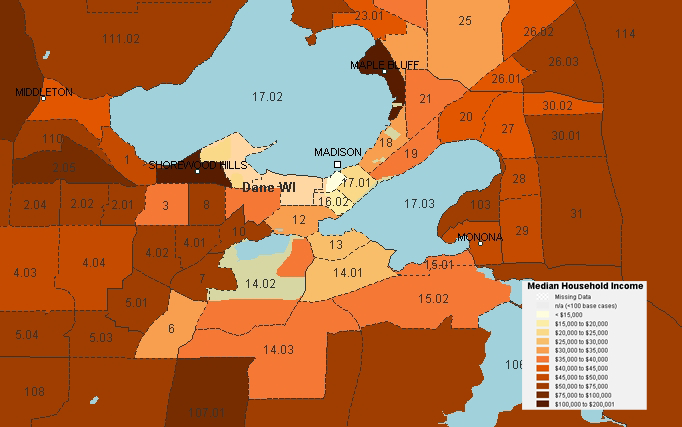
2000-census1.jpg

This is a quick update on the earlier post “(Not?) Talking about Diversity and Boundaries, 2008 Style.” The good news is that it appears that some people have at least started talking. Susan Troller’s article in today’s Capital Times has some good quotes from three Board of Education members. Everything they say is fine and (at least) one addresses resistance to diversity head on:

School Board member Carol Carstensen, who chairs the long range planning committee, said she has been very troubled by the tone of many of the e-mails she and other board members have been getting regarding the proposed changes.

“It’s dramatized for me the significant gap we have in our community,” she said.

“It’s very troubling that we are increasingly separating ourselves and that there are parents who are saying they will not allow their children the experience of going to school with ‘those children,'” she said.

Lucy Mathiak offered a reminder that test scores aren’t everything:

“The performance and the test scores simply don’t warrant this kind of reaction,” she said, adding that hearsay, not actual experience, is fueling a gap between perception and reality at many low income schools.

Along with Beth Moss, Mathiak and Carstensen put things in perspective and reminded the community that perceptions and realities of schools can be changed and that active involved community members are the key:

“My children attended East, and I know how painful it is to have the school your kids attend labeled as some kind of loser ghetto school,” she [Mathiak]said.

“My kids came out of their school experiences as well-educated for life success as I could possibly hope,” she added.

Beth Moss, who is the third member of the long-range planning committee, and who has children who attend Jefferson, said a school’s reputation can change quickly.

“Last year I was sitting with a group of very irate parents who were extremely concerned about school safety, violence and bullying at Jefferson,” she said.

“We talked about it, and some changes were made, but I do find it kind of ironic that now Jefferson is seen as some kind of nirvana,” she said.

“The reality is that no school is perfect,” Carstensen said. “If you don’t like something, do what so many parents have done. Work at it, and change it.”

I’m glad to hear this from our Board members.

The many comments on the Capital Times story show others talking directly about the difficult issues of race, class and diversity. Not everything said there is constructive, but I do think that airing this is better than pretending it doesn’t exist.

Another good sign is the use of language and concepts from the Equity Task Force work at the Long Range Planning forum last week. The notes are posted here. Even though the Board has not directly addressed that portion of the Task Force recommendations, the idea that Madison needs to take affirmative steps to create and maintain schools with reasonably balanced socio economic characteristics (and that schools with low poverty numbers are as unacceptable as schools with high poverty numbers) seems to be gaining currency with some. More good news.

And on a non-local note, Mica Pollock, the author of Colormute: Race Talk Dilemmas in an American School and editor of Everyday Antiracism: Getting Real About Race in School (discussed in the previous post), will be participating in an on-line chat hosted by EducationWeek.org. the chat will be on February 27, but they are taking questions now. More info here.

Thomas J. Mertz

Leave a comment

Filed under AMPS, Best Practices, education, Equity, Local News, Uncategorized

AMPS Clean Up

brooms-jlm.jpg

When we moved the site to a new platform and server about a month ago, many of the internal links stopped working.  We’ve been doing a little clean up here and there, but nothing systematic.  You can help.  When you come across a link that doesn’t work, please use the comments for that post to let us know.  We’ll get it fixed.

 Thanks.

Thomas J. Mertz

Leave a comment

Filed under AMPS