Category Archives: Best Practices

Mad City GRUMPS Are Back

There are lots of good new things on the Mad City GRUMPS (Grandparents United for Madison Public Schools) web site.

Here is their “mission statement”

Let’s Pass the November 4th Referendum!!

We are Grandparents United for the Madison Public Schools

We treasure the high quality of public education that Madison has provided our children and their children.

We want to continue to attract people of every educational and income level to Madison on the basis of the quality of our public schools.

We worry that our generation and those that follow have become more fearful of escalating property taxes than the prospect that children may be shortchanged in their learning opportunities.We ARE grumpy, ESPECIALLY when we worry about the eroding resources for public education for our grandchildren and all Madison children.

The site features a brief description of the November 4 referendum, information on school taxes since 1994, frequently asked questions, data on student achievement, and an invitation to help GRUMPS pass the referendum and provide the resources for the good work to continue.

Welcome back.

Thomas J. Mertz

Leave a comment

Filed under "education finance", Accountability, Best Practices, Budget, Elections, finance, Local News, Referenda, referendum, School Finance, Take Action

“The System…Is Broken”: Milwaukee Public Schools Dissolution Vote

Joan Jett, “You dont know what you got (till it’s gone)” (click to listen or download)

The big news from Milwaukee this week was the 6-3 vote to explore dissolving the school district  This is news so big that even the New York Times covered it.  It is only the first step in what might turn out to be a long process (Alan Borsuk at the Journal-Sentinal has a good Q&A on the details), a similar process is ongoing in Wausaukee.

How did it come to this.?

Milwaukee Superintendent William Andrekopoulos began the meeting where the vote was taken by repeating the sentence: “The state finance system to fund Milwaukee Public Schools is broken.”

This is true.

The broader  statement, ““The state finance system is broken,” is also true.

Legally, politically, demographically and in many other ways the Milwaukee schools are different than the rest of the state, but we all share the same basic, broken system of funding education.  This broken system wrecks havoc on different districts in different ways, but in both the long and short term, it isn’t working as well as it should for any district or any of the students.

If you want to know more about the unique issues Milwaukee faces, I’d start with Supt. Andrekopoulos 2006 testimony before the Special Joint Committee to Review the School Aid Formula and the accompanying documents (scroll down to Oct. 5; if you want to learn about the damage being done elsewhere, check the other testimony).  Some developments since then have also contributed to the situation.  Most of these have been covered very well on Gretchen Schuldt’s Blogging MPS.

Shudlt is a financial analyst with MPS, so she knows her stuff.  Her latest post is a memo from School Board President Peter Blewett complaining/explaining that the vote was not by the Board per se, but by all nine members of the Board meeting as the Strategic Planning Committee.  Perhaps a distinction without difference, but given how convoluted Board rules can be, it could have significance.

I am going to quote an earlier post in full, because it is short and really captures the no-win situation Milwaukee faces:

The ugly outlook

The ugly fiscal outlook for MPS was made quite clear in a report the School Board’s Strategic Planning and Budget Committee got last night.

Here it is in a nutshell.

If the School Board, in adopting a final FY09 budget next month, doesn’t make any cuts to the budget it gave preliminary approval to in the spring, the required tax levy would be 14.9% higher than the levy for the FY08 budget.

If it adopts the budget total proposed by the administration, before the Board amended it, the levy would increase 11.3%; holding spending at FY08 levels would require a 9.1% levy increase.

It’s amazing what a $20 million state aid cut will do, isn’t it?

A property tax freeze would force the School Board to cut $37.5 million from the spring-approved budget, while holding the district’s levy increase to the southeastern Wisconsin average of 6.9% would require a $20.2 million cut.

You can see the chart the committee received here.

What’s a district to do? Any suggestions?

Of course there is glee , but no real answers in the right-wing blogsphere.  Texas Hold’Em Blogger, Nick at Badger Blogger and others have their predictable rants about “educrats,” teachers unions, mismanagement and “trimming the fat.”  The best any can come up with is Owen at Boots and Sabers‘ unsupported statement that “dissolving it outright, or breaking it into several smaller districts, would make a real difference.”  Of course Owen knows this because…well, just because.

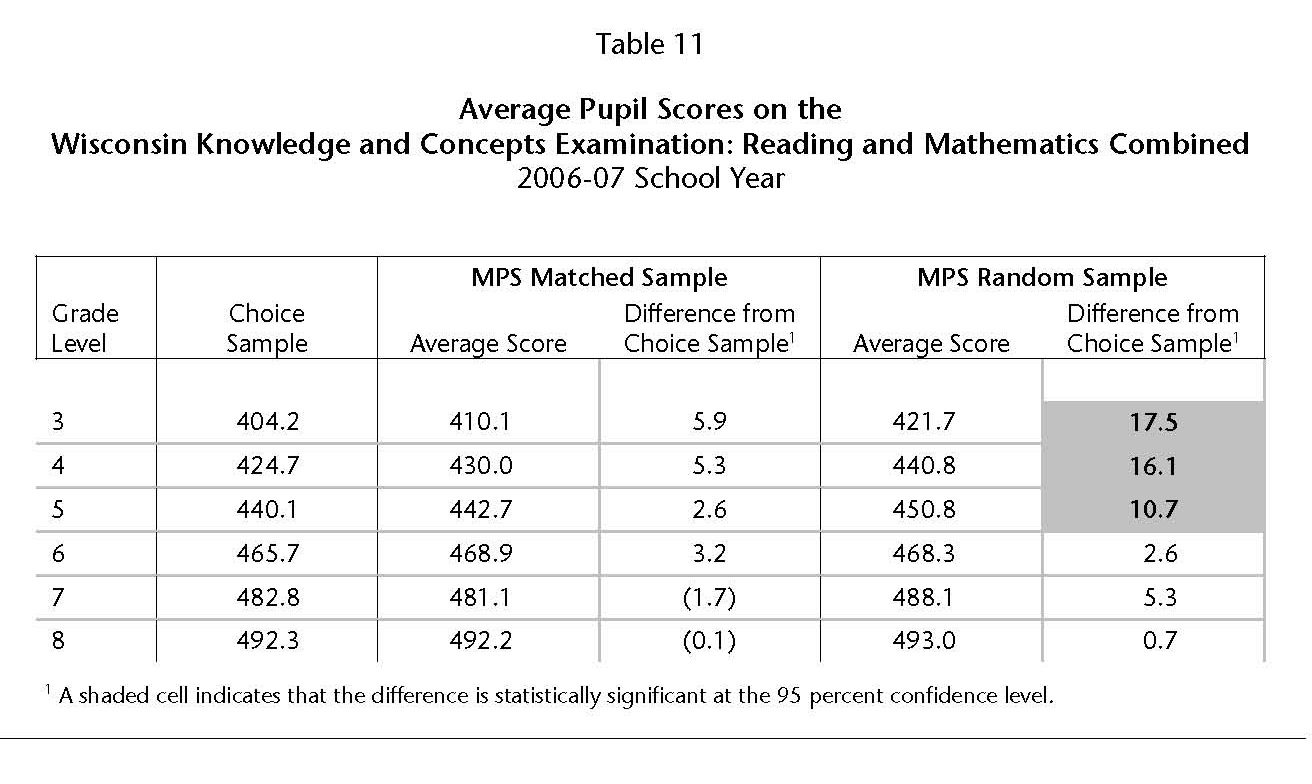
The Joan Jett song at the top is there as a reminder that despite all the faults and missteps, MPS does many things well and if it were gone these things would be lost.  The recent comparison of MPS student achievement and  voucher school student achievement demonstrated that Milwaukee schools does as well or better than the only alternative anyone has come up with.

Unfortunately, Governor Doyle has added fuel to the fire being stoked by the anti crowd.  He wants a “complete evaluation” of the situation “wants to know whether MPS is making the best use of the money it has.”  Investigation is in order, but this kind of language isn’t helpful.  First, no organization as large as MPS (or the State of Wisconsin, or AIG, or…) ever always “makes the best use of” their resources.  There are always mistakes and there is always waste.  Every effort can and must (and has) been made to improve, but the “best use” standard is false and unachievable, kind of like all students proficient under NCLB.  Second, Doyle is well aware of the statewide problems caused by a broken school finance system and the particulars of how these have played out in Milwaukee.  Being no fool, he knows that these — not local mismanagement in Milwaukee or Wausaukee —  are the primary problem.  Thus far he has lacked the political courage to act on this knowledge.  There is much hope in some quarters that the election results in November will change this.

A teacher blogger at School Board Watch has the right idea about how this might happen:

I want every school board member to get to Madison weekly and tell the real stories of MPS and our kids. I want the Milwaukee newspapers to ask teachers what we need, and then tell those stories; and even more than that, I want the MJS to get behind a better way of funding schools…

I want the citizens of this state to listen to Libby Burmaster when she says that Wisconsin schools have reached their limit.…because the reality is that MPS is suffering, but so are Florence, River Falls, Sparta, Kimberly, and Hazel Green. And I want everyone to know that we are teaching the greatest proportion of kids in the state who have needs beyond what most of us can imagine or understand.

Next to last word goes to another Milwaukee educator/blogger and a favorite with the AMPS team, Jay Bullock of Folkbum’s Rambles.  He does a fine job reviewing the particulars of the funding situation and ends with a very pessimistic thought,

More likely, it will simply increase the rate at which the parents who can keep bailing on MPS. Those departing students leaves a harder-to-teach population behind, compounding every one of our most expensive problems exponentially.

This is the “starve the beast,” “going out of business,” death spiral that is the dream of the provocateurs of privatization.  We can’t let that happen.  We need to remember the common good and work for it.

The Milwaukee voucher program has hurt the schools financially and already put the district in the targeting sites of the antis.  We have to stand up for Milwaukee and all the other threatened districts before the death spiral is out of control, before it is too late.

Give our schools a system of allocating resources that works, give those that are struggling some time and then see what happens.  These things have to happen in that order, to judge so harshly the products of a broken finance system is senseless.

Thomas J. Mertz

Leave a comment

Filed under "education finance", Accountability, AMPS, Best Practices, Budget, education, finance, Local News, nclb, No Child Left Behind, School Finance, Take Action, Uncategorized

Most Excellent Band-Aids: Elizabeth Burmaster, State of Education and Budget Proposal

Excerpted.  Full presentation, including Madison Supt Dan Nerad, at WisconsinEye.

[SAGE section edited to correct a misunderstanding, TJM]

Yesterday, Wisconsin State Superintendent of Public Instruction Elizabeth Burmaster gave her annual “State of Education” speech and released a budget proposal which would greatly improve the state of education (press release, here).  It isn’t comprehensive reform, but the message and the proposals are very good.

In the speech, she presented “access and opportunity in public education” as “moral issues,” “social justice issues,” and as an “economic imperative.”

This strong and accurate rhetoric was accompanied by a realistic portrayal of the harm that our broken system of funding education has wrought over the last 15 years and promising budget initiatives to put Wisconsin back on the right path.

Some highlights on the state of education.

Public education in Wisconsin has been stretched to the limit. Wisconsin’s dedicated educators have been resilient in balancing the needs of today with tomorrow’s expectations….

Faced with 15 years of revenue caps and rising costs, school boards have struggled to preserve academic success and promote innovation. They have been forced into agonizing decisions to close schools, cut programs, eliminate services, and limit educational opportunities.

Public education in Wisconsin has been stretched to the limit. Is the breaking point near? Ask any one of these district superintendents. Our schools and communities can stretch no longer.

Today, I am proposing a state education budget that significantly reinvests in our PK-12 system.

These budget highlights appeared in the speech:

A budget that commits to two-thirds state funding.

A budget that brings local property taxpayer relief.

A budget that prioritizes early childhood education, small class sizes, global literacy, teacher recruitment,compensation, and repeal of the QEO.

A budget that addresses increasing child poverty and the rising cost of transportation, special education,English-language learners, public libraries, and operating small, rural school districts.

And, a budget that, for the first time in 15 years, provides real revenue limit relief for all our schools.

As always, the devil is in the details; in this case the details are good.

Restoring real 2/3 funding is huge, but for many  districts the biggest boon would be the Revenue Limit Flexibility proposal (not all — see the problems of Milwaukee, which does not tax to the limit now).  This would allow for annual per pupil revenue authority increases of $335 in fiscal year 2010 and $350 in 2011; in percent terms this moves the limit increase from about 2.5% to about 3.0%.  In real dollars (based on stable enrollments), for MMSD this alone would mean about $1.2 million more in 2010-11 than would be available if current law continued (the MMSD projections for the referendum use a somewhat lower estimate of future revenue authority).  It gets better.

There are lots of meaningful adjustments in categorical aids and other things.  I’m just going to note that there is a proposal for a significant increase in Sparsity and Transportation, which would help the “small but necassary” districts that have been struggling for years and concentrate on the SAGE, Bilingual/Bicultural and Special Education portions.

The SAGE proposal uses the phrase “fully fund.” This addresses situations like the one in 2003-4 when districts submitted reimbursements for more students than had been budgeted for.  It would entail an increase of $3.7 million the first year and about $5.4 million the second.

Tempering my enthusiasm (along with knowledge that this just the first step of a long budget process) is the increasing difficulty of districts in covering the local costs of implementing SAGE (see here), the lack of any expansion in the number of SAGE contracts and the lack of a poverty categorical aid beyond the early grades.  As many of you know, Madison and other districts have had to make some hard choices when assigning their limited SAGE contract to particular schools and many poor children in schools with 30% or less poverty rates have been left out as a result.  We are also all aware that the educational problems associated with poverty are not confined to the early grades and that many poor children also move frequently and will come to districts in the later grades without having had the benefits of SAGE funded small classes.

Bilingual/Bicultural aid rates would remain at the current 12%.  Nothing to get excited about, but in the current anti-immigrant political climate maintaining the status quo is something.

Burmaster also proposes that the basic 28% Special Education rate is be maintained and that High Cost Special Education be fully funded (in fiscal year 2008 it was prorated at 39.6%).  The first year increase in the High Cost aid is from $5.4 Million to $7.4 Million, which is significant.

There is much more here that is good — click the links at the top to explore –, but the basic, broken structures remain intact (despite a call for the repeal of the QEO).  I’d still like to see comprehensive education fiance reform, reform that begins with the question “What does quality education for all children, in each of our districts cost?, ” and finds an answer to the revenues questions next.  What Burmaster has proposed is another set of band-aids —  most excellent band-aids of the highest quality administered with great skill and expertise — but band-aids, nonetheless.

Then there is the whole matter of the Governor and the Legislature taking Burmaster’s proposal and doing what they will with it.  One more reason to elect a pro-education Assembly.

Thomas J. Mertz

Leave a comment

Filed under "education finance", Best Practices, Budget, Elections, finance, Local News, School Finance, Uncategorized

Schools and the Common Good

Elsewhere, I’ve touched on the history of public education and the important idea of the “Common,” as in the Common School and the Common Good. My whole thinking about public education is that our schools are where we express our vision of a good society and try to create that society. In doing this we come together, finding common ground, defining the common good while preparing our children to contribute to a society where the common good is paramount.

This is by definition a secular project; church and state are separate.  The creation of public schools was in part designed to secularize the notion of a common good. But religious groups and thinking are an important part of our society and those visions remain relevant. Earlier I posted some excerpts from the United Church of Christ on public education. Today I’m posting some thoughts from a recent document in the Catholic Social Action tradition, a tradition that has shaped who I am. These come from, A Platform for the Common Good, drafted and ratified by a coalition of Catholic organizations. One of the authors, Robert Beezat, will be speaking at Edgewood College on September 25.

Under the heading of “Promote the General Welfare” there are calls to action on a number of topics, including education.  This is what the platform has to say.

Government Action Needed:

On Education

  • Increase education funding and distribute resources equitably, with special attention to schools in low-income neighborhoods
  • Pay teachers fair and adequate wages and institute programs to encourage teacher retention
  • Provide more arts, music and other cultural enrichment courses
  • Ensure that special education students have the resources and trained teachers they need
  • Ensure that education includes life skills and vocational training to prepare students for jobs
  • Provide free universal preschool/Head Start
  • Fund educational mandates.

Individual/ Community Action Needed:

  • As parents, be involved in our children’s education
  • Hold regional school boards accountable.

Other education related planks appear elsewhere, under the headings “Establish Justice” and “Ensure Domestic Tranquility.”

  • Work to lessen income disparities and to reform tax policies that favor the wealthy and corporate interests.
  • Acknowledge that discrimination, including racism and sexism, continues to impact public systems and encourage public employees and others to engage in anti-discrimination training
  • End discrimination in all institutional forms.Support and promote programs that promote a fair distribution of resources and serve vulnerable populations
  • Support and promote programs and activities that address prejudice and discrimination
  • Write letters to the editor and op-eds to encourage anti-racism education and better relationships within our communities
  • Fund after-school programs, jobs for youth, and continuing education (GED, ESL) for adults

Many, many good and important ideas about how to work toward the common good.  These ideas should be at the heart of the Church’s work, but often get lost.

Thomas J. Mertz

Leave a comment

Filed under "education finance", AMPS, Best Practices, education, Elections, Equity, finance, National News, nclb, No Child Left Behind, School Finance, Take Action

A Blow to School “Choice” in Wisconsin

The Wisconsin Legislative Audit Bureau has released their legislatively mandated report on Test Score Date for Pupils in Milwaukee’s Pupil Choice Program (voucher schools).  The news is not good for choice advocates.  In every instance where there was a statistically significant difference between choice students and students in traditional public schools, the students in the traditional public schools did better.

I’m sure there will be lots of spin from all sides, but to me the choice this recommends is very clear.

One caveat — I do not now and never will think standardized test scores should be the sole measure of school quality.  They are part of the tool kit and in this case a part that favors MPS over choice schools.

Thomas J. Mertz

Leave a comment

Filed under Accountability, Best Practices, education, Local News

Why Arbitration Is Rarely a Good Idea

The Adverts, “Bored Teenagers” (click to listen or download)

Portuguese Joe. “Teenage Riot” (click to listen or download)

I’ve written many times about why it is rarely best for School Districts to use the arbitration procedure available under the Qualified Economic Offer law (most extensively, here).  There is new evidence from Wauwatosa of the harm that arbitration can cause.

In that district, the Board has chosen to invoke arbitration; in response the teacher’s are “working to contract.”  That means that they have ceased to volunteer their time outside of required hours and duties.

According to WauwatosaNow, “a lot of teachers are cutting back on volunteering for after-school activities and writing letters of recommendation for students.”

Although involvement in many co and extra curricular activities is paid and contracted, not all is.  Our teachers volunteer because they care and the efforts they put in as volunteers often make connections with potentially “disconnected youth.”  With no volunteers, fewer connections, more bored and disconnected youth, more delinquency….

One more thing to think about next time you hear complaints about School Districts avoiding arbitration.

Thomas J. Mertz

Leave a comment

Filed under "education finance", Best Practices, Budget, Contracts, education, Local News, School Finance

We Are Not Alone #23 – Wisconsin Referenda Roundup, Tuesday, September 9, 2008 votes.

[Updated with more video on Montello, Sptember 7, 2008, 11:45AM]

The number of school districts seeking sufficient funding via referenda this Fall (September and November) keeps growing. My count is 20 districts committed to 23 referenda questions (12 questions in September), and this does not inlcude the Madison referendum, which will become official on Monday, September 8.

Do we really need any more evidence that the way Wisconsin funds schools doesn’t work?  As Beth Sweeden exemplified so well in  “I Just Want to Be A School Volunteer Again,” (her open letter to the Joint Finance Committee a year and a half ago), too many good people  —  educators, parents and others — are putting too much energy into trying to address the structural budget gaps the system creates, energy that could and should be spent working to help educate and improve our schools.

Today I am mostly going to write about the operating referenda not related to new capital projects to be held next Tuesday, September 9.  I’ll get to the November 4 measures eventually.

The debt/building votes include two from Colby (see here and here for more); Poynette seeking $13.4 million to build and equip a new K-3 school; Rhinelander is asking for $23.575 Million for a variety of building and upgrade projects and related operational costs (in a second question); and Shawano is requesting $24.9 million to build “a new energy efficient Early Childhood through grade 2 school; [make] improvements [to] and [build] an addition to the Olga Brener elementary school to convert it to a grade 3 through 5 facility; and equipment acquisition related to said projects.” The Shawano Leader has some good stories (including “New school could be boon to economic development“).

That leaves seven operating referenda being voted on Tuesday.

Deerfield, after extensive community input and involvement, is asking for five year non-recurring authority to address structural operating revenue gaps in amounts ranging from $275,000 to $475,000 per year.  I liked this from the Community Advisory Committee’s Final Report:

Ideally, some time in the next 5 years the Wisconsin State Legislature will come up with a more sane way of funding K-12 education than pitting schools against homeowners. (We can always hope…).

I was also impressed with the district referendum web page.

Another Madison neighbor, Mineral Point, has a five-year nonrecurring referendum on the ballot.  The annual amounts escalate from $590,000 to $1 million.  The district’s referendum documents are here.  This is from the “Why a Referendum” document:

The Referendum Remedy

The revenue gap and the declining enrollment penalty are built into Wisconsin’s school funding formula. Together they ensure under funded schools.  State law allows school districts to exceed the revenue limit, but only by conducting a referendum vote.

Preserving Quality Education

School quality means many things to many people and Mineral Point has high expectations for its schools.

  • Quality means good instruction in core academic classes and Mineral Point students out perform students statewide on nearly all measures.
  • Quality means providing opportunities in the fine arts, world languages, career and technical courses, health, PE, and extra and co-curricular activities.
  • Quality also means providing program variety so that students of varying interests and abilities can pursue a meaningful educational path.
  • Quality means being able to attract and retain quality staff members who are highly skilled, motivated and hard working. And that means competitive wages and benefits, ongoing training, the tools to work with and reasonable workloads.

The only path to maintaining quality education is via referenda.  This has to change.

Montello will also vote on a nonrecurring operating referendum on September 9.  After three failed referendums in the last year or so, they are only asking for two years at $950,000.  Consolidation talks with Westfield continue and dissolution is very much on people’s minds.  Administrator Jeff Holmes broached the topic back in July, now Board Member John Sheller is “scared to death” about the possibility.  Here is a video report from WKOW-TV:

And another from WISC-TV.

If the referendum fails, we may have another Florence or Wausaukee to deal with.

It is nice to see the Madison media cover this story.  It would be better yet if they did more with the big story of how the way all districts are funded makes it extremely difficult to maintain quality education and they should place the pending Madison referendum in this larger context.

Neillsville had a failed referendum in 2006, now they are asking for a five-year non recurring authority in the amount of $300,000 a year.  According to the district fact sheet, because of declining enrollments and rising property values passing the referendum will still result in property tax mill rates going down in the district.  Video from WEAU on this one:

Neillsville, like all districts, is facing rising energy costs and would like to invest in greater efficiencies for long-term savings, but are unable to under the revenue caps. The referendum would not only preserve educational quality, it would allow them to take this important step.

The small Rubicon Joint 6 district is trying for a three-year nonrecurring at $150,000 a year.  In the recent past, they have eliminated World Languages and instructional aids, reduced Physical Education, Art, Music, Reading Specialists, Guidance, and Library services.  They have prepared the following cut list for consideration in the event of a failed referendum:

Eliminate Cleaning (currently 50%)
Eliminate Guidance (currently 40%)
Eliminate Secretarial/Tech support (currently 80%)
Eliminate Writing tech (currently 20%)
Eliminate PE (currently 60%)
Eliminate Art (currently 25%)
Eliminate General Music (currently 25%)
Eliminate Instrumental Music (currently 25%)
Eliminate Instructional Aide (currently 50%)
Eliminate Forensics
Eliminate Student Council
Eliminate School Nurse
Eliminate Athletics
Eliminate Librarian (currently 20%)
Eliminate Library Aide (currently 80%)
Reduce Administrator 40%
No new text books
Minimal Support Staff Salary Increase
Increase student fees $20/child
Increase Athletic fee to $40 per child
Reduce tech upgrades to $1,000 per year
No additional middle school lockers (currently more students than lockers)
No new English text books
Reduce classroom supplies

Is there any doubt that these cuts would harm the education of the students?

The Salem School District voters will decide on a $1.16 million recurring referendum on Tuesday.  In June a smaller four-year nonrecurring referendum failed by 34 votes out of 504 cast.  Major cuts loom there too.  Technical Education and Gifted and Talented may be eliminated, class sizes will increase up to 29 or 30, Chior and languages would be reduced, a total of 13 staff postions would likely be cut (see here, here and here for more details).  Insanity.

Last, but not least is Weston.  An April vote on a recurring referendum failed 395-364 (much more here).  The new proposal is nonrecurring at $210,000 the first two years and $575,000 the last year.  Like elswhere, the cuts have been going on for a long time and getting deeper each year.  Republican State Senator Dale Schultz (a favorite on AMPS) was quoted on the referendum in Weston and a possible future referendum in Reedsburg:

“It’s just a dirty shame people have to put so much time and effort into another referendum,” Schultz said…

Schultz praised Weston administration and school board for doing all they could under the existing system.

“They have done an excellent job being fiscally responsible,” Schultz said. “I don’t know what more people could expect from a school district.”

Maybe he read Beth Swedeen’s letter.  It sure sounds like it.

I wish all the districts well and hope they all pass.  Check back after Tuesday for the results and updates on the November referenda in the weeks ahead.

Thomas J. Mertz
Leave a comment

Filed under "education finance", AMPS, Best Practices, Budget, education, Elections, finance, Local News, Referenda, referendum, School Finance, Uncategorized, We Are Not Alone

Quote of the Day – [School] Districts at a Disadvantage

It wasn’t until after a recent school board meeting while listening to the views of a vote no taxpayer that “it” hit me. This opponent of the upcoming referendum will vote no due to rising taxes in his township. He said, “I can no longer afford to pay the $50 a year that it will cost me to support the Rhinelander School District’s referendum because my township continues to raise my taxes and I need this $50 to pay for those.”

It was at this moment that the “Catch 22” hit me and I realized that school districts are at such a disadvantage. Taxpayers have little say over tax increases from other governmental agencies when they need something, yet schools are required to get voter approval. The fallout of this situation is school districts so often being wrongly accused and somehow responsible for rising taxes, along with the divisions in the community. He said, “The $50 per year that it will cost me for a successful referendum is just too much to support education, students, and our community.”

Dave Wall, letter to the editor, Rhinelander Daily News

Mr Wall is exactly right.  I am reminded of the fact that the City of Madison is budgeting based on a 4% annual increase.  School districts under the revenue caps budget for increases of about 2.5% and require referenda to issue debt over $1 million.

Thomas J. Mertz

Leave a comment

Filed under "education finance", AMPS, Best Practices, Budget, education, Elections, finance, Quote of the Day, Referenda, referendum, School Finance, We Are Not Alone

Back to School

“Up in the morning and out to School…”

Chuck Berry, “School Days.”

Thomas J. Mertz

Leave a comment

Filed under Best Practices, education

Margaret Haley: A Heroine of Education, Labor, Feminism and Politics

“Educate in order that your children may be free.”

Irish Proverb often quoted by Margaret Haley.

“Only through the freedom of their teachers could the children remain free.”

Margaret Haley, ca 1899.

Margaret Haley is one of my heroes.  She was a woman of great ideals who acted on these ideals and accomplished much.  She began as an underpaid elementary school classroom teacher, with no job security and subject to the whims of her supervisors. To win protections, security and respect for the mostly female elementary school teachers, she organized the Chicago Teachers Federation (CTF).  She led the affiliation of the CTF with the Chicago Federation of Labor and fully participated in the radical world of turn-of-the-century labor politics in that city.  She was the first woman to speak at a National Education Association meeting where her 1904 talk “Why Teachers Should Organize” scandalized the conservative, professor-and-administrator-dominated organization.  She helped secure the passage of Illinois’ Woman’s School Suffrage law, which like those in about 30 other states and territories granted women limited suffrage and office-holding rights for school related elections and posts.  She was a fighter; her autobiography is titled Battleground and she was dubbed a “lady labor slugger.” You can see why she is one of my heroes.

Perhaps her finest hour was the 1900 “tax fight.”  When the Board of Education pled poverty and failed to pay hard-fought-for raises to the teachers in the CTF.  In order to remedy the situation, Haley led a team that researched and then sued to secure back taxes totaling over $600,000 from major utility and street car companies; money that the politicians were not interested in collecting.  This was more than enough to pay for the raises.  At about the same time she exposed sweetheart and (tax free) lease arrangements of School District property with major Chicago businesses, including the Chicago Tribune.  The courts refused to find wrong in the Tribune case, but Haley had many successes fighting for education against corporate power and the politicians who protected that power.

For more on Haley, see:

Citizen Teacher, by Kate Rousmaniere.

Battleground: The Autobiography of Margaret Haley (edited by Robert L. Reid).

“Margaret Haley calls for teachers to organize,” History of Education, Selected Moments in the 20th Century.

Margaret Haley (1861-1939) – Early Career, The Chicago Teachers Federation, American Federation of Teachers, Politics, Haley’s Contribution, by Kate Rousmaniere.

Encyclopedia of World Biography on Margaret A. Haley.

“Being Margaret Haley, Chicago, 1903,” by Kate Rousmaniere.

Happy Labor Day

Check out the LaborFest (1602 S. Park, 12:00-5:30), great atmosphere, great music, good food, cold beer, fun for the kids.  I’ll be there, both to celebrate with my family and friends and to promote the November MMSD referendum with CAST.  Come and raise a glass to Margaret Haley and others worth honoring.

Some Labor Day Music Videos:

“Union Maid,” Pete Seeger and Arlo Guthrie

“Salt of the Earth,” The Rolling Stones

“There is Power in a Union,” Billy Bragg

Thomas J. Mertz

2 Comments

Filed under "education finance", AMPS, Best Practices, Blast from the Past, education, Local News, Referenda, referendum, School Finance, Take Action, Uncategorized