
Category Archives: Best Practices

On the Agenda: MMSD Board of Education, the Week of August 30, 2010

Note: For a while, I’m going to be illustrating the “On the Agenda” posts with various graphs documenting achievement gaps in MMSD as revealed by the admittedly flawed and limited WSAS/WKCE results. I think regular reminders may do some good.

Time for the Metropolitan School District Board of Education to get down to some serious work.  Past time.

I had high hopes that this would be a productive Summer for improving education and the governance of education in MMSD, but with 1/3 of their term complete this Board hasn’t given the public much to see.  I phrased that carefully because the one thing they have been working on is the Superintendent evaluation and all that has taken place behind closed doors, so the public hasn’t seen anything (yet, I hope).  More on the Superintendent evaluation below.

Two meetings this week; one open to the public and the other another closed session on the Superintendent evaluation.  The open meeting is 5:00 Monday, August 30 at the Lowell Center, 610 Langdon Street, Madison, WI, Room 118.   Note that this location means that there will be no broadcast or video record of the meeting via MMSD-TV.  The closed meeting is Tuesday at 5:00,  Room 103 or the Doyle Building.

The open meeting is billed as a “Workshop,” so no public testimony invited.

The first item is the approval of numerous minutes of previous meetings: October 23, October 26, 2009; February 22, March 15, April 5, May 10, June 1, June 21, June 23, and June 28, 2010.

Next comes:

Standing Committees of the School Board: Review of experience to date under the standing committee structure established by Board Policy 1031 and appointment of standing committee chairs and discuss various options.

The current structure — described in the linked policy —  was put in place at the request of Superintendent Dan Nerad.

This and other items on the agenda closely resemble the items on  the June 21 Workshop meeting.  That meeting was about goal setting for the year and also included a discussion of committee structure.

I attended that meeting, but lost my  notes in a hard drive failure.  My memory is that some progress was made on setting goals, but there was much work left to do.  My memory on the committee structure issue was that 5 of the 6 members with experience under the current structure desired changes, that there was interest in aligning the committees with the non-existent goals and that nothing was decided.

All this has been hanging there since June 21.  Without goals and a committees, the Summer has largely been wasted.

The next couple of items are also about Board duties and schedules:

3.Designating appointments/representatives and review of time commitments, expectations, roles/responsibilities in connection with:

a) The School Board Member liaisons to MMSD
schools/programs under Board Policy 1041;
b) School Board Member liaisons to community groups
implementing specific MMSD-supported initiatives; and
c) MMSD Board/School representation to various
organizations, associations, boards, committees, etc. as
described under Board Policy 1041

4.School Board and Board Committee meeting schedule and meeting structure through the first semester of the 2010-2011 school term, including identifying potential needs for public input/listening sessions, any ad hoc committees, etc.

I’m not clear on what all these committees, programs, organizations…are, or whether any of this is new (I like the idea of new, semi-formal relationships with community organizations).

As to the schedule (#4), there is only one subsequent meeting currently scheduled;  a September 13, Special Board meeting.

After these they will consider revisions of the ethics policy.  There was a draft circulated at some meeting and I have it on file (I may try to dig it up and scan), but having seen it I’m not at all clear what they are trying to accomplish or why this has become a priority.

Last up,  is  “Next Steps for Future Board Development Meetings and Topics.’  Board development is good and important, but with only 2/3 of the term left I hate to see too much time and energy devoted to Board Development.

I keep coming back to this.  Every year about 1/3 of the time and energy is devoted to budget matters, that leaves 2/3 to try to make things better.   Put it another way; it is September, budget season starts in January.  Past time to get to work.

This just leaves the closed meeting on the Superintendent evaluation.  Not much to add to what I wrote here.  My big point is that almost all of  this process should be public.  I will repost the links to things that are public:

Superintendent Goals from MMSD Board of Education Progress Report – January, 2010.

Process for Evaluation from July 20, 2009.

Revised Process for Evaluation, August 17, 2009.

Minutes of meetings where this was discussed:  November 28, 2009September 21, 2009; September 14, 2009.

That’s all folks…

Thomas J.  Mertz
3 Comments

Filed under Accountability, Best Practices, Budget, education, Uncategorized

On the Agenda, MMSD Board of Education the Week of August 9, 2010

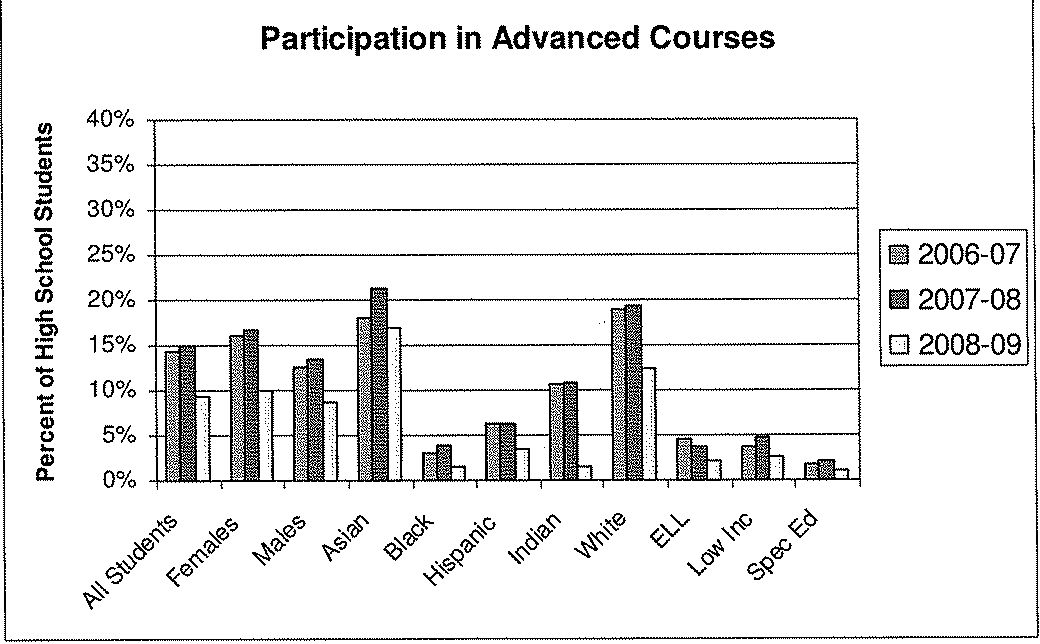
Note: For a while, I’m going to be illustrating the “On the Agenda” posts with various graphs documenting gaps in MMSD. This one is from the Equity Report, which is on the agenda.

After an unplanned break from blogging, I’m going to ease back in with a partial run down of  this week’s Board of Education agenda.

There are two meetings on Monday August 9, an Executive (closed) session at 5:00 PM in Doyle RM 103 and an open session in the Auditorium at 6:00 (plus an exchange of proposals on the Security Assistant contract on Friday).  The agendas for the first (and last) are here.  Unfortunately the link to the open meeting agenda is broken (fixed now).  A Board member scanned a copy for me and I’ve uploaded that (the hyperlinks don’t work, but you can get to the documents by pasting the appendix designation after http://boeweb.madison.k12.wi.us/files/boe/Appx, for example MM 2-8 becomes http://boeweb.madison.k12.wi.us/files/boe/Appx 2-8.pdf).

The big item of public interest on the closed session agenda is the Superintendent Evaluation.  It is perfectly legal to do this in a closed session, but I don’t think it is good policy.   Voters have only the Board to hold accountable and the Board has chosen to funnel most or all administrative accountability into the Superintendency.  The public can’t make an informed judgment on the Board when this process takes place behind closed doors.

In the two plus years Dan Nerad has headed MMSD, I haven’t seen a single document reflecting the Board’s assessment of his job performance and public discussions on this topic have been rare, indirect  and partial.

If you are interested in the terms and process of the evaluation, there are some public documents.

Superintendent Goals from MMSD Board of Education Progress Report – January, 2010.

Process for Evaluation from July 20, 2009.

Revised Process for Evaluation, August 17, 2009.

Minutes of meetings where this was discussed:  November 28, 2009September 21, 2009; September 14, 2009.

The approved Process requires that a summary document be made public.  I’ll be waiting for that.

I’ll close this section with a quote from Nerad:

Q: How do you receive feedback based on your performance?

A: One of the things that is in some ways unique… is that I report to the Board of Education. I have seven bosses, and they do an evaluation process of me… I’m a big believer in self-assessment, so part of my evaluation will be to self-assess. I’m also a believer in what’s called 360-degree feedback, where you get feedback from others involved in the organization, so part of it will involve that… So ultimately it does come down to the Board of Education with multiple kinds of inputs that evaluate my performance.

Sounds good, but having 360-degree visibility would be better.

I’m running late on this, so the only thing from the open meeting I want to highlight is the “Annual” Equity Report (annual is in quotes because the policy requiring an annual report was passed in June of 2008 and this is the first report — a previous atempt from earlier this year was sent back for revision — I wonder if any of this came up in the Superintendent Evaluation?).

You can read more about my hopes and wishes for the Report in this post and this one too.

In terms of information provided, this version is an improvement over the first attempt.   That said, there is still room for improvement (both with the report and in achieving equity) and there is at least one thing about the first version I like better.

What I liked about the first version was that it attempted to identify district initiatives that addressed the recommendations of the Equity Task Force.  This isn’t required, but it was nice and useful.

The current version uses selected equity-related  Strategic Plan measures more than the Equity Task Force work.  In this way it serves as a preview of what can be expected with the Strategic Plan reports.

I’m withholding most judgment until I have a chance to hear the presentation and the reactions of the Board, but there are some things I do want to note.

Might as well start with the graph at the top.  Pretty disturbing.  The Equity Task Force thought that expanded access to advance programs was of the highest importance and this indicates that the number of high school students taking advanced courses is declining and the diversity of those students is not markedly improving.

Two notes before going deeper on this.  First, “advanced courses” isn’t defined and second, the graph without data makes it very hard to know what is happening with the demographics.

What is worse is the Report simply says “the reason for the decline is unclear” and moves on.  That isn’t good enough.  The purpose of having this report is to raise red flags so that inequities and bad trends get attention and action.  Noting the lack of clarity of causality isn’t going to reverse this trend.

In light of the dismal data on the diversity of TAG participation, I’d also like to see data for all advanced programs, not just high school courses.

The other thing that really bothered me was the note that the Report isn’t “applicable” to “Budget Implications.”   This appears to be pro forma, but resource allocations are central to the concept of equity advanced by the Task Force and reflected in the district Policy.  Quoting from the Policy:

Achieving equity often requires an unequal distribution of resources and services in response to the unequal distribution of needs and educational barriers.

How can you have  report on Equity that reflects this assertion and has no budgetary application?

Other things to note:

  • More presentations of data by school would be good.
  • The extensive use of climate surveys is a good idea (these are broken down by school), but I’d like to see school level demographic breakdowns here.

I want to get this up, so I’m leaving it at this for now.

Thomas J.  Mertz

Leave a comment

Filed under Accountability, Best Practices, Budget, education, Equity, Local News, Uncategorized

Hearing on Edgewater TIF (yes, this is about schools)

See below for hearing information, background and talking points on the Edgewater TIF.  This directly impacts the schools by diverting property taxes.

Joint Review Board Hearing and the Edgewater Project

On Thursday, August 12, 2010 the TIF Joint Review Board will be holding a public hearing on amending Tax Incremental Finance District (TID) 32 in order to provide over $18 million in property tax based financing for the proposed luxury hotel plaza. The Board meets at 5:00 PM, 215 Martin Luther King, Jr. Blvd. Room 260 (Madison Municipal Building). Speakers will have three minutes to testify. A vote is anticipated in September.

If this goes through the closure of TID 32 will be delayed, meaning that for six years the benefits from that TIF investment will be used for the Edgewater instead of to fund schools, city and county services and MATC. With the schools and other local governments suffering from decreased state support and families having trouble with property tax increases this is a bad idea.

Below is some background information along with some suggested talking points. The Joint review Board needs to know that their constituents understand the issues and oppose the TID amendment. Please consider attending the hearing, testifying and/or contacting the Board and appointing authorities. It isn’t too late to stop this.

TIF Basics

The idea behind Tax Incremental Financing is that a government body promotes development and funds infrastructure in “blighted” areas by borrowing against anticipated property tax revenues and then designating the growth in revenue due to the development (the increment) to repay these loans and associated costs. Once the loan is repaid and the district is closed, the increment becomes part of the general tax base.

TID 32 and the Edgewater

TID 32, anchored by the University Square redevelopment has been extremely successful. It is generating about $3 million annually in increment and is projected to close in three years.

The increment for the Edgewater project only meets the requirements for a stand alone TIF of $3.3 million. In order to give the project over $18 million in financing (or $15 million more than it can support) it has been proposed to annex the project to TID 32 and use the success of that TID to finance the luxury hotel plaza. This delays the closure of the district and postpones the time when the success of TID 32 will ease the property tax burden on the rest of us. While the TID is open, all increases in assessments and revenues in the district – whether related to the project or not – will be diverted to pay for the luxury hotel plaza, further shifting the tax burden.

Projections indicate that the amended TID would close in nine years, or six more than without the amendment.

The Joint Review Board

Because diverting property taxes to developments via TIFs has an effect on all taxing entities, state law requires that TIFs be approved by a Joint Review Board where these bodies are represented. In considering the creation or amendment of a TID the Board must employ these criteria:

  • Whether the development expected in the TID would occur without the use of TIF (commonly referred to as the ‘but for test’).
  • Whether the economic benefits, as measured by increased employment, business and personal income and property value, are sufficient to compensate for the cost of the improvements.
  • Whether the benefits of the proposed plan outweigh the costs, in taxes on the value increment, to the overlying tax districts.

Although the “benefits” language in the third is somewhat open ended, considerations of the architectural or historic appropriateness of the project are largely outside the charge to the Board.

Of primary concern to the Board is whether temporarily diverting the projected tax revenues to support this project is in the best interest of the taxpayers and bodies they represent — Madison Metropolitan School District (MMSD), Madison Area Technical College (MATC) and Dane County.

Property Taxes, State Aid, Shared Revenue, the Economy and TIFs

The bulk of the City, the County, the school district and MATC budgets are funded by a combination of state aid (or shared revenue) and property taxes. The recent economic downturn and a continuing state structural deficit – projected at over $2.5 Billion for the next biennium – has shifted more of the responsibility to local property taxes. This has hit the school district particularly hard, with nearly 15% cuts in state aid the last two years and more of the same anticipated.

The economic downturn has also slowed the growth of the property tax base. The aggregate assessments of existing property has fallen slightly and growth due to new development is below previous years. Under these circumstances, increases in property tax revenues to make up for decreases in state aid require existing property tax payers to pay more.

All the taxing entities have sought cuts from same service budgets in order to ease the burden on tax payers. Again, the schools have been hit particularly hard, enacting more than $13 million in budget reductions for the 2010-11 school year.

Timely closure of TID 32 would ease this situation by adding the increment to the tax base; extending the life of TID 32 to fund the luxury hotel plaza would make it worse.

Talking Points

Based on the Above:

  • The Edgewater Project can’t support the TIF.
  • The taxpayers, the schools, MATC, the County and the City would all benefit from an early closure of TID 32.
  • Delaying the closure of TID 32 will result in at least a $15 million property tax increase over the next nine years.
  • The economic situation has already lead to property tax increases and cuts to programs and services; amending TID 32 will exacerbate this at a time when both families and governing bodies are struggling to make ends meet.

Other Things to Consider (most detailed in this briefing from CNI):

  • The ratio of private investment to TIF isn’t good policy.
  • The costs and benefits are not substantiated (The Joint Review Board has the power to request more information and a review of information they consider unsubstantiated)
  • These include project costs as well as job and property value projections.
  • Costs assigned to the TIF do not meet TIF requirements.
  • This project requires deviations from guidelines in self-support, 50% payback, equity participation and personal guaranty.
  • The operating agreement for the Plaza limits public access and works to the benefit of the hotel through catering and other requirements.

Contact Information

If you cannot attend the hearing, you can contact the Joint Review Board via email:

Dean Brasser
dbrasser@cityofmadison.com

Gary L. Poulson
GaryPoulson@gmail.com

Roger Price

rwprice@matcmadison.edu

Lucy Mathiak
lucym@charter.net

Dave Worzala

worzala@co.dane.wi.us

You can also contact the appointing bodies and ask them to advise their Member to vote against the amendment:

MATC Board

http://matcmadison.edu/email-district-board

Dane County Board

county_board_recipients@co.dane.wi.us

MMSD Board of Education

board@madison.k12.wi.us

Thomas J. Mertz and Jacque Pokorney

Co-Chairs, Progressive Dane

Leave a comment

Filed under "education finance", Best Practices, Budget, education, finance, Local News, School Finance, Take Action

How low can you go? Obama, EduJobs and Food Stamps

Eddie Bo, “Lets Limbo” (click to listen or download)

The latest on the Obama Administration’s ridiculous priorities, from an interview with Rep. David Obey:

We were told we have to offset every damn dime of [new teacher spending]. Well, it ain’t easy to find offsets, and with all due respect to the administration their first suggestion for offsets was to cut food stamps. Now they were careful not to make an official budget request, because they didn’t want to take the political heat for it, but that was the first trial balloon they sent down here. … Their line of argument was, well, the cost of food relative to what we thought it would be has come down, so people on food stamps are getting a pretty good deal in comparison to what we thought they were going to get. Well isn’t that nice. Some poor bastard is going to get a break for a change.

Can’t cut the military, can’t raise taxes on the rich and corporations, need to bail out Wall Street; Race to the Top’s destructive policies are popular with the Newt Gingrich’s we want to apeal to…let’s cut food stamps.

The answer to the titular question is “lower than a pregnant snake’s belly.”

Thomas J. Mertz

Leave a comment

Filed under "education finance", Accountability, Arne Duncan, Best Practices, Budget, Gimme Some Truth, National News, School Finance

A New Blog from Board Member Ed Hughes

Madison Metropolitan School Board Member Ed Hughes has a new blog up and if you care about accuracy in discussions of the district it is a must read (unfortunately many don’t care).

The majority of the initial entries are on the maintenance issues raised in Susan Troller’s recent Cap Times article and the reactions to that article.  There is also a nice piece on the disappearance of the traditional special section in the State Journal recognizing the top area scholars (a section I too enjoyed but also viewed as an annual reminder of our achievement gaps) and a post that notes how the use of the mythical $250,000 house as the basis for property tax comparisons obscures the fact that despite consecutive annual cuts in state aid of 15%, the district-wide tax increase is only 5.76 (as compared to MATC’s 8.94% increase).

This a really good start and I’m glad Ed Hughes is doing this.

Two pieces of  unsolicited advice:  First, give us more links, especially when referencing district documents; number two is harder and something I struggle with, but be careful about assuming what your readership knows and when in doubt err on the side of providing more background.

Welcome and thanks.

Thomas J. Mertz.

Leave a comment

Filed under "education finance", Accountability, Best Practices, Budget, education, Gimme Some Truth, Local News, School Finance

On the Agenda — MMSD Board of Education, Week of June 20, 2010

Note: For a while, I’m going to be illustrating the “On the Agenda” posts with various graphs documenting achievement gaps in MMSD as revealed by the admittedly flawed and limited WSAS/WKCE results. I think regular reminders may do some good. Note also that despite recent progress, 32 point gap remains between children in poverty and those more economically secure.

A busy and important week for the Madison Metropolitan School District Board of Education (all meetings listed here, the only agenda document posted).

The important meeting is tonight’s (June 21).  This has been called a “retreat” and an organizational meeting. Apparently this calls for a change of venue; they will be meeting at 5:00 PM, Lowell Center, 610 Langdon Street, Room 118.  Among other things, this almost certainly means that meeting will not e carried by MMSD-TV.  There are  no public appearances.

Four items on the agenda and no linked documents in the original.

1. Presentation on Parliamentary Procedure

2. Goal-setting workshop surrounding best practices on the work of effective school boards, establishing MMSD-specific goals and mutual expectations to guide the processes by which the School Board accomplishes its work; and identifying specific areas of focus and priorities for the work of the School Board in 2010-2011.

3. Draft Board Ethics Policies (draft revisions to Board Policies 1540 and 9000)

4. Next Steps for Future Board Development Meetings and Topics

What this is all about is what the Board wants to do in the next year and how they intend to go about doing it.  I’ve heard rumors a Five Year Budget project (with a Committee of Board members being formed), a Committee Restructuring, desires to reform the annual Budget Process (Yeah!), and Ethics policies designed limit conflict in public meetings.

I really hate that matters of such import will discussed and perhaps decided without any direct input from the public.  Maybe,  just maybe “stakeholders” would have something to contribute to setting the goals for the Board and the district and maybe interested citizens might have some ideas about how things could be better accomplished.   When things are done in this manner it is hard to take seriously the Board and district’s expressed desires for community engagement.

Other meetings This week:

Tuesday, June 22 MMSD Building Services, 4711 Pflaum Road, Large Conference Room
1:00 p.m.
Collective Bargaining – Exchange of Proposals
Initial exchange of proposals and supporting rationale for such proposals in regard to collective bargaining negotiations regarding the Local 60-Custodial Collective Bargaining Unit, held as a public meeting pursuant to Wis. Stat. §111.70(4)(cm).

Wednesday, June 23, Doyle Administration Bldg.,545 W. Dayton St., Room 103
5:00 p.m.
Special Board of Education Meeting (agenda items 1 and 2 in Open Session)
1. Approval of Minutes dated June 7, 2010
2. Proposed contracts between Google, Inc. and MMSD for the provision of “Google Apps” education edition, including but not limited to “Google Docs” and “Gmail” electronic mail system functionality and services, and for the provision of email archiving functionality and services
Special Board of Education Meeting Continued in Closed Session
3. Review of and Receipt of Advice from Counsel regarding Disciplinary Proceedings and Decisions involving Individual Students, Including a Request for Reconsideration of a School Board Disciplinary Order, pursuant to Wis. Stat. §§19.85(1)(a), (f), and (g); and 118.125 and/or
120.13(1)(e)
4. Employment Matter (the closed session agenda items noticed under this heading shall be begin and be taken up by the Board no earlier than 6 p.m.):

a.Consideration of proposals, if any, to resolve a pending personnel matter involving the contract of an individual employee within a bargaining unit, pursuant to Wis. Stat. §§ 19.82(1) and 19.85(1)(c)
b.  A private conference concerning the renewal or nonrenewal of a teaching contract, pursuant to Wis. Stat. §§ 19.85(1)(b) and (c); 19.82(1); and 118.22(3)

c. Deliberations and determination of action to be taken with respect to the renewal or nonrenewal of a teaching contract, pursuant to Wis. Stat. §§ 19.85(1)(b) and (c); and 118.22(2)

5.  Adjournment or, if necessary, motion to continue the meeting in open session for the purpose specified under item 6, below.
Special Meeting of the Board of Education Continued in Open Session (if necessary) immediately following the conclusion of the closed session agenda
6. Determination of action to be taken with respect to the renewal or nonrenewal of a teaching contract.
7.Adjournment

Thomas J. Mertz

Leave a comment

Filed under Accountability, Best Practices, Contracts, education, Local News, Uncategorized

On the Agenda, MMSD Board of Education, Week of June 14, 2010

Note:  For a while, I’m going to be illustrating the “On the Agenda” posts with various graphs documenting achievement gaps in MMSD as revealed by the admittedly flawed and limited WSAS/WKCE results.  I think regular reminders may do some good.

Last week was Madison Metropolitan School District Board of Education Committee meetings; this week they meet as a full Board and (among other things) take votes on action items.  Prior to the open meeting there will be a closed session to discuss among other things a contract for Google apps (to replace district email with Gmail, this is also on the open meeting agenda with  a price tag, so I don’t know why it is part of  the closed session), the Superintendent Salary (I thought that had been done in closed and open sessions as part of the Budget) and the negotiation strategy for the budgeted pay freeze for support employees.

The open meeting is scheduled to begin at 6:00 PM, in the Doyle Building Auditorium.  It will be carried by MMSD-TV.

Most of the agenda items were before the Committees last week (video here).  I attended most, but not all of that meeting and rather than repeat what I wrote in the preview of that meeting will be just adding a few things.

The meeting kicks off with announcements and recognition of awards and service (full agenda here).  These include the recognition of Sarah Maslin at the end of her service and the installation of new Student Rep.  Wyatt Jackson.

The first policy item is dealing with the SAGE reconfiguration (an unposted document with more info can be found here) necessitated by recent legislation eliminating the waivers for SAGE Block (small classes for math and literacy only).  As I noted before, this has budget implications and should have been done as part of the budget process.  Because of time constraints, this was not discussed last week.

The administration recommendation is to go to 18/1 class sizes in the current SAGE Block schools (Crestwood, Gompers, Huegel and Muir) and make SAGE in the other schools “flexible” with allocations ranging from 17/1 to 15/1.  The allocations used for the recently passed preliminary budget included allocations based on the first, despite the fact that this was never addressed directly in any of the budget documents or open budget meetings.

I’m not 100% clear what “flexible” will mean in practice, but my guess is that initial allocations will be made at 15/1 but instead of new classes being added when September student counts go to 16/1, they will be added only if they go above 17/1.

I don’t like the 18/1 and I don’t like the flexibility.  I’ll add that I don’t like the lack of any consideration of expanding SAGE at any ratio to the three 30%+ poverty schools that do not have it (as allowed under the same legislation that eliminated the waivers).

MMSD can’t plead poverty as a reason to raise class sizes, not  after they left $13.5 million on the table; I’d like to see anyone with a straight face say that this would be a “do no harm efficiency.”  Some great comments on this on the WEAC site, where the Union’s positive spin was rejected by teachers and others.  I hope MMSD also rejects the spin and the changes.

Changes to Internet Access and Student records policies are next.

Then the Superintendent will present a “Protocol for the Evaluation of MMSD Programs.”  This is a step in the right direction.   A couple of things I really like are the collaborative work on research questions and design up front, with extensive Board involvement and that there instead of a promise of quick answers and fixes there is no expectation of any significant changes being implemented till year four of a six year cycle.   If done correctly this could be meaningful, useful and not just an exercise in “See, we are using data” public relations.   I know the Research and Evaluation team would like to do this correctly, let’s hope they are given the resources (along with outside partners), corporations and freedom form political exigencies to do so.

Speaking of public relations, it looks like Supt. Dan Nerad may have enlisted spinmeister James Woods (of Wisconsin Way infamy) to raise money for and draft a communications and engagement plan.  No question that Woods is good at this kind of thing, he has been able to keep a straight face for years while telling the people of Wisconsin that the likes the Realtors, WEAC and the Road Builders are civic-minded,disinterested parties selflessly seeking to change the political culture of Wisconsin for the benefit of all state residents, all the while these same parties have continued to expend obscene amounts of money to advance their vested interests, continued to be the sources of the corruption the Wisconsin Way pretends to want to change.  Yeah, he’s good.

I’d stay as far away from him as possible.   I know PR is PR, but education needs trust, not spin; transparency, not manipulation; honesty above all.  Speaking of honesty, I don’t want to hear anyone say MMSD can’t afford to hire a communications consultant.  They left over $13 million on the table; it was a choice they made not one they were forced into.

The High School Initiatives Report from the Committee meeting is next.  The reports from the individual schools were very positive and inspiring.  Many, many good things going on and more in the works.  Collaboration was a big theme.   The one thing I like the most is the expansion of AVID and the methods used by AVID.  The high school versions of the achievement gap at the top won’t change until “rigor for all” with supports is in place and AVID offers much along those lines.

Student Code of Conduct and Expulsions revisions follow.  There is some new material here on the Code of Conduct, a comparison grid (distributed at the meeting last week) here and a new appendix on expulsions here.  Based on the discussion last week and the new materials much of the discussion will focus on whether bullying is adequately and correctly addressed in the Code of Conduct.   The expulsion plan is based on offering educational services and transition help for students in the expulsion process.

The Annual Strategic Plan Review is next.   This is worth a look, especially for the progress that has and has not been made.   I had some more comments last week.  I want to add that I like there being continued community involvement, but an annual meeting is pretty minimal.  In Green Bay, under Dan Nerad, for a long time after the plan had been approved, there were monthly “strategic plan “work sessions.”

Last week I raised some questions about the budgeted but unspent ARRA items in the Monthly Financial Statements (next on the agenda).  Asst. Supt Erik Kass provided some informal answers.  I did read correctly, there are around $5 million in approved ARRA projects form 2009-10 that have not been implemented, so the money has not “flowed through.’  There are about another $5 million in projects slated for 2010-11 (much of it designated as the second year of a a two year budget).  These look to be good projects and the district needs to get moving on them.  In answer to my other question, it appears that the ARRA things are considered like special grants and are therefore outside the budget process.  I don’t like that and think you could make a very good case that it is a violation of the state statutes governing the budget.  I’m not going to push that case — all this was done in public I don’t think it is worth fighting that fight — but when the budget process spends time on things like food for receptions, I believe these substantial funds and significant initiatives should be included in the discussion.

Lots of bills, contracts, RFPs and the like come next.  Some are consent items, some aren’t.

There is also a revised Human Resources report.  I didn’t take the time identify the revisions.   I think I forgot to note previously that this confirms John Harper as permanent head of Education Services.  The recommendations for administrative non-renewals for Career and Tech Ed Coordinator, Asst. Director of Equity and Parent Involvement, Expulsions and Truancy Coordinator, Library Media Services Coordinator, Fine Arts Coordinator,  Public Communication Director and Legislative Liaison remain.  The budget-related pay freeze is also listed.  In a related matter, a one month extension of departing General Legal Counsel Dan Malin’s employment is recommended, because there is no replacement in place.

I started looking for job ads related to all this.  The General Legal Counsel is here (with a May 31 deadline), the Equity Director is here, Director of Building Services is here, I couldn’t find the new Chief Learning Officer posted (I hope that means that the search is well along), but I did see that the Talented and Gifted Coordinator search has been reopened.

Reports for the Student Senate and Common Council/Board come next.

Next up is the Legislative Liaison on stalled Education Jobs Act (which President Obama gave a belated push to this weekend).  To get involved in the effort, join the Speak Up for Education and Kids Facebook group and current education related Wisconsin legislative studies. I guess our elected officials have to look busy while they ignore the funding crisis they created and proposed remedies like Penny for Kids.

The Google thing/switch to Gmail is last

Thomas J. Mertz

2 Comments

Filed under "education finance", Accountability, Best Practices, Budget, education, Local News, Pennies for Kids, School Finance, Uncategorized

On the Agenda, MMSD Board of Education the Week of June 7, 2010

The 2010-11 budget is mostly finished and the work of governing the schools begins again.  I have a couple of “in the works”  posts on budget things that may never get posted.   The short version is the process is in great need of reform and that when you don’t use over $13 million  of the revenue authority authorized by the state and voters many, many things get much harder (and I can’t think of one thing that gets easier).  The old Pogo phrase “We have met the enemy and he is us” keeps going through my head.  Leaving the budget stuff with  a big thank you to all who testified or contacted the Board.

On to this week’s Board of Education Committee meetings.  They commence at 5:00 PM, Doyle Administration Bldg, Room 103 and should be carried by MMSD-TV.

Student Achievement and Performance Monitoring Committee is first.  After Public Appearances comes a report on High School Initiatives including,

1. Individual Relationships/Engagement/Learning (REaL) School Action Plans for 2009-10
2. REaL District Action for 2009-10
3. American College Testing (ACT) Educational Planning and Assessment (EPAS) Overview and Implementation Plan
4. Advancement Via Individualized Determination (AVID) Overview
5. Individual Learning Plan (ILP) Overview and Implementation Plan

There is so much in the REaL plans that it is hard to grasp and I would think hard to evaluate what works and what doesn’t.  On the ACT, I’m just glad to see something other than the WKCE prominent in the mix.  AVID is  a great program in the Rigor for All, with supports mode.   In theory, I like the Individual Learning Plans, but I’m skeptical about how much individualization can happen when Counselor case loads are so high (300, if I remember correctly).  I fear that this will end up being current practices repackaged and not much of a change.

Student Code of Conduct and Expulsion Process reforms are next.  These are being presented as a greater alignment with Positive Behavior Support principles.  The current Code is here; Expulsions and Suspensions here.  You can compare for yourself.  A proposal to eliminate the Expulsion Navigator position was floated during the budget process.  The administration advised that the $83,000 budget line was needed for the proposed reforms.  The cost of the new expulsion process is $183,732.  This means that one week after the budget vote, there is a request for an amending vote.    There has to be a better way to do budget things.

SAGE options are next.  This is another item that has a potential big budget impact and should have been dealt with as part of the big budget song and dance.   To review, legislation was passed last session allowing SAGE class sizes to increase from 15/1 to 18/1, allowing for unlimited new SAGE contracts in  30%+ poverty schools and eliminating waivers that had been given.  MMSD has/had four schools where there were waivers for SAGE Block (small class sizes in Math and Literacy only).  I believe these waivers were unique and a remnant from when MMSD had extensive locally funded class size reductions.

SAGE block requires less general operating funding than 18/1 and much less than 15/1.  This means that all the options — except increasing class sizes — will cost more.   With no public discussion, the SAGE Block classrooms were allocated at 18/1 in the budget just passed.  No discussion.

The administration is recommending that the current SAGE Block schools go to 18/1 (really an accomplished fact, requiring 5 votes to change)  and that the current full SAGE 15/1 schools be allocated with “flexibility” between 15/1 and 17/1.  It isn’t clear if that was also part of the allocation assumptions in the budget just passed.  There are figures, but no discussion concerning expanding SAGE at any allocation level to those 30%+ schools currently allocated between 22/1 and 26/1.  These figures do not include current allocations.  A document sent to the Board earlier this year has a little more.

Class size has consistently been something community members care about.  maybe that’s why they are doing this after the budget-related public attention has waned.

Internet Access, Student Records and Evaluation of Learning Materials are also on the agenda.

Operational Support is next.

The Monthly Financial Statements (first on the agenda) again include millions of dollars in ARRA projects where the “budgeted” money has not been spent.  I’m not clear if the ARRA money is being treated as “outside the budget” or if it buried in the 2009-10 and 2010-11 budgets.   It is bad policy and probably illegal to not include it as part of the regular budget.  I hope that’s not the case (it was to at least some degree last year, where ARRA was not part of the Spring budget).  I’m also very confused about what “budgeted” means in this context and why this money has not been used, why these projects have been approved but not implemented.

Also on this agenda are lots of contract approvals, including the Global Academy and Human Resources Transactions.   Some of the effects of the Reorganization (and perhaps other things) can be seen in the recommendations for administrative non-renewals for Career and Tech Ed Coordinator, Asst. Director of Equity and Parent Involvement, Expulsions and Truancy Coordinator, Library Media Services Coordinator, Fine Arts Coordinator,  Public Communication Director and Legislative Liaison.  I hope that the last doesn’t mean that in the future MMSD does not have  a lobbyist.  I can see redefining the position, but government relations should remain part of the mix.  MMSD’s voice needs to be heard on a regular basis in the halls of power.

Also in the HR Report (but not in the MMSD Today story on retirements) is the sad news that one of my favorite MMSD teachers — Barb Rubin – is retiring.  Barb is just a great teacher who cared about her students and about equity.  Here are some links to her Classroom Action Research projects.  Congratulations on a fine career.  She’ll be missed.  I also want to express my thanks to another fine educator who is retiring.  Kathy Lyngass staffed the Equity Task Force and earned my respect and affection.  She too will be missed.

The last Committee is Planning and Development.  The only item is a Strategic Plan update.  This includes more on progress than the version distributed prior to the recent Strategic Plan meeting and little or nothing about “narrowing” the goals.

That’s all I have time for…

Thomas J. Mertz

Leave a comment

Filed under "education finance", Best Practices, Budget, education, Equity, finance, Local News, School Finance, Uncategorized

Not Gonna Fly

The Madison Metropolitan School District Board of Education will likely leave over $13 million in revenue authority unused in the district’s 2010-11 budget.

If they prioritize property tax relief over education in this manner, if they do not reallocate a significant portion of this amount to improving our schools, for at least the next year pleading a lack of resources for maintenance as Board Member Lucy Mathiak recently did,  isn’t going to fly.  Citing “resource constraints” as a reason to lower the ambitions for the strategic plan, as Superintendent Dan Nerad recently did, isn’t going to fly.

Any and all resource-based explanations for the relative failure to narrow shameful achievement gaps aren’t going to fly.  Any and all resource-based explanations for lapses in student and staff safety aren’t going to fly.  Any and all resource-based explanations for lacks in curricular breadth and depth, aren’t going to fly.

Finally, any and all appeals to state officials to prioritize investments in education over tax relief, aren’t going to fly.  If you want to talk the talk, you have to walk the walk.

It was failures by state officials that shifted too much of the cost of education to local property taxpayers; failure to reform the school funding system and failure to reform revenue to maintain previous levels of state support.  Madison was hit particularly hard by these failures, leaving the Board with difficult choices (get involved with the Wisconsin Alliance for Excellent Schools and their Penny for Kids campaign to change things at the state level).

Although they have protected core programs and services from cuts, thus far they have not acted as true “guardians of the schools.”  On Tuesday June 1, 2010, they have one last chance to change that.  That same day you have one last chance to let them know that you want want them to change that.

Madison School Budget Hearing
June 1, 2010, 5:00 PM
Doyle Administration Building Auditorium

Show up and testify (suggested talking points here).

Thomas J. Mertz

Leave a comment

Filed under "education finance", Accountability, Best Practices, Budget, education, Equity, finance, Gimme Some Truth, Local News, School Finance, Take Action, Uncategorized

Testify

Eleventh Dream Day, “Testify” (live) — click to listen or download.

Via Progressive Dane (I am Co-Chair and education Task Force Chair, so this is via me too):

6/1 — Call for Action, MMSD School Budget Hearing

At the General membership Meeting last night PD voted support for the call for action below. Although the odds of great changes this school budget cycle are low, it is important that the voices of school supporters — those who think that some of the $13 million slated for property tax relief be used to make out schools better — be heard. As one person who testified earlier put it, the Board of Education needs to be reminded that they were elected to be the “guardians of the schools…not the guardians of the taxpayers.”

Please join me Tuesday. The meeting begins at 5:00, so you can stop by on your way to the Immigration Rally.

Distribute Widely!

Madison School Budget Hearing
Call to Action
June 1, 2010, 5:00 PM
Doyle Administration Building Auditorium

On June 1, the Madison Metropolitan School District (MMSD) Board of Education will hold their fourth and final hearing on the 2010-11 Budget. After the hearing they will finalize and vote on a preliminary budget (the final budget comes in October, after student counts and state aid are certified). This is your last chance to stand up for schools and education and make your voice heard.

The Talking Points

General

  • Tax increases are better than cuts to school budgets; Invest in Education, Raise My Taxes.
  • School Budgets have been cut for 16 years; it is time to stop this trend.
  • The trend in taxes paid by property owners for schools has been down for the last 15 years; levying to the full authority would return the mil rate to about the 2004-5 level.
  • The 2008 Operating Referendum passed with 69% of the vote.
  • Madison schools are very good, but there is much that needs improvement.
  • For the benefit of all students, the Strategic Plan needs to be implemented, not “narrowed.”
  • The achievement gaps of over 30% points between low income and other students on standardized tests in every subject and in every tested grade are not going to be helped by budget cuts.

It is doubtful that any of the cuts that have already been initially approved will be rescinded, but there are places where some of the savings might be reallocated.

  • Specifics
  • I’ve proposed two budget amendments, one on information for decision making and the other on Equity.
    • Budget $250,000 for improved data collection analysis and reporting as required in the Strategic Plan, TAG Plan, and Equity Policy, Literacy Education Evaluation and elsewhere. This should include the creation of a position working with the Board of Education to determine and meet their informational needs.
    • Budget $2.0 million in Supplemental Allocations to high need schools via the Equity Resource Formula (or similar criteria) and aligned with purposes identified in School Improvement Plans and consistent with the Strategic Plan and Equity Policy. Since SAGE and Title I do provide resources to high need elementary schools, it may be advisable to disproportionately target secondary schools with these funds.
    • You can read more about these on the MadisonAmps blog.
  • Create a fund for Strategic Plan Initiatives that can be approved by the Board throughout the year.
  • Create a fund for Equity Initiatives that can be approved by the Board throughout the year.
  • Fund much-needed Facilities Maintenance.
  • Rescind the decision to seek pay freezes for some of the lowest paid employees.

Background

Due to Wisconsin’s broken school funding system and cuts in state aid to schools, at the start of the budget process maintaining educational offering and quality would have required an estimated $28.2 million increase in locally generated revenue. This comes after over a decade when the trend ahs been reduced school property taxes for homeowners. After examining and voting on over 200 options for cuts and efficiencies, the Board has reduced this amount by about $13.5 million.

In 2008 over 68% of the voters approved a referendum to avoid cuts and bring about improvements. At that time the anticipated budget cuts for 2010-11 without a referenda were $9 million; now they are cutting $13.5 million from the levy despite the successful referendum.

Efficiencies are almost always good and most of the cuts will not have a significant effect on the breadth or quality of educational offerings. In many ways the Board has done a good job under difficult circumstances.

What they haven’t done is looked for ways that they could use some or all of that $13.5 million to improve our schools. Instead it has been designated for property tax relief.

There is much room for improvement. 17 years of cuts due to the state finance system have limited opportunities and support for all students. The achievement gaps remain a source of shame. On the most recent WKCE tests the gaps between low income and non low income students scoring proficient was over 30% in every grade for every subject.. African American and Hispanic students are more likely to drop out than participate in programs for the “talented and gifted.”

A big part of the 2008 referendum was the promise of a strategic plan to improve education in Madison. A plan is in place, but these self-imposed cuts have placed the improvements in jeopardy. Superintendent Dan Nerad recently cited “resource constraints” as the source of a “need” to “narrow the priorities within the [strategic] plan.” They have the resources to make big improvements, but would rather give tax breaks.

If you think, improving education and the futures of our children and community are more important than tax breaks, come to the June 1 hearing and show support or write the Board of Education at board@madison.k12.wi.us.

For more information on the Madison Budget, visit the district Budget Page: http://drupal.madison.k12.wi.us/node/6001

To get involved in fixing things at the state level, join the Wisconsin Alliance for Excellent Schools (www.excellentschools.org) and sign the Penny for Kids petition (www.apennyforkids.org).

I’d really like for the Board to hear from at least a dozen or two school supporters on June 1.  If they don’t hear from you, they can pretend you don’t exist.

Thomas J. Mertz

Leave a comment

Filed under "education finance", Best Practices, Budget, Contracts, education, Equity, finance, Local News, Pennies for Kids, Referenda, referendum, School Finance, Take Action, Uncategorized