Category Archives: Budget

Data _____Decision Making — MMSD Math Task Force Action

WKCE Mathematics Perecentages from DPI

WKCE Mathematics Percentages from DPI

In an earlier post I wrote about the dangerous, counterproductive, if casual racism of the Math Task Force Report and in another I wrote about the almost complete lack of assessment of MMSD Middle School Math teacher knowledge and skills to back up the assertion that “the adequacy of teacher preparation is a significant problem” and the linked recommendation that there be a “substantial investment in mathematics content-based professional development and a change in hiring priorities at the district level.”

On Monday April 20, the Board of Education will likely act on this recommendation, to the tune of $392,500 through 2011-12 1nd a continuing cost of $159,00 annually, thereafter. Before that happens, I think it is appropriate to revisit and expand on the earlier post concerning the treatment of middle school teacher preparation as “the problem” by the Math Task Force.

Before doing that I want to say a few things about the “Data ____ Decision Making” in the title. I’ve always believed in “data informed decision making,” or “data guided decision making” and have rejected the “data driven decision making” because it gives too much power to the in all ways limited data we have to work with, pretends to a false objectivity, when the data itself, and how it is presented, are the products of biases and choices, ignores what cannot be quantified, and marginalizes human feelings and judgment as somehow illegitimate. [For previous related posts, see here, here and here; for similar ideas see Deborah Meier, “‘Data Informed,’ Not ‘Data Driven.’”] Some in MMSD administration and governance (and at least rhetorically the Math Task Force) espouse the “data driven” ideal. In the case of this recommendation, the Emperor has no (or few) clothes, where there should be data to inform or guide, there is a blank, a hole.

I mapped part of that hole in the previous post and I’m not going to do over the details again. Here is the short version. The Task Force was asked to provide (among other things), “A discussion of how to improve MMSD student achievement.” As explored in the earlier post, nationally there has been a lot of heat and some light around the idea that inadequately trained Middle School math teachers are a major problem. They then lazily applied this analysis to Madison.

Finding out if this is a problem in Madison would have been a good thing for the Task Force to do. Instead, they did a very cursory survey of how many middle school Math teachers had a credential that the report itself says needs to be changed and then jumped on the “middle school teachers are the problem” bandwagon. Now the MMSD administration has joined them and the Board is poised to board the same wagon, bringing our tax dollars with them.

As I recommended in the previous post, the first (now next step) should be assessing the knowledge of our teachers via “the materials being developed by the Learning Mathematics for Teaching Project at the University of Michigan or a similar inventory.” Certainly before we commit $392,500 to fixing a problem we should have some idea if there is a problem.

There is another way to see if Middle School Mathematics instruction is the problem and that is by looking at student achievement. Although the report devotes 83 pages to WKCE data analysis, the question of whether the test scores in any way reveal a problem with Middle School instruction is never addressed. From what I can tell, they don’t.

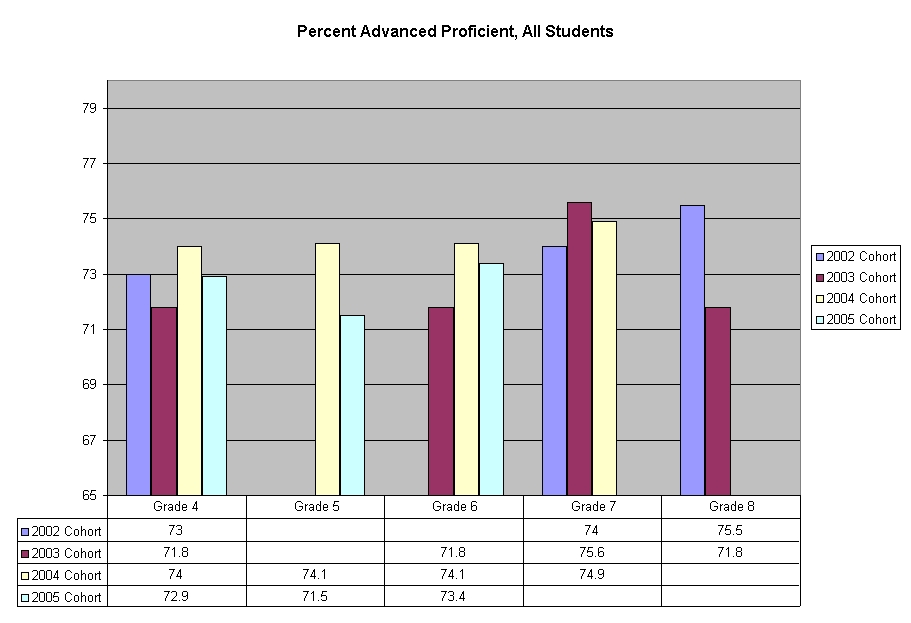
I don’t have access to the scale scores or the grant money or the expertise time the Task Force had, but I did take a look and there were no red flags identifying the Middle School years as being the locus of achievement problems. The chart at the top (and below for your convenience) is the product of my exploration.

WKCE Mathematics Perecentages from DPI

WKCE Mathematics Percentages from DPI

What I did was try to identify trends by looking at cohorts, starting with the class that was in 4th grade in 2002 (the WKCE changed that year and use of prior years for comparisons is not recommended). This chart shows the percentage of students who scored in the advanced or proficient range as they moved from 4th grade to 8th grade. The scores aren’t there for each grade for each year, but this is what we have to work with (informed, guided, not driven). Call it a poor man’s “value added.”

The most striking thing is that things don’t change much from year to year, or cohort or between the cohort. The range of variation is small; from 71.5% to 75.6%.

When we look at the cohorts, the 4th, 5th and 6th grade scores are mostly a baseline and any identification of failures in Middle school would be in the 7th and 8th grade scores. The data is minimal, but in all three data points for 7th grade there is improvement over the previous data point for that cohort and one 8th grade cohort shows continued improvement while the other shows a good sized drop off.

What does this tell us? Not much. What might that mean? To me it means we should know more before we commit to investing in improving Middle School teacher preparation.

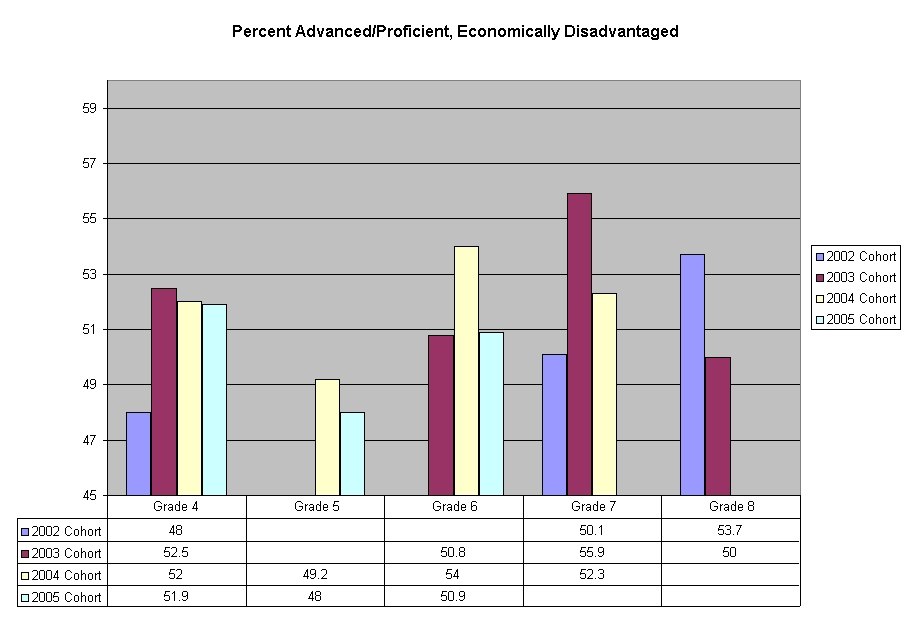
One more chart, because I think we always need to keep inequalities in mind.
ap-econ-dis

WKCE Mathematics Percentages from DPI

Same idea as the other chart, but this time only looking at “Economically Disadvantaged” students. The first thing I notice is how low the percentages are and see yet more evidence that we have a long way to go to eliminate gaps in achievement based on wealth. That this may never happen is no reason to stop trying. Next, again a narrow range, this time between 48% and 55.9%.

Some up and down but I don’t see anything compelling pointing to the Middle School years as the problem.

I did find the 2003 cohort up and down here and for all students intriguing, so I looked at state trends for those years, What I found was a similar if less extreme pattern, which may indicate that it is a product of the test and not a measure of the students. Statewide the 6th grade advanced/proficient percentage (A/S) for that all students (AS) in that cohort was 73%; for Economically Disadvantaged students (ED) it was 53.9%. In seventh grade the A/S rose to 79.1% and the ED to 61.5%. The 8th grade drops were to 75.3% AS and 56.8 ED. [I’d do a full chart, but I don’t have time, maybe in an update later). Data guided or informed, not driven or blank.

One last related note. A good thing about the new governance system in MMSD is that action items are supposed to come before committees a week before the Board acts. No more release of recommendations late Friday for action on Monday. This one didn’t. Last Monday the Board of Education agenda included a 10 page, 13 point “Summary Response” that gave an outline, but few details (Recommendation 3, here). I think a commitment of $392,500 deserves to go through the process.

As the above should make clear, I have serious doubts about whether the commitment of these resources is a good idea and have no doubt that the case that has been made so far, recommending this commitment, is less than weak. I ask that the Board and the administration step back and begin by clearly demonstrating there is a problem that needs to be addressed, and again recommend that part of this be a real assessment of the knowledge and skills of our Mathematics teachers. What will be before the board on Monday is an expensive solution in search of a problem.

Thomas J. Mertz

Leave a comment

Filed under Accountability, Best Practices, Budget, education, Local News, Uncategorized

School Finance Network Assembly Hearing, Tuesday April 21, Be There!

sfn_logo_option_b

The hearing is on the School Finance Network plan, but it is more generally an important opportunity to show support for comprehensive school finance reform.  The lawmakers need to know we care.  Be there if you can!

Details here and below.  The Basics: Tuesday April 21 at 1:00 PM at the Wisconsin State Capitol in room 413 north.

School Finance Network Reform Plan Subject of April 21st Hearing at the Capitol

Statewide coalition of more than 100,000 members announces support for changes to public school funding

Members of the Assembly Education Committee have scheduled a hearing for April 21st at 1 p.m., to consider the School Finance Network’s funding reform plan.

The meeting will be held at the Wisconsin State Capitol in room 413 north, and is open to the public. In addition to members of the SFN coalition, parents, students, educators, and taxpayers from around the state will speak.

The School Finance Network is a statewide coalition of educational, religious, and community-oriented organizations, committed to strengthening the funding system for our public schools.

The School Finance Network plan details how public school districts statewide would benefit through changes that help children with special needs, disabilities and from low income families. It also includes updates to the funding formula for rural districts and those with declining enrollment. The plan also helps maintain classes that help young people to learn skills that can benefit their communities.

The School Finance Network is made up of the following groups: AFT–Wisconsin, the Fair Aid Coalition, the School Administrators Alliance, the South-eastern Wisconsin Schools Alliance, the Wisconsin Alliance for Excellent Schools, the Wisconsin Association of School Boards, the Wisconsin Association of School District Administrators, the Wisconsin Education Association Council, and the Wisconsin PTA

What: Assembly Education Committee hearing on the School Finance Network plan.

When: April 21st at 1 p.m.

Where: Wisconsin State Capitol, Room 413 North.

Thomas J. Mertz

Leave a comment

Filed under "education finance", Best Practices, Budget, education, finance, Local News, Pope-Roberts/Breske Resolution, Referenda, referendum, School Finance, Take Action, Uncategorized

Another District Heading for Dissolution? Give Paris One More Chance

parispantherlogomelt1

Jonathan Richman, “Give Paris One More Chance” (click to listen or download).

Last year it was Wausaukee and Milwaukee, before that Florence; now the Paris District is talking and voting on dissolution (and here).

You can’t say this is a surprise.  The whole way Wisconsin funds education has been accurately called a “going out of business” plan (video here); Prior to the overwhelming defeat of a referendum on April 7, Administrator Roger Gahart warned that a no vote could lead to dissolving the district.

Here is how the situation was explained.

A combination of factors have led Paris into financial difficulty.

The district is considered property-rich under state funding formulas, and has had declines in student enrollment, both factors leading to a steady reduction in state aid. At the same time, state law limits the amount of money districts can collect under the revenue cap, and its expenses have grown faster than revenues.

Paris has cut its budget over the past year, eliminating some staff positions and reducing costs. But the district, with just one classroom per grade level, has little room left to cut…

The dissolution vote is only the first step of  a long process that most often does not end in a dissolution.

Paris is a very small K-8 district, serving less than 200 students.  A case can be made that consolidating with another district would be  best.  Certainly economics should play a role in this decision, yet when you look closely  it is clear that dissolution/consolidation won’t fix many of the problems.

There will be some economies of scale, but the recent cuts in Paris indicate that this potential is limited.

• Reductions in staff for 2008-2009 school year saved $100,240.
• Reductions in staff for 2009-2010 school year projected to be $60,000 to $70,000.
• Total current expenses reduced $121,966 from Fall Budget report.
• 26.5% reduction in supply expenses from 2007-2008 school year to 2008-2009.
• 52% reduction in supply expenses from
2008-2009 school year to 2009-2010.
• Improved energy conservation and building maintenance practices.
• Taking advantage of used, refurbished, and donated materials and equipment.

The district mentioned as possible new homes for the Paris students are Kenosha Unified, Bristol, Union Grove or Brighton.  They all have there problems.

Kenosha is dealing with the aftermath of an ill-advised investment strategy (inspired by the need to do something to try to deal with the broken state finance system), the budget pressures were a major issue in the recent School Board elections, they are phasing out the Music Department and not too long ago faced protests against “excessive budget cuts.”

I can’t find anything on the Bristol or Brighton budgets.  Not much on Union Grove either, except an incumbent Board Member seeking re-eletion saying “school funding” is “the most important issue facing the board.”

If dissolution/consolidation is only a partial and temporary fix, the School Finance Network (SFN) has a proposal that will help all districts in Wisconsin achieve sustainable funding for excellent education.  There will be a hearing on the SFN plan on Tuesday April 21 at 1:00 PM at the Wisconsin State Capitol in room 413 north (more details here).  It is important that there be a good crowd supporting comprehensive reform.  Be there!

Meanwhile, contact your elected officials, the media and get involved (see here for “how to’).

Thomas J. Mertz

Leave a comment

Filed under "education finance", Budget, education, finance, Local News, Referenda, referendum, School Finance, Take Action, Uncategorized

MMSD (Preliminary) Budget Released

mmsd-budget

All the information is here; the Wisconsin State Journal has a story also.

More to follow in the coming weeks.

Thomas J. Mertz

Leave a comment

Filed under "education finance", Budget, education, finance, Local News

FDR 1938 Speech to the NEA

Franklin Delano Roosevelt’s June 1938 speech to the National Education Association (hat tip, Crooks and Liars).

Full text here; some excerpts:

We have believed wholeheartedly in investing the money of all the people on the education of the people. That conviction, backed up by taxes and dollars, is no accident, for it is the logical application of our faith in democracy.


Here is where the whole problem of education ties in definitely with natural resources and the economic picture of the individual community or state. We all know that the best schools are, in most cases, located in those communities which can afford to spend the most money on them—the most money for adequate teachers’ salaries, for modern buildings and for modern equipment of all kinds. We know that the weakest educational link in the system lies in those communities which have the lowest taxable values, therefore, the smallest per capita tax receipts and, therefore, the lowest teachers’ salaries and most inadequate buildings and equipment. We do not blame these latter communities. They want better educational facilities, but simply have not enough money to pay the cost.

There is probably a wider divergence today in the standard of education between the richest communities and the poorest communities than there was one hundred years ago; and it is, therefore, our immediate task to seek to close that gap—not in any way by decreasing the facilities of the richer communities but by extending aid to those less fortunate. We all know that if we do not close this gap it will continue to widen, for the best brains in the poor communities will either have no chance to develop or will migrate to those places where their ability will stand a better chance.

Make them listen to this in Madison and in Washington.

Thomas J. Mertz


Leave a comment

Filed under "education finance", Accountability, Best Practices, Blast from the Past, Budget, education, Equity, finance, Gimme Some Truth, National News, School Finance, Take Action

April 7, 2009 Referenda Results

From Modern Mechanix (click image for more)

From Modern Mechanix (click image for more)

The results are in.  Good news with Tony Evers, Shirley Abrahamson and Arlene Siveira.  Very mixed results on the school referend in Wisconsin.  Not as bad as February, but many children’s educations will suffer as a result of the losses.

Information on the measures can be found in this previous post and the full report from DPI is here.

First the Non Recurring Operating Referenda where 10 passed and 14 failed.

DISTRICT

Referenda Type

Yes Votes

No Votes

RESULTS

Birchwood (0441)

NR – 2009 – 2011

360

386

Failed

Horicon (2576)

NR – 2009

505

822

Failed

Kiel Area (2828)

NR – 2009 – 2016

887

928

Failed

Loyal (3206)

NR – 2009 – 2012

439

514

Failed

Manawa (3276)

NR – 2009 – 2014

590

937

Failed

Oakfield (4025)

NR – 2010 – 2014

308

344

Failed

Oshkosh Area (4179)

NR – 2009 – 2014

6,872

6,930

Failed

Reedsburg (4753)

NR – 2009 – 2012

999

2,240

Failed

Ripon (4872)

NR – 2009 – 2012

854

1,112

Failed

Wheatland J1 (6412)

NR – 2009 – 2013

363

417

Failed

Albany (0063)

NR – 2009 – 2013

459

333

Passed

Benton (0427)

NR – 2009 – 2012

407

291

Passed

Bowler (0623)

NR – 2009 – 2012

223

216

Passed

Elcho (1582)

NR – 2009 – 2012

800

632

Passed

Herman #22 (2523)

NR – 2009 – 2014

142

137

Passed

Maple Dale-Indian Hill (1897)

NR – 2009 – 2019

809

632

Passed

Mineral Point (3633)

NR – 2009 – 2011

896

592

Passed

Northland Pines (1526)

NR – 2009 – 2012

1,963

1,767

Passed

Oshkosh Area (4179)

NR – 2009 – 2014

7,212

6,624

Passed

Phelps (4330)

NR – 2009 – 2012

378

144

Passed

Phelps (4330)

NR – 2009 – 2012

360

161

Passed

Ripon (4872)

NR – 2009 – 2015

1,077

898

Passed

Washington (6069)

NR – 2009

242

236

Passed

Wisconsin Heights (0469)

NR – 2009 – 2011

1,225

598

Passed

Lots of close votes (6 on Washington Island referendum!) and unfortunately, unless there is comprehensive reform (see below), even the districts where the referenda passed will soon be asking again or heading off the cliff.  Many of the ones that failed will return to the voters, sooner rather than later.

The results for Recurring Operating Referenda were not as good.  7 failed and only 2 passed.

DISTRICT

Referenda Type

Yes Votes

No Votes

RESULTS

Medford Area (3409)

RR – 2010

1,220

2,428

Failed

Merrill Area (3500)

RR – 2009

1,836

3,153

Failed

Middleton-Cross Plains (3549)

RR – 2009

4,963

5,726

Failed

Paris J1 (4235)

RR – 2009

165

512

Failed

Reedsburg (4753)

RR – 2009

1,349

1,907

Failed

Riverdale (3850)

RR – 2009

559

883

Failed

Siren (5376)

RR – 2009

234

418

Failed

North Lakeland (0616)

RR – 2009

839

732

Passed

Reedsville (4760)

RR – 2009

863

554

Passed

The votes don’t look to have been as close. Recurring referenda make much more sense in terms of planning, but for some reason the anti-forces have been very successful demagoguing the concept.

Last the Issue Debt Referenda (building, remodling, upgrading HVAC…).

DISTRICT

Referenda Type

Yes Votes

No Votes

RESULTS

Medford Area (3409)

Issue Debt

1,191

2,505

Failed

Middleton-Cross Plains (3549)

Issue Debt

4,766

5,677

Failed

Middleton-Cross Plains (3549)

Issue Debt

5,008

5,425

Failed

Oshkosh Area (4179)

Issue Debt

3,761

10,124

Failed

West Bend (6307)

Issue Debt

5,632

6,317

Failed

Albany (0063)

Issue Debt

539

257

Passed

Cudahy (1253)

Issue Debt

1,085

1,000

Passed

Elk Mound Area (1645)

Issue Debt

648

413

Passed

Maple Dale-Indian Hill (1897)

Issue Debt

972

465

Passed

Reedsville (4760)

Issue Debt

795

624

Passed

Ripon (4872)

Issue Debt

1,372

616

Passed

West Bend (6307)

Issue Debt

5,971

5,897

Passed

5 yes and 7 no, with mixed results in West Bend.

More votes in Salem and Cuba City later this month and elsewhere — especially where referenda failed —  the axe will continue to fall and AMPS will cover as many of the cuts as we can.

Now the” take action” boilerplate (literally cut-and-paste this time).

This growing reliance on regular referenda is perhaps the clearest evidence that the way our state funds education is broken.  Too much time and energy is being misdirected at securing basic funding instead of educating, too many communities are being split over these votes instead of united to give their children the opportunities to create a better future.

It is well past time to fix it.

Get involved in the effort by attending the April 21, 2009 Assembly Education Committee hearing on the School Finance Network proposal (info here), and joining the School Finance Network and the Wisconsin Alliance for Excellent Schools (it is just fine to do all of the above, I have or will).

Thomas J. Mertz

Leave a comment

Filed under "education finance", Best Practices, Budget, education, Elections, finance, Local News, Referenda, referendum, School Finance, Take Action, Uncategorized, We Are Not Alone

44 School Referenda On April 7!

From the Cleveland Municipal School District Visions of Democracy project, click on the image for more.

From the Cleveland Municipal School District Visions of Democracy project, click on the image for more.

Today,  April 7, 2009 voters in 30 Wisconsin school districts will decide 44 referenda questions.  April 21 brings a 31st in Cuba City.  On April 28 a 32st district, Salem, will vote on a referendum for the fourth time in less than a year.

Salem is an extreme case, but at least 10 of the districts seeking operating funds have had failed operating referenda in the last two years and five seeking operating funds are districts facing the “off the cliff” loss of funds scenario that hits when a non-recurring referendum runs out.

There are a total of 32 operating referenda, 9 recurring and 23 non recurring (including 3 of the 5 districts on the edge of the cliff because previous non-recurring referenda are expiring); the remaining 12 votes are to issue debt for building, maintenance, refurbishing and upgrading projects. Before listing and linking,  some context and a call to action.

[Note:  Wisconsin Heights was missed in the original post.  It has been added below, but the rest has not been updated.]

Not counting the April 2009 votes, since April 1, 2007 there have been 252 referenda in Wisconsin; since April 1, 2005 there have been 481.

This growing reliance on regular referenda is perhaps the clearest evidence that the way our state funds education is broken.  Too much time and energy is being misdirected at securing basic funding instead of educating, too many communities are being split over these votes instead of united to give their children the opportunities to create a better future.

It is well past time to fix it.

Get involved in the effort by attending the April 21, 2009 Assembly Education Committee hearing on the School Finance Network proposal (info on both here), and joining the School Finance Network and the Wisconsin Alliance for Excellent Schools (it is just fine to do all of the above, I have or will).

The official details of all the referenda are here; Below are links to more information on the ballot measures (search AMPS for more on many)

Operating, Non-Recurring:

Wisconsin Heights:  Newsletter.

Wheatland J1: District Site; District Press Release, News Story “Wheatland Center to vote on revenue cap referendum.”

Washington Island District Referendum Info.

Ripon District Referendum Page; PolicyOptions.org, Brief (good stuff)

Phelps District Referendum Page.

Oshkosh Area District Referendum Page; News Stories, “Details emerge on Oshkosh school district’s three question referendum in April,” “Teachers organization underwriting majority of referendum ‘Yes’ vote push.”

Oakfield District Site; “What makes Oakfield special?’

Northland Pines Referendum Page.

North Lakeland District Site; News Stories, “North Lakeland voters to consider referendum Tuesday,” “Vought, committee make case for proposed new levy referendum.”

Mineral Point District Referendum Page.

Middleton-Cross Plains District “Community Conversation;” Referendum Page; Ellen Lindgren: “Middleton’s Kromrey School should be replaced.”

Maple Dale-Indian HillDistrict Site; News Story, “Maple Dale-Indian Hill School Board votes for referendum.”

Manawa District Referendum Page; Editorial: “Manawa referendum helps protect schools.”

Loyal District Site; News Story, “School District of Loyal Asks Taxpayers to Reach Into Pockets.”

Kiel Area District Referendum Page; Letters to the Editor.

Horicon District Site; News Story, “Horicon to pursue school referendum.”

Herman District Referendum Page.

Elcho District Referendum Page, News Stories, “Elcho school district leaders push for referendum” (with video), “Elcho heads to referendum.”

Bowler District Site; News Story, “Bowler school district leaders asking taxpayers for referendum.”

Birchwood District Site.

Benton District Site; Fact Sheet; PowerPoint.

Albany District Referendum Page; News Story: “Albany voters face two school referendums.

Operating, Recurring:

Siren:  District Site; News Story “Siren looks at school referendum.”

Riverdale District Referendum Page

Reedsville District Referendum Page; News Stories, “Reedsville public schools facing financial crisis,” “Reedsville schools’ future up to voters.”

Reedsburg District Referendum Page; News Story, “District will leave no stone unturned.”

Paris J1: District Fact Sheet; News Story: “Will Paris deal with budget shortfall or dissolve the district?

Merrill Area District Referendum Page; News Stories, “Leaders like Merrill referendum’s chances,” “Merrill will try again for school aid.”

Medford AreaDistrict Site; Building the Medford Community.

Issue Debt

West Bend District Referendum Page.

Ripon District Referendum Page; PolicyOptions.org, Brief (good stuff).

Oshkosh Area District Referendum Page; News Stories, “Details emerge on Oshkosh school district’s three question referendum in April,” “Teachers organization underwriting majority of referendum ‘Yes’ vote push.”

Middleton-Cross Plains District “Community Conversation;” Referendum Page; Ellen Lindgren: “Middleton’s Kromrey School should be replaced.”

Medford AreaDistrict Site; Building the Medford Community.

Maple Dale-Indian HillDistrict Site; News Story, “Maple Dale-Indian Hill School Board votes for referendum.”

Elk Mound Area District Referendum Page, News Video; Blog post “Referendums are a tough sell,” News Story,” Elk Mound Board OKs spending referendum.”

Cudahy District Referendum Page, News Story.,” Roof work tops Cudahy referendum spending list.”

Turnout will be low in most places.  So many futures riding on so few votes.

I wish them all the best.

Vote Yes for Schools!

Thomas J. Mertz

Leave a comment

Filed under "education finance", Budget, education, Elections, Local News, Referenda, referendum, School Finance, Uncategorized, We Are Not Alone

Joint Finance Budget Hearings

Andy Warhol, "Dollar Signs"

Andy Warhol, "Dollar Signs"

The Parliaments, “(I Just Wanna) Testify” (click to listen or download)

The public testimony phase of the Joint Committee On Finance‘s (JFC) budget process has begun.  There were official hearings last week in Sparta, West Allis and Eau Claire, as well as a listening session in Ashland. This week the committee will be in Racine on Monday, March 30;  Appleton, Wednesday April 1; and Cambridge on Friday, April 3 (click here for details).

The way it works is, first the Governor proposes a budget, then the JFC hears from agency heads and the public and proposes changes (or not), each house of the legislature takes up the options and than it is a three-way back-and forth, till there is budget that both houses agree on and the Governor signs (the Governor gets one final swipe with his now-limited partial veto).  Much of this is explained in this 2007 memo.

These hearings are the only official public opportunity for citizens to have a say in Wisconsin’s  taxing, spending and investment priorities over the next two years.

It is disappointing that the media coverage has been so minimal (see below for some of what has appeared).

Some of this is due to the reality that these hearings are largely a ritualistic dance.  Advocates make their case, legislators smile and nod and look for openings to make their points and then behind closed caucus and office doors the real work is done (Reps. Cory Mason, D-Racine, and Dean Kaufert, R-Neenah have proposed bringing party caucuses under the open meetings laws).  I still think that the hearings are important, if only to keep the voice of the public before the powerful.  The hundreds who testified last week also think it is important.

For advocates of comprehensive school finance reform, the ritual dance requires some awkward steps.  It isn’t easy to simultaneously speak to pressing need a big fix of the broken system and address what is likely to be helpful or harmful in the immediate budget process.

Most  advocates also have an interest in budget matters not directly related to comprehensive school funding reform.   So teachers such as Kelly McMahon and Abby Ryan make strong cases for the Student Achievement Guarantee  in Education (SAGE) program within the context of the general benefits of investing in education but with no direct appeal for comprehensive reform.

John Smart, a Board Member in Park Falls testifying in Ashland didn’t use any fancy terpsichorean moves, he simply reminded the committee members of the failures of our current system and the possibilities offered by the School Finance Network:

My name is John Smart – I am a member of the Park Falls School Board, the Policies & Resolutions Committee of the Wisconsin Association of School Boards [WASB], and the board of the Wisconsin Alliance for Excellent Schools [WAES].

The Park Falls and Glidden School Districts have voted to consolidate, and the new Chequamegon School District will officially come into existence on July 1st of this year. I am running for the new board as well in the April 7th election, but I don’t know how I will fare! As elected officials yourselves, you will understand that…

We hope to realize some economies of scale by consolidating, but the principle reason for doing so is to provide our students with more opportunities. We will appreciate anything that the legislature can do to assist us in this challenge. You will be seeing many more school district consolidations in the near future, so be prepared.

You are certainly aware that the costs of running an effective school district continue to rise: staff – healthcare – technology – building maintenance – and so much more. You are also aware that referenda have been increasingly unsuccessful in raising the necessary funds. Ours was. Our property-taxpayers are rebelling. The existing school funding formula does not work anymore – if it ever did – and reform is desperately needed.

The WASB and the WAES are both members of the School Finance Network, along with representatives of almost all of the stakeholders in education in Wisconsin, including the PTA. The SFN has proposed a new funding formula, which will be analyzed at a hearing of the Assembly Education Committee on April 21st, and I intend to be there as well.

I urge you to look closely at school funding. We really must do something to resolve this situation before we do damage to one of the best education establishments in the nation. Thank you for your consideration.

WEAC President Mary Bell moved with grace between the immediate and the big picture while also advocating for consideration of the School Finance Network‘s proposals.  Here are excerpts from her testimony in Sparta:

The budget proposal introduced by Gov. Jim Doyle recognizes that we must all make sacrifices in light of Wisconsin’s challenging economic conditions, but that there is no greater promise than the one we make to educate our children for the future. Investing in them reaps dividends for generations to come, and we cannot turn our backs on who we are and what we value – our children’s education. Wisconsin has great schools because the people of our state have been committed to building great schools for generations – even in times of hardship. We urge the legislature to uphold our great tradition by passing the Governor’s budget proposal with funding for schools intact.

I’d like to now speak to some of the specific features of the Governor’s budget proposal that will affect public schools and colleges in Wisconsin….

We support these funding improvements, but urge the legislature not to assume they will solve the serious funding issues of Wisconsin’s public schools. Layoffs and program cuts will still be part of the spring and summer news reports, though certainly not as deep as without this important investment. A thoughtful and comprehensive look at school funding is needed, if not with this budget, then in this legislative session. The School Finance Network proposal is, we believe, worthy of your attention as we, the citizens of Wisconsin engage in that conversation…

Many others testified on education issues, but the news reports are pretty skimpy, so it is hard to tell how they managed the dance.

WAYY reports that in West Eau Claire:

Eau Claire School Superintendent, Dr. Ron Heilmann, was one of several area administrators who spoke on the difficulties facing school districts. Heilmann says revenue limits over the past 16 years are threatening public schools across the state. Eau Claire is one of several districts considering lay-offs for teachers and other staff to cut expenses (see this on AMPS for more on cuts in Eau Claire and elsewhere).

The story on WEAU also mentions Dr. Heilmann’s testimony.

The Leader-Telegram article includes Heilmann and adds some words about others educators:

Many educators addressed the committee, saying limiting revenues as costs continue to grow has created a budgetary imbalance that threatens the quality of services schools can provide. From growing class sizes to fewer programs, schools can’t continue under the current funding system without gutting educational programs, school officials said.

“We’re not making it here, folks,” Eau Claire school board member Brent Wogahn told panel members, who were spread across the full width of the Gantner Concert Hall stage.

After years of school districts trimming budgets, Heilmann said, “The fat is gone … and (budget cuts) are impacting our students in ways that are unacceptable.”

The testimony of  Chippewa Falls School District Business Manager Chad Trowbridge, also in Eau Claire, was covered by Chppewa.com:

Trowbridge said the district had made $2.3 million in cuts since 2000, and was still facing a deficit in 2010-2011.

“We continue to do more with less and we are subjected to the same kind of inflationary pressures as everyone else,” he said.

Trowbridge warned that any state cuts from the two-thirds finding level would result in increased property taxes. He also spoke in opposition to repeal of the Qualified Economic Offer policy that limits teacher salary and benefit increases.

Finally, here is a video on the Sparta hearing  from Channel 3000, Madison.  Not much on school funding, but a great time-lapse sequence that gives the feel of the ritual dance.

As always the WisPolitics Budget Blog is a good source for updates on the budget process, including the JFC hearings (although this time around, the coverage seems a bit thin thus far).

Don’t forget that you too can learn how to do the citizen/lobbyist for school finance reform dance at the MMSD Legislative Advocacy Forum on Wednesday, April 1 at Wright Middle School.

Thomas J. Mertz

Leave a comment

Filed under "education finance", Budget, education, finance, Local News, Referenda, referendum, School Finance, Take Action, Uncategorized, We Are Not Alone

MMSD State Budget Advocacy Forum, April 1

Click on image for pdf flier.

Click on image for pdf flier to print and post.

Here are the details in plain text:

State Budget Advocacy Forum

Wednesday, April 1st, 6:00 pm

Wright Middle School LMC
1717 Fish Hatchery Road

Faced with an unprecedented $5.7 billion deficit, the state budget cuts programs all across state government. Come to the session to:

  • Learn how the state budget affects Madison Schools
  • Find out how to advocate for school resources at the Capitol
  • Learn about future prospects for comprehensive school funding reform
  • This brief session will provide you with the tools to advocate for our schools and children.

For more information about the K-12 provisions in the state budget, click here.

Thomas J. Mertz

Leave a comment

Filed under "education finance", Best Practices, Budget, education, finance, Local News, School Finance, Take Action

Dane County Board of Education Candidates

vp052a

From the Cleveland Municipal School District Visions of Democracy - Digital Gallery. Click on image for more.

April 7, 2009 will be a big day for school votes in Wisconsin.  There is the State Superintendent race (I’m backing Tony Evers, for reasons that I hope to have a chance to post on at some length), 41 school referenda in 29 school districts are on the ballot (those posts are in the works, see here for a summary of the measures) and around the state voters will elect their representatives to school boards.  The League of Women Voters of Dane County election guide has been published and posted, with answers from many of the candidates and descriptions of local referenda.

I spent some time going through the candidates answers and was struck by the combination of widespread concerns about the ability to provide necessary and desired educational opportunities under the pressures of budget constraints and by how few pointed to the broken state school finance system as the source of this ongoing situation.

The biggest exception is MMSD Board president Arlene Silveira.  This is what she wrote about the “the major issues confronting your school district, and, if elected, how will you deal with them?”

Equitable school funding system. Unless changed, all school districts will be forced to make devastating cuts detrimental to all students. I will initiate community-based advocacy efforts to work toward changing the funding. Enhancement of minority achievement efforts by improving efforts in schools to raise instruction quality; expanding availability of schooling opportunities and working with community to develop policies that enable all children to begin/attend school on a more even playing field. Ensure we are providing students with skills needed to compete in the 21st century, irrespective of their path. Continue efforts focused on redesign of our high schools. (Emphasis added.)

This is one reason I’m supporting Arlene.  Click on her name above to join me.

Her opponent, Donald Gors is more typical in his non specific reference to financial issues and lack of expressed committment to work for change at the state level:

One large looming issue facing Madison’s School District is MONEY!

True, but not very helpful.

The same is true for most other Dane County candidates who discussed the issue (many did not discuss finances at all or had almost nothing to say — these responses have not been included).  Here is what other Dane County candidates said about school finances.

CHUCK POIRIER incumbent, Deefield:

Expenditures continue to raise and outpace funding. The board and administration need to review funding formula and actual costs per student and determine if the tax payers would incur a tax savings or a tax loss by allowing transfer students from outside our community to enroll in the District.

VICTOR GONZALEZ, Edgerton:

The Edgerton School District will soon be replacing a principal and its superintendent; it will also be facing a significant decrease in its high school enrollment and will have to tackle large maintenance expenses with a tight budget.

JEFF ZIEGLER incumbent, Marshall:

Crafting a budget that meets the needs of our students and allows us to continue to improve the education we provide continues to be a significant challenge. This is especially difficult with state imposed revenue controls. The key to meeting this challenge is to make sure that all of the board’s decisions are made with the goal of providing the best educational experience that we can. The Marshall School District has done a good job of implementing needed changes and improving our educational programs during difficult economic times by keeping this key idea in mind.

Ziegler also refers to the importance of “full funding” for “”bilingual education for all children; b) music and art; c) civics; d) 4-year-old kindergarten; e) preparation for the work force.”

LEE WEINSTOCK incumbent, Marshall:

Tight budgets, academic performance and school safety are top issues facing many schools, including Marshall. I have been a good steward of the school district’s finances in my nine years on the board and will continue to make budget decisions in the interest of what is best for the success of students.

JASON McCUTCHIN, Monona Grove:

One of the major issues for this district is the budget shortage that is forecasted for the next couple of years. Because this is an issue that is likely going to be a recurring issue I would like to see the next board take a hard and fast look at this year’s deficit and see how the decisions that are made this year will affect upcoming years. Additionally, we need to be cognizant of any how any cuts will impact our building infrastructure and the quality of our children’s education.

LIONEL NORTON, Monona Grove:

As a nation we are facing tough economic times and the Monona Grove School District is not immune to this. Our biggest challenge in the next couple of years will be to prevent our district from cutting programs and activities that make our district special and from falling further into debt. I will listen without bias to all ideas and suggestions on the best way to achieve this with the least negative impact to our students and teachers. Neighborhood growth continues to be a challenge for our schools; we must proactively address this issue to prevent overcrowding at our schools.

STEVEN C. ZACH incumbent, Oregon:

Annually the Board must adopt a budget that balances the needs of students, fairly compensates employees, maintains facilities and does not burden taxpayers. We have done that during my Board tenure.

TINA HUNTER, Stoughton:

During this time of uncertain budgets and fluctuating enrollments, we need to maintain opportunities. We must find creative options to meet all District goals while also serving our students and community. School consolidations need to happen logically and painlessly. We must make wise decisions regarding staffing, transportation, and boundaries during this time of transitions.

TERRI WATKINS incumbent, Stoughton (this answer is almost as good as Arlene’s):

Increasing student achievement, recruiting and retaining quality staff and maintaining facilities are all priorities in SASD. The current state funding formula creates challenges to these priorities in districts like SASD with declining enrollment. School consolidation, bussing guideline updates, and enrollment-driven staff reductions will help in the short term. It is important to continue our collaborative work to encourage community growth, energy conservation and educate our community on school funding issues and solutions including pressure to bring legislative change that will provide more long-term financial relief. (Emphasis added.)

TERRY W. SHIMEK incumbent, Sun Prairie:

Property taxes are also an issue, especially for those on fixed income. I would support a solution for the fixed income hardship at the state level. Despite rising costs, my goal is stabilize or even reduce the property tax rate.

JOHN E. WHALEN incumbent, Sun Prairie:

The Sun Prairie Area School district has been both blessed and cursed with a rapidly growing student population. We don’t have to deal with the budget problems associated with declining enrollments, but growth has its own budget issues. Growth has required significant investment in infrastructure, and has required the District to work hard to meet the needs of our student population. I am a firm believer that all children are entitled to a quality education. If elected, I will continue to pursue all opportunities that support quality education for all students.

Two other observations.  First, it appears that incumbents are more likely to “get it” that the budget problems begin with the state system.  Second, despite the facts that about 250 referenda have been held in the last two years and about as many can be expected in the next two years, I don’t believe a single candidate directly mentioned referenda.

Don’t forget to come to the MMSD school funding forum on April 1 to learn more about state funding reform efforts and to get involved.

Thomas J. Mertz

2 Comments

Filed under "education finance", Best Practices, Budget, education, Elections, Equity, finance, Local News, Referenda, referendum, School Finance, Take Action, Uncategorized