Category Archives: education

Quote of the day

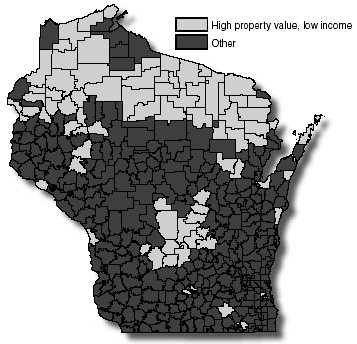
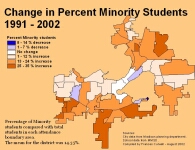
Map from the Wisconsin Atlas of School Finance, by Jack Norman, a publication of the Institute for Wisconsin’s Future.

“I have been on the school board for ten years and we have had to make cuts eight of those years. We are looking at the destruction of education in Northern Wisconsin. What I would like to see is the media saying it’s a problem,” said [Rhinelander School District] school board president Chuck Fitzgerald.

Quoted in the Rhinelander Daily News.

An April 2008 referendum in Rhinelander was defeated by about 3,000 votes. The last referendum to pass in the district was in 1998.

It isn’t just in Northern Wisconsin or Madison where our once great public schools are being destroyed, it is throughout the state. Let’s “Get-er Done” and fix the state school finance system.

Thomas J. Mertz

Leave a comment

Filed under "education finance", AMPS, Budget, education, Equity, finance, Gimme Some Truth, Referenda, School Finance, We Are Not Alone

A Message to Gov. Doyle (updated)

The Wisconsin Assembly joined the Senate last night in passing a budget repair bill. In the Assembly, the Madison delegation was split. Governor Doyle has promised swift action, including some vetoes. Some democrats are saying they will vote to override (some?, all?) vetoes.

The bill is not great for schools. One good thing is the measure closing the “Wal-Mart Loophole.” If we are going to move toward better school funding, fairer tax policies have to part of the answer. Not so great is shifting $125 million from state aids to local school taxes. This will make passing referenda more difficult.

Madison Superintendent Art Rainwater sent a message to Governor Doyle about another bad provision, this one further limits phase in funding for school districts wishing to start 4 year-old kindergarten programs.

May 15, 2008

Governor Jim Doyle
115 East – State Capitol
Madison, WI 53702

Dear Governor Doyle,

I am requesting that you use your partial veto powers to improve the unnecessarily restrictive 4-year old kindergarten language contained in the budget repair bill.

The provision allows for a 5-year phase-in of 4K programs only for school districts that are operating a 4K program during the 2007-08 school year. This language would only benefit a handful of school districts. Allowing all school districts to phase-in 4K programs would assist districts, such as Madison, in potentially moving forward with 4K programs and assist your laudable goal of expanded early childhood opportunities for our state’s children.

Madison Schools has worked with local child care providers to lay the groundwork for a 4K program, but is substantially stymied by funding problems. The inequity in K4 funding should be fixed in the 2009-2011 biennial budget. It is fundamentally wrong for a Milwaukee voucher school to be able to start a 4K program and September and receive the full state reimbursement by the following June – public schools should have the same opportunity.

Please veto the 4K language to allow all school districts the opportunity to phase in a 4K program over a 5-year period. Thank you for your steadfast support of K-12 public education.

Sincerely,

Art Rainwater
Superintendent

The consensus in Madison is growing that we need need to do this in the very near future. If this measure goes through, it will be nearly impossible.

If you believe that we should establish 4k, now is the time to join Superintendent Rainwater in contacting the Governor and our legislative delegation.

Update:

Doyle issued his veto message.  He did not go along with the legislature on the school aid payments, but he did OK the limit on 4K phase in funding.  This is not good news for the future of 4K in Madison and the state.

Thomas J. Mertz

Leave a comment

Filed under "education finance", AMPS, Budget, education, finance, Local News, Referenda, School Finance, Take Action

Honoring Carol Carstensen

School Board’s Carstensen gets fond farewell

Samara Kalk Derby (Capital Times)— 5/15/2008 7:19 am

More than 100 friends, colleagues, family members and parents showed up at a farewell party Wednesday at Olbrich Gardens to say goodbye and thank you to Carol Carstensen, who served six terms on the Madison School Board and stepped down after the spring elections.

“There will never be another Carol Carstensen. I will predict that,” said School Board member Johnny Winston Jr. “There will never be another School Board member in this community that will serve 18 years. I miss her already.”

Winston called it a wonderful experience to work with Carstensen.

“She really not only knew the material and had a grasp of the issues going on, but she also had her pulse on the community as well,” he said.

Former board member Nan Brien, who served with Carstensen in the early 1990s, said that for 18 years Carstensen was the spokesperson on the board for all the kids in the district.

“She was particularly adamant that all kids, no matter their background, have an opportunity for the best education. That is the heart and soul of who Carol Carstensen is,” Brien said.

Carstensen always cared about the kids above anything else, she added. “That’s really why she fought all the budget battles and all the referendum battles — so the district would have the resources to give all the kids an equal opportunity,” Brien said.

The liberal Carstensen, who served four years as president of the seven-member board, aggravated conservatives by backing all 14 referendum questions during her tenure. Her critics viewed her as an advocate of higher school property taxes in Madison. Still, she never lost a School Board election.

Carstensen said she was delighted by the turnout at her party Wednesday. Old friends and new friends came out from the various areas of her life — the school district, her neighborhood, her book club, and the UW Law School, where her husband, Peter, is a professor.

She said she’s been ambivalent about stepping down.

“There are a lot of things I don’t miss and won’t miss at all, but there are other things — a number of things that have yet to be decided — that I will miss,” Carstensen said.

“The new superintendent will be working with the board in a new way, and I will miss that,” she said.

Well-wishers approached with their goodbyes: “Eighteen years is not nearly enough as far as I’m concerned,” one said. “Enjoy the freedom,” said another. “What are you going to do on Monday nights?” wondered a third.

Carstensen said she plans to do some volunteer work on the re-election campaign of Wisconsin Supreme Court Chief Justice Shirley Abrahamson and possibly the presidential campaign of Barack Obama.

David Cohen, a district parent, called Carstensen “one of the nicest, fairest School Board members that any parent would ever have to engage, and I’ve engaged with her a lot — good and bad.”

Many people at the gathering said they admired Carstensen’s dedication. “I do think that’s why she served as long as she did,” said Carole Trone, who has three children in the district.

“She believes in our schools. I think sometimes it was a thankless position with tough choices to make,” Trone added. “I think she symbolizes what makes this community strong — that we have people like her who are willing to give so many years of service.”

Mary Ellen LaChance, a district Reading Recovery teacher leader, called Carstensen a thoughtful decision-maker and someone who is willing to listen and learn about all the different facets of school programs.

“Obviously, the fact that she’s worked for so many years as a School Board member reflects her extreme dedication to education and Madison,” LaChance said.

Parent Jerry Eykholt called Carstensen an analytical thinker, who is strategic and effective.

“She’s just a fantastic community member, first and foremost. Everyone knows where her heart is — it’s really with the kids and how they are progressing. It’s hard not to join her.”

I had the pleasure of being part of this tribute to Carol. Not mentioned in the story is that the event was appropriately a fund raiser for the Foundation for Madison Public Schools. Here is a form to make a donation in Carol’s name.

It is difficult to give Carol Carstensen enough thanks for all the good she has done our schools and community. I think the best way is to follow her example and work to keep our schools strong; Volunteer in your school, serve on a district task force or committee, work to change the state school finance system, help with a referendum campaign

Thomas J. Mertz

Leave a comment

Filed under AMPS, education, Local News, Referenda, Take Action

Board Member Budget Amendments Posted

The MMSD website just posted the proposed budget amendments of Board of Education members (and one from the administration). The Board will consider and vote on the budget on Monday, May 12. It looked like there might be some action (click for video) on class size and specials classes and some other things, but that didn’t happen.

Instead, just one amendment from the administration concerning what seems to be Fund 80 housecleaning on contributions to the Wisconsin Retirement system and the tax levy (anyone know if this is a new issue or how the retirement contributions were handled in prior years?); one from Beth Moss funding the replacement of 143 Windows 98 computers via a reduction in the reserve for contingency; and one from Marjorie Passman employing $60,000 of the Fund 80 levy (contingent on other funding?) to help continue the Madison Family Literacy/Even Start Literacy program at Lakeview/Northport. All seem reasonable to me. That’s it. Relative budget peace.

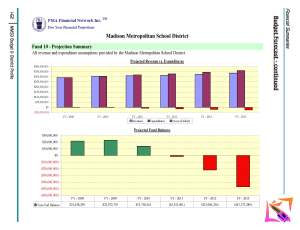
It is important to realize that this peace is the product of a one time distribution of excess Tax Incremental Finance District collections. Next year, we are back to dealing with the “going out of business” system of funding education in Wisconsin. Without a referendum, these are the budget projections (for Fund 10).

Lots of red ink ahead. Time to get to work on a referendum.

Thomas J. Mertz

1 Comment

Filed under "education finance", AMPS, Best Practices, Budget, education, finance, Referenda, School Finance, Uncategorized

Learning in and from the past

In an earlier post I mentioned that my students are working on a primary sources assignment. At least one student is writing about a document found in a recently posted digital history collection of material from Madison schools stretching from the 1880s to the mid 1970s. The project is a “cooperative effort between the Madison School & Community Education Library (MSCEL), the UW School of Education and the University of Wisconsin Digital Collections Center (UWDCC). ” It contains over 17,000 pages of material. I’ve only looked at 100 or so, but have found it fascinating.

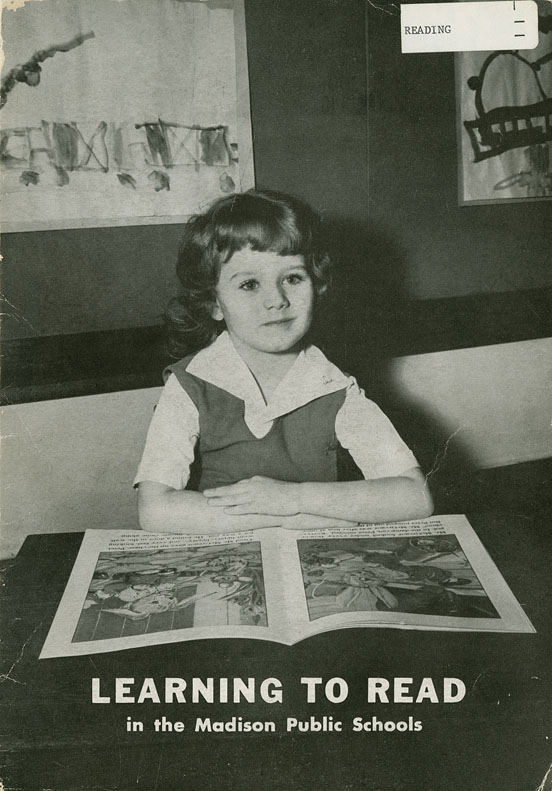
Here are a couple of choice excerpts from Superintendent Phillip Falk’s 1949 Learning to Read in the Madison Public Schools.

Problems of Long Standing

One of the most common misunderstandings in recent years is the belief that a startling new technique of teaching reading is being used which lacks some of the sterling virtues of the old techniques. Usually the implication is that either the old “alphabet” method, which began with the a b c’s, or the phonic method, which emphasized the sounds of letters, is the logical way to teach beginning reading. Any change in procedure today is looked upon as the cause of every deficiency, from inability to read well orally to poor spelling.

Few adults can remember the method by which they learned to read. Records show that the a b c method was discarded in Madison as early as 1871. In his short report for that year Superintendent B. M. Reynolds stated, “During the year the teachers in the Primary grades have discarded the Alphabetic Method of teaching reading, and have adopted what is called the ‘Word-Method’.”

By 1889 the phonic method, too, was losing ground. In December of that year Isabella Lamont, a primary teacher in Madison’s Second Ward school, read a paper before the state teachers’ convention in which she stated, “In the teaching of reading (which is the key to every other study and is therefore of the first importance) there is the a b c method, the word method, the sentence method, and the phonic method. None of these methods is wrong, but all are incomplete … ” One may well ask how new is new,or how old is old.

And (describing the practices of 1949)

There is no one “best” method of teaching children to read. Almost every known method, technique, or device is utilized as needed – experience, phonetic, word, sentence, story, meaningful drill or practice – not in isolation, but in an approach to a particular problem of a particular group or of a particular child.

Makes sense to me.

Thomas J. Mertz

Leave a comment

Filed under AMPS, Best Practices, education, Local News

Quotes of the Day

From the Wisconsin Center for Education Research report:

Educational equity issues within the school district [MMSD] are the source of much public controversy, with a relatively small but vocal parent community that is advocating for directing greater resources toward meeting the needs of high achieving students. This has slowed efforts to implement strong academic equity initiatives, particularly at the middle and early high school levels.

From Matthew Yglesias:

The rhetoric of No Child Left Behind is, I think, an appealing one. The idea is that, well, no child should be left behind. It’s an essentially egalitarian aspiration — the school system should try to do well for the hardest to teach kids, included ones coming from difficult backgrounds and ones who simply for whatever reason have a hard time with school. The idea of “gifted” programs is basically the reverse vision — that the school system should focus on the easiest cases and push them to the highest level of achievement possible.

There’s not a stark either/or choice between the hard cases and the easy cases, but at some level you do need to make a decision about priorities. Insofar as we’re serious about educational equality, that will to some extent involve shortchanging the best and the brightest. Insofar as we’re serious about taking the most talented as far as they can go, that will involve shortchanging equity. The former strikes me as more desirable than the latter, especially for people who want to think of themselves as being on the left.

From Michael Bérubé:

If we as a society are going to make decisions concerning prioritizing scarce educational resources, it makes sense to me, for us to consider what kind of output we desire. Do we want to, for example, maximize the number of future American Nobel prize winners and enjoy the fruits of the breakthroughs that our most gifted can achieve, or do we want to maximize the educational level of the median American worker? Both results have great value, and if we were to quantify them in terms of dollars, I’m not sure which one would prove to be of greater value to society. But I think these are the questions we should be discussing. And that devoting our resources to maximizing the future opportunities of our least educationally apt children for the sake of doing so, without examining the costs, is fuzzy-headed. Which may or may not be a liberal value. But as liberals we do acknowledge that society is not just a collection of disparate competitive individual maximizers, but that we live in a community where cooperation is also an important value. And that maximizing the strength and resources of that community is itself a liberal value.

The National Access Network just reported that “the United States now has the highest relative childhood poverty rate among developed countries.” When the test scores of white American students are reported separately and compared to the test scores of students in developed countries, the United States ranks third highest. In contrast, if Hispanic and African American test scores are compared to the same international scores, the United States ranks last and next to last. It noted that “the authors of a 2001 Wisconsin study concluded that a weighting of 3.4 times the base cost for education was needed for poverty students to reach state standards.” In a new paper on class size reduction efforts, research found that “Wisconsin SAGE class-size reduction experiments showed positive effects on student performance, especially for disadvantaged students.” Economists estimate that reduction efforts targeting disadvantaged schools nationally would cost about $2 billion, and as the evidence shows, it would reap many benefits.

Robert Godfrey

2 Comments

Filed under "education finance", AMPS, Best Practices, education, Equity, finance, Gimme Some Truth, No Child Left Behind, Quote of the Day

Primary Sources

My students have an exercise based on primary sources due soon. It seemed like a good idea to post some here.

It is hereby declared to be the policy of the commonwealth to encourage all school committees to adopt as educational objectives the promotion of racial balance and the correction of existing racial imbalance in the public schools. The prevention or elimination of racial imbalance shall be an objective in all decisions involving the drawing or altering of school attendance lines and the selection of new school sites.

An Act providing for the Elimination of Racial Imbalance in the Public Schools, Massachusetts, 1965

George Wallace 1968 television ad, from The Living Room Candidate.

Richard Nixon 1972 television ad, from The Living Room Candidate.

.

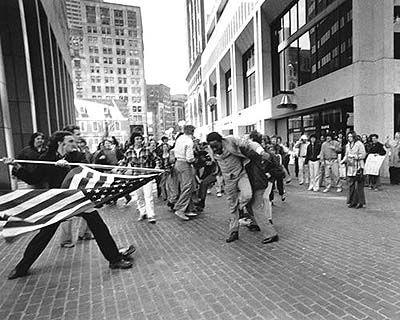
“Soiling Old Glory” Louis P. Masur (Boston anti-busing protest, 1976)

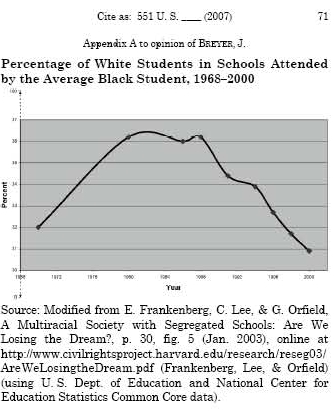
From Justice Stephen Breyer’s dissent in Parents Involved in Community Schools v Seattle School District (2007).

From MMSD, click image for power point (I wish they would update these).

And bonus links to recent blog entries on school desegregation from Sherman Dorn and Eduwonkette

Thomas J. Mertz

Leave a comment

Filed under AMPS, Best Practices, education, Equity, National News, Uncategorized

Dressed down for dressing up

A number of schools in Madison have foregone the celebration of Halloween over the past couple of years. The stated reason for not allowing Halloween costume parades at my school is that certain children, because of religious prohibitions, cannot participate, and therefore since a few are excluded from such an activity, such an event is deemed to be exclusionary. This is part of trend happening across the country. I don’t believe there is a district policy for this, at least one I could find. Despite the canard trotted out in such situations, boundary changes being one of the latest, the one that says “kids will get over it,” I can say my two children were quite upset and still bring up the ban each Halloween and a nostalgia for the event. Now comes a story out Reedsburg.

An elementary-school event in which kids were encouraged to dress as members of the opposite gender drew the ire of a Christian radio group, whose angry broadcast prompted outraged calls to the district office.

Students at Pineview Elementary in Reedsburg had been dressing in costume all last week as part of an annual school tradition called Wacky Week. On Friday, students were encouraged to dress either as senior citizens or as members of the opposite sex.

A local resident informed the Voice of Christian Youth America on Friday. The Milwaukee-based radio network responded by interrupting its morning programming for a special broadcast that aired on nine radio stations throughout Wisconsin. The broadcast criticized the dress-up day and accused the district of promoting alternative lifestyles. “We believe it’s the wrong message to send to elementary students,” said Jim Schneider, the network’s program director. “Our station is one that promotes traditional family values. It concerns us when a school district strikes at the heart and core of the Biblical values. To promote this to elementary-school students is a great error.”

The response surprised Principal Tammy Hayes, who said no one had raised any objections beforehand. She said a flier detailing Wacky Week had been sent home with children the prior week, and an announcement was also included in teacher newsletters.

The dress-up day was not an attempt to promote cross-dressing, homosexuality or alternative gender roles, district administrator Tom Benson said. “The promotion of transgenderism — that was not our purpose,” Benson told the Baraboo News Republic. “Our purpose was to have a Wacky Week, mixing in a bit of silliness with our reading, writing and arithmetic.”

Our school’s “Wacky Day” dress up just took place recently, miraculously surviving censure. I wonder when it too will be ended. What are these people afraid of?

Robert Godfrey

1 Comment

Filed under Best Practices, education, Gimme Some Truth

We Are Not Alone #20

At the April 4 th press conference for the release of the MMSD administration’s proposed budget — at the prompting of the press — the “R-Word” (referendum) was discussed. Since the one time Tax Incremental Finance District disbursement saved Madison from the annual rituals of cuts and conflict this year (and gave Art Rainwater the fitting farewell gift of an opportunity to make his last budget a true “cost to continue” budget), referendum talk was the headline in the Capital Times and the State Journal:

Referendum talk is back for schools
Susan Troller

A gaping $9.2 million hole in the Madison school district’s 2009-2010 budget will likely be stirring talk of a referendum as soon as the city’s new schools superintendent, Dan Nerad, takes office at the beginning of July.

By Andy Hall

Madison school officials soon will begin considering whether to ask voters for additional money to head off a potentially “catastrophic ” $9.2 million budget gap for the 2009-10 school year.

We are not alone.

41 Wisconsin school districts had 61 referenda on the ballot April 1st; 33 of these were for basic operating or maintenance expenses (the remainder were to authorize debt for capital projects).

As the State Journal recently editorialized, these referenda are a manifestation of the “no win situation” districts face due to the “system for financing public schools that essentially requires most schools to spend at a faster rate than they are allowed to raise revenue.”

The mess created by the state ‘s outdated and unfair school financing system is not new, but the consequences are mounting. Gov. Jim Doyle and lawmakers tweaked the system a year ago, but the state ‘s political leaders continue to shrink from the overhaul required…

The victims are the students — along with Wisconsin ‘s future in the globally-competitive, knowledge-based economy.

Superintendent Rainwater’s last words at the press conference summed things up nicely (I hope these are not his last words on the subject — Art, enjoy retirement but please continue to advocate for our schools and children):

“The politicians in the state of Wisconsin and those who fund the politicians need to understand what’s going to happen to this state if they lose this great public school system. We will be sitting here 10 years from now, wondering what in the heck happened to us. And what happened is this: We destroyed our ability to compete in a world that is changing.”

Now to the April 1st votes (with links to the Department of Public Instruction summaries):

Now the districts where the referenda failed are looking at what to cut next.

Here is a list of probable cuts (covering two years) from Waupan where the three-year nonrecurring referendum lost by 589 votes:

  • Reduce the teaching staff at Jefferson by 2.0 FTE?s (grade 1 and grade 2)
  • Reduce the teaching staff at Washington by 2.0 FTE?s (grade 1 and grade 2)
  • Eliminate the position of Gifted and Talented Teacher (1.0 FTE)
  • Eliminate the position of Director of Instruction (.8 FTE)
  • Eliminate 1.0 FTE elementary principal
  • Restructure administration
  • Eliminate the position of Police Liaison Officer
  • Eliminate Alternative School Program (.5 ? 1.5 FTE)
  • Reduce High School Health/PE (1.0 FTE)
  • Eliminate High School French (1.0 FTE)
  • Eliminate Guidance position (.6 FTE)
  • Eliminate Media Program (1.0 FTE)
  • Eliminate Library Aide (1.0 FTE)
  • Eliminate Clerical positions (.7 FTE)
  • Eliminate part-time custodians at middle school
  • Eliminate Industrial Arts at the middle school (1.0 FTE)
  • Combine Computer/FCE at the middle school (1.0 FTE)
  • Eliminate Special Education Aide (1.0 FTE)
  • Reduce one section of Honors Math at the middle school level

*FTE – Full Time Employee

As the district website asks, “If we continue to eliminate programs and cut staff, it will diminish and erode the quality of education in our district. What will happen to our kids and our community?”

As they have been for over a decade in Wisconsin, cuts like this are being contemplated around the state —  both in districts where referenda failed in those districts where no referenda were held. AMPS will give updates on these as the school budget season continues. For now, just a couple of videos about Wisconsin Heights, where the second referendum in two years failed, this time by 75 votes out of 1,975 cast (3.8%).

From before the vote:

From after the vote:

What can we do? Keep the pressure on our state officials, especially Governor Doyle; support the Wisconsin Alliance for Excellent Schools; join ABC-Madison; write your local newspapers; and last but not least vote and know where the candidates stand before you vote.

Thomas J. Mertz

Leave a comment

Filed under "education finance", AMPS, Budget, education, Elections, finance, Local News, Referenda, School Finance, Take Action, Uncategorized, We Are Not Alone

Wright Middle School 10th Anniversary

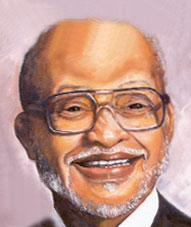
jcwpainting_001.jpg

James C. Wright Middle School is holding a 10th anniversary celebration on Sunday, April 6 from 3:00-5:00 (1717 Fish Hatchery Road). Wright is a very bright spot in our district and community.  Please come and join in recognizing the good work.  There will be an original play on Reverend Wright’s life and work,  the release of a book on Reverend Wright, inspiring speeches and more.

Hope to see you there.
Thomas J. Mertz

Leave a comment

Filed under AMPS, Best Practices, education, Local News, Uncategorized