Category Archives: Elections

NCLB Action

We haven’t posted much on No Child Left Behind lately.  Time to remedy that.

The reauthorization/reform are still pending, but don’t appear likely in this election year (see also here).  I don’t know if that is good news or bad news.  A straight re-authorization would be very bad news, but a better federal education policy (and less high stakes testing, less money for charters and vouchers, more money for underfunded mandates, more realistic accommodations and exclusions of special education students and English language learners for all testing) would be welcome, whatever the name.

I have to thank Madison teacher Gary L. Stout for prompting me on this post (and to add the Collaborative for Academic, Social, and Emotional Learning to the AMPS Resources page — check it out).  Gary, along with David Wasserman (see here and here, on AMPS) has been doing his best to get out a teacher’s perspective on the damage the law is doing to our schools and children.  Here is an excerpt from his site on NCLB (check out the Social, Emotional, and Academic Learning in Kindergarten material too, it is well worth the time if you care about early education).

Developmentally Appropriate Practices

If a person is truly knowledgeable about what constitutes Developmentally Appropriate Practices (DAP) for our school age children it is inconceivable that they support NCLB.

The concept of Developmentally Appropriate Practices are the cornerstone of what is good for our children in all schools. You will never, ever see the two phrases NCLB and DAP in the same sentence in any credible professional educational journal, never, ever. The more a person studies and works in teaching the more a person sees how developmentally inappropriate NCLB really is.

NCLB is the most destructive, vindictive piece of federal legislation ever passed. It is a deliberate assault on public education. It is a disease that is presently in every classroom, every day. It starts in kindergarten classrooms by undermining all aspects of Developmentally Appropriate Practices. It continues on through the grades and stops in High School when it lures, misleads, misinforms, and recruits our students into the all too real prospects of death or maiming. It is a tribute to the existing presidential administration
and their success at destruction and manipulation. NCLB is an all encompassing cancer that needs to be stopped.

The whole essay is here, including good quotes from our Board of Education members.  One more excerpt on what we can do: Take Action!

What Can We Do?

It is easy to be critical of NCLB. The challenging part is addressing the question of what can we do to change things?

1. We need to unite and get politically active locally and nationally to eliminate NCLB or change it drastically. The problem is that political change is slow. We as a nation have been taking steps backward in the education of our children for five years now. We will continue going backwards on a daily basis as long as NCLB exists as it is today.

2. It is critical for Wisconsin to change the way our public schools are funded. The elimination of revenue caps and the use of property taxes as a major way to fund public schools has got to change.

3. Third, we need to educate many of our co-workers, parents, and the voting public as to the truth about how our schools are being deliberately set up for failure and how our schools are presently failing on a daily basis to meet even the basic needs of all our children
There are also at least three things we can do immediately as a progressive and accountable school district.

1. Stop the one dimensional focus on academic learning and teach to the whole child. We need to teach and give every child the opportunity to grow socially, emotionally, physically, and creatively as well as academically.

In March 2003 I addressed a Madison school board committee suggesting that our school districts emphasis on testing and academic learning at the expense of social, emotional, physical and creative learning was developmentally inappropriate. Since then our approach to teaching to the whole child as become even more one dimensional with the developmentally inappropriate mandates of NCLB.

2. Change the focus of the Madison summer school program. Instead of using behavioral issues as a deterrent to getting into the program, children with behavioral issues should be the first to be enrolled. The public needs to know that when a classroom has just one socially
inappropriate child, that child takes educational opportunities away from every child in the classroom. Social development is similar to reading and math development. They need to be taught every day, in every classroom, at every grade level.

3. We need to remember Rosa Parks and say no to NCLB. Our school district should be commended for having the courage to say no to the Reading First program. Lets have the courage to say no to NCLB. As a community lets find ways to fund our schools without having the George Orwell effect tied to federal dollars.

I’ll add one more.  The Board of Education Communications Committee is planning forums on various topics.  I think the NCLB Act should be one of them.  If you agree, let them know.

Here are some of my other favorite anti-NCLB resources:

The Educator Roundtable (with petition).

Susanohanian.org (with a compilation of NCLB Outrages).

No NCLB.org

Thomas J. Mertz

Leave a comment

Filed under Accountability, Best Practices, Budget, Elections, Equity, finance, Gimme Some Truth, Local News, National News, nclb, No Child Left Behind, School Finance, Take Action, Uncategorized

We are not alone #19

bubble_nebula.jpg

Many, many referenda on the ballot in Wisconsin today.  Due to the TIF windfall, Madison escaped this round.  A large operating referendum is almost certain for November.

With that in mind, here are links and (very few) excerpts on today’s school referenda votes.

Unified tries to sway voters

Marshfield (links to many stories)

Students Support Marshfield Referendum

“”I think there’s a lot of people who don’t understand how big of an impact these extracurriculars have on our school lives. Like, I’m really into drama and band and I write for the school newspaper. All of those are going to be cut if this doesn’t pass.”

Marshfield School District Needs $2 Million Referendum

Support city school referendum to save education options

“My little sister can’t wait until she is in fifth grade and is able to join band, but that might not even happen. Why would they take away the foundation of the question “What do you want to be when you grow up” I loathe the fact that most people don’t even know or care what’s going on! People also, I feel, are being scared away by the thought of a raise in taxes, but the raise is a small price to pay for your/my future. What about the teachers that might be laid off because of this? Do you have any advice/help?”

Local School District Putting Multi-Million Dollar Referendum on the Ballot

“I’m not sitting here saying the football program will be cut,” Sally Sarnstrom said. “But it’s like any system. When you just keep reducing it, it just isn’t as effective.”

‘Dismantling’ would follow referendum’s failure

“Without the referendum, the district likely would cut four staff positions at its elementary schools and eliminate German from the curriculum at Prairie River Middle School next school year, officials said.

Future cuts would include reduced funding for special education and technology and additional teacher positions.

“The appropriate term to use now is dismantling,” Superintendent Sally Sarnstrom said, implying that the district has no room left to downsize. “”

Merrill voters will consider $2.9 million school measure

Spend the money, although it hurts

“The number of staff eliminated is almost staggering since 2001-2002.”

Oconto Falls Outdoor Facilities Referendum

Rio Schools to go to referendum in February

“After squeezing every penny from its 2004 referendum, the Rio Community School Board hopes that its diligence will convince residents to pass another ballot initiative in February.

“There is no room to cut anymore, and we have been very honest with the community about that,” said Doug Shippert, school board member. “In the past we have made cuts with staff and courses, but you can only make so many reductions. And the community knows we have made good fiscal decisions in the past.”

Thorpe referendum info

Thorpe referendum literature from the Future Farmers of America Alumni (this one broke my heart) 

Waterloo referendum newsletter

Arbor Vitae-Woodruff referendum powerpoint

Arbor Vitae-Woodruff Referendum

AV-W board approves referendum

I’ve said it before, this insanity has to stop.  It is long past time to fix the school finance system in this state.

Thomas J. Mertz

Leave a comment

Filed under "education finance", Best Practices, Budget, education, Elections, finance, Pope-Roberts/Breske Resolution, Referenda, School Finance, Uncategorized, We Are Not Alone

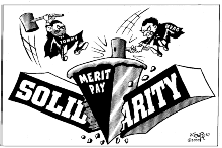
Paul Soglin on Merit Pay

wedge.gif

 Paul Soglin has a good post up on some problems with merit pay and related issues.

Time Magazine Gets An ‘F’ on Merit Pay for Teachers

The line, “It’s hard to argue against the notion of rewarding the best teachers for doing a good job.” in the Time Magazine article, How To Make Great Teachers jumped out at me.

It is very easy to make the argument.

There is a false assumption, an unarticulated premise, that workers, particularly teachers, perform better if they are financially rewarded with additional compensation.

We all work to make a living. We do better work for a variety of reasons. Actually most people do better work when motivated by pride in their job, not additional compensation.  That is why educators recognize that the most successful schools are the ones where the principal motivates the entire faculty to work as a team. 

If any kind of financial incentive is given, it should be to the entire faculty, not to individuals.

The Time article needs examination in other areas:

  • We never forget our best teachers – those who imbued us with a deeper understanding or an enduring passion… Wrong. I did not like Mrs. Gertz and frankly, I do not think she liked me. My sixth grade teacher was most unpleasant, especially when it came to adjectives and adverbs. She taught me how to write, she was not what I would call a great teacher. But she did her job.
  • …the nation will need to recruit an additional 2.8 million over the next eight years…Finding and keeping high-quality teachers are key to America’s competitiveness as a nation. The solution is not a merit pay system; the solution is recognizing the value of educators and paying them what they could make in the private sector.
  • Research suggests that a good teacher is the single most important factor in boosting achievement, more important than class size, the dollars spent per student or the quality of textbooks and materials. I am not sure which is most important, but the studies I read indicate that the quality of the faculty, the amount spent on education, which is reflected in class size, and parental involvement are the three major factors.
  • Why do teachers bail? One of the biggest reasons is pay. U.S. public-school teachers earn an average annual salary of less than $48,000, and they start off at an average of about $32,000…And there’s evidence that the best and brightest are the first to leave.  Hello, Wisconsin Manufacturers & Commerce (WMC), are you listening?
  • It’s too soon to say if ProComp (an incentive pay system) will raise achievement in Denver, but a pilot study found that students of teachers who enrolled on a trial basis performed better on standardized tests than other students. Great, but do the kids who performed better on the standardized test learn anything?  Now we have teachers teaching for the test,’ not teaching so that the kids learn to think.

Nate at Proletariat had some good thoughts about collaberation and merit pay a while back.

 Governor Jim Doyle and Barack Obama both support merit pay. Hillary Clinton does not.  More on presidential candidates and education here and here.


Thomas J. Metz

Leave a comment

Filed under AMPS, Best Practices, Contracts, Elections

Pope-Roberts/Breske Resolution Hearing Report

Pope-Roberts and Breske
Rep. Sondy Pope-Roberts, Middleton, and Sen. Roger Breske, Eland, testified before a packed house, Nov. 15, on Senate Joint Resolution 27.

From the Wisconsin Alliance for Excellent Schools
Message delivered to Legislature: Change the school-funding system

On Thursday, Nov. 15, comprehensive school-funding reform was before the Senate Education Committee. In 6-1/2 hours of testimony, 50 speakers from across the state urged the committee to back a, resolution — authored by Rep. Sondy Pope-Roberts, of Middleton, and Sen. Roger Breske, of Eland — to throw out the present funding system and replace it by July 1, 2009.

An additional 62 people registered their support at the meeting for Senate Joint Resolution 27. In their demands for reform, they joined 60 members of the Senate and Assembly who signed on as co-sponsors.

Testimony by Sen. Kathleen Vinehout, of Alma, not a member of the Committee, highlighted the troubles the small schools in her district have under the current state financing formula. She said there is “a fundamental disconnect” between what drives spending and what drives revenue.

Vinehout framed the resolution as a “get‘er done” order for the State Legislature, not a specific plan. The Senator called it a needed first step.

Rep. Pope-Roberts said that “we have the opportunity to get it right, something we failed to do in 1993” when the Legislature approved the present formula that places limits on how much revenue school districts can raise. Several testifiers reiterated the point that the revenue limits have failed to keep pace with districts’ rising expenses.

Testifiers at last Thursday’s hearing came from urban, suburban, and rural districts. Speakers cited shortages of books and desks; crumbling buildings; and too few courses, librarians and counselors, sports, and after-school programs. Many said these problems have been compounded by increasing class sizes. Those districts hardest hit are the ones with declining enrollments, six out of every 10 school districts in the state.

“Instead of prescribing how the school-finance system should be changed, the resolution calls for a finance system that meets four criteria. It must be based on:

  • The actual cost of educating children;
  • Sufficient resources have to be provided to meet state and federal mandates;
  • Additional help to students and districts who have special needs; and
  • The equitable collection of and distribution of funds
  • Ruth Page Jones, president of a parent group called Project ABC-Waukesha, said “it’s time to trash this going-out-of-business plan.” Jones said the present system pits neighbor against neighbor as communities are forced to go to referendum in order to stop program losses.

    Talking to that point, Tony Evers, deputy superintendent of the Wisconsin Department of Public Instruction, said half of all referendums have failed in recent years. He said, basically, that geographic location is now the prime indicator of how good an education a child will receive.

    Page Jones observed that “districts have already fired administrators, delayed maintenance, slowed text-book adoption . . . and now in the last few years all that is left to cut are teachers.”

    Upcoming, the Senate Education Committee will determine whether to forward the resolution to the full Senate. No hearings have been scheduled in the Assembly. You can weigh in on both accounts. Click on the following links to:

    »Find out what you can do.

    »Read the testimony of those appearing on behalf of WAES, and others

    »Watch the entire hearing on SJR27 on Wisconsin Eye

    »Read the media coverage of the hearing:

    Milwaukee Journal-Sentinel
    Wisconsin State Journal
    WISC-TV, Madison
    Wisconsin Radio Network
    Waukesha Freeman
    Wisconsin Public Radio
    WEAC Website

    Links to additional coverage:

    From a local blogger and sometime AMPS contributer: Democracy in Action.

    From Jennifer Morales of the MPS Board: Democracy is Sexy.

    And of course all the related posts on AMPS (including videos!)

    Thomas J. Mertz

    Leave a comment

    Filed under AMPS, Best Practices, Budget, Elections, Local News, Pope-Roberts/Breske Resolution, School Finance, Take Action, We Are Not Alone

    Senate Hearing Video

    Randy Kunch

    The testimony at the Senate Education Committee Hearing on the Pope-Roberts/Breske Resolution was beyond compelling. At times I was moved to tears. There was some anger too, but as I noted previously, the dominant theme was optimism, a belief that we (meaning the people of Wisconsin and our elected officials) can and will fix the shameful mess that is school funding in Wisconsin.

    In the coming days and weeks I am going to be posting video excerpts from the hearing(video from Wisconsin Eye — the full November 15 hearing can be accessed here — , excerpts posted via YouTube, playlist of all hearing videos posted thus far, here). I chose Randy Kunch from the Phillips School District as the first post (click here to watch). Please take the five or so minutes to watch and listen to Randy and then sit down to write your elected officials or your local paper and tell them that someting needs to be done and the time is now!

    Thomas J. Mertz

    Leave a comment

    Filed under AMPS, Best Practices, Budget, Elections, Local News, Pope-Roberts/Breske Resolution, School Finance, Take Action, We Are Not Alone

    Simple Majority Declares Victory for Kids and Schools…Let’s Do the Same!

    In the Election Roundup I wrote that the Simple Majority campaign in Washington State had lost. With more complete returns, victory has been snatched from the jaws of defeat. Congratulations to the League of Education Voters and the people of Washington!

    I attended the Senate Education Committee hearing on the Pope-Roberts/Breske resolution today (more on that later), and I think there is a lesson from Washington for the Wisconsin legislature and the people of Wisconsin. In Washington, they fought against great odds and achieved a major and positive change is state school finance.

    Everyone I heard testify today agreed Wisconsin’s system is broken and that each year we move further away from providing the education our children deserve. Most of those testifying were passionate and optimistic — they believe we can fix this and are committed to doing just that. However, some (not all) of the Senators seemed to be primarily interested in the difficulties and obstacles and 1,000 reasons why we can’t do better. This is the wrong attitude and they need to know that if they’d rather make excuses than do the job the Constitution gives them and the people demand of them, we will elect those who can and will.

    The resolution itself, like the voters and advocates in Washington, rejects this kind of thinking. It simply asks for a commitment to try to do what almost everyone agrees is the right thing.

    Is this too much to ask?

    Thomas J. Mertz

    Leave a comment

    Filed under AMPS, Elections, Local News, National News, Pope-Roberts/Breske Resolution, School Finance, Take Action

    Election Roundup

    The biggest news is the overwhelming rejection of a statewide voucher plan in Utah.

    Washington State has a requirement of a 60% super majority for school levies. There was a ballot measure to require only a simple majority. Returns aren’t final, but it appears to be failing. More info here.

    Update: Voters say no to simple majority.

    Many, many referenda in Minnesota (99 total, the second most in state history). 67.6% of the operating levy referenda passed; 50% of the districts asking for bond referenda and capital projects passed at least one request. For more, see these links:

    Districts reel from levy failures

    School levy wins don’t quiet calls for more state cash

    School funding advocates offer day-after commentary on school levy elections

    Latest: What’s next for schools? For many, plans for next referendum

    Complete list of School Districts’ Referendum Results ( Minnesota School Boards Association)

    Closer to home, there were a number of school referenda on the ballot Tuesday (and a few others, from September and October).

    Voters Approve Abbotsford School Referendum (building).

    Abbotsford passes $12 million building referendum

    Denmark referendum fails for fourth time (building, maintenance and operation).

    Galesville-Ettrick Voters Pass School Referendums (building).

    Genoa City (building — I can’t find a report yet, but it passed, 250-227). Update: ‘Yes’ to school project.

    Hartford voters reject school referendums (building and operating).

    Holmen voters approve both school referendum questions (building and operation).

    Lake Mills board members review failed referendum (10/2/07, building, maintenance, technology).

    Montello considers program cuts (9/11/07, building and operating, failed).

    New Glarus School Referendum Passes by 11 Votes (10/09/07, operating, see also here on AMPS).

    Voters pass Prairie du Chien school issues (10/30/07, building and refinance).

    Prescott school referendum passes (operating).

    New Sun Prairie school approved
    (pool and pool operating failed).

    West Bend rejects school referendum: It would have been state’s largest (building).

    Park Falls/Butternut consolidation — Butternut voters reject Park Falls/Butternut consolidation (Park Falls voters voted yes, 965-389). More on Park Falls on AMPS here).

    Thomas J. Mertz

    (updated, 11/07/2007, 7:10 PM)

    1 Comment

    Filed under AMPS, Budget, Elections, Local News, National News, Referenda, School Finance, We Are Not Alone

    Education DINOS

    DINO is an acronym for Democrat in Name Only. We are seeing a rise in the activism of education DINOS. Education is an issue that hits close to home and forces people to confront the depth of their beliefs in things like “the common good” and “equality of opportunity.” These ideals are often abandoned when forced to compete with the promise of political gains or their desires for the specific needs of their children. So we get self-justifying stories about abandoning urban schools and advocacy for charters and ability grouping among those who desire to maintain some relationship to the public schools.

    This consumerist stance pays only lip service to both Democratic and democratic values.

    Phillip Kovacs of the University of Alabama and the Educational Policy Blog has a great post up about two of the biggest DINO players in the education policy and politics; Democrats for Education Reform and The Education Sector

    Here is how he ends it:

    At present organizations such as these dominate policy making. I’m interested in ending that dominance. Perhaps the problem is that we have not pushed ideology enough. The belief that education should serve democracy is an ideological position, is it not? Perhaps we need to do a better job of marketing that brand…

    Marketing is part of it, but I think we need to do a better job in our schools and homes teaching the privileged to understand and work for equity and justice and equality. Tom Beebe of the Wisconsin Alliance for Excellent Schools closes his emails with this quote:

    “The moral test of a government is how it treats those who are at the dawn of life, the children; those who are in the twilight of life, the aged; and those who are in the shadow of life, the sick, the needy, and the handicapped,” — Hubert Humphrey, 1976

    I’d like to see that idea included in state and national standards.

    Thomas J. Mertz

    2 Comments

    Filed under AMPS, Elections, Equity, Gimme Some Truth

    More Presidential Education Info

    I want to thank Jerry for his post and add a few things.

    The Education Writers Association is doing an Education Election blog with regular updates.

    Teacherken at the Education Policy Blog and the dailykos has posts up on Obama, Richardson and Edwards education statements. They are worth reading in full, but the titles give some idea:

    Obama on education – decent, not spectacular

    Richardson: education plan & conference call, but really not ready

    A very good Education Plan from John Edwards

    Thomas J. Mertz

    1 Comment

    Filed under AMPS, Elections, National News, No Child Left Behind

    We are not alone #17

    Things have been bad in Park Falls for a long time. A $850,000 referendum failed in April. After that they announced an unbelievable set of cuts:

  • Reduce staff by one full-time staff member in the district offices.
  • Reduce staff by one half-time staff member in the elementary school office and one half-time staff member in the high school office.
  • Reduce by one maintenance position.
  • Reduce by one transportation position.
  • Reduce by 1-1/2 food service positions.
  • Reduce by one high school history teacher, one elementary and middle school guidance counselor, one high school technical education teacher, one half-time middle school consumer education teacher, one elementary alone.gifmusic teacher, one half-time high school physical education teacher, one half-time high school English teacher, one elementary school teacher, one .6-time middle school music teacher, and one special education aide. Further reduction includes five positions due to attrition/retirements.
  • Eliminate the position of middle and high school disciplinary assistant.
  • Eliminate all middle school [grades six to eight] athletics and other extracurricular activities — club or volunteer activities only.
  • Eliminate the following sports: cheerleading, hockey, gymnastics and golf.
  • There will be varsity and junior varsity sports only, no freshman or “C” teams.
  • Two coaches only per sport, varsity and junior varsity — any others must be volunteers.
  • Only authorized WIAA programs will be funded.
  • Eliminate the summer marching band program.
  • Reduce the FBLA program by disallowing national competition, unless other funding can be found.
  • Eliminate the forensics program.
  • Cut participation in any music competitions beyond the solo and ensemble competitions.
  • Reduce district’s technology budget by $30,000.
  • Reduce building administrators’ budgets by $55,000.
  • Reduce overall maintenance budget by $25,000 – $30,000.
  • Close the swimming pool.
  • It is further recommended that all athletic coaches and extra-curricular advisors be laid off at the end of the 2006-2007 season, including the position of grades seven-12 athletic director. These positions will all be re-evaluated, posted and rehired as necessary, as per collective bargaining agreement, with first consideration being given to employees of the school district.
  • It is also recommended that a system of fees and charges be established for school activities and events to raise additional revenue. A committee has been established to determine fair fees and charges. Such fees and charges would be for all athletic and music events, for use of the building by any profit-making activity [such as drivers’ education, karate, etc.], for special course textbooks and materials, for any non-class-related school computer usage, and for anything else the committee deems appropriate.
  • They are currently working on a consolidation with Butternut (another struggling district). Apparently the consolidation will produce some temporary savings but in the long run the combination of a basic state funding system that is designed to fail, declining enrollments and “sparsity” will take them right back where they are now (unless of course our lawmakers enact real reform).

    Sparsity is used to describe the special issues faced by large geographic districts with small enrollments, for example the need to staff a French or chemistry class for only a handful of students. These sorts of diseconomies of scale along with the need to maintain schools within a couple hour drive of student’s homes create real challenges and our funding system denies districts the resources they need to meet these challenges.

    Meanwhile, (according to the Park Falls Herald) “Impacts of cuts in school district felt

    This is the part that got to me:

    Elementary School Principal Michael Plemon addressed the board during his administrative report about the “desperate need for a guidance counselor” at the elementary school.

    “I believe strongly that we need this at the elementary level,” Plemon said. “We have got a kindergarten class and a first-grade class, I’m not exaggerating when I say this, where I could already be in a situation of suspending kids from school. We’ve got a few kids in that situation that need guidance. These are children that need help and discussion, and a place for them to go and get some guidance.”

    Plemon said he is able to handle the situations and discipline on a day-to-day basis, but that those students aren’t getting the help they need to change the behaviors, and that the concerns include the other students.

    “Children today come with a lot more social issues than they once did,” Plemon said, noting the need for assistance with issues including grief, loss, self-control and other social skills, especially anger management. “You’re looking at five to maybe 10 kids in the elementary, but they have this anger management issue every day. Other kids are getting hurt because of this.”

    “It is an area I believe is vital for our elementary school,” he said.

    Waller said a good rule of thumb is one guidance counselor for each principal. The district currently has one guidance counselor, working in the high school and middle school. Waller said the item would be on the agenda for the October meeting, but many board members felt the need was important and asked if it could be placed on the agenda for the meeting scheduled for tonight, Thursday, Sept. 27.

    In response to a question from board member Jean Gottwald, Schuchardt said the position was not in the 2007-08 budget but could be added.

    How long can this insanity go on? Make some noise! Call, write, visit any and all legislators and don’t let Governor Doyle off the hook. Come November, let’s work statewide to elect people who will fix this.

    Thomas J. Mertz

    Leave a comment

    Filed under AMPS, Budget, Elections, Referenda, School Finance, Take Action, We Are Not Alone