Category Archives: Equity

This is Wrong – $5 Freshman Orientation Fee (updated)

From Johnny Burrito's Ugly Money (click for more).

From Johnny Burrito's Ugly Money (click for more).

Update (8/27/2009, 5:15PM: I learned from Asst. Superintendent for Secondary Education Pam Nash, that West will follow the example of the other High Schools and find a way to fund the Freshman Orientation activities and refreshments without charging a fee. See here for an interim update.

I just learned that all 9th graders at Madison West High School will be charged a Freshman Orientation Day fee of $5 (I don’t know about the other High Schools).  This is wrong in so many ways.

It is wrong because — as recent Board of Education discussions and the draft Strategic Plan acknowledge — transitions are important, difficult and need attention.    Giving attention to transitions should be a district funded matter, not self-funded by the students and their families.

It is wrong because the preliminary 2009-10 budget passed in May includes the statement:

Student fees of all types are assumed to be unchanged for 2009-10

The MMSD website listing of 2009-10 fees does not include this charge.  It appears to be a new fee that was instituted without  public discussion or  Board of Education approval (in the past, the Board has taken an interest in student fees).

It is wrong because it may be illegal.   It depends on what the fee is for. According to the 1974 case State v. Sinclair (cited in this DPI information sheet) a Wisconsin Circuit Court ruled that the state constitutional guaranty of public education “”free and without charge for tuition to all children . . ” prohibited fees  “”charged for instruction.”  If the Freshman Orientation Day fee is for instruction, than it is illegal.

In the same case, the court permitted fees for extracurricular activities.  However, the orientation is mandatory and extracurricular activities are generally not.  It is not clearly against the law to charge for a mandatory extracurricular activity, although the whole idea of  a mandatory extracurricular activity and a fee for that activity invites care scrutiny.  This hasn’t happened.

It may be that the fee is for pizza or other refreshments.  In which case, requiring students to pay for food they may not want or consume seems wrong too.

Someone, the Board of Education or the administration, needs to give this some attention and kill the fee.

I  know money is tight, but this is not the answer (btw – the district needs to update their budget page, it still has the “everything is hunky-dory” material from the Spring).

Thomas J. Mertz

3 Comments

Filed under "education finance", Best Practices, education, Equity, finance, Local News, School Finance, Uncategorized

WAES School Funding Reform Update, Week of July 20, 2009

waesgraphicFrom the Wisconsin Alliance for Excellent Schools.  Table of contents below (with links to related AMPS posts); PDF of full update here (click and read, good stuff!).

  • State budget dust-up drawing attention to need for reform
  • Evers, new DPI head, commits to school-funding reform
  • More ammunition proving adequate funding makes a difference
  • Now is the time to sign up for a funding reform presentation
  • WAES membership keeps the reform message before the public
  • New video explains the basics of school-funding reform
  • Wisconsin gets good report from American Diploma Project
  • School-funding reform calendar

Thomas J. Mertz

Leave a comment

Filed under "education finance", Best Practices, Budget, education, Equity, Local News, School Finance, Take Action

MMSD Equity Report Due

Logo for the 2008 Minority Student Achievement Network (MSAN) Conference, for more on MSAN click the image.

Logo for the 2008 Minority Student Achievement Network (MSAN) Conference, for more on MSAN click the image.

On June 2, 2008 The Madison Metropolitan School District Board of Education adopted a new Equity Policy (policy here, minutes here, video here). This policy requires a two-part annual report on equity, described as follows:

Reporting

Administration will report on an annual basis to the Board of Education the extent of progress on specific measures in eliminating gaps in access, opportunities and achievement.

Administration will develop an annual report that will provide data on the distribution of staff, financial, and programmatic resources across all schools.

In six days, a year will have passed since this policy was adopted. By the end of that six days, the annual equity report is due.

After all of the work of the Equity Task Force and all of the disappointments — with the Board of Education never even discussing important portions of the Task Force work (and here), and with the Board’s confused and inattentive dropping of the implementation portion of the draft policy (and here) — the only clear victory for the Task Force and Equity was the annual report requirement.

It is essential that this report be issued, be substantive, and be given a thorough examination by the Board and the public.

Although it was an open secret and a common complaint that the previous Equity Policy was never followed, I’m going to take it on faith (for now) that the required report will be issued. I can’t control how the Board treats this report, but I will do my best to raise public awareness and facilitate an examination. That leaves the substance of the report and I have some ideas I would like to share.

In part, as a response to NCLB and state laws, The MMSD administration already issues reports on achievement and achievement gaps. A report on access and opportunities would be something new, and would get to the heart of some of the concepts of Equity put forth by the Task Force and adopted by the Board:

Goals

  1. The district will eliminate gaps in access, opportunities, and achievement by recognizing and addressing historic and contemporary inequalities.
  2. The district will recognize and eliminate inequitable policies and practices at the district level.

Ideally, the first annual report would provide a baseline to assess if progress is being made in access and opportunities.

I would suggest that this portion of the report be as comprehensive as possible, broken down by school and demographics, and place a particular emphasis on access and opportunities for advanced programs or individual work. Evidence of disproportionality is the key. Under state statutes, the district already reports on disproportionality in special education referrals and placements (link to the  PowerPoint presentation because unfortunately I can’t find an actual report on line). This could serve as a model.

The report should include both opportunities (by school) and participation in fine arts programing, world languages, technical and vocational education, remedial and other support opportunities — did you know that at least three elementary schools have no Reading Recovery –, honors, Talented and Gifted (TAG, including In Step referrals and outcomes), accelerated programs, AP, really anything and everything that is outside of the core, basic curriculum. All of this should cover curricular, co-curricular and extra-curricular opportunities and access.

I said above that special attention needs to be given to advanced opportunities. I was twice recently reminded of how important this issue is. The first time was the complete absence of African American and Hispanic students taking the qualifying test for West High School Accerelated Biology. The second time was in an Capital City Hues interview with long-time Madison educator Tenia Jenkins. Ms Jenkins had this to say:

So you set up a mechanism that targets one group and the other groups obviously benefit from it. But there are some groups where that doesn’t happen, for example, the gifted and talented classes in the district. They’ve been around for 20-25 years. And most Black children are still not benefiting from them, only a few here and a few there. So what we are simply asking is for the district to set up the same kind of thing for Black children that they are doing for White students in terms of gifted and talented classes.

The perception and reality is that TAG is (mostly) for “White students.” This must change. One way to start is by forcing the administration, the Board, and the public, to confront the stark data on disproportionate access, opportunities and participation.

The other part of the report involves resources. There is one breakdown of resources in the annual budget, but I don’t believe that this is sufficient for Equity purposes.

There are three things I would like to see incorporated into the resources analysis: an assessment of needs, staffing descriptions, dollar and FTE allocations.

The first would involve some version of the Equity Resource Index/Educational Needs Index developed by previously by the district to distribute resources based on factors that have been demonstrated to negatively impact academic success.

The second should be along the lines of this being a user friendly look at school staffing prepared on Middle Schools in 2006 (link corrected, previous linked document here — TJM, 5/28/09).

Last, budgetary resources need to be considered in terms of both Full Time Equivalent (FTE) and dollars per student. One the most important recent lessons on Equity is that experienced teachers tend to be in lower needs schools, dollar figures for staffing capture some of this inequity because more experienced and better trained teachers rise higher on the pay scale. An example of the latter from 2006 can be accessed here.

These differing versions of looking at resources need to be presented in a manner that makes the relationships among them transparent.

There are other things I would like to see in an Equity Report — such as demographic breakdowns of classroom assignments by school, demographics of requests for inter and intra district transfers and transfers granted — but these fall outside of the report requirements in the policy. You take what you can get.

I’m looking forward to the Equity Report, the discussion it prompts, and (I hope) the actions that come from that discussion.

One last note. I know that much faith has been placed in the current Strategic Planning process, but it would be a mistake if that process supplanted, not supplemented the good work on Equity (and other things) that came before.

Thomas J. Mertz

Leave a comment

Filed under "education finance", Budget, education, Equity, Local News, School Finance, Uncategorized

Equity Inaction

cft0505_222151144

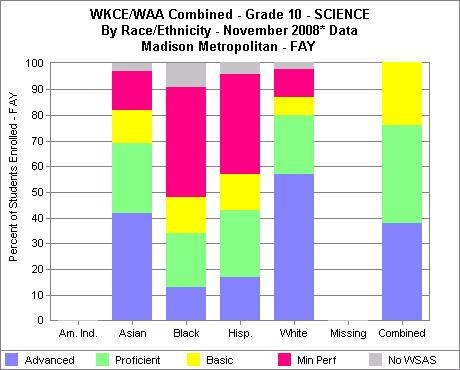
Today was one of two opportunities for 8th graders in the West High School attendance area to take a test to qualify for Accelerated Biology next year (the other is tomorrow, May 6, 2009, 4:00 to 6:00 PM in room 225 at West High School).  I have it on good authority that there were no African American or Hispanic students among the approximately 40 students who took the test today.

The Equity Task Force was very concerned about these sorts of disparities (and those revealed in the graph at the top).  We recommended the following remedy:

Open access to advanced programs, actively recruit students from historically underserved populations, and provide support for all students to be successful.

The Board of Education never publicly discussed this recommendation and did not act on it.

Access is not open, it is by tests.  If recruitment is going on, today’s test takers show that it has not been effective.  I don’t know what supports are in place for those who chose to challenge themselves.

Although a desire to overcome not reproduce societal inequality was behind the recommendation, there was also another more basic idea:  No person (or test) associated with our schools should ever tell a student that their ambitions are beyond them, that they aren’t smart enough, that they should aim lower.

Those who took that test today and did not pass will be given exactly that message; many of those who weren’t taking the test have already heard that message, loud and clear.

Thomas J. Mertz

Leave a comment

Filed under Best Practices, education, Equity, Local News

A Slice of Two-Thirds

Credit: TeckPoh

Credit: TeckPoh

Following several hours of impassioned testimony from administrators, parents, and staff from school districts throughout the state, both large and small, at this week’s School Finance Network Assembly Hearing, it ended, unfortunately, on what could be charitably characterized as a flat note. Despite the hard work of disparate leaders of education groups meeting constantly for the past couple of years to come up with a thoroughly conceptualized school finance reform plan to present to the legislature, a committee composed of organizations in the School Finance Network who have often been traditionally at odds with each other in the past (for example WEAC and WASB ), came to the hearing armed with numbers vetted by both economists at the UW-Madison and the state Legislative Fiscal Bureau, including a number of suggestions for how to pay for this reform. However, the Committee on Education made it clear they were not going to take any action on this plan for the upcoming budget legislation hearings for the 2009-2011 budget. And most discouragingly there was, as far as I’m aware, no newspaper coverage of this event. I saw only one Madison tv crew present. They covered some of the personal testimony at the beginning but were not around to hear the actual presentation of the plan itself, which came late in the proceedings, too late to make it into the evening broadcast.

There are several political issues at play here, and with the funding reform process seemingly ended as soon as it was given its first oxygen to breathe, I think we may be headed towards even more dangerous waters. We will try and cover what rocky shores we may be encountering in future posts (such as the Governor’s push to repeal the QEO without other fundamental reforms). I want to draw your attention to one of them that, frankly, I missed in some of our earlier discussion on AMPS here about the use of federal stimulus money for school budgeting. In the Summary of Governor’s Budget Recommendations, Thomas Mertz pointed out his confusion with the school district’s use of their increase in their federal Title I and Individuals with Disabilities Education Act (IDEA) funding to reduce their levies and the potential bad effects this may have on district’s budgets in subsequent years. I, along with Mr. Mertz, remain quite confused about the Governor’s and the Legislative Fiscal Bureau’s thinking on the added stimulus money to IDEA and Title I as a way to keep within the Fed guidlines of “supplement not supplant.” It would appear that the Governor is planning to scale back his professed desire for the state to provide 2/3’s funding for education and instead reduce it to a level between 62.0% and 63.2% in 2010-11 and the shortfall made up with increased short-term Fed dollars. As an editorial in the New York Times noted the other day:

The education portion of the federal stimulus package gives a $13 billion boost to Title I, the federal program that is meant to provide extra help to disadvantaged schoolchildren. And the Department of Education has issued new guidelines, requiring states to give a clearer accounting of how education dollars are spent. But the federal money won’t get to the students for whom it is intended unless the department bird dogs this issue.

As envisioned by Congress, Title I is supposed to serve as an additional layer of financing for high-poverty schools that already are provided with budgets comparable to other schools in the same system. In reality, states and localities have often shortchanged schools that served the poor and used federal money to make up the difference in their basic budgets.

They further added:

The states and localities will resist the reporting requirement, which could easily unmask unethical financing gaps and even evasions of federal education law. But Arne Duncan, the education secretary, needs to hold them to the rules. The new reporting requirement is absolutely essential to school reform in general and fairness for impoverished children in particular.

But in yesterday’s State Journal report showing that MMSD would be receiving $11.7 million over two years from the stimulus bill, the Governor was quoted as warning school districts against “creating “funding cliffs”: using the short-term dollars to start new programs that would have to be sustained later by other funding.” But isn’t that what he is doing in his budget, promising something and then pretending he’s actually paying for it with two funds that are meant to supplement and not supplant state funding?

The Governor is further quoted, “This money can really protect our property taxpayers, and it also can add real quality to our schools if used correctly,” Doyle said.

Indeed. We’ll wait to see what the Obama administration has to say about this old street hustle 3-cups-and-a-ball routine.

Robert Godfrey

Leave a comment

Filed under "education finance", Accountability, AMPS, Best Practices, Budget, Equity, finance, Gimme Some Truth, Local News, National News, School Finance

FDR 1938 Speech to the NEA

Franklin Delano Roosevelt’s June 1938 speech to the National Education Association (hat tip, Crooks and Liars).

Full text here; some excerpts:

We have believed wholeheartedly in investing the money of all the people on the education of the people. That conviction, backed up by taxes and dollars, is no accident, for it is the logical application of our faith in democracy.


Here is where the whole problem of education ties in definitely with natural resources and the economic picture of the individual community or state. We all know that the best schools are, in most cases, located in those communities which can afford to spend the most money on them—the most money for adequate teachers’ salaries, for modern buildings and for modern equipment of all kinds. We know that the weakest educational link in the system lies in those communities which have the lowest taxable values, therefore, the smallest per capita tax receipts and, therefore, the lowest teachers’ salaries and most inadequate buildings and equipment. We do not blame these latter communities. They want better educational facilities, but simply have not enough money to pay the cost.

There is probably a wider divergence today in the standard of education between the richest communities and the poorest communities than there was one hundred years ago; and it is, therefore, our immediate task to seek to close that gap—not in any way by decreasing the facilities of the richer communities but by extending aid to those less fortunate. We all know that if we do not close this gap it will continue to widen, for the best brains in the poor communities will either have no chance to develop or will migrate to those places where their ability will stand a better chance.

Make them listen to this in Madison and in Washington.

Thomas J. Mertz


Leave a comment

Filed under "education finance", Accountability, Best Practices, Blast from the Past, Budget, education, Equity, finance, Gimme Some Truth, National News, School Finance, Take Action

Dane County Board of Education Candidates

vp052a

From the Cleveland Municipal School District Visions of Democracy - Digital Gallery. Click on image for more.

April 7, 2009 will be a big day for school votes in Wisconsin.  There is the State Superintendent race (I’m backing Tony Evers, for reasons that I hope to have a chance to post on at some length), 41 school referenda in 29 school districts are on the ballot (those posts are in the works, see here for a summary of the measures) and around the state voters will elect their representatives to school boards.  The League of Women Voters of Dane County election guide has been published and posted, with answers from many of the candidates and descriptions of local referenda.

I spent some time going through the candidates answers and was struck by the combination of widespread concerns about the ability to provide necessary and desired educational opportunities under the pressures of budget constraints and by how few pointed to the broken state school finance system as the source of this ongoing situation.

The biggest exception is MMSD Board president Arlene Silveira.  This is what she wrote about the “the major issues confronting your school district, and, if elected, how will you deal with them?”

Equitable school funding system. Unless changed, all school districts will be forced to make devastating cuts detrimental to all students. I will initiate community-based advocacy efforts to work toward changing the funding. Enhancement of minority achievement efforts by improving efforts in schools to raise instruction quality; expanding availability of schooling opportunities and working with community to develop policies that enable all children to begin/attend school on a more even playing field. Ensure we are providing students with skills needed to compete in the 21st century, irrespective of their path. Continue efforts focused on redesign of our high schools. (Emphasis added.)

This is one reason I’m supporting Arlene.  Click on her name above to join me.

Her opponent, Donald Gors is more typical in his non specific reference to financial issues and lack of expressed committment to work for change at the state level:

One large looming issue facing Madison’s School District is MONEY!

True, but not very helpful.

The same is true for most other Dane County candidates who discussed the issue (many did not discuss finances at all or had almost nothing to say — these responses have not been included).  Here is what other Dane County candidates said about school finances.

CHUCK POIRIER incumbent, Deefield:

Expenditures continue to raise and outpace funding. The board and administration need to review funding formula and actual costs per student and determine if the tax payers would incur a tax savings or a tax loss by allowing transfer students from outside our community to enroll in the District.

VICTOR GONZALEZ, Edgerton:

The Edgerton School District will soon be replacing a principal and its superintendent; it will also be facing a significant decrease in its high school enrollment and will have to tackle large maintenance expenses with a tight budget.

JEFF ZIEGLER incumbent, Marshall:

Crafting a budget that meets the needs of our students and allows us to continue to improve the education we provide continues to be a significant challenge. This is especially difficult with state imposed revenue controls. The key to meeting this challenge is to make sure that all of the board’s decisions are made with the goal of providing the best educational experience that we can. The Marshall School District has done a good job of implementing needed changes and improving our educational programs during difficult economic times by keeping this key idea in mind.

Ziegler also refers to the importance of “full funding” for “”bilingual education for all children; b) music and art; c) civics; d) 4-year-old kindergarten; e) preparation for the work force.”

LEE WEINSTOCK incumbent, Marshall:

Tight budgets, academic performance and school safety are top issues facing many schools, including Marshall. I have been a good steward of the school district’s finances in my nine years on the board and will continue to make budget decisions in the interest of what is best for the success of students.

JASON McCUTCHIN, Monona Grove:

One of the major issues for this district is the budget shortage that is forecasted for the next couple of years. Because this is an issue that is likely going to be a recurring issue I would like to see the next board take a hard and fast look at this year’s deficit and see how the decisions that are made this year will affect upcoming years. Additionally, we need to be cognizant of any how any cuts will impact our building infrastructure and the quality of our children’s education.

LIONEL NORTON, Monona Grove:

As a nation we are facing tough economic times and the Monona Grove School District is not immune to this. Our biggest challenge in the next couple of years will be to prevent our district from cutting programs and activities that make our district special and from falling further into debt. I will listen without bias to all ideas and suggestions on the best way to achieve this with the least negative impact to our students and teachers. Neighborhood growth continues to be a challenge for our schools; we must proactively address this issue to prevent overcrowding at our schools.

STEVEN C. ZACH incumbent, Oregon:

Annually the Board must adopt a budget that balances the needs of students, fairly compensates employees, maintains facilities and does not burden taxpayers. We have done that during my Board tenure.

TINA HUNTER, Stoughton:

During this time of uncertain budgets and fluctuating enrollments, we need to maintain opportunities. We must find creative options to meet all District goals while also serving our students and community. School consolidations need to happen logically and painlessly. We must make wise decisions regarding staffing, transportation, and boundaries during this time of transitions.

TERRI WATKINS incumbent, Stoughton (this answer is almost as good as Arlene’s):

Increasing student achievement, recruiting and retaining quality staff and maintaining facilities are all priorities in SASD. The current state funding formula creates challenges to these priorities in districts like SASD with declining enrollment. School consolidation, bussing guideline updates, and enrollment-driven staff reductions will help in the short term. It is important to continue our collaborative work to encourage community growth, energy conservation and educate our community on school funding issues and solutions including pressure to bring legislative change that will provide more long-term financial relief. (Emphasis added.)

TERRY W. SHIMEK incumbent, Sun Prairie:

Property taxes are also an issue, especially for those on fixed income. I would support a solution for the fixed income hardship at the state level. Despite rising costs, my goal is stabilize or even reduce the property tax rate.

JOHN E. WHALEN incumbent, Sun Prairie:

The Sun Prairie Area School district has been both blessed and cursed with a rapidly growing student population. We don’t have to deal with the budget problems associated with declining enrollments, but growth has its own budget issues. Growth has required significant investment in infrastructure, and has required the District to work hard to meet the needs of our student population. I am a firm believer that all children are entitled to a quality education. If elected, I will continue to pursue all opportunities that support quality education for all students.

Two other observations.  First, it appears that incumbents are more likely to “get it” that the budget problems begin with the state system.  Second, despite the facts that about 250 referenda have been held in the last two years and about as many can be expected in the next two years, I don’t believe a single candidate directly mentioned referenda.

Don’t forget to come to the MMSD school funding forum on April 1 to learn more about state funding reform efforts and to get involved.

Thomas J. Mertz

2 Comments

Filed under "education finance", Best Practices, Budget, education, Elections, Equity, finance, Local News, Referenda, referendum, School Finance, Take Action, Uncategorized

The Axe Keeps Falling — More Cuts and Layoffs, Trying To More With Less

From the Paul Bunyan murals by James S. Watrous at the University of Wisconsin Memorial Union.  For more information. click the image.

From the Paul Bunyan murals by James S. Watrous at the University of Wisconsin Memorial Union. For more information, click the image.

Bo Diddley, “Bo’s a Lumberjack” (click to listen or download)

As noted last week, under Wisconsin’s broken school funding system, Spring is the season for budget cuts  in districts around the state.  The latest places the axe is falling are Minocqua-Hazelhurst-Lake Tomahawk, Kaukauna, and Oshkosh.

Minocqua-Hazelhurst-Lake Tomahawk (MHLT) is a K-8 district serving 550 students spread out over 350 square miles.  It is a classic “small but necessary” district in dire need of realistic  sparsity aid as one part of an improved system of funding schools.  Governor Jim Doyle’s budget proposal cuts the already inadequate sparsity aid by 1%.

The Lakeland Times reports that the district voted to lay off two teacher, cut the employment of three others by 20%,  lay off four educational support team members and discontinue funding for outside curriculum integration with the Lakeland Union High School (LUHS).

These were obviously painful decisions.  One board member had this to say about the curriculum integration defunding:

“We’re facing decisions that you well know,” board member Billy Fried said. “We’re negotiating with teachers. We’re making cuts in staff, and it’s really hard to look them in the face and also look our taxpayers in the face when we’re kind of shrinking our own, yet maintain an outside service that a lot of us feel confident they [MHLT current staff] can do a good job.”

The probability of an operating referendum in the near future was part of the decision:

“If I had any thoughts or felt that from the administration that it would be detrimental to the students, I would do nothing [and continue the service] … I think, too, one thing to keep in mind is we are going, we know we have to go to referendum soon, and I think we need to show we’ve done every possible thing before we go to referendum,” [Board Member] Laura Ahonen said.

Administrators and others did weigh in on the issue.  Principal Rob Way “admit(ted) that it would be a challenge, but one that they could handle successfully.”  Tom Gabert, Lakeland Union High School Board Member said “The major concern with doing it internally, was that past experience has shown that when there is no money on the table, it often gets neglected.”

Combined with the layoffs and this decision means that MHLT staff will be asked to do more with less.  The newspaper simply noted that the layoff notices were given with “much regret.”

Oshkosh is a much larger district (about 10,000 students) and the layoffs are also larger.  Oshkosh has referendum votes scheduled for April 7 on a complicated mix of building. upgrades and maintenance measures.  Although one of the questions asks for operating funds, these are designated for “the costs of small additions and renovations to existing school facilities and equipment acquisition” and would have no impact on the layoffs.

According to the Oshkosh Northwestern, here is what is being done to balance the budget:

The district plans to propose a freeze on administrator salaries and reduce at least one full-time equivalent administrator, said school district Human Resources Director John Sprangers.

The list includes 36 full-time teachers and nine part-time teachers primarily from middle and high school elective courses. Music and special education departments would take the biggest hit, losing six educators each.

Last year, “The district filled a $1.4 million hole in its budget… entirely by cutting non-personnel expenses such as maintenance and department funds.”  These cuts are part of the reason that there is now a maintenance operating referendum on the ballot.  What an insane circle of robbing Peter to pay Paul and then asking for money to pay back Peter while taking back from Paul…This has to end.

WLUK-TV has more on the story:

Note that both larger class sizes and fewer options will result from the cuts.   According to the Northwestern the middle school schedule will be reconfigured  “allowing each teacher to do more,” (I’ll add “with less” because that’s what is happening, and note that the “more” is in terms of classes and students taught and the the reality in terms of quality and learning will likely be that they are doing less).

The Kaukauna layoffs were actually approved on March 9, 2009.  With so many cuts it is hard to keep up.

Kaukauna serves about 4,100 students with a staff of approximately 500 and a budget of about $52 million.  In order to meet the projected $2.9 million shortfall for 2009-10, the Board froze administrator salaries, and laid off over 10% of their teachings staff.  The projections are based on very conservative estimates of future revenue caps, but past experiences with losing students due to open enrollment and underestimates of costs have taught the Board to be conservative.  One Board member noted that the new cuts will probably lead to the loss of more students via open enrollment.

Delayed maintenance projects,  threatening safety are also a factor in the layoffs.

To avoid big cuts last year, Kaukauna closed a school and sold the administrative building.  The layoffs will mean in increase of about two students per class.  Past cuts mean that like the teachers, administrators will be doing more with less:

Board President Jeff McCabe and clerk Cindy Fallona pointed out that because of cuts, administrators have had to tack on more duties without being compensated. Among them are financial officer Bob Schafer, who is overseeing buildings and maintenance, and human resources director Mary Weber, who is serving as Park principal. Randy Hughes, special education and pupil services director, has helped with administrative duties at an elementary school. Eric Brinkmann, Haen principal, tracks student academic performance for the district.

Superintendent LLoyd McCabe correctly identified Wisconsin’s dysfunctional system of educational investment as the source of all these troubles:

McCabe is hoping state lawmakers will tackle the school funding issue to relieve pressure on districts.

“I think that there’s pretty good agreement that state funding has to be revised and the problem that the state has is that they don’t have the money to do anything about it,” he said.

“Wisconsin schools cannot continue to produce students who rank at the very top of the nation with the funding structure that exists today.”

This leads directly to my “join the fight” plea.

If we don’t put/keep the pressure on, nothing will happen except more cuts, more referendum fights, more kids not getting the education they need and deserve, fewer kids reaching adulthood with the tools to be successful…we all need to get and be active.

Use your own experiences to write your own letters to the editor:

Contact the Governor, your Senators and Representatives.  Make them keep their promises (for more as-yet-unmet promises from Governor Doyle, see here and here).

Don’t forget the April 1, 2009 MMSD “Legislative Informational Community Session” and the April 21 Assembly hearing on the School Finance Network (SFN) plan (details on both, here).

Connect with activists around the state and support real change by joining the Wisconsin Alliance for Excellent Schools.  Keep up-to-date with SFN by signing on as a School Finance Network supporter.

Talk to your friends, neighbors, co-workers…spread the word.

Thomas J. Mertz

Leave a comment

Filed under "education finance", Best Practices, Budget, education, Equity, finance, Local News, Referenda, referendum, School Finance, Take Action, Uncategorized, We Are Not Alone

The Axe Is Falling — School Layoffs, Closures and Cuts

Paul Gauguin "The Man with an Axe"

Paul Gauguin "The Man with an Axe"

All over Wisconsin — in districts where referenda failed, in districts where referenda weren’t tried and maybe in some districts where referenda passed — the axe is falling, teachers and programs are being cut and the “New Wisconsin Promise” of  “A Quality Education for Every Child” is sounding more like a cruel joke every day.  As long as Wisconsin’s politicians lack the courage to fix our broken school finance system with the  structural gap between allowed revenues and mandated costs, the annual Spring chopping ritual will continue.

If you know the story already and don’t need the latest details, skip to the bottom for ways to take action and make reform happen.

Appleton, where two referenda failed in February has eliminated 44 teaching positions, the equivalent of 31 full time teachers.  Here is what it will look like in the classrooms according to district financial officer Don Hietpas:

“We’re staffing the high schools this year at 28-to-1 (student-to-teacher ratio). We are staffing the elementary school at one per class than we did last year, so it’s 27-to-1. So the average class size is going up at all levels, except for K-3, which is an area we continue to protect.”

Board President Sharon Fenlon noted an unintended consequence that will have long term implications for districts and the teaching profession:

“It’s very tough,…especially because the layoff is in order of seniority. Many of the people laid-off are quite new to the profession and people we would like to encourage to stay in the profession, and to have to lay them off is very painful.”

Teachers aren’t the only thing on the chopping block in Appleton:

“We’re cutting capital projects, we’re cutting technology, we’re cutting other areas besides classroom teachers, secretaries, para-professionals, administrators, so the reductions will be across the board,” Hietpas said.

Appleton is often held up as the poster district for charter schools in Wisconsin, but all the charters in the world can’t stop the budget cuts when the school funding system is broken.

Eau Claire hasn’t tried a referendum since 2007 and hasn’t passed one since 1999.  After the defeat in 2007 they closed the “Little Red School” and continued with the steady cuts in othe areas.  This year the structural budget gap is about $4.1 million (from a budget of  about $105 million) and things look to be particularly bad.  SAGE has been cut back, athletic directors are gone, salary freezes are being floated and still more cuts will be needed. WEAU News has the list of things being considered:

–10 high school teachers. That would save the district $650,000.

–2 elementary art teachers (while cutting art time from 60 minutes to 45 minutes a week). That would save $124,000.

–15 elementary school support staff or assistants, saving $600,000.
–5 middle school support staff, saving $205,000.
–10 high school support staff, saving $410,000.
–4.5 central office support staff, saving $184,500.

–1.1 library media specialists. That would save $68,700.

–5 custodians, saving $310,000.
–1 senior maintenance position, saving $62,000.

–A vacant staff development/assessment coordinator position, saving $105,200.

Other options to save money include:

–Eliminating custodial overtime on the weekends. It would save the district $35,500, but could mean the cancellation of weekend athletics, music and theatre.

–Reducing elementary art, music, PE, and special ed PE program specialists. That would not cut teacher jobs, but eliminate positions above and beyond their daily duties. It would save the district $39,200.

–Discontinuing Spanish classes in elementary schools because grant funding is no longer available. That would equal a savings of $13,000.

Also on the table is “cutting the number of teams for certain high school sports. ”

As the Board struggles  “”to reduce the programs that have the least impact on the kids,” the head of the local teacher’s union points the finger where it belongs — our state elected officials:

“This problem isn’t going to go away. We’re going to have the same problem next year. We’re going to have it the following year until we really change the way schools are funded in the state of Wisconsin,” says Ron Martin, president of the Eau Claire Association of Educators.

And here from an earlier story:

But Martin says the school district and the school board really aren’t to blame. He says the revenue caps and funding at the state level are the major reason for the budget issues.

“It’s stifling us and in Eau Claire’s situation, it’s killing us.”

Pretty bleak assessment, but absolutely correct.

Waupun is another district that lost referenda votes in February.  Since 1996, eight operating referenda have failed in Waupun.  They’ve gotten used to cuts, but this time in addittion to eliminating 30 positions (30 positions!), it means closing schools.  Nothing divides a district like school closures.  To make matters worse, the schools slated for closure are not in Waupun proper, but in Alto and Fox Lake.  At the March 16, 2009 Board meeting, Fox Lake’s Mayor made a formal request to detach from the district.  The request had not been properly filed, but the Board went on record denying it anyway.  Fox Residents are still exploring options:

Kim Derleth, a member of the Concerned Area Residents for Education (CARE), said the Fox Lake-based organization will hold a special listening session at 6:30 p.m. today (Tuesday) in the Fox Lake Community Center to discuss area residents’ options.

Derleth said the intent of the session is to hear the viewpoints of the public to determine a course of action following Monday night’s “no” vote. One of the options the group has discussed is exploring secession from the Waupun Area School District.

It looks like this controversy won’t go away soon.

In Neneeh they are in the last year of a non recurring referendum and it appears that like Madison last  Novemeber, they asked for less than is needed to meet the structural gaps. In Neneeh’s case, the third year’s over the caps revenue authorization was $1.4 less than the first year’s and $1.2 less than the secon year’s.  It appears they also chose to fund a fiber optic netweork from operating funds.   Through the combination of factors, primary among them a state school fiannce system that is built on annual cuts and doesn’t allow for capital investments without referenda, Neneeh is facing about a $1 million shortfall in an $84.3 million projected budget for 2009-10.

The proposed solution, cut teaching positions:

Under the plan, Neenah would employ the equivalent of 447.5 teachers, compared with 458 teachers this year.

The staffing plan would cut 8.8 positions at the high school and 4.3 positions at the middle schools. It would result in no change at the elementary schools and slight increases in instructional support services (0.2 position) and contingency staffing (0.4 position).

“Staffing plan” may sound better than “cutting teachers,” but whatever the terminology there will be fewer class choices, larger classes (up to 30 students), less individual attention and a decline in educational opportunities.

Merrill and I am sure others have already started their cuts; Janesville and I am sure others are starting to work on theirs.   30 districts are holding referenda in April (the 29 detailed here, plus Salem), some won’t pass.  Sadly, more to come.

Now for the “do something” soapbox boilerplate.  If we don’t put/keep the pressure on, nothing will happen except more cuts, more referendum fights, more kids not getting the education they need and deserve, fewer kids reaching adulthood with the tools to be successful…we all need to get and be active.

Maya Cole’s recent op ed hit the right notes.  Pass it around.  Write your own letters to the editor:

Contact the Governor, your Senators and Representatives.  Make them keep their promises (for more as-yet-unmet promises from Governor Doyle, see here and here).

Don’t forget the April 1, 2009 MMSD “Legislative Informational Community Session” and the April 21 Assembly hearing on the School Finance Network (SFN) plan (details on both, here).

Connect with activists around the state and support real change by joining the Wisconsin Alliance for Excellent Schools.  Keep up-to-date with SFN by signing on as a School Finance Network supporter.

Talk to your friends, neighbors, co-workers…spread the word.

Thomas J. Mertz

Leave a comment

Filed under "education finance", Accountability, Budget, education, Equity, finance, Local News, Referenda, referendum, School Finance, Take Action, Uncategorized, We Are Not Alone

Governor’s Budget Numbers from the Legislative Fiscal Bureau

Jasper Johns, Numbers in Color

Jasper Johns, Numbers in Color

The Legislative Fiscal Bureau has released their analysis of the Governor Jim Doyle’s Budget proposal.  The  Department of Public Instruction/Schools section is here.  I haven’t had time yet to go through all of it, but here are a few excerpts and fewer comments.

Using the definition of partial school revenues as it existed prior to the repeal of the two thirds funding commitment and including the proposed federal general aid funding, the administration estimates that state support of partial school revenues would decrease from 65.8% in 2008-09 to between 63.8% and 65.1% in 2009-10 and to between 62.0% and 63.2% in 2010-11. The low end of the ranges identified by DOA assumes school districts levy to the maximum allowed under revenue limits, while the high end of the range assumes that school districts use all of the increase in their federal Title I and Individuals with Disabilities Education Act (IDEA) funding to reduce their levies. All of these DOA estimates assume the current law revenue limit per pupil adjustment (estimated by DOA to be $277 in 2009-10 and $286 in 2010- 11), the proposed revenue limit modifications, and the state support funding in the bill, which is presented in Table 1 (emphasis added).

Not only is one time revenue being used for ongoing expenses (which may be acceptable in these economic circumstance), but all this revenue is being used to offset state funds.  When combined with the “current law” revenue cap increases estimated at $277 and $286 per member for the two years, this shifts the burden to local property taxpayers in significant ways.

However things go down, the state will move further from the 2/3 support concept and consequently the local property tax portion of school revenues will be increasing at a faster rate than the state portion (unless districts don’t tax to the limit, but that has some bad effects in subsequent years).    I am still confused about the Governor’s and the LFB thoughts on IDEA and Title I, which appear to be at least partially contrary to the “supplement not supplant” provisions. I do know that there is lobbying going on from many quarters to expand the loopholes and allow more of the stimulus money to be used to fund existing, not expanded programs and services.

There are also some positives.  Revenue cap increases are included at past levels, school safety, nurses and transportation are eased; the low revenue ceiling is raised, Special Education isn’t actually cut, SAGE and 4 K are given increases, albeit insufficient ones.  It could be worse.

In other areas across the board 1% reductions are called for.  This will tough to deal with, but Title I and IDEA stimulus money may fill some gaps.  See this chart:

Click on image for pdf of page.

Click on image for pdf of page.

This brings me to the Qualified Economic Offer (QEO).

The Governor has again called for the elimination of the QEO.  With the Democrats in control of both houses, this may well be one of the few educational promises they keep.  I’m philosophically opposed to the QEO, but I’m philosophically opposed to the revenue caps also and to lift the QEO in absence of comprehensive school finance reform is a recipe for disaster.

Comprehensive reform is what we need.  The School Finance Network plan looks like the best shot at making this happen in ways that positive ways.  read the proposal, sign on as a supporter and attend the April 21 hearing.

I know that this biennial budget could have been much worse for education in Wisconsin and I am grateful that the “death by 1,000 cuts” status quo was not expanded to “death by 2,000 cuts, or 3.000 cuts…”

I also know that there are a multitude of revenue options that have not been proposed (see the Institute for Wisconsin’s Future (IWF) and the Wisconsin Council on Children and Families (WCCF) Catalog of Tax Reform Options for Wisconsin). Mostly I know that for 15 years education has been eroding in our state because of a broken system that privileges property tax control over education, that “it could of been worse” means little to a student whose educational opportunities are limited by inadequate investments and I know that in two years the stimulus money will be gone and if our state elected officials (they need to earn the term “leaders”) don’t act now to put in place a system of school funding that works for all of Wisconsin’s students things will be much worse than any of us want to imagine.

Thomas J. Mertz

2 Comments

Filed under "education finance", Best Practices, Budget, education, Equity, finance, Local News, School Finance, Take Action, Uncategorized