Despite a large group of people testifying and an editorial on the topic in the Wisconsin State Journal (my earlier comments on that editorial here). I have seen no news coverage of this decision. Strange and not good.
On Monday, March 9, 2008 The MMSD Board of Education will consider an application from the Nuestro Mundo community to begin the process of chartering a dual language immersion secondary school.
Madison needs to get past its outdated phobia of charter schools.
Charter schools are not a threat to public schools here or anywhere else in Wisconsin (emphasis added).
Later in the editorial they note the President Obama has pledged to double the Federal money for charters and note that the group hopes to get $1.1 million in Federal planning grants. It doesn’t take a genius to figure out that Obama’s funding of charters, like that of George W. Bush, will divert money from traditional public schools. That $1.1 million that they hope to get is $1.1 million that isn’t and won’t be available for our underfunded district schools. Yes, charters are a threat. An insidious threat, because regardless of the merits of a particular proposal or the drawbacks of charters as a policy choice, cash strapped state and local decision makers are easily seduced by the promise of this money.
The editorial continues:
They are an exciting addition and asset to public schools — a potential source of innovation, higher student achievement and millions in federal grants.
And when charter schools do succeed at something new, their formula for success can be replicated at traditional schools to help all students (emphases added).
This is exactly what has happened in Madison. Nuestro Mundo pioneered dual language immersion, the district saw good things happening and they are now in the process of “replicating.”
Apparently the State Journal doesn’t really believe this because later they opine:
The School Board should reward their success by opening the door to a charter middle school. Instead, too many board members seem bent on keeping any dual-language middle school within the framework of a traditional school.
So it isn’t about what is best for the district and the students at all, it is about “rewarding” certain people. This goes to the heart of one big problem with charters: They divide; they Balkanize.
What is good for the district as a whole and most children can easily get lost when well organized charter groups advocate tirelessnessly for their “rewards.” This is true at the state and national levels also. This is another way that charters threaten public education.
Even the most optimistic charter advocates must recognize that there is no realistic scenario where most children will not be in traditional public schools. The Board’s job is to do what is best for all children; in practice they must make the utilitarian calculations about what is best for most children and that means doing everything they can to strengthen the district schools most children will attend. This may include limited charters for purposes of innovation and to address persistent problems, but it certainly does not include “rewarding” anyone at the expense of the district as a whole.
Kujoth covered much of the same shakey ground as the State Journal, so I’m only going to touch on one paragraph in her letter that caught my attention.
Creating a charter school will have many benefits. The law affords charters greater flexibility to create curricula and measure progress. Students in these schools often have higher rates of achievement because educators have flexibility to design teaching methods that appeal to the needs of each student and to change modalities when they aren’t working without being constrained by traditional district practices (emphasis added).
Note the “often” before “higher rates of achievement. ” In fact there is no consistent evidence that students in charters have any higher achievement, the best evidence is that achievement is about the same or slightly lower than in traditional schools.
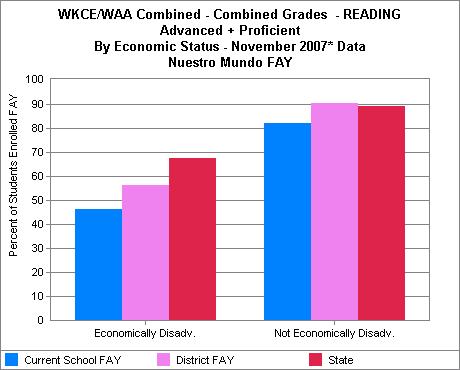
I’m skeptical of standardized tests as a measure of achievement, but it worth noting that Nuestro Mundo students have performed below the levels of students in other MMSD and Wisconsin schools and that this difference is more pronounced for low income students (chart from DPI)
In the next sentence, also with no evidence what so ever, she asserts the cause for this nonexistent achievement gain to be the “flexibility to design teaching methods that appeal to the needs of each student and to change modalities when they aren’t working.” Since some charters, KIPP for instance, are infamous for their inflexibility (and resultant push outs of students), this is a laughable generalization about charters.
The last line, the final assertion that “traditional district practices constrain flexibility is also counter to my experience as an MMSD parent. The teachers my children have had — good and bad — have been very flexible in their teaching. Even if my experience is not typical and the constraints on flexibility are a real problem isn’t the answer to work to free all teachers from these constraints, not set up a charter where only some children benefit from flexibility?
If these represent the best case for the new charter proposal, the Board should have an easy time rejecting it, unless political pressure holds sway. I urge the Board to do what is right, not what might be popular.
In the spirit of honesty, I must state that my older son attends James C. Wright Middle School, a charter, if in name only. At an earlier point in the history of the school, charter status may have been important. In the years that I know about, Wright functions as a district specialty school, not a charter in any meaningful way. I would a support a change in status for Wright to reflect this reality.
In the documents for agenda of the Common Council/District Liaison Committee is the most complete version of the strategic planning documents I have seen. Worth reviewing. Also, what looks to be the same things on this page, in parts.
No time for analysis this morning, except to note that there is almost nothing directly or indirectly about financial planning and to say that I am not clear what the next steps will be.
I also thought it might be useful to compare with some earlier things.
Some quick results and very few thoughts this morning.
Turnout was pathetic. During the Presidential campaign season we heard a lot about a new political engagement, especially among the young. February primaries lack the glamor (and resources) of Presidential votes, but going from about 2.9 million statewide voters in November 2008 to about 250,000 statewide voters in February of 2009 does not bode well for our political culture. Locally, in Madison District 8 — one of the campus districts — the vote total in November 2008 was about 7,500; yesterday it was 528. One data point does not make a trend, but this can’t be good for our democracy.
Tony Evers and Rose Fernandez survived the Sate Superintendent primary. Here are the totals:
Schools Superintendent
REPORTING
97%
Tony Evers
88,734
35%
Rose Fernandez
78,830
31%
Van Mobley
34,534
14%
Todd Price
28,641
11%
Lowell Holtz
22,163
9%
I want to thank Todd Price for his effort and his successes in raising awareness of the continuing crises in school funding, testing and other school matters. Tony Evers now has my full support (and I hope to see more evidence of the aggressive advocacy he has claimed).
The Appleton referenda lost by a 5 to 4 margin. According to the Post Crescent this will mean “as many as 30 fewer teachers and larger class sizes next fall, plus delaying safety measures for several school buildings.”
The Clinton referendum asking to fund investments in a geothermal HVAC system failed again, this time by a large margin of 968-576. This is exactly the sort of infrastructure investments we should be making, but under our current state school finance system they are difficult (more here, here and here).
Class sizes will be going up in Salem. There is confusion about the margin. DPI reports that it was 964 to 654. The Kenosha News says 664 to 654. More form that source on what this will mean to the quality of education in Salem:
The increase, officials said, was needed to cover expenses for the upcoming school year. School Board President Patricia Merrill said the result means 19 employees would be laid off for the 2009-10 school year, with layoff notices likely to be announced at Thursday’s School Board meeting.
Also on the chopping block are extra-curricular and after-school programs, starting this fall. Other programs scheduled for elimination include the gifted-and-talented program and technical education. Cuts are expected for music, arts, gym and Spanish. Merrill also said technology upgrades could be halted and staff workshops and travel will be reduced.
Superintendent Dave Milz said class sizes will likely increase.
“I’m not sure how any of these things can be beneficial for the kids,” Milz said. “This will certainly prove to be a challenging experience for the board and community to overcome.”
Referenda were narrowly defeated in Salem last June and September.
The votes on the three asks in Waupun were also relatively close. Out of about 2,700 votes cast, they ranged from 698 in the “ongoing operational expenses vote,” to 26 votes in the “textbooks” and “materials” measure. There will likely be school closures, and many cuts.
Closing the two outlying schools is a ticket item that would address about half of the budget deficit. No other suggestions presented could put a dent into it as closing Alto and Fox Lake elementary schools.
School board president Cathy Loomans said, “The business we’re in is about putting teachers in front of students. So the majority of our budget is staffing, and unfortunately, when you make these kinds of cuts, they have to come from staffing and that’s going to directly affect class size. There’s no way anymore to insulate the students from making these kinds of cuts.”
“Looking at what cuts we’re going to do, we have to look at what’s best for all the students to give the students across the district an equitable education,” Anne Kraintz, school board member, said.
For more information on the situation in Waupun (from one perspective), check out this site.
All around, not a great day for the future of education in Wisconsin.
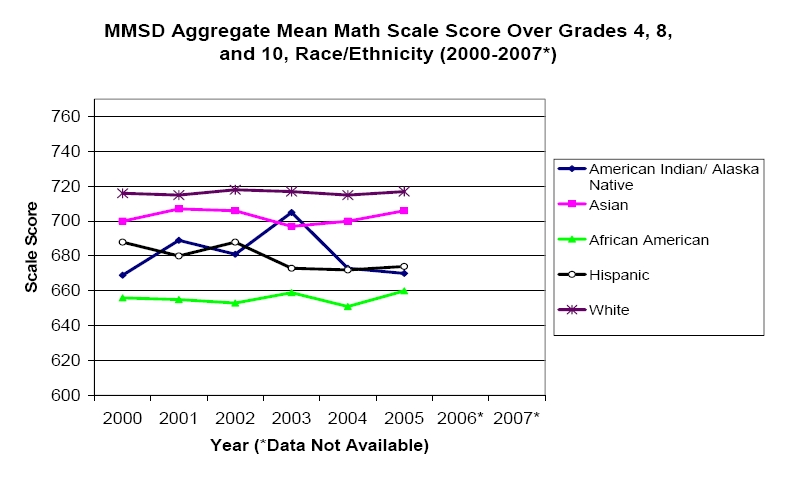
Assigning a meaning and interpretation to the decline in mathematics achievement scale scores over eight years is more difficult. As indicated in Exhibit I.3, the racial composition of the MMSD changed over this same period from about one-third minority students to nearly one-half minority students.
In the middle of a discussion of declining achievement, after a warning that this trend is difficult interpret — bang — a “helpful” reminder about the growing minority population. Talk about you subtle invitations to insert your favorite crap about race and intelligence. Shameful. Disgusting.
Look, we all know that achievement gaps are a reality but this is not the way to discuss or present that information. It might be OK if it was followed by some discussion of why these gaps exist and what can, (should and must) be done to address the gaps.
Don’t look in the report for that. The only recommendations that even indirectly acknowledge the gaps are these:
8. In making improvements and investing resources, the district should consider how best to reduce the large achievement gaps among subgroups of students.
9. More time should be provided for teacher collaboration for teachers to learn from each other, analyze achievement data, meet needs of diverse learners, plan for instruction, and ensure both horizontal and vertical alignment of the curriculum. (See Section 4: Survey of Teachers, Parents, and Students.)
And there is no accompanying discussion of strategies to address the gap [correction, these issues are given some attention in the section on curriculum materials, basically saying that the materials MMSD uses are among those found to be good in addressing achievement gaps]. I thought they were supposed to give more guidance on “how best.”
If I’m reading the charts right (the presentation leaves much to be desired), low income 10th graders score below non-low income 8th graders. They are over two years behind. This and other achievement differentials deserve serious attention. Instead the Task Force gives us colorful charts and an invitation to racism.
Somewhere the lessons about high expectations leading to higher achievement have been lost.
We all know that declining enrollment districts have been hit hard, but despite adding 100 students this year, Verona is considering dropping out or getting kicked out of SAGE, of denying their students the benefits of small classes in the early grades.
Verona is having troubles with the new strictness on the 15/1 ratio, and having troubles paying to keep this ratio out of general operating funds. If they drop or lose SAGE, they will lose $850,000, but to comply with the rules would mean adding classes at an additional cost of $430,000. Even without the SAGE issue, Verona was looking at $600,000 in cuts for 2009-10. What’s a district to do?
Segregation is one very unfortunate solution. The way this is reported is scary and not 100% accurate:
One choice would be to group low-income students at a couple schools and designate those as SAGE sites, as many districts – including Madison – already do.
SAGE contracts are limited and in recent years MMSD has cut local funds for class size reduction and moved their limited contracts to high poverty schools. Madison has not embraced an affirmative policy of economic segregation and still gives some attention to seeking desegregation when assigning students.
Madison has also not embraced a policy of affirmative desegregation and I’ve heard no concern that the Third Friday Count showed Glendale at 80% low income, while the adjoining attendance area for Elvehjem is 25% low income.
The Equity Task Force asked the Board to consider having an annual report on economic segregation in schools and in class assignment. They have never discussed this proposal in an open meeting.
“We must not continue to welcome into Madison more at-risk populations from elsewhere because we will never have sufficient resources to provide for them.”
We are a wealthy and prosperous city in what by any standard is a wealthy and prosperous nation. Maybe some can enjoy their wealth and prosperity while turning their back on the less fortunate or in Alder Phan-Remmele’s words, the “at risk.”
I believe that instead we should try to spread that prosperity to the less fortunate. I am proud that our city and our schools devote resources to the “at risk,” I think both should do more.
And Alder Phan-Remmele, without our attention the “at risk” aren’t going to disappear, they will continue to struggle in cycles of poverty and become more desperate. Many in Madison, some elsewhere, but in the nation and on the planet we share. With our attention, with the opportunities and support we can afford to provide some will cease to be at risk and will be productive and contributing and the cycle will be broken.
But once again I say, that Madison is large enough, wealthy enough and diverse enough that we can achieve these benefits without hanging up the “not welcome” sign. I’ll also add that resources like SAGE and Title I money may not follow poor children to the suburbs (as they don’t in some Madison Schools), and that the loss of the services these provide may undercut the gains of increased economic diversity.
Elsewhere, I’ve touched on the history of public education and the important idea of the “Common,” as in the Common School and the Common Good. My whole thinking about public education is that our schools are where we express our vision of a good society and try to create that society. In doing this we come together, finding common ground, defining the common good while preparing our children to contribute to a society where the common good is paramount.
Under the heading of “Promote the General Welfare” there are calls to action on a number of topics, including education. This is what the platform has to say.
Government Action Needed:
On Education
Increase education funding and distribute resources equitably, with special attention to schools in low-income neighborhoods
Pay teachers fair and adequate wages and institute programs to encourage teacher retention
Provide more arts, music and other cultural enrichment courses
Ensure that special education students have the resources and trained teachers they need
Ensure that education includes life skills and vocational training to prepare students for jobs
Provide free universal preschool/Head Start
Fund educational mandates.
Individual/ Community Action Needed:
As parents, be involved in our children’s education
Hold regional school boards accountable.
Other education related planks appear elsewhere, under the headings “Establish Justice” and “Ensure Domestic Tranquility.”
Work to lessen income disparities and to reform tax policies that favor the wealthy and corporate interests.
Acknowledge that discrimination, including racism and sexism, continues to impact public systems and encourage public employees and others to engage in anti-discrimination training
End discrimination in all institutional forms.Support and promote programs that promote a fair distribution of resources and serve vulnerable populations
Support and promote programs and activities that address prejudice and discrimination
Write letters to the editor and op-eds to encourage anti-racism education and better relationships within our communities
Fund after-school programs, jobs for youth, and continuing education (GED, ESL) for adults
Many, many good and important ideas about how to work toward the common good. These ideas should be at the heart of the Church’s work, but often get lost.
[There are three parts to this post: A news roundup, an explanation and analysis of the administrative proposal and my thoughts on why the first year of the referendum should be $6 million instead of the $5 million proposed. Although they are intertwined, the bulk of each part is presented in the order listed. — TJM]
Some clarifications on this report. Marjorie Passman is incorrectly identified as Lucy Mathiak. The “list of potential cuts” mentioned is very, very, very initial. It is a first effort to identify general areas that may be discussed for cuts. I heard more than one Board member grumble about what was in the list. Board President Arlene Silviera has promised to schedule a discussion of this list and potential cuts in general at a future date. I suggest all hold off on critiquing or complaining till that discussion takes place. We all know that $6 million to $8 million in cuts would be painful. For now, let’s just use our imagination as to where this pain would be experienced.
Some clarifications on this report. First the use of $2 million from the Fund Balance in the first year is based on an estimated $4 million growth in the Fund Balance as the 2007-08 year is closed out (more below). The “other” $2 million from the Community Services Fund (Fund 80) Fund Balance as part of the plan to minimize the tax impact, is actually a plan to decrease the Fund 80 levy by that in amount in 2009-10 and use excess money previously collected instead to fund on going Fund 80 programing.
That said, Madsen has a quote from Superintendent Dan Nerad worth citing:
We’re about two things here: one is ensuring that the needs of our kids are met to be educated well and the other is to be sensitive to taxpayers going forward.
And Hall quotes Marj Passman with a sobering reminder of what this is about:
[W]e’re desperate and we need this passed and even if it is passed we’re not adding anything back.
Supt. Nerad is calling this a partnership. So what’s the partnership and what’s the plan? The partnership is an addendum to the deal that was struck long ago when public education was established. At that time and since, our society has entrusted our children, our tax dollars and our futures to public schools with the understanding that the schools with the help of community members will educate the rising generation, create a society based on opportunity for all and be good stewards of the public funds provided for this most important work. While asking the voters for more funds via a referendum, Supt. Nerad demonstrates good faith and worthiness in two ways. First, the request is substantially less than is needed for “cost-to-continue” budgeting and there is a promise to meet these shortfalls by finding new ways to do things without sacrificing (and maybe improving) the quality of education. Second (but not unrelated), Supt. Nerad and Assistant Supt. Erik Kass have sought and found ways to minimize the impact of exceeding the revenue caps on local property tax payers. In other words, the addendum might read: “In exchange for a small increase in our revenue authority — less than 1.5% — we promise to use this increase responsibly to educate while doing our best to minimize the burden placed on local property taxpayers.”
This sounds like a pretty fair deal. I think it would be a better deal for our community if we upped the “small increase in our revenue authority” a bit.
I want to go through the details of the plan and my thoughts in three parts. First, what is (and is not) proposed for the referendum, then the ways that the costs to property taxpayers will be mitigated. Finally some words on why I think that the district should ask for more money in the first year. There will be some overlap.
The (Proposed) Referendum.
Three year, recurring.
$5 Million year one (projected gap, $8.11 million).
$4 million year two (projected gap, $4.37 million).
$4 million year three (projected gap, $4.26 million).
Recurring means that it is cumulative. The authority to exceed the revenue cap the second year will be $9 million and the third year and beyond $13 million. The advantages of a recurring referendum are two-fold: It allows for better long-term planning and it minimizes the gap and probable cuts to meet that gap in subsequent years. The disadvantage is that recurring referenda are more easily demagogued. I’m not sure why this is so, except that the words “Permanent Tax Increase” carry some emotional weight. Of course the same people who use this appeal complain about the lack of long-range planning. Consistency is rarely the strong suit of the complaining classes.
What isn’t proposed is preserving everything the way it is now. There will be cuts or reorganizations or reallocations each of the three years. They won’t be huge, they probably won’t be too divisive, but they will happen each year.
I value the fresh perspective and approaches Dan Nerad has brought. I am glad that there will be comprehensive strategic planning and that new ways of doing things will be implemented. I understand that this is being connected to asking for less than the gaps in the referendum and that is a legitimate connection.
I don’t think asking for this much less than the gaps is for the best. I think that in order for our children to realize the full benefit of contributions of the new administration we should authorize resources at least equal to a cost-to-continue budget. I’m not advocating keeping things as they are; I’m advocating reforms without cuts. I’m advocating $6 million for the first year (because of the recurring formulation, this also funds the subsequent years). This money can be used to do things like restore Ready-Set-Goals, revitalize the equity work of the district, expand funding of supplemental positions via something like the equity resource formula, fix some of the problems with class size and specials, initiate world languages in the early grades…and most importantly implement initiatives identified through the strategic planning processwith less pressure to defund existing programs.
I think that as a community we can afford this. That brings me to the tax impact parts of the plan.
Mitigating the Property Tax Impact
As presented by Dan Nerad and Erik Kass, the tax impact mitigation plans have little directly to do with the referendum itself. It is likely that most of these would be implemented even if there was no referendum. However, they are indirectly related in two ways. First, they are a demonstration of the partnership principles that Supt. Nerad has articulated; second, in very real ways they make a referendum more affordable to the local taxpayers. I want to start this part of my consideration with a some charts from the administration’s presentation.
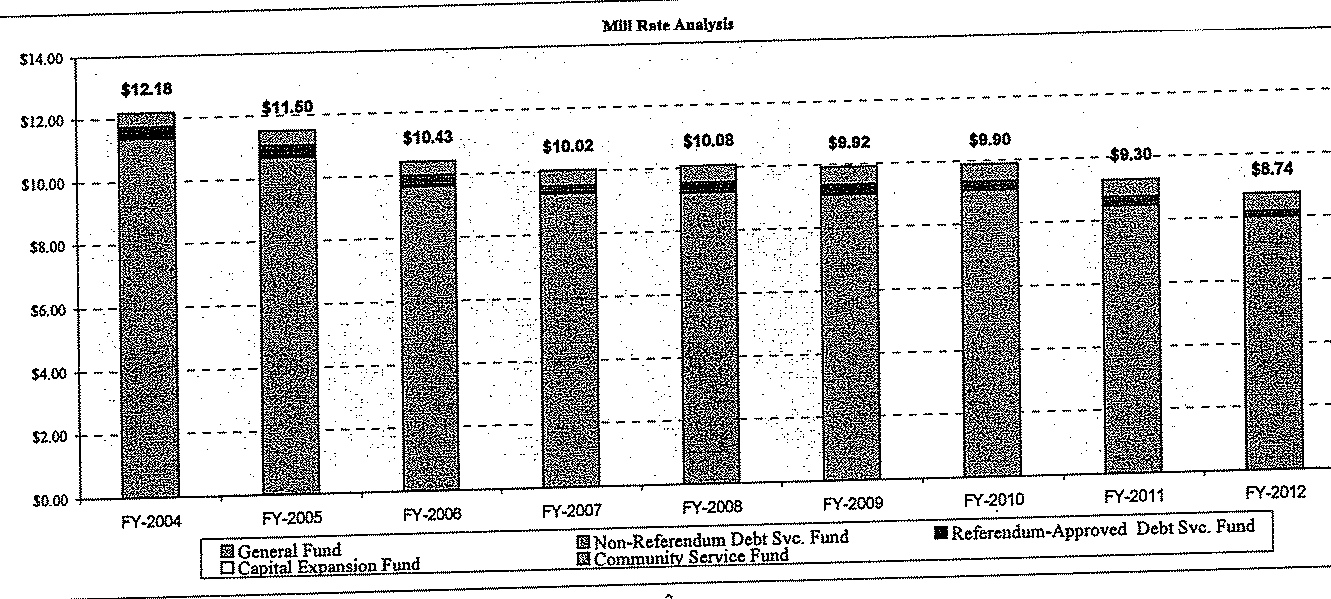
Mill Rate History and Projections without a Referendum
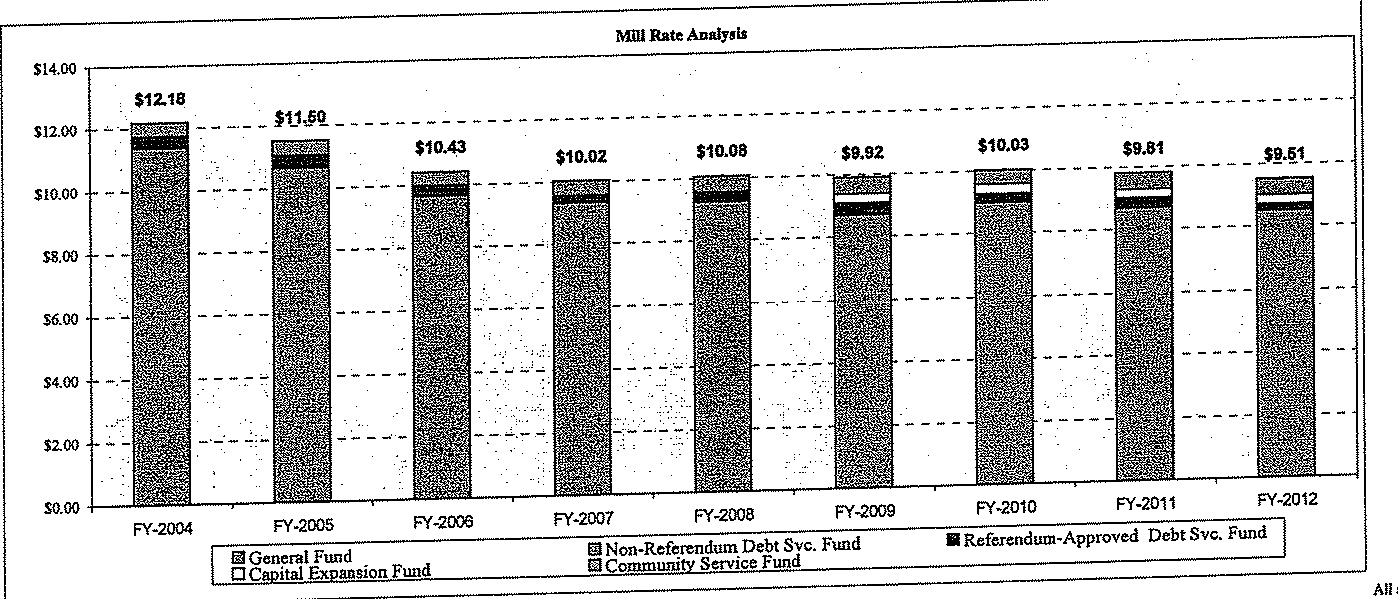
Mill Rate History and Projections With A Referendum, Other Administrative Proposals and Renewal of Maintenance Referendum.
Mill Rate History and Projections with A Referendum, Other Administrative Proposals and Renewal of Maintenance Referendum
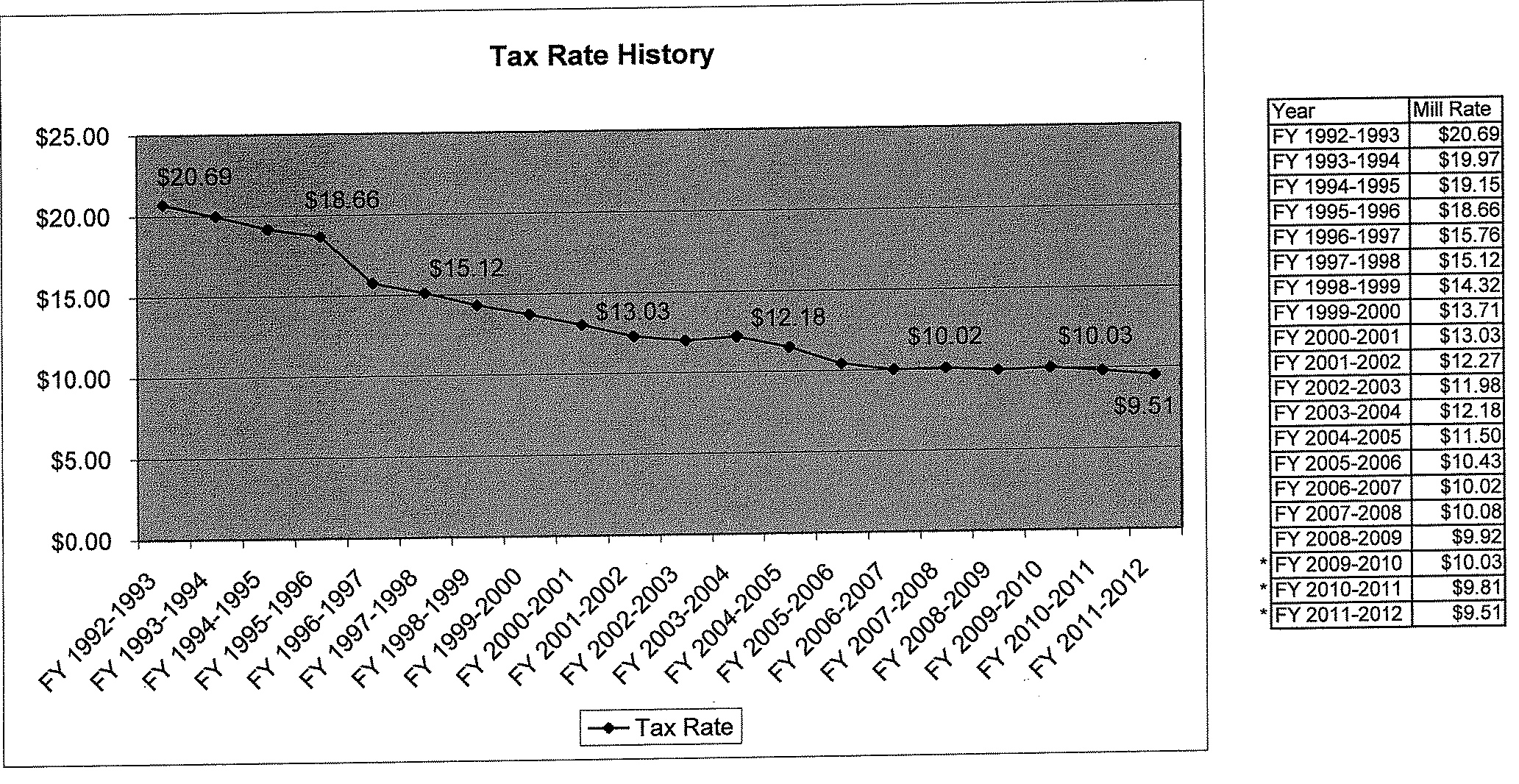
The first chart is the status quo. If there is no referendum and nothing else changes mill rates (taxes per $1,000 of property value) will resume their significant downward trend. With the exception of a very slight up-tick in 2007-8, the school mill rate has fallen steadily since 1992-3. For 2008-9, it is less than one half of what it was in 1992-3!
If there is a referendum and the proposed changes are enacted, the downward trend will also continue with the exception of another slight up-tick for 2009-10 (charts 2 and 3). The calculations I’ve seen say that for $250,000 home taxes will drop about $27.50 from the current rate in the second year and about $100.00 in the third.
This will be accomplished in four ways. First, by not seeking revenues to the amount of the projected gaps. Second, by slowing the rate of growth of the operating Fund Balance (Fund 10) and using some of the Community Service (Fund 80) Fund Balance to lower that levy without cutting programs. Third by moving money to a Capital Expansion Fund (Fund 41) which shifts the responsibility for some revenue from local taxpayers to the state (I’ll offer a more complete explanation at a later date). All of these are fiscally sound practices. The last piece is a conservative projection of 4% annual growth in the total value of property in the district.
Mitigate and Do the Right thing
I fully support all of these ideas for mitigating the tax impact, including not seeking the full gap amount. Where I differ is that I think we should seek closer to the gap and ask for $6 million in the first year. Our schools and our children are worth it.
The projections for what this will cost get very complicated. If my calculations are correct adding $1 million to the first year would produce the following mill rates:
Year 1: 13.24
Year 2: 11.54
Year 3: 10.68
The highest of these puts about where we were in 1999, when the revenue caps had been wrecking their damage for four years. By year three, mill rates would be back at 2005 levels.
I haven’t had a chance to project the tax impact on a $250,000 home for all three years (too many variables), but my initial calculation is that in the first “worst” year it would be $36.30, or about $9.00 more than what the administration proposed. For something as important as education, I think we can afford that much.
I want to leave numbers aside and talk about three things that I observed and heard today while registering my son for first grade. They are minor and they are indicative of what happens when we neglect our schools, or try to do things on the cheap.
On the entrance to the playground there is a ramp with concrete walls on either side. On one side the wall has crumbled and rebar is sticking out. The rebar is covered by empty plastic soda bottles taped on.
While on the playground, I spoke with the custodian. We talked about lots of things. My spouse asked if wood chips had been ordered (they are badly needed). He said they had, but the amount sent in the last few years has not been sufficient for all the surfaces that need covering.
We also spoke about snow removal. Apparently due to budget cuts, there are no longer removal crews assigned to specific schools (in all cases). Each snowfall brings different crews. Before this was the case, there was good communication about the particular characteristics of this school site and the crew knew where to plow and where not to, where to pile snow and where not to. Now it is random and the school custodians spend time each snowfall taking care of what was not done correctly.
A crumbling wall with dangerous metal protruding, a short load of wood chips and not staffing consistently aren’t huge things. Still they are things we should be able to afford to do right. I know we can’t afford them or many other things. I know we still have some Windows 98 computers in our schools.
What does this say about us that we haven’t cared enough to demand that this situation be fixed? What does it say about us that our school officials think that in order to get us to pass a referendum they need promise further cuts?
I’m not sure that the referendum as proposed will change any of this. It may help with some of these. It will keep things from getting (much) worse and that is very important.
I truly believe that quality public education is what creates and preserves prosperous and enjoyable communities; that public schools are the best tool we have for creating opportunities and overcoming inequality; that if we want the next generations to live in a better world our schools are the best tool we have for making that happen.
(If this passes) There won’t be another operating referendum for some time (maybe never if the state finance system gets fixed). Let’s do it right this time.
One more million in the first year and loads of possibilities open up. We can dream a little again. Wouldn’t that be great?
I’ll be working hard in support of a referendum as proposed by the administration (find out how to help by visiting Community and Schools Together), but I’d have a bigger smile on my face as I worked if the Board and the administration would askfor some more opportunities to dream.
Share your thoughts in the comments here and let the Board know what you think. Come to the Board meeting Monday, August 25 (last I heard, there will be public testimony) or write: comments@madison.k12.wi.us.
Thomas J. Mertz
[Slightly revised, 11:50 AM and 12:48 PM, 8/22/08]








 AMPS
AMPS 