Category Archives: Equity

Georgia on My Mind – “Adequacy” Lawsuit

Hoagy Carmichael, “Georgia on My Mind” (click to listen or download) — from the wonderful Pacific Jazz LP, Hoagy Sings Carmichael.

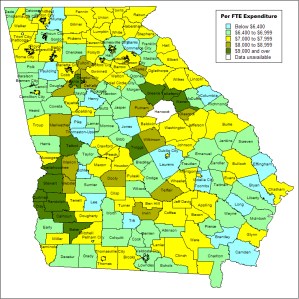
It looks like an “adequacy” lawsuit filed in Georgia over four years ago may finally go to trial this October. The suit, filed by the Consortium for Adequate School Funding in Georgia contends that:

The Georgia school funding system fails to provide school districts, including Plaintiff Districts as well as other districts, with the resources needed to educate their students to meet contemporary educational standards and competitively function in a society where a high school diploma constitutes the bare minimum gateway qualification for viable employment and higher education. The educational inadequacy in Plaintiff Districts and other districts is reflected, inter alia, in high drop-out and non-graduation rates, which result from insufficient resources to provide their students with educational opportunities and interventions reasonably calculated to prepare them to function as productive members of society.

1/3 of the districts in Georgia have joined in the suit.

The “Basics of of Georgia School Finance” are similar to those of the failing Wisconsin system in that both systems are based on a combination of state and local monies, there is basic floor of funding per student, there are categorical aids for some categories of students, it iss extremely complex and it doesn’t work.

There are also some differences, the biggest one being that where Wisconsin uses a system of primary, secondary and tertiary aids based on the district property wealth and spending for equalization between “rich” and “poor: districts, Georgia uses a “Quality Basic Education” formula and a 5 mill basis to figure the local share. At least I think that;s how it is supposed to work. As I said, it is extremely complex. There is a PowerPoint from the Governor’s Education Finance Task Force linked, that may do a better job explaining things.

The 2000 decision in the Wisconsin Vincent v. Voight adequacy suit was a mixed result. The Supreme Court ruled that the state finance system did not then violate the Constitution, but the court also set standards for judging the constitutionality of the system. A good case can be made that after eight more years of placing poperty taxes above education, the system no longer meets the constitutional standard as defined by the court. Unfortunately, with Annette Ziegler and Michael Gableman as part of anew majority on the court, making a good case really won’t matter.

Thomas J. Mertz

Leave a comment

Filed under "education finance", AMPS, Budget, education, Elections, Equity, finance, Local News, National News, School Finance, Uncategorized

Leading the Nation?

Charlie Feathers, “Bottle to the Baby” (click to listen or download)

There measures where you don’t want to be #1; Fetal Alcohol Syndrome (FASD) is certainly one of these. Unfortunately, the Oshkosh Northwestern reports that Wisconsin leads the nation in reported drinking among women of childbearing age and likely leads in FASD (hat tip to Madison NORML).

Each year as many as 200 Wisconsin newborns show the effects of prenatal alcohol exposure, according to the University of Wisconsin’s Fetal Alcohol Spectrum Disorders Treatment Outreach Project.

Dr. Georgiana Wilton, an associate scientist at the University of Wisconsin Department of Family Medicine in Madison, believes it’s likely the state leads the nation in that category, though such data is not kept by every state.

Prenatal alcohol exposure is a leading cause of mental retardation and learning disabilities nationwide. By that standard, Wisconsin babies are at greatest risk.

Wisconsin leads the nation in reported drinking among women of childbearing age. The state has the highest prevalence of frequent alcohol consumption among women ages 18 to 44, according to a 2006 risk-factor survey by the Centers for Disease Control and Prevention….

Exposure to alcohol puts a fetus at risk of a cluster of preventable developmental problems known collectively as fetal alcohol syndrome or the related fetal alcohol spectrum disorders — a term describing the range of effects that can occur in any individual whose mother drank alcohol during pregnancy.

Brain damage, facial deformities, growth deficits, heart, liver and kidney defects characterize fetal alcohol syndrome, as do difficulties with vision, hearing, learning, attention, memory and problem solving.

An individual with fetal alcohol syndrome can incur a lifetime health cost of more than $860,000, although the National Organization on Fetal Alcohol Syndrome says costs can be as high as $4.2 million. It costs the U.S. $5.4 billion annually in direct and indirect costs. Direct costs are estimated at $3.9 billion annually, which includes healthcare costs as well as costs associated with social services and incarceration.

Sixty percent of individuals with FASD will end up in an institution (mental health facility or prison). And it is estimated that almost 70 percent of the children in foster care are affected by prenatal alcohol exposure in varying degrees.

Not mentioned are the increased educational costs associated with FASD. Like lead paint exposure, this is preventable factor which adversely effects the future prospects of children, costs our schools time and money and contributes to inequality. It is also another example of why schools alone are not sufficient to address the needs of our children (and their parents) and why things like the “Broader, Bolder Approach to Education” make sense.

Thomas J. Mertz

1 Comment

Filed under Best Practices, education, Equity, Local News

“The Next Kind of Integration”

Excerpts from the recent New York Times article, “The Next Kind of Integration” (with links and emphases added).

In the last 40 years, Coleman’s findings, known informally as the Coleman Report, have been confirmed again and again. Most recently, in a 2006 study, Douglas Harris, an economist at the University of Wisconsin, found that when more than half the students were low-income, only 1.1 percent of schools consistently performed at a “high” level (defined as two years of scores in the top third of the U.S. Department of Education’s national achievement database in two grades and in two subjects: English and math). By contrast, 24.2 percent of schools that are majority middle-class met Harris’s standard.

There are, of course, determined urban educators who have proved that select schools filled with poor and minority students can thrive — in the right circumstances, with the right teachers and programs. But consistently good education at schools with such student bodies remains the rare exception. The powerful effect of the socioeconomic makeup of a student body on academic achievement has become “one of the most consistent findings in research on education,” Gary Orfield, a U.C.L.A. education professor, and Susan Eaton, a research director at Harvard Law, wrote in their 1996 book, “Dismantling Desegregation.”

Most researchers think that this result is brought about by the advantages that middle-class students bring with them. Richard Kahlenberg of the Century Foundation lays them out in his 2001 book, “All Together Now”: more high-level classes, more parent volunteers and peers who on average have twice the vocabulary and half the behavioral problems of poor students. And, especially, more good teachers. Harris, the economist, says that poor minority students still don’t have comparable access to effective teachers, measured by preparation and experience. The question, then, is whether a plan that integrates a district by class as well as by race will help win for all its schools the kind of teaching that tends to be linked to achievement. “The evidence indicates that it would,” Harris says.

Ronald Ferguson, an economist at the Kennedy School of Government at Harvard, is less persuaded. His research highlights the nagging persistence of a racial achievement gap in well-off suburbs. “What happens with the achievement gap in a place like Louisville,” he says, “will depend on how vigilant their leaders are to make sure high-quality instruction is delivered across the board.” Such teaching is more likely in a school with a critical mass of middle-class parents, he concedes. But he stresses that to reap the benefits, poor kids have to be evenly distributed among classrooms and not just grouped together in the lowest tracks. “To the degree a district takes the kids who struggle the most academically and spreads them across different classrooms, they’re making teachers’ work more doable,” he says. “And that may be the biggest effect.”

Whatever the exact answer, there is some support for the view that schools can handle a substantial fraction of poor students without sacrificing performance. In Wake County, test scores of middle-class students have risen since instituting income-based integration. Additionally, Kahlenberg points out that middle-class students are generally less influenced by a school’s environment because they tend to learn more at home, and that the achievement of white students has not declined in specific schools that experienced racial (and thus some class) desegregation.

Would schools need to track students by ability to protect middle-class students, who are more often higher-achieving than their low-income peers? Perhaps not. In a 2006 longitudinal study of an accelerated middle-school math program in Nassau County N.Y., which grouped students heterogeneously, the authors found that students at all achievement levels, as well as minority and low-income students, were more likely than the students in tracked classes to take advanced math in high school. In addition, the kids who came into the program as math whizzes performed as well as other top-achievers in homogenous classes.

This study underscores Ronald Ferguson’s point about the value of seating students of different backgrounds and abilities in class together, as opposed to tracking them. Still, it’s worth noting that less than 15 percent of the students studied in Nassau County were low-income. So the math study doesn’t tell us what happens to the high-achieving middle-class kids when close to half of their classmates aren’t as well off.

I’ve posted about the missed opportunities for Madison to be a leader in this new integration movements many times. Two examples are linked below. I do want to make clear — as I wrote in one of those posts — I believe that “[f]or the most part MMSD has done a very good, if relatively quiet and indirect job of addressing [all kinds of] diversity. ” I’m still asking for more.

Previously on AMPS:

(Not?) Talking about Diversity and Boundaries, 2008 Style.

(Now?) Talking about Boundaries and Diversity, 2008 Style.

Talking is essential, but so are policies and actions. It is not too late.

Thomas J. Mertz

4 Comments

Filed under AMPS, Best Practices, Equity, Local News, National News, Uncategorized

New Blog – Mica Pollock, schoolracetalk.org

Curtis Mayfield — “Mighty, Mighty (Spade and Whitey)” (click to listen or download)

I’ve highlighted Mica Pollock’s work on the importance of talking about race and other inequalities and ways to cultivate productive conversations here and here on AMPS. She has launched a new blog/site, www.schoolracetalk.org. I suggest you check it out. Here is her description:

I started schoolracetalk.org to create a virtual place where people can talk together about race issues in schools. We have to discuss these issues face to face with local people. But we also need places to go test ideas, and to learn some “gold nugget” ideas from others. We need to think together about how to handle racial inequality and what to “do with” difference and diversity.

Mica Pollock also had a very good guest post at eduwonkette recently.

I’ve said it before in a variety of ways, when those associated with our schools only indirectly address difficult matters of inequality, very little is gained. We might avoid or postpone some conflicts this way, but we don’t move forward toward better schools or a better society.

Thomas J. Mertz

Leave a comment

Filed under Best Practices, Equity, Gimme Some Truth, National News, Take Action, Uncategorized

An exercise in delusion

Hieronymus Bosch

During a speech to the National Association of Latino Elected & Appointed Officials the other day, John McCain launched into a discussion of NCLB and education funding, holding up New York City (with awful – and similar funding issues to Wisconsin) and New Orleans (oy!) as examples of Republican success stories in education. Charter schools, according to him, can be our silver bullet. Pardon me, but we all need a national conversation to start now. However for Mr. McCain, it would seem his mind is made up.

“I mean, they also re-authorized No Child Left Behind, with the lessons we learned in the intervening years since we passed it, in a bi-partisan fashion, I would fully fund those programs that have never been fully funded. But let me also say to you: choice and competition. I believe that every family in America should have the same choice that Cindy and I did. We chose to send our children to a Catholic school. That was because we were able to do so. So I believe that charter schools work. I believe that they’re not much better than public education, but they provide competition. There are two examples I’d like to mention very briefly: New York City and New Orleans. If you missed it, there is now a dramatic uptick in the performance of school children in New York City, a place where a lot of experts thought there would never be improvement. We ought to go up there and see what Mr. Klein and Mayor Bloomberg and others have done and dedicated educators have done in New York City. New Orleans, they had to start at square one, as you know. There are now 30 charter schools in the city of New Orleans. Anyone will tell you that they’re starting to see a dramatic improvement in the quality of education in the city of New Orleans. My friends, choice and competition, reward the teachers, God bless them, find bad teachers another line of work. Choice and competition.”

I’ll bet Mr. “Choice and Competition” has never seen this documentary. He won’t – but you can. Educate yourself. See what magic an unregulated post-Katrina education industry has brought to New Orleans and shades of things to come if some mainstream thinking about reforming education comes to fruition.

Robert Godfrey

1 Comment

Filed under AMPS, Equity, Gimme Some Truth, nclb, No Child Left Behind, School Finance, We Are Not Alone

One day in Iraq: What if it was spent on education

Robert Godfrey

Leave a comment

Filed under "education finance", Accountability, Budget, education, Equity, Gimme Some Truth, National News, Take Action

School-funding reform update, week of June 16

From the Wisconsin Alliance for Excellent Schools.

The Wisconsin Alliance for Excellent Schools (WAES) is a statewide, independent, membership-based organization of educators, school board members, students, parents, community leaders, researchers, citizens, and community activists whose lone goal is the comprehensive reform of Wisconsin’s school-funding system. If you would like more information about the organization — or on becoming part of WAES — contact Tom Beebe at 920-650-0525 or tbeebe@wisconsinsfuture.org.

*******

Good news and not so good news out of Winneconne

Because of the flaws in Wisconsin’s school-funding system, more and more communities are forced to go to expensive and divisive referenda in order to operate their public schools. To date, a couple of things are known: The number of votes being taken is increasing and the rate of success is about 50 percent. While a “no” vote tells us that a great many public schools are approaching fiscal and educational crisis, there is also something to be learned in a “yes” vote.

One such lesson comes from Winneconne, where a scaled back referenda to exceed revenue limits by $880,000 in the 2008-09 and 2009-10 school years (a vote on a $1.19 million and $1.45 million proposal was defeated in April) was approved 1,645 to 1,116.

The good news is the referendum passed and allows the district to cover ongoing labor, transportation, and utility expenses. The not-so-good news is its passage does not eliminate the need for some budget cuts. The board had already identified $310,000 in cuts for next year and an additional $260,000 in 2009-10.

*******

Wisconsin’s tax ranking drops … What does it mean?

According to headlines and stories in media across the state, Wisconsin has, for the first time in years, moved off of the Top 10 tax list. Is that, however, a claim to fame or is it the canary in the mine shaft for those interested in school-funding reform and the protection of the state’s public structures that are financed through state and local taxes?

One view is offered by the Institute for Wisconsin’s Future

Executive Director Karen Royster and Research Director Jack Norman wrote in the May 24 Milwaukee Journal-Sentinel that instead of worrying about where the state is in regard to total taxes, we need to pay much more attention to tax fairness . We “built momentum (in the last legislative session) for smart tax reform that will modernize our out-of-date system and create a fair and efficient method of raising revenue,” the pair said. The article went on to talk about recent successes and suggestions for the next session of the Legislature.

On May 29, Norman joined Andrew Reschovsky, professor of public affairs and applied economics with the LaFollette Institute at the University of Wisconsin-Madison on Wisconsin Public Radio to talk about taxes and public spending in Wisconsin. You can hear the complete hour on “Conversations with Joy Cardin” by clicking here.

*******

Tomah Journal wants candidates to get real about spending cuts
Sometimes, a newspaper editorial hits the nail squarely on the head in its insight and intelligence. June 5, the Tomah Journal did just that in an editorial titled, “Cut state spending? Candidates should offer specifics.” The paper vowed to make sure candidates in the upcoming election who talk about cutting spending are specific about those cuts.

The editorial was an answer to the fact Wisconsin dropped from 10th to 11th in terms of tax ranking. “Tax rankings by themselves have little meaning,” the editorial said. “What matters is tax value. Are state and local governments effectively providing public services that are cost-prohibitive for most individuals to purchase on their own? And is Wisconsin upholding its moral responsibility to make sure the poor, sick, and vulnerable aren’t doomed to destitution?”

That just about says it all and is the measure of good government … not just the relative position of tax payments. “Just as politicians who advocate more spending have an obligation to identify which taxes they would raise,” the Journal says, “aggressive tax-cutters have an obligation to identify the spending they would cut. And, if they can’t identify specific cuts, then it’s a concession that Wisconsin is making the right choices on taxes and spending.”

*******

WAES upgrades website; joins YouTube and Facebook

It will be a while before it is finished, but we are in the process of giving a new look and feel to the WAES website in order to make it more user friendly and, most importantly, valuable to those involved in reforming the way Wisconsin funds its public schools.

At the present time, not much will look different, but that will change. One of the new features is that you can join WAES online and send in your dues with a credit card or with PayPal. It should also be easier to sign up for and read the e-mail update and to register for a school-funding reform presentation. Give the site a look-see at http://www.excellentschools.org. Let me know what features you feel would make it more valuable for you.

That’s not all that’s new. WAES has also entered the brave new world of Facebook and YouTube. For those of you using the former, check us out, join up, bring in your friends, use this new and exciting technology to spread the word about school-funding reform, and show your support and network with other people working to change school finance by joining the Wisconsin Alliance for Excellent Schools Facebook cause. Also, they say a picture is worth a thousand words. If that’s true, then video must be worth a million. WAES is new at it, but go to the WAES YouTube Channel and, thanks to WAES members and technical folks at Advocates for Madison Public Schools, see what’s going on. Be sure to subscribe to the WAES Channel on YouTube or check back for updates
*******

Sen. Schultz continues to advocate school-funding reform

Too many people think that school-funding reform is all about Republicans vs. Democrats. It’s not, and Sen. Dale Schultz, a Republican from Richland Center, is a good example. In a recent column in The Monroe Evening Times, he praised the Governor for signaling his willingness to talk about reform and said he looks “forward to joining him to improve how our schools are funded.”

Sen. Schultz also offered some good comments on the property tax levy credit, part of the school-funding formula that directs state aid intended for children in classrooms to property taxpayers. “The name is misleading,” Schultz said, “because school levy credits actually are payments to municipalities to offset municipal tax levies, and schools never see the money. The shifting of millions of aid dollars to the levy credit meant less in general school aids that go where needs are greatest — small, rural, and poor school districts … ”

The comments didn’t go quite far enough, however, because there are “small, rural, and poor school districts” in some parts of the state — those with artificially high property values — that actually do benefit from the levy credit. Because of their high property values, these groups get very little if any state aid. Taxpayers in those districts do, however, get the levy credit. It is, therefore, a big piece of the school budget for many districts.

WAES Wisconsin Adequacy Plan addresses the problems in both types of school districts and looks forward to working with Sen. Schultz and other legislators to actually change what is an unfair and inadequate funding system.

*******

WAES needs your support now more than ever

There’s a great deal going on around the country and in Wisconsin that will affect our communities and our families for years to come, but nothing is more important than the the future of our public schools. At a time we need a state school-funding formula that moves our children’s education to the next level, however, we have one that is unequal, inadequate, and too complicated. It doesn’t work for children. It doesn’t work for families, and, it doesn’t work for schools.

We need to change the way we fund public schools in Wisconsin and we need to do it soon. If we don’t act, we should expect nothing more than the status quo which, for the last 15 years,has been laying off teachers, increasing class sizes, divisive referenda just to run our schools, and cuts in the quality programs and services we used to offer Wisconsin’s children. The quality and quantity of education continues to erode in virtually every corner of Wisconsin.

Nothing will change until we demand that the Legislature and the Governor do what is right for children and for taxpayers. That is the sole purpose of WAES — to make that demand and to work with the people of the state to make it happen.

As an independent, dues-supported, non-profit organization, WAES needs your help to continue this important work. As more and more school districts edge toward the brink of fiscal and educational crisis, this work and your support are more important than ever.

If you haven’t joined already, now is the time to join WAES. You can go to our website and use PayPal or your credit card. If that doesn’t work for you, print the Membership Statement, fill it out and mail it, along with your check, to Wisconsin Alliance for Excellent Schools, 315 Maple Street, Fort Atkinson, WI 53538. To get the dues structure for organizations — or for more information — contact Tom Beebe at 920-650-0525 or tbeebe@wisconsinsfuture.org.

You can make a difference.

*******

Yet more proof that early-childhood-education programs work

It isn’t something we don’t already know, but the latest analysis of a long-running early-childhood-education program for children of low-income families in Chicago suggests economic payoffs from such services that continue well into childhood.

The most recent work reported by the Early Childhood Focus says that attendance in the preschool program for 18 months — averaging a cost of $6,692 per child — generated a return to society of $47,759 per participant. This figure includes increased taxes on earnings due to educational attainment ($7,243), savings to the criminal justice system ($7,130), reductions in school remedial services ($4,652) and averted tangible costs to crime victims ($6,127).

This research is recognized by WAES and is included as a key piece in most adequacy funding reform models — including the Wisconsin Adequacy Plan — that is based on research. At the same time, it flies in the face of the claims made by some members of the State Legislature arguing against increases in public school revenue.

*******

School-funding reform organization welcomes four new members
WAES welcomed two new members since the last e-mail update. We need your help now, so please consider joining as a dues-paying member of the school-funding reform organization

New members are (you can see the complete list here):

Individuals: Doug Leuck and Carol Krogmann

School district:Athens and Cadott

*******

Help us better serve you by letting us know when you change your e-mail address. In that way we can stop sending the update to the old one and switch over to the new address as soon as possible.
*******

School-funding reform calendar
June 19 — School-funding reform presentation for the Northwoods School Funding Alliance, 7 p.m., at Lakeland Union High School in Minocqua.

June 20 — School-funding reform presentation as part of the finance class of the education leadership course offered through Edgewood College, 10 a.m., DC Everest School District office, 6300 Alderson Street, Weston
July 29 — School-funding reform presentation as part of the School Law and Politics class offered through Marian University , 9 a.m., Northcentral Technical College, Wausau.

*******

Please feel free to share your copy of the WAES school-funding update with anyone interested in this important public policy issue. Contact Tom Beebe at tbeebe@wisconsinsfuture.org or 920-650-0525 for details.

Thomas S. Beebe, Outreach SpecialistWisconsin Alliance for Excellent Schools315 Maple StreetFort Atkinson, WI 53538Cell: 920-650-0525E-mail: tbeebe@wisconsinsfuture.org.

The moral test of a government is how it treats those who are at the dawn of life, the children; those who are in the twilight of life, the aged; and those who are in the shadow of life, the sick, the needy, and the handicapped,” — Hubert Humphrey, 1976

[Disclosure: I am a member of the WAES Board of Directors}

Thomas J. Mertz

Leave a comment

Filed under "education finance", AMPS, Best Practices, Budget, education, Elections, Equity, finance, Local News, National News, Referenda, School Finance, Take Action, Uncategorized, We Are Not Alone

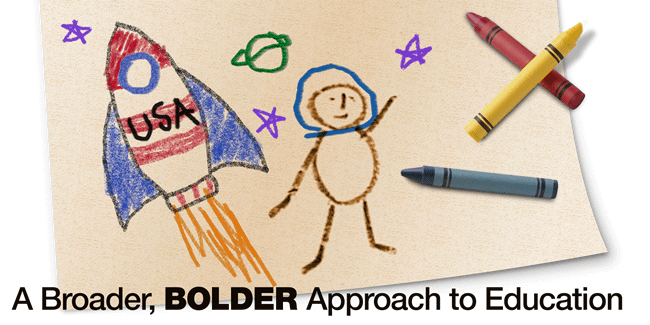
A Broader, Bolder Approach to Education

As promised, a task force associated with the Economic Policy Institute has released a framework for improving education. Here are the highlights from the press release:

1. Continued school improvement efforts. To close achievement gaps, we need to reduce class sizes in early grades for disadvantaged children; attract high-quality teachers in hard-to-staff schools; improve teacher and school leadership training; make college preparatory curriculum accessible to all; and pay special attention to recent immigrants.

2. Developmentally appropriate and high-quality early childhood, pre-school and kindergarten care and education. These programs must not only help low-income children academically, but provide support in developing appropriate social, economic and behavioral skills.

3. Routine pediatric, dental, hearing and vision care for all infants, toddlers and schoolchildren. In particular, full-service school clinics can fill the health gaps created by the absence of primary care physicians in low-income areas, and by poor parents’ inability to miss work for children’s routine health services.

4. Improving the quality of students’ out-of-school time
. Low-income students learn rapidly in school, but often lose ground after school and during summers. Policymakers should increase investments in areas such as longer school days, after-school and summer programs, and school-to-work programs with demonstrated track records.

It reminds me of the video from the Educator Roundtable, in this post and this write up by eduwonkette of an American Education Research Association session, “Research on Neighborhoods and Communities: Implications for Research Methods on Social Contexts.”

It should go without saying that the this expansive view of inequality and education and what should be done about it is not “throwing in the towel,” making excuses for schools or conceding that inequality of educational outcomes is intractable (unlike the genetic determinists on the right). The broader, bolder approach realistically recognizes that educational inequality begins with childrens’ environment, living conditions and resources and seeks to address these inside and outside of school. Makes sense to me.

Become a co-signer to the statement. Work locally to make these things happen.

Thomas J. Mertz

BTW, this is post #300 on AMPS!

2 Comments

Filed under Accountability, AMPS, Best Practices, education, Equity, National News, nclb, Take Action, Uncategorized

Talkin’ Dropouts

James Brown, “Don’t Be a Dropout.”

Lots of news about dropouts and graduation rates recently.

Education Week just published their Diplomas Count report. It is pretty alarmist. Graduation rate scholars Jim Heckman, Paul LaFontaine, Larry Mishel, and Joydeep Roy raised some issues with how Education Week counted (hat tip to eduwonkette, one of my new favorite education bloggers):

In our examination of the data and methodologies available to estimate high school graduation rates we have found that insights can be gained from household surveys and from administrative data on student enrollment and diplomas granted. However, we find the measures of graduation rates in Education Week’s Diploma Counts project, computed from diploma and enrollment data, to be exceedingly inaccurate. The main problem is the assumption that the number of students enrolled in 9th grade is the same as the number of students entering high school. This assumption artificially lowers the estimates of current graduation rates, especially for minorities who are more likely to be retained (repeat 9th grade). This measure also artificially reduces the growth of the graduation rate over time because the practice of grade retention has grown over time, again, especially among minorities.

The resulting errors are sufficiently large to artificially lower the graduation rate by 9 percentage points overall and by 14 percentage points for minorities. Grade retention also differs sharply across states and localities, distorting geographic comparisons. Last, these measures do not reflect the ultimate graduation rates of a cohort of students because the data do not capture diplomas provided by adult education and other sources than schools.

Paper from Heckman and Lafontaine, here; Paper from Mishel and Roy, here.

The Wisconsin State Journal editorialized in favor of adopting the graduation rate measure endorsed by the National Governor’s Association (NGA) as a single national standard (Leslie Anne Howard of the Dane County United Way had an op. ed., mostly in support of this position). There is much to be said in favor of national statistical standardization, but if the adopted standard is flawed, you open the door to a new set of problems. The NGA measure is largely based on the one used by Florida. Sherman Dorn notes some “troubling issues” with the Florida rate calculations:

  • The inclusion of alternatives to standard diplomas in the graduation numbers, with no public disaggregation
  • The exclusion of alleged transfers and movers from the base (creating an adjusted cohort) without any data quality checks to ensure that transfers really show up at a private school or in another state
  • The exclusion from the base (adjusted cohort) of students who drop out and immediately enroll in GED programs (as transfers to adult programs)

He also has some nice general thoughts on what to look for in graduation rate calculations here and here (lots more on his site, browse around or do a search; his posts are very accessible for those of us who are not steeped in the swamp of grad rate measures).

Information on how Wisconsin calculates dropout and completion rates. Many of the issues noted in the critiques of the various measures are present with Wisconsin’s. MMSD posted am 81.8% “regular diploma” completion rate in 2006-7, but there are great disparities among the rates for white students (90.4%), African American students (61.6%) and Hispanic students (60.8). The 2006-7 dropout rate was 2.699%, also with pronounced racial disparities (data can be accessed here).

Finally, this story in the Cap Times on Operation Fresh Start, (which has a GED component). By the way, I think this is a fine use of Wal-Mart’s money, but I still wish our legislators would get them to pay their fair share of taxes (some recent progress, but a long way to go).

Thomas J. Mertz

Leave a comment

Filed under "education finance", Accountability, AMPS, Best Practices, education, Equity, Local News, National News, nclb, No Child Left Behind, School Finance, Uncategorized

Equity Policies — Learning from Others

I’m still working through what did and did not happen with Equity at Monday’s MMSD Board of Education meeting (video here, starting at about the 2 hour and 25 minute mark) and how and why things did and did not happen. The very short version is that the Board passed a policy that did not include the “Considerations” or any implementation regulation or guidance, but thanks to an amendment by Maya Cole does improve upon the draft version’s reporting clause (for more information and my pre-meeting thoughts, see this post).

One of the canards that was part of the discussion was that (Equity) policies can or should not include implementation guidelines or regulations. Policies and implementation plans come in many forms; there is no one right way. For that reason, I’m going do a series of posts on what other districts are doing in this area.

My opinion is that Madison is doing much and isn’t doing enough. Madison is doing much because many of the programs and procedures in place embody equity ideals. Madison isn’t doing enough because there is not a systematic focus on equity related issues and much of what goes on is simply “current practice” and note the result of any clear commitment. Focus and commitment could be derived from a policy or (like in Brookline, MA) a specific initiative. Whatever you think is best, it is always good to know what other districts are doing as a basis for comparison.

Today’s post is from Charlotte-Mecklenburg, NC School District. Like MMSD, CMS is a founding member of the Minority Student Achievement Network.

Here is the entirety of CMS’s “Equitable Educational Opportunities” policy:

The Board of Education is committed to providing equal access to excellent educational opportunities for all its students in all its schools.

The provision of such opportunities for all students is expected to require providing additional resources and implementing innovative strategies to schools serving students with additional educational needs, particularly students at risk of academic failure. Such resources and strategies may include, but are not limited to: differentiated staffing; smaller class sizes; increased instructional supplies and materials; expanded and renovated facilities; innovative family and community involvement initiatives; upgraded technology; comprehensive co-curricular activities; supplemental guidance and counseling; enhanced professional development; and preschool educational opportunities.

In determining whether all students are being provided with such opportunities, the Board of Education shall adopt baseline standards in the following areas: educational opportunities; student achievement; instructional materials and supplies; media equipment and resources; technology; facilities; faculty; teacher/student ratio; and family and community involvement.

On an annual basis, aligned with the annual budget process, the Superintendent shall present to the Board of Education the following: recommendations related to the baseline standards in the areas listed above; assessment of whether all students are being provided equal access to excellent educational opportunities; strategies for ensuring that all students are provided such opportunities; determination of the amounts of funding and resources needed to provide such opportunities; and recommended allocation and reallocation of the funds and resources needed to provide those opportunities.

On an annual basis, aligned with the annual budget process, the Board of Education shall do the following: comprehensively review and revise the baseline standards in the areas listed above; assess whether all students are being provided equal access to excellent educational opportunities; direct the Superintendent to develop strategies for ensuring that those opportunities are being provided; determine the amounts of funding and resources needed to provide such opportunities; seek and direct the Superintendent to seek the funds and resources needed to provide such opportunities; and allocate, reallocate and direct the Superintendent to allocate and reallocate the funds and resources needed to provide those opportunities.

The Board and Superintendent shall appoint a committee to help facilitate the annual analysis of the provision of equal access to excellent educational opportunities for all its students in all its schools. The Superintendent shall establish and implement regulations and strategies designed to accomplish the requirements of this policy.

This is much, much more specific in implementation and reporting than what Madison has adopted. I like it.

For more equity related policies from CMS, click here.

For more on the equity work in CMS, click here, 2006 PowerPoint here.

Thomas J. Mertz

1 Comment

Filed under "education finance", AMPS, Best Practices, Budget, education, Equity, Local News, Uncategorized, We Are Not Alone