Category Archives: Equity

James C. Wright Middle School by the Numbers

Curtis Mayfield and the Impressions — We’re a Winner (listen)

The Wisconsin Knowledge and Concepts test results for November 2007 have been released (this lag of over six months make the results nearly worthless as a formative assessment for timely targeting at the school, class or individual level). I’ll have more to say about Madison’s results in the coming week or weeks (see here for the District analysis, here for the Cap Times story, and here for the Wisconsin State Journal’s).

Right now I just want to brag on my son’s school, James C. Wright Middle School.

In almost every category and on almost every test, Wright Students scored very well. For me most importantly, with very few exceptions the economically disadvantaged and English Language Learner students out performed their peers in Madison and in Wisconsin. This is a school with an 85%+ poverty rate, 90% minority population, beating the odds and achieving success for (almost) all.

Here is the chart for reading by economic status.

And reading by English Proficiency (something strange with the terminology when 63% of students labeled Limited English Proficient score advanced or proficient in reading).

The obvious question is “what is Wright doing right?” My answer is many things, most of which would not turn up in a Value Added Analysis and if they did would be difficult to reproduce. Chief among these are Leadership, staff and community. Principal Nancy Evans does a great job (as recognized by Wisconsin Urban Schools Leadership Project). The staff works hard and smart and works together (the last is partially a product of leadership). There is a school community and it is a community school; The staff, parents, students and much of the central Southside have a sense of ownership with Wright (this is in part a product of history, but it is a legacy that has been nurtured).

Other factors that may be reproducible are that Wright is a small school and it has the least ability grouping or tracking of any of the middle schools in Madison.

It is also a charter school, but as anyone familiar with Wright knows, it really functions more as a magnet/specialty school.

Congratulations to the Wright community for job well done (not mission accomplished, the work goes on). Panther Pride!

(Note that to access fuller data go to the WINSS site. Because of the way the site handles cookies, linking is difficult).

Thomas J. Mertz

Leave a comment

Filed under Accountability, AMPS, Best Practices, education, Equity, Local News, Uncategorized

Equity: What happened?

Click the image for more on this excellent book. It can be found in the Madison Public Library.

The Board of Education will consider and vote on a new equity policy on Monday. There will be public appearances.

In my opinion the draft policy is a huge step backward, from the work of the Task Force, from the direction the Board had been going and from the current policy.

The key is “what does the Board do with the policy.” At the prior meeting on Equity the Board worked with a document that included “considerations for determining whether equity is or will be provided” . These were the answers to that question, they moved from words to action.

The minutes of the April 21 Board of Education meeting (the last time equity was on the agenda) read:

“It was moved by Johnny Winston, Jr. and seconded by Lucy Mathiak to keep the Definition, Assumptions, and Goals and to ask the Superintendent for formulate a policy that incorporates the Considerations and bring it back to the Board. Motion unanimously carried.

The “draft policy” for Monday doesn’t “incorporate” the “Considerations,” it simply eliminates them.

I’ll add that the reporting measures in the draft policy are very, very thin (thinner than the current, really nothing more than NCLB and State laws require in terms of reporting) and that there are no actions contemplated at all in the policy.

I don’t know what happened, why there are no “Considerations” or contemplated actions in the draft. Maybe the work on the “Considerations” and other things will go forward in a different way at a different time, but I think that it is a very bad move to enact such a “do nothing” policy. Join me Monday at the meeting to find out what’s going on and stop this before it is too late (there will be public appearances).

While I’m on my soap box, I want to add that there are some things — like the socio-economic diversity, open access to advanced programming, support for heterogeneous classrooms, early childhood/4k — where we recommended specific policies and actions and the Board has never in any form discussed, considered or addressed the recommendations (note, despite what some think, the Task Force never expected to “restrict” the Board’s “exercise of independent judgment” or “tell” any Board member “what to do,” but we did expect the Board to give our recommendations thorough exploration and apply their collective judgment This still seems like a reasonable expectation). Even with the ‘Considerations,” there is more work to be done.

I hate to see all the work of the Task Force, the Board of Education and the Administration end with a policy that is next to useless.

There is a certain strangeness that a member of the Task Force (me) which has been mischaracterized as being overly concerned with words is now protesting a draft policy because it is little more than words in a policy book. Of course if this policy is passed, then the critique will be correct, but the fault will not lay with the Task Force.

Thomas J. Mertz

Leave a comment

Filed under Accountability, AMPS, Best Practices, education, Equity, Local News, Take Action, Uncategorized

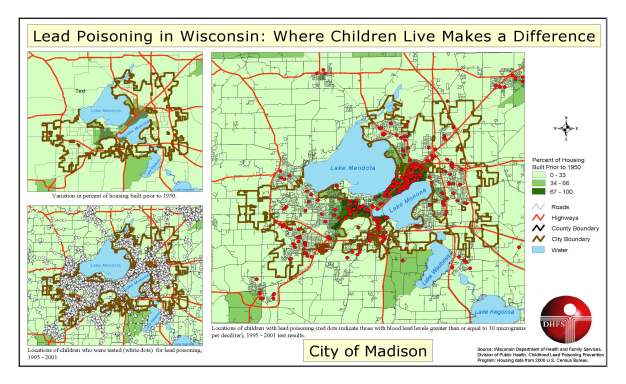
Lead exposure and more

A story today in US News and World Report discusses a study published in PLoS Medicine linking early exposure to lead to later criminality.

This reminded me of all the hidden dimensions of inequality and how they relate to school success and things like disproportionate Learning, Emotional and Behavioral Disability classifications.

That thought reminded me of this video from the Educator Roundtable.

More resources on lead exposure:

Lead Safe Wisconsin

“Goodbye Old Paint,” in Affordable Housing: A Crisis for Wisconsin’s Families (a publication of WisKids Count, a project of the Wisconsin Council on Families and Children).

Thomas J. Mertz

1 Comment

Filed under AMPS, Best Practices, education, Equity, Local News, National News, nclb, No Child Left Behind

Quote of the day

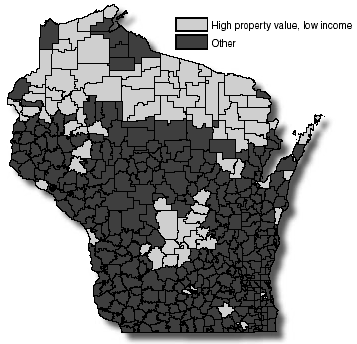
Map from the Wisconsin Atlas of School Finance, by Jack Norman, a publication of the Institute for Wisconsin’s Future.

“I have been on the school board for ten years and we have had to make cuts eight of those years. We are looking at the destruction of education in Northern Wisconsin. What I would like to see is the media saying it’s a problem,” said [Rhinelander School District] school board president Chuck Fitzgerald.

Quoted in the Rhinelander Daily News.

An April 2008 referendum in Rhinelander was defeated by about 3,000 votes. The last referendum to pass in the district was in 1998.

It isn’t just in Northern Wisconsin or Madison where our once great public schools are being destroyed, it is throughout the state. Let’s “Get-er Done” and fix the state school finance system.

Thomas J. Mertz

Leave a comment

Filed under "education finance", AMPS, Budget, education, Equity, finance, Gimme Some Truth, Referenda, School Finance, We Are Not Alone

Quotes of the Day

From the Wisconsin Center for Education Research report:

Educational equity issues within the school district [MMSD] are the source of much public controversy, with a relatively small but vocal parent community that is advocating for directing greater resources toward meeting the needs of high achieving students. This has slowed efforts to implement strong academic equity initiatives, particularly at the middle and early high school levels.

From Matthew Yglesias:

The rhetoric of No Child Left Behind is, I think, an appealing one. The idea is that, well, no child should be left behind. It’s an essentially egalitarian aspiration — the school system should try to do well for the hardest to teach kids, included ones coming from difficult backgrounds and ones who simply for whatever reason have a hard time with school. The idea of “gifted” programs is basically the reverse vision — that the school system should focus on the easiest cases and push them to the highest level of achievement possible.

There’s not a stark either/or choice between the hard cases and the easy cases, but at some level you do need to make a decision about priorities. Insofar as we’re serious about educational equality, that will to some extent involve shortchanging the best and the brightest. Insofar as we’re serious about taking the most talented as far as they can go, that will involve shortchanging equity. The former strikes me as more desirable than the latter, especially for people who want to think of themselves as being on the left.

From Michael Bérubé:

If we as a society are going to make decisions concerning prioritizing scarce educational resources, it makes sense to me, for us to consider what kind of output we desire. Do we want to, for example, maximize the number of future American Nobel prize winners and enjoy the fruits of the breakthroughs that our most gifted can achieve, or do we want to maximize the educational level of the median American worker? Both results have great value, and if we were to quantify them in terms of dollars, I’m not sure which one would prove to be of greater value to society. But I think these are the questions we should be discussing. And that devoting our resources to maximizing the future opportunities of our least educationally apt children for the sake of doing so, without examining the costs, is fuzzy-headed. Which may or may not be a liberal value. But as liberals we do acknowledge that society is not just a collection of disparate competitive individual maximizers, but that we live in a community where cooperation is also an important value. And that maximizing the strength and resources of that community is itself a liberal value.

The National Access Network just reported that “the United States now has the highest relative childhood poverty rate among developed countries.” When the test scores of white American students are reported separately and compared to the test scores of students in developed countries, the United States ranks third highest. In contrast, if Hispanic and African American test scores are compared to the same international scores, the United States ranks last and next to last. It noted that “the authors of a 2001 Wisconsin study concluded that a weighting of 3.4 times the base cost for education was needed for poverty students to reach state standards.” In a new paper on class size reduction efforts, research found that “Wisconsin SAGE class-size reduction experiments showed positive effects on student performance, especially for disadvantaged students.” Economists estimate that reduction efforts targeting disadvantaged schools nationally would cost about $2 billion, and as the evidence shows, it would reap many benefits.

Robert Godfrey

2 Comments

Filed under "education finance", AMPS, Best Practices, education, Equity, finance, Gimme Some Truth, No Child Left Behind, Quote of the Day

Primary Sources

My students have an exercise based on primary sources due soon. It seemed like a good idea to post some here.

It is hereby declared to be the policy of the commonwealth to encourage all school committees to adopt as educational objectives the promotion of racial balance and the correction of existing racial imbalance in the public schools. The prevention or elimination of racial imbalance shall be an objective in all decisions involving the drawing or altering of school attendance lines and the selection of new school sites.

An Act providing for the Elimination of Racial Imbalance in the Public Schools, Massachusetts, 1965

George Wallace 1968 television ad, from The Living Room Candidate.

Richard Nixon 1972 television ad, from The Living Room Candidate.

.

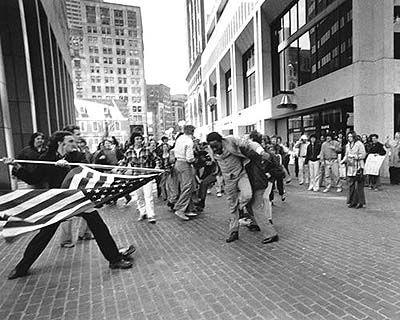
“Soiling Old Glory” Louis P. Masur (Boston anti-busing protest, 1976)

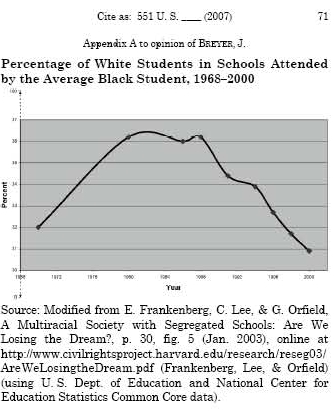
From Justice Stephen Breyer’s dissent in Parents Involved in Community Schools v Seattle School District (2007).

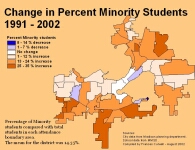
From MMSD, click image for power point (I wish they would update these).

And bonus links to recent blog entries on school desegregation from Sherman Dorn and Eduwonkette

Thomas J. Mertz

Leave a comment

Filed under AMPS, Best Practices, education, Equity, National News, Uncategorized

Pass the Hatchet

“Let me chop it, let me chop it”

Roger and the Gypsies – Pass the Hatchet (listen)

Marc Eisen of the Isthmus has checked in again on the Madison Schools with a column titled “When Policy Trumps Results.” This time the target of his ill informed scribblings is the equity work of the district, particularly the Equity Task Force, of which I was a member. It is a hatchet job.

Mr. Eisen gets his facts wrong, misreads or misrepresents task force documents and at no point engages with the content of the task force’s work. We offered the Board ideas for policies and practices that we thought would help produce and assess results. You would never know that reading Mr. Eisen’s column. Despite the title, all he seems to care about is style.

In return, I’m going to wield the axe. I’m going to go paragraph by paragraph to highlight the low level of knowledge and effort Eisen displays and the ultimate emptiness of his critique, hitting some other things along the way (quotes from Mr. Eisen in italics). Mr. Eisen’s column probably does not deserve this much attention. However the power of the press is such that often when uncorrected, “the legend becomes fact.” I believe equity work in our school district is too important to allow that to happen. Let’s get started.

Much to its credit, the Madison school board has mostly ignored the March 2007 recommendations of the district’s Equity Task Force.

This is simply wrong. On April 21 the Board of Education moved forward on equity, asking the Administration for a redraft of a working document based largely on the report of the task force. Over the last year — in discussions over budgets, school closings, boundaries, discipline and expulsions and more — Board members have explicitly and implicitly employed the work of the Task Force. I wish the Board had more extensively and more directly worked through the Report in public meetings, but the record shows they haven’t ignored it.

This earnest but unhelpful committee delved into the abstractions of what distinguishes “equity” from “equality,” how the board might commit to equity and what esoteric guidelines could measure that commitment.

Yes we were an earnest bunch. Who else would volunteer their time for a year and a half?

I’m no judge of how helpful we were/are, but I do know that Board members (of all stripes), administrators, and teachers have all termed the work of the task force “helpful.” In a manner typical of Isthmus coverage of school issues, rather than talk to those involved — the people who the task force sought to help –, Eisen simply asserts his own opinion.

As to “abstractions of what distinguishes ‘equity’ from ‘equality,'” I am not sure what Report Mr. Eisen read, but there is nothing resembling this in the Final Report. The word equality appears only once in a simple statement that “equity and equality, though closely related, are not the same.” We did discuss this among ourselves and discuss it when we met with community groups, because we wanted to be clear that equity cannot be achieved via a “one size fits all” version of equality.

We were asked by the Board of Education to give them a definition of equity, a statement of commitment and guidelines for implementation. Mr. Eisen labels these last two “esoteric.” This seems to me to be a poor word choice. The vast majority of these portions of the Task Force Report are written in plain language, there is a minimum of education speak; it is very accessible. Click the link and judge for yourself. We also sought to ground the strategies by preparing a responsibility chart and giving examples of how success might be measured.

This points to another basic misunderstanding of Mr. Eisen’s. The guidelines in the report are “guidelines for implementation,” clearly labeled as such and make no mention of measuring commitment or anything else. Because we shared Mr. Eisen’s desire for results we went beyond our charge to include a statement on “Monitoring and Evaluating Outcomes,” emphasized accountability in the statement of commitment and included in the appendices the notes on measuring success. These are separate and distinct for the guidelines.

It is worth noting that a number of the guidelines for implementation are things that Mr. Eisen has advocated for in the past (and even advocates in the column under discussion). Some examples from the Report (linked to works of Mr. Eisen with similar ideas)

I honestly don’t know what to make of Mr Eisen’s wholesale dismissal of the task force in light of these and other shared beliefs. There may be a clue in his next paragraph.

If you are already slipping into catatonia from the meaningless rattle of words, that’s understandable. This is stuff that appeals to progressive professors at the UW-Madison School of Education and to graduate students who aspire to become progressive professors at the UW-Madison School of Education.

Before speculating on Mr. Eisen’s agenda, I can’t resist pointing out the “meaningless rattle of words” inducing catatonia can only be those of Mr. Eisen because the only words quoted from the task force to this point are “equity” and “equality.’ In addition to being a poor reader and a lazy researcher, Mr. Eisen is either a perceptive self critic or a very bad writer/editor.

Once past this revealing gaffe, Mr. Eisen indulges in a favorite sport of the neo-conservatives, ridiculing “progressives” and academics (more below). I’m a proud progressive. While I share some of this skepticism toward academics, I think Mr. Eisen’s brush is much too broad.

“Equity,” the committee announced in its report to the board, “involves opportunity; access; elimination of barriers; distribution of resources; protection of specific groups; recognition and acceptance of differences” and marches on for another 75 words in an act of faux definition.

Two important things here. First, Mr. Eisen does not quote the definition itself, only the introductory material. Second, he has no specific criticisms of any of the ideas the task force sought to include in the definition, only general ridicule and dismissal. For the record, here is the definition we suggested to the Board:

Equity assures full access to opportunities for each MMSD student to achieve educational excellence and social responsibility.

In a sense Mr. Eisen is correct that this is a faux definition. We avoided saying what equity is, settling on trying to say what equity does, to put the focus on results

The more it seeks to explain itself, the more suspect the whole equity endeavor becomes. As someone who sat through a meeting at East High last year where the task force’s work was explained to baffled parents (we filled out a survey that asked, “What does the definition of equity mean to you?”) and who then watched a poorly attended forum discuss the task force’s findings at Centro Hispano on April 3, all I can ask is:

What is it about progressives and their penchant to champion programs on the basis of their rhetorical gloss rather than their success, or at least their prospects for success?

I was one of the presenters at the East High meeting and attended the forum at Centro Hispano. The purpose of the East High meeting was not to explain the task force work, but to get feedback. At that and other venues we received some very useful feedback. I didn’t take a survey about who was “baffled” and who wasn’t, but my memory is that once we got past who we were and what we wanted from them, the parents were interested and engaged. I just dug up a couple of emails from parents who were there and neither indicates any bafflement. I don’t doubt that Mr. Eisen was baffled, but I do question his unsupported assertion that the others in attendance were.

As to the meeting at Centro Hispano, the forum was organized by a charter school advocacy group, only one Equity Task Force member was involved, at least two of the invited panelists were not familiar with the task force’s work (although the announcement said a task force member would be on the panel, to my knowledge none were invited), the Task Force Report was apparently attached to the invitations but discussing the work of the task force was not on the announced agenda and only came up in passing. Mr. Eisen’s characterization is misleading.

The question Mr. Eisen asks seems to be the crux of his complaints. He reads the recommendations of the task force as mere rhetoric and sees nothing that offers “prospects for success.” Here we differ. I see much that I think will add to the success of the district, but beyond that I find it sad and confusing that Mr. Eisen can read the Report and find nothing of use — even in areas where he is in agreement with the recommendations — and can only respond with a nonsensical criticism (disguised as a question) of those easy strawmen “progressives.” For the record, the task force was a relatively diverse group and I have doubts about how many members could accurately be called progressives. I don’t care, but if Mr. Eisen is going to label people, maybe he should learn something about them first.

The Madison schools face a real problem in the achievement gap that separates white students from minority students, poor students from middle-class students.

I can’t think of a bigger challenge for this community than to get these kids up to grade level before they get lost in the hormones and peer pressure of middle and high school.

These are the kids who drop out, who lack the skills to hold jobs, who run the risks of drugs and alcohol, who break the law, who shatter neighborhood comity, who get busted.

I agree with most of this. The only thing I’d add is that we can’t ignore those students who are already in middle and high school and behind. Here and elsewhere Mr. Eisen appears to have given up on these students.

Call me naive, but I think most Madisonians are prepared to give these troubled kids extra help. They might volunteer their own time in the Schools of Hope program to tutor struggling readers. They might support raising taxes to fund four-year-old kindergarten or other programs designed to rescue kids from a dreadful fate.

This point needs to be emphasized. Madisonians aren’t afraid to tax themselves. They just want good services in return and know that their money isn’t being wasted.

Yes, I will call you naive, or at least somewhat naive.

Schools of Hope has been a great success. The community involvement has been heartening, the results impressive, but gaps remain and both involvement and progress seem to have plateaued. Again, the task force recognized the importance of community involvement as one part of the answer.

The task force also called for universal quality early childhood education. Unfortunately this is one part of the Report the Board of Education has ignored. After the Centro Hispano meeting I had a long talk with Mr. Eisen. Most of it was about how shoddy the Isthmus coverage of school issues is, but at one point he challenged me by asking (something like) “Why aren’t you advocating for four-year-old kindergarten?” I answered that I was and that the task force had also. I explained to him that in private conversations with multiple Board members I had asked them to consider a referendum on 4K, that just that evening I had brought the matter up with a Board member and that thus far they had not shared his optimism and have been reluctant to move in this direction.

I’m going to keep trying to get a referendum on 4K because it is the right thing to do, but I understand their reluctance and am also not optimistic. There is a pressing need for an operating referendum — without a successful referendum the district in 2009-10 will face $5-$10 million in cuts from the same service budget — and this has to be the first priority. Multiple measures on a referendum ballot invite a split vote, making it more difficult to pass any. I’d like to at least try for 4K and hope to convince at least four Board members. I hope Mr. Eisen continues to advocate for 4K.

I’m not terribly optimistic about an operating referendum vote either. Mr. Eisen blithely declares that “Madisonians aren’t afraid to tax themselves. They just want good services in return and know that their money isn’t being wasted.” Maybe Mr. Eisen believes that our schools waste money and don’t provide good services (if so, I’d be happy to go round for round with him on these matters), because the last time MMSD asked Madisonians to tax themselves to preserve programs and services, the measure lost by almost 11%. I also want to point out that making the case for any referendum, a 4K referendum in particular is going to involve citing the expertise of those progressive education professors that Mr. Eisen doesn’t like, the work of Progressive Dane and other progressive organizations and the votes of many progressives. It does not make sense to dismiss and alienate these people.

But I can’t for the life of me see them rallying around a pompous and abstruse equity policy, especially one that reads like it was formulated by the UW Department of Leftwing Social Engineering. (Example: “Equity will come about when we raise a generation of children tolerant of differences and engaged in their democracy to stop the processes leading to inequity.”)

Again Mr. Eisen’s reading skills seem to have failed him. The quoted passage is not from the body of Task Force Report, nor the draft policy but an excerpt from public comments included in the appendices. At best this is irresponsible; at worst it is dishonest. I ask readers to judge pomposity and abtuseness themselves and note that again Mr. Eisen says nothing about the substance of the task force’s work, only the style. If anything it appears that Mr. Eisen is the one obsessed with matters of rhetoric to exclusion of content.

The issue of public response is a real, if secondary, one. The primary job of the task force was to report to the Board of Education. This was not a campaign document. That said, we did recognize that a commitment to equity could either enhance or detract from perceptions of the district and that the success of all things related to public schools require public support. It was our hope that the community would recognize that our recommendations addressed important matters in a positive ways.

There is some evidence that Mr. Eisen is wrong in general about Madisonians rallying around equity. The East Area Parent Teacher Organization and the Northside Planning Council have been using equity as a rallying point for years and have had some success in generating Board and public interest.

The school board, after a suitable 14-month delay, should politely shelve the task force’s recommendations when it finally gets around to voting on them in May.

As the comments on Mr Eisen’s opening paragraph indicated, it is much too late for that.

Equity can be honored in principle, but in practice the board needs to be laser-focused on the practicalities of closing the achievement gap.

So much more wrong here. First there is the implication that raising achievement can be accomplished via a laser focus, when common sense and research agree that academic success depends on multiple factors and no single initiative can promise results for most (much less all) students. There is the related implication that MMSD has been neither focused nor successful in raising achievement. Both of these are relative and subjective, but again I disagree and again Mr. Eisen offers no evidence in support of his position. Most significantly Mr. Eisen does not identify what that focus would entail. The task force offered specific recommendations, Mr. Eisen does not.

Mr. Eisen has been on record in opposition to one initiative of demonstrated utility in raising the achievement of those in the middle and at the bottom and supported by the task force: heterogeneous or mixed ability classrooms. Maybe his desire for a laser focus is a desire to make sure that his children and the children of his peers aren’t part of the effort to improve the achievement of poor children.

Too often Madison’s libs and progs devote themselves to elaborate exercises in policy-making as if policy is an end in itself.

I can only speak to the case of the Equity Task Force, but in that case I can say without fear of contradiction that none of us saw policy as an end in itself, but as a means to an end. We knew words in a policy book without action are useless and actions without results are a wasted effort. Many of us are and have been involved at the school, district and state level working for better policy, actions and results.

Here I’m going to get a little earnest. It was an honor to serve with my fellow Equity Task Force members. They are people who care deeply about making our schools work for all students and have repeatedly demonstrated their commitment by volunteering their time. I’m proud of our work and proud to have come to know you all.

Most of the rest of the article is about Inclusionary Zoning (I hope Brenda Konkel or someone more familiar with that issue weighs in), but one further reference to education deserves attention.

This failure has only exacerbated the school board’s challenge in dealing with the achievement gap. The research is crystal clear: Kids in high-poverty schools fare far worse academically than poor kids attending middle-class schools.

This is exactly why policy matters. The current policy and practices of the district say nothing about economic segregation in classrooms and are relatively weak in school assignment (see here). The task force recommended that the administration annually report to the Board any schools or classrooms that significantly diverge from the overall socio-economic makeup of the district and offer actions to address this segregation. Mr Eisen may have a better way to deal with this issue. He offers none beyond Mayor Cieslewicz’s ill conceived “share the poverty” proposal. My thoughts on that will have to wait for another day, but simple numbers show that even if this is wildly successful and 2,000 children in poverty move to other districts, MMSD will still be at close to 40% free and reduced lunch. History shows that those children will remain geographically concentrated. Whatever the solution, it will involve policy.

This is all very frustrating. Many people read the Isthmus and few people pay much attention to school issues that do not directly impact them. Mr. Eisen’s latest “effort” is one of many examples of that newspaper’s confidently criticizing the schools and the Board of Education with little regard for logic or truth. It is all about posturing, style over substance. Nowhere in his column does Mr. Eisen discuss any of the policy recommendations of the task force. Nowhere. There is a certain irony in that Mr. Eisen’s supposed concern for results is manifested exclusively as a critique of style.

Bob Somerby at The Daily Howler has extensively documented how the national press does the same thing — from falsely labeling Al Gore a congenital liar to constant references to of John McCain’s “straight shooter” image — they endlessly repeat falsehoods or focus on the trivial; ignoring important matters in order to create amusing fictions. The people working to make our schools better, the children and the public deserve better.

Thomas J. Mertz

1 Comment

Filed under AMPS, Best Practices, Equity, Gimme Some Truth, Local News, Referenda, Take Action, Uncategorized

SAGE Thoughts

lu-yu-god-of-tea.jpg

The Student Achievement Guarantee in Education (SAGE) contracts for MMSD schools will be on the agenda at Monday’s (3-10-2008) Special Board of Education Workshop meeting.  I have mixed feelings about the SAGE program because of the choices it forces school district to make.

A serious overhaul of the school funding system is needed and one of the things that should be addressed are the problems with SAGE.  Most of the proposals I’ve seen (Wisconsin Alliance for Excellent Schools, School Finance Network, Alan Odden…) would minimize or eliminate some of the issues discussed below.

I am all in favor of targeting resources (or the money to pay for resources) to children in poverty and schools with high concentrations of children in poverty.  I also think all four parts of the SAGE program are great:

Program Elements

SAGE promotes academic achievement through the implementation of four school improvement strategies:

  • class sizes of no more than 15:1 in grades K-3;
  • increased collaboration between schools and their communities;
  • implementation of a rigorous curriculum; and
  • improved professional development and staff-evaluation practices.

SAGE does this by providing districts with $2,000 per student in poverty at SAGE schools (next year it will be $2,500, the first increase since the program started over a decade ago).  I even like the fact that there are some strings associated with the money, that it has to be used in certain ways.  In this fiscal climate legislators and tax payers want to know that their money will be spent wisely and the preponderance of research (and here) indicates that the areas SAGE money can be spent are productive best practices.

The two of the biggest problems with SAGE are that 1) There are a limited number of SAGE contracts, meaning there is a cap on the number of schools (and children) that can benefit from the program (MMSD has 20 contracts);  and 2) SAGE does not direct extra resources to poor children in non-SAGE schools (it isn’t easy being a poor child in a rich school).  I’ll add a number 3, that SAGE does nothing for children after third grade).   As a result of these —  and the fact that SAGE funding is insufficient (it is an under-funded “mandate”) — the SAGE program promotes economic segregation in our schools.

Economic segregation was among the considerations in the recent West-side attendance area boundary discussions.  The Equity Task Force has weighed in with guidelines to minimize economic segregation.  I am an unapologetic believer in promoting integration as a key element of the social mission of public education.   However, the case for  economic integration does not rest solely on these ideals, significant research has demonstrated that poor children tend to achieve more in schools with an economic balance (and here and here and here…. Note that  —  like everything else in education research — there are no absolutes and that there are schools with very high poverty proportions where achievement is also high and schools with low poverty where achievement is not so high).   These finding are reflected in the local data below (see also the “Classmates Count” study).

poverty-mmsd.jpg

Graphic taken from “Effect of Concentration of Poverty in School on Reading Scores (MMSD).”

The problems come in because unless there are high concentrations of poverty in individual schools, meeting the SAGE program requirements demands great expenditures from general operating budgets, budgets that are already stretched to near the breaking point.

For simplification, I am only going to do the math for approximate classroom teacher wages and benefits costs (this means that expenses having to do with community collaboration, curriculum, staff development, evaluation, specials teachers, facilities and supplies are not included).  A full time equivalent teacher costs MMSD about $76,000/year in wages in benefits.   There are 28 schools in MMSD serving K-3 (not counting the hand-full of students listed at Lincoln; there will be 29 schools next year).  Among those schools the average number of kindergartners is 72, to make the math easier (and more dramatic), let’s use a school with 63 kindergarten students (these are  crude estimates because the the way the numbers break down with 21/1 and 15/1 are crucial and the use of multi grade classrooms opens up some other possibilities for maximizing SAGE dollars).   At a 21/1 pupil/teacher ratio this would mean the school would require 3 kindergarten teachers and classrooms.

63/21 = 3.0.

At a 15/1 ratio the school would require 5 kindergarten teachers and classrooms.

63/15 = 4.2 (round up to 5…SAGE requires 15/1 or less).

At $76,000 per teacher the difference in cost is $152,000.  Using next year’s SAGE funding ($2,500/student in poverty) it would take about 61 students in poverty to make SAGE to pay for itself.

152,000/2,500 = 60.8 (round up to 61).

Out of a class of 63, this means a poverty proportion of 96.8% is required for SAGE class size reduction to be “fully funded.”  No K-3 schools in Madison are currently at or above this level.  The closer you get to that 96.8% the less general operating money is needed.   Here is a chart for percentage of kindergarten students in poverty and local implementation costs (the unfunded portion) based on the assumptions and calculations above:

30%

$104,750
40% $89,000
50% $73,250
60% $57,500
70% $41,750
80% $26,000

This creates a dilemma.  Maximizing SAGE dollars pulls toward concentrating poor children; best practices pushes toward balancing poverty at the school level.

SAGE also creates a related dilemma in the allocation of contracts between big schools with low poverty and small schools with higher poverty numbers.  Using the contract in a big school can bring in more SAGE dollars, but will also require more local dollars also.  Using the contract in a small school will mean fewer total students will benefit and may mean fewer students in poverty benefit.  I’m going to use Gompers and Chavez to illustrate this (see here).

Gompers (2007 figures)

154 K-3 students, 60% low income, about 93 SAGE funded students,

at $2,500/student = $232,500 in SAGE dollars.

Cost differential for 15/1 ratio (four more classrooms) = about $228,000.

Chavez (2007 figures)

482 K-3 students, 27% low income, about 130 SAGE funded students,

at $250,00/student = $325,000 in SAGE dollars.

Cost differential for 15/ratio (12 more classrooms) = about $912,000.

So fully implementing (K-3) a SAGE contract at Chavez instead of Gompers would bring in more money,  serve more students and more students in poverty, but at an additional cost to the district of about $684,000 per year.  Tough choices.

In Madison these choice are made even more difficult by the fact that we have about seven schools between 23% and 33%  poverty level, but only enough SAGE contracts for two or three these schools.  These schools vary greatly in size, and the exact percentages cannot be known till after the third Friday counts in September, further complicating the issue and making the equity based choices even more elusive.

In the past Madison has worked around some of these issues via implementing various levels of SAGE (K-1, K-3, whole school…) and using local funds to reduce class size in non-SAGE schools.  Madison has also won praise for leveraging federal, state and local monies to maximize the impact of all the dollars (see: Resource Distribution in the Implementation of Class Size Reduction Policy: Looking Inside the Black Box of District Practice, MMSD is “Maxwell”). Last year was the first year the district moved away from locally based class size reductions.  Without a successful referendum in November 2008, it won’t be the last.

In closing, there are some questions surrounding what options a district has in transferring SAGE contracts.  Last year the administration analysed choices based on the assumption that contracts could be moved (and here). Recently, the Board of Education was advised that “neither the statutes nor the administrative rules expressly prohibit the transfer of a contract.”  The DPI guidelines from February of 2007 state:

Transfer of contracts has been allowed when SAGE schools have been closed, consolidated, or moved to new buildings to ensure the benefits of the program could follow the students to their new location.

  • Within the term of a five-year SAGE contract the contract may be moved by the district from an existing school to a different school more in need of the program only with the consent of the recognized representatives of both the staff and parents of the school giving up the contract
  • At the end of a five-year contract the district board may transfer a SAGE contract from one school to another the SAGE requirements will immediately apply to the school to which the contract is transferred.

I don’t know what decisions the Board might make on Monday.  With a matter this complicated and with budgetary and equity consequences for the entire district, I believe that in the absence of guidelines or policy directly addressing the issues, these discussions and decisions should take place as part of the budget process and not as a separate item.  I also wish the Board the best with these very difficult issues.  Last, I hope that the community understands that there are no easy or clear choices and that the Board must weigh many factors and options with an eye on what is best for the district as a whole.

Thomas J. Mertz

[Note post edited at 5:42 PM, 3-09-08 to correct mathematical error. The new version uses  a school with 63 kindergarten students as an illustration, the first version used a school with 72.  Because of MMSD policies and the way the numbers work out the cost differences for a school with between 63 and 91 students in a grade would not be as dramatic (only one more teacher required).  The district cannot know if a particular school will hit a sweet spot (64, 65, 66,..) or a sour spot (62, 63, 91, 92…).]

Leave a comment

Filed under "education finance", Best Practices, Budget, education, Equity, finance, Local News, Pope-Roberts/Breske Resolution, Referenda, School Finance, Uncategorized

NCLB News

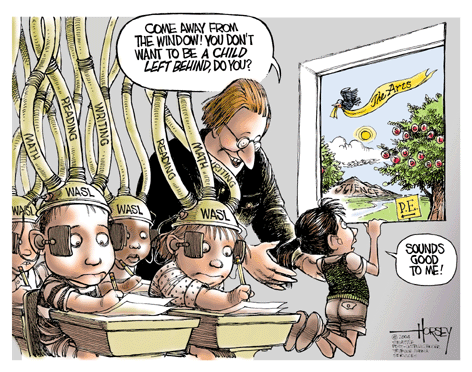
nclb-cartoon.gif

I’m going to start trying to post regularly on No Child Left Behind.  This is the first (or second) collection of links and excerpts.

Education Secretary Margaret Spellings was before the House Appropriations Committee recently.  The Chronicle of Higher Education reported on the session.

Democrats were harsh, with Rep. Jesse L. Jackson Jr. of Illinois calling the administration’s budget priorities “a bunch of garbage,” and Rep. Rosa L. DeLauro of Connecticut saying she was glad today was the last time she had to hear Ms. Spellings defend the president’s priorities. But Republicans were barely kinder, with Rep. John E. Peterson of Pennsylvania saying the administration’s budget “puts a zero priority on technical education,” and Rep. Dennis R. Rehberg of Montana accusing Ms. Spellings of neglecting American Indians. “I don’t know what you guys are smoking over there,” Mr. Rehberg told Ms. Spellings, “but it just ain’t working.”

The United Church of Christ has some wonderful anti-NCLB resources.  I think my favorite is Ten Moral Concerns in the No Child Left Behind Act.

1. While it is a civic responsibility to insist that schools do a better job of educating every child, we must also recognize that undermining support for public schooling threatens our democracy. The No Child Left Behind Act sets an impossibly high bar—that every single student will be proficient in reading and math by 2014. We fear that this law will discredit public educationwhen it becomes clear that schools cannot possibly realize this utopian ideal.

6. The No Child Left Behind Act blames schools and teachers for many challenges that are neither of their making nor within their capacity to change. The test score focus obscures the importance of the quality of the relationship between the child and teacher. Sincere, often heroic efforts of teachers are made invisible. While the goals of the law are important—to proclaim that every child can learn, to challenge every child to dream of a bright future, and to prepare all children to contribute to society—educators also need financial and community support to accomplish these goals.

7. The relentless focus on testing basic skills in the No Child Left Behind Act diminishes attention to the hu­manities, the social studies, the arts, and child and adolescent development. While education should cover basic skills in reading and math, the educational process should aspire to far more. We believe education should help all children develop their gifts and realize their promise—intellectually physically, socially, and ethically. The No Child Left Behind Act treats children as products to be tested, measured and made more uniform.

9. The No Child Left Behind Act exacerbates racial and economic segregation in metropolitan areas by rating homogeneous, wealthier school districts as excellent, while labeling urban districts with far more subgroups and more complex demands made by the law as “in need of improvement.” Such labeling of schools and districts encourages families with means to move to wealthy, homogeneous school districts.

The Center on Education Policy has issued a new report on the curriculumn narrowing which has resulted from the high stakes testing in math and reading.

Among the districts that reported both increasing time for ELA or math and reducing time in other subjects, 72%indicated that they reduced time by a total of at least 75 minutes per week for one or more of these other subjects. For example, more than half (53%) of these districts cut instructional time by at least 75 minutes per week in social studies, and the same percentage (53%) cut time by at least 75 minutes per week in science.

Some news on the “opt out” front (states, districts, schools and students considering refusing to comply with the law).  Virginia is on the edge of leaving NCLB behind (hat tip to Jim Horn at Schools Matter).  The Carol Stream (IL) Elementary District 93 has decided not to force children who don’t speak and read English to take tests writen for  English speakers (this is a violation of the law…another tip of the hat to Jim Horn is in order).

District 93 officials say they’re willing to break the law this spring to shield students from the frustration and humiliation of taking an exam not designed for them.

“The board believes it’s appropriate to do that,” District 93 Superintendent Henry Gmitro said. “While there may be consequences for the adults in the organization, we shouldn’t ask kids to be tested on things they haven’t been taught.”

Illinois dropped the test that was designed for English learners this fall, after the U.S. Department of Education made a final ruling that the test wasn’t an adequate measure of state learning standards. The old test was written in simpler English.

As a stopgap measure, English learners will take standard assessments with some special accommodations, such as extended time and audio recordings, while Illinois develops a test that will meet federal guidelines.

Locally, the Wisconsin Peace & Justice Network  is asking people to identify alternate uses for the money that is being spent on the Iraq war.  According to their figures, Madison taxpayers have contributed about $300 million.  After fully funding free quality early child education and restoring MMSD’s cost to continue cuts of the last few years, I would suggest Madison opt out of NCLB at a cost of about $5 million per year.  We can dream.

Last, I’ve added a new blog to the Resources page: the NEA’s NCLB – It’s Time for a Change!.  Check it out.

Thomas J. Mertz

Leave a comment

Filed under "education finance", Accountability, Best Practices, education, Elections, Equity, finance, National News, nclb, No Child Left Behind

Quote of the Day

lines.jpg

No boundary changes ever occur without fear, or frustration. That’s what happens when you live in a growing city. Arguments that folks moved to a specific neighborhood for a specific school are weak at best. We cannot afford a school for every neighborhood, and we have to address over-crowding as well as school equity as it relates to children of low income families.

SP-EYE: Keeping an EYE on the Sun Prairie School District

Our neighbors in Sun Prairie are dealing with similar issues in redrawing school boundaries.  Clean and easy attendance area redistrictings are exceedingly rare, add issues of racial, linguistic and economic diversity and there is sure to be conflict.  That’s the nature of the beast.

The MMSD West-side boundaries are on the agenda for Monday, March 3, 2008.

Related items:

“Moving the Lines,” Jason H. Silverman.

“Planning for Equity,” Kelley D. Carey.

“Planning for Integration,” Kelley D. Carey.

Sun Prairie Area School District Boundary Task Force (District Home Page).

More student moves loom in Sun Prairie (Capital Times).

Sun Prairie Parents Weigh In On School Boundary Changes (Channel 3000).

Sun Prairie schools still in a deadlock (Capital Times).

Opposition voiced to boundary changes (Sun Prairie Star).

MMSD New Elementary School page (with boundary proposals).

Parents Upset Over Plan F Recommendation (WKOW).

School Board panel recommends significant changes (Capital Times).

Cheryl Rebholz: Toki Middle School responses unfair (letter to the editor).

Thomas J. Mertz

Leave a comment

Filed under AMPS, Best Practices, education, Equity, Local News, Quote of the Day, Uncategorized