Category Archives: National News

Primary Sources

My students have an exercise based on primary sources due soon. It seemed like a good idea to post some here.

It is hereby declared to be the policy of the commonwealth to encourage all school committees to adopt as educational objectives the promotion of racial balance and the correction of existing racial imbalance in the public schools. The prevention or elimination of racial imbalance shall be an objective in all decisions involving the drawing or altering of school attendance lines and the selection of new school sites.

An Act providing for the Elimination of Racial Imbalance in the Public Schools, Massachusetts, 1965

George Wallace 1968 television ad, from The Living Room Candidate.

Richard Nixon 1972 television ad, from The Living Room Candidate.

.

“Soiling Old Glory” Louis P. Masur (Boston anti-busing protest, 1976)

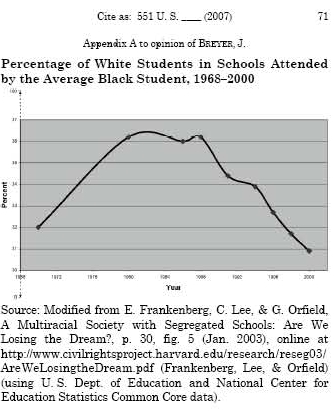
From Justice Stephen Breyer’s dissent in Parents Involved in Community Schools v Seattle School District (2007).

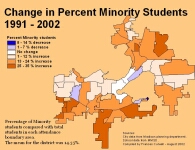
From MMSD, click image for power point (I wish they would update these).

And bonus links to recent blog entries on school desegregation from Sherman Dorn and Eduwonkette

Thomas J. Mertz

Leave a comment

Filed under AMPS, Best Practices, education, Equity, National News, Uncategorized

Knee Jerks

ppreflex.gif

The knee jerk critics of public education, including our local contingent, are quick to propagate any story that appears to put our school systems in a bad light.  Too quick.

A story spread around the anti-public education sphere today under headlines such as   “Parental Rights Die In California,” “Education or indoctrination,” You vil go to our skools und you vil like ti,” CA Judges: “Parents Have No Constitutional Right to Homeschool.””  The source of all this panic is a post by Bob Unruh on WorldNetDaily: “Judge orders homeschoolers into government education Court: Family’s religious beliefs ‘no evidence’ of 1st Amendment violation.”  One glance at this site and post is all it should take realize that this is not a reliable source.  Here are excerpts of the original post:

“We find no reason to strike down the Legislature’s evaluation of what constitutes an adequate education scheme sufficient to promote the ‘general diffusion of knowledge and intelligence,'” the court said in the case. “We agree … ‘the educational program of the State of California was designed to promote the general welfare of all the people and was not designed to accommodate the personal ideas of any individual in the field of education.'”

The words echo the ideas of officials from Germany, where homeschooling has been outlawed since 1938 under a law adopted when Adolf Hitler decided he wanted the state, and no one else, to control the minds of the nation’s youth.

Wolfgang Drautz, consul general for the Federal Republic of Germany, has said “school teaches not only knowledge but also social conduct, encourages dialogue among people of different beliefs and cultures, and helps students to become responsible citizens.”…

The father, Phillip Long, said the family is working on ways to appeal to the state Supreme Court, because he won’t allow the pro-homosexual, pro-bisexual, pro-transgender agenda of California’s public schools, on which WND previously has reported, to indoctrinate his children.

“We just don’t want them teaching our children,” he told WND. “They teach things that are totally contrary to what we believe. They put questions in our children’s minds we don’t feel they’re ready for.

“When they are much more mature, they can deal with these issues, alternative lifestyles, and such, or whether they came from primordial slop. At the present time it’s my job to teach them the correct way of thinking,” he said.

“We’re going to appeal. We have to. I don’t want to put my children in a public school system that teaches ideologies I don’t believe in,” he said.

Nazis? The pro-homosexual, pro-bisexual, pro-transgender agenda?  I’d be pretty careful linking to this stuff and I certainly wouldn’t pick a seemingly innocuous passage to excerpt and link without comment.

I try to provide context for quotes and excerpts posted here and vett the sources a bit.  I did a little of that on WorldNetDaily and you can check it out yourself here and here.

I also thought it would be worthwhile to find out more about the case before posting (click the link to read it).  The case itself isn’t all that interesting or important.  The panic over “no constitutional right” and similar ideas is silly.  I have no constitutional right to kiss my son good night and tuck him in (which I just did), but there is no constitutional prohibition either.  All the judges did was affirm the long standing idea that society and therefore the state has an interest in the education and well being of children that can at times trump the interests of parents.  This has been recognized in public education at least since the 1852 Massachusetts Compulsory School Law and is at the core of child abuse protections.

I looked at a related case against the parents too.  That’s where I found what Unruh doesn’t want you to know and those who linked to him  —  without thinking because the story seemed to support their hostility to public schools —  should have known.  The family lost their privilege to home school because of serious allegations of child abuse and other things that placed the children in danger.  Here are excerpts from that ruling:

The family’s third contact with the juvenile court came when a petition was filed in November 1993 for the same five children plus minor Rachel. According to a Department report in the instant case and a Department report in a 2001 matter involving this family, the six minors were found to be persons coming within the provisions of section 300 on the basis of the following sustained allegations: the parents’ home was dangerous to the minors in that it included, but was not limited to, approximately 60 guns, rifles and/or assault weapons; black powder in an unsecured location; and live ammunition, shells, and magazines, all of which was within access of the minors, and the guns and ammunition were in close proximity to each other. Further, the minors’ home was found to be in [*9] an endangering filthy, unsanitary and unsafe condition, and the minors were chronically filthy, and unsupervised late at night. Additionally, the parents unlawfully concealed the whereabouts of the children from the Department and father willfully gave false information to the court concerning the whereabouts of the children. Eventually all of the minors were released to mother’s care….

The fifth and current involvement of the Department with this [*10] family came as the result of minor Rachel’s contact with the Los Angeles Police Department, Wilshire Division, on January 26, 2006, when she asked to be picked up because she was tired, hungry and had no place to live. She was fourteen years old at the time. She had run away from the family home on October 29, 2005. Rachel told the Department social worker that she was tired of living under father’s house rules. She stated father would hit her with a stick, hanger or shoe if she did not follow his rules. She said he will not let her wear pants at home and she had to wear skirts or dresses, not let her wear makeup, and not let her attend public school. Rachel also reported that Leonard C. repeatedly molested her when she was between the ages of four and nine. He repeatedly groped her and would come into her room when she was in bed and put his finger into her vagina. She said she told the parents about it when she was 12 years old but they did not believe her. She stated the man still comes to the house occasionally and she worries that he might begin molesting her sister Mary Grace. She stated she engages in selfmutilation (cutting herself with a razor blade) and has problems with [*11] depression, but her parents will not send her to therapy because father tells her that speaking with him is all the therapy she needs. She stated she would never be all right with father now because she has been sexually active. She stated she would continue to run away if she is forced to live at home. The social worker reported that Rachel’s situation was similar to her sister Elizabeth’s, who also ran away, wanted to attend public school, objected to father’s house rules, was removed from the home for physical and emotional abuse, and complained that father dominates everyone in the house, including mother.

A different picture than the one of activist judges of  a totalitarian state serving the degenerate interests of the public education monopoly that Unruh would like you to believe. 

Maybe the knee jerks will be a little more careful of the company they keep the next time some bogus voucher or tax study or inflammatory report bolstering their assumptions comes their way and maybe follow the linked examples and seek the truth.  We can hope.

 Thomas J. Mertz

2 Comments

Filed under education, Gimme Some Truth, National News, Uncategorized

NCLB News

nclb-cartoon.gif

I’m going to start trying to post regularly on No Child Left Behind.  This is the first (or second) collection of links and excerpts.

Education Secretary Margaret Spellings was before the House Appropriations Committee recently.  The Chronicle of Higher Education reported on the session.

Democrats were harsh, with Rep. Jesse L. Jackson Jr. of Illinois calling the administration’s budget priorities “a bunch of garbage,” and Rep. Rosa L. DeLauro of Connecticut saying she was glad today was the last time she had to hear Ms. Spellings defend the president’s priorities. But Republicans were barely kinder, with Rep. John E. Peterson of Pennsylvania saying the administration’s budget “puts a zero priority on technical education,” and Rep. Dennis R. Rehberg of Montana accusing Ms. Spellings of neglecting American Indians. “I don’t know what you guys are smoking over there,” Mr. Rehberg told Ms. Spellings, “but it just ain’t working.”

The United Church of Christ has some wonderful anti-NCLB resources.  I think my favorite is Ten Moral Concerns in the No Child Left Behind Act.

1. While it is a civic responsibility to insist that schools do a better job of educating every child, we must also recognize that undermining support for public schooling threatens our democracy. The No Child Left Behind Act sets an impossibly high bar—that every single student will be proficient in reading and math by 2014. We fear that this law will discredit public educationwhen it becomes clear that schools cannot possibly realize this utopian ideal.

6. The No Child Left Behind Act blames schools and teachers for many challenges that are neither of their making nor within their capacity to change. The test score focus obscures the importance of the quality of the relationship between the child and teacher. Sincere, often heroic efforts of teachers are made invisible. While the goals of the law are important—to proclaim that every child can learn, to challenge every child to dream of a bright future, and to prepare all children to contribute to society—educators also need financial and community support to accomplish these goals.

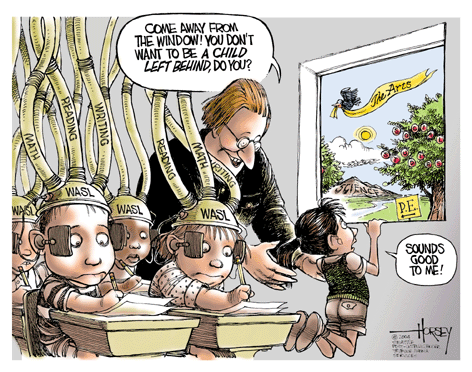
7. The relentless focus on testing basic skills in the No Child Left Behind Act diminishes attention to the hu­manities, the social studies, the arts, and child and adolescent development. While education should cover basic skills in reading and math, the educational process should aspire to far more. We believe education should help all children develop their gifts and realize their promise—intellectually physically, socially, and ethically. The No Child Left Behind Act treats children as products to be tested, measured and made more uniform.

9. The No Child Left Behind Act exacerbates racial and economic segregation in metropolitan areas by rating homogeneous, wealthier school districts as excellent, while labeling urban districts with far more subgroups and more complex demands made by the law as “in need of improvement.” Such labeling of schools and districts encourages families with means to move to wealthy, homogeneous school districts.

The Center on Education Policy has issued a new report on the curriculumn narrowing which has resulted from the high stakes testing in math and reading.

Among the districts that reported both increasing time for ELA or math and reducing time in other subjects, 72%indicated that they reduced time by a total of at least 75 minutes per week for one or more of these other subjects. For example, more than half (53%) of these districts cut instructional time by at least 75 minutes per week in social studies, and the same percentage (53%) cut time by at least 75 minutes per week in science.

Some news on the “opt out” front (states, districts, schools and students considering refusing to comply with the law).  Virginia is on the edge of leaving NCLB behind (hat tip to Jim Horn at Schools Matter).  The Carol Stream (IL) Elementary District 93 has decided not to force children who don’t speak and read English to take tests writen for  English speakers (this is a violation of the law…another tip of the hat to Jim Horn is in order).

District 93 officials say they’re willing to break the law this spring to shield students from the frustration and humiliation of taking an exam not designed for them.

“The board believes it’s appropriate to do that,” District 93 Superintendent Henry Gmitro said. “While there may be consequences for the adults in the organization, we shouldn’t ask kids to be tested on things they haven’t been taught.”

Illinois dropped the test that was designed for English learners this fall, after the U.S. Department of Education made a final ruling that the test wasn’t an adequate measure of state learning standards. The old test was written in simpler English.

As a stopgap measure, English learners will take standard assessments with some special accommodations, such as extended time and audio recordings, while Illinois develops a test that will meet federal guidelines.

Locally, the Wisconsin Peace & Justice Network  is asking people to identify alternate uses for the money that is being spent on the Iraq war.  According to their figures, Madison taxpayers have contributed about $300 million.  After fully funding free quality early child education and restoring MMSD’s cost to continue cuts of the last few years, I would suggest Madison opt out of NCLB at a cost of about $5 million per year.  We can dream.

Last, I’ve added a new blog to the Resources page: the NEA’s NCLB – It’s Time for a Change!.  Check it out.

Thomas J. Mertz

Leave a comment

Filed under "education finance", Accountability, Best Practices, education, Elections, Equity, finance, National News, nclb, No Child Left Behind

NCLB Action

We haven’t posted much on No Child Left Behind lately.  Time to remedy that.

The reauthorization/reform are still pending, but don’t appear likely in this election year (see also here).  I don’t know if that is good news or bad news.  A straight re-authorization would be very bad news, but a better federal education policy (and less high stakes testing, less money for charters and vouchers, more money for underfunded mandates, more realistic accommodations and exclusions of special education students and English language learners for all testing) would be welcome, whatever the name.

I have to thank Madison teacher Gary L. Stout for prompting me on this post (and to add the Collaborative for Academic, Social, and Emotional Learning to the AMPS Resources page — check it out).  Gary, along with David Wasserman (see here and here, on AMPS) has been doing his best to get out a teacher’s perspective on the damage the law is doing to our schools and children.  Here is an excerpt from his site on NCLB (check out the Social, Emotional, and Academic Learning in Kindergarten material too, it is well worth the time if you care about early education).

Developmentally Appropriate Practices

If a person is truly knowledgeable about what constitutes Developmentally Appropriate Practices (DAP) for our school age children it is inconceivable that they support NCLB.

The concept of Developmentally Appropriate Practices are the cornerstone of what is good for our children in all schools. You will never, ever see the two phrases NCLB and DAP in the same sentence in any credible professional educational journal, never, ever. The more a person studies and works in teaching the more a person sees how developmentally inappropriate NCLB really is.

NCLB is the most destructive, vindictive piece of federal legislation ever passed. It is a deliberate assault on public education. It is a disease that is presently in every classroom, every day. It starts in kindergarten classrooms by undermining all aspects of Developmentally Appropriate Practices. It continues on through the grades and stops in High School when it lures, misleads, misinforms, and recruits our students into the all too real prospects of death or maiming. It is a tribute to the existing presidential administration
and their success at destruction and manipulation. NCLB is an all encompassing cancer that needs to be stopped.

The whole essay is here, including good quotes from our Board of Education members.  One more excerpt on what we can do: Take Action!

What Can We Do?

It is easy to be critical of NCLB. The challenging part is addressing the question of what can we do to change things?

1. We need to unite and get politically active locally and nationally to eliminate NCLB or change it drastically. The problem is that political change is slow. We as a nation have been taking steps backward in the education of our children for five years now. We will continue going backwards on a daily basis as long as NCLB exists as it is today.

2. It is critical for Wisconsin to change the way our public schools are funded. The elimination of revenue caps and the use of property taxes as a major way to fund public schools has got to change.

3. Third, we need to educate many of our co-workers, parents, and the voting public as to the truth about how our schools are being deliberately set up for failure and how our schools are presently failing on a daily basis to meet even the basic needs of all our children
There are also at least three things we can do immediately as a progressive and accountable school district.

1. Stop the one dimensional focus on academic learning and teach to the whole child. We need to teach and give every child the opportunity to grow socially, emotionally, physically, and creatively as well as academically.

In March 2003 I addressed a Madison school board committee suggesting that our school districts emphasis on testing and academic learning at the expense of social, emotional, physical and creative learning was developmentally inappropriate. Since then our approach to teaching to the whole child as become even more one dimensional with the developmentally inappropriate mandates of NCLB.

2. Change the focus of the Madison summer school program. Instead of using behavioral issues as a deterrent to getting into the program, children with behavioral issues should be the first to be enrolled. The public needs to know that when a classroom has just one socially
inappropriate child, that child takes educational opportunities away from every child in the classroom. Social development is similar to reading and math development. They need to be taught every day, in every classroom, at every grade level.

3. We need to remember Rosa Parks and say no to NCLB. Our school district should be commended for having the courage to say no to the Reading First program. Lets have the courage to say no to NCLB. As a community lets find ways to fund our schools without having the George Orwell effect tied to federal dollars.

I’ll add one more.  The Board of Education Communications Committee is planning forums on various topics.  I think the NCLB Act should be one of them.  If you agree, let them know.

Here are some of my other favorite anti-NCLB resources:

The Educator Roundtable (with petition).

Susanohanian.org (with a compilation of NCLB Outrages).

No NCLB.org

Thomas J. Mertz

Leave a comment

Filed under Accountability, Best Practices, Budget, Elections, Equity, finance, Gimme Some Truth, Local News, National News, nclb, No Child Left Behind, School Finance, Take Action, Uncategorized

Wolf in sheep’s clothing or a Trojan horse?

trojan-horse.jpg

In his state of the union address last night, President Bush touted “Pell Grants for Kids,” (PGFK) a $300 million federal voucher program. Pell grants are a popular program that provides needs-based post secondary tuition assistance. The program, like most things involving education, has been underfunded during the Bush presidency. Of course PGFK also tries to do things on the cheap, promising only $500 per student in aid, hardly enough to make a difference for most of the low income families who would be eligible. As policy PGFK is ridiculous; as symbolism it is important. The hook is that like pell grants, the “new” program could be used at private and religious institutions. In 1,000 ways higher education and k-12 education developed differently in this country — for example there are no compulsory higher education laws — and using tax dollars to fund private and religious education for children is not the same as helping adults afford to attend the college of their choice.

Of course unlike PGFK, pell grants can also be used at public institutions. Wouldn’t it be great if Bush had proposed giving every school district $500 more per student in federal aid. Although this probably still wouldn’t take care of all the underfunded federal mandates, it would mean about $12 million a year more for MMSD. Don’t hold your breath.

I put “new” in quotation marks above because this is an old idea all around. It was introduced as “The GI Bill for kids” By Lamar Alexander, when he was Secretary of Education under Bush I. Again, the attempt to create confusion by naming a voucher program after a popular program for adults. This went nowhere and it was reborn as PGFK in 2004, with a push from (then and now) Senator Lamar Alexander. The Senate testimony of (then) Arlington, VA Superintendent Robert Smith from 2004 gives a nice summary of how wrongheaded the proposal was and is. Andrew Rotherman of EdSector/Edwonk noted at the time that this was all about scoring a “political point” for school choice (note: I agree with Rotherman that this was and is about politics; I don’t agree with much else he has to say about it).

The title of this post is a trick question, the correct answer is both. Invoking pell grants covers the wolf of vouchers in the sheep’s clothing. Voucher proponents like Bush and Alexander hope to smuggle a small part of their policies into law under disguise thereby scoring points with people like the Hoover Institution, opening the door to more privatization and further undermining support for public education (and less support means more underfunding, which in turn leads to less support…starve the beast).

Don’t let it happen.

Thomas J. Mertz

Related links:

The New York Times, Grants Would Finance Private Schooling

Educational Whisper, Pell Grants For Kids = Vouchers In Disquise

Senate Hearing from 2004

Think Progress, SOTU: Bush’s ‘Pell Grants for Kids’ Plan Is Vouchers In Disguise

Engaged Intellectuals, Pell Grants for Kids?!

Carpetbagger Report, ‘Pell Grants for Kids’ = Vouchers

1 Comment

Filed under Gimme Some Truth, National News, nclb, No Child Left Behind, School Finance, Uncategorized

They only want to help our schools

mcd-reportcard120507.jpg

Ad Age has a report out on a move by McDonald’s to pick up the printing costs for report cards.
A Happy Meal coupon is included on the card’s cover. “With 27,000 elementary school kids taking their report-card jackets home to be signed three or four times a year, that’s less than 2 cents per impression.”

I guess healthy food advocates can pay for their own report cards.

Robert Godfrey

Leave a comment

Filed under AMPS, Best Practices, Budget, National News, Quote of the Day

Paul Soglin Checks in on School Finance

pennies.jpg

Former Madison Mayor Paul Soglin has given sporadic attention to state school finance issues on his blog. More would be better, but today’s is good:

The Tragedy That is California Education and Now Wisconsin

A trip last week to Los Angeles and San Francisco served as a graphic reminder of the rise and fall of public education in the state of California since the adoption of Proposition 13. The enactment of that law after a 1978 referendum created an unfair tax system, taxing property not on its use, its present value, or its potential for development, but the assessment on the day it was purchased.

The result not only creates an imbalance in taxation but it strangles deprives government of needed revenues. The most important example is California public education. In the three decades following World War II, California public schools were the best in the nation. Now they are among the worst.

Within California, test results and rankings of their schools show a clear delineation along economic lines. Schools in wealthy communities score the best. Obviously, schools in low income areas do poorly.

Starved for adequate funding, each school is dependent upon activist parents and community leaders to raise hundreds of thousands of dollars each and every year. It is no surprise that the poorest communities fail miserably at this semi-privatization of education.

One impact of Proposition 13 was, in part, to privatize the schools. Public schools cannot survive without private resources. The same thing is occurring in Wisconsin where restraints on school expenditures from public funds results in continued fundraising. Some communities like Madison centralize the fundraising for the entire district so that all schools share equitably in the private monies.

In the meantime, while some taxpayers can point to significant savings, the quality of education suffers at greater expense to all of us, particularly those dependent upon a well educated workforce.

If there are problems with the public education system, then fix it. Ensuring failure was not a wise choice.

One correction, Soglin wrote: “Some communities like Madison centralize the fundraising for the entire district so that all schools share equitably in the private monies.”

Madison does not do this. PTO raised funds are not pooled, individual donations may be targeted to individual schools or purposes, the Foundation for Madison Public Schools’ grants are often for a single school and their endowment program is based on matching grants. There is much, much inequity in MMSD fundraising.

For more on wealthy schools (or schools serving wealthy kids) scoring high, see the US News and World Report “Best High Schools” ranking/.

I hate these rankings. If I have time I’ll do a little thing on the method and methodology of the US News & World Report ranking, but without taking the time to look closely at how the rankings are made they are a complete waste of time. Sometimes even after looking they are a waste of time, more often they are interesting but not useful. At least this one is an improvement on Jay Mathews’ ridiculous “Challenge Index” (scroll to comments).

Thomas J. Mertz

Leave a comment

Filed under Accountability, AMPS, Best Practices, Gimme Some Truth, National News

Why hasn’t MMSD done this?

The Onion has identified another efficiency that has the potential to save millions for school districts:

Underfunded Schools Forced To Cut Past Tense From Language Programs
November 30, 2007 | Issue 43•48

WASHINGTON—Faced with ongoing budget crises, underfunded schools nationwide are increasingly left with no option but to cut the past tense—a grammatical construction traditionally used to relate all actions, and states that have transpired at an earlier point in time—from their standard English and language arts programs.

A Chicago-area teacher begins the new past tense–free curriculum.
A part of American school curricula for more than 200 years, the past tense was deemed by school administrators to be too expensive to keep in primary and secondary education.

“This was by no means an easy decision, but teaching our students how to conjugate verbs in a way that would allow them to describe events that have already occurred is a luxury that we can no longer afford,” Phoenix-area high-school principal Sam Pennock said. “With our current budget, the past tense must unfortunately become a thing of the past.”

In the most dramatic display of the new trend yet, the Tennessee Department of Education decided Monday to remove “-ed” endings from all of the state’s English classrooms, saving struggling schools an estimated $3 million each year. Officials say they plan to slowly phase out the tense by first eliminating the past perfect; once students have adjusted to the change, the past progressive, the past continuous, the past perfect progressive, and the simple past will be cut. Hundreds of school districts across the country are expected to follow suit.

“This is the end of an era,” said Alicia Reynolds, a school district director in Tuscaloosa, AL. “For some, reading and writing about things not immediately taking place was almost as much a part of school as history class and social studies.”

“That is, until we were forced to drop history class and social studies a couple of months ago,” Reynolds added.

Nevertheless, a number of educators are coming out against the cuts, claiming that the embattled verb tense, while outmoded, still plays an important role in the development of today’s youth.

“Much like art and music, the past tense provides students with a unique and consistent outlet for self-expression,” South Boston English teacher David Floen said. “Without it I fear many of our students will lack a number of important creative skills. Like being able to describe anything that happened earlier in the day.”

Despite concerns that cutting the past-tense will prevent graduates from communicating effectively in the workplace, the home, the grocery store, church, and various other public spaces, a number of lawmakers, such as Utah’s Sen. Orrin Hatch, have welcomed the cuts as proof that the American school system is taking a more forward-thinking approach to education and the dimension of time.

“Our tax dollars should be spent preparing our children for the future, not for what has already happened,” Hatch said at a recent press conference. “It’s about time we stopped wasting everyone’s time with who ‘did’ what or ‘went’ where. The past tense is, by definition, outdated.”

Said Hatch, “I can’t even remember the last time I had to use it.”

Past-tense instruction is only the latest school program to face the chopping block. School districts in California have been forced to cut addition and subtraction from their math departments, while nearly all high schools have reduced foreign language courses to only the most basic phrases, including “May I please use the bathroom?” and “No, I do not want to go to the beach with Maria and Juan.” Some legislators are even calling for an end to teaching grammar itself, saying that in many inner-city school districts, where funding is most lacking, students rarely use grammar at all.

Regardless of the recent upheaval, students throughout the country are learning to accept, and even embrace, the change to their curriculum.

“At first I think the decision to drop the past tense from class is ridiculous, and I feel very upset by it,” said David Keller, a seventh-grade student at Hampstead School in Fort Meyers, FL. “But now, it’s almost like it never happens.”

Thomas J. Mertz

Leave a comment

Filed under AMPS, Best Practices, Gimme Some Truth, National News, School Finance

Reactions to the Madison Test Protest

A few weeks ago I posted some links and information about David Wasserman’s protest against standardized testing to the Education Disinformation Detection and Reporting Agency list maintained by Gerald Bracey. There some problems with the list and I only got responses yesterday. Although not as timely, I think they are still worth sharing.

Here are the initial links:

Teacher gives in, gives test (Capital Times)
Teacher’s test protest leads to reprimand (Wisconsin State Journal)
Protesting teacher faces reprimand (Capital Times/AP)

I also sent this from George Lightbourn of the Wisconsin Policy Research Institute (for more on Mr. Lightbourn on AMPS, see here). More local coverage and reaction here and here and on AMPS.

Steven C. Lozeau, School District Administrator, Potosi (WI) Public Schools weighed in with a letter directed to Mr. Lightbourn:

Dear Sir:

I agree wholeheartedly with accountability, testing and with finding ways to use the information to improve student performance.

Knowing that this is only one part of the picture we must also integrate other measures that account for some of the areas you describe such as creativity and other non-standardize tested criteria.

But I disagree with shoring up your position using already overused and questionable data such as the position of US students compared to the world.

We can spend hours on such comparisons and their failings.

Please do not use non comparables to prove your point as most of what you said can stand alone. Comparing apples and oranges, which most country to country testing does only disclaims your point, propagates bad information, and damages higher education’s relationship with public schools.

Sincerely,

Dr. Steven C. Lozeau
Potosi School District Administrator

I’m not sure if this was a response to my post, but Michael Paul Goldenberg of the Rational Mathematics Education blog posted AN OPEN LETTER IN SUPPORT OF DAVID WASSERMAN . Here are some excerpts:

I am writing to support David Wasserman’s decision to refuse to administer a test in which he did not believe and to decry the way in which he was subsequently dealt with by his superiors. I am a mathematics teacher educator, teacher, and expert on standardized test preparation with more than 30 years’ experience working with students on various instruments (e.g., SAT, GRE, ACT, LSAT, and GMAT) as well as with grading state tests from Michigan, New York, and Connecticut. With that experience and expertise in mind, I am deeply troubled by the manner in which this nation has been pushed further and further towards accepting an ill-founded religious belief in the power of (for the most part) multiple-choice, multiple-guess tests to measure not only student achievement, a concept which is at best open to question, but teacher, administrator, school, district, and state competency (not to mention national status when viewing similar international tests such as the TIMSS), in total violation of one of the basic principles of psychometrics: never use a test to measure something it has not been specifically designed and normed to measure. This country has long been enamored with numbers and rankings, going back to the early decades of the 20th century, when we shamefully abused IQ scores to restrict immigration in ways that can only be viewed as unscientific and utterly racist. I urge everyone to read Stephen Jay Gould’s definitive work on the abuse of “intelligence” testing, THE MISMEASURE OF MAN, for a shocking and sobering account of how standardized tests have been misused and abused in the United States, generally out of racist and chauvinistic ignorance and bias.

It takes a brave person to risk his job and his livelihood, to put himself and his family in jeopardy, in the face of blind obedience on the part of so many of his fellow teachers and education professionals to what is nothing more than an outlandish political ploy to destroy public education, undermine teacher authority and autonomy, punish students, parents, teachers, administrators, schools, and districts MOST in need of support, and to shamelessly promote vouchers and privatization to help those most advantaged and least in need already. Sadly, there is not a single member of the US Congress (and, I suspect, of any state legislature) who has a balanced view of educational politics, who actually has K-12 teaching experience, who has a background in either education or psychometrics, and who understands that measuring something is not the way to improve it….

David Wasserman had the guts to stand up for his students and for meaningful assessment over shallow, cheaply processed “data”-gathering and number worship. His colleagues, principal, and superintendent should have applauded him. I suspect many of his students were grateful for even a moment’s thought for their plight. Instead, we saw no acts of courage from those with a little more power than a mere classroom teacher. It was business as usual, full speed ahead, and testing uber alles. How utterly sad, and how utterly tragic for real kids and real learning.

I too support Mr. Wasserman and hope that MMSD’s “reprimand” does not come to pass.

Thomas J. Mertz

Leave a comment

Filed under Accountability, AMPS, Best Practices, Gimme Some Truth, Local News, National News, nclb, No Child Left Behind

Quote of the day

“You need more psychologists in the school. You need more counselors in the school, because when you can address the needs of the soul, then you can get them to perform.”

Gloria Balton, Anacostia High School, Washington DC.

From the NewsHour, via the Daily Howler

Thomas J. Mertz

Leave a comment

Filed under AMPS, Best Practices, National News, Quote of the Day