Category Archives: National News

The price of censorship

My daughter read this book in her middle school this past spring. I later watched the film with her, and while I was surprised by some of its rawness, it was a true story of transformative change of kids from an impoverished neighborhood who go on to attain college degrees. It was very inspirational.

The facts are these for this Indiana school. The book was in the library. The principal gave permission to use the book. Parents signed off on the book. The biggest problem going against this teacher was that the School Board appears to have had some 18 months of turmoil that started when a majority of board members ousted the School Superintendent. Sides were taken, tempers flared, and 10 folks ran for 3 spots on the School Board with the election just 2 months ago in May. The teacher decided to take her stand up against a new board & School Superintendent, who, perhaps, felt they had a mandate from the Perry Township citizens. Bad timing.

Robert Godfrey

1 Comment

Filed under Best Practices, National News

One day in Iraq: What if it was spent on education

Robert Godfrey

Leave a comment

Filed under "education finance", Accountability, Budget, education, Equity, Gimme Some Truth, National News, Take Action

George Carlin on NCLB, Education and More

Warning, expletives not deleted (it would have been wrong to delete the expletives of the man responsible for bringing the “Seven Dirty Words You Can’t Say on Television” all the way to the Supreme Court).

Don’t rest in peace George; keep stirring up trouble wherever you are.

Thomas J. Mertz

1 Comment

Filed under Best Practices, Gimme Some Truth, National News, nclb, No Child Left Behind, Quote of the Day

School-funding reform update, week of June 16

From the Wisconsin Alliance for Excellent Schools.

The Wisconsin Alliance for Excellent Schools (WAES) is a statewide, independent, membership-based organization of educators, school board members, students, parents, community leaders, researchers, citizens, and community activists whose lone goal is the comprehensive reform of Wisconsin’s school-funding system. If you would like more information about the organization — or on becoming part of WAES — contact Tom Beebe at 920-650-0525 or tbeebe@wisconsinsfuture.org.

*******

Good news and not so good news out of Winneconne

Because of the flaws in Wisconsin’s school-funding system, more and more communities are forced to go to expensive and divisive referenda in order to operate their public schools. To date, a couple of things are known: The number of votes being taken is increasing and the rate of success is about 50 percent. While a “no” vote tells us that a great many public schools are approaching fiscal and educational crisis, there is also something to be learned in a “yes” vote.

One such lesson comes from Winneconne, where a scaled back referenda to exceed revenue limits by $880,000 in the 2008-09 and 2009-10 school years (a vote on a $1.19 million and $1.45 million proposal was defeated in April) was approved 1,645 to 1,116.

The good news is the referendum passed and allows the district to cover ongoing labor, transportation, and utility expenses. The not-so-good news is its passage does not eliminate the need for some budget cuts. The board had already identified $310,000 in cuts for next year and an additional $260,000 in 2009-10.

*******

Wisconsin’s tax ranking drops … What does it mean?

According to headlines and stories in media across the state, Wisconsin has, for the first time in years, moved off of the Top 10 tax list. Is that, however, a claim to fame or is it the canary in the mine shaft for those interested in school-funding reform and the protection of the state’s public structures that are financed through state and local taxes?

One view is offered by the Institute for Wisconsin’s Future

Executive Director Karen Royster and Research Director Jack Norman wrote in the May 24 Milwaukee Journal-Sentinel that instead of worrying about where the state is in regard to total taxes, we need to pay much more attention to tax fairness . We “built momentum (in the last legislative session) for smart tax reform that will modernize our out-of-date system and create a fair and efficient method of raising revenue,” the pair said. The article went on to talk about recent successes and suggestions for the next session of the Legislature.

On May 29, Norman joined Andrew Reschovsky, professor of public affairs and applied economics with the LaFollette Institute at the University of Wisconsin-Madison on Wisconsin Public Radio to talk about taxes and public spending in Wisconsin. You can hear the complete hour on “Conversations with Joy Cardin” by clicking here.

*******

Tomah Journal wants candidates to get real about spending cuts
Sometimes, a newspaper editorial hits the nail squarely on the head in its insight and intelligence. June 5, the Tomah Journal did just that in an editorial titled, “Cut state spending? Candidates should offer specifics.” The paper vowed to make sure candidates in the upcoming election who talk about cutting spending are specific about those cuts.

The editorial was an answer to the fact Wisconsin dropped from 10th to 11th in terms of tax ranking. “Tax rankings by themselves have little meaning,” the editorial said. “What matters is tax value. Are state and local governments effectively providing public services that are cost-prohibitive for most individuals to purchase on their own? And is Wisconsin upholding its moral responsibility to make sure the poor, sick, and vulnerable aren’t doomed to destitution?”

That just about says it all and is the measure of good government … not just the relative position of tax payments. “Just as politicians who advocate more spending have an obligation to identify which taxes they would raise,” the Journal says, “aggressive tax-cutters have an obligation to identify the spending they would cut. And, if they can’t identify specific cuts, then it’s a concession that Wisconsin is making the right choices on taxes and spending.”

*******

WAES upgrades website; joins YouTube and Facebook

It will be a while before it is finished, but we are in the process of giving a new look and feel to the WAES website in order to make it more user friendly and, most importantly, valuable to those involved in reforming the way Wisconsin funds its public schools.

At the present time, not much will look different, but that will change. One of the new features is that you can join WAES online and send in your dues with a credit card or with PayPal. It should also be easier to sign up for and read the e-mail update and to register for a school-funding reform presentation. Give the site a look-see at http://www.excellentschools.org. Let me know what features you feel would make it more valuable for you.

That’s not all that’s new. WAES has also entered the brave new world of Facebook and YouTube. For those of you using the former, check us out, join up, bring in your friends, use this new and exciting technology to spread the word about school-funding reform, and show your support and network with other people working to change school finance by joining the Wisconsin Alliance for Excellent Schools Facebook cause. Also, they say a picture is worth a thousand words. If that’s true, then video must be worth a million. WAES is new at it, but go to the WAES YouTube Channel and, thanks to WAES members and technical folks at Advocates for Madison Public Schools, see what’s going on. Be sure to subscribe to the WAES Channel on YouTube or check back for updates
*******

Sen. Schultz continues to advocate school-funding reform

Too many people think that school-funding reform is all about Republicans vs. Democrats. It’s not, and Sen. Dale Schultz, a Republican from Richland Center, is a good example. In a recent column in The Monroe Evening Times, he praised the Governor for signaling his willingness to talk about reform and said he looks “forward to joining him to improve how our schools are funded.”

Sen. Schultz also offered some good comments on the property tax levy credit, part of the school-funding formula that directs state aid intended for children in classrooms to property taxpayers. “The name is misleading,” Schultz said, “because school levy credits actually are payments to municipalities to offset municipal tax levies, and schools never see the money. The shifting of millions of aid dollars to the levy credit meant less in general school aids that go where needs are greatest — small, rural, and poor school districts … ”

The comments didn’t go quite far enough, however, because there are “small, rural, and poor school districts” in some parts of the state — those with artificially high property values — that actually do benefit from the levy credit. Because of their high property values, these groups get very little if any state aid. Taxpayers in those districts do, however, get the levy credit. It is, therefore, a big piece of the school budget for many districts.

WAES Wisconsin Adequacy Plan addresses the problems in both types of school districts and looks forward to working with Sen. Schultz and other legislators to actually change what is an unfair and inadequate funding system.

*******

WAES needs your support now more than ever

There’s a great deal going on around the country and in Wisconsin that will affect our communities and our families for years to come, but nothing is more important than the the future of our public schools. At a time we need a state school-funding formula that moves our children’s education to the next level, however, we have one that is unequal, inadequate, and too complicated. It doesn’t work for children. It doesn’t work for families, and, it doesn’t work for schools.

We need to change the way we fund public schools in Wisconsin and we need to do it soon. If we don’t act, we should expect nothing more than the status quo which, for the last 15 years,has been laying off teachers, increasing class sizes, divisive referenda just to run our schools, and cuts in the quality programs and services we used to offer Wisconsin’s children. The quality and quantity of education continues to erode in virtually every corner of Wisconsin.

Nothing will change until we demand that the Legislature and the Governor do what is right for children and for taxpayers. That is the sole purpose of WAES — to make that demand and to work with the people of the state to make it happen.

As an independent, dues-supported, non-profit organization, WAES needs your help to continue this important work. As more and more school districts edge toward the brink of fiscal and educational crisis, this work and your support are more important than ever.

If you haven’t joined already, now is the time to join WAES. You can go to our website and use PayPal or your credit card. If that doesn’t work for you, print the Membership Statement, fill it out and mail it, along with your check, to Wisconsin Alliance for Excellent Schools, 315 Maple Street, Fort Atkinson, WI 53538. To get the dues structure for organizations — or for more information — contact Tom Beebe at 920-650-0525 or tbeebe@wisconsinsfuture.org.

You can make a difference.

*******

Yet more proof that early-childhood-education programs work

It isn’t something we don’t already know, but the latest analysis of a long-running early-childhood-education program for children of low-income families in Chicago suggests economic payoffs from such services that continue well into childhood.

The most recent work reported by the Early Childhood Focus says that attendance in the preschool program for 18 months — averaging a cost of $6,692 per child — generated a return to society of $47,759 per participant. This figure includes increased taxes on earnings due to educational attainment ($7,243), savings to the criminal justice system ($7,130), reductions in school remedial services ($4,652) and averted tangible costs to crime victims ($6,127).

This research is recognized by WAES and is included as a key piece in most adequacy funding reform models — including the Wisconsin Adequacy Plan — that is based on research. At the same time, it flies in the face of the claims made by some members of the State Legislature arguing against increases in public school revenue.

*******

School-funding reform organization welcomes four new members
WAES welcomed two new members since the last e-mail update. We need your help now, so please consider joining as a dues-paying member of the school-funding reform organization

New members are (you can see the complete list here):

Individuals: Doug Leuck and Carol Krogmann

School district:Athens and Cadott

*******

Help us better serve you by letting us know when you change your e-mail address. In that way we can stop sending the update to the old one and switch over to the new address as soon as possible.
*******

School-funding reform calendar
June 19 — School-funding reform presentation for the Northwoods School Funding Alliance, 7 p.m., at Lakeland Union High School in Minocqua.

June 20 — School-funding reform presentation as part of the finance class of the education leadership course offered through Edgewood College, 10 a.m., DC Everest School District office, 6300 Alderson Street, Weston
July 29 — School-funding reform presentation as part of the School Law and Politics class offered through Marian University , 9 a.m., Northcentral Technical College, Wausau.

*******

Please feel free to share your copy of the WAES school-funding update with anyone interested in this important public policy issue. Contact Tom Beebe at tbeebe@wisconsinsfuture.org or 920-650-0525 for details.

Thomas S. Beebe, Outreach SpecialistWisconsin Alliance for Excellent Schools315 Maple StreetFort Atkinson, WI 53538Cell: 920-650-0525E-mail: tbeebe@wisconsinsfuture.org.

The moral test of a government is how it treats those who are at the dawn of life, the children; those who are in the twilight of life, the aged; and those who are in the shadow of life, the sick, the needy, and the handicapped,” — Hubert Humphrey, 1976

[Disclosure: I am a member of the WAES Board of Directors}

Thomas J. Mertz

Leave a comment

Filed under "education finance", AMPS, Best Practices, Budget, education, Elections, Equity, finance, Local News, National News, Referenda, School Finance, Take Action, Uncategorized, We Are Not Alone

A Broader, Bolder Approach to Education

As promised, a task force associated with the Economic Policy Institute has released a framework for improving education. Here are the highlights from the press release:

1. Continued school improvement efforts. To close achievement gaps, we need to reduce class sizes in early grades for disadvantaged children; attract high-quality teachers in hard-to-staff schools; improve teacher and school leadership training; make college preparatory curriculum accessible to all; and pay special attention to recent immigrants.

2. Developmentally appropriate and high-quality early childhood, pre-school and kindergarten care and education. These programs must not only help low-income children academically, but provide support in developing appropriate social, economic and behavioral skills.

3. Routine pediatric, dental, hearing and vision care for all infants, toddlers and schoolchildren. In particular, full-service school clinics can fill the health gaps created by the absence of primary care physicians in low-income areas, and by poor parents’ inability to miss work for children’s routine health services.

4. Improving the quality of students’ out-of-school time
. Low-income students learn rapidly in school, but often lose ground after school and during summers. Policymakers should increase investments in areas such as longer school days, after-school and summer programs, and school-to-work programs with demonstrated track records.

It reminds me of the video from the Educator Roundtable, in this post and this write up by eduwonkette of an American Education Research Association session, “Research on Neighborhoods and Communities: Implications for Research Methods on Social Contexts.”

It should go without saying that the this expansive view of inequality and education and what should be done about it is not “throwing in the towel,” making excuses for schools or conceding that inequality of educational outcomes is intractable (unlike the genetic determinists on the right). The broader, bolder approach realistically recognizes that educational inequality begins with childrens’ environment, living conditions and resources and seeks to address these inside and outside of school. Makes sense to me.

Become a co-signer to the statement. Work locally to make these things happen.

Thomas J. Mertz

BTW, this is post #300 on AMPS!

2 Comments

Filed under Accountability, AMPS, Best Practices, education, Equity, National News, nclb, Take Action, Uncategorized

Too Late the Truth?

From “The Impact of the Adequate Yearly Progress Requirement of the Federal No Child Left Behind Act on the Great Lakes Region,” a study released by the Great Lakes Center for Educational Research and the Education Policy Studies Laboratory at Arizona State University.

From “The Impact of the Adequate Yearly Progress Requirement of. the Federal “No Child Left Behind” Act on Schools in the Great Lakes Region,” a study released by the Great Lakes Center for Educational Research and the Education Policy Studies Laboratory at Arizona State University.  See also “Many States Have Taken a “Backloaded” Approach to No Child Left Behind Goal of All Students Scoring ‘Proficient'” from the Center on Education Policy.

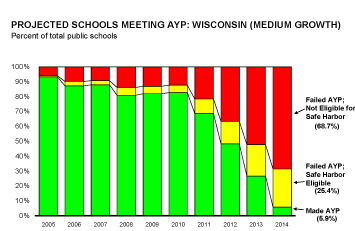
On June 24, The Department of Public Instruction will release the preliminary Adequate Yearly Progress Reports on schools and districts in Wisconsin, as required by the No Child Left Behind Act. My guess is that MMSD will have a higher number of “failing schools” this year. Think of Madison as being “ahead of the curve.”

AYP is not the best gauge of the work our district is doing; NCLB isn’t a good law and AYP is ridiculous yardstick.

If the flaws in and political manipulation behind NCLB weren’t obvious already, an interview with former Assistant Secretary for Elementary and Secondary Education Susan Neuman in the new Time magazine confirms what we already knew. Excerpts below.

There was always something slightly insane about No Child Left Behind (NCLB), the ambitious education law often described as the Bush Administration’s signature domestic achievement. For one thing, in the view of many educators, the law’s 2014 goal — which calls for all public school students in grades 4 through 8 to be achieving on grade level in reading and math — is something no educational system anywhere on earth has ever accomplished. Even more unrealistic: every kid (except for 3% with serious handicaps or other issues) is supposed to be achieving on grade level every year, climbing in lockstep up an ever more challenging ladder. This flies in the face of all sorts of research showing that children start off in different places academically and grow at different rates.

Add to the mix the fact that much of the promised funding failed to materialize and many early critics insisted that No Child Left Behind was nothing more than a cynical plan to destroy American faith in public education and open the way to vouchers and school choice.

Now a former official in Bush’s Education department is giving at least some support to that notion…

[T]here were others in the department, according to Neuman, who saw NCLB as a Trojan horse for the choice agenda — a way to expose the failure of public education and “blow it up a bit,” she says. “There were a number of people pushing hard for market forces and privatization.”

Neuman also regrets the Administration’s use of humiliation and shame as a lever for school reform. Failure to meet NCLB’s inflexible goals meant schools would be publicly labeled as failures. Neuman now sees this as a mistake: “Vilifying teachers and saying we are going to shame them was not the right approach.”

The combination of inflexibility and public humiliation for those not meeting federal goals ignited so much frustration among educators that NCLB now appears to be an irreparably damaged brand. “The problems lingered long enough and there’s so much anger that it may not be fixable,” says Neuman. While the American Federation of Teachers was once on board with the NCLB goals, she notes, the union has turned against it. “Teachers hate NCLB because they feel like they’ve been picked on.”

Is there a way out of the mess? Neuman still supports school accountability and the much-maligned annual tests mandated by the law. But she now believes that the nation has to look beyond the schoolroom, if it wishes to leave no child behind. Along with 59 other top educators, policymakers and health officials, she’s put her name to a nonpartisan document to be released on Tuesday by the Economic Policy Institute, a Washington think tank. Titled “A Broader, Bolder Approach to Education,” it lays out an expansive vision for leveling the playing field for low-income kids, one that looks toward new policies on child health and support for parents and communities. Neuman says that money she’s seen wasted on current programs should be reallocated accordingly. “Pinning all our hopes on schools will never change the odds for kids.”

The right wing attack machine turned on Scott McClellan when he belatedly told the truth. We can expect the same treatment for Neuman.

Thomas J. Mertz

1 Comment

Filed under Accountability, AMPS, Best Practices, education, finance, Gimme Some Truth, Local News, National News, nclb, No Child Left Behind, Uncategorized

The Teacher Project Film

From Public Schools Insights:

In this third and final installment of our interview, [Dave] Eggers announces his plans to create a new documentary depicting the professional lives of teachers. (You heard it here first.)

Eggers and Oscar-winning documentary filmmaker Vanessa Roth are collaborating on a film they hope will do for teaching what An Inconvenient Truth did for the environment. Featuring footage taken by teachers themselves, the film aims to offer a first-hand view of the challenges educators face every day–and to inspire greater public support for teachers’ work.

Eggers3.jpg

Eggers’ advocacy for public schools and educators took center stage at the TED (Technology, Education, Design) Conference, where “the world’s leading thinkers and doers gather to find inspiration.” (No, I wasn’t invited.) At TED, Eggers introduced Once Upon a School, a new project that shares stories about communities supporting public education and challenges adults across the country to become involved in their local public schools.

Hear Eggers describe his forthcoming documentary project and Once Upon a School in part III of Public School Insights’ exclusive interview

Hat tip to Jim Horn, Schools Matter.

Are We Better Off: Reading, Writing, and Landscaping, Mowing lawns, scrubbing bathrooms, selling stereos: How teachers make ends meet By Dave Eggers (Mother Jones).

Thomas J. Mertz

Leave a comment

Filed under "education finance", AMPS, Best Practices, Budget, Contracts, education, finance, National News, nclb, No Child Left Behind, School Finance

Talkin’ Dropouts

James Brown, “Don’t Be a Dropout.”

Lots of news about dropouts and graduation rates recently.

Education Week just published their Diplomas Count report. It is pretty alarmist. Graduation rate scholars Jim Heckman, Paul LaFontaine, Larry Mishel, and Joydeep Roy raised some issues with how Education Week counted (hat tip to eduwonkette, one of my new favorite education bloggers):

In our examination of the data and methodologies available to estimate high school graduation rates we have found that insights can be gained from household surveys and from administrative data on student enrollment and diplomas granted. However, we find the measures of graduation rates in Education Week’s Diploma Counts project, computed from diploma and enrollment data, to be exceedingly inaccurate. The main problem is the assumption that the number of students enrolled in 9th grade is the same as the number of students entering high school. This assumption artificially lowers the estimates of current graduation rates, especially for minorities who are more likely to be retained (repeat 9th grade). This measure also artificially reduces the growth of the graduation rate over time because the practice of grade retention has grown over time, again, especially among minorities.

The resulting errors are sufficiently large to artificially lower the graduation rate by 9 percentage points overall and by 14 percentage points for minorities. Grade retention also differs sharply across states and localities, distorting geographic comparisons. Last, these measures do not reflect the ultimate graduation rates of a cohort of students because the data do not capture diplomas provided by adult education and other sources than schools.

Paper from Heckman and Lafontaine, here; Paper from Mishel and Roy, here.

The Wisconsin State Journal editorialized in favor of adopting the graduation rate measure endorsed by the National Governor’s Association (NGA) as a single national standard (Leslie Anne Howard of the Dane County United Way had an op. ed., mostly in support of this position). There is much to be said in favor of national statistical standardization, but if the adopted standard is flawed, you open the door to a new set of problems. The NGA measure is largely based on the one used by Florida. Sherman Dorn notes some “troubling issues” with the Florida rate calculations:

  • The inclusion of alternatives to standard diplomas in the graduation numbers, with no public disaggregation
  • The exclusion of alleged transfers and movers from the base (creating an adjusted cohort) without any data quality checks to ensure that transfers really show up at a private school or in another state
  • The exclusion from the base (adjusted cohort) of students who drop out and immediately enroll in GED programs (as transfers to adult programs)

He also has some nice general thoughts on what to look for in graduation rate calculations here and here (lots more on his site, browse around or do a search; his posts are very accessible for those of us who are not steeped in the swamp of grad rate measures).

Information on how Wisconsin calculates dropout and completion rates. Many of the issues noted in the critiques of the various measures are present with Wisconsin’s. MMSD posted am 81.8% “regular diploma” completion rate in 2006-7, but there are great disparities among the rates for white students (90.4%), African American students (61.6%) and Hispanic students (60.8). The 2006-7 dropout rate was 2.699%, also with pronounced racial disparities (data can be accessed here).

Finally, this story in the Cap Times on Operation Fresh Start, (which has a GED component). By the way, I think this is a fine use of Wal-Mart’s money, but I still wish our legislators would get them to pay their fair share of taxes (some recent progress, but a long way to go).

Thomas J. Mertz

Leave a comment

Filed under "education finance", Accountability, AMPS, Best Practices, education, Equity, Local News, National News, nclb, No Child Left Behind, School Finance, Uncategorized

Gender inequality and the math gap

A very interesting study appearing last week in the journal “Science” relied on a test from the Programme for International Student Assessment (PISA). It assessed over 275,000 15 year old teenagers in 40 countries. One of the most fascinating conclusions of this study was that, despite the usual reported gap in math and reading scores between boys and girls, the explanation for such a discrepancy could perhaps lie not in biology but instead could have more to do with gender equality. John Timmer from Ars Technica reports:

On average, girls scored about 2 percent lower than boys on math, but nearly 7 percent higher on reading, consistent with previous test results.

The researchers, noted, however, that the math gap wasn’t consistent between countries. For example, it was nearly twice as large as the average in Turkey, while Icelandic girls outscored males by roughly 2 percent. The general pattern of these differences suggested to the authors that the performance differences correlated with the status of women. The authors of the study built a composite score that reflected the gender equality of the countries based on the World Economic Forum’s Gender Gap Index, data extracted from the World Values Surveys, measures of female political participation, and measures of the economic significance of females.

Scandinavian countries such as Norway and Sweden score very high on gender equality measures; in these nations, the gender gap on math performance is extremely small. In contrast, nations at the other end of the spectrum, such as Turkey and Korea, had the largest gender gap. The correlations between gender equality and math scores held up under a statistical test designed to catch spurious associations. The authors even checked out the possibility of genetic effects not linked to the Y chromosome by examining whether genetic similarity between various European populations could account for these differences, but they found that it could not.

The frightening thing, from a male perspective, is that a lack of gender equality also seems to be holding down girls’ reading scores. Female superiority in reading tests is slightly lower than average in Turkey, but the gap is actually wider in countries with greater equality between the sexes. In Iceland, for example, girls outscore boys by well over 10 percent.

The math gender gap thus joins a long list of differences in test scores that were once ascribed to biology, but now appear to be caused by social influences. The study, however, leaves us with yet another question of this sort: why do boys appear to read so poorly? We clearly can’t ascribe it to social inequality, but that doesn’t mean it isn’t due to some other social factor.

Robert Godfrey

Leave a comment

Filed under AMPS, Gimme Some Truth, National News

Lead exposure and more

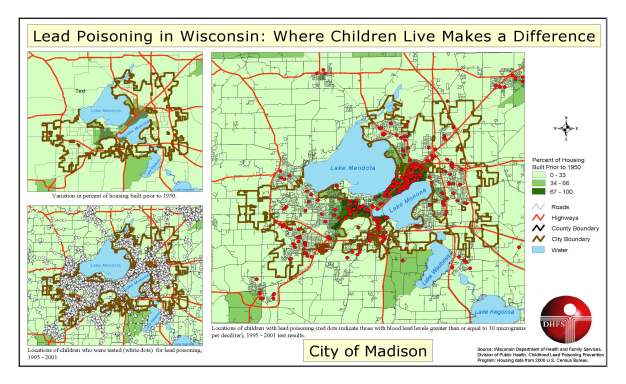
A story today in US News and World Report discusses a study published in PLoS Medicine linking early exposure to lead to later criminality.

This reminded me of all the hidden dimensions of inequality and how they relate to school success and things like disproportionate Learning, Emotional and Behavioral Disability classifications.

That thought reminded me of this video from the Educator Roundtable.

More resources on lead exposure:

Lead Safe Wisconsin

“Goodbye Old Paint,” in Affordable Housing: A Crisis for Wisconsin’s Families (a publication of WisKids Count, a project of the Wisconsin Council on Families and Children).

Thomas J. Mertz

1 Comment

Filed under AMPS, Best Practices, education, Equity, Local News, National News, nclb, No Child Left Behind