Category Archives: Referenda

More Madison Referendum Talk

Sonny Boy Williamson “Dont Start Me Talkin'” (click to listen or download)

Stories in both newspapers and on the radio and television, another presentation to the Board of Education, referendum talk everywhere.

In the State Journal Andy Hall set the table with a report over the weekend and followed up with a story on Monday. Tamara Madsen of the Cap Times had the story on Tuesday. With the exception of Johnny Winston Jr. — who Andy Hall quotes as saying ” “Gotta have it…We can’t wait for the state to help us out” — all the other Board Members seem to be playing things close to the vest (to one degree or another). I think Johnny Winston Jr, is right. The dollar figure might not be settled and the case has to be taken to the people, but as Board Members who have extensive knowledge of the the district’s finances it should be clear to one and all that some operating referendum is the right thing to do. The longer it takes them to come out and say that, the less time we all have to convince those who don’t know as much about the situation and the harder that job becomes. Let’s move beyond the “if” and get to the “how” the “how much” and the “for what.”

The Monday, August 4, 2008 Madison Board of Education meeting was mostly devoted to further presentations by Supt. Dan Nerad and Eric Kass on the past, present and future. The materials from these presentations and information on the next week’s public forums have been posted on the MMSD site under the heading “Current Financial Condition.” I’m going to highlight some of the things there.

The “Current Options to Address Fiscal Situation” is the “master narrative document,” with the others mostly expanding on things outlined there. It gives the big story, and the details are in the accompanying documents. It moves from the state finance system, to what Madison has done in the way of savings and cuts, to the possibilities of further cuts and savings and referendum options. One thing I liked is that in this document (and the one from the previous week) Supt. Nerad began with an introductory quote from the Vincent v. Voight school finance decision:

Wisconsin students have a fundamental right to an equal opportunity for a sound basic education. An equal opportunity for a sound basic education is one that will equip students for their roles as citizens and enable them to succeed economically and personally.

A not-so-subtle reminder that that school finance in this state violates the spirit and maybe the letter of the law.

The “Effects of Reduction” is a partial assessment of the impact that previous program and service cuts have had on the education of our children and the functioning of the district. More detailed budget line listings are in the Historical Budget Reductions 1993-2008 by Category and Historical Budget Reductions 1993-2008 documents. As a friend pointed out in an email to me today many “important existing and proven successful programs and personnel” have been cut over the years and that as we talk about a referendum it makes sense to look toward not only preserving what we have, but also to restoring what we have given up (I’d add expanding in new directions too). The class and a half arrangements for specials and the general loss of locally funded class size reduction is a recent cut that appears to be putting a strain on teachers and students. Three other things really jumped out at me from this document. First is the “Ready, Set Goals” conferences. Every teacher and parent I’ve talked to found these valuable and at $84,000 it seems like something we should be able to afford. The second is the loss of 32 FTE positions in Student Services and Alternative Programs (psychologists, social workers, nurses…). Last, I’d note the cuts of 157 FTE (teachers and SEAs in Special Education).

The “Effects” document also addresses the gutting of the work in Parent, Community and Race Relations. I knew this had happened, but it took going through the line-by-line histories to appreciate how the district’s once concerted effort has eroded to almost nothing.

  • 1997-98 Eliminate Parenting Classes.
  • 1997-98 Eliminate Diversity Advocacy Positions.
  • 1998-99 Eliminate Alternatives to Suspensions.
  • 2000-01 $10,000 cut to “Staff and Student Equity.”
  • 2001-02 Eliminate Two Minority Student Achievement support teachers.
  • 2001-02 Eliminate clerical position in Race Relations.
  • 2001-02 Project Bootstrap, Centro Hispano and Urban League Partnerships cut (moved to Fund 80?).
  • 2002-03 Community Partnerships Coordinator moved to Fund 80.
  • 2002-03 Parent Community Response Unit funding reduced $85,000.
  • 2004-05 Race Relations Coordinator of Parent Relations Eliminated.
  • 2004-05 .5 FTE Parent Community Relations Response Teacher cut.
  • 2005-06 Eliminate Parent Community Response Department.
  • 2006-07 Cut of $45,131 in “Race Relations – Supplies and Materials.”
  • 2006-07 Eliminate Race Relations Special Assistant Supt.
  • 2006-07 Cut $45,254 in “Minority Achievement Supplies and Materials.”

Keep in mind that this all happened at a time when our district was growing more diverse. I’m not going to defend every race or community relations program that has been cut, but I do think that this is an area where we should consider putting more resources, not fewer.

Off that soap box for now. One more item I want to highlight from the presentation materials is the “Examples of Efficiencies.” Art Rainwater used to say that the first couple of years under the revenue caps actually helped the district figure out how to do things better and these examples in areas like transportation and energy conservation show that this has continued. Supt. Nerad may find other new efficiencies, but we can’t cover the $8.2 million and growing gap through efficiencies.
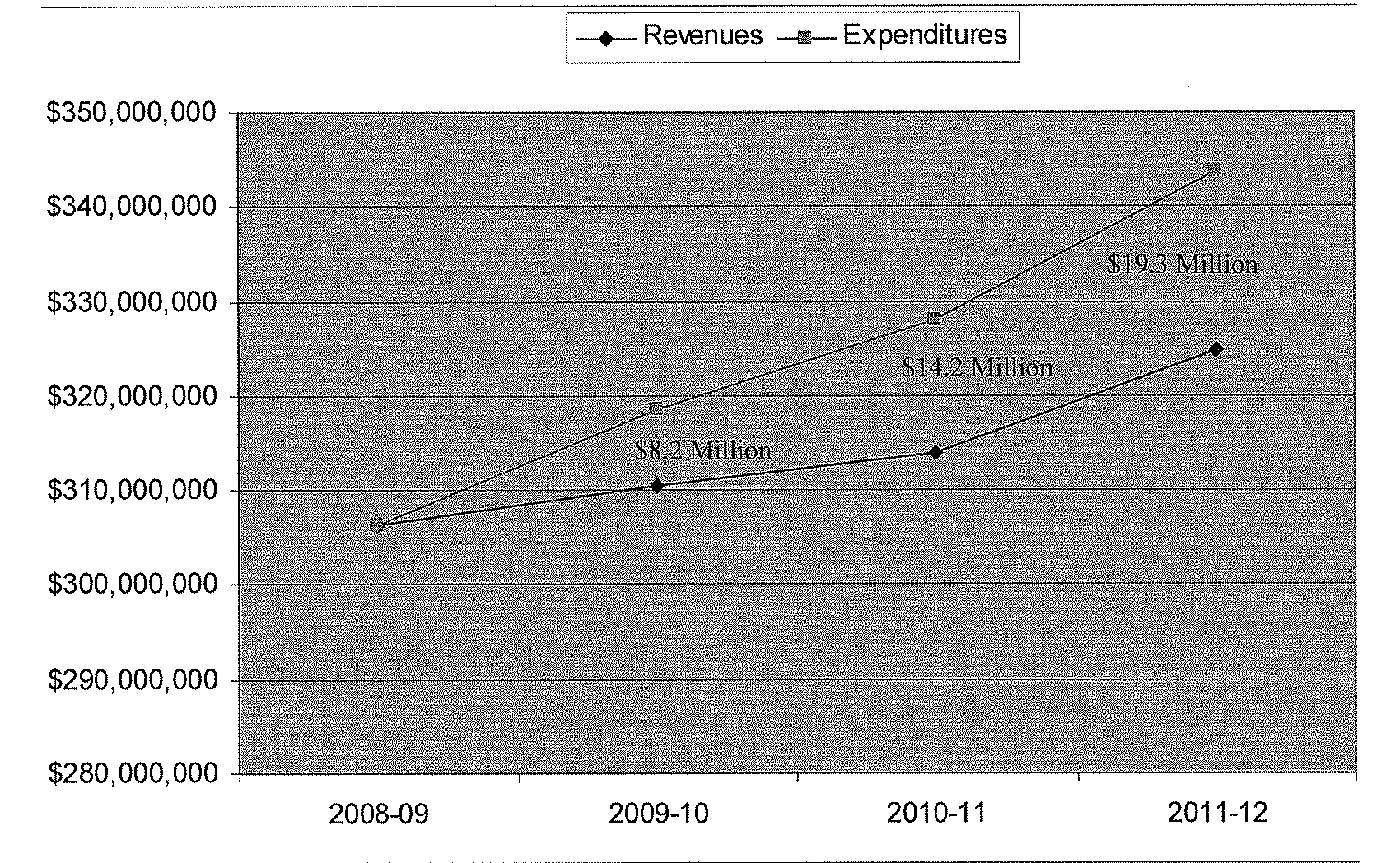
From "Current Options to Address Fiscal Situation," MMSD.

From "Current Options to Address Fiscal Situation," MMSD.

One item listed is the much maligned Lawson Software system, which according to the current figure (as revised in the “Current Options” document) has led to $700,000 in annual staffing savings. It is also worth pointing out that a December 2007 article in the American School Board Journal praised the cooperation among area districts in purchasing and implementing the system and noted that the approach taken reduced both short and long term costs. I’m no expert on business operation software for school systems, but I do know that the ASBJ is a reliable source and I trust them more than I trust our local ranting and raving radio talk show host (listen here as Lucy Mathiak does her best to get a word in).

Last word is please do contact the Board of Education and/or attend the forums (info below) and let your voice be heard.

Thomas J. Mertz

As families across our community begin preparations for the 2008-09 school year, the Board of Education is going out into the community to discuss the financial status of the district.

Two public forums are scheduled:

Tuesday, August 12 at 6 p.m. in the Warner Park Community Center, 1625 Northport Drive, and

Thursday, August 14 at 6 p.m. in the James Madison Memorial High School Auditorium, 201 S. Gammon Rd.

The forums will provide an overview of the district’s financial situation and a discussion of the Board’s options, including going to referendum this November.

The audience will be divided into small groups depending on the number of people attending. The small groups will be facilitated by members of the Management Team and a Board member will be assigned to each group. This will provide an opportunity for questions and discussion.

Key questions that will be asked each small group include:

  • Is there any additional information you need regarding the District’s financial situation?
  • What are your reactions to the options the Board is considering?
  • Are there other ideas you have to address the District’s current financial situation?
At the end of the evening, there will be a large group share-out of information from each smaller group. Notes from each group will be organized and posted on the website.

We encourage you to attend, so you are better informed about the fiscal issues confronting the school district. Please feel free to pass this information on to others.

We look forward to seeing you,

Dan Nerad Arlene Silveira

Superintendent Board of Education President

1 Comment

Filed under "education finance", AMPS, Best Practices, Budget, Local News, Referenda, referendum, School Finance, Take Action, Uncategorized

Quote of the Day – Dale Schultz on Referenda

This is State Senator Dale Schultz‘s second appearance in the AMPS Quote of the Day series.  Congratualtions.

“The No. 1 issue people talked to me about was their frustration with the referendums that ‘seem to be popping up increasingly’ in southwest Wisconsin….I think people would like to see some alternatives to the current system.”

From the Dubuque, IA Telegraph Herald

Maybe he should tell this to Frank Lasee next time the GOP gets together?

Thomas J. Mertz

Leave a comment

Filed under "education finance", AMPS, Budget, education, Elections, finance, Local News, Quote of the Day, Referenda, referendum, School Finance

“We’ve given up on dreaming” — Madison Board of Education Referendum Discussion (updated)

Paul Klee, "Dream City," 1921

Paul Klee, "Dream City," 1921

Elvis Presley, “If I Can Dream” (click to listen or download)

Update on schedule of public forums below.

The MMSD Board of Education held their first discussion of a possible referendum at their Monday, July 28, 2008 meeting. Most of the right and expected things were said (more below, video should be up here soon).

What stuck with me from the meeting was something Marj Passman said. I’ve used part of her statement as the title of this post.

“We’ve given up on dreaming…the dreams that keep you going.”

The topic was the toll that the pressures from the state school finance system has taken on our district and how a referendum might help. There was much talk at other points in the meeting of wanting to avoid both a comparative discussion of potential cuts and belaboring past cuts. Ms Passman spoke to some of this, but she did something much more important; she reminded us that endless cycles of cuts have taken away opportunities to think about and work toward the best possible public schools. It made me think of the Langston Hughes poem, “A Dream Deferred.” As Marj said, we need these dreams to keep us going.

This is important in so many ways.

Struggling to do more with less without dreams or hope is demoralizing. As teachers and staff and the administration and the Board lose track of their dreams and hope, this hopelessness is inevitably communicated to our students. That’s exactly the wrong lesson to be teaching.

As the structure and dollar amounts for a referendum discussed, I hope all keep what Ms. Passman said in mind. Some will oppose a referendum of any size and many others will look to do a referendum on the cheap, partially in anticipation of planning and restructuring that Dan Nerad is already laying the groundwork for. This is the wrong attitude. We need to give Supt. Nerad some room to work; we need to finance our schools so that not every new initiative requires scaling back some existing program; we need to be able to try to make some of our dreams a reality.

I’ve got other observations about the discussion, but first some “news.”

The biggest news is that new Asst. Superintendent for Business Services, Erik Kass, in reviewing the assumptions for budget projections, “found” a $1 million “error.” That places the 2009-10 budget gap at $8.2 million, instead of $9.2 million. Mr. Kass will be doing a complete review of the projections prior to the final decision on a referendum. As Supt. Nerad pointed out, there may be no more errors or if there are additional errors found they may lead to increases or decreases in the projected budget shortfall.

The other important news concerns the schedule for decision making. The almost unspoken assumption everyone is operating under is that there will be an operating referendum on the ballot on November 4, 2008. For that to happen, the Board needs to have referendum language to the clerk’s office by the start of September. This means a pretty tight schedule for all discussions, forums, deliberations and votes. Things may change, but here is my understanding of the next steps (with some comments).

August 4, 200 Board of Education Workshop Meeting

At this meeting I think more of the nitty-gritty of a a referendum will be discussed. This may include alternate ways to look at budget history and projections (Board members had some specific requests), a projected schedule through the November vote with some initial talk of communication planning (another Board request), recurring vs. nonrecurring and other matters of type and form, maybe a presentation of some of the potential cuts or changes if there is no referendum or if a referendum fails, the scheduling of public forums prior to a referendum vote and more.

August 11, Regular Board of Education Meeting

This looks to be a continuation and expansion of the discussions from the August 4 meeting.

Week of August 11, Public Forums

This is the tentative time set aside to hear from the public. There will likely be two forums, one on the East Side and one on the West Side. In order to be as friendly as possible, the administration is seeking to schedule these at non-MMSD sites. It was heartening to hear the Board and Supt. Nerad seeking ways to involve as many people and groups as possible.

Update:

From Board President Arlene Silveira, on the The Daily Page:

We will have 2 information/public input sessions for the community to provide feedback on our options. These are scheduled for:

* Tuesday, August 12, 6:00-8:00pm, Warner Park Community Center
* Thursday, August 14, 6:00-8:00pm, Memorial High School

The discussion of the forums also touched on what the Board does and does not want from the forums, with a general agreement that the comparative cut talk isn’t very helpful. Elected officials seeking to shape the kind of input they get from the public is a tricky issue. On one hand, it is very reasonable for them to first figure out what will be of use to them and then look at ways to get this type of information. On the other hand, on things like referenda (and maybe everything else), it is important that officials be exposed to the full and free range of opinions and ideas. Whatever attempts are made to shape this process, experience tells me that people in our district will do and say whatever they want.

August 18, Board of Education Workshop Meeting

This is probably when referendum form and language will be discussed and perhaps voted on.

August 25, Board of Education Workshop Meeting

Johnny Winston (and maybe others) anticipated the possibility that the Board may not be ready to make a final decision on August 18, that they may want more time to think and hear from constituents. If this is the case, the vote will be on August 25.

A few other observations.

The presentation of the current fiscal situation by Erick Kass and Supt. Nerad was very good. I suggest you take a look.

The timing on all this is tough. Some of this has to do with the change in the Superintendency. I think it would have been better if the discussions and public input had started months ago, maybe as long ago as last Fall. It didn’t and we have to make the best of it. The Board should also learn from this and do better in anticipating and preparing to make major decisions on things like referenda. I think that in the long run the strategic planning process that Supt. Nerad is initiating will take care of this, but there may be things that will come up before that process is far enough a long to deal with them (Leopold crowding comes to mind).

Supt. Nerad and many Board members correctly identified the state funding system as the root cause and seem committed to upping the effort to work for change.

My last thoughts are two-fold. First, I urge everyone to use the available opportunities for public input and to use them to share your dreams for the schools. Second, the (pre)campaign work has begun, contact Communities and Schools Together (CAST) to get involved.

Thomas J. Mertz

3 Comments

Filed under "education finance", AMPS, Best Practices, Budget, education, Elections, finance, Local News, Referenda, referendum, School Finance, Take Action, Uncategorized

Did Frank Lasee Tell the Truth?

Jimi Hendrix, “If 6 was 9” (click to listen or download)

In the June 10, 2008 edition of “Lasee’s Notes,” State Assembly Member Frank Lasee (Republican, 2nd district) sang the praises of our current system of keeping taxes down by starving education and requiring referenda to address the structural faults in the revenue caps. In the paragraph reproduced below, Lasee cited questionable polling data:

The school referendum system has worked reasonably well and has helped to control property taxes (click for recent news that statewide property taxes have increased 3.8% this year). There aren’t many state elected officials willing to talk about removing these revenue controls (one of WEAC, the state’s teachers union’s top priorities) or taking away these spending controls (with voter override approval). This is because they enjoy 70% approval ratings when citizens are asked. Once citizens get the right to vote, they don’t want to give it up.

I was intrigued by the 70% figure, so I wrote Rep. Lasee to ask where this number came from. Four days later (June 19), I got an email asking that I provide a home address, but promising “If I have your address, I will respond regardless of where you live.” I responded that day, with the requested information. Ten days latter, I emailed again, with my address and asking about the polling numbers. On July 18, I wrote again. I haven’t heard from Rep. Lasee or his office since the initial request for my address. It appears he doesn’t want to answer my question.

Lasee is an embarrassment — it could be that like another embarrassment to the Wisconsin political traditions, Joe McCarthy — he just makes up his numbers.

I’ve done some digging and the closest polling I can find was a news story on a survey commissioned by the Wisconsin Association of School Boards (WASB) and released in 2001. The 70% figure isn’t there, the results are full of contradictions and we have had seven more years of struggles under the state school finance system since then. Here are some highlights from the story:

  • “Nearly two-thirds of taxpayers support state-imposed limits on local school districts’ spending” (no number cited).
  • 78% of those polled said the balance of financial power should shift toward the school boards and away from state government.”
  • “Majorities of respondents also said that in almost all cases, a school board should be required to seek voters’ approval before raising spending.”
    • More money for a new building – 90% wanted a referendum.
    • More money for teacher salaries or school security – 66% wanted a referendum.
    • For athletics – 64%. For computers, desks and classroom equipment – 63%.
    • For an unexpected increase in health insurance premiums – 58%.
    • For routine maintenance or for art and music programs – 55%.
  • “Only in the case of an unexpected increase in fuel costs did a majority of those surveyed, 56%, say a school board should be able to spend more money without holding a referendum.
  • A WASB backed proposal to allow school boards [to] spend an extra $148 per student each year – about 2% of the average revenue limit statewide – without holding referendums was supported 52% or respondents at the start of the survey and when asked again at the end 59% backed the “2% solution.”

So 78% favored more local control and over 52% to 59% of the respondents favored a measure that would have allowed major increases in school funding. If the 2% solution had been enacted in 2001 (at $148 per year) and renewed, this would have meant over $24 million more in the 2008-9 MMSD budget.  Hard to spin support for a change of that magnitude as support for “the school referendum system.”

After seven years of cuts and conflict, I’d guess the numbers in favor of big and small reform have grown considerably.

Whatever changes may have happened, the only poll I can find does not back Lasee up.

I’m still waiting for an answer from Frank Lasee, but I’m not expecting one.

Thomas J. Mertz

6 Comments

Filed under "education finance", AMPS, Budget, education, Elections, finance, Gimme Some Truth, Local News, Referenda, referendum, School Finance, Uncategorized

We Are Not Alone #22 (Referendum Roundup)

It must be that time of year, or more likely the “going out of business” state finance system continuing to take its toll on districts in Wisconsin. Five more districts have placed referenda Fall ballots. That brings the total to ten by my count, eight for operation and maintenance and two to issue debt for, renovating and upgrades.

I posted before on the September 9 Colby measures, one of the debt referenda. Interestingly like Colby’s, the other debt referendum — A November 4th vote in the Clinton Community School District — also includes an attempt to move toward energy efficiency and environmentally sound practices, in this case via a Geo-Thermal heating system (Milton is also looking at Geo-Thermal). With this and the other items, Clinton is trying to plan for the future in ways that our school funding system makes nearly impossible.

The district could wait to ask residents to pay for new projects, but [Board President Randy] Gracyalny said gambling on the economy improving and prices going down isn’t a move he wants to make.

“Where will we be three years from now?” he asked. “I don’t know. No one knows. We know where we are now.

“Yeah, we might not absolutely need this, this year. But if we put it off too long, it’s going to get to that point of making some tough cuts.”

It is a smart approach and I wish them the best (more here).

In the districts seeking to pay for operations and maintenance it is the usual recipe of costs rising faster than allowed revenues, with added seasoning of declining enrollments for some.

Taking them in chronological order, Wausaukee will vote on August 19th. This is the “do or (probably) die” referendum. You can read lots more about Wausaukee in previous posts. Sadly, our local media has had nothing to say about this. Nothing. Even the Chicago Tribune picked up the story, but not our Madison newsies. The district has posted a “Fact Sheet” on the referendum and — as they have to — are moving ahead with the dissolution planning. The linked story from the Peshtigo Times is worth reading, especially the lengthy statement Board member Dave Kipp offered before voting against dissolution. Rather than excerpt that, I offer excerpts from a letter to the editor by Gert Wilson, “Retired Teacher”:

Democracy has diminished and that is sad because children learn from adults and what they see is disrespect for others’ opinions and bossy individuals who control meetings to delay or stop procedures. Of course, all people are not guilty of such actions.

We have seen this also at Coleman, Crivitz and Wausaukee in regard to education. The Times has been overwhelmed with nasty discussions, critical items in the paper and parents discussing issues in irate voices along with school boards. As usual, the students pay the price. They probably will, if Wausaukee folds and students have to ride to Crivitz. When will they eat, sleep and do school work? (emphasis added)

Amberg, a few years ago, opted to join the Wausaukee School District. Was that an error? Now it is possible these student will ride to Crivitz. Teachers, school boards and parents, are you happy about all your adult complications? I give credit to all who try to make it right.

Small towns cannot survive peaceably when all this divides friends and parents and teaches some children to rebel, be bossy, be bullies, show disrespect and have drinking problems.

You tell ’em Gert. There is also a good commentary on the Wausaukee situation from Ken Krall at NewsoftheNorth.Net.

Deerfield, Neillsville, and Montello will all vote on September 9.

Deerfield is asking for a five-year nonrecurring, with annual amounts starting at $275,000 and going to $475,000 (another version of planning for the future). Deerfield appointed a Citizens Advisory Committee last year to work on the plan and surveyed the community before proceeding. They’ve also put together a very nice web page explaining the what the referendum is about. Madison could learn some things from our neighbors fifteen miles to the East.

Neillsville has been experiencing declining enrollment at a rate of 30 or more students a year and started out as a low spending district in 1993 when the revenue caps were put in place. This is a double whammy. District spending levels are still based on what they spent over 15 years ago; because the caps are set on per member basis, declining enrollment –especially in small districts — makes it increasingly hard to cover fixed costs such as heating and transportation and almost impossible to pay for diverse offerings that larger districts take for granted. As Superintendent John Gair said: “”We’re at the point now where departments are made up of one person in some cases. If we reduce (spending) any more, we’re going to lose programs for kids.” To meet these challenges, Neilsville is asking for a five-year, $300,000 a year increase in the amount of revenue they are allowed to collect.

According to District Administrator Jeff Holmes, Montello is one year away from joining Wausaukee in dissolution (or exploring consolidation). Last September two referenda were defeated; one operating and one to borrow for things like resurfacing the parking lot and replacing air conditioning. They cut for administrators last year and have not replaced retiring teachers. This time they are going to ask for a two-year non recurring $950,000 increase in their revenue limits. If it passes, two years isn’t very long. Unless the Governor and the Legislators do something quick, they will have to go back to the voters again.

Lafarge, Mercer, Seneca, and Pittsville all have November 4 referenda scheduled.

Some may remember that in 2000 disputed ballots in the Lafarge referendum went all the way to State Supreme Court, which after years of litigation upheld “the intent of the voter” precedents and a referendum victory (unfortunately that same year the US Supreme Court threw away precedent and the Constitution and gave the Presidency to George W. Bush). This time Lafarge is one of two districts (thus far) asking for a recurring referendum, in the amount of $250,000 annually.

In Mercer they’ve reached the final year of a three-year nonrecurring referendum and the wolf is at the door. A rigged state finance system and declining enrollment are threatening to blow the house down. They also convened a Task Force, which laid out the options:

  • Approve the new referendum to keep the school open.
  • Close the school and dissolve the district.
  • Consolidate with another district.

“Dissolving” was also mentioned. They are asking for four-year, $350,000 per year revenue cap relief.

Seneca is another small enrollment, rural district with declining enrollment. I’ve described above what this does to the ability to give students the education they deserve, the Institute for Wisconsin’s Future’s Atlas of School Finance goes into more detail. They are asking for $800,000 a year on a recurring basis.

Pittsville covers 440 square miles and serves 686 students. Wrap you mind around that and you will understand that districts like this are essential (consolidate into a district that serves 1,300 students spread over 1,000 square miles?) and do not enjoy the economies that larger, more compact districts have. Because of these these issues and projected declining enrollment, the plan in Pittsville is to decrease staff even if the three-year $175,000 nonrecurring referendum passes.

These posts are a lot of work, but they are also rewarding. I learn about the districts in Wisconsin, the good they are doing, their hopes and dreams. I urge you to visit a few of the district web sites linked here; look at the pictures, read the mission statements, find things like Pittsville’s “Why enroll your child at Pittsville?” and sense the pride and dedication. You will find it rewarding too.

On most of these web sites I also see the logo for “The New Wisconsin Promise,” and wonder if the slogan “A Quality Education for Every Child” is some kind of sick joke. Our schools — even those in dire financial straits — are still doing a fine job, but how much longer can they and we hang on?

Why can’t we put in place a way of investing in our children’s future that makes those words an accurate boast? Why not Governor Doyle? Why not Senators and Assembly members? Why not?

Take the five minutes to click the links and ask them. Maybe if enough of us do, something will change.

Thomas J. Mertz

Leave a comment

Filed under "education finance", Accountability, AMPS, Best Practices, Budget, Contracts, education, Elections, finance, Gimme Some Truth, Referenda, referendum, School Finance, Take Action, Uncategorized, We Are Not Alone

Dan Nerad Talks 4-Year old Kindergarten

From WISC-TV

One thing that needs to be corrected is this: “After the first year, the state kicks in two-thirds of the funding and covers the full cost after four years.”

What happens is that the district must absorb all costs the first year, the second year and beyond the students are added to the member count (on a prorated basis, since 4-K is not full time) and figured in the three-year rolling average calculations for the revenue cap. This would mean they would be counted at 1/3 for the second year. 2/3 for the third year and fully thereafter. Like all other students in Madison, the state share of costs would be based on relative property wealth.  In Madison this translates into about 40% state funding.

I’ve been trying to track down how Green Bay managed the start up costs. No luck yet, but I’ll find out and post here.

One answer is via a referendum.

Thomas J. Mertz

Leave a comment

Filed under "education finance", AMPS, Best Practices, Budget, finance, Local News, Referenda, referendum, School Finance

We Are Not Alone #21

As Madison prepares to discuss a school operating referendum, it is important to remember that we are not alone.

In the past two years districts in Wisconsin have held over 150 operating and maintenance referenda simply to continue the quality and diversity of educational programming that they have had in the past. This isn’t because of local mismanagement; these referenda are a product of a school finance system designed to fail. The referenda aren’t about adding back things have been cut or expanding the good schools do by adding things like 4-year-old kindergarten, elementary foreign languages, more teacher training in things like differentiation or classroom management, support for college prep work for students not yet on the college track…(I could go on and on). These referenda are about not losing ground, about stopping the cuts and staunching the bleeding.

Many districts, like Madison, are simultaneously struggling with the annual cuts dictated by the state finance system and needs or desires for new schools (based on either inadequate facilities or population growth in areas without sufficient capacity). In La Crosse, this combination is reaching critical point.

In April the voters of La Crosse passed a five-year nonrecurring $4,175,000 a year operating referendum (5,701-4,993), but defeated a $35 million renovating and building referendum (5,144-5,417). The $35 million would have paid for a new school, allowed the district to close two schools and upgrade the “HVAC, safety, and security systems” in others (including new energy efficient equipment to create long term savings). Some of these upgrades were termed “urgent.”

“Urgent” needs don’t go away. Now the La Crosse district is contemplating what to do next.

On Monday July 8, 2008 the Board of Education voted 6-3 to take the “no referendum” option off the table.

President Christine Clair said the vote will keep board conversations centered on the administration’s other options, which include asking for the capital improvements sought in the April referendum, only separated into two questions, and addressing only the facility needs.

Board member Neil Drusky voted against eliminating the “no referendum” option:

He suggested closing two schools, which would take two to three boilers off line and buy the school district more time while the community gets involved. He also said he didn’t recall knowing about the boilers until the referendum process. [Ed Note: Those energy efficiency issues again.]

The administration will report back to the Board on July 21, 2008. Eight options (or combinations of options) are being analyzed:

  • Eliminate SAGE
  • Close a school
    • Most agree a school has to be closed, but there is disagreement about which one. It is estimated that closing a school would save about $410,000.
  • Close two schools
    • This would “eliminate the cost of replacing two to three boilers and other building repairs” but require “massive redrawing of elementary boundaries.”
  • Build a new North Side elementary school
    • “Consolidating Franklin Elementary School and Roosevelt Elementary/Coulee Montessori in a new building at the Franklin site would provide an improved learning environment and bring together the North Side community.” Maintenance issues at two of the district’s oldest — and neediest — buildings would go away, and staffing costs would be reduced by $410,000 or more.

  • April referendum — lite
    • “This referendum proposal for $21.5 million in capital improvements would address the same facility needs the board put forth in its April package, but without a new school. Safety and security equipment would be installed in schools, as would new heating, ventilation and air conditioning systems. Facility needs such as bathroom and locker remodeling, window replacement, kitchen expansion, and classroom, elevator and stair tower additions also would be addressed.”

  • A scaled-back referendum
    • “Some board members have deemed a few items on the facility needs list to be not as urgent as others. A $15 million facility needs referendum would address three-fourths of the total package with a reduced effect on annual property taxes”
  • Dip into fund balance
    • “Some board members have suggested the district dip into its $33 million fund balance to fix a few of the more “urgent” needs. They asked administration Monday to report back July 21 on the feasibility of using from $5 million to $10 million for repairs to reduce the amount potentially sought by referendum.” [director of business services Janet] Rosseter said in May that the money only should be used for unforeseen expenditures or revenue shortfalls, and the district’s needs — although deemed “urgent” and “necessary” — don’t rise to that level. She stood by that statement Thursday. [Ed Note: This is Ms Rosseter’s opinion and it is her job to share that opinion with the Board, but it is the elected Board’s job to make these kind of judgments. The DPI page of guidance on Fund Balances does not oppose or support districts employing Fund Balances in the manner being contemplated.]
  • Use instructional dollars
    • “School board members have said that without passing a capital referendum, instructional dollars are at stake because the budget is too tight.Without a passed building referendum, board member Connie Troyanek said, the board will be forced to close at least one school and raise class sizes because “we don’t have any money” to make the necessary repairs.”

Much to contemplate. Hard decisions, no real good options.  Without a successful referendum, Madison will face similar choices…larger classes, closed schools, programs eliminated…

A few final words from La Crosse to add to the mix:

From Board Clerk Mary Larson:

“There is so much going for this district. If we could just get our basic systems in order,” the district would be more appealing to outside families who want to take advantage of open enrollment.

I think that should be “if the state would allow us to get our basic systems in order.

From Board Member Deb Suchla who spoke of a:

“bidding war” between the school board and the community. Each time, the board comes back to voters asking for a little less money,…“That’s not … public policy, and that’s not how you do good work,” Suchla said.

Suchla is right, it isn’t how you do good work, it isn’t [good] public policy, but it is how we fund education in Wisconsin.

Governor Doyle? State Legislators? Are you paying attention?

Thomas J. Mertz

Leave a comment

Filed under "education finance", AMPS, Best Practices, Budget, education, finance, Local News, Referenda, referendum, School Finance, Take Action, Uncategorized, We Are Not Alone

Talkin’ Referendum

Tav Falco and the Unapproachable Panther Burns – “Money Talks” (click to listen or download)

On July 28th the Madison Metropolitan School District Board of Education will begin discussing a possible operating referendum. This is what Board President Arlene Silveira had to say on The Daily Page:

You will start to hear talk of a referendum in November as there is a community group starting to form in support of this action. At this point in time, the Board has not had any discussions on a future referendum. We will have a meeting on July 28 to start the discussion on this topic. The budget gap for the 09/10 school year is projected to be approximately $9.2M. Dan Nerad has our business office reviewing numbers in preparation for our discussion. IF, after our discussions and public hearing, we vote to go to referendum in November, the question(s) are due to the clerk’s office in early September. There will be an opportunity for public input. There is quite a bit of discussion that will take place in a short period of time. If you have any questions/comments, please let me know.

Arlene Silveira Madison Board of Ed

There is also a new note on the front page of the Communities and Schools Together (CAST) site:

At their July 28, 2008 meeting the Board of Education will begin discussions of a possible referendum. If they go forward, a public hearing will be scheduled followed by deliberations on the details of the referendum. The Board needs to hear from us, they need to know a referendum would have support from the community and be aware of what their constituents think is important. Attend a meeting or contact the Board at comments@madison.k12.wi.us.

We need a referendum. The school finance system in Wisconsin is creates annual budget gaps of about 2.3% between the revenue that districts are allowed to collect and what it costs to continue the same level and quality of education. Each year districts must cut programs and services. The only alternative is to hold a referendum and ask the tax-payers for the authority to collect more revenue. Without a referendum there will be about $9.2 million in cuts in the 2009-10 MMSD budget .

In 15 years under this system, Madison schools have eliminated over 600 positions (including about 25 administrators), cut programs and services, and found more efficient ways of doing things. Any further cuts will affect what we value most about our schools. Our children, our schools and our community deserve better.

If a referendum is placed on the ballot, the timeline will likely be short. Communities and Schoools Together — along with other interested groups and individuals — has begun initial pre-campaign organizing. We will need help with big and small things. To get involved, please contact us at madisoncast@sbcglobal.net.

I want to emphasize that this may happen fairly quickly. That means that if there are things you would like to see funded (or not funded) by a referendum, the time to let the Board know that is short. It also means that if you want to volunteer to help pass a referendum it would be good to contact CAST as soon as possible.

Thomas J. Mertz

Leave a comment

Filed under "education finance", AMPS, Budget, education, Elections, finance, Local News, Referenda, referendum, School Finance, Take Action, Uncategorized

No Greenbacks for Green Schools — Penny Wise and Pound Foolish

Click on the picture for a very cool interactive vesrion for the Wiscvonsin Department of Natural Resources.

Click on the image for a very cool interactive version from the Wisconsin Department of Natural Resourses.

Ray Charles, Greenback Dollar (click to listen or download).

In many, many ways the Wisconsin school finance system is-in-and-of-itself penny wise and pound foolish. Beyond the general truths that a lack of investment in the education of our children weakens our future competitiveness, depresses the earning (and taxpaying) potential of the coming generations and lead to increases in social service and criminal justice spending (see the work of The Center for Benefit-Cost Studies of Education), our school finance system also precludes many districts from making the kind of investments that in the relatively short term will create great savings. Because of endless cycle of annual same service budget cuts created by the revenue limits, districts are rarely able to look even one or two years ahead for savings to be realized. Energy efficiency is a prime example of this.

Lt. Governor Babara Lawton has spearheaded an Energy Star School Challenge initiative (MMSD has accepted this challenge). This is good program, but there are no funds attached to participation and without funds even the program’s modest goal of a 10% increase in efficiency is beyond the means of many of our cash strapped school districts.

Some districts have taken matters in their own hands and have gone to the voters with referendums to fund energy efficiency investments. In April of 2007, the voters of the Rice Lake District approved $3.88 million for an upgrade of an 1980s era system. Superintendent Paul Vine said, “We use the savings to try to maintain and support other student educational programs.” A failed boiler at Waterloo High School led to school officials to investigate an upgrade. In February of 2008, voters in the Waterloo District approved $1.5 million to replace a 50 year-old boiler that was 60% efficient with a new 98% efficient system. As a news story noted:

Without voter approval to exceed the state-imposed revenue caps, the board would have had to cut educational programs to pay for a new boiler. Revenue caps limit the amount of money a school district can raise through the property tax levy. The project is nothing the district can do within its budget officials have said.

The Colby district is going forward with a similar referendum. The current system operates at 50% efficiency, the upgrade would be 95% efficient. The financial numbers are good, in the longer term:

A district-wide upgrade of heating, ventilating and air conditioning systems would cost about $841,000, but it would pay for itself in a little more than nine years and save the district over $92,000 annually, according to the study.

Like Waterloo, Colby can’t make the investment required to realize these saving without going to referendum. meanwhile, Colby struggles to with annual same service cuts like most other districts in Wisconsin. Two failed operating referenda in 2006 have already led to the closure of a school and an early learning center, and cuts to “classes like agriculture, foreign languages, business, consumer ed, music, and art” are now being contemplated (thanks to Terri Wiersma of the Marshfield News Herald for information and a local perspective).

The Colby referendum will also seek to  refinance existing debts at a lower the interest rate. High interest rate debts and obligations, particularly those associated retirement benefits, are a growing problem for many Wisconsin districts. the inability of districts to do the fiscally responsible thing by refinancing is yet another example of the “penny wise and pound foolish” choices our school finance system creates. I’ll probably be posting more on this in the future.

Efficient word burning, like that sought by Colby, is also more sustainable than fossil based fuel consumption. A study by the Biomass Energy Resource Center concluded that:

Biomass heating in schools holds great promise to advance renewable energy policy, stabilize and reduce school heating costs, benefit the local economy, support the forest products industry, and reduce greenhouse gas emissions.

So we can add global energy and greenhouse gas issues to the growing list of benefits that our state school finance system makes it difficult to realize. While I’m at it, I want to point out that the long bus rides caused by school closures, mergers, consolidations and dissolutions forced on districts by the state finance system aren’t helping the environment or energy consumption.

Currently about eleven districts on Wisconsin are using wood heat. There is a nice report on the Barron system here. Barron saves an estimated $100,000 a year via efficient wood heating and cooling. That’s money that is instead being used to educate students.

What a great idea, too bad our state finance system puts short term property tax cuts ahead of education.

Penny wise and pound foolish.

Thomas J. Mertz

Leave a comment

Filed under "education finance", AMPS, Best Practices, Budget, education, Elections, finance, Local News, Referenda, referendum, School Finance, Uncategorized, We Are Not Alone

WAES on the Radio

Tom Beebe of the Wisconsin Alliance for Excellent Schools and John Smart of the Park Falls School Board, the Policies & Resolutions Committee of the Wisconsin Association of School Boards and the Board of Directors of the Wisconsin Alliance for Excellent Schools. were on WORT‘s “In our Back Yard” today discussing the Wausaukee situation and the sad state of school funding in Wisconsin.

Click here to listen or download.

Support community-sponsored radio on WORT.

More on the possible Wausaukee School District dissolution here, here and here.

Thomas J. Mertz

Leave a comment

Filed under "education finance", AMPS, Best Practices, Budget, education, finance, Local News, Referenda, referendum, School Finance, We Are Not Alone