Category Archives: Take Action

Joint Finance Budget Hearings

Andy Warhol, "Dollar Signs"

Andy Warhol, "Dollar Signs"

The Parliaments, “(I Just Wanna) Testify” (click to listen or download)

The public testimony phase of the Joint Committee On Finance‘s (JFC) budget process has begun.  There were official hearings last week in Sparta, West Allis and Eau Claire, as well as a listening session in Ashland. This week the committee will be in Racine on Monday, March 30;  Appleton, Wednesday April 1; and Cambridge on Friday, April 3 (click here for details).

The way it works is, first the Governor proposes a budget, then the JFC hears from agency heads and the public and proposes changes (or not), each house of the legislature takes up the options and than it is a three-way back-and forth, till there is budget that both houses agree on and the Governor signs (the Governor gets one final swipe with his now-limited partial veto).  Much of this is explained in this 2007 memo.

These hearings are the only official public opportunity for citizens to have a say in Wisconsin’s  taxing, spending and investment priorities over the next two years.

It is disappointing that the media coverage has been so minimal (see below for some of what has appeared).

Some of this is due to the reality that these hearings are largely a ritualistic dance.  Advocates make their case, legislators smile and nod and look for openings to make their points and then behind closed caucus and office doors the real work is done (Reps. Cory Mason, D-Racine, and Dean Kaufert, R-Neenah have proposed bringing party caucuses under the open meetings laws).  I still think that the hearings are important, if only to keep the voice of the public before the powerful.  The hundreds who testified last week also think it is important.

For advocates of comprehensive school finance reform, the ritual dance requires some awkward steps.  It isn’t easy to simultaneously speak to pressing need a big fix of the broken system and address what is likely to be helpful or harmful in the immediate budget process.

Most  advocates also have an interest in budget matters not directly related to comprehensive school funding reform.   So teachers such as Kelly McMahon and Abby Ryan make strong cases for the Student Achievement Guarantee  in Education (SAGE) program within the context of the general benefits of investing in education but with no direct appeal for comprehensive reform.

John Smart, a Board Member in Park Falls testifying in Ashland didn’t use any fancy terpsichorean moves, he simply reminded the committee members of the failures of our current system and the possibilities offered by the School Finance Network:

My name is John Smart – I am a member of the Park Falls School Board, the Policies & Resolutions Committee of the Wisconsin Association of School Boards [WASB], and the board of the Wisconsin Alliance for Excellent Schools [WAES].

The Park Falls and Glidden School Districts have voted to consolidate, and the new Chequamegon School District will officially come into existence on July 1st of this year. I am running for the new board as well in the April 7th election, but I don’t know how I will fare! As elected officials yourselves, you will understand that…

We hope to realize some economies of scale by consolidating, but the principle reason for doing so is to provide our students with more opportunities. We will appreciate anything that the legislature can do to assist us in this challenge. You will be seeing many more school district consolidations in the near future, so be prepared.

You are certainly aware that the costs of running an effective school district continue to rise: staff – healthcare – technology – building maintenance – and so much more. You are also aware that referenda have been increasingly unsuccessful in raising the necessary funds. Ours was. Our property-taxpayers are rebelling. The existing school funding formula does not work anymore – if it ever did – and reform is desperately needed.

The WASB and the WAES are both members of the School Finance Network, along with representatives of almost all of the stakeholders in education in Wisconsin, including the PTA. The SFN has proposed a new funding formula, which will be analyzed at a hearing of the Assembly Education Committee on April 21st, and I intend to be there as well.

I urge you to look closely at school funding. We really must do something to resolve this situation before we do damage to one of the best education establishments in the nation. Thank you for your consideration.

WEAC President Mary Bell moved with grace between the immediate and the big picture while also advocating for consideration of the School Finance Network‘s proposals.  Here are excerpts from her testimony in Sparta:

The budget proposal introduced by Gov. Jim Doyle recognizes that we must all make sacrifices in light of Wisconsin’s challenging economic conditions, but that there is no greater promise than the one we make to educate our children for the future. Investing in them reaps dividends for generations to come, and we cannot turn our backs on who we are and what we value – our children’s education. Wisconsin has great schools because the people of our state have been committed to building great schools for generations – even in times of hardship. We urge the legislature to uphold our great tradition by passing the Governor’s budget proposal with funding for schools intact.

I’d like to now speak to some of the specific features of the Governor’s budget proposal that will affect public schools and colleges in Wisconsin….

We support these funding improvements, but urge the legislature not to assume they will solve the serious funding issues of Wisconsin’s public schools. Layoffs and program cuts will still be part of the spring and summer news reports, though certainly not as deep as without this important investment. A thoughtful and comprehensive look at school funding is needed, if not with this budget, then in this legislative session. The School Finance Network proposal is, we believe, worthy of your attention as we, the citizens of Wisconsin engage in that conversation…

Many others testified on education issues, but the news reports are pretty skimpy, so it is hard to tell how they managed the dance.

WAYY reports that in West Eau Claire:

Eau Claire School Superintendent, Dr. Ron Heilmann, was one of several area administrators who spoke on the difficulties facing school districts. Heilmann says revenue limits over the past 16 years are threatening public schools across the state. Eau Claire is one of several districts considering lay-offs for teachers and other staff to cut expenses (see this on AMPS for more on cuts in Eau Claire and elsewhere).

The story on WEAU also mentions Dr. Heilmann’s testimony.

The Leader-Telegram article includes Heilmann and adds some words about others educators:

Many educators addressed the committee, saying limiting revenues as costs continue to grow has created a budgetary imbalance that threatens the quality of services schools can provide. From growing class sizes to fewer programs, schools can’t continue under the current funding system without gutting educational programs, school officials said.

“We’re not making it here, folks,” Eau Claire school board member Brent Wogahn told panel members, who were spread across the full width of the Gantner Concert Hall stage.

After years of school districts trimming budgets, Heilmann said, “The fat is gone … and (budget cuts) are impacting our students in ways that are unacceptable.”

The testimony of  Chippewa Falls School District Business Manager Chad Trowbridge, also in Eau Claire, was covered by Chppewa.com:

Trowbridge said the district had made $2.3 million in cuts since 2000, and was still facing a deficit in 2010-2011.

“We continue to do more with less and we are subjected to the same kind of inflationary pressures as everyone else,” he said.

Trowbridge warned that any state cuts from the two-thirds finding level would result in increased property taxes. He also spoke in opposition to repeal of the Qualified Economic Offer policy that limits teacher salary and benefit increases.

Finally, here is a video on the Sparta hearing  from Channel 3000, Madison.  Not much on school funding, but a great time-lapse sequence that gives the feel of the ritual dance.

As always the WisPolitics Budget Blog is a good source for updates on the budget process, including the JFC hearings (although this time around, the coverage seems a bit thin thus far).

Don’t forget that you too can learn how to do the citizen/lobbyist for school finance reform dance at the MMSD Legislative Advocacy Forum on Wednesday, April 1 at Wright Middle School.

Thomas J. Mertz

Leave a comment

Filed under "education finance", Budget, education, finance, Local News, Referenda, referendum, School Finance, Take Action, Uncategorized, We Are Not Alone

MMSD State Budget Advocacy Forum, April 1

Click on image for pdf flier.

Click on image for pdf flier to print and post.

Here are the details in plain text:

State Budget Advocacy Forum

Wednesday, April 1st, 6:00 pm

Wright Middle School LMC
1717 Fish Hatchery Road

Faced with an unprecedented $5.7 billion deficit, the state budget cuts programs all across state government. Come to the session to:

  • Learn how the state budget affects Madison Schools
  • Find out how to advocate for school resources at the Capitol
  • Learn about future prospects for comprehensive school funding reform
  • This brief session will provide you with the tools to advocate for our schools and children.

For more information about the K-12 provisions in the state budget, click here.

Thomas J. Mertz

Leave a comment

Filed under "education finance", Best Practices, Budget, education, finance, Local News, School Finance, Take Action

Dane County Board of Education Candidates

vp052a

From the Cleveland Municipal School District Visions of Democracy - Digital Gallery. Click on image for more.

April 7, 2009 will be a big day for school votes in Wisconsin.  There is the State Superintendent race (I’m backing Tony Evers, for reasons that I hope to have a chance to post on at some length), 41 school referenda in 29 school districts are on the ballot (those posts are in the works, see here for a summary of the measures) and around the state voters will elect their representatives to school boards.  The League of Women Voters of Dane County election guide has been published and posted, with answers from many of the candidates and descriptions of local referenda.

I spent some time going through the candidates answers and was struck by the combination of widespread concerns about the ability to provide necessary and desired educational opportunities under the pressures of budget constraints and by how few pointed to the broken state school finance system as the source of this ongoing situation.

The biggest exception is MMSD Board president Arlene Silveira.  This is what she wrote about the “the major issues confronting your school district, and, if elected, how will you deal with them?”

Equitable school funding system. Unless changed, all school districts will be forced to make devastating cuts detrimental to all students. I will initiate community-based advocacy efforts to work toward changing the funding. Enhancement of minority achievement efforts by improving efforts in schools to raise instruction quality; expanding availability of schooling opportunities and working with community to develop policies that enable all children to begin/attend school on a more even playing field. Ensure we are providing students with skills needed to compete in the 21st century, irrespective of their path. Continue efforts focused on redesign of our high schools. (Emphasis added.)

This is one reason I’m supporting Arlene.  Click on her name above to join me.

Her opponent, Donald Gors is more typical in his non specific reference to financial issues and lack of expressed committment to work for change at the state level:

One large looming issue facing Madison’s School District is MONEY!

True, but not very helpful.

The same is true for most other Dane County candidates who discussed the issue (many did not discuss finances at all or had almost nothing to say — these responses have not been included).  Here is what other Dane County candidates said about school finances.

CHUCK POIRIER incumbent, Deefield:

Expenditures continue to raise and outpace funding. The board and administration need to review funding formula and actual costs per student and determine if the tax payers would incur a tax savings or a tax loss by allowing transfer students from outside our community to enroll in the District.

VICTOR GONZALEZ, Edgerton:

The Edgerton School District will soon be replacing a principal and its superintendent; it will also be facing a significant decrease in its high school enrollment and will have to tackle large maintenance expenses with a tight budget.

JEFF ZIEGLER incumbent, Marshall:

Crafting a budget that meets the needs of our students and allows us to continue to improve the education we provide continues to be a significant challenge. This is especially difficult with state imposed revenue controls. The key to meeting this challenge is to make sure that all of the board’s decisions are made with the goal of providing the best educational experience that we can. The Marshall School District has done a good job of implementing needed changes and improving our educational programs during difficult economic times by keeping this key idea in mind.

Ziegler also refers to the importance of “full funding” for “”bilingual education for all children; b) music and art; c) civics; d) 4-year-old kindergarten; e) preparation for the work force.”

LEE WEINSTOCK incumbent, Marshall:

Tight budgets, academic performance and school safety are top issues facing many schools, including Marshall. I have been a good steward of the school district’s finances in my nine years on the board and will continue to make budget decisions in the interest of what is best for the success of students.

JASON McCUTCHIN, Monona Grove:

One of the major issues for this district is the budget shortage that is forecasted for the next couple of years. Because this is an issue that is likely going to be a recurring issue I would like to see the next board take a hard and fast look at this year’s deficit and see how the decisions that are made this year will affect upcoming years. Additionally, we need to be cognizant of any how any cuts will impact our building infrastructure and the quality of our children’s education.

LIONEL NORTON, Monona Grove:

As a nation we are facing tough economic times and the Monona Grove School District is not immune to this. Our biggest challenge in the next couple of years will be to prevent our district from cutting programs and activities that make our district special and from falling further into debt. I will listen without bias to all ideas and suggestions on the best way to achieve this with the least negative impact to our students and teachers. Neighborhood growth continues to be a challenge for our schools; we must proactively address this issue to prevent overcrowding at our schools.

STEVEN C. ZACH incumbent, Oregon:

Annually the Board must adopt a budget that balances the needs of students, fairly compensates employees, maintains facilities and does not burden taxpayers. We have done that during my Board tenure.

TINA HUNTER, Stoughton:

During this time of uncertain budgets and fluctuating enrollments, we need to maintain opportunities. We must find creative options to meet all District goals while also serving our students and community. School consolidations need to happen logically and painlessly. We must make wise decisions regarding staffing, transportation, and boundaries during this time of transitions.

TERRI WATKINS incumbent, Stoughton (this answer is almost as good as Arlene’s):

Increasing student achievement, recruiting and retaining quality staff and maintaining facilities are all priorities in SASD. The current state funding formula creates challenges to these priorities in districts like SASD with declining enrollment. School consolidation, bussing guideline updates, and enrollment-driven staff reductions will help in the short term. It is important to continue our collaborative work to encourage community growth, energy conservation and educate our community on school funding issues and solutions including pressure to bring legislative change that will provide more long-term financial relief. (Emphasis added.)

TERRY W. SHIMEK incumbent, Sun Prairie:

Property taxes are also an issue, especially for those on fixed income. I would support a solution for the fixed income hardship at the state level. Despite rising costs, my goal is stabilize or even reduce the property tax rate.

JOHN E. WHALEN incumbent, Sun Prairie:

The Sun Prairie Area School district has been both blessed and cursed with a rapidly growing student population. We don’t have to deal with the budget problems associated with declining enrollments, but growth has its own budget issues. Growth has required significant investment in infrastructure, and has required the District to work hard to meet the needs of our student population. I am a firm believer that all children are entitled to a quality education. If elected, I will continue to pursue all opportunities that support quality education for all students.

Two other observations.  First, it appears that incumbents are more likely to “get it” that the budget problems begin with the state system.  Second, despite the facts that about 250 referenda have been held in the last two years and about as many can be expected in the next two years, I don’t believe a single candidate directly mentioned referenda.

Don’t forget to come to the MMSD school funding forum on April 1 to learn more about state funding reform efforts and to get involved.

Thomas J. Mertz

2 Comments

Filed under "education finance", Best Practices, Budget, education, Elections, Equity, finance, Local News, Referenda, referendum, School Finance, Take Action, Uncategorized

Historian and Citizen John Hope Franklin Dies at 94

jhfportrait

Historian John Hope Franklin died on March 25, 2009 at age 94. Franklin was a consummate scholar, a pioneer in African American history, an engaged citizen and a man of great warmth.  His honors include the Presidential Medal of Freedom,  a MacArthur “Genius”  Grant, The Presidencies of both the Organization of American Historians and the American Historical Association and many more.  I had the honor being mentored by one of his former students, Betty Balanoff,  and of meeting him through Betty.

As important as Franklin’s work has been in reshaping the discipline of history by placing African American history and the history of race at the center of scholarly understandings through such works as ,The Free Negro in North Carolina, 1790-1860The Militant South, 1800-1861Reconstruction After the Civil War, and the continually revised and now standard From Slavery to Freedom ; it is his legacy as a citizen scholar and activist scholar that I want to say a little about.

Actually, I want to start by having Professor Franklin say a few words:

Those in a position to speak for the country and to outline its current mission insist that we citizens are undertaking to share with the world the blessings of a free and prosperous society and to spread democracy throughout the world. Under the most favorable circumstances, this would be a remarkable mission; and it is not too much to argue that these are not the most ideal times for such an undertaking. Before we enter upon such an ambitious mission it is well to remember that we ourselves are still in the process of becoming democratic, and it has taken us more than two hundred years to arrive at this stage.

Franklin’s scholarship is a reminder of our nation’s struggles and triumphs in the process of “becoming democratic” and of the distance that remains.  This scholarship was informed by his own struggles and his own belief in the ideals of freedom and democracy.  The scholarship was also inseparable from his work  as a citizen to move our nation toward true democracy and freedom.  History was a tool for social change.

Franklin wielded the tool of history in many arenas beyond the class and seminar rooms.  He worked with the NAACP legal team on the Brown v. Board of Education case;  he publicly and privately supported Rev. Martin Luther King, W.E.B DuBois, Rev. Jesse Jackson and others in the struggles for racial justice,  testified against the nomination of Robert Bork to the Supreme Court, served as part of the United States delegation to UNESCO and on the National Council of the Humanities, and headed One America (President Bill Clinton’s initiative on race).

The traditions of activist scholarship and scholarly activism that Franklin exemplified are in danger of being lost.  Teaching at all levels is increasingly dominated by the consumerist pressures of vocationalism and entertainment.    Scholarship is increasingly informed almost exclusively by the pressures of tenure where narrow debates within the academy matter more than contributions to furthering social justice.  In the public sphere, simplistic sound bytes take precedence over informed analysis.   Both the academy and the public sphere are poorer because of these developments.

As John Hope Franklin demonstrated, scholarship in general and history in particular have great contributions to make to advancing social justice.   I believe that his life also demontsrates that enagement with contemporary social action enriches scholarship.

On the first day of each class I teach, after covering the official scope and goals of the course, I lay the syllabus aside and confess to students that in my own head and heart, the most important goal is to use the knowledge of history to make them better and more engaged citizens.  When I do this I think of the Betty Balanoff and how her activism, scholarship and teaching advanced the legacy of John Hope Franklin and how I,  in turn am honored to advance Betty’s legacy.

Thomas J. Mertz

Some more links:

Mirror to America:  The Autobiography of John Hope Franklin video at the Library of Congress.

Mirror to America: The Autobigraphy of John Hope Franklin.

UNC-TV Biographical Conversations.

Washington Post obituary.

John Hope Franklin Collection at Duke University.

Leave a comment

Filed under Best Practices, education, National News, Take Action, Uncategorized

The Axe Keeps Falling — More Cuts and Layoffs, Trying To More With Less

From the Paul Bunyan murals by James S. Watrous at the University of Wisconsin Memorial Union.  For more information. click the image.

From the Paul Bunyan murals by James S. Watrous at the University of Wisconsin Memorial Union. For more information, click the image.

Bo Diddley, “Bo’s a Lumberjack” (click to listen or download)

As noted last week, under Wisconsin’s broken school funding system, Spring is the season for budget cuts  in districts around the state.  The latest places the axe is falling are Minocqua-Hazelhurst-Lake Tomahawk, Kaukauna, and Oshkosh.

Minocqua-Hazelhurst-Lake Tomahawk (MHLT) is a K-8 district serving 550 students spread out over 350 square miles.  It is a classic “small but necessary” district in dire need of realistic  sparsity aid as one part of an improved system of funding schools.  Governor Jim Doyle’s budget proposal cuts the already inadequate sparsity aid by 1%.

The Lakeland Times reports that the district voted to lay off two teacher, cut the employment of three others by 20%,  lay off four educational support team members and discontinue funding for outside curriculum integration with the Lakeland Union High School (LUHS).

These were obviously painful decisions.  One board member had this to say about the curriculum integration defunding:

“We’re facing decisions that you well know,” board member Billy Fried said. “We’re negotiating with teachers. We’re making cuts in staff, and it’s really hard to look them in the face and also look our taxpayers in the face when we’re kind of shrinking our own, yet maintain an outside service that a lot of us feel confident they [MHLT current staff] can do a good job.”

The probability of an operating referendum in the near future was part of the decision:

“If I had any thoughts or felt that from the administration that it would be detrimental to the students, I would do nothing [and continue the service] … I think, too, one thing to keep in mind is we are going, we know we have to go to referendum soon, and I think we need to show we’ve done every possible thing before we go to referendum,” [Board Member] Laura Ahonen said.

Administrators and others did weigh in on the issue.  Principal Rob Way “admit(ted) that it would be a challenge, but one that they could handle successfully.”  Tom Gabert, Lakeland Union High School Board Member said “The major concern with doing it internally, was that past experience has shown that when there is no money on the table, it often gets neglected.”

Combined with the layoffs and this decision means that MHLT staff will be asked to do more with less.  The newspaper simply noted that the layoff notices were given with “much regret.”

Oshkosh is a much larger district (about 10,000 students) and the layoffs are also larger.  Oshkosh has referendum votes scheduled for April 7 on a complicated mix of building. upgrades and maintenance measures.  Although one of the questions asks for operating funds, these are designated for “the costs of small additions and renovations to existing school facilities and equipment acquisition” and would have no impact on the layoffs.

According to the Oshkosh Northwestern, here is what is being done to balance the budget:

The district plans to propose a freeze on administrator salaries and reduce at least one full-time equivalent administrator, said school district Human Resources Director John Sprangers.

The list includes 36 full-time teachers and nine part-time teachers primarily from middle and high school elective courses. Music and special education departments would take the biggest hit, losing six educators each.

Last year, “The district filled a $1.4 million hole in its budget… entirely by cutting non-personnel expenses such as maintenance and department funds.”  These cuts are part of the reason that there is now a maintenance operating referendum on the ballot.  What an insane circle of robbing Peter to pay Paul and then asking for money to pay back Peter while taking back from Paul…This has to end.

WLUK-TV has more on the story:

Note that both larger class sizes and fewer options will result from the cuts.   According to the Northwestern the middle school schedule will be reconfigured  “allowing each teacher to do more,” (I’ll add “with less” because that’s what is happening, and note that the “more” is in terms of classes and students taught and the the reality in terms of quality and learning will likely be that they are doing less).

The Kaukauna layoffs were actually approved on March 9, 2009.  With so many cuts it is hard to keep up.

Kaukauna serves about 4,100 students with a staff of approximately 500 and a budget of about $52 million.  In order to meet the projected $2.9 million shortfall for 2009-10, the Board froze administrator salaries, and laid off over 10% of their teachings staff.  The projections are based on very conservative estimates of future revenue caps, but past experiences with losing students due to open enrollment and underestimates of costs have taught the Board to be conservative.  One Board member noted that the new cuts will probably lead to the loss of more students via open enrollment.

Delayed maintenance projects,  threatening safety are also a factor in the layoffs.

To avoid big cuts last year, Kaukauna closed a school and sold the administrative building.  The layoffs will mean in increase of about two students per class.  Past cuts mean that like the teachers, administrators will be doing more with less:

Board President Jeff McCabe and clerk Cindy Fallona pointed out that because of cuts, administrators have had to tack on more duties without being compensated. Among them are financial officer Bob Schafer, who is overseeing buildings and maintenance, and human resources director Mary Weber, who is serving as Park principal. Randy Hughes, special education and pupil services director, has helped with administrative duties at an elementary school. Eric Brinkmann, Haen principal, tracks student academic performance for the district.

Superintendent LLoyd McCabe correctly identified Wisconsin’s dysfunctional system of educational investment as the source of all these troubles:

McCabe is hoping state lawmakers will tackle the school funding issue to relieve pressure on districts.

“I think that there’s pretty good agreement that state funding has to be revised and the problem that the state has is that they don’t have the money to do anything about it,” he said.

“Wisconsin schools cannot continue to produce students who rank at the very top of the nation with the funding structure that exists today.”

This leads directly to my “join the fight” plea.

If we don’t put/keep the pressure on, nothing will happen except more cuts, more referendum fights, more kids not getting the education they need and deserve, fewer kids reaching adulthood with the tools to be successful…we all need to get and be active.

Use your own experiences to write your own letters to the editor:

Contact the Governor, your Senators and Representatives.  Make them keep their promises (for more as-yet-unmet promises from Governor Doyle, see here and here).

Don’t forget the April 1, 2009 MMSD “Legislative Informational Community Session” and the April 21 Assembly hearing on the School Finance Network (SFN) plan (details on both, here).

Connect with activists around the state and support real change by joining the Wisconsin Alliance for Excellent Schools.  Keep up-to-date with SFN by signing on as a School Finance Network supporter.

Talk to your friends, neighbors, co-workers…spread the word.

Thomas J. Mertz

Leave a comment

Filed under "education finance", Best Practices, Budget, education, Equity, finance, Local News, Referenda, referendum, School Finance, Take Action, Uncategorized, We Are Not Alone

WAES School-Funding Reform Update, Week of March 23, 2009

waesgraphic

Table of Contents below.  Click here for the entire update and click on linked items for related stories on AMPS.

For more information, check out the Wisconsin Alliance for Excellent Schools web site.

Thomas J. Mertz

Leave a comment

Filed under "education finance", Budget, education, finance, Local News, Referenda, referendum, School Finance, Take Action, Uncategorized, We Are Not Alone

The Axe Is Falling — School Layoffs, Closures and Cuts

Paul Gauguin "The Man with an Axe"

Paul Gauguin "The Man with an Axe"

All over Wisconsin — in districts where referenda failed, in districts where referenda weren’t tried and maybe in some districts where referenda passed — the axe is falling, teachers and programs are being cut and the “New Wisconsin Promise” of  “A Quality Education for Every Child” is sounding more like a cruel joke every day.  As long as Wisconsin’s politicians lack the courage to fix our broken school finance system with the  structural gap between allowed revenues and mandated costs, the annual Spring chopping ritual will continue.

If you know the story already and don’t need the latest details, skip to the bottom for ways to take action and make reform happen.

Appleton, where two referenda failed in February has eliminated 44 teaching positions, the equivalent of 31 full time teachers.  Here is what it will look like in the classrooms according to district financial officer Don Hietpas:

“We’re staffing the high schools this year at 28-to-1 (student-to-teacher ratio). We are staffing the elementary school at one per class than we did last year, so it’s 27-to-1. So the average class size is going up at all levels, except for K-3, which is an area we continue to protect.”

Board President Sharon Fenlon noted an unintended consequence that will have long term implications for districts and the teaching profession:

“It’s very tough,…especially because the layoff is in order of seniority. Many of the people laid-off are quite new to the profession and people we would like to encourage to stay in the profession, and to have to lay them off is very painful.”

Teachers aren’t the only thing on the chopping block in Appleton:

“We’re cutting capital projects, we’re cutting technology, we’re cutting other areas besides classroom teachers, secretaries, para-professionals, administrators, so the reductions will be across the board,” Hietpas said.

Appleton is often held up as the poster district for charter schools in Wisconsin, but all the charters in the world can’t stop the budget cuts when the school funding system is broken.

Eau Claire hasn’t tried a referendum since 2007 and hasn’t passed one since 1999.  After the defeat in 2007 they closed the “Little Red School” and continued with the steady cuts in othe areas.  This year the structural budget gap is about $4.1 million (from a budget of  about $105 million) and things look to be particularly bad.  SAGE has been cut back, athletic directors are gone, salary freezes are being floated and still more cuts will be needed. WEAU News has the list of things being considered:

–10 high school teachers. That would save the district $650,000.

–2 elementary art teachers (while cutting art time from 60 minutes to 45 minutes a week). That would save $124,000.

–15 elementary school support staff or assistants, saving $600,000.
–5 middle school support staff, saving $205,000.
–10 high school support staff, saving $410,000.
–4.5 central office support staff, saving $184,500.

–1.1 library media specialists. That would save $68,700.

–5 custodians, saving $310,000.
–1 senior maintenance position, saving $62,000.

–A vacant staff development/assessment coordinator position, saving $105,200.

Other options to save money include:

–Eliminating custodial overtime on the weekends. It would save the district $35,500, but could mean the cancellation of weekend athletics, music and theatre.

–Reducing elementary art, music, PE, and special ed PE program specialists. That would not cut teacher jobs, but eliminate positions above and beyond their daily duties. It would save the district $39,200.

–Discontinuing Spanish classes in elementary schools because grant funding is no longer available. That would equal a savings of $13,000.

Also on the table is “cutting the number of teams for certain high school sports. ”

As the Board struggles  “”to reduce the programs that have the least impact on the kids,” the head of the local teacher’s union points the finger where it belongs — our state elected officials:

“This problem isn’t going to go away. We’re going to have the same problem next year. We’re going to have it the following year until we really change the way schools are funded in the state of Wisconsin,” says Ron Martin, president of the Eau Claire Association of Educators.

And here from an earlier story:

But Martin says the school district and the school board really aren’t to blame. He says the revenue caps and funding at the state level are the major reason for the budget issues.

“It’s stifling us and in Eau Claire’s situation, it’s killing us.”

Pretty bleak assessment, but absolutely correct.

Waupun is another district that lost referenda votes in February.  Since 1996, eight operating referenda have failed in Waupun.  They’ve gotten used to cuts, but this time in addittion to eliminating 30 positions (30 positions!), it means closing schools.  Nothing divides a district like school closures.  To make matters worse, the schools slated for closure are not in Waupun proper, but in Alto and Fox Lake.  At the March 16, 2009 Board meeting, Fox Lake’s Mayor made a formal request to detach from the district.  The request had not been properly filed, but the Board went on record denying it anyway.  Fox Residents are still exploring options:

Kim Derleth, a member of the Concerned Area Residents for Education (CARE), said the Fox Lake-based organization will hold a special listening session at 6:30 p.m. today (Tuesday) in the Fox Lake Community Center to discuss area residents’ options.

Derleth said the intent of the session is to hear the viewpoints of the public to determine a course of action following Monday night’s “no” vote. One of the options the group has discussed is exploring secession from the Waupun Area School District.

It looks like this controversy won’t go away soon.

In Neneeh they are in the last year of a non recurring referendum and it appears that like Madison last  Novemeber, they asked for less than is needed to meet the structural gaps. In Neneeh’s case, the third year’s over the caps revenue authorization was $1.4 less than the first year’s and $1.2 less than the secon year’s.  It appears they also chose to fund a fiber optic netweork from operating funds.   Through the combination of factors, primary among them a state school fiannce system that is built on annual cuts and doesn’t allow for capital investments without referenda, Neneeh is facing about a $1 million shortfall in an $84.3 million projected budget for 2009-10.

The proposed solution, cut teaching positions:

Under the plan, Neenah would employ the equivalent of 447.5 teachers, compared with 458 teachers this year.

The staffing plan would cut 8.8 positions at the high school and 4.3 positions at the middle schools. It would result in no change at the elementary schools and slight increases in instructional support services (0.2 position) and contingency staffing (0.4 position).

“Staffing plan” may sound better than “cutting teachers,” but whatever the terminology there will be fewer class choices, larger classes (up to 30 students), less individual attention and a decline in educational opportunities.

Merrill and I am sure others have already started their cuts; Janesville and I am sure others are starting to work on theirs.   30 districts are holding referenda in April (the 29 detailed here, plus Salem), some won’t pass.  Sadly, more to come.

Now for the “do something” soapbox boilerplate.  If we don’t put/keep the pressure on, nothing will happen except more cuts, more referendum fights, more kids not getting the education they need and deserve, fewer kids reaching adulthood with the tools to be successful…we all need to get and be active.

Maya Cole’s recent op ed hit the right notes.  Pass it around.  Write your own letters to the editor:

Contact the Governor, your Senators and Representatives.  Make them keep their promises (for more as-yet-unmet promises from Governor Doyle, see here and here).

Don’t forget the April 1, 2009 MMSD “Legislative Informational Community Session” and the April 21 Assembly hearing on the School Finance Network (SFN) plan (details on both, here).

Connect with activists around the state and support real change by joining the Wisconsin Alliance for Excellent Schools.  Keep up-to-date with SFN by signing on as a School Finance Network supporter.

Talk to your friends, neighbors, co-workers…spread the word.

Thomas J. Mertz

Leave a comment

Filed under "education finance", Accountability, Budget, education, Equity, finance, Local News, Referenda, referendum, School Finance, Take Action, Uncategorized, We Are Not Alone

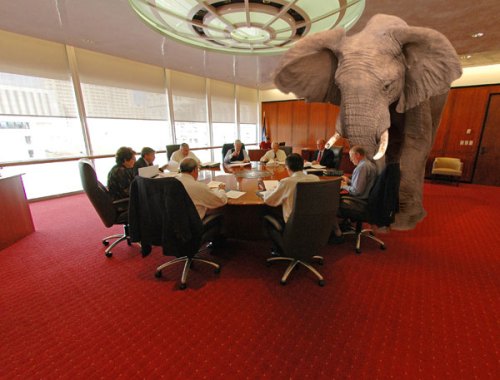
Elephant in the Room

elephant-in-the-room

Maya Cole, Madison School Board member, wrote an op-ed for the Cap Times that provided an excellent piece of analysis on the current state of play at the Capital; the tired old dance routine between the governor and the legislature over how to finance our schools. But this budget season, the sound track has been suddenly revved up due to the stimulus money on the horizon.

The predictable talk of paying for education plays to the citizenry. Don’t raise taxes and do more with less — it’s the same old dichotomy. Lately there’s new irony, as suggested by Gov. Jim Doyle, that school boards should go to the table with “more creative ways” to bargain and without the QEO (qualified economic offer).

As Cole rightly pointed out, this “more with less” canard is trotted out in other guises such as a “creative teacher compensation package.” This meme of, “get more creative,” is meant to be compensation for the often referred to “three legged stool” of the Wisconsin school finance system: 2/3 funding from state revenues (1/3 from local and federal sources), the QEO to limit teacher contract costs and the revenue caps to limit local property taxes. She also astutely noted that the current system originated as a short term plan 16 years ago, and asks, when will it be revised?

Several years hence, the elephant in the room (school finance reform) stands on stage taunting school boards across the state. The Wisconsin Association of School Boards, a member of the coalition of the School Finance Network, has one approach — it’s not in the script this year. We are asked by the governor to accept a watered down plan and continue to be mired in the same old strategies.

What really should keep lawmakers up at night is the dependent nature of these one time (maybe two) short term “fixes,” a “solution” in which Doyle hopes that school districts will remain under the revenue caps while spending federal dollars (TJ Mertz investigated the Legislative Fiscal Bureau’s newest numbers here). Cole instead called for a clear departure from the current process of having property owners paying the lion’s share of the costs for schools.

We must be bold and put our spending and revenue practices on the table. Districts across the state have been cutting budgets for over 10 years. Property owners have shouldered the costs to pay for schools. When we add in the confluence of federal mandates (unfunded), demographic shifts, and the dwindling manufacturing in the state, it’s clear we’re in the third act.

Doyle should take his own advice. A budget dependent on one-time federal money for education and transfers to plug holes in budget gaps is shortsighted at best

The Assembly Education Committee will hold a hearing on Tuesday, April 21 1:00 PM at Room 413 North in the Capitol to discuss the School Finance Network education funding reform proposal.

Don’t forget too that on Wednesday April 1, 2009, 6:00 PM at Wright Middle School — the Madison School District will be hosting a “Legislative Informational Community Session” to “provide updates on school funding and state budget issues that affect the MMSD” and “discuss and share strategies on how the community can get involved in advocating for our schools.” More information on the MMSD Legislative Agenda can be found here.

Robert Godfrey

Leave a comment

Filed under "education finance", Accountability, AMPS, Budget, finance, Gimme Some Truth, Pope-Roberts/Breske Resolution, School Finance, Take Action

Governor’s Budget Numbers from the Legislative Fiscal Bureau

Jasper Johns, Numbers in Color

Jasper Johns, Numbers in Color

The Legislative Fiscal Bureau has released their analysis of the Governor Jim Doyle’s Budget proposal.  The  Department of Public Instruction/Schools section is here.  I haven’t had time yet to go through all of it, but here are a few excerpts and fewer comments.

Using the definition of partial school revenues as it existed prior to the repeal of the two thirds funding commitment and including the proposed federal general aid funding, the administration estimates that state support of partial school revenues would decrease from 65.8% in 2008-09 to between 63.8% and 65.1% in 2009-10 and to between 62.0% and 63.2% in 2010-11. The low end of the ranges identified by DOA assumes school districts levy to the maximum allowed under revenue limits, while the high end of the range assumes that school districts use all of the increase in their federal Title I and Individuals with Disabilities Education Act (IDEA) funding to reduce their levies. All of these DOA estimates assume the current law revenue limit per pupil adjustment (estimated by DOA to be $277 in 2009-10 and $286 in 2010- 11), the proposed revenue limit modifications, and the state support funding in the bill, which is presented in Table 1 (emphasis added).

Not only is one time revenue being used for ongoing expenses (which may be acceptable in these economic circumstance), but all this revenue is being used to offset state funds.  When combined with the “current law” revenue cap increases estimated at $277 and $286 per member for the two years, this shifts the burden to local property taxpayers in significant ways.

However things go down, the state will move further from the 2/3 support concept and consequently the local property tax portion of school revenues will be increasing at a faster rate than the state portion (unless districts don’t tax to the limit, but that has some bad effects in subsequent years).    I am still confused about the Governor’s and the LFB thoughts on IDEA and Title I, which appear to be at least partially contrary to the “supplement not supplant” provisions. I do know that there is lobbying going on from many quarters to expand the loopholes and allow more of the stimulus money to be used to fund existing, not expanded programs and services.

There are also some positives.  Revenue cap increases are included at past levels, school safety, nurses and transportation are eased; the low revenue ceiling is raised, Special Education isn’t actually cut, SAGE and 4 K are given increases, albeit insufficient ones.  It could be worse.

In other areas across the board 1% reductions are called for.  This will tough to deal with, but Title I and IDEA stimulus money may fill some gaps.  See this chart:

Click on image for pdf of page.

Click on image for pdf of page.

This brings me to the Qualified Economic Offer (QEO).

The Governor has again called for the elimination of the QEO.  With the Democrats in control of both houses, this may well be one of the few educational promises they keep.  I’m philosophically opposed to the QEO, but I’m philosophically opposed to the revenue caps also and to lift the QEO in absence of comprehensive school finance reform is a recipe for disaster.

Comprehensive reform is what we need.  The School Finance Network plan looks like the best shot at making this happen in ways that positive ways.  read the proposal, sign on as a supporter and attend the April 21 hearing.

I know that this biennial budget could have been much worse for education in Wisconsin and I am grateful that the “death by 1,000 cuts” status quo was not expanded to “death by 2,000 cuts, or 3.000 cuts…”

I also know that there are a multitude of revenue options that have not been proposed (see the Institute for Wisconsin’s Future (IWF) and the Wisconsin Council on Children and Families (WCCF) Catalog of Tax Reform Options for Wisconsin). Mostly I know that for 15 years education has been eroding in our state because of a broken system that privileges property tax control over education, that “it could of been worse” means little to a student whose educational opportunities are limited by inadequate investments and I know that in two years the stimulus money will be gone and if our state elected officials (they need to earn the term “leaders”) don’t act now to put in place a system of school funding that works for all of Wisconsin’s students things will be much worse than any of us want to imagine.

Thomas J. Mertz

2 Comments

Filed under "education finance", Best Practices, Budget, education, Equity, finance, Local News, School Finance, Take Action, Uncategorized

Quote of the Day — Promises to Keep

logo_dpw_whiteonblue

From the 2008 Platform of the Democratic Party of Wisconsin:

Education, Labor, and Economics

Quality public education for all is critical to a healthy democracy and economy. Public funding for private schools diverts resources from and adversely impacts public schools. Increased governmental funding and financial aid is essential for all levels of public education. Nobody should be denied a quality education because of a personal lack of financial resources. The benefits of a quality education always outweigh the costs.

We believe that students have the right to receive their education in a safe, respectful, and nurturing environment, free from harassment or discrimination by teachers, staff, parents, or other students. We support fair and equitable funding for all elements of the curriculum, including art, music and physical education. A strong Wisconsin public education system builds a strong Wisconsin.

Wisconsin‘s current educational funding system has failed. The law allowing a limited qualified economic offer has caused diminishing compensation for teachers. Teacher compensation must keep pace with costs of benefits and inflation. Public school teachers must not be taken for granted. They deserve tremendous respect for their work educating our youth under challenging circumstances.

Revenue caps on school districts and other local governments must be eliminated. State or federal governments must fully fund their mandates (emphasis added).

The Democratic Party now controls the Assembly, the Senate and the Governor’s office in Wisconsin.  Time to keep the promises they made in order to gain that control.

Thomas J. Mertz

Leave a comment

Filed under "education finance", Accountability, Budget, education, Elections, finance, Gimme Some Truth, Local News, Quote of the Day, School Finance, Take Action