Category Archives: Take Action

Moneyball

1969 Chicago Cubs, “Pennant Fever” (click to listen or download)

Willie Sutton supposedly once replied to the question, “Why do you rob banks?” with the answer “Because that’s where the money is.”

In his protests against the broken state school finance system in his state, the Illinois State Senator, Rev. James Meeks has shown a similar shrewdness.  The first week of school he led Chicago school children to the rich suburbs to register for school; he went where the money was and the reporters and cameras followed.  Now he has planned a protest outside the first playoff game at Wrigley Field (and here).  Good for him!

I’m sure tickets are going for thousands of dollars, I know that a beer costs $6.00 at Wrigley.  While the “haves” and others enjoy their good fortunes of having the opportunity to enjoy October baseball, it is a good thing that they be reminded that many of our children don’t have decent educational opportunities.

For more information on school finance in Illinois, see this page (and links) from the Access Network.  Like Wisconsin, they have a broken school finance system.  Illinois is also home to a very creative school finance advocacy organization, A+ Illinois.

For our readers in the Milwaukee area, the first home Brewers’ playoff game is Saturday at 5:30 PM.  Not to late to get a protest together.

And for any who care, I am a St. Louis Cardinals fan who spent a good deal of my youth and young adult years regularly attending games at Wrigley.  This post-season, I’m rooting for (in order) the Brewers, the Cubs and the White Sox.

Thomas J. Mertz

Leave a comment

Filed under "education finance", AMPS, Budget, education, finance, National News, School Finance, Take Action

Quotes of the Day – Broken System, Broken Record Edition (#1)

John Hartford, “Dont leave your records in the  sun” (click to listen or download)

Last week, Milwaukee Superintendent William Andrekopoulos strung together the words “State, “Finance,” “Schools,” “System,” and “Broken.” At AMPS, we’ve strung those words together in a variety of ways ourselves or quoted others using these words on more than one occasion.

It thought it might be fun to see who else has said this or similar things about school finance in Wisconsin, who else has given voice to the truth that in Wisconsin, the school finance system is broken.

Here we go, not comprehensive and in no particular order.

We need to do a better job of looking out for taxpayers, and we will. It means making work pay, by encouraging and fostering economic development that pays family-supporting wages and respects the environment. It means ensuring healthy communities, through public health programs and a new, more powerful and consumer-friendly, organization of how we buy prescription drugs and health insurance. It means fixing our broken system of school funding, and making an ironclad guarantee to every Wisconsin child that this state will give you a good start in life a quality education that enables you to succeed in tomorrow’s economy.

Governor Jim Doyle, 2002 victory speech.

The school finance system is broken and needs to be fixed or the quality of public education will suffer significantly.

Cooperative Education Service Agency #3, “Can Wisconsin avoid an educational crisis?” 2007.

Everyone agrees that the school funding system is broken.

Wisdom, “Education Position Paper,” 2007.

Wisconsin’s school-funding system is broken, it needs to be thrown out, and the Legislature needs to come up with a better plan…

Wisconsin PTA, 2007.

First, it’s clear that the school funding system is broken at the state level. I encourage you to join me in calling upon Governor Doyle and our state legislators to fix this broken system that every year forces school boards around the state to cut budgets.

Madison District 12 Alder, Satya Rhodes-Conway, 2007.

Wisconsin’s K-12 education funding system is definitely broken. After 15 years of living under revenue caps and a funding formula that leave school districts with an approximate 1% deficit every year, our schools are increasingly finding themselves having to cut programs and staff. This is especially true in our rural schools where declining enrollment is an issue.

47th Assembly District Candidate, Trish O’Neil, 2008.

The Oshkosh school system isn’t broken; the state funding formula is. I disagree that we have to “fix” our school system because of the budget problems the funding formula creates. Until the state changes the formula, we should ask through an annual referendum to exceed the state budget caps.

Oshkosh Board of Education Member, John Lemberger, 2008.

The current system of funding public education in Wisconsin is broken.

Milwaukee Board of School Directors President, Peter Blewett, 2008.

The school funding system is broken and it was created broken.

Professor Emeritus, Economics,  University of Wisconsin-Platteville, John Simonson.

Partners in WAES believe that Wisconsin’s school-funding system is broken beyond repair and should be linked to the needs of children, giving each of them—no matter where he or she lives—the opportunity to meet rigorous academic goals.

Wisconsin Alliance for Excellent Schools, 2004

School Funding is Broken

  • Mandates, needs and costs continue to grow faster than allowed revenues.
  • Annual service and program cuts of 1-2% over the last 14 years.
  • Over 100 districts in Wisconsin have held referenda in the last year.
  • After 14 years of cutting, essential services are in danger.

Community and Schools Together (CAST), Madison, 2007.

The system is broken. We’ll have to raise taxes.

Superior parent and school board member Kris Kintop, 2003.

We want to be clear that we are painfully aware of the broken system of funding public education in Wisconsin,

Madison Board of Education Member, Lucy Mathiak, 2007.

Wisconsin has conducted several studies on how we can fix the funding of our education system. Isn’t it time that the governor and Legislature start looking at those recommendations and consider other ideas instead of foolishly tinkering with the same old broken system?

Dave Zweifel, the Capital Times, 2007.

The school finance system is broken and needs to be fixed or the quality of public education will suffer significantly.

Dean Isaacson, Platteville School District Administrator, 2008.

Wisconsin is extremely fortunate to have one of the best public education systems in the country. But our school funding system is badly broken, and we are headed in the wrong direction. School districts throughout the state are cutting programs and staff and closing schools. Children have returned to school this fall to find fewer academic choices and larger class sizes.

If we are going to jump-start our economy, we need to find a better way to provide schools with resources to meet the needs of children so we can be assured that we are turning out future workers who can help our state’s businesses thrive.

Dan Burkhalter, Executive Director of the Wisconsin Education Association Council, 2007.

The state school finance system is “broken.

Pete Etter, interim superintendent, Black Hawk School District, 2007.

To be continued.

Thomas J. Mertz

Leave a comment

Filed under "education finance", AMPS, Best Practices, Budget, education, finance, Local News, Quote of the Day, Referenda, referendum, School Finance, Take Action, Uncategorized

Smart, Caring Students, Working for Good

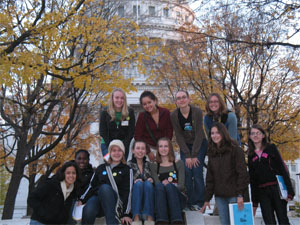
Madison SOS Teen Leaders at the State Capitol

Madison SOS Teen Leaders at the State Capitol (note: SOS is not the group working on the school referendum, but another group working for good in different ways)

Among the items in the MMSD Philosophy of Education is this call for students to be given the tools to engage historical, political and social knowledge to create a “faith in our future:”

To develop faith in our future by understanding and appreciating the history and geography of our nation and our world and their social and political systems.

It doesn’t say anything about working to create that better future, but this story — by Tamara Madsen in the Capital Times on students working on behalf of the Novemember 4 school referendum —  shows that at least some of  our students have grasped the truth that they can and must take active roles in making their community and futures better.

Madison high school students get organized, push referendum

Officials at La Follette were forced to drop the Italian language program from the curriculum for the 2008-09 school year, and students had to scramble to restructure their class schedules.

Stroup said elimination of the courses put many seniors like her in a tough situation when thinking ahead to college.

“Their schedules are messed up now because colleges want you to have four years of the same foreign language, and they’ve had to switch to French and Spanish, and it’s thrown things off for them,” Stroup said.

She is part of a group of Madison Metropolitan School District students intent on bolstering community approval for the school referendum so deeper budget cuts won’t have to be made going forward. Leaders of the group hope to have some two dozen students getting out the word about voting “yes” on Nov. 4.

Voters will be asked if they want to let the school district exceed its revenue limits by $5 million during the 2009-10 school year, then by an additional $4 million in each of the following two years. After that, the higher limits would be permanent. The referendum would add $27.50 onto the tax rate of a $250,000 home in the first year, district officials say, but accounting changes would decrease taxes for homeowners in the second and third years.

The district faces an $8.1 million hole in the budget for the 2009-10 school year, $4.4 million for 2010-11 and $4.3 million for 2011-12.

Stroup, a senior and president of La Follette’s Student Athlete Advisory Council, was one of eight students from Madison’s five high schools who met with Superintendent Dan Nerad more than three weeks ago to learn more about the referendum.

Stroup said she came away with a greater understanding of many issues, including the fact that the money being asked for by the district will be used just to continue current programs.

Nerad has already laid out a plan for program and service cuts in the 2009-2010 budget if voters do not pass the referendum. Those include increasing class sizes at elementary and high schools, trimming services for at-risk students, reducing high school support staff, decreasing special education staffing and eliminating some maintenance projects.

Even if the referendum does pass, the $5 million the district would get the first year still would not cover the $8.1 million gap and would force some budget trimming.

“I really want people to understand that this referendum is just to get by; it’s just to help sustain,” Stroup said. “If the referendum doesn’t pass, there’s going to have to be a lot of cuts.

“People think these cuts are insignificant, but they can affect students greatly. The highlight of a student’s day could be going to chess club or forensics, but cutting one of these programs could devastate them.”

The meeting with Nerad was organized by Natalia Thompson, a West High School senior who runs Madison SOS (Speak Out, Sister!), a nonprofit group that seeks to engage high school girls in grassroots activism.

Although she’s not old enough to vote, Thompson, 17, was one of two West students who took time earlier this month to make a public appearance at a Madison School Board meeting to explain why she is in favor of the referendum.

When school started this month, Thompson was disappointed that the writing lab at West was closed due to staff cuts. A federal grant will lead to its reopening in the near future, but other programs are under pressure as well, like West’s Fine Arts Week. The annual event, which takes place in May and has art, drama and dance elements, will not include one-act performances this year because of staff cuts.

Getting the chance to sit down with Nerad and learn more about school finance issues influenced Thompson to act.

“I do really see this as sort of one of the biggest social justice and political issues facing my generation — access to affordable, quality education — and I am seeing through my work in the community how important the schools are,” Thompson said.

She will work with the pro-referendum group Community and Schools Together leading up to the election by writing campaign literature, opinion pieces for news outlets and handing out literature in neighborhoods. She hopes at least 20 to 30 students will join her.

In an effort to collect even more student support, she also created a Facebook page titled “High School Students for the Referendum” that has 60 members.

To do her part, Stroup plans on handing out campaign literature and working on a short speech to give during announcements at La Follette.

Thompson said she’s been pleased with student responses to assist in getting the word out.

“With every student I’ve talked to about it, as soon as I explain what this is — what’s going on, why we need students to get involved — there’s no question it’s something they want to support,” Thompson said. “We’ve been faced with budget cuts since we’ve been in kindergarten.”

Since a state-imposed revenue formula was implemented in 1993 to control property taxes, the school district’s overall budgets have continued to rise due to annual increases in salaries and fixed costs like transportation, but it has had to cut $60 million worth of programs, staffing and services.

District officials are planning sessions at the five area high schools to offer information on the referendum, though they cannot collaborate directly with any advocacy efforts.

Nerad, though, said he will continue to cultivate lines of communication with students by becoming actively involved in the Student Senate and scheduling lunches at schools to establish dialogue.

“I believe we have a mission-based responsibility to ensure that we’re developing in students the skills of civic responsibility, and how to engage around important civic and social issues,” Nerad said. “I believe that part of my role and our role is that we have to model that by ensuring students do have a voice on issues that affect them.”

He said student engagement has always been one of his priorities in his job as superintendent, and he’s been pleased to see students’ interest in the referendum issue. “I think it’s very heartening to see, and it’s less about them and more about students that will follow them.”

tmadsen@madison.com

On a personal note, I’ve had the pleasure of working a little with Natalia and others and I want to tell them what a pleasure it has been and how much their contributions are valued.

Thomas J. Mertz
Leave a comment

Filed under "education finance", AMPS, Best Practices, Budget, education, Elections, finance, Local News, Referenda, referendum, School Finance, Take Action, Uncategorized

Mad City GRUMPS Are Back

There are lots of good new things on the Mad City GRUMPS (Grandparents United for Madison Public Schools) web site.

Here is their “mission statement”

Let’s Pass the November 4th Referendum!!

We are Grandparents United for the Madison Public Schools

We treasure the high quality of public education that Madison has provided our children and their children.

We want to continue to attract people of every educational and income level to Madison on the basis of the quality of our public schools.

We worry that our generation and those that follow have become more fearful of escalating property taxes than the prospect that children may be shortchanged in their learning opportunities.We ARE grumpy, ESPECIALLY when we worry about the eroding resources for public education for our grandchildren and all Madison children.

The site features a brief description of the November 4 referendum, information on school taxes since 1994, frequently asked questions, data on student achievement, and an invitation to help GRUMPS pass the referendum and provide the resources for the good work to continue.

Welcome back.

Thomas J. Mertz

Leave a comment

Filed under "education finance", Accountability, Best Practices, Budget, Elections, finance, Local News, Referenda, referendum, School Finance, Take Action

“The System…Is Broken”: Milwaukee Public Schools Dissolution Vote

Joan Jett, “You dont know what you got (till it’s gone)” (click to listen or download)

The big news from Milwaukee this week was the 6-3 vote to explore dissolving the school district  This is news so big that even the New York Times covered it.  It is only the first step in what might turn out to be a long process (Alan Borsuk at the Journal-Sentinal has a good Q&A on the details), a similar process is ongoing in Wausaukee.

How did it come to this.?

Milwaukee Superintendent William Andrekopoulos began the meeting where the vote was taken by repeating the sentence: “The state finance system to fund Milwaukee Public Schools is broken.”

This is true.

The broader  statement, ““The state finance system is broken,” is also true.

Legally, politically, demographically and in many other ways the Milwaukee schools are different than the rest of the state, but we all share the same basic, broken system of funding education.  This broken system wrecks havoc on different districts in different ways, but in both the long and short term, it isn’t working as well as it should for any district or any of the students.

If you want to know more about the unique issues Milwaukee faces, I’d start with Supt. Andrekopoulos 2006 testimony before the Special Joint Committee to Review the School Aid Formula and the accompanying documents (scroll down to Oct. 5; if you want to learn about the damage being done elsewhere, check the other testimony).  Some developments since then have also contributed to the situation.  Most of these have been covered very well on Gretchen Schuldt’s Blogging MPS.

Shudlt is a financial analyst with MPS, so she knows her stuff.  Her latest post is a memo from School Board President Peter Blewett complaining/explaining that the vote was not by the Board per se, but by all nine members of the Board meeting as the Strategic Planning Committee.  Perhaps a distinction without difference, but given how convoluted Board rules can be, it could have significance.

I am going to quote an earlier post in full, because it is short and really captures the no-win situation Milwaukee faces:

The ugly outlook

The ugly fiscal outlook for MPS was made quite clear in a report the School Board’s Strategic Planning and Budget Committee got last night.

Here it is in a nutshell.

If the School Board, in adopting a final FY09 budget next month, doesn’t make any cuts to the budget it gave preliminary approval to in the spring, the required tax levy would be 14.9% higher than the levy for the FY08 budget.

If it adopts the budget total proposed by the administration, before the Board amended it, the levy would increase 11.3%; holding spending at FY08 levels would require a 9.1% levy increase.

It’s amazing what a $20 million state aid cut will do, isn’t it?

A property tax freeze would force the School Board to cut $37.5 million from the spring-approved budget, while holding the district’s levy increase to the southeastern Wisconsin average of 6.9% would require a $20.2 million cut.

You can see the chart the committee received here.

What’s a district to do? Any suggestions?

Of course there is glee , but no real answers in the right-wing blogsphere.  Texas Hold’Em Blogger, Nick at Badger Blogger and others have their predictable rants about “educrats,” teachers unions, mismanagement and “trimming the fat.”  The best any can come up with is Owen at Boots and Sabers‘ unsupported statement that “dissolving it outright, or breaking it into several smaller districts, would make a real difference.”  Of course Owen knows this because…well, just because.

The Joan Jett song at the top is there as a reminder that despite all the faults and missteps, MPS does many things well and if it were gone these things would be lost.  The recent comparison of MPS student achievement and  voucher school student achievement demonstrated that Milwaukee schools does as well or better than the only alternative anyone has come up with.

Unfortunately, Governor Doyle has added fuel to the fire being stoked by the anti crowd.  He wants a “complete evaluation” of the situation “wants to know whether MPS is making the best use of the money it has.”  Investigation is in order, but this kind of language isn’t helpful.  First, no organization as large as MPS (or the State of Wisconsin, or AIG, or…) ever always “makes the best use of” their resources.  There are always mistakes and there is always waste.  Every effort can and must (and has) been made to improve, but the “best use” standard is false and unachievable, kind of like all students proficient under NCLB.  Second, Doyle is well aware of the statewide problems caused by a broken school finance system and the particulars of how these have played out in Milwaukee.  Being no fool, he knows that these — not local mismanagement in Milwaukee or Wausaukee —  are the primary problem.  Thus far he has lacked the political courage to act on this knowledge.  There is much hope in some quarters that the election results in November will change this.

A teacher blogger at School Board Watch has the right idea about how this might happen:

I want every school board member to get to Madison weekly and tell the real stories of MPS and our kids. I want the Milwaukee newspapers to ask teachers what we need, and then tell those stories; and even more than that, I want the MJS to get behind a better way of funding schools…

I want the citizens of this state to listen to Libby Burmaster when she says that Wisconsin schools have reached their limit.…because the reality is that MPS is suffering, but so are Florence, River Falls, Sparta, Kimberly, and Hazel Green. And I want everyone to know that we are teaching the greatest proportion of kids in the state who have needs beyond what most of us can imagine or understand.

Next to last word goes to another Milwaukee educator/blogger and a favorite with the AMPS team, Jay Bullock of Folkbum’s Rambles.  He does a fine job reviewing the particulars of the funding situation and ends with a very pessimistic thought,

More likely, it will simply increase the rate at which the parents who can keep bailing on MPS. Those departing students leaves a harder-to-teach population behind, compounding every one of our most expensive problems exponentially.

This is the “starve the beast,” “going out of business,” death spiral that is the dream of the provocateurs of privatization.  We can’t let that happen.  We need to remember the common good and work for it.

The Milwaukee voucher program has hurt the schools financially and already put the district in the targeting sites of the antis.  We have to stand up for Milwaukee and all the other threatened districts before the death spiral is out of control, before it is too late.

Give our schools a system of allocating resources that works, give those that are struggling some time and then see what happens.  These things have to happen in that order, to judge so harshly the products of a broken finance system is senseless.

Thomas J. Mertz

Leave a comment

Filed under "education finance", Accountability, AMPS, Best Practices, Budget, education, finance, Local News, nclb, No Child Left Behind, School Finance, Take Action, Uncategorized

Schools and the Common Good

Elsewhere, I’ve touched on the history of public education and the important idea of the “Common,” as in the Common School and the Common Good. My whole thinking about public education is that our schools are where we express our vision of a good society and try to create that society. In doing this we come together, finding common ground, defining the common good while preparing our children to contribute to a society where the common good is paramount.

This is by definition a secular project; church and state are separate.  The creation of public schools was in part designed to secularize the notion of a common good. But religious groups and thinking are an important part of our society and those visions remain relevant. Earlier I posted some excerpts from the United Church of Christ on public education. Today I’m posting some thoughts from a recent document in the Catholic Social Action tradition, a tradition that has shaped who I am. These come from, A Platform for the Common Good, drafted and ratified by a coalition of Catholic organizations. One of the authors, Robert Beezat, will be speaking at Edgewood College on September 25.

Under the heading of “Promote the General Welfare” there are calls to action on a number of topics, including education.  This is what the platform has to say.

Government Action Needed:

On Education

  • Increase education funding and distribute resources equitably, with special attention to schools in low-income neighborhoods
  • Pay teachers fair and adequate wages and institute programs to encourage teacher retention
  • Provide more arts, music and other cultural enrichment courses
  • Ensure that special education students have the resources and trained teachers they need
  • Ensure that education includes life skills and vocational training to prepare students for jobs
  • Provide free universal preschool/Head Start
  • Fund educational mandates.

Individual/ Community Action Needed:

  • As parents, be involved in our children’s education
  • Hold regional school boards accountable.

Other education related planks appear elsewhere, under the headings “Establish Justice” and “Ensure Domestic Tranquility.”

  • Work to lessen income disparities and to reform tax policies that favor the wealthy and corporate interests.
  • Acknowledge that discrimination, including racism and sexism, continues to impact public systems and encourage public employees and others to engage in anti-discrimination training
  • End discrimination in all institutional forms.Support and promote programs that promote a fair distribution of resources and serve vulnerable populations
  • Support and promote programs and activities that address prejudice and discrimination
  • Write letters to the editor and op-eds to encourage anti-racism education and better relationships within our communities
  • Fund after-school programs, jobs for youth, and continuing education (GED, ESL) for adults

Many, many good and important ideas about how to work toward the common good.  These ideas should be at the heart of the Church’s work, but often get lost.

Thomas J. Mertz

Leave a comment

Filed under "education finance", AMPS, Best Practices, education, Elections, Equity, finance, National News, nclb, No Child Left Behind, School Finance, Take Action

Referenda Results – We Are Not alone #24

Of the 12 referendum questions on the ballot yesterday —  8 operating and  4 to issue debt, — 8 passed (5 operating and 3 debt).  Of the operating referenda that passed, all were nonrecurring.  That means that when the authority expires, these districts will be headed “off the cliff.”  Thankfully, Madison had the wisdom to facilitate long-term planning with a recurring referendum.

One by one, in reverse alphabetical order.

A “big” win in Weston (after a close loss in April) — 482 to 308 — on a three-year non recurring in amounts for $210, 000 to $575,000.  This means that for the next three years Weston will survive and be able to ““keep the books and equipment in the budget year after year.” Got that — in order for a school district to have books, they need the approval of the voters at a referendum. Are you listening Governor Doyle? Are you listening State Legislators? Are you listening voters as you look toward your November ballots?  Click the links and try to get the ears of our elected officials.

Shawano got approval to go ahead with the $24.9 Million construction of an Early Childhood – Grade 2 facility and upgrades and additions to other buildings by a vote of 2,186 to 1,842.  “The children of Shawano won tonight,” said Lincoln Elementary principal Troy Edwards.

Bad news from Salem, where $1.16 Million recurring referendum went down 677 to 286.  Time for more cuts.

Board members will be forced to cut staff, said board vice president Larry Kamin. The layoff notices will go out in February…

Officials have said as many as seven full-time teachers could be cut, increasing class sizes above state-recommended minimums. Combined-grade classes could also become a reality, officials said.

Salem serves about 1,100 students.  The equivalent loss for Madison would be about 153 teachers.

Tiny Rubicon’s non recurring $150,000 a year measure passed 132 to 91.  See this previous post for a list of past cuts and what was at stake.

The news for Rhinelander was not so good.  Voters there defeated both the request to issue $23.35 Million in debt to renovate, add to and improve existing buildings and build a new facility (3,180 to 3,135) and a recurring referendum in the amount of $225,000 for operations ($3,204 to 3,105).  This was a scaled back version of a referendum that failed in April.  Prior to the vote The Rhinelander Daily News editorialized:

We believe this community needs to reinvest in our schools so that today’s students get an education that fits today’s world; so students get an education that provides them with options and opportunities. We need an educational system that students can take pride in and that the community can grow around.

and characterized the vote as “an opportunity to do great things, for the schools and the community.”

It is now a missed opportunity.  How many other opportunities have been missed in our state because voters don’t fully understand that providing quality education requires successful referenda?  How many opportunities have been missed because Boards of Education are reluctant to even ask the voters (or, as in case of Madison, are reluctant to ask for the funding required to maintain our present level or restore valued programs and services that have been cut in the past)?   How many have been missed because our elected officials lack the will to enact a way of funding schools that is based on educational needs? Way too many.

Neillsville voters understood what was at stake and approved five-year non recurring authority at $300,000 a year by a vote of 557 to 481.

A 959 to 866 victory in Montello means they can take a step back from the edge of do-or-die finances.  Failure of the two-year non recurring $950,000 measure would likely have set them on the road to dissolution.  This breathless video report from WISC-TV tells part of the story and doesn’t even tell that part very well.

I don’t know which is worse, breezy or breathless.  The details of school funding are complex (see here for an accessable introduction), but one fact is simple: Each year, without referenda,  the (nearly) mandated costs increase faster than the allowed revenues.  How hard would it be to convey that information every time referenda are the topic?  Apparently too hard for most local members of the fourth estate.  In addition to omitting that basic and essential information, the video report neglects to clearly state that when the non recurring authority runs out, Montello will likely be back on the edge and mis-characterizes consolidation as a panacea.  By most accounts, consolidation buys a year or two away from crisis while the erosion created by our “going-out-of-business” way Wisconsin funds education continues to eat away at the future of our children and our state.

The referendum in Mineral Point also went down.  The vote on the five-year non recurring referendum was 599-328.  For a guide to the damage this no vote will lead to, see here.

The story in Deerfield is much more encouraging.  The six-year non recurring referendum passed 422 to 265.  as I’ve noted repeatedly, the community involvement process in Deerfield was exemplary.

“We had a very active group of citizens that came together eight months ago and spent eight months looking at all the needs of the district. They were vital in terms of putting this plan together. They came to the board with the referendum plan and the board backed that plan unanimously,” [Superintendent Michelle] Jensen said.

Small class sizes will be kept, technology upgraded, plumbing HVAC and electrical work will be done and there will be a new track (replacing one built 30 years ago).  These are basic things that a district should be able to do without having to hold a referendum.

Colby will get the greenbacks for green schools they requested.  The vote on that debt measure was 696 to 287.  Another vote to refinance retirement obligations also passed, 738 to 228.  The Marshfield News Herald reports:

“These referendum questions are focused on a win for everybody, and I think that’s why they were successful,” said Colby Superintendent Terry Downen. “We certainly hope to save programs as a result of softening the blow of increasing costs by having these additional savings in place.”

[Neillsville Superintendent John] Gaier said if the state’s school funding formula remains unchanged, every district in Wisconsin, including Neillsville, will continue asking taxpayers for more money.

Madison media, pay attention.  Notice how simple it was to give some of the bigger picture by  including that quote from Superintendent Gaier.

Congratulations to all the winners, my most sincere empathy to the losers and to all, let’s fix the system that requires these referenda, let’s “Get’er done.”

Thomas J. Mertz

Leave a comment

Filed under "education finance", AMPS, Budget, education, Elections, finance, Gimme Some Truth, Local News, Pope-Roberts/Breske Resolution, Referenda, referendum, Take Action, Uncategorized, We Are Not Alone

Ruth Page Jones — An Education Champion for the Assembly

Ruth Page Jones narrowly won the Democratic primary in the 97th district.  She is President of the Wisconsin Alliance for Excellent Schools, Activist in Project ABC-Waukesha, longtime champion of school finance reform and a friend (see her testimony before the State Senate Education Committee here).  If you believe that changing the way Wisconsin funds schools needs to be a priority, then help Ruth defeat Bill Kramer in November.

And don’t forget the “Building a pro-education Democratic Majority” event in Madison on Thursday, September 18.

Closer to home, Kelda Roys won the 81st Primary in Dane County.  All indications are that she will also work for change in school funding.

Referendum results later today.

Thomas J. Mertz

Leave a comment

Filed under "education finance", AMPS, education, Elections, Local News, School Finance, Take Action, Uncategorized

Let’s build a pro-education Democratic majority in the State Assembly

Click on image for PDF flier.

Leave a comment

Filed under AMPS, Elections, Local News, School Finance, Take Action

New Video from CAST

Community and Schools Together has posted a new video on their web site.  It explains why a recurring referendum (like the Board of Education voted in favor of) is better than a nonrecurring referendum.

You can see all the videos from the 2006 referendum campaign here.

Thomas J. Mertz

2 Comments

Filed under "education finance", AMPS, Budget, education, Elections, finance, Local News, Referenda, referendum, School Finance, Take Action