Category Archives: Take Action

Fast MMSD Budget Hearing Report

Just a quick report, more later.

The big news is that by two 7-0 votes the Madison Metropolitan School District Board of Education agreed to raise taxes by at least  $11.7 Million ($4 Million from referendum and $7.7 from new cap room) and took most of Tier 4 (7-0 vote) and on a motion by Marj Passman some items from Tier 3 off the table (no time for links tonight, all documents are linked off of the district pages).  The Tier 3 items were 12, 35, 138, 140, 142, 146, covering Positive Behavior Support, Social Workers, Guidance Counselors, Nurses, Middle School Learning Coordinators and Psychologists.    The vote here was 5-2 with Lucy Mathiak and I believe Johnny Winston Jr Corrected Maya Cole voting no.

Passman’s motion came after a broader motion from Ed Hughes  to take many other items out of consideration (8, 12, 17, 35, 137, 138, 140, 142, 146, 149, 174, 175, 198, and maybe 44, 45 , 46– have to double check, it may be the 140s are wrong and the 40s are right Corrected:  8, 12, 17, 35, 44, 45, 46, 137, 138, 140, 142, 146, 149, 174, 175, 198) failed by a 3-3 vote with Winston abstaining. and Beth Moss, Marj Passman voting with Hughes.  The logic that helped Passman’s motion carry was that the Tier 3 cuts she identified paralleled Tier 4 cuts in those areas.  By Superintendent Nerad’s own admission the numbers in and even the inclusion in each Tier was a product of wanting the dollar amounts to come out neat and not any educational or policy thinking.

The one item not removed from Tier four was #9, Elementary Instructional Resource Teachers.  Much confusion around this in the budget and  the Reorganization. The one thing I know is that IRTs or coaches are considered n effective and efficient use of resources in all the research I’ve read.  I’m confused too.

I understand why Board President Silveira made the spending motions based on the amounts of the referendum and the new cap room, but the truth is authority is authority, is authority and it could just as well have been a round $10 million r $20 million.

The bulk of the night was public testimony.  Packed room, overflow crowd, strong support for schools and many reminders about the good they do, how.  Much of the testimony was about the Lincoln Open Classroom and some of the most moving about the Omega School.  Many also came to say “raise my taxes” and share their thoughts about why investments in education are so important. There was some anger, much rightly directed at state officials with Mark Pocan and Mark Miller called out by name multiple times.  Others were angry that in this year, after 17 years of cuts,  when the Board has the authority to almost fully fund education, they are hesitating.  Much more on this all later.

Stand up for schools!

Thomas J. Mertz

Leave a comment

Filed under "education finance", Best Practices, Budget, education, finance, Local News, referendum, School Finance, Take Action

Stand Up for Schools – MMSD Budget Hearing Monday, March 22

Progressive Dane has been working with others to coordinate some of the Madison school supporters for this Monday’s Budget Hearing and the rest of the process.  Here’s the message from PD:

MONDAY: Stand Up for Schools!

Help Keep Our Schools Strong!

We all know that what affects the city, impacts the schools and what affects the schools, impacts the city and our neighborhoods. Their fate is tied together. With the looming $30M hole in the school budget, now is the time to let the School Board know what we need to keep our schools, our city and our future strong. Unfortunately, the School Board has been handed terrible news from the State and are left to try to pick up the pieces. We need to find a way to manage this mess without decimating the schools and affecting our kids’ futures. Saving $300 on taxes is important to many in these economic times, but we can’t let our teachers have all their resources taken away and expect to be able to give every child the attention they need to succeed. Without support, our achievement gap will grow and more people will choose to leave the district. To keep the district strong, we need to support the teachers and make sure they have the infrastructure they need to be successful with our kids. We can’t let this short term economic downturn impact the future of our schools.

What can you do?

1. Email the school board members and let them know we need to keep the schools strong. This address will go to all school board members, board@madison.k12.wi.us. Contact information for individual members is here.

2. Show up on Monday night.

Monday, March 22, 6 p.m.
UW Space Place in Villager Mall – 2300 S. Park St.

Bring your kids cuz if you can’t stay for long, you can still stand in support of initial speakers that will ask to keep our schools strong. When you register write the statement “Invest to Keep our Schools, City and Future Strong” or something similar on your registration statement.

3. Stay and speak if you have time.

4. Join the Facebook group.

Monday night is important, because it is the first and only public hearing before the budget amendments are due. The last public hearing is after the amendments have been made and things are on the chopping block. If you need more information on the budget, it can be found here. The information about what could be cut is found here, but it’s a bit overwhelming. While closing schools is likely off the table, there is still much there to look at that will have a big impact on our children’s education.

Hope to see you Monday night!

TJ Mertz, Co-chair and Education Chair
Brenda Konkel, Policy Chair

Make your voices heard!

Thomas J. Mertz

Leave a comment

Filed under "education finance", Best Practices, Budget, education, Equity, Local News, School Finance, Take Action, Uncategorized

Farley vs Howard, School Board Race Update

Cleveland Municipal School District Visions of Democracy - Digital Gallery, Click on the image for more.

Well past time to catch up on the James Howard/Tom Farley contest.

First, a couple of forums.  The first is Saturday, March 20.  Here is what the State Journal has to say:

A Madison School Board candidate forum with simultaneous translation in both Spanish and English will be held at 12:30 p.m. on March 20, at Centro Hispano, 810 W. Badger Road.

Topics will include Latino student progress, possible expansion of Nuestro Mundo Community school, charter schools and the school district’s equity policy. Audience members may also pose questions.

The event is sponsored by Centro Hispano of Dane County, Communities United, Latinos United for Change and Advancement, Latino Education Council, Nuestro Mundo Inc., and the Wisconsin Charter School Association.

The other is March 25:

25 March 2010
Community Forum- Involving the Candidates of the April Madison School Board Election; 6:00-7:30 p.m., THE NEW Urban League Center for Economic Development & Workforce Training, 2222 S. Park Street, Madison, Wisconsin || Sponsored by the African American Communication and Collaboration Council (AACCC)

Both candidates weighed in on MMSD budget issues in the Wisconsin State Journal and have guest columns up at the Cap Times: James Howard; Tom Farley.

I have seen nothing in he ay of a ground campaign from either, no lit drops, no yard signs…maybe I’ve just missed it.

I’m not going to go through these statements line-by-line, you can read them yourself.  I am going to point put a couple of things about each.

Tom Farley:  In the State Journal article, Farley said he “favored dropping the district’s plans to institute four-year-old kindergarten in the 2011-12 school year.”  This is the exact opposite of what he said when asked directly about this at the Progressive Dane Forum (and here).  Beyond that the recent things from Farley are filled with empty buzz words about innovation and transformation, ill-informed criticism of the recent work of district,  a misunderstandings about how schools and districts function (here is a hint, classrooms and classroom teachers do not stand alone, they need supports), and seeming reversals about the need to fund education.  Charters have become more and more prominent in his campaign.

James Howard: Howard has touted his knowledge and experience, but by beginning his Cap Times piece by proposing and rejecting another operating referendum when anyone who has paid attention knows that a referendum would do nothing to help the current situation in Madison (they have most of the necessary the tax authority, the choice is whether to use it) he creates real doubts about how deep that knowledge is.  At least he has been consistent in supporting 4K and on school fiance issues (some waffling on school closures and consolidations). Like most candidates, Howard is also not immune to empty buzz words.

At this point I’m leaning Howard, between the two and leaning toward writing in Art Rainwater overall.

Thomas J. Mertz

2 Comments

Filed under Best Practices, Budget, education, Elections, finance, Gimme Some Truth, Local News, School Finance, Take Action, Uncategorized

MMSD Board of Education Wrap Up — March 15, 2010 (Updated)

[Update at the bottom]

I wish the Madison Metropolitan School District Board of Education meeting had been as clear as Saran Wrap and as neat as their hair in picture above.  It wasn’t; It was messy.

The preview of the agenda and some of my thoughts going in are here.

Johnny Winston Jr. was absent.

Things started off OK.  After the approval of what seemed like a dozen minutes from previous meetings, Erik Kass cleared up issues about the effect of under-levies on future Revenue Limits.  According to his explanation, unused recurring tax authority does carry over, so there is not a need to be concerned that  if they don’t tax to the max this year the max for next year will go down.  There has been a lot of confusion about this and I admit I’ve been confused in the past.  If you want to know more, this PowerPoint from DPI (slides 54-61) may help.

Next was some Q&A on the Citizen’s Budget that also clarified some things.  The big issue here was about how Special Education spending needs to be treated under state statute or DPI rules.  Special Education money is spent from Fund 27 and the portion of Special Education spending that isn’t not covered by State and Federal aids and grants (that would be about 82.7%) is transferred from Fund 10 (the general fund) to Fund 27.  Apparently one result is that in some places that money gets counted twice.  If I heard right, this is a big part of why some “MMSD Total Revenues/Expenditures” calculations are in the $370 Million range and some are in the $418 Million range.

In the discussion of the Citizen’s Budget, Beth Moss pointed out that “Grants and Contributions” at 13.5% of the revenues are approaching the 17.% that comes from General State Aid.  If General State Aid continues to decline at 15% a year, it won’t be long before a larger portion of MMSD’s budget will be funded by Grants and Contributions than is being funded by the state (if I heard correctly the Grants and Contributions figure does not include State and Federal grants).    This is just wrong.  The state has an obligation to support education.  It is in the Constitution.

Ed Hughes also pointed to the $4 Million lost via open enrollments.  I don’t think this is the biggest or the best reason for the district to be working to improve communications, but it certainly one reason (more on this below).

Then they moved on to trying to clarify the budget situation and various gaps, and things fell apart  An inordinate amount of time was spent on this and at the end there was more confusion than there had been at the start.  Lucy Mathiak has posted a version of the issues and questions, that unfortunately furthers the confusion.

Before going into what is wrong with all this and offering a simpler version (which seeks to avoid the confusing parts by concentrating on the choices the Board faces), I want to say that there are legitimate issues about how this has been framed and communicated and how the information available confuses the issues and the process.  I’ll hit some of these along the way.

Here goes, kind of from the start (basic info in bold, comments not, see GrUMPS for a very different, but very good explanation).

The gap between allowed revenue and the cost-to-continue/same service 2010-11 budget for MMSD is estimated at $1.2 million (without the 2008 referendum this would be $5.2 million).*  This is the gap that has been the focus of attention over the years.  It isn’t the focus this year.

Here is where the first problem comes in.  There is no cost-to-continue/same service budget yet; no “Budget Book.”  There are forecasts, talk of a $12.8 Million increase for a “same service” budget, but no line-by-line budget.  As Board members and others have pointed out, the forecasts and the Budget Options assume that things which have already been changed or cut will go forward (and may also assume that things that have been added will not be added).  At this meeting Donna Williams said that the Board would receive some kind of  “revenue by fund and object, expenditures by cost and object” mini budget on Tuesday.  If they did, it has not been posted.  ***The target date for the full Budget Book is April 1 (it must legally be out by April 3, or 15 days prior to the official Budget Hearing).  Even with all these issues, the most important fact is that MMSD has the authority to almost fully fund at the current service level.  Note that because there is no Budget Book, many of my figures can’t be checked, so I’ll stand by the concepts but not the numbers.   Let me repeat:

The gap between allowed revenue and the cost-to-continue/same service 2010-11 budget for MMSD is estimated at $1.2 million.

Now some new info.

For 2010-11 MMSD will have an estimated $250 million in revenue/tax authority (I’m mostly using round figures and working from memory).  Again, this is enough to almost fully fund the same service budget.

This does not include Fund 80 (mostly MSCR), which has essentially unlimited authority (about $8 million exercised last year and about $4 million spent from fund equity).

We’ll get back to Fund 80.

Last year MMSD exercised about $226 million in authority (leaving aside Fund 80).  That means that there is about $24 million in “new” authority or taxes.  Add in the $4 million that Fund 80 spent from equity last year and you get the $28 million “tax gap” figure.

Tax authority is tax authority.   It doesn’t matter where it comes from or how long it has been exercised (assuming it is recurring authority and all the things being talked about are).

Much of the confusion and the $30 million the table are the result of people trying to make false distinctions among recurring referendum authority, authority that carried over from previous years, authority that comes from an increase in the revenue caps and then mixing these up with calculations about the losses in state aid.  In some contexts — like state school funding reform — these do matter, but when deciding what to fund and what to cut, they are a distraction.

Fully exercising tax authority, nearly fully maintaining current levels of quality,  will mean significant property tax increases.  The total is about $28.2 million, the calculations are that this means about $300 on a $250,000 house.

Nobody wants to raise taxes.  That’s why the state officials shifted these decisions to the local school boards.  They passed the buck.

The choice before the Board is mostly about balancing their duty to provide quality education and their desire to not raise taxes too much.  Note, “duty” and “desire.”  The “mostly” is because their are some savings, efficiencies and smarter ways to project and budget that have no impact on the quality of education and should be done no matter what (these are mostly in Tier I, but may also be found elsewhere and there are some in the MSCR Tier II things).

The state officials also had a duty, but they shirked it and went with the desire to not raise taxes.  Board Members have correctly criticized them for this.

Since most of this isn’t about any real “gap” there could easily be $50 million on the table (tax cut fever), $5 million on the table or only options for the $1.2 million real gap on the table.  The $30 million on the table was and is misleading and a mistake from both a communications and policy perspective.

What should have happened was very early in the process there should have been a decision about a range of taxation the Board wanted to consider and options reflecting that range should have been offered.  The Board asked to see the full $30 million, but they could have been discouraged or they could have been asked at the same time to make some preliminary decision about the range of taxes and cuts that would actually be considered.  None of this happened and we are stuck debating and considering at least $10 million and maybe as much as $15 million worth of cuts (school closures, layoffs, program elimination…) that nobody involved thinks will ever happen.  Bad.

OK, that’s done.  Note, I did not recreate or directly engage what was said about this on Monday.  It was too awful to relive.  I may burn my notes.

Back to the meeting.

There was more back and forth about things like CLC grants and the Fund 80 Grants that were for one year only, all in an attempt to get at what has been included in the “Budget” they are cutting from (but haven’t seen yet).

Finally Beth Moss asks “why not take Tier IV off the table now” (that’s the one I called  the “over my dead body Tier” and includes the school closings, lots of staff cuts and bigger class sizes).

Beth has the right idea.  Maybe not all of Tier IV, but at least parts of it.

This highlights another problem with how this has been handled.  I think that if you are going to cut (which beyond $1.2 M, they don’t have to cut), then maybe some of the classroom staffing cuts and somewhat bigger class sizes should be part of the discussion, however not at the levels presented in Tier IV.  There should be a range of options in these areas offered as part of the various Tiers, instead the items are very distinct with all the classroom teacher cuts basically in two Tier IV items, out there as a yes or no kind of thing.  The reality is the Board can do what they want on any of the options, pick and choose, cut half of what is in Item 27 and 1/3 of Item 187…but the presentation does not reflect this or make it easy.

Beth’s suggestion leads to no action, but it does elicit from other Board Members the understanding that all items will be considered individually.  This is the best way to do it, but with 200+ items, that meeting is going to be one long nightmare.

Back to Beth’s suggestion.  The meeting was very free-form, so things come in and out, but I want to trace what happened with the idea of taking anything off the table on Monday and why it didn’t happen.

Marj Passman asks about the number of FTEs in all the Tiers and in Tier IV (252 and 96).  She speaks with empathy of people being surplussed and “hanging by their fingernails, not knowing if they have a job or not.”  This appears to be a reason to take some of the things off the table.

Ed Hughes talks about understanding wanting to hear from the public, but some things are “too complex” to consider and he refers to the “North Side [closing] Plan” with the implication this should be taken off the table.

Maya Cole says something about the value of Tier IV cuts in communicating how bad the state school funding system is.  She’s right, but the point has been made, this is no reason not to take things off the table now.

Lucy Mathiak is the only one who speaks forcibly against taking things off the table.  She has some good pints about wanting to see the whole picture  — the lack of a Budget Book again –, wanting to hear from the public, wanting to “completely have done the homework” before taking anything off the table.  Good points, but I’m not convinced.  I think, moving forward to save time at other meetings, easing the worries of North Side families, saving some staff from uncertainty all out weigh these reasons.  The truth is that some things — like the school closures — should never have been on the table in the first place and are  not going to happen.  Make that official, the sooner the better.

I don’t think the some of the rest of the Board Members who might have been willing to vote on some things were convinced either.  I think their inaction, their deferral to the strong wishes of a single Member and the reluctance of others was the product of a misguided desire to preserve harmony at any cost and present a united front.  Note, I’m not clear that absent Lucy Mathiak’s clear opposition to taking things off the table, there would have been four members who wanted to do that.  Others did express a desire to hear from the public before voting and there wasn’t enough said to get a solid vote count.

If I were a family in one of the schools that is part of the North Side “Plan,” there really is no choice but to mobilize to make sure that the ridiculous proposal is seen for what it is.  What a waste of everyone’s time and energy.  If four Board Members in attendance Monday had acted, it could have been prevented.

So nothing was accomplished on the 2010-11 Budget.  This was frustrating for many, including some Board Members and that led to the one vote of the session, a vote that was in all likelihood illegal.

Board President Arlene Silveira at one point mentioned that the proposals for the Communications Plan consult were back and ready for consideration.  It is clear that the Board has gotten some heat for doing this at a time of possible budget cuts.  She asked the other Members for their thoughts.  Saying she “wants to accomplish something” Marj Passman made a motion to “deduct Communications Plan set aside” (whatever that means) and after some discussion it passed 6-0 (with Ed Hughes voting yes, “reluctantly.”).

This probably should not have been allowed by legal counsel.  The agenda for the meeting included possible action on the options related to the 2010-11 Budget; the money for the consult is from the 2009-10 Budget, which is nowhere listed on the agenda.

You can make a case that not spending money from 2009-10 leaves more money for 2010-11 and therefore it was indirectly on the agenda.  It is a weak case.  the agenda is pretty specific:

2010-11 MMSD Budget Reduction and Efficiency Options for Addressing the Property Tax Impact of and Revenue Gap within the Projected Budget (action may be taken)

The “2010-11 Budget Gap and Tax Impact Options” page has nothing directly or indirectly on the budget for a communications plan consult.  The law is very specific that non agenda items cannot be discussed, much less acted on.

In fact, had I known that this was on the table, I would have communicated to the Board that I think the money would be well spent.  If nothing else, the whole way they did the premature focus group, handled the backlash, the Reorganization Plan roll out and much of what they have done with the Budget indicates that they need help communicating.

Some other items from my notes.

Both Marj Passman and Maya Cole noted that the proposed elimination of Reading Recovery would leave the district with no reading remediation program (another example of how bad some of the Budget option preparation and presentation is, note “some,” some of it is good work).

Ed Hughes spoke forcefully on the issue of calling refinancing savings that I had raised earlier.  There was no response from the administration, but from the looks on the faces of the other Board Members, I doubt this will go through and that means that $4 million in Tier I “savings” are gone.  Good for Ed.  I wish they would have had a discussion of this at this point, because that is another complex and potentially lengthy thing they will have to deal with sooner or later.

On the MSCR stuff, there are no alternative cuts and it doesn’t look like there will be.  Only the adult fee increases and there seems to be an orchestrated push-back on those happening.  There was also no discussion about whether the 70% price increases may diminish participation and projected revenues.  I have to say, that of all the administrators or staff  have seen testify before various bodies, I have never seen one be less responsive than Lucy Chaffin (head of MSCR) was recently.  Here’s a clue, when the people who vote your budget are looking to cut, you want to make them feel like they are being listened to.  I went into that meeting thinking that MSCR needed advocates; I came out thinking that MSCR needs leadership.

As I’ve said before, the MSCR cuts on the table are mostly bad, but by almost all  accounts there are some other things in the MSCR Budget that should be on the table.  I don’t know why this hasn’t happened.

On the Instructional Resource Teacher (IRT) proposed cuts, it was clarified that if the cuts go through, the remaining school-based positions will all be those that are Title I funded; there will be no locally funded school-based IRTs.   It is important to keep in mind  that IRTs are at the center of the Reorganization Plan.

Some discussion of Transportation issues, ongoing negotiations with Metro and the possibility of a future study to see if there might be savings by returning some or all of the expenidtures now spent on Metro to a” Yellow Bus” contract.

Maya Cole suggests a small savings to be had by quitting the Wisconsin Association of School Boards, because they “don’t represent us” and asks for an accounting of fees paid to them for various labor relations services.

Ed Hughes asks that Board Members get any suggestions for cuts that are not part of the Options in as soon as possible for analysis and consideration.  He uses the phrase “sweeping and dramatic” so there might be something coming from his direction.  Lucy Mathiak also indicates that she will have some proposals of her own and I’d guess Maya Cole might too.

Arlene Silveira asks for information about the long term maintenance needs and plans.

That’s about it from my notes.  It was a messy meeting and nothing was accomplished.

A couple of other things.

The Board Q&A are being updated and are worth a look.

The first “Public Hearing” is Monday, March 22, 6 p.m. at the UW Space Place in Villager Mall – 2300 S. Park St.

Thomas J.  Mertz

[10:30 PM — I did some clean up for clarity and typos and added a couple small things]

* Note that because part of the way taxes were reduced last year involved not using non-recurring referendum authority and shifting debt to future years, the $1.2 Million figure may be wrong and the real gap might in fact be significantly higher.  Beginning paying that debt again is part of the projections for 2010-11 (at $7.1 million) so the money must be found and that means other things must be cut (unless I missed something and I may just be confused about all this and the debt payments are part of the discussion as “State aid cut last year”).  This whole thing has not been very transparent and the lack of a Budget Book or even the old “Parameters Used to Build the Budget” makes it impossible to see what is being assumed on this and other things.

**For those who care, hre is a simple version of where the need to increase taxes comes from:

$7.6M NEW AUTHORITY (Revenue Cap increase)

$4.0M  REFERENDUM AUTHORITY

$9.2M LAST YEAR’S STATE AID CUT, NOT LEVIED (includes Fund 80, mostly instead of increasing the levy last year they put off debt payments, re budgeted and spend equity)

$7.8M THIS YEAR’S STATE AID CUT

$28.6M TOTAL “NEW” REVENUE AUTHORITY

***Update:  Arlene Silveira sent me copies of the “Mini Budget Book” documents.  Here they are:

Cost To Continue – Memo 3_16_10_1

Expenditures by Fund #3 031610 ctc final

Revenue by Source #3 031610 ctc final

2010-11 Cost to Continue Budget and Tax Levy -1

Proposed Property Tax Levy for 2010-15 (Up

Thanks much!

Leave a comment

Filed under "education finance", Budget, education, finance, Local News, School Finance, Take Action, Uncategorized

Hatchets at the Ready — More Wisconsin School Budget News

Tav Falco’s Panther Burns, “Pass the Hatchet” (click to listen or download”

As they sharpen the hatchets to cut the Madison school budget, time for another installment in the sad story of diminishing educational quality in Wisconsin.

Might as well get the first “what you can do to stop this” out of the way at the start.  The easiest thing to do to help is to sign the Penny for Kids petition sponsored by the Wisconsin Alliance for Excellent Schools (WAES).  We (I’m a WAES Board Member) are asking that the state enact a 1 cent per dollar sales tax to address the immediate crisis and move Wisconsin toward better ways of investing in education.  You can read more and find out how to help in other ways at the links.

Most of these stories and links are from the last couple of weeks, but some are from earlier this year.  I’ve left Madison out this time, because we’ll be posting lots about the home front in the coming weeks.  This is no particular order and far from comprehensive (with districts holding April referenda reserved for another post).

I’ll get started with the districts mentioned in Chris Murphy’s  recent “What’s News: Schools’ money troubles are news all over Wisconsin “story on the Cap Times:  Oshkosh, Appleton and  Monona Grove.

Lots more on the major cuts in Oshkosh in this post.  My favorite recent thing is the Facebook group “The children in the Oshkosh Area School District are screwed!!!!!”  I love the lack of spin.

The Oshkosh West student paper has a good story: “Board decision ushers in winter of discontent.”  Here is an  excerpt:

State and local budget woes have placed a sharp edge at the throat of the Oshkosh Area School District. At an OASD school board meeting on February 10, board members voted 7-0 to raise the student to teacher ratio to 25:1 beginning in the fall of 2010, effectively eliminating some 35 teaching positions in order to shave approximately $2 million from the budget deficit. Although the board was scheduled to meet on February 24 (which was too late for publication in this issue of the Index) regarding specifics of implementation, the impact of these cuts could be dire, according to Assistant Principal Jay Jones.

“My biggest fear is that we could potentially lose some upper level electives that students have had some interest in,” he said. “One of the suggestions from Superintendent Bette Lang is that some of these elective classes will have to run every other year. But at the same time it could mean that an awful lot of classes simply do not run.”

Some more on the cuts and firings from School Board candidate Karl Lowenstein:

It is hard to describe the passion, energy, and eloquence of the students who lined up and stayed for hours to try to save smaller classes that were important to them. It was a testament to a hopeful future. Unfortunately, the board ignored their pleas.

In the end, the board voted unanimously to fire the teachers. There was very little discussion about the real implications of this cut. Bette Lang and the board members insisted that hardly anyone will miss the teachers–all it means is that small classes will be offered less frequently. Not one board member asked how a fired teacher can offer courses every other year. The board’s belief is that other districts have higher ratios, so our should too.

Although the information put out by the asst. principals at North and West, which listed all the classes which may be canceled next year, is surely exaggerated, the idea that firing 35 teachers will have no impact on the kind of education our kids get is simply not true.

Once those 35 teachers are gone, what will have disappeared from our high schools? It remains to be seen how many math teachers or business teachers or language teachers they will have to fire. It looks like at least 17 at West and 18 at North will lose their jobs. After that happens, we will have a better sense of how much worse the options have become for our high school students.

At least two more entries from his blog are worth reading: “Where’s the Plan? February 24 Meeting Report,” and “Students Organize Against Cuts.”

Here is a little more on the reactions from WLUK-TV.

With the High School cuts decided, the Oshkosh Board has moved on to debating school closures.  Two schools are on the block and the projected savings is $383,000.  Like Madison in elsewhere the discussions about cuts and closures are based on the combination of revenue limits that do not reflect the costs of education and the state budget that shifted much more of those costs to local property taxes.  The Northwestern reports some are urging taxing to the max.

Parents and teachers urged the district to increase taxes instead of making the tough choice to close another school.

“You can tax us to the max. I’m OK with that,” Lakeside parent Bill Keys said. “There’s no easy choice to be made.”

Increasing the tax rate to the maximum level would generate about $3 million in additional revenue and increase the tax bill on a home valued at $100,000 by about $66.

Now an editorial from the Northwestern: “Editorial: Teacher bashing won’t balance school budgets.”

Knocking teachers for compensation earned at the bargaining table is counterproductive, especially when concessions on health insurance and other benefits will have to be won through contract negotiations. Moreover, critics overlook that 34 teaching positions were cut this school year and that 35 positions have already eliminated for next school year, with more expected. On balance, Oshkosh educators have not been immune to economic pain.

And last from Oshkosh, a great exercise in sarcasm from columnist Tom Willderson (hat tip County Supervisor Mike Norton):

Your bill shows that I owe about $970 to the school district. This figure is much too high. My sons attend only two of the 13 grades the schools provide. Furthermore, they only use one of the district’s 21 buildings! My calculations show that I owe $7.18 for schools, given that my children use such a small part of what the district offers.

On to Appleton, where 27 educators’  jobs are on the block (16 full time positions).  The Post-Crescent reports some of the reasons for the layoffs:

It became obvious in recent months that the school board would have to lay off more staff after it was determined Appleton faces a $2.4 million budget deficit for 2010-11.

[Mark] Huenink [assistant superintendent for school services] said half of the layoffs are the result of an enrollment decline at the high school level, noting that even without staff reductions to balance the budget, the district would need to eliminate positions because there aren’t enough students signed up for several classes next fall.

Reading the district budget web page it appears that Appleton is caught in the old version of the budget gap and that not taxing to the max is not on the table, yet.

WHBY Radio reports that the layoff notices were approved on March 8.

Another part of the balancing might be a teacher pay freeze, but this doesn’t seem too likely.

Susan Troller has been following the Monona Grove situation in the Cap Times and one of the best sources of information is Board Member Peter Sobol’s blog.

As this video from Channel 3000 says, the big issue is school closures, but the long term picture isn’t good with cuts year after year. after year…

I really like the guy who hits the anti-tax/tax cuts politics as the root cause.

Rob Kahl the Mayor of Monona has also checked in.

Residents of the Monona Grove School District are hopefully by now beginning to fully understand the dire financial situation confronting our district. However, I think a quick recap is in order to ensure everyone fully comprehends the extent of the problem.

This is not a $1 million dollar budget hole that can be fixed this year with cuts including closing Maywood School. The district’s problems are much larger than that. Superintendent Gerlach has often referred to this as a $15 million dollar operating budget deficit and I know there are many questions of how he comes to that total. Quite simply, using a five year projection the total amounts to $15 million because the district needs to make $1 million in cuts each year in addition to the money cut in preceding years. The chart below shows how this amount is calculated.

Year 1 2010-2011 Needed Cut of $1 million

Year 2
2010-2011 Needed Cut of $1 million PLUS
2011-2012 Needed Cut of $1 million

Year 3
2010-2011 Needed Cut of $1 million PLUS
2011-2012 Needed Cut of $1 million PLUS
2012-2013 Needed Cut of $1 million

Year 4
2010-2011 Needed Cut of $1 million PLUS
2011-2012 Needed Cut of $1 million PLUS
2012-2013 Needed Cut of $1 million PLUS
2013-2014 Needed Cut of $1 million

Year 5
2010-2011 Needed Cut of $1 million PLUS
2011-2012 Needed Cut of $1 million PLUS
2012-2013 Needed Cut of $1 million PLUS
2013-2014 Needed Cut of $1 million PLUS
2014-2015 Needed Cut of $1 million

Total Deficit if No Cuts Made = $15 million….

. It is apparent to anyone with a calculator that the district will need to go to a referendum to raise more property taxes and do so soon as it is simply unfeasible to make the total amount of needed cuts. The “plan” of the district is prior to going to that referendum to have some “blood in the streets” in their own words by undergoing significant cuts to programming and closing Maywood School. After this blood letting, they will then come to the citizens of the district within the next year or so and ask for permission to exceed the property tax levy limits.

What’s missing here is that this has been going on in many districts for 16 years.

It is very sad the School Boards are (and have been) trying to find that magic balance point between the pain of repeated cuts and continued faith in the schools before asking for referendum.  Cut too much and people are too disgusted and disheartened to vote yes; cut too little and people think the Board is crying wolf.  Even Madison, with the “Partnership Pl;an” felt the need to put forth a referendum that required further cuts (and now the cuts are looking larger and some of the referendum authority may not be used).

Most of the “blood in the streets” right now is school closings, but other things are are also being cut.  A music teacher points to the cuts in her area:

* Increase the instructional minutes that define a full-time teacher for Elementary Related Arts from 1280 minutes per week to 1350 minutes per week.

* Reduce instructional minutes for the elementary related arts classes (art, music, PE) from 40 minutes twice a week to 30 minutes twice a week at grades 3-5, and for art only at grades K-2.

* Eliminate the 4th-grade string program

* Reduce staffing in 6-8th grade music programs by 1.53 full-time teachers.

This proposal intends to staff the middle school music programs with only 1 full-time teacher in each curricular area for band, choir, and orchestra.

All the proposed Monona cuts are here, on the district website.

It makes me think of what Madison has been through in times past and what is going on in Milwaukee this year.

South Milwaukee too.  Arts are always a place to look for cuts, especially when so much of “accountability” is linked to Math and Reading standardized test scores.  In both Milwaukee and South Milwaukee, students came out to protest (videos from WTMJ).

Milwaukee

South Milwaukee

I can’t find much in the way of details, but 9 teachers were cut in Weyauwega-Fremont a couple of weeks ago and it is anticipated that 7-8 support staff will also be axed.

Big cuts in ManitowocLast year they lost $400, 000 in state aid and had cuts of $1.6 million (it could have been worse, $700,000 in one time stimulus money stayed the hatchets).  They are looking at another $1.7 million in cuts this year, but the Herald Times Reporter quotes business services Director Ken Mischler being positive:

Despite the cuts that will need to be made, many other school districts are facing more dire situations, Mischler said.

“Financially, we’re doing OK,” he said.

Board member Jim Protsman said the fact that the 2010-11 year likely won’t be the last year of budget cuts would influence his decisions regarding cuts for this year.

There are at least a couple of dynamics going on here.  First, the whole “it could be worse” diminished ambitions and expectations is exactly the wrong attitude to bring to education, even in the business office.  Education should be about reaching higher and higher.  Second, there is the the professional pride that induces administrators to downplay the damage being done by the repeated cuts to educational opportunities.  The Board member quoted is correct that there will be more cuts next year and beyond, especially if people keep saying “it could be worse” and “it’s not that bad” instead of shouting that the cuts must stop.  If you want to join the shouting, become part of the Penny for Kids campaign.

On to Kaukauna where the budget hole is $2.4 million in a $44 million budget and the layoffs have started. According to this WLUK-TV report, some of the the positions cut are in “School Within a School” alternative program which  serves students who are struggling and in danger of dropping out.

More than 125 people attended the meeting where the cuts were made, but that didn’t stop the hatchets.  There really isn’t much Board Members can do about the costs/revenue limit gaps but cut, these are a product of the broken school finance system that has been in place for 16 years (the Madison gap and the gaps in other districts where part of the equation is deciding whether to tax to the max are different in that Boards do have some options).  It is state action that is needed.

Milton has big problems too; an $850,000 gap in in a $34 million budget.  Possible school closures are again the focus of much of the frustration (really, the frustration needs to be directed at the state officials who continue to do little or nothing about this crisis)., but there are many other items on the chopping block.   These include laying off elementary teachers, cuting guidance staff, reducing the High School Dean to half time and axing a business education teacher.  The Janesville Gazette reports that one student provided some needed perspective on the last:

Ben Oliver, an 18-year-old Milton High student, spoke against the proposed elimination of a high school business teacher. He said with the state of the economy, the district should be adding, not subtracting from the business department.

“We have a local, national and financial responsibility to financially educate America’s youth, he said. “By no means is that a task for an understaffed department.”

WKOW had more — mostly on the school closures — in this report:

Just a couple more districts for now…

Wausau has a new teacher contract, below the old QEO 3.8%, but is still looking at $3.8 million in cuts from a $100 million budgetThey have also cut 10 teachers and added a sixth class to the workload of teachers in Middle and High School.

Two Rivers is looking to cut about $850,000.  Like in Madison, a proposed administrative restructuring is part of the package.  Other things include eliminating the one staffer for Gifted and Talented education, reassigning the Family and Consumer Science teacher, cutting pack on technology education, having a single librarian cover the Middle and High School,  and larger class sizes.

I’ve got at least another half dozen links that will have to wait, or more likely never be posted here because by the time I get to them there will be new cuts to in other districts to post on.  I hate this.

I hate doing this too.  Yet I keep on because I cling to the hope that if enough people become aware of the way education is being chopped in Wisconsin they will put enough pressure on out Legislators to move them from them to do something, even in an election year.

Might as well close with the “What you can do” also.

The easiest thing to do to help is to sign the Penny for Kids petition sponsored by the Wisconsin Alliance for Excellent Schools (WAES).  We (I’m a WAES Board Member) are asking that the state enact a 1 cent per dollar sales tax to address the immediate crisis and move Wisconsin toward better ways of investing in education.  You can read more and find out how to help in other ways at the links.

Thomas J. Mertz

1 Comment

Filed under "education finance", Budget, education, finance, Local News, Pennies for Kids, Referenda, referendum, School Finance, Take Action, Uncategorized, We Are Not Alone

Another Lesson in Leadership from Jim Doyle

The Journal-Sentinel is reporting that “Doyle drops plan on school funding.”  I think they got that wrong.  Replays show that Governor Jim Doyle never actually had a plan in his possession.  What he had were some ideas scribbled on a cocktail napkin and trotted out to a gullible press.

He also had little or no interest in working with the legislature or stakeholders to actually arrive at a plan, put it into legislation and get it passed.  He had little or no interest in doing anything about what he has repeatedly — since his first campaign — identified as a priority. His words have been good about the need to provide the resources to give all children in Wisconsin a quality education, but his actions — from getting rid of 2/3 state funding in his first budget, to the cuts in aid in his last budget — have repeatedly moved our state further from this goal.

As usual, he does have excuses and blame for others:

“The governor’s obviously always been interested in moving this forward, but the Legislature needs to approve it,” [Spokesman Adam] Collins said Friday. “It looks like the Legislature has other priorities.”

Anyone who has paid attention knows that the educational priorities in recent months have been driven by the Governor’s obsession with the failed Race to the Top application and bills to enact mayoral control and and give the State Superintendent the power to essentially take over any district that he label as “in need of improvement” (is there a single district that doesn’t in some sense need improvement?).

I think it might be time for Doyle to resign, before he embarrasses himself or the state any further and makes a successful Democratic 2010 election cycle even less likely.

This one goes out to Jim Doyle: Charlie Rich, “Feel Like Going Home [demo]” (click to listen or download).

Lord I feel like going home

I tried and I failed and I’m tired and weary

Everything I ever done was wrong

And I feel like going home

Meanwhile, districts around the state are doing triage, trying to clean up the mess the state has created and neglected and do the best they can for their students under the conditions created by the state.

For more on Doyle’s leadership in education finance see what Rep. Mark Pocan had to say last November.

I don’t want to let the legislative “leadership” off to easy.  They too have neglected and continue to postpone addressing the difficulties on school finance reform.

It isn’t too late.  The Penny for Kids proposal would undo much of the recent damage and begin moving Wisconsin in the right direction.

Thomas J. Mertz

Leave a comment

Filed under "education finance", Budget, education, finance, Gimme Some Truth, Local News, Pennies for Kids, School Finance, Take Action, Uncategorized

Ask Tom Barrett — Get School Funding on the Agenda

Click image to go to the "Ask Tom" page.

Almost certain Democratic Gubernatorial nominee will be participating in a live video chat on Sunday, March 7 at 4:00 PM.  You can submit questions in advance by clicking the image above or this link.  Now is the time to get school finance reform on his agenda, to make him know that this is an issue that potential voters care about. Ask about long term solutions, Penny for Kids, the current crisis or all of the above.  The more specific the better.

In a related matter, Republican Gubernatorial candidate Mark Neumann came out in favor of Education Excellence this week (I think he meant “Educational Excellence”).  A bold stand.  I hear next week he will be singing the praises of apple pie.

As one might guess the the specifics in most areas are lacking.  Some things caught my eye.  These two bullet points appear to be contradictory:

  • Giving public school districts the ability to ensure that tax dollars are directly benefiting the classroom. That means removing rules, mandates and regulations that are costing districts more and more money, and empowering local action to control costs.
  • Strengthening the state government partnership with public school boards, concentrating on enacting policies that ultimately demand excellence and accountability, while ensuring schools are safe and nurturing places for kids to learn.

Virtual schools and charters are singled out for praise and expansion.  More contradiction and fewer details here:

  • Keeping K-12 education funding as Wisconsin’s top budget priority and fixing the broken state budget process to ensure public schools and the UW System receive necessary funding.

He’s right that the budget process is broken, but part of the reason it is broken is that avoiding real revenue reforms,  — not K-12 education funding — has been the “top budget priority.”  Since elsewhere Neumann talks of keeping revenue growth below the rate of inflation,  it is doubtful that the fixes Neumann will support will be of help in providing schools the resources they need.  Very doubtful.

Thomas J. Mertz

1 Comment

Filed under "education finance", Budget, education, Elections, finance, Local News, Pennies for Kids, School Finance, Take Action

All the News from WAES

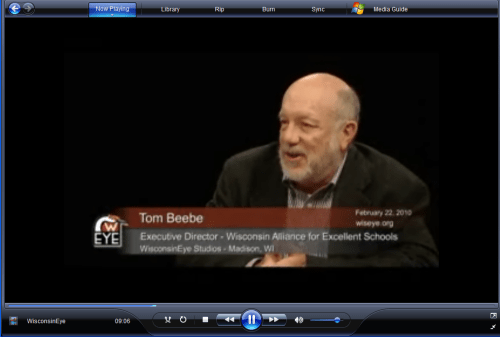
Click on image for video of Tom Beebe of WAES discussing Penny for Kids on WisconsinEye's Newsmakers

Things have been busy with the Wisconsin Alliance for Excellent Schools (WAES) and the Penny for Kids campaign.  Time to catch up a little.

Click on the image at the top for a fine interview with WAES Executive Director (and lone employee) Tom Beebe.  It really explains what Penny for Kids is all about.

The Rural Caucus presented some proposals on school-funding this week.  They aren’t bad, but they aren’t anywhere near enough.  WAES issued a press release, mostly saying that.  Here is an excerpt.

Their package of ideas addresses very real problems. For 15 years, schools and children have been subjected to an unsustainable school funding formula and now they are actually facing drastic cuts in state funding. As a result of this crisis, many schools are cutting personnel, services, and programs, others are fighting just to keep their doors open, and property taxpayers are being overburdened.

So while I applaud the Rural Caucus for their efforts, their proposal falls far short of what our children, schools, and communities need.The ideas forwarded by the Rural Caucus are Band-Aids and Band-Aids won’t stop this kind of bleeding.

What we urgently need is bold thinking and immediate, significant financial help – – a transfusion, not Band-Aids — as well as a long-term solution to the school funding crisis.

It is for this reason that the Wisconsin Alliance for Excellent Schools has launched “A Penny for Kids,” a program that has the support of thousands of voters. It proposes a one-penny increase in the sales tax in order to meet, head on, the revenue shortfall. This transfusion of revenue will buy us the time we need to address the structural failures of our current funding formula.

I appreciate the Rural Caucus’s willingness to take on this issue, but their solution falls far short of the urgent and significant reform that must begin now.

Last, but not least, the latest School-Funding reform Update from WAES (full update linked here, table of contents below with selected items linked to related posts on AMPS:

It is both good and bad that WAES is so busy.  It has become clear that WAES with Penny for Kids is the only group who have recognized the crisis that is happening and are trying to do something about it, in both the long and short term.   WAES can do this because we (I’m on the Board) are truly a grassroots organization, not beholden to the status quo or “the powers that be.”  As people realize this, WAES is attraxting more attention and interest.  That’s good.  The downside is that WAES is resource poor and over-extended.  We need more help from individuals and organizations.  Get in touch with WAES and find out how you can help.

Thomas J. Mertz

Leave a comment

Filed under "education finance", Budget, education, finance, Local News, National News, School Finance, Take Action, Uncategorized

Action to the South

At Fred Klonsky’s Blog there was recently a mini version of an AMPS type “Buzzsaw/Cuts” post on school budget issues in Illinois:

On this Saturday morning, this is how the state of Illinois is dealing with its school funding crisis: In Lemont, in Galesburg, in East Richland, in Hoopston, in Kaneland, in Waukegan, in Eldorado, in Jasper, in Elgin, in Knoxville, in Indian Prairie District 204, in Plainfield, in Ottawa, in Orion near the Quad Cities, and in Quincy.

I can’t say if the state and school budgets are worse in Illinois or Wisconsin and it doesn’t really matter which has gone further or faster in the wrong direction.  Both are in bad shape and both states are dominated by politicians who believe their re-elections are more important than addressing this reality and the lobbyists and donors who reinforce this message.

At least in Illinois, people are fed up enough to try to make their voices heard.  They have formed the Responsible Budget Coalition.  The video above is from their February 17 rally.  Below is their “We Can’t Wait” video.

We may not have thousands at the Capitol yet, but interest in tax and budget reform is growing and thousands in Wisconsin have signed the Penny For Kids petition.  Click the link to join them.

Thomas J. Mertz

Leave a comment

Filed under "education finance", Budget, education, finance, Local News, National News, Pennies for Kids, School Finance, Take Action, Uncategorized, We Are Not Alone

WISC EDITORIAL — THE PUBLIC’S SCHOOLS/ UNSUSTAINABLE BUDGETS

I need to add the The Wisconsin Alliance for Excellent Schools “stepped up” a long time ago and and is urging a step a Penny for Kids.  State officials talk the talk, but they need to walk the walk.  Sign on with WAES and Penny for Kids to remind them.

Thomas J. Mertz

Leave a comment

Filed under "education finance", Accountability, Budget, education, finance, Gimme Some Truth, Local News, Pennies for Kids, School Finance, Take Action, Uncategorized