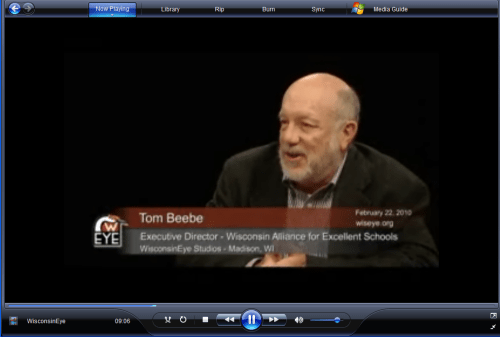
Click on the image at the top for a fine interview with WAES Executive Director (and lone employee) Tom Beebe. It really explains what Penny for Kids is all about.
Their package of ideas addresses very real problems. For 15 years, schools and children have been subjected to an unsustainable school funding formula and now they are actually facing drastic cuts in state funding. As a result of this crisis, many schools are cutting personnel, services, and programs, others are fighting just to keep their doors open, and property taxpayers are being overburdened.
So while I applaud the Rural Caucus for their efforts, their proposal falls far short of what our children, schools, and communities need.The ideas forwarded by the Rural Caucus are Band-Aids and Band-Aids won’t stop this kind of bleeding.
What we urgently need is bold thinking and immediate, significant financial help – – a transfusion, not Band-Aids — as well as a long-term solution to the school funding crisis.
It is for this reason that the Wisconsin Alliance for Excellent Schools has launched “A Penny for Kids,” a program that has the support of thousands of voters. It proposes a one-penny increase in the sales tax in order to meet, head on, the revenue shortfall. This transfusion of revenue will buy us the time we need to address the structural failures of our current funding formula.
I appreciate the Rural Caucus’s willingness to take on this issue, but their solution falls far short of the urgent and significant reform that must begin now.
Last, but not least, the latest School-Funding reform Update from WAES (full update linked here, table of contents below with selected items linked to related posts on AMPS:
School-funding reform remedies proceed in Ohio, Washington
Oregonians vote in tax increases to protect schools, other services
IWF, others to host forum on local revenue challenges
Cutting dropouts is good thing for Milwaukee and the U.S.
Help WAES correct e-mail update glitch
School-funding reform calendar
It is both good and bad that WAES is so busy. It has become clear that WAES with Penny for Kids is the only group who have recognized the crisis that is happening and are trying to do something about it, in both the long and short term. WAES can do this because we (I’m on the Board) are truly a grassroots organization, not beholden to the status quo or “the powers that be.” As people realize this, WAES is attraxting more attention and interest. That’s good. The downside is that WAES is resource poor and over-extended. We need more help from individuals and organizations. Get in touch with WAES and find out how you can help.
A couple of days ago, Governor Jim Doyle announced a grant from the American Reinvestment and Recovery Act to improve the state’s telecommunications network. The goal of the award is to bring fiber optic broadband to 380 Wisconsin communities. The $28.7 million BadgerNet project will expand infrastructure for rural schools and libraries, via phone lines, throughout the State.
Access to the Internet in the U.S. is about as common as having cable TV. Unfortunately, it’s still a luxury many families cannot afford. The ongoing cuts in work hours and benefits, or loss of a job altogether, is of course tragic. For many of us, access to technology is something we tend to take for granted. In our increasingly technology-dependent age, access to a computer and the Internet is becoming quite essential. But many of our low-income families cannot afford a computer or Internet access in their home. Many low-income families are fighting hard just to maintain basic living standards. With education becoming more dependent on the Internet, it’s even more critical that we level the playing field for all students and families.
But, as Mike Ivey of the Cap Times pointed out in his story this week, the reality is that Madison’s poverty rate is climbing — rising nine times faster than the rate of other U.S. cities, according to a new report from the liberal-leaning Brookings Institution, cited by Ivey. Since 2000, the poverty rate (defined as a family of four with an income under $21,800) in Madison has jumped from 15 percent to 17.7 percent. That’s one in every six residents. One of every two students in the Madison Metropolitan School District is now considered “low income” using the free and reduced lunch standard. In 1990, just one in five Madison school kids qualified. According to the American Community Survey, an annual estimate from the Census Bureau, Madison added nearly 8,400 residents living below the poverty line between 2000 and 2008, a 29 percent increase. Ivey cited the report’s prediction that “Madison will likely see its poverty rate jump another 1.1 percent this year, surpassing the average poverty rate for the 95 largest U.S. cities.”
In addition to BadgerNet, our school district is also trying to improve the various schools’ access to the internet and to better define its uses as a communication tool. This access needs to be extended to the families of the students it services. Jeff Richgels at the Cap Times reported yesterday that due to cost and a lack of digital literacy, over a third of the country does not have high-speed Internet access in the home (defined as non dial-up service). Broadcasting & Cable reported on an FCC consumer survey that found that “more than a third of the non-adopters (28 million adults) said they don’t have broadband because the price of service is too high (15%); they can’t afford a computer; installation costs are too high (10%); or they don’t want a long-term service contract (9%). According to the survey, the average monthly broadband bill is $41.”
A recent story done by WKOW pointed to the conundrum, “a hard copy of the monthly school news letter is becoming less common these days. That’s one reason why Madison School leaders say they need to change with the times, and find new ways to communicate with parents and community members.”
MMSD posts plenty of information online in the form of press releases, a monthly newsletter, and a video of school-related interest. They also have Infinite Campus so that parents can keep in touch with what is going on with their child. Infinite Campus is a district-wide student information system designed to manage attendance, grades, schedules, test scores, and other information about the students in the MMSD. The Parent Portal is a confidential and secure Web site where you can get current information about your child’s school attendance and grades. E-mail hyperlinks facilitate communication with classroom teachers. In addition, schools post important information on the home page, such as events, notices, etc,. Attendance information is also available. The Parent Portal allows report cards to be viewed online and printed.
My concern is that in our move to a more online world, we are ignoring a large amount of low income and minority families that do not have an email address. One example of this came to mind recently. Every year, MMSD asks parents to voice their opinions about the “climate” or feeling at their children’s schools. They use the survey results to assist with the school improvement planning process. This survey is available on the MMSD website although, it seems it was never sent out as a press release or included in the MMSD newsletter. The School Climate Survey was sent to the parent’s email address list as generated by each individual school. Surprisingly, this list is apparently not very comprehensive; two of our PTO officers were not on the list, despite having filled out the forms at registration and regularly receive emails from school personnel.
I hope that computers and the internet become as inexpensive as televisions and basic cable service. Until they are affordable, MMSD cannot rely on the Public Library to be the way for low income families or minority families to access the internet and communicate with their children’s school district.
Jackie Woodruff
(Editor’s Note: We apologize for not crediting Mike Ivey’s fantastic reporting in this post in an earlier iteration posted yesterday)
I can’t say if the state and school budgets are worse in Illinois or Wisconsin and it doesn’t really matter which has gone further or faster in the wrong direction. Both are in bad shape and both states are dominated by politicians who believe their re-elections are more important than addressing this reality and the lobbyists and donors who reinforce this message.
At least in Illinois, people are fed up enough to try to make their voices heard. They have formed the Responsible Budget Coalition. The video above is from their February 17 rally. Below is their “We Can’t Wait” video.
We may not have thousands at the Capitol yet, but interest in tax and budget reform is growing and thousands in Wisconsin have signed the Penny For Kids petition. Click the link to join them.
The main Madison Metropolitan School District meeting this week is on “Branding.” The other meetings noticed are of the Four-Year-Old Kindergarten Advisory Council (Monday, 9:00AM at 4C, 5 Odana Court), the Wellness Committee (10:00 AM Tuesday, Hoyt Building) and the Talented and Gifted Advisory Committee (Tuesday, 4:00 PM at Lapham).
Hosted by the Board of Education, the Engagement Session is an early step in the development of a communications plan aimed at ways to focus on positive branding of the MMSD school experience and to publicize the benefits of graduating from the MMSD.
The overall goal – from the school district’s new strategic plan — is to identify ways the MMSD can actively promote the benefits that all students derive from the challenging, respectful, inclusive education that Madison Schools provide.
The session is open to the public. Parents of MMSD students are particularly welcome.
After a short introductory presentation, attendees will break into smaller groups for discussion, followed by a brief report-out period. The session will be facilitated by Superintendent Dan Nerad and other district leaders.
The desire to spiff up the public perception of Madison schools came out of months of discussions last year as a community team formed a five-year strategic plan for the district, said Superintendent Dan Nerad.
“There was a strong feeling that, one, we have a lot of positive things that need to be more proactively discussed,” Nerad said. “And two, as we face our challenges, (such as) becoming a more diverse School District and needing to meet the needs of a broad range of learners, it is even more important that we do this work.”
….
The district has given marketing firms until March 1 to apply for a two-year contract, at $43,000 a year, to create a communication plan. Monday’s public meeting is billed as an “early step” in the process, and officials said they have no idea what form any branding efforts might take.
….
Part of the message that needs to get out is how well Madison schools prepare students for college, said School Board member Ed Hughes.
“The benefits of going to a diverse school are really apparent to our graduates once they’re out in the world,” said Hughes. “But we could be better, I think, in communicating those benefits to people.”
Counteracting “street-corner conversations” is another hurdle, he said.
“You hear a discussion about school safety issues and concerns about academic rigor, and I think a lot of those are based on less than a full understanding of what’s really going on in our schools,” Hughes said. “The problem is that there is some kind of information that is kind of sticky – people hear it and that’s what they remember. If there’s a fight in the school, that’s what they know about. And how you get over those images and get people to take a fresh look at what’s really going on in the schools is a challenge.”
This school year alone, 589 students living in Madison opted to attend a different school district, while 172 students living outside the city’s boundaries asked to attend a Madison school.
Meanwhile, online schools run by districts throughout the state have ramped up their advertising in the Madison market, which only raises the stakes. For every student that leaves the district, it loses $6,443 in state aid.
My own thoughts are that A) With the contact pending the session this week is putting the horse before the cart; B) The RFP could be more about enhancing communication with families with students in the district — something that has a direct effect on climate and achievement — and less about spreading the word to others; and C) I am glad this is getting some attention, think a consult is agood idea but am skeptical that the potential will be realized.
The 4K group will be reviewing “output” (input?) from forums (I believe these are forums with providers) and setting a time-line for the next year.
I got nothing on the Wellness meeting.
I got lots on the TAG meeting agenda, but no time to write some of it up. Unfortunately, I will not be unable to attend, so there won’t be a meeting report ( I can’t attend the “Branding” meeting either).
I am glad that they are starting with improved identification procedures. As I have said, a successful and equitable TAG program must begin with purring in place procedures that are much, much better than those that have been used.
The work by Peters that I have had a chance to review holds some promise and serves as a reminder of why this is and will be difficult.
The key difficulty is that there is no real definition of giftedness; no scientific, professional or lay agreement about who should be receiving gifted services or interventions (much less what those services, programs or interventions should consist of). Note I phrased this as “should be” not “would benefit from.”
I firmly believe that almost all students would benefit from most of the services, programs or interventions in place or contemplated for those classified as “gifted.” This isn’t to deny that there are some students who “need” these services, programs and interventions or that there are some who are “profoundly gifted” and I agree that it is the duty of any responsible educational institution to recognize and address this.
There is a related difficulty and that is that gifted programs have historically been disproportionality populated by white, middle and upper class students (for an exploration, see: Barlow and Dunbar, “Race, Class, and Whiteness in Gifted and Talented Identification: A Case Study“). This has become politically untenable and has been morally indefensible. For advocates of expanded TAG programing and those in the gifted industry (like Peters), the lack of a definition provides a way around or out of the problem of disproportionality.
Whether it is by promising to recognize giftedness in multiple domains or — as Peters’ work does — improve teacher referrals, the lack of a definition means that there is a lot of room to work with. Gifteness is whatever they say it is and with that as the first principle it is possible to say 1% or 30% or 99% of students are gifted and locate giftedness among diverse students in any proportion you desire.
Of course in these days of data fetishes, it helps to have some numbers to crunch. Peters crunches numbers and crunches them very well. With the Hope Scale, he has produced an instrument for teacher referrals that is consistent and clean internally and demonstrably nearly sociio-economically non-discriminatory (his sample had very few African Americans and he presents this as a work in progress). See his “Initial Validity Evidence for the HOPE Scale: New Instrumentation to Identify Low-Income Elementary Students for Gifted Programs” for some fine number-crunching and note that the “validity” in the title is internal validity because with no definition there is no possibility of external validation.
Lohman’s argument is thus that the more specific the norm group used for comparison, the better. This is true for groupings such as income, race/ethnicity, as well as school or grade-level groups. The use of narrowly defined comparison groups allows educators to see which students are achieving or have the potential to achieve given similar background and circumstances.
I have to think about this. On one hand, I appreciate the recognition of bias and the desire to overcome it. On the other hand I see something like “she’s smart, for a poor girl” happening and I don’t like that. I have to think about it.
I have friends who say that whenever I write about TAG issues it is overwhelmingly negative. I like to think of it as more skeptical than negative (and in this post also observational/analytical), but they do have a point.
With that in mind, I want to close by emphasizing how happy I am that MMSD is trying to improve identification, repeat that despite my criticisms I see promising things in Peters work and am glad that MMSD has the benefit of both his general knowledge of the field and his ongoing research, and once again say that I support efforts to improve transparency, consistency and services in the TAG area (not every manifestation, but the some and the idea of doing these things).
On an unrelated topic, Lucy Mathiak’s “The Edgewater TIF. Or, Can I Use My MasterCard to Pay My Visa Bill???” is a must read (I don’t know when the Edgewater TIF will go before the Board of Education — not “on the agenda” yet — but Lucy Mathiak is the Board rep to the TIF Board).
The video at the top is from the 2006 Madison referendum campaign, since the voter turnout on Tuesday is expected to be small I thought a little shame might help bring people out.
We are in a new era of referenda. Referenda for building purposes remain much the same, except in many districts property tax increases to make up for drops in state support have made passage more difficult. Operating referenda are also more difficult for the same reason, but there is a twist. Previously the biggest financial issue was that rising costs — many of them mandated or near mandated — outstripped allowed revenue increases (the revenue caps). This problem remains, but in many districts it has receded in importance because the drop in state support has made simply taxing to the max — using all the allowed revenue authority — and the large property tax increases that result intolerable to many voters and Board members. According to the Wisconsin Taxpayers Alliance, a recent record 98 out of 427 districts — including Madison — did not tax to the max for the current year. Every indication is that the percent will be higher this year. For these districts, increased revenue authority via a referendum is irrelevant. These districts have to cut to address the gap between allowed revenues and costs (like always) and are cutting to limit property tax increases. It is a new era.
It is this situation that leading our schools into crisis and making our schools the center of conflict instead aspirations. It is this situation that inspired the Wisconsin Alliance for Excellent Schools to launch the Penny for Kids campaign to increase state education funding and improve how it is allocated. Click the links, find out more and sign the petition.
On Tuesday, eight districts will have a total of ten referenda before the voters; four for construction borrowing, and six for operating expenses (one recurring and five nonrecurring). You can see all the referenda details here.
The Bangor district is asking for $580,000 in demolition and construction debt authority (for the old high school gym, this would be a no interest ARRA loan) and three years on additional revenue authority at $350,000 a year. The district referendum page is here. Here is what the LaCrosse Tribunereported on the operating referendum:
“We’ve pared things down, and even if this one passes we will still have to look at ways to reduce our budget and conserve our expenses,” Superintendent Roger Foegen said. “But the board felt in these tight economic times we couldn’t ask for any more than we are currently getting.”
The district is in the final year of a three-year $350,000 operating referendum, he said.
Without renewal, it will face a $400,000 to $450,000 deficit next school year.
The district already trimmed $600,000 from its annual budget before going to the public three years ago, Foegen said.
“Because of the state funding formula and the things that go into it, we need to maintain it if we are going to keep our current programs and personnel,” he said.
Foegen said the plan will cost the owner of a $100,000 property an estimated $78 in 2010-11; $39 in 2011-12; and $13 in 2012-13.
The Brodhead district has a four year non recurring measure on the ballot. Here is how it breaks down:
2010-2011 $635,000
2011-2012 $810,000
2012-2013 $855,000
2013-2014$1,285,000
Total $3,585,000
The district has a nice referendum page here. It includes a list of cuts made sine 2003-4, which is good reminder that the current crisis comes on top of 16 years of cuts because — by state design — revenues have bee kept below cost-to-continue. You can read the whole list at the link, here are the programs:
Programs or Activities Eliminated
– Jazz Band II eliminated – FHA (Future Homemakers) eliminated
– FBLA (Future Business Leaders) eliminated
– drivers’ education eliminated
– District funding for 7th grade camp eliminated (still runs thru funding by student activity account)
– access to HSED/GED programming at BlackHawk Tech reduced and restricted
– greenhouse no longer heated by District funds (now provided by FFA Alumni)
– eliminated French as an elective class at the HS
The School Board has identified staff and program cuts that will be necessary to balance the budget without a successful referendum. These would include: three elementary teaching positions (moving all grades to three sections, regardless of the number of students in the grade); three teaching positions between the high school and middle school, plus two elective programs (and their teachers) at the high school and middle school; one guidance counselor; two administrators; the high school adventures class; the long-distance learning program; and ALL extra-curricular positions at the high school and middle school. These cuts would be phased in over the next two years.
And, what is the impact of these cuts? Class sizes in the elementary school would increase from the current 18-23 students, to classes in the high twenties. Class sizes in the high school would increase from the current mid-twenties to around thirty, with some classes pushing thirty-five students. With the larger class sizes, students would receive less of the individual attention many of them need to be successful in school. Curriculum development and innovative new programs would fall by the wayside. Students would have less access to advanced coursework, at a time when they most need it to compete with graduates of other schools. And, access to some elective programs that prepare students for specific career fields might be eliminated altogether. Students having problems at school or home would have less access to a counselor.
Remember that Governor Jim Doyle and the Democratic leadership continue to boast of having “protected education.” With “friends” like that — who look the other way while cuts like these are on the table — education doesn’t need enemies.
The Janesville Gazette reports another factor at play in the Bradhead and other votes on Tuesday (the Beloit Daily News includes similar observations):
District officials have “real serious concerns” if the referendum fails because families will have three days to file by the state’s open enrollment deadline to attend different districts, [Superintendent Chuck] Deery said.
“I’ve been hearing from quite a few families that that’s exactly what they’re going to do,” he said. “They won’t wait around (to see the board make the cuts). They want those activities for their kids.”
This is the death spiral. State policies and budgets force program cuts, enrollment declines as temporarily better off districts poach students, accelerating the cuts.
general obligation bonds in an amount not to exceed $7,600,000 for the public purpose of paying the cost of remodeling existing physical education facilities for use as performance center/auditorium, constructing replacement physical education facilities, adding additional elementary classrooms, renovating and remodeling food service and music facilities, and acquiring equipment
Green Lake has the only recurring measure this time around. For reasons that should be obvious recurring referenda make more sense. The Bangor situation described at the top of this post is a perfect example. Three years ago they went through the work to pass a nonrecrring referendum; now three years later they are having to ask again. The reality of a system that does not provide for adequate revenues isn’t likely to change soon (here are those links to help work for change: Wisconsin Alliance for Excellent Schools, Penny for Kids, School Finance Network and the AMPS “Take Action” page) and districts and communities repeatedly “going to referendum” is a divisive waste of resources.
The open enrollment issue is part of this story too. Green Lake has implemented environmental education and International Baccalaureate programs in an attempt to reverse the demographically-driven declining enrollment by attracting new students.
QUESTION: What happens if the referendum vote is no?
ANSWER: The district would have to cut $660,000 in the next budget, and there would be no additional funds for maintenance or technology. This would be followed by more cuts each year after that. There would be program and staffing reductions. Suffice it to say, the school would not be the same as it is today.
QUESTION: Has the district made cuts?
ANSWER: Yes, in the past four years the cuts have totaled over $600,000. This has allowed the district to extend the 2001 referendum extra years beyond the five years it was predicated to last.
[U]pating classrooms; adding a new science wing; converting the current instructional media center and science labs to a larger library and media area and computer classroom; and upgrading heating, ventilation and air conditioning.
This is really the basic essentials, and if we turn this down I don’t know where we will go,” said Hilbert Supt. Tony Sweere, expressing hope that more voters “can get behind this.”
“It amounts to a 25- to 30-year fix for the middle/high school campus, which hasn’t been touched since it was built in 1974-75,” he said. “This will upgrade everything.”
A larger construction referendum failed by 89 votes in November 2008.
Rhinelander is another district with both construction and operating expenses on the ballot (referendum page here). The state finance squeeze has been particularly tough on Rhinelander. They’ve tried repeatedly for relief from referenda without much success. Since 2005, four construction debt referenda have failed, as have five operating votes. The only one to pass was an HVAC upgrade paid for by a one-time operating levy increase.
The current construction ask is for ‘for remodeling and repairing existing buildings” and would also take advantage of the ARRA interest savings.
“The way the state’s school aid formula works means that every school district in the state eventually will go bankrupt, some sooner than later. In time, every district will need to go to referendum, asking residents to exceed the revenue caps,” she said.
State aid to the Rhinelander district has dropped precipitously in the past decade. In 2000-01, state aid was $13.2 million, approximately 52 percent of the general budget. By 2008-09, state aid had dropped to $7.7 million, approximately 28 percent of the general budget, requiring residents to shoulder more of the cost of running the district. State aid is estimated to be at zero for this district in four years. The adjacent graph charts the decline of state aid to the district since 2001 and the corresponding rise in property taxes.
Year Property Taxes State Aid
2000-01 $12,035,267 $13,249,469
2001-02 $13,460,627 $12,387,722
2002-03 $14,108,872 $12,145,111
2003-04 $15,351,872 $11,337,277
2004-05 $17,012,020 $10,089,233
2005-06 $15,613,885 $11,693,310
2006-07 $16,560,823 $10,859,344
2007-08 $18,600,885 $ 9,314,011
2008-09 $19,875,455 $ 7,721,621
The district’s annual budget from state aid and tax revenues for 2008-09 was $27.59 million, down $317,820 from the previous year. Comparatively, in 2001-02, the annual budget from these sources was $25.84 million.
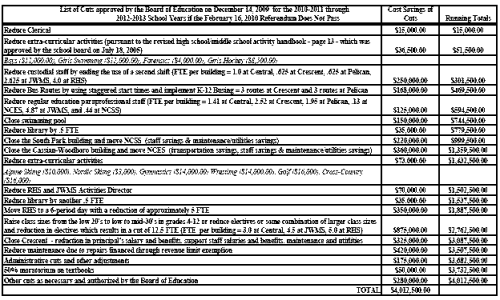
Here are the proposed cuts if the referendum fails (click on image for pdf):
Closing schools, cutting extra-curriculars, raising class sizes, stopping book purchases….throwing the future in the trash.
Shiocton is another example of the false attraction of nonrecurring referenda, compounded by the squeeze of state defunding. Their four year referendum is expiring but because of state cuts in education investments, they had tor raise property taxes last year by 20%. The plan now is to ask for another nonrecurring operating referendum below cost-to-continue and combine that with cuts (this is similar to what Madison did with the “Partnership Plan“).
The referendum asks voters’ permission to exceed state revenue limits by $500,000 for the 2010-11 school year, $600,000 for 2011-12 and $700,000 in each of the following three school years.
Shiocton school Supt. Chris VanderHeyden said the district faces a $900,000 shortfall next school year if it does not take this step to help balance the budget by covering the cost of preserving district education programs.
Regardless of whether the referendum passes or fails, the school district of 790 students in pre- kindergarten through grade 12 will need to cut $400,000 to stay in the black, VanderHeyden said.
About 65 percent of the $400,000 will come in staffing cuts, he said, which includes a reduction of 3.5 teachers and two paraprofessionals. The rest will come from such areas as departmental budgets, athletics, staff development, textbook adoptions and food service. “We will make the cuts but we also need the referendum to balance the budget,” he said. …
The increase this year was up nearly 20 percent. Either way, the tax rate will drop next year, VanderHeyden said. If the referendum passes, property taxes will drop $107 for the owner of a $100,000 home. If it fails, the property taxes will drop $278 for the owner of a $100,000 home.
So if it passes, there will be major cuts and taxes will go down. If it fails, there will be even larger cuts and taxes will go down more. Where is the choice for fully funding education?
Last but not least is Three Lakes. This is one of those districts caught in declining enrollment and relatively high property wealth. It also another district in the last year of a nonrecurring operating referendum. Three Lakes is in worse financial shape, has been squeezed harder, have been cutting for years; according to the district figures, without a successful referendum they will run out of money in February 2011.
Therefore they are asking:
…that the revenues included in the School District budget for three years beginning with the 2010-2011 school year and ending with the 2012-2013 school year be authorized to exceed the revenue limit specified in Section 121.91, Wisconsin Statutes, by $1,517,469 a year, for non-recurring purposes consisting of funding operating expenses.
Three Lakes District Administrator George Karling said the override voters are being asked to approve is necessary to fund current programs and amounts to about half of the annual revenue that has been lost, compared to 10 years ago.
With about $900,000 in the district’s general fund, Karling said Three Lakes would only have funds available to operate through February 2011 absent approval of the override.
Informational material the district sent to voters indicates the district is not allowed to operate at a deficit and would “become insolvent and close in the near future” if the referendum fails.
School Board Clerk Tom Rulseh said the district’s budget is “really tight,” with the budgeted expenditures of $10,507,798.50 for 2009-10 down about $80,000 from the previous school year, while the revenue override is necessary to continue to operate.
“I don’t know where the money would come from” if the referendum fails, Rulseh said.
…When asked whether it would be necessary to approve another revenue override three years from now, Karling said he hopes state lawmakers change Wisconsin’s school funding formula by then to provide more money for Three Lakes, which is considered a “property rich” district and receives little state funding.
He said proposals on the state level to boost funding for K-12 education include an additional 1 percent sales tax, which is known as “A Penny for Kids” and backed by the Wisconsin Alliance for Excellent Schools, and a “65 percent hold harmless” provision to lessen the amount of lost revenue because of declining enrollment.
They also note that dissolving the district would likely lead to even higher property taxes.
That’s the roundup. More votes in April. Before closing I wnat to again share something and suggest you follow my lead. When I do these posts that involve districts all over the state, I often take a look around their web sites. I am always struck by the good work being done, some traditional, some innovative but all a source of pride for the students, the educators, the families and the communities. All the sites are linked at their names, so I suggest you do the same. It is a good reminder of why education is so important and why we need to do better recognizing that. When you are done, help Wisconsin do better by getting involved for change.
The main Madison Metropolitan School District Board of Education meeting this week will be in closed session. There are some other Board related meetings this week that are open. The full notice of all the meetings is here.
Here is what the closed session notice says:
Monday, February 15 5:00 p.m. Special Board of Education Meeting in Executive Session
Renewal or Non-Renewal of the Contracts of Individual Employees pursuant to Wis. Stat. §§19.85(1)(c) and 118.24
Potential Reorganization within the District Affecting Individuals’ Employment and Employment Contracts, including Extensions or Non-extensions of said Contracts, pursuant to Wis. Stat. §§19.85(1)(c)
Adjournment
There are very specific statutorily required procedures for renewal/non renewal deliberations and a closed session is part of them (a non-renewed employee may request a subsequent public hearing).
I’m not sure on the closed session “potential reorganization” discussion as a legal matter or as policy. Not feeling qualified to offer much more than my doubts on the legal issues, I’ll stick to policy, where everyone is qualified to offer an opinion (ain’t America grand?).
There are two parts to the policy issue.
The first is whether all discussions of a potential district reorganization should be had in public. I think they should. I think the public should know what our employees and our elected officials are saying about the current organization and how it might be improved. I always side on more openness.
The second is whether decisions about the structure of an organization of the size and complexity and MMSD should be based on the skills, knowledge, competencies and incompetencies of current employees. I think the answer is no. If these are not part of the decision-making , then there is no reason (certainly no legal justification) for a closed session.
Employees come and go and can be let go (in Wisconsin administrator contracts are limited to two years); the district goes on. Plugging individuals in or unplugging them is not a long-range organizational strategy. Decide what works from a structural point of view and then find the people for the slots. If current employees don’t fit the slots, they should not be renewed, but defining the slots should be prior, separate and public. Even worse is designing the slot to fit an individual’s skill set. The individual will not be there forever and then the organization has an unfillable hole.
So I’d like an open session on reorganization, hope that nothing substantive of the reorganization is discussed in closed session and understand the need for closed sessions on employees. Maybe I’m just curious about the reorganization.
For the other meetings, on Tuesday at noon there is a meeting of the ad hoc Board Committee on revising the Ethics Policy (nothing linked the week, but this from last week); on Wednesday at 8:00 AM the School Food Initiative Committee will discuss ‘”Lunch Lessons” covering all aspects of MMSD food service” (I can’t find any official reference to this group except this from the week of January 25 meeting notice); and on Thursday at 1:30 (at building services on Plaum Rd), the 4-Year-Old Kindergarten Subcommittee on Curriculum will meet. The first thing on the agenda for the last is “Open Meetings Laws,” and that’s a good thing. N o info on the sub-committee, but the main 4K page is here and the Advisory Council page is here (with only the January 26 minutes posted, although they have been meeting for over a year). I do want to note that the times and/or locations of these meetings are not the most accessible. That will happen sometimes but you want it kept to a minimum.
I guess the theme this week was open governance, open meetings and open records. I’m glad to make that the theme, these are essential to democracy.
One good thing about the school governance schedule this week is that everyone can make time to attend the Progressive Dane School Board Candidate Forum, Sunday February 21, 1:30 PM at JC Wright Middle School, 1717 Fish Hatchery Rd. (info, fliers to print and post, and more, here). See you there!
Just some of the stories about the budget struggles of Wisconsin districts in the last week or so (linked and excerpted with emphases added). Bad all over.
The Madison School District is facing a $30 million budget hole for 2010-11, a dilemma that could force school board members this spring to order massive cuts in programs, dramatically raise property taxes, or impose a combination of both.
District officials will unveil a list of possible cuts — which could include layoffs — next month, with public hearings to follow.
“This is a big number,” School Board President Arlene Silveira said. “So we have to look at how we do business, we have to look at efficiencies, we have to look at our overall budget, and we are going to have to make hard decisions. We are in a horrible situation right now, and we do have to look at all options.”
…
“I think what’s happened is the state of Wisconsin has effectively passed along the tax problem to the local level, in terms of either we raise taxes to support public education, or public education isn’t going to be supported,” said Erik Kass, assistant superintendent for business services.
“We’re going to have to start cutting some of these more main items,” [Superintendent Craig] Bender said, adding that every dollar in the budget is important to someone. “We didn’t start this process because we thought this was the best way to improve education, but we’re doing it though believing we’ll try to make it better wherever we can.”
“We can address things one-by-one as we have been,” he [Board member Sean McNevin] said, “or we can take a top-down approach,” and hand the administration a set number of cuts with which to grapple.
“Every fiscal cut we make tends to lay us on the road of mediocrity … but at some point it’s going to have to happen.”
[Baraboo High School Principal Machell] Schwarz said the district had been dealing with slim budgets for the past 10 years, however.
“We need to continue looking at the big picture, and stop focusing on money, and focus more on kids,” she said.
The Monona Grove school district is scrambling for ideas to plug a budget hole of about a million dollars, including a proposal to consolidate the Monona community’s two elementary schools, Maywood School and Winnequah School.
…
“We have to look at every option. We have budgetary problems just like everyone else because of the state funding system and the poor economy,” [District Superintendent Craig] Gerlach noted in a phone interview on Thursday.
…
“I don’t want to close a school. But we have a predicted $1 million deficit every year for the next five years. We can’t balance the budget without threatening programs in our district that people have come to expect. In the long run, we can’t afford the luxury of this school,” he [Peter Sobol, Monona School Board vice president] said, noting that $250,000 in annual savings could keep four or five teachers in the classroom.
But, nearly one in four districts, including Oshkosh, chose to tax below their caps this year despite the budget squeeze. The Wisconsin Taxpayers Alliance, an independent research group,reports 98 out of 427 districts did not tax to their revenue limits.
…
The change, he [Dale Knapp, research director for the Taxpayers Alliance] said, likely stems from a significant financial shakeup in the thick of a floundering economy. State lawmakers last summer cut aid to schools for the first time since the state’s education funding system was established in 1993. Local property tax payers were left with the burden of making up the difference if districts didn’t cut spending.
…
“When you talk to residents about the cuts being made to your school programs and then ask for a 10 percent or higher increase in the school levy, there’s a disconnect there, and that’s hard to take in,” Knapp said.
…
Many parents and educators in the district, along with some board members, have complained that cutting more than necessary only exacerbated today’s budget problems.
“It’s time for us to tax to the full levy. I’ve thought about that for a long time,” board member Karen Bowen said during a January school board discussion about the issue. “I don’t see how we can do good things for our kids if we just slash and burn.“
More from Oshkosh. First, some videos from WBAY-TV (I’m not sure of the right order, but they are all worth a watch).
For those who don’t watch, here’s the basic situation as described in this story:
The Oshkosh School Board had some difficult decisions to make Wednesday night — facing a multi-million dollar budget shortfall and making unfavorable cuts. The district faces a $4 million deficit.
In a late-night vote, after hours of discussion, the school board voted to increase the student-teacher ratio at North and West high schools to 25-to-1. This effectively eliminates an estimated 35 or 36 teaching jobs.
However, the school board rejected a plan to consolidate five of its middle schools into four buildings. Two elementary schools would close, and Perry Tipler Middle School would become an elementary school. Now, Tipler will remain a middle school.
The board took no action on the possibility of raising taxes.
A big crowd was on-hand for the school board meeting. About 80 people spoke out — many endorsing a double-digit tax hike to avoid drastic cuts.
The emotional audience was mostly teachers, parents, and students. Many said the cuts being proposed were too much.
“Some of the cuts are catastrophic,” high school senior Derek Maters said. “If you look at the depth of them, it’s reaching from people who are looking at a tech career to people looking at a college career.“
High school students easily accounted for most of the crowd at Alberta Kimball Auditorium at Oshkosh West High School, where hundreds gathered to hear the results of the meeting. One student presented the school board a petition with more then 480 student signatures opposing the cuts.
“For those who are not able to escape the district, you’re condemning their success,” said high school student Dereck Mathers, referring a report created by the high schools’ assistant principals detailing the impact of teacher layoffs on course offerings.
The report lists 43 West High classes and 67 North High classes that would no longer be offered next year if the resolution passes. The report predicts 787 West students and 1,142 North students would be impacted
“The problem with this is that if these courses are cut, many students will have to compromise for a lower level (education),” said Connor Schroeder, vice president of West High School’s student government.
West High School junior Ryan Steffen said he believes the cuts would create more impersonal relationship between students and over-worked teachers.
“I would like to speak for all the teachers because I’d like to not see them cut,” he said. “I know the passion they bring into work.”
Reading and hearing these students made me think of our older son. He is at West and MMSD high school students are in the process of choosing classes for next year. I told him that it is very possible some of the classes he picks will not be offered due to budget pressures. Hard to tell him that. He’s volunteered on referendum campaigns and for school board candidates. He did this because we taught him that being involved was a way to preserve and expand educational opportunities. We’ve won those battles, we even won the battles to “Take Back the Assembly,” but the Assembly took back the victories. Hard to tell him that too.
Budget forecasts suggest the Kimberly Area School District could have a $3.1 million structural deficit in five years should factors including state aid and teacher-to-student ratios remain unchanged.
…
[Scott] Gralla, [a consultant with PMA Financial Network] said there’s optimism that legislators will eventually restore higher funding levels to schools. Kimberly isn’t alone in the depth of deficits projected.
“This is not out of the norm at all for districts your size,” Gralla said.
About $720,000 worth of reductions are planned for next school year, about $485,000 of which will come from the removal or reduction of 11 Nekoosa School District teaching staff members, according to documents provided to the public at Tuesday’s Nekoosa School Board meeting.
The plan includes eliminating a math and technical education teacher position from Nekoosa High School, a first-grade teaching job at Humke Elementary because of enrollment numbers, and English and social studies teachers at Alexander Middle School.
Several other positions are likely to have hours reduced, including choral music and art at Alexander, and business education and family and consumer education at the high school. A high school counseling position being vacated this summer because of a retirement also will not be filled.
“We are absolutely in financial crisis,” Superintendent Wayne Johnson said. “Virtually every school district in the state of Wisconsin is a little worse or a little better off than we are. The state funding formula is flat-out broke.”
“We had cut as much as possible without cutting education,” he [candidate Joe Kasle] said. “We did not cut the arts, feeling that is part of having well rounded students. We had fund balance left to get through only 18 months. If the referendum had failed, we would have had to go to referendum again. After 17 years of 2 percent funding from the state and 4 to 5 percent increases in costs, there was just no money.”
That’s it for now. I have more links and stories, but this is too depressing to do all in a couple of sittings.
I’m just finding the time to post this on the Monday February 8, meeting (preview of that meeting here). To be honest, it wasn’t a very exciting meeting. Most of the real work was done the previous week, when they met as Committees.
Almost everything on the agenda passed 6-0 (Lucy Mathiak, absent) with no discussion. A few things deserve a little comment.
It looks like there will be something of a restart on the La Follette area planning. The Board voted to use technology and other things for 2010-11. The timeline for the restart was given as “6-9 months.” I hope the 9 instead of the 6. Johnny Winston Jr also suggested that the Board be involved in the initial phases, the Board and administration agreed and I think that is good. Overall a good way to move forward on something that was looking like a big mess.
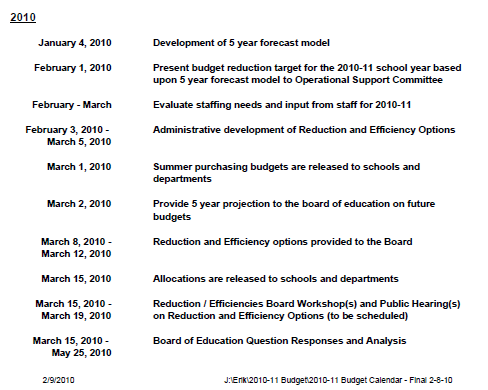
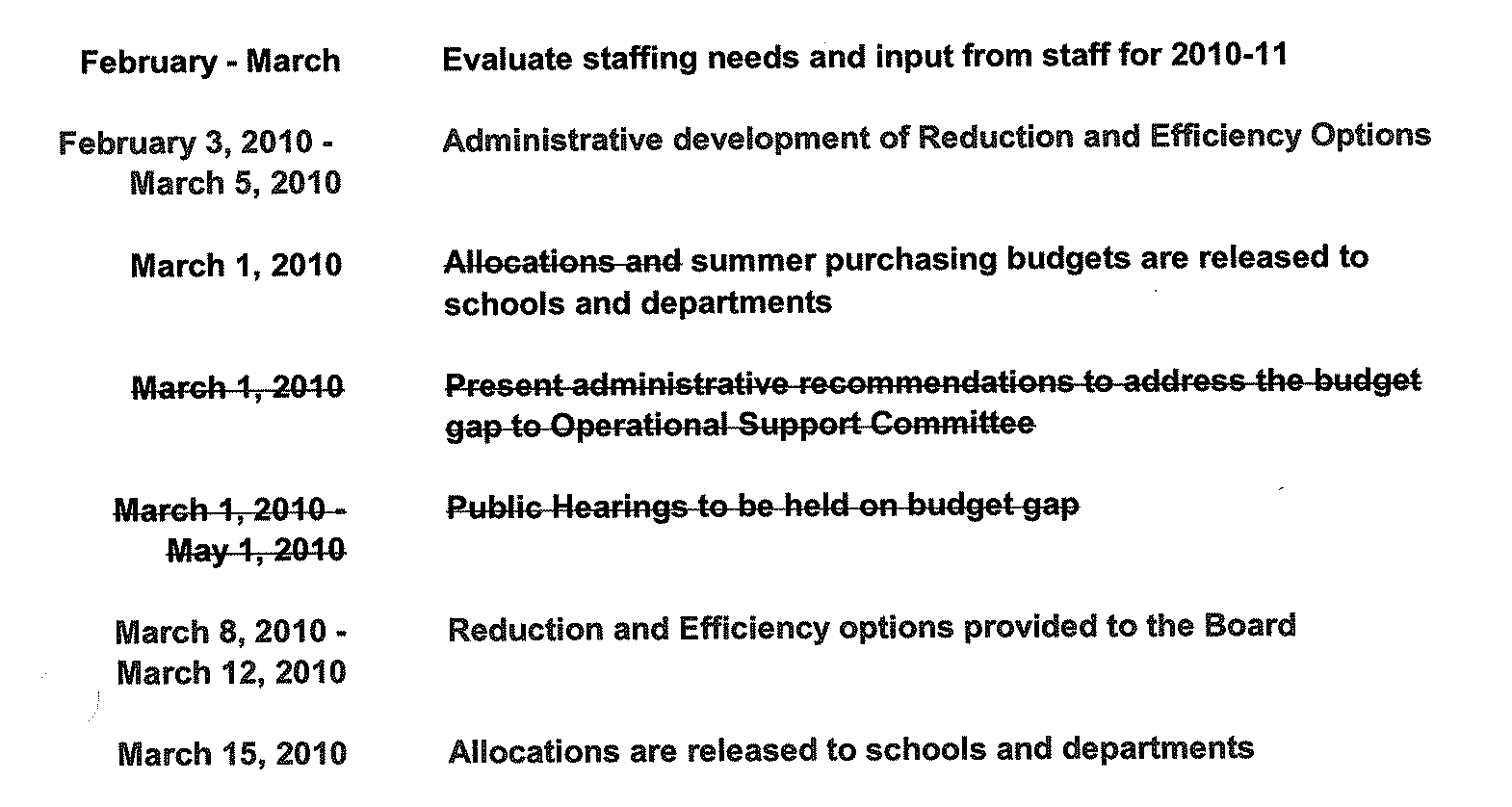
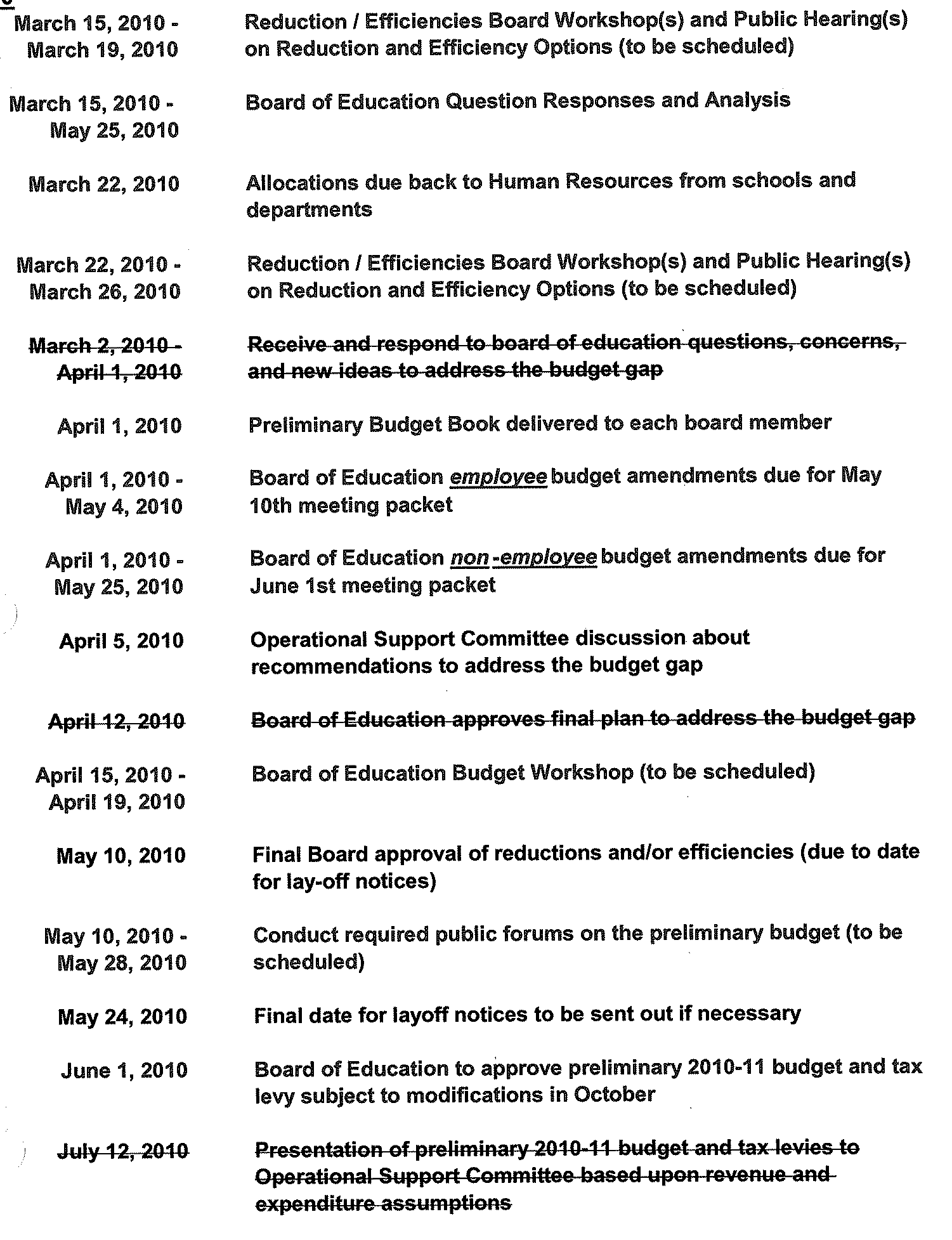
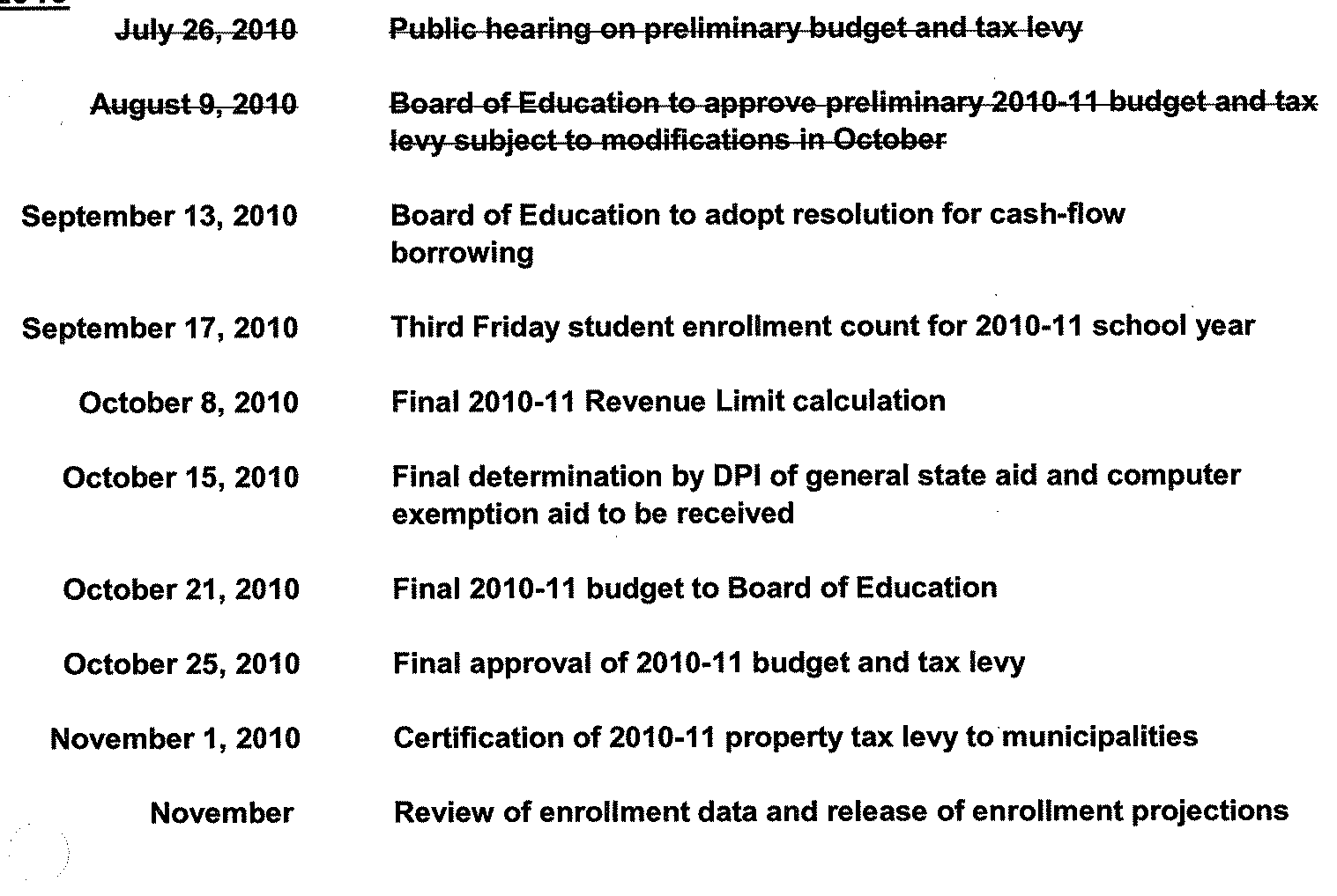
The new Budget timeline was approved (see Gayle Worland’s Wisconsin State Journal story for more). So there is now a plan for how to consider $30 million in cuts. The only big change was that personnel cuts and other cuts will be taken together. Here it is:
Some things to note. First, the May 3-7 meeting where the Board approves reductions will be the first meeting for either James Howard or Tom Farley (see here for info on the February 21 Progressive Dane Candidate Forum). Second, the state mandated budget hearings will be odd this year due to the timing. At that point the Board can add things back, but no real cuts are possible. I would really like that hearing to occur at a time when everything is still on the table. I am also somewhat bothered that the Budget Book comes out after the Public Engagement sessions.
I did hear some good things from the Board and the administration about how this will be be done. They seem committed to gathering as much information as possible, sharing that information with the public, trying to work from some common principles and as much as possible avoiding rancor. It won’t be easy. There will be a lot of pressure from the anti-tax crowd to cut and a lot of pressure from others not to cut specific things. Going into this I do think it is important to keep in mind that the current situation cannot be attributed to local mismanagement. This is a state created problem. If you are going to get mad about the school funding situation, get mad at the state officials.
One other thing I’d like to say is that there have been some positive things done on things like 4K and the Strategic Plan where a real work on defining and implementing a vision for improving educational opportunities has been started and I hope that does not get lost in all this. The Board Members have expressed similar hopes.
On the Retirement Refinance and 4K funding the Board went with option 2B, smaller overall savings but more front loaded. I believe the vote was 5-1, with Marj Passman favoring 5A.
Week two of the agenda rundown experiment. The big important things are the La Follette Area attendance info (now including East Area and West Area) and the Budget Timeline.
As explained in the first post in this series, the Madison Metropolitan School district Board of Education first sees most agenda items when meeting in committee and then meets the following week as the Board of Education to reconsider and take action. Last week was a committee week and this week is a Board week. I’m not going to repeat the commentary from last week — I suggest reading that post if you haven’t already —, but will give some updates — big updates on the La Follette Area assignments, ones that stretch into the West and East Areas — and add a few things. There are also some new items to cover (and one In missed).
The Board will meet at 5:00 PM in closed session to consider an extension of Superintendent Dan Nerad’s contract and student disciplinary matters. The contract extension will be voted on at the open meeting.
The open meeting will begin at 6:00 Pm, Monday February 8, 2010, Doyle Administration Bldg. 545 W. Dayton Street Madison, WI 53703 in the Auditorium. There will be public appearances at the beginning. Like almost all Board meetings, these will be carried by MMSD-TV. Here it is.
BOARD PRESIDENT’S ANNOUNCEMENTS AND REPORTS
The Foundation for Madison’s Public Schools Employee Giving Campaign is underway
The Great Lakes Higher Education Corporation calls for applicants for its College Access Champion Award for teachers
Eleven Madison students have qualified as Presidential Scholar Finalists
The Schools of Hope 5th Annual Multicultural dinner will be held on March 3, 2010
SUPERINTENDENT’S ANNOUNCEMENTS AND REPORTS
*A Proposed Board Policy Modification regarding Public Appearances at School Board Meetings (Board Policy 1222)—Appendix LLL-8-26.
Two minor changes. One specifically bars people from ceding time to other people. All speakers are allotted 3 minutes, so this says that you can’t get a group of 10 and have one person speak for a half hour. The other encourages people who have written testimony to summarize and submit. Last time there were proposed changes, I protested vociferously.
These seem reasonable, but I do have two observations. Even worse than last time, these changes will be voted on with little or no opportunity for the public to weigh in. The first hint was the posting of the agenda after 5:00 PM on Friday and the vote is Monday….if you wonder why people feel alienated from the district, consider what it says to change the way public input is taken without giving the public a real chance to have their say. Second, it would seem to me that A) These have not been big problems in the past and the B) The administration should have much more important things to do than mess around with this (like the Equity Report, which has now been informally promised for March, 21 months late and right in the middle of the budget mess).
I said a lot about this last week, so I’m just going to offer a video on the use of Value Added in teacher compensation from Prof. Daniel Willingham and two semi related links on “standards” and “accountability.” Here is the video:
This comes with a recommended timeline and process that begins with hiring a consultant, continues with further outside services and ends with a report.
OK, I will repeat some things. I think the Core Measures are pretty good and it doesn’t look like there will be much more than conceptual guidance from the Strategic Plan process come budget time. This is good, bad and inevitable. Next year there will be some data on the Core Measures and other things, but this data will not give easy answers (see more here). I generally think this is good, data shouldn’t “drive.” The bad is that some will feel that it is a promise betrayed and tat it would be nice if there were easy answers, whether from data or elsewhere.
There was a lot of dissatisfaction with this at last week’s meeting, much of it for reasons similar to those I expressed. Here and elsewhere it was very heartening to hear Board Members cite Equity principals from the policy and event some concepts from the Equity Task Force that did not make it directly and explicitly into the policy. Lucy Mathiak deserves special mention and praise.
The two big equity things here are technology allocations and attendance assignments. The one real plan brought forward last week involved moving 155 students with 115 of those being low income. That’s 74% of the kids moved (the low income % for the area is 55%). Most of the low income students involved are from the Moorland and that area was to be split between two schools. No resident of that area serves on the committee. They had no voice in the recommendation to move their children. I say again, is it any wonder people feel alienated from the district.
We now have plans 17-24 (last week we only had plan 14). It isn’t clear if these have been reviewed by the committee. It is clear that there has been no opportunity for community input on these yet.
Plan 17 moves Nuestro Mundo to Lowell. I like that at least they are “thinking outside the attendance area.” Does next to nothing for socioeconomic disparities. About 1,100 students would change schools in this plan (that’s a lot); about 600 are low income. I don’t believe the Lowell (or any East Area school communities have been privy to this process).
Plan 18 is labeled “Balance Low Income” and it does that, greatly narrowing the disparities. 728 students would be reassigned of whom 342 are low income.
Plan 19 is “Pair Lowell Emerson, Move Nuestro Mundo.” Obviously this would mean huge changes for Lowell, Emerson and Nuestro Mundo. Not the kind of thing you rush into and unfortunately we seem to now be at the rush stage (unless they do another year of band aids). 1,078 students are reassigned; 653 low income. Overall, little or no change in income disparities among schools.
Plan 20 goes into the East and West Areas. In general I like the district-wide approach for exploring options, but you have to do these things transparently, publicly and with all parties at the table. This hasn’t happened. None of it.
On the table in addition to La Follette area schools are, Franklin-Randall, Marquette-Lapham, Emerson and Lowell. Some minimal changes to income disparity (with Franklin-Randall — one of the lowest low income school communities in the district — in the mix, I would have hoped for more, like maybe keep the Bay View kids in the pair and move some non-low income areas to the Lincoln-Midvale pair). 492 students are reassigned, 272 low income (quick note, I have not been listing English Language Learner numbers because availability of services can shape decision-making in ways that I’m not clear on).
Plan 21 is similar to Plan 20, with a choice component and some tweaks. It too involves moving Bay View from Franklin-Randall to Marquette-Lapham, current Allis students would go to Franklin-Randall, some Marquette-Lapham to Emerson and some Kennedy to Elvehjem. 242 stdenst involeved; 163 low income. Again, little change in low income disparities.
Plan 22 moves Schenk students to Emerson and Lowell and Nuestro Mundo to Schenk. 573 students involved; 387 low income; no real change in disparities (I’m tired of writing that).
Plan 23 moves Whitehorse to Sennett, Nuestro Mundo to the Whitehorse/Schenk Building. That looks like closing a Middle School to me. 893 students moved; 511 low income, no real changes in disparities.
Plan 24 is all within the La Follette Area. 166 students moved; 96 low income, some, but no much change in the disparities.
To be honest, I have only glanced at these plans, but I plan to study them and hope others will do the same.
There is no nice way to say this, but Supt. Dan Nerad has made a mess of the process part of his first Boundary change. It hasn’t been transparent, it hasn’t addressed equity, it hasn’t been thorough, it hasn’t been public and now that these matters are starting to be considered, the timeline is out the window. Any way you look at it this is going to be happening in the middle of an ugly budget season, unless there is a restart. That did not have to happen. The results may end up being very good, but much work is left to be done and the first steps were bad.
One last thing is that with the probable budget cuts, class size will surely be on the table (along with the allocation of SAGE contracts). I see no awareness of this in the planning and projections. Another mistake.
My summation thus far is first too little; now too much, too late and all too top down.
It isn’t clear at all what the next steps are. I think there needs to be tweaks to get through next year (if the class size stuff with the budget doesn’t take care of that) and a post-budget restart. Not a continuation, but a restart; everybody possibly involved at the table, very public, very transparent.
I missed this in last week’s agenda post. About $10,000 million over 4 years. For next year $700,000 comes from the last year of the referendum, which means mostly local tax dollars and $500,ooo each year comes from general operating budget (more local tax dollars). The rest is ARRA and other dedicated outside sources (including a Microsoft settlement!).
This is good stuff that needs to be done. There are other good things that also need to be done. We are going to find it difficult to do all the good things that need to be done.
I want also point out that Lucy Mathiak again raised issues of equity in the priorities and allocations. The answer was that all schools would be taken care of. A good answer, maybe not the best…the best would have been that we have prioritized some of our neediest schools.
Here is the proposed remaining schedule. It may be changed Monday by the Board, it may change for other reasons as things go forward. Sorry about the multiple images, it was the quickest way to include it in the post itself and I think that this is important enough to justify the aesthetic issues.
I’m not seeing much public outreach in the first phases, and I can’t help but notice that both “final Board approval of reductions” and layoff notices go out prior to the mandated public hearing. I don’t like it as policy and I don’t think Madison will like it as reality. At best, the meetings prior will be filled with very confused and angry public testimony. The anger is inevitable, but the confusion can be minimized if things are done right and the timing of the public input can be such that it maximizes consideration and interferes minimally with Board’s efficiency. I don’t see those with this schedule.
This is very bad and different budget. The revenue authority is there to keep cuts to a minimum, but the reductions in state aid mean doing that brings property tax increases that are hard to swallow. Consequently there will be up to $25 million in cuts on the table and likely cuts made in the $5 to $10 million range (this is guess work on my part). The results will not be good, but the process can be.
There was some good discussion last week about how to structure this and the balance between maximize savings and when that savings will do the most good. I expect that to continue this Monday. Hard choices and complex matters.
This allows Baird to consult with the district, do the bond/debt issues and bid on the bond/debt issues. I can see what is in it for Baird, not sure what is in it for us, unless the increased competition of one more potential bidder gets us better rates.
I’ll repeat that I think Dan Nerad more than deserves a renewal (yes I criticize, but the job is hard and criticism doesn’t mean I don’t like and respect him). I’ll also repeat that I think a pay freeze should at least be considered. And I’ll add that I would like to see at least portions of the Superintendent evaluation attached to this and discussed with this (I may well have missed it, but I don’t recall much public on that).
Also graduations and HS Equivalency Diplomas, Playground sign, Cooperative Gymnastics and Hockey Teams, Server Upgrade, the allocations for the Desktop Instructional Technology Purchases and theScholastic System 44 (reading remediation) Pilot Project and grants and donations.
I have no idea what this is about. I guess it can’t hurt to review, but it doesn’t seem pressing. With the district’s role in TIF’s some lobbying rules might be in order.
That’s all folks. Heck of a lot for one meeting. Diverse, complex and important work for the Board.
Last week one Board member thanked me for doing this. After saying you are welcome, I told him I thought that since most of this week’s agenda paralleled last week’s it would be an easy week for me to get the post done. I was wrong. Many changes that needed attention and explication. I hope next week is easy.