An Also Ran — Wisconsin in the Race to the Top Sweepstakes

The news is out, Wisconsin was not among the finalists in the Race to the Top bribery to deform education con game.  Here is the list from EdWeek:

Colorado, Delaware, the District of Columbia, Florida, Georgia, Illinois, Kentucky, Louisiana, Massachusetts, New York, North Carolina, Ohio, Pennsylvania, Rhode Island, South Carolina, and Tennessee.

Most of the also rans, including Wisconsin, rushed through ill-conceived and ill-considered policy changes but didn’t get a sweepstakes ticket for the possibility of  splitting the pot (the “winners” only won a chance at a payday).  Unfortunately, there is always round two, which makes this a “long con.”  Arne Duncan is quite the grifter.

As we’ve come to expect from him, Wisconsin’s lame (duck) Governor Jim Doyle has issued a misleading statement  that seeks to avoid responsibility by blaming others.

“The train is leaving the station. But because the Milwaukee School Board continues to cling to the status quo – and because the State Legislature has so far failed to make real reforms – Wisconsin is not on that train,” Governor Doyle said. “Today’s announcement should be a wake up call to many. U.S. Education Secretary Arne Duncan has made it clear. The federal government will provide significant resources to states that are serious about reform. Milwaukee needs clear, consistent, accountable leadership focused on reform.”

Last I checked the legislature enacted laws that met all the criteria.  Last I checked, neither the Milwaukee School Board nor the legislature prepared the application (that was done out of Doyle’s office in near secrecy, with school districts and others given only the choice to sign on or not and only given that choice at the last minute).  Last I checked — despite the implication in Doyle’s statement — mayoral control was not among the criteria by which the applications were judged (unless of course the fix was in).

Thomas J. Mertz

Leave a comment

Filed under Arne Duncan, education, Gimme Some Truth, Local News, National News

Coming Transformations

Credit: Computer Vision Laboratory, Columbia University

I want start off with one of the most egregious aspects of a horribly underfunded public school system and what acts of desperations that can ensue, followed by some “respectable” examples of education reform percolating around the country and ending with the next big “shining object” that will command our full attention here in Wisconsin shortly, whether we like it or not.

We begin with Charlotte Hill’s recent reporting at the change.org site that highlighted a distressing development; four inner-city schools in Detroit are “partnering” with Walmart

to offer a course in job-readiness. Student participants earn school credit while learning how to hold down one of the superstore’s infamously low-paying positions. When the bell rings at 3:30, off the students go to their new entry-level jobs, where they work for minimal pay.

Their public school system, like the majority in the country, are struggling. They need money. Enter Walmart, licking their chops to come in and fill the breach. And in their world, students will be conditioned to accept a work environment that is “notorious for its low wages, discriminatory [in its] treatment of female employees, mass lay-offs and refusal to acknowledge, much less support, employee unions,” says Hill. 29 schools were closed this past fall, with 40 more due to be shuttered in the coming year – “financial need — not educational integrity — is driving the decision.”

At the end of the day, Walmart is the true winner in this partnership. Hill reported that

According to the Department of Labor, “Employees under 20 years of age may be paid $4.25 per hour during their first 90 consecutive calendar days of employment with an employer.” From my calculations, 11 weeks of training amounts to just under 90 days of employment. Looks like whichever Walmart executive made the decision to partner with Detroit schools was just living by the corporation’s own slogan: “Save money. Live better.”

As Alex DiBranco pointed out:

The real message goes more like: Your educational system has failed you. Because of mass class inequities, you will not be offered opportunities to succeed in life. In fact, we’ve so given up on you, that even though you still come to school, we’re going to turn school into training on how to hold down the worst job possible and suffer all sorts of labor abuses. Just in case you’ve made it to your teenage years without realizing this, know the world doesn’t care about you, and you might as well give up on your dreams now.

Proposals for enormous changes in the school system have always been a feature during times of economic crisis, but you have to stop and catch your breath at times when some of the more “throw the baby out with the bathwater” schemes get a serious airing from our self-appointed “out of the box” thinkers on education “reform,” or, as one of our local school board candidates would prefer, “transformation.” Take for example Utah state senator, Chris Buttars. He has introduced a bill that would eliminate 12th grade in all public schools in his state, saving, according to Buttars, $60 million dollars from a state shortfall of $700 million. You might say to yourself that such a large hatchet would appear to have a fairly minimal impact on such a large deficit, and would therefore be dismissed out of hand, but you would be wrong. Eight other states are contemplating similar moves. It also wouldn’t probably surprise you to learn that the Gates Foundation is providing the initial planning grant to get this initiative off the ground. And while the impetus for having a so-called board exam system in which students must achieve some core competencies, instead of seat time in a classroom, has some laudatory elements to it, the larger gorilla in the room is that it will take an enormous amount of one-time stimulus money just to get this initiative off the ground in these handful of states.

A question I continue to ask is: why, in all these reports on new initiatives for “reform” (or if you like “transformation”), is it rarely mentioned or raised as a concern, the issue of how these initiatives will be paid for in a long term, sustained way?

Getting back to the actual students who are at the center of this maelstrom of education innovation, as Jessica Shiller has noted:

Seems like the students that would benefit most from having public school for longer would get left out in the cold. Graduating in 11th grade and having to look for a job in a dismal market is not much of an option. Going to community college or a vocational program could offer more, but with graduation rates pretty low, around 25% — to the point that the Gates Foundation is getting involved to help community colleges do better by their students — this also doesn’t seem like a suitable substitute for a full high school education.

Students who don’t do well early in high school might be left with dead-end options. At least if those students have a couple more years, they can try and improve their grades for college, but under these grade elimination plans, there is no room for that. Young people will be sorted into vocational and college-bound tracks at age 15. No more messing around kids: decisions about your futures will be made very early on in life. So much for the late bloomer.

It is rumored that shortly the beautiful minds behind the Wisconsin Way initiative, will finally roll out their plan, one that will have been already largely crafted in the minds of its corporate interests from the get go when they first held their state-wide forums a couple of years ago. It is likely that the fait accompli plan will contain much that is good, some that seems “sensible,” inducing the pundits to skim past the troubling parts in their embrace of “transformations.” For an excellent primer on the Wisconsin Way, please reread the warning signs that Thomas Mertz was writing about already 2 1/2 years ago.  Also, look for his excellent coverage of this roll out/fall out to come.

Meanwhile, it doesn’t take great creative thinking to know that the oxygen will be largely sucked out of all the hard work of analyses and stakeholder development that WAES has been engaged in for over a decade and its more recent Pennies for Kids initiative. Perhaps, when the chips are comfortably resting on the ground for a while, some parts or aspects of actual education finance/tax reform will get a hearing. But as we’ve seen in the past, nothing gets done in an election year. Sadly, the struggle for real finance reform, will continue for a long time to come.

Robert Godfrey

2 Comments

Filed under "education finance", Accountability, AMPS, Best Practices, Budget, education, Elections, finance, Gimme Some Truth, Local News, National News, Pennies for Kids, School Finance, We Are Not Alone

MMSD Board of Education Wrap Up (3/1/2010)

Christo, "Package," 1963, fabric, twine, wire in painted wooden box

Only time for a quick wrap up of the Board of Education meeting.  See here for what was “On the Agenda.”

The big and good news — from my perspective — is that the Board asked that portions of the Equity Report be redone, along the lines of and for reasons similar to those decribed here.   They were nicer about it than I was, but at times those of us on the outside need to be direct and passionate in order to get attention and communicate how strongly we feel.  The revamped report is due in June.  The High School Initiatives has been moved to June (post-budget) also.  I still plan to post on some Equity Report related things in the very near future.

At one point Marj Passman termed the weak portions of the report “Data, data, data and no conclusions.”  I’d differ a little and say that one big problem was selected data points, no full data sets and no conclusions/analysis.   This was true with both the achievement measures and most of the resource distribution information (with the notable exception of the programmatic resources).

Two other good things came out of the discussion.  First, Lucy Mathiak asked that administrative proposals have attached in addition to a fiscal note some Equity assessment.  The Equity Task Force had talked about “Equity Impact Statements” being required, but did not use that language.  Instead we included this:

Concluding Statement

Abide by these equity guidelines when considering new and evaluating or implementing existing policies and programs.

and some related things.  This didn’t make it directly into the policy, but for the last couple of years it has been done informally via Board questions and discussions.  Now it will be more formalized.  This led Maya Cole to ask that the administration prepare a template for proposals and reports incorporating this and other ideas that have continually been of concern.  Apparently that is already in the works.  Progress both in terms of efficiency (answer the questions before asked) and the culture of governance.

Two of the other two items that got the most attention were budget related:  The Five-Year Financial Outlook to include Projected Budget Gaps and Tax Impacts and MSCR Proposed Budget Reductions and Efficiencies for 2010-11; (the third is the Reorganization, which is also indirectly budget related).

Much of the discussion of the Budget gaps was Board members clarifying their understandings of the nature and sources of the budget shortfall.  The discussion ended with Board President Arlene Silviera asking for an explanation in three sentences or less and using the word “gap” only once.  Susan Troller has a piece in the Cap Times where Supt. Nerad and others give it a shot (much more than three sentences and I counted seven “gaps” in the body).   “Tax Gap” seems to be one possible short hand.  Here is an excerpt:

What’s commonly been defined as the district’s budget gap in the past — the difference between the cost to continue existing programs and salaries and what the district is allowed to tax under state revenue caps — is actually $1.2 million. That’s the amount the district would still have to cut if the board were willing to tax to the maximum amount allowed under the state revenue limits. But if you add in the drop in revenue from the state — about $17 million for the 2010-2011 budget — it’s a loss of $18.2 million.

It’s fair to ask then, what makes up the other $11.6 million that the administration calls the $29.8 million 2010-2011 budget gap? In a rather unorthodox manner, Nerad and company are including two other figures: $4 million in levying authority the district was granted through the 2008 referendum and $7.6 million in levying authority within the revenue limit formula.

Confused? You’re not alone. It’s got many folks scratching their heads. But the bottom line is this: Although the district has the authority to raise property taxes up to $312 on an average $250,000 home, it’s unlikely the board would want to reap that amount of revenue ($11.6 million) from increased taxes. Large property tax hikes — never popular — are particularly painful in the current economy.

Pretty good job.  I’ll post my versions —  long (all the gory details) and short (three sentences, one “gap”) —  later this week.  I’ve put pieces of this up before in different contexts, for three examples see:  No to the Max: The New Trend in School District Tax Levies? from last September, February 16, 2010 Wisconsin Referendum Votes, and parts of Buzzsaw Time — Wisconsin School Budget Roundup.  By-the-way, it would be good if AMPS readers could add some facts and sanity to the comments on the Cap Times story!

The MSCR proposal did not get a good reception.  There was a sense from some that much of what was included was there in an attempt to scare the Board off from any MSCR cuts.   There were also differences among the Board members on what the district’s responsibilities are in terms of recreational and adult activities and how these relate to overall budget priorities, with most Board Members uncertain as to their position.  Part of the distaste for the proposed cuts was that many of these cuts were in areas that are closest to the educational work of the district.  The Equity issues were certainly present, particularly in regard to cuts to programing at high poverty schools and fee raises for Youth programs.

This was an initial set of proposals and the Board asked for a redo here also.  New MSCR cuts and efficiencies will come back  during the budget process and will be finalized along with the rest of the budget in the next two months.  My impression is that many of the efficiencies (staff changes mostly) will remain, as will most of the Youth Fee increases and waiver cuts, that some programs will be restored and that adult Fees will be increased more in the revision.  That was my read of the room.

This is good time for a reminder about the Budget time-line.  Board members will get about $30 million in cut options from the Administration on Thursday and then the fun really gets rolling.  Here is the full time-line again:

I urge the district to make all information — cut options, Board questions, administrative responses, new projections, … — publicly accessible on the website in as close to real time as possible.  In other words, if the Board gets the options this Thursday, so should the public; if the Board gets an answer to a question on Saturday, so should the public.

There was lots of time devoted to the Reorganization (memo, revised appendix one, appendix two) and to be honest after all that discussion, I’m still not clear on many things. I’ll admit to not being clear on how many things work now, I know that many of the “how will this look/work?” questions can only be answered after implementation, but it is clear that there are many aspects where decisions have not been made yet and the vision isn’t clear.  If you want to spin that nice, call it flexibility.

My impression is that this is driven by a combination of big concepts (most good, some not so good), slotting existing staff where they will be better, budget savings (which apparently were not part of the original concept but are now) and change for the sake of change.  All of these are reasonable (I don’t like the last, but it isn’t unreasonable).  The result is something less than elegant.

The financial, contractual and job posting aspects got much attention in the Q&A.  The “savings” are as described here, some of the issues around the new “Teacher Leaders” have not been resolved but only two positions changes will require new job postings.

There was much concern about the relationship between existing professional development personnel and resources and the new structure.  It seems departmental/disciplinary budget lines will remain, but the new structure will coordinate among them via the “Clusters” and other means.  It seems.  July is the planned start of the changes.

On the big concepts, Supt. Nerad cited Atlanta and the University of Washington numerous times, so I’m going to close this part with some links to that work.

Atlanta’s Hall Says ‘Flipping the Script’ Has Transformed the Schools.

School Reform Teams and Flipping the Script in the Atlanta Public Schools: Creating a Customer-focused Culture in the Delivery of Services from the Central Office to the Schools.

A Marathon, Not a Sprint: Ten Years of Reform and Growth in Atlanta Public Schools.

Honig, M.I. (2009). No small thing: School district central office bureaucracies and the implementation of New Small Autonomous Schools Initiatives. American Educational Research Journal 46(2), 387-422.

Start at the Top: How Central Office Reform Is Improving Student Achievement (webcast).

Honig, M.I. (2008). District central offices as learning organizations: How sociocultural and organizational learning theories elaborate district central office administrators’ participation in teaching and learning improvement efforts. American Journal of Education, 114, 627-664.

Probably more on this later as I dig into the linked material and follow the trails.

I almost forgot the Badger Rock Charter School Planning Grant Application.  Some new financial information was presented.  This is a very together group.  Impressive.  They will certainly get Board approval for the planning grant application, but some issues do remain.  The grant approval is not the same approval for the school.  I’d say the odds are in favor of that too, but you never know.

Thomas J. Mertz

Leave a comment

Filed under "education finance", Accountability, Best Practices, Budget, Contracts, education, Equity, finance, Local News, School Finance, Uncategorized

Candidate Forum

The East Attendance Area PTO Coalition, an umbrella group of parent-staff organizations in the East High School attendance area, has invited the four candidates for Madison School Board to its March meeting for a Question and Answer session. The meeting/Q & A will take place tomorrow, March 2nd at the Lakeview branch of the public library, 2845 N.Sherman Ave., in the large meeting room in the rear of the library, from 6:30 to 8 p.m. If you missed the candidate forum last Sunday at Wright Middle School, this is an opportunity to hear what the candidates have to say before the election on Tuesday, April 6th.

Robert Godfrey

Leave a comment

Filed under Elections, Local News

On the Agenda (#1) — MMSD, Week of March 1, 2010 (Updated)

Update: The High School Report and the Infinite Campus proposal to increase usage are off the agenda due to time considerations.  There is also a new Re-Organization Budget (appendix A) updated with corrected calculations showing different “savings” figures.

Another very busy week with Madison Metropolitan School District governance matters.  So busy that I’m doing a once over “lightly” (can’t really call something this long light) with this post and time permitting intend to post in more detail on some of the items such as the much-delayed and unacceptable Equity Report,  and maybe the budget matters (five year analysis here , MSCR cuts and effciencies here and  time-line here), the Reorganization proposal (memo, appendix one, appendix two) and perhaps others.  You can access the entire week’s notice of meetings here.

The week starts bright and early with a Monday, 8:00 AM visit from the Madison Legislative delegation to Falk Elementary School.  This is something Board Member Maya Cole has been pushing.  The idea is to bring those in control of school funding into the schools to witness and here about the difficulties their actions and inaction have created.  Beyond actually getting the legislators there and listening, the key to success is to find the right balance between “we are doing a good job” and “the children’s education is suffering.”  Professional educators have a lot of trouble with the latter.   Here is a guide to a similar exercise from the Illinois Education Association, the key point they make is to stay on message.

This is a Committee meeting week.  Most items are first presented this week to the Board — meeting as Committees — for discussion and then return next week to the Board — meeting as the Board — for votes.   The Committee meetings are consecutive and commence at 5:00 PM in Doyle Administration Bldg., 545 W. Dayton Street, Room 103.  Like almost all Board meetings, these will be carried by MMSD-TV.  Public appearances for all items and committees are at the start of the first meeting.

This week, the first Committee is Planning and DevelopmentHere is the agenda.

The big item is the Reorganization (memo, appendix one, appendix two).  This is the first public look and it is listed as an action item for the March 8 meeting (the Board previously discussed some version or some aspects in closed session, the big problem with closed sessions is you don’t know what happened).   There is a lot here and I have not had time to look closely, but will offer some initial observations.

  • The big idea is to align the structure with the Strategic Plan.
  • The “side by side” is nice, but comparative organizational charts would be useful too.  You really can’t tell the players without a scorecard.
  • What might be the biggest change is the adding Chief Learning Officer to the title of Deputy Superintendent and changing the duties and structure accordingly.  I say might, because it is difficult to see how this will not continue to be a primarily administrative (as opposed to educational) position.  Steve Hartley who holds the position now is retiring.  I’ve heard nothing about who might be filling the revamped position next year.
  • The other big change involves what is now Teaching and Learning.  A  new Department of Professional Development is being created, moving this out from under Teaching and Learning.
  • Teaching and Learning will be re-dubbed Curriculum and Assessment.
  • TAG moves to the Elementary and Secondary departments (I’m not clear on waht that means or who they will report to).
  • The Special Asst. for Race and Equity becomes the Assistant Director of Equity and Parent Involvement, in the Curriculum and  Assessment Department, with Cultural Relevance Resource Teachers and Minority Service Coordinators in the new division.  The emphasis on Parent Involvement in the new name doesn’t jibe with the new organizational home.  Come to think of it, it also doesn’t jibe with the definition of Equity in the district Policy (curriculum and assessment are only two parts of that and not — in my opinion or as reflected in the policy — the most important parts.
  • In a related matter, the Affirmative Action officer will be moved Superintendents officer with duties involving Community Partnerships.
  • Although Community Partnerships are being moved, the Public Information Department becomes the Public Information and Community Engagement Department.  Partnerships to the left, engagement to the right?
  • There are things going on with a “Cluster Program” that I’m not clear about.  It appears to be about delivering central office support services via quadrants or clusters, but also appears to be headed by the a principal of Shabazz, with support by principals from small elementary schools and I’m not sure how that will work in practice.  I think I’m missing something.
  • As part of a related restructuring, Alternatives becomes Alternative and Innovative Programs, with some new duties for the director and day-to-day responsibilities for the students and staff of the programs housed in Marquette and Lapham devolving to those principals.  This is another one that doesn’t feel right.
  • MSCR will report to Asst. Sup for Business and Finance.  I think this is to get control of things.
  • The Lead Elementary Principal postilion has been axed, replaced by Director of Early and Extended Learning (4K, after-school, Summer…).
  • The net cut is (I think) five administrative positions.
  • Savings are in the $550,000 range (which as far as I can tell is the same range as the administrative raises recently given without a fiscal analysis or any discussion and not including the raise recently given to Supt. Nerad, also without a public discussion).
  • The savings figure ($556,439.50) includes positions that have been eliminated but due to continuing contracts the personnel involved will remain on the payroll in temporary positions and the proposal calls for Fund Balance money to be used for their salaries and benefits.  This totals $337,538.3, leaving a little under $220 Grand in savings for the 2010-11 budget.  As the Board looks at the 2010-11 Budget, these kind of deceptive labels need to stop.
  • A lot of people are being asked to do more, some with less to work with.
  • Much, much more on rationales, leadership councils, renamed departments and positions…I get some of it, but am not clear on the what, or why with much.

Next on the agenda is the Badger Rock Charter School Planning Grant Application.  This looks unchanged from the last time it was before the Board.

This Committee closes with the Lindbergh Elementary Community Garden Proposal.  This looks great.   More on school/community gardens here (with music!).

Operational Support is next (agenda linked).

Any good feelings lingering from the garden proposal won’t last long as the Board takes up the Five-Year Financial Outlook to include Projected Budget Gaps and Tax Impacts.  No smiles here.

Lets’ start with the projected deficits (the gap between allowed revenues and cost-to-continue):
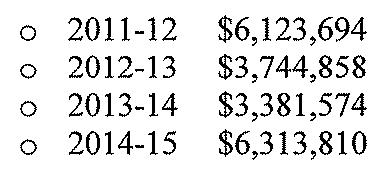
These are with 4K.  That’s about $19.5 million in savings, efficiencies, program and service cuts over four years (on top of whatever is saved/cut in 2010-11).  Yow.

The projected levy and tax impact numbers are another “yow.”  Some of these come in with 4K and without 4K versions.  These don’t reproduce well, so some just selected parts, figures and notes.

One interesting thing is that they are based on an assumption of no property wealth growth.  My guess is that property wealth in Madison will continue to grow slowly (easing the burden on individual taxpayers), but will grow faster than the rest of the state (leading to cuts in state aid).  How this balances out, I don’t know except that recent history inclines me to believe that Madisonians will be hurt more than helped.

In the “with 4K” projections, if the district taxes to the max and the deficits are met with Fund Balance spending and not cuts etc, the district goes broke in 2014 (no “without 4K version on this one).  Our younger son would be in Middle School that year.

Here is what the tax-to-the max mill rates and taxes look like for 2011-12 through 2014-15(with and without):

The current mil rate is 10.18 (on page nine of the linked document there is a fuller chart, with projections for homeowners that did not reproduce well enough to post).  These are huge tax increases.    Talk about unsustainable.

Insert obligatory Wisconsin Alliance for Excellent Schools and Penny for Kids links along with discretionary School Finance Network link.

Next up is MSCR Proposed Budget Reductions and Efficiencies for 2010-11.  There is much here.; position cuts, schedule changes to save overtime, program cuts, fee increases…much.

MSCR is an orphan.  Some with the school district believe that it is outside the “core mission” and this is true if you look at the strategic plan.  It isn’t true if you look wider and note that MMSD has accepted the taxation authority and responsibility for providing recreational programing.  I wish there was a Parks & Recreation Department in Madison (not necessarily under Kevin Briski), but there isn’t.  There is a hodge-podge and some of it is the the responsibility of the district.   Quality of life in Madison depends in part on a wide variety of recreational activities accessible to all  and like other quality of life matters this means that it is proper for tax dollars to be used to create and to some degree subsidize these activities.   There are a couple of places in the document with asides like (paraphrased)  “based on fees, more like the YMCA” or “maybe the Boys & Girls Club will do something.”  To me this is shirking responsibility.  Maybe not in every case, but as an attitude.

My impression is that there are real savings and efficiencies to be found, some justifiable cuts and fee increases, but a real need to keep opportunities and keep them affordable for all.

The total savings is $1,838,928.  Some big items (dollars and impact, no order):

  • Discontinue after-school contract for low income at Red Caboose and YMCA (my note:  the variety of after-school programs and varied costs of these needs to be addressed).
  • Reduce School Year and Summer Transportation (my note:  all good, except many parts of the city have no or almost no MSCR programing, I’d like to see this addressed also).
  • Increase staff to student ratio by 2.5%.
  • Shift Safe Haven Fee Waivers to Dane County Childcare Assistance (does the County know? Robbing Peter to pay Paul?).
  • Reduce Fee Waivers (adult and youth).
  • Raise Program Fees (some big and OK, some small, some seem too big).
  • Reduce Programing (Middle School, Summer, Penn Park, after-school enrichment, adult…)
  • Discontinue Safe Haven at Lindbergh (this isn’t sitting well with that neighborhood).
  • Much, much more.

Take  a look yourself, but do keep in mind that if we want Madison to be a rich and attractive place to live, part of the price is public support for the things MSCR provides.

Next, Proposal for a Lease and Contract to Permit the Construction of a Cellular/Communications Tower on Gompers/Black Hawk Property.

Then it is time for Approval of the “Resolution Authorizing the Issuance and Sale of $28,590,000 Taxable General Obligation Refunding Bonds”.  This is the retirement refinance/4K finance voted on here.

The last big item for this Committee is the budget time-line.  Feast your eyes:

It looks like an intense and unpleasant couple of months.

Everything else is Bills, Purchases and Contracts, Other Financial Transactions as well as the Human Resources update, (with lots of retirements, including Debra Stanko who did more than right in recognizing and addressing our older son’s talents and needs at JC Wright).

Among these, the Formative Classroom Assessment Tool Development and Data Sharing Agreement caught my attention and not in a good way.  The contract is with UW to pay a Grad Student to develop an I-Pod Touch assessment app.  Do we need this; do we want this?

The only reason that I can see to have an assessment app on a handheld device is to be able to assess while teaching, to enter assessment data while walking around the classroom.  I want my teachers in the moment, teaching.  This is the current obsession with data over teaching in a nutshell.  If this is the future, I don’t like it.

The last meeting is the Student Achievement and Performance Monitoring Committee.

The first item is a Madison School & Community Recreation (MSCR) After School Programs report.  This and other reports on MSCR should inform considerations of the proposed changes discussed above.

Then it is time for the long awaited (well over a year and a half late) Annual Equity Report.  A full consideration of this will appear in a subsequent post.  My initial impression is that there is one part part I think is based on a very good concept, but overall it is more than a day late and more than a dollar short.

The lateness and shortness are related significant failures.  The idea was to measure progress or document the lack of progress and the not only has much time been lost in setting the benchmarks, but the shortness has to do with the reports failure to provide those very benchmarks.

First the part I like conceptually.  The final portion of the report takes strategies recommended by the Equity Task Force and links them to things the district is doing, “Programmatic Resources.” . This is very interesting and useful.  I’ve got some doubts about some of the links and there is a certain impression of “we’ve got this covered” that can lead to complacency where urgency is needed.  Still I like the idea and much of the execution.

The Board Equity Policy includes this reporting requirement:

Administration will report on an annual basis to the Board of Education the extent of progress on specific measures in eliminating gaps in access, opportunities and achievement.

Obviously with the first report, progress will be difficult to report (that timing issue again); because of the lack of specific measures it will also be difficult with next year’s (the shortness).

At this time I’m not going to question the measures chosen for achievement, but rather criticize the presentation of the data related to these measures.   There is no raw data, no analysis (statistical or otherwise). Instead we are given selected factoids (the State of the District presentation which serves as the basis for much of the report suffered from a similar lack of information and rigor).

For now a couple of examples will suffice.

Is there any possible way to use this to measure progress or lack of progress?  Remember, this isn’t the analysis of the data presented, this is totality of the data.  They aren’t all that bad; this one is more typical:

At least here there are some numbers.

The other reporting requirement reads:

Administration will develop an annual report that will provide data on the distribution of staff, financial, and programmatic resources across all schools.

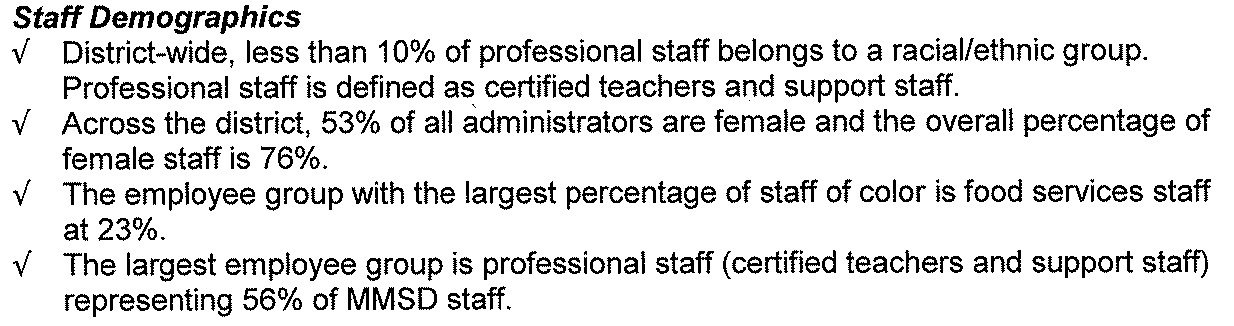
As I said above, the programmatic portion is a positive thing.  The staff and financial parts are another story.  Instead of looking at the staffing at particular schools (as was done for middle schools in 2006)  or reports on diversity in various jobs or schools (there was a Human Resources Report about 6 months ago that did the former, I’ll link to it when I get a chance) we get this:
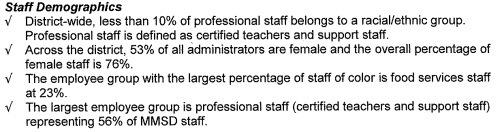
There is no there, there.  Factoids.  Nothing to work with.

In terms of resources, we are given explanations of the Equity Resource Formula and Title I, but no “data” on how these are distributed  “across all schools.”  Information is similarly lacking in other areas:  the goals of the Technology Plan are presented with an Equity framework (good), there is no information on the technology in or slated for particular schools and how that related to Equity (bad); The School Improvement Process is sketched and funds are mentioned (good), but there is no accounting of those funds (bad); Professional Development and Indigent Bus Passes are also mentioned.   More than a dollar short.

As I noted, I’ll be returning to what is and is not here in a subsequent post (see here for an earlier related post).

In closing this topic, I was recently reminded that the Board accepting a report is not the same as approving it.  I understand that, but think that this report should not be accepted.  It is unacceptable.  It does not meet the requirements of the Policy by any stretch of the imagination and does not provide a basis for assessing the future success or failure of the district’s Equity work.  We’ve waited long enough and can wait longer if we must; there is no excuse for not doing this right.

The High School Initiatives agenda item has much of interest on the REal work, the ACT/Eplore initiative, AVID, and the Individual Learning Plan implementation.  I’m not sure how much is new here and don’t have time to dig tonight.

The action items are Recommendations to Increase Usage of the Infinite Campus Student Information System, Renewal of DPI Waiver for Days of Instruction for Sixth and Ninth Grade First-Day Transitions, and Five-Year Education for Employment Plan (precursor to the first and the last were covered in previous “On the Agenda” posts).  Consent items are Learning Materials purchases, 57 High School Diplomas and the enrollment of students in Equivalency programs.

The other meetings this week are the Common Council/BOE Liaison Committee, Wednesday 5:30 PM at the City/County Building and the Superintendent’s Human Relations Advisory Committee, Thursday, 1:15, Doyle Building room 103 (agendas on the Weekly Notice).

Thomas J. Mertz

Leave a comment

Filed under "education finance", Best Practices, Budget, education, Equity, finance, Gimme Some Truth, Local News, Pennies for Kids, School Finance, Uncategorized

Ask Tom Barrett — Get School Funding on the Agenda

Click image to go to the "Ask Tom" page.

Almost certain Democratic Gubernatorial nominee will be participating in a live video chat on Sunday, March 7 at 4:00 PM.  You can submit questions in advance by clicking the image above or this link.  Now is the time to get school finance reform on his agenda, to make him know that this is an issue that potential voters care about. Ask about long term solutions, Penny for Kids, the current crisis or all of the above.  The more specific the better.

In a related matter, Republican Gubernatorial candidate Mark Neumann came out in favor of Education Excellence this week (I think he meant “Educational Excellence”).  A bold stand.  I hear next week he will be singing the praises of apple pie.

As one might guess the the specifics in most areas are lacking.  Some things caught my eye.  These two bullet points appear to be contradictory:

  • Giving public school districts the ability to ensure that tax dollars are directly benefiting the classroom. That means removing rules, mandates and regulations that are costing districts more and more money, and empowering local action to control costs.
  • Strengthening the state government partnership with public school boards, concentrating on enacting policies that ultimately demand excellence and accountability, while ensuring schools are safe and nurturing places for kids to learn.

Virtual schools and charters are singled out for praise and expansion.  More contradiction and fewer details here:

  • Keeping K-12 education funding as Wisconsin’s top budget priority and fixing the broken state budget process to ensure public schools and the UW System receive necessary funding.

He’s right that the budget process is broken, but part of the reason it is broken is that avoiding real revenue reforms,  — not K-12 education funding — has been the “top budget priority.”  Since elsewhere Neumann talks of keeping revenue growth below the rate of inflation,  it is doubtful that the fixes Neumann will support will be of help in providing schools the resources they need.  Very doubtful.

Thomas J. Mertz

1 Comment

Filed under "education finance", Budget, education, Elections, finance, Local News, Pennies for Kids, School Finance, Take Action

All the News from WAES

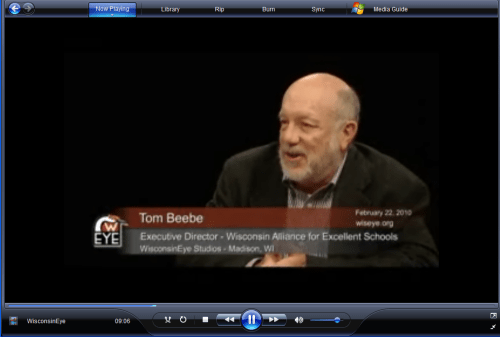
Click on image for video of Tom Beebe of WAES discussing Penny for Kids on WisconsinEye's Newsmakers

Things have been busy with the Wisconsin Alliance for Excellent Schools (WAES) and the Penny for Kids campaign.  Time to catch up a little.

Click on the image at the top for a fine interview with WAES Executive Director (and lone employee) Tom Beebe.  It really explains what Penny for Kids is all about.

The Rural Caucus presented some proposals on school-funding this week.  They aren’t bad, but they aren’t anywhere near enough.  WAES issued a press release, mostly saying that.  Here is an excerpt.

Their package of ideas addresses very real problems. For 15 years, schools and children have been subjected to an unsustainable school funding formula and now they are actually facing drastic cuts in state funding. As a result of this crisis, many schools are cutting personnel, services, and programs, others are fighting just to keep their doors open, and property taxpayers are being overburdened.

So while I applaud the Rural Caucus for their efforts, their proposal falls far short of what our children, schools, and communities need.The ideas forwarded by the Rural Caucus are Band-Aids and Band-Aids won’t stop this kind of bleeding.

What we urgently need is bold thinking and immediate, significant financial help – – a transfusion, not Band-Aids — as well as a long-term solution to the school funding crisis.

It is for this reason that the Wisconsin Alliance for Excellent Schools has launched “A Penny for Kids,” a program that has the support of thousands of voters. It proposes a one-penny increase in the sales tax in order to meet, head on, the revenue shortfall. This transfusion of revenue will buy us the time we need to address the structural failures of our current funding formula.

I appreciate the Rural Caucus’s willingness to take on this issue, but their solution falls far short of the urgent and significant reform that must begin now.

Last, but not least, the latest School-Funding reform Update from WAES (full update linked here, table of contents below with selected items linked to related posts on AMPS:

It is both good and bad that WAES is so busy.  It has become clear that WAES with Penny for Kids is the only group who have recognized the crisis that is happening and are trying to do something about it, in both the long and short term.   WAES can do this because we (I’m on the Board) are truly a grassroots organization, not beholden to the status quo or “the powers that be.”  As people realize this, WAES is attraxting more attention and interest.  That’s good.  The downside is that WAES is resource poor and over-extended.  We need more help from individuals and organizations.  Get in touch with WAES and find out how you can help.

Thomas J. Mertz

Leave a comment

Filed under "education finance", Budget, education, finance, Local News, National News, School Finance, Take Action, Uncategorized

The Move to Digital

A couple of days ago, Governor Jim Doyle announced a grant from the American Reinvestment and Recovery Act to improve the state’s telecommunications network. The goal of the award is to bring fiber optic broadband to 380 Wisconsin communities.  The $28.7 million BadgerNet project will expand infrastructure for rural schools and libraries, via phone lines, throughout the State.

Access to the Internet in the U.S. is about as common as having cable TV. Unfortunately, it’s still a luxury many families cannot afford.  The ongoing cuts in work hours and benefits, or loss of a job altogether, is of course tragic. For many of us, access to technology is something we tend to take for granted. In our increasingly technology-dependent age, access to a computer and the Internet is becoming quite essential. But many of our low-income families cannot afford a computer or Internet access in their home. Many low-income families are fighting hard just to maintain basic living standards.  With education becoming more dependent on the Internet, it’s even more critical that we level the playing field for all students and families.

But, as Mike Ivey of the Cap Times pointed out in his story this week, the reality is that Madison’s poverty rate is climbing — rising nine times faster than the rate of other U.S. cities, according to a new report from the liberal-leaning Brookings Institution, cited by Ivey. Since 2000, the poverty rate (defined as a family of four with an income under $21,800) in Madison has jumped from 15 percent to 17.7 percent. That’s one in every six residents. One of every two students in the Madison Metropolitan School District is now considered “low income” using the free and reduced lunch standard. In 1990, just one in five Madison school kids qualified.  According to the American Community Survey, an annual estimate from the Census Bureau, Madison added nearly 8,400 residents living below the poverty line between 2000 and 2008, a 29 percent increase.  Ivey cited the report’s prediction that “Madison will likely see its poverty rate jump another 1.1 percent this year, surpassing the average poverty rate for the 95 largest U.S. cities.”

In addition to BadgerNet, our school district is also trying to improve the various schools’ access to the internet and to better define its uses as a communication tool.  This access needs to be extended to the families of the students it services.  Jeff Richgels at the Cap Times reported yesterday that due to cost and a lack of digital literacy, over a third of the country does not have high-speed Internet access in the home (defined as non dial-up service).  Broadcasting & Cable reported on an FCC consumer survey that found that “more than a third of the non-adopters (28 million adults) said they don’t have broadband because the price of service is too high (15%); they can’t afford a computer; installation costs are too high (10%); or they don’t want a long-term service contract (9%). According to the survey, the average monthly broadband bill is $41.”

A recent story done by WKOW pointed to the conundrum, “a hard copy of the monthly school news letter is becoming less common these days. That’s one reason why Madison School leaders say they need to change with the times, and find new ways to communicate with parents and community members.”

MMSD posts plenty of information online in the form of press releases, a monthly newsletter, and a video of school-related interest.  They also have Infinite Campus so that parents can keep in touch with what is going on with their child.  Infinite Campus is a district-wide student information system designed to manage attendance, grades, schedules, test scores, and other information about the students in the MMSD.  The Parent Portal is a confidential and secure Web site where you can get current information about your child’s school attendance and grades.   E-mail hyperlinks facilitate communication with classroom teachers. In addition, schools post important information on the home page, such as events, notices, etc,. Attendance information is also available. The Parent Portal allows report cards to be viewed online and printed.

My concern is that in our move to a more online world, we are ignoring a large amount of low income and minority families that do not have an email address.  One example of this came to mind recently. Every year, MMSD asks parents to voice their opinions about the “climate” or feeling at their children’s schools.  They use the survey results to assist with the school improvement planning process.  This survey is available on the MMSD website although, it seems it was never sent out as a press release or included in the MMSD newsletter. The School Climate Survey was sent to the parent’s email address list as generated by each individual school. Surprisingly, this list is apparently not very comprehensive; two of our PTO officers were not on the list, despite having filled out the forms at registration and regularly receive emails from school personnel.

I hope that computers and the internet become as inexpensive as televisions and basic cable service.  Until they are affordable, MMSD cannot rely on the Public Library to be the way for low income families or minority families to access the internet and communicate with their children’s school district.

Jackie Woodruff

(Editor’s Note: We apologize for not crediting Mike Ivey’s fantastic reporting in this post in an earlier iteration posted yesterday)

2 Comments

Filed under "education finance", Accountability, Best Practices, Uncategorized

Action to the South

At Fred Klonsky’s Blog there was recently a mini version of an AMPS type “Buzzsaw/Cuts” post on school budget issues in Illinois:

On this Saturday morning, this is how the state of Illinois is dealing with its school funding crisis: In Lemont, in Galesburg, in East Richland, in Hoopston, in Kaneland, in Waukegan, in Eldorado, in Jasper, in Elgin, in Knoxville, in Indian Prairie District 204, in Plainfield, in Ottawa, in Orion near the Quad Cities, and in Quincy.

I can’t say if the state and school budgets are worse in Illinois or Wisconsin and it doesn’t really matter which has gone further or faster in the wrong direction.  Both are in bad shape and both states are dominated by politicians who believe their re-elections are more important than addressing this reality and the lobbyists and donors who reinforce this message.

At least in Illinois, people are fed up enough to try to make their voices heard.  They have formed the Responsible Budget Coalition.  The video above is from their February 17 rally.  Below is their “We Can’t Wait” video.

We may not have thousands at the Capitol yet, but interest in tax and budget reform is growing and thousands in Wisconsin have signed the Penny For Kids petition.  Click the link to join them.

Thomas J. Mertz

Leave a comment

Filed under "education finance", Budget, education, finance, Local News, National News, Pennies for Kids, School Finance, Take Action, Uncategorized, We Are Not Alone

On the Agenda — MMSD, Week of February 22, 2010

The main Madison Metropolitan School District meeting this week is on “Branding.”  The other meetings noticed are of the  Four-Year-Old Kindergarten Advisory Council (Monday, 9:00AM at 4C, 5 Odana Court), the Wellness Committee (10:00 AM Tuesday, Hoyt Building) and the Talented and Gifted Advisory Committee (Tuesday, 4:00 PM at Lapham).

The “Branding” meeting is labeled a “Community Engagement” session and  will be held at Marquette on Monday at 6:00 PM.   Here is how it is described on the District website:

Hosted by the Board of Education, the Engagement Session is an early step in the development of a communications plan aimed at ways to focus on positive branding of the MMSD school experience and to publicize the benefits of graduating from the MMSD.

The overall goal – from the school district’s new strategic plan — is to identify ways the MMSD can actively promote the benefits that all students derive from the challenging, respectful, inclusive education that Madison Schools provide.

The session is open to the public. Parents of MMSD students are particularly welcome.

After a short introductory presentation, attendees will break into smaller groups for discussion, followed by a brief report-out period. The session will be facilitated by Superintendent Dan Nerad and other district leaders.

Gayle Worland has more in the Wisconsin State Journal.  Some excerpts:

The desire to spiff up the public perception of Madison schools came out of months of discussions last year as a community team formed a five-year strategic plan for the district, said Superintendent Dan Nerad.

“There was a strong feeling that, one, we have a lot of positive things that need to be more proactively discussed,” Nerad said. “And two, as we face our challenges, (such as) becoming a more diverse School District and needing to meet the needs of a broad range of learners, it is even more important that we do this work.”

….

The district has given marketing firms until March 1 to apply for a two-year contract, at $43,000 a year, to create a communication plan. Monday’s public meeting is billed as an “early step” in the process, and officials said they have no idea what form any branding efforts might take.

….

Part of the message that needs to get out is how well Madison schools prepare students for college, said School Board member Ed Hughes.

“The benefits of going to a diverse school are really apparent to our graduates once they’re out in the world,” said Hughes. “But we could be better, I think, in communicating those benefits to people.”

Counteracting “street-corner conversations” is another hurdle, he said.

“You hear a discussion about school safety issues and concerns about academic rigor, and I think a lot of those are based on less than a full understanding of what’s really going on in our schools,” Hughes said. “The problem is that there is some kind of information that is kind of sticky – people hear it and that’s what they remember. If there’s a fight in the school, that’s what they know about. And how you get over those images and get people to take a fresh look at what’s really going on in the schools is a challenge.”

This school year alone, 589 students living in Madison opted to attend a different school district, while 172 students living outside the city’s boundaries asked to attend a Madison school.

Meanwhile, online schools run by districts throughout the state have ramped up their advertising in the Madison market, which only raises the stakes. For every student that leaves the district, it loses $6,443 in state aid.

More on Ed Hughes’ attempt to call attention to the way Virtual Schools are being used as a a “cash cow” to the detriment of state taxpayers and other districts and the benefit of the districts that host them in Susan Troller’s Cap Times post and Amy Hetzner from the Journal-SentinelSome background on how the well-funded lobbying campaign led by former State Superintendent candidate Rose Fernandez scared the Democrats off from addressing this issue here.  I wish Ed luck, but doubt that in this election year the Democrats have any more backbone.

For some background on the the long-delayed Communications Plan see the minutes of the August 23, 2007 Board meeting here.  The Request for Proposals for the Communications Consulting contract can be read here.

My own thoughts are that A) With the contact pending the session this week is putting the horse before the cart; B) The RFP could be more about enhancing communication with families with students in the district — something that has a direct effect on climate and achievement — and less about spreading the word to others; and C) I am glad this is getting some attention, think a consult is  agood idea but am skeptical that the potential will be realized.

The 4K group will be reviewing “output” (input?) from forums (I believe these are forums with providers) and setting a time-line for the next year.

I got nothing on the Wellness meeting.

I got lots on the TAG meeting agenda, but no time to write some of it up.  Unfortunately, I will not be unable to attend, so there won’t be a meeting report ( I can’t attend the “Branding” meeting either).

The most interesting thing on the agenda is a presentation on “Comprehensive Identification” by Committee Member,  UW- Whitewater Professor and Gifted Education professional Scott J. Peters.  Peters is a former student of “Cluster Grouping” researcher and consultant Marcia Gentry and recently completed a dissertation entitled “Practical instrumentation for identifying low-income, minority, and ethnically diverse students for gifted and talented programs: The HOPE teacher rating Scale.”

I am glad that they are starting with improved identification procedures.  As I have said, a successful and equitable TAG program must begin with purring in place procedures that are much, much better than those that have been used.

The work by Peters that I have had a chance to review holds some promise and serves as a reminder of why this is and will be difficult.

The key difficulty is that there is no real definition of giftedness; no scientific, professional or lay agreement about who should be receiving gifted services or interventions (much less what those services, programs or interventions should consist of).   Note I phrased this as “should be” not “would benefit from.”

I firmly believe that almost all students would benefit from most of the services, programs or interventions in place or contemplated for those classified as “gifted.”   This isn’t to deny that there are some students who “need” these services, programs and interventions or that there are some who are “profoundly gifted” and I agree that it is the duty of any responsible educational institution to recognize and address this.

There is a related difficulty and that is that gifted programs have historically been disproportionality populated by white, middle and upper class students (for an exploration, see:  Barlow and Dunbar, “Race, Class, and Whiteness in Gifted and Talented Identification: A Case Study“).  This has become politically untenable and has been morally indefensible.  For advocates of expanded TAG programing and those in the gifted industry (like Peters), the lack of a definition provides a way around or out of the problem of disproportionality.

Whether it is by promising to recognize giftedness in multiple domains or  — as Peters’ work does — improve teacher referrals, the lack of a definition means that there is  a lot of room to work with.  Gifteness is whatever they say it is and with that as the first principle it is possible to say 1% or 30% or 99% of students are gifted and locate giftedness among diverse students in any proportion you desire.

Of course in these days of  data fetishes, it helps to have some numbers to crunch.  Peters crunches numbers and crunches them very well.  With the Hope Scale, he has produced an instrument for teacher referrals that is consistent and clean internally and demonstrably nearly sociio-economically non-discriminatory (his sample had very few African Americans and he presents this as a work in progress).  See his “Initial Validity Evidence for the HOPE Scale: New Instrumentation to Identify Low-Income Elementary Students for Gifted Programs” for some fine number-crunching and note that the “validity” in the title is internal validity because with no definition there is no possibility of external validation.

Returning to the elasticity of definitions  as both an opportunity and problem, I was particularly struck by this instruction given to teachers using the Hope assessment (there is a discussion of this in this paper co-authored by Peters):

“When completing this form please respond by thinking about the student compared to other children similar in age, experience, and/or environment”

Elsewhere, in a review of  David Lohman’s Identifying Academically Talented Minority Students Peters wrote:

Lohman’s argument is thus that the more specific the norm group used for comparison, the better. This is true for groupings such as income, race/ethnicity, as well as school or grade-level groups. The use of narrowly defined comparison groups allows educators to see which students are achieving or have the potential to achieve given similar background and circumstances.

I have to think about this.  On one hand, I appreciate the recognition of bias and the desire to overcome it.  On the other hand I see something like “she’s smart, for a poor girl” happening and I don’t like that.  I have to think about it.

I have friends who say that whenever I write about TAG issues it is overwhelmingly negative.  I like to think of  it as more skeptical than negative (and in this post also observational/analytical), but they do have  a point.

With that in mind, I want to close by emphasizing how happy I am that MMSD is trying to improve identification,   repeat that despite my criticisms I see promising things in Peters work and am glad that MMSD has the benefit of both his general knowledge of the field and his ongoing research, and once again say that I support efforts to improve transparency, consistency and services in the TAG area (not every manifestation, but the some and the idea of doing these things).

On an unrelated topic, Lucy Mathiak’s “The Edgewater TIF. Or, Can I Use My MasterCard to Pay My Visa Bill???” is a must read (I don’t know when the Edgewater TIF will go before the Board of Education — not “on the agenda” yet —  but Lucy Mathiak is the Board rep to the TIF Board).

Thomas J. Mertz

Leave a comment

Filed under Best Practices, education, Gimme Some Truth, Local News, Uncategorized