Following the Money — MMSD Budget Updates (part 1)

segal-600sub

Clyde McPhatter & the Drifters-“Money Honey” (click to listen or download).

Busy, busy time at the Madison Board of Education.

At the Monday, August 10th meetings, in addition to the Talented and Gifted Program Plan, new limitations on the transportation of homeless students, middle school report card evaluation (more linked here), Singapore Math, and much, much else; there are big items involving the Budget Gap created by the State Budget and the use of American Recovery and Reinvestment Act Title I and IDEA funds.

The Budget Gap document is interesting and intriguing, though not terribly detailed. For those who need a reminder of the situation the district finds itself in, here is how Supt. Dan Nerad describes their circumstances:

The amount of revenue the district is projected to lose amounts to $2,810,851 for the 2009-10 school year compared to the preliminary budget approved by the board of education. This amount is due to the decrease in numerous categorical aids the school district receives annually and the reduction of the per pupil increase from $275 per child to $200 per child.

The amount of state aid the school district is projected to lose is in 2009-10 is approximately $9.2 million. Under current revenue limit laws, for every dollar of state aid lost, the school district would have the ability to increase taxes by that same amount. Over the past month, administration has worked to mitigate the tax impact due to the loss in state aid.

There are two documents attached as initial recommendations to the Board for discussion. The first is described as utilizing “four specific budget areas to apply a decrease in funding without a reduction or elimination of programs and services.” There are only three listed.

These three are the fund for contingencies and re-budgeting the Elementary Teacher and substitute projections “based on historical” reviews and analyses (I’d like to see these!). These adjustments total $2,810,851.

This all seems good. The re-budgets are related to issues around the Fund Balance and “Salary Savings.” It gets a little complicated, but I think it is worth at least sketching (if you aren’t interested in a little history, please skip down because there is important current stuff below).

“Salary Savings” is an accounting concept that some entities use (some abuse it too). It is based on the reality that allocations for staff are often unfilled — temporarily or permanently — or filled at costs below the allocation. A classic example is when a teacher goes on leave. If for some portion of that period a substitute is employed, the difference between the salary and benefits of the teacher and the substitute would be a (salary) savings. Many public entities budget salary savings at between 1% and 2% of their personnel budgets.

In the minds of some, MMSD abused Salary Savings for a few years. In order to limit programmatic cuts they used unrealistic projections. This led to spending down the Fund Balance.

As the 2007-8 budget was being prepared and considered the district fell under the sway of a fiscal conservative over-reaction. Salary Savings had recently been budgeted in the range of $5 million to $7 million (if I remember correctly) and the reality had been about $2 million or $3 million less (again, if I remember correctly…the figures might be off, but the trends are right). The Fund Balance was shrinking and some Board members were making political hay on this.

When the initial 2007-8 budget was prepared, Salary Savings were projected at $1 million. You may remember that budget. The 2007-8 fiscal year was the year that MMSD almost closed schools; did decimate locally funded class size reductions, did reconfigure special education; did initiate the Athletic Director mess; did reduce allocations for psychologists, social workers, reading specialists and English Language Learning; did eliminate yellow buses for Wright and Spring Harbor, did initiate the private school busing mess.

That budget produced a Fund 10 surplus of $4.3 million. The 2008-9 budget also under-budgeted Salary Savings and a surplus is anticipated.

Another way of phrasing this is that these budgets over budgeted salaries and benefits. That is the way Asst. Supt. Erik Kass likes to think of it.

Erik Kass doesn’t like the concept of salary savings and is working toward more accurate initial allocations. That’s the basis of these re-budgets. The history is why I think it is sound policy.

The third part is the “Tax Impact Solution,” and I am not 100% clear on how to read this, but can at least point out some things. Below is an unclear image file, click here for the full document pdf.

tax impact

The biggest news here is that MMSD is proposing not to tax to their maximum revenue limit in 2009-10. Of $245,140,473 in taxing authority, MMSD proposes to use $237,625, 752; they have authority to increase projected taxes on a $250,000 home by $162.50 and the proposal is to raise taxes on that home by $82.50 (this is from all funds).

As Governor Jim Doyle and others continue to pretend that the revenue limits are all that is wrong with school funding in Wisconsin and pass budgets and propound schemes (and here) that shift more of the burden for educational investments to local property taxes, the fact that a prosperous district in a community with a track record of valuing education does not have the political will to tax to the limit is hard evidence that the problems go well beyond the revenue limits and require a comprehensive solution. New Berlin and Appleton are among the other districts that are not taxing to the max. This is a trend I will be posting on in the future.

Technically, MMSD is proposing to tax to the max with the Fund 10/General Fund and is cutting the taxation for debt service and for Fund 80/Community Services. I believe this is related to state laws that take away revenue authority if it is not used in consecutive years. The way they are doing things should provide more flexibility to not tax to the max in 2010-11.

Whatever happens with the 2010-11 budget/tax decisions, things will be ugly that year and the year following. The projections in this document are for a $110 tax increase on a $250,000 home in 2010-11. The pressure against that increase will be high. 2010-11 will also bring more cuts in categorical aids, as well as more cuts due to the structural gap between allowed revenues and costs. 2011-12 will bring the end of stimulus funding. The maintenance referendum runs out some time in here too. Repeat after me: “We need comprehensive school finance reform.” Send that message to the powers that be.

The document is not clear on how the debt service will be paid. My guess is that the Fund Balance will be used.

The second part of the document promises “no reductions in programs or services,” but the third part reduces the projected levy for Fund 10 from the preliminary budget by $900,00 (the preliminary budget had reduced that levy by $1.5 million already and used the Fund 10 Fund Balance to make up most or all of that amount). There may be some cuts here, or there may be more use of Fund Balances.

Stay tuned for more as things develop.

This post is titled “part 1”; part 2 will be on the ARRA plans. I don’t know when I will get to that. Here is a link to the document. For now, a few highlights/observations based on a first read:

  • Proposals for these monies include some 4 Year-Old Kindergarten start up costs, some Ready, Set, Goals costs in Title I schools that may not be within the guidelines. Communication with DPI is ongoing.
  • Culturally Relevant programming/development/staffing is included.
  • Dual-Immersion implementation is included.
  • There is some parent/community outreach development funding.
  • Millions in technology purchases are included .
  • This money will go away in two years!
  • Some of the needs addressed will not go away.
  • This will mean that cuts must be found here or elsewhere.
  • We need comprehensive school finance reform.

Thomas J. Mertz

1 Comment

Filed under "education finance", Best Practices, Budget, education, Local News, School Finance, Take Action, Uncategorized

MMSD “Gifted” Program Plan — No Thank You

roy-lichtenstein-no-thank-you

Roy Lichtenstein, "No Thank You."

The Madison Board of Education will be considering a “Talented and Gifted Program Plan” at their Monday, August 10, Student Achievement and Performance Monitoring Committee meeting. It is on the agenda as an action item for the August 17 regular Board meeting. This plan was developed outside of the public eye — no noticed meetings of the Advisory Committee, no published minutes — and the first look any interested citizens have had was when it was posted on Friday. August 7.*

Although there are some things I like in the plan, my initial overall reaction is “no thank you.”

My number one reason for urging rejection is the lack of attention given to demographics in the plan. The word “minority” only appears in reference to the Minority Student Achievement Network, the phrase “low income” does not appear. There is nice language about increasing the “identification of students from underrepresented populations,” and researching “additional assessment tools that are non·biased, multi·cultural,” but at the time of implementation (September, 2010), the screening and identification measures that will be in place (the WKCE, the Primary Math Assessment, the Primary Language Arts Assessment, TOMAGS, Writing Samples, Middle School Math Assessment, referrals, and even the Torrance Test of Creative Thinking) do not have great track records in these areas (there is also a mention of MAP tests, but the meaning of that mention is not clear). Additionally, with the exception of the Torrance (and maybe TOMAGS) tests, these are all achievement, not ability, measures. They are not designed to be employed in the manner contemplated by the plan.

I said there are some things I like. These have some potential. I’m going to touch on three now (there are more — like the consistency throughout the district — that I don’t have time to delve into).

The first one is the requirement that the evaluation use data disaggregated by demographics (it also calls for annual reports, but as the case of the Equity Policy indicates, don’t hold your breath waiting for that). This is good. It would have been much, much better if the committee had instead begun their work by assessing the the current demographic inequalities in Talented and Gifted and advanced opportunities in MMSD.

The second is a guideline from the National Association for Gifted Children. In general, I am uncomfortable with the cut-and-paste inclusion of materials from a lobbying/advocacy organization in the plan, but this one is good:

Gifted programs must establish and use an advisory committee that reflects the cultural and socio-economic diversity of the school or school district’s total student population, and includes parents, community members, students, and school staff members.

This is clearly not the case with the current committee (is there a single member whose family income would qualify for free or reduced lunch? Do the families of 44.6% of the members?). Unfortunately, the locally produced “action steps” call for the current committee to continue and a sub-committee to be formed from current membership. This needs to be changed.

I also like the “Differentiated Education Plans,” but limiting these to “Talented and Gifted Students” is wrong. The one thing from the Strategic Plan draft that I can endorse without reservation is the policy of Individual Learning Plans for all students. This would be a wonderful but expensive reform. Only individualizing for those perceived as “Talented and Gifted,” is offensively inequitable.

Back to the things I don’t like (as you can tell, the lines are a bit blurry). Just two more that I have the time to address.

The plan asks the district to commit to “cluster grouping” in classroom assignments. The research on the benefits of “cluster grouping” is thin, the applicability of this research to Madison is questionable, and the potential for harm is great.

Since the Advisory Committee did not deign to provide the Board or the public with an extended exploration of what “cluster grouping” is, I’ll offer a little more here (contrast with this literature review provided to the Clayton, Mo. Board and note that if MMSD wants to do its own version there will be no extant research on that version).

According the Cluster Grouping Handbook, the practice requires dividing students into quintiles based on “local criteria” (that means those tests and referrals that have been so successful in bringing diversity to Talented and Gifted programs in Madison and elsewhere). The five groups are labeled Gifted, High Achieving, Average, Below Average, and Far Below Average. In classroom assignments, the Gifted are isolated from the Far Below Average and the High Achieving; the students are otherwise mixed. I repeat, the main “innovation” is to keep the “Far Below Average” and the “High Achievers” away from the “Gifted.”

Every student in Madison will be slotted into one of these categories and decisions concerning their education will be made based on incredibly imperfect assessment tools. We are talking about five and six year olds.**

As I said, the research on the supposed educational benefits of this is thin (in contrast, the research on the flaws of these assessment and referral practices, and on the harm done by labeling, is voluminous). The authors of the Handbook cite exactly two empirical studies. One of these is the unpublished Doctoral dissertation of Handbook co-author Dina Brulles. I could not find any peer-reviewed or non peer-reviewed publications of Dr. Brulles research. The other is a widely cited (but also not peer-reviewed) study by Marcia Gentry. My extensive searches of databases turned up other empirically based publications by Gentry, but none by other authors. I would welcome any citations.

Doctor Gentry conducted her research in schools that were less than 1% minority. Given the history of grouping practices and the demographics of Madison, I think extreme caution should be used in asserting the reproducibility of Gentry’s results in our district.

Additionally, the lack of diversity in her study means that important issues such as segregative and unequal impacts were not examined. At the very least, prior to implementation, the Board of Education and the public should be provided with assessments of segregation based on a trial run of the cluster grouping scheme. If the practice is implemented, these factors should also be included in all evaluations.

One of the asserted advantages of “cluster grouping” over tracking is that it allows for mobility among the quintiles. If cluster grouping is implemented, measures of this mobility in practice should also be part of evaluations. As Doctor Willis D. Hawley has noted, “Ability grouping often turns into tracking” (read the whole linked document for a fine introduction to the issues).

Cluster grouping may appear to be a politically attractive compromise. I am generally wary of both political compromises and grouping schemes in education policy, especially when the research basis for the desirability of the compromise is almost nonexistent. I urge the Board of Education to be wary also.

The other big area where I find the plan lacking is not about Talented and Gifted programing per se, but about advanced and honors programs and courses. The plan includes these action steps:

Develop a plan to increase participation of students in advanced courses, including support systems for transition to and completion of courses, and greater consistency in eligibility requirements across the District.

Review the design, implementation, and requirements for District embedded honors courses. Survey teachers, parents, and students to determine effectiveness and interest.

The idea is good, but do we really need a plan and a review? Here is what the Equity Task Force said in a recommendation that was never discussed in public by the Board of Education:

Open access to advanced programs, actively recruit students from historically underserved populations, and provide support for all students to be successful.

Pretty simple and it could be done tomorrow.

I’ll admit that some work would be needed to determine which courses have legitimate prerequisites, but with little effort, things like the “advanced biology placement test” and screening for 8th Grade Algebra could be tossed in the dustbin of history where they belong.

These entry level courses, the first rungs of the ladder, are the key to opening access; the barriers need to go. As long as the district puts these first rungs out of the reach of students who want to be challenged, inequalities will continue to be reproduced and upward mobility will be exception not the rule.

One related side note. These barriers are the reason I hate the “raise the bar” language that the Board of Education recently added to the Strategic Plan. We have enough bars keeping people out; the ambiguity invites more and higher bars.

Last thought is that the long-term costs — financial but also human — of this plan are not clearly explored in the document (there is offered a one year, prior to implementation figure of $83,000).

I’ll be offering some version of this critique in public testimony to the Board on Monday, August 10th. If you have thoughts — whether in agreement or disagreement with what I have written — please join me or email to comments@madison.k12.wi.us.

Thomas J. Mertz

*[Note: Because the Advisory Committee that produced the plan was not appointed by Board of Education, it is unclear if open meetings statutes are applicable, see: Staples Correspondence, February 10, 1981 and a 1991 memo to former MMSD Legal Counsel Clarence Sherrodd. If the Board approves this plan with the authorization of a continued Advisory Committee, that committee will be required to post meeting notices and publish minutes. Whatever the legality, it is not a good policy to have a plan which will effect every child in the district drafted without public scrutiny or input.]

**[Note: I am not clear what procedures are currently being used by MMSD although I have heard talk that some “cluster grouping” is going on. For sketchy information on current practices, see here and here.]

Leave a comment

Filed under Accountability, Best Practices, education, Equity, Local News, Take Action, Uncategorized

Race to the Bottom? – Quote of the Day

declineOverall, our results consistently indicate that the increased focus on individual teacher performance caused a sizable and statistically significant decline in student achievement. This decline in achievement is also much more pronounced in the case of national exams with an e ffect of up to 40% of a standard deviation. As in the different effects in terms of internal and external results, our triple-difference evidence also documents a significant increase of grade inflation. In addition, in support of a causal interpretation of our results, we also find that in almost all specifications and dependent variables there are no significant differences between the treatment and control groups over time before the introduction of merit-pay. Finally, the inclusion of different control variables or the consideration of different subsets of the data makes only very minor differences to the size of our estimates, as would be the case if assignment to treatment were random.

Graph and quote from Pedro S.  Martins, “Individual Teacher Incentives, Student Achievement and Grade Inflation,” Institute for the Study of Labor (2009).

In 2007 Portugal instituted a merit pay plan.  Azores and Madeira (the graph above) and private schools were excluded.   Using these as a control, the quoted study found that this merit pay plan resulted in a decline is student achievement.

Arne Duncan and Barack Obama have made incentive pay plans a centerpiece of their “Race to the Top” scheme.  It may be a path to the bottom.

More on the “Race to the Top” later this week.

Thomas J. Mertz

Leave a comment

Filed under Accountability, Arne Duncan, Best Practices, Contracts, education, Gimme Some Truth, National News, nclb, No Child Left Behind, Uncategorized

Student Orientation Day Fee, Updated (and updated again)

From Johnny Burtito's Ugly Money (click for more)

From Johnny Burrito's Ugly Money (click for more)

Update (8/27/2009, 5:15PM): I learned from Asst. Superintendent for Secondary Education Pam Nash, that West will follow the example of the other High Schools and find a way to fund the Freshman Orientation activities and refreshments without charging a fee.

I’ve been given more information by a Board of Education member and asked to “correct” my previous post on the Freshman Orientation Day fee at West High School.  The new information is welcome and I am glad to share it, but since this information does not contradict anything in the initial post, this is an update, not a “correction.”

I am told that this fee has been in place previous years.  I have no easy way to check that because the Regent Reporter is not archived on line.  As I noted previously, the fee does not appear on the Madison Metropolitan School District web page on 2009-10 student fees.  Nor is it mentioned in a 2005 report to the Board of Education on student fees. Based on this I wrote “It appears to be a new fee.”

I am told that it is used for “ the cost of the food and carnival.”  In the previous post the possibility that it was for refreshments was considered;  I hadn’t realized that there was a carnival involved.

I repeat that if transitions are a priority, they should be funded by the district.

I also want to add something more, based on the DPI Guidelines. That document permits fees for  “[s]ocial and extracurricular activities, as they are not necessary elements of a high school career (emphasis added). This is the crux. If the orientation is necessary, it should be free.  If it isn’t, then students should be able to decide if they want to pay for food and carnivals (bread and circuses?) or not.

A five-spot won’t buy much these days, but I still think the fee is wrong.

Thomas J. Mertz

Leave a comment

Filed under "education finance", Budget, education, finance, Local News, School Finance

This is Wrong – $5 Freshman Orientation Fee (updated)

From Johnny Burrito's Ugly Money (click for more).

From Johnny Burrito's Ugly Money (click for more).

Update (8/27/2009, 5:15PM: I learned from Asst. Superintendent for Secondary Education Pam Nash, that West will follow the example of the other High Schools and find a way to fund the Freshman Orientation activities and refreshments without charging a fee. See here for an interim update.

I just learned that all 9th graders at Madison West High School will be charged a Freshman Orientation Day fee of $5 (I don’t know about the other High Schools).  This is wrong in so many ways.

It is wrong because — as recent Board of Education discussions and the draft Strategic Plan acknowledge — transitions are important, difficult and need attention.    Giving attention to transitions should be a district funded matter, not self-funded by the students and their families.

It is wrong because the preliminary 2009-10 budget passed in May includes the statement:

Student fees of all types are assumed to be unchanged for 2009-10

The MMSD website listing of 2009-10 fees does not include this charge.  It appears to be a new fee that was instituted without  public discussion or  Board of Education approval (in the past, the Board has taken an interest in student fees).

It is wrong because it may be illegal.   It depends on what the fee is for. According to the 1974 case State v. Sinclair (cited in this DPI information sheet) a Wisconsin Circuit Court ruled that the state constitutional guaranty of public education “”free and without charge for tuition to all children . . ” prohibited fees  “”charged for instruction.”  If the Freshman Orientation Day fee is for instruction, than it is illegal.

In the same case, the court permitted fees for extracurricular activities.  However, the orientation is mandatory and extracurricular activities are generally not.  It is not clearly against the law to charge for a mandatory extracurricular activity, although the whole idea of  a mandatory extracurricular activity and a fee for that activity invites care scrutiny.  This hasn’t happened.

It may be that the fee is for pizza or other refreshments.  In which case, requiring students to pay for food they may not want or consume seems wrong too.

Someone, the Board of Education or the administration, needs to give this some attention and kill the fee.

I  know money is tight, but this is not the answer (btw – the district needs to update their budget page, it still has the “everything is hunky-dory” material from the Spring).

Thomas J. Mertz

3 Comments

Filed under "education finance", Best Practices, education, Equity, finance, Local News, School Finance, Uncategorized

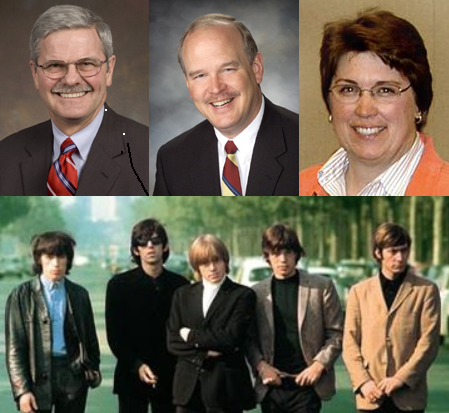
3 State Senators and 3 Rolling Stones’ Songs

3 and 3

Statements by three Wisconsin State Senators on education in the 2009-2011 biennial state budget brought to mind three songs by the Rolling Stones, so I’m offering some special dedications.   Read, listen, think, act (click on their names to contact the Senators).

Before getting to the excerpts from the statements and the songs I want to say that whatever my opinion of the statements themselves, I want to applaud the Senators for talking about this in public.  It takes a little courage to address these difficult issues and if nobody is talking no progress can be made.

Senator Mark Miller:

“[T]he state’s complex school finance formula…can’t be changed easily.”

In the Wisconsin State Journal.

The Rolling Stones , “It’s Not Easy” (click to listen or download).

We all know it is complex and that change isn’t easy.  As noted in regard to Miller’s fuller statement, change requires work and that work is the responsibility of the State Senate and Assembly.

Senator Dale Schultz:

“I thought protecting education should have been the top priority in the budget, but instead students and property taxpayers are shortchanged with less state aid,” Schultz said.”…

“State school aid is important for our kids and for property taxpayers and it should have been a higher priority.”

State budget hits local schools and property taxpayers.

The Rolling Stones, “I Am Waiting” (click to listen or download).

Senator Schultz has been in his position since 1991; before that he served a decade in the Assembly.  By the standards generally applied to Republicans in Wisconsin, he has been considered a “friend of public education.”  This is mostly because he often says something close to the right things.  Words are nice: actions are needed.  Leadership would be even better.  I am waiting.

Senator Kathleen Vinehout:

“We don’t have the money to do school funding reform,” goes conventional wisdom around the Capitol. It costs money to fix the funding formula and money is in very short supply.

Given the state’s fiscal condition, many considered any reform of school funding impossible. But in our Senate District schools simply can’t wait….

As one man from Pepin said, “We have got to start somewhere and we have got to start right now.”

Fixing School Funding One Step at a Time.

The Rolling Stones, “You Can Make It if You Try” (click to listen or download).

This last song goes out to all the Senators and Members of the Assembly, but Senator Vinehout seems to display more of the “can do,” “get-er’-done” spirit than most who work at the Capitol (including elected officials, staff and lobbyists).  As the Miller quote indicates, many will always find reasons why progress and reform can’t happen.  I believe it can and must happen.  The first step is trying.

Thomas J. Mertz

1 Comment

Filed under "education finance", Budget, education, finance, Local News, Pope-Roberts/Breske Resolution, Quote of the Day, School Finance, Take Action, Uncategorized

We are (Still) Not Alone

From the Wisconsin Department of Public Instruction (click on image for pdf).  2009-10 will look even worse.

From the Wisconsin Department of Public Instruction (click on image for pdf). 2009-10 will look even worse.

It has been a long time since there has been a “we are not alone” post, reminding Madison readers that school finance is a state issue and needs a state solution.

It has been so long that there are many, many  stories of school cuts and layoffs in Wisconsin from the last few months that I never got around to noting.

I want to begin with one of these older items —  a story from before the state budget was passed — and then move on to more recent post state budget things.  As districts struggle with the difficulties that budget has produced  it is essential that these be understood  in the context of 16 years of struggles under our broken school funding system.

The story is from Appleton and the headline says much about the erosion of education in Wisconsin: “Award bittersweet for laid -off Appleton teacher.”  Here are some excerpts:

Appleton North High School teacher Kevin Deering will remember the last day of the school year with equal parts pleasure and pain.

On one hand, students surprised him Thursday by voting him North’s
Educator of the Year. On the other, it was Deering’s final day on the job after
district cost cutting forced layoffs of dozens of teachers for next school year….

“It’s kind of an emotional thing,” he said afterward. “It’s a bittersweet ending
to get voted Educator of the Year and not being able to come back. When I
came to North I never thought I’d be leaving two years later.”

Deering, 27, is in his fourth year of teaching, two of those in Appleton. He
teaches physical science, genetics, and biology. He is an advisor for Link
Crew, a program that eases freshmen into high school life, and has coached
girls track at Appleton East, football at North and boys track at North.

“He will be missed,” said North Principal James Huggins…

The layoffs are the result of budget cuts that became necessary after a
failed referendum in February and account for more than half of the district’s
$3 million deficit for 2009-10 that was projected in March.

With the state budget in deeper trouble than first thought, that figure could go higher.

Unlike last year, when most laid-off teachers, including Deering, were called
back, the number who will not return is substantial.

Due to the finalized state budget, we can now say it is all but certain the 43 teachers laid off earlier in Appleton — and the 40  teachers laid off by Oshkosh in March and all those laid off previously in other districts because the school funding system has been broken for 16 years —  will not be called back.  From bad to worse.

Oshkosh is now looking at more layoffs.

In the state budget Oshkosh was hit with a 3.76%, $2.3 million cut in general aid, as well the minimal revenue limit raise and categorical aid cut all districts must address, creating a $3.2 million hole to be filled (see here for an initial compilation of the impact on of the general aid changes to all individual districts).

As I write this the Board of Education is considering a depressing list of options which includes layoffs to paraprofessionals, counselors, interpreters, administrators  and teachers (art, physical education and technology have been identified as possibilities); eliminating programs such as marketing; raising class sizes; raising taxes; and closing schools.

Update: WBAY and NBC26 report that the Board voted to close Green Meadow and Lincoln Elementary Schools.  They also rejected the option of not filling open positions.

Yes, closing schools, in July.  Video here from WLUK-TV of parent reactions to the news that their childrens’ schools are on the chopping block less than two months before the start of classes.

As the Northwestern reports, the families are angry.  They are pitting one neighborhood against another, saying that different schools should be closed and saying the “”Oshkosh Area School District’s administrators and board members unfairly targeted Green Meadow.”

The anger is understandable and even good, but it needs to be redirected to the state officials who put the district in this impossible situation.

A few paragraphs from one of the Northwestern news story:

Administrators feel trapped by the unexpected revenue shortfall – the state has never before cut aid to schools in the 16-year history of the existing funding formula – because employment contracts have already been set. Reduction options are now limited to vacant positions and staff who were handed initial layoff notices in February but not let go in the first $2.2 million in budget cuts approved in May.

That means the proposed staffing reductions are based on limited options rather than student needs or interests, Lang said.

“All of our choices have a negative impact one way or another,” she said. Staff cuts hurt immediately, while reductions to site budgets or maintenance services could haunt the district in future years.

“We’re already living with the long term detriments from cuts made 10 years ago,” she said, referring to the district’s deferred maintenance problem….

On one end of the debate sits Board President Ben Schneider II, who said he would struggle to support a plan that raises taxes more than 3 percent.

“I don’t want to shock the system by shifting it all onto the tax payers,” he said. “I’m of the opinion that during a terrible economy we should be reducing taxes.”

Board member Karen Bowen, on the other hand, said she’d prefer a double-digit tax increase to cutting any more teachers or programs.

“I don’t think people really understand what our district will look like if we have to cut much deeper,” she said.

Bowen is right that people don’t understand.  Otherwise you wouldn’t have powerful people like new Wisconsin Democratic Party Chair Mike Tate making ridiculous and insulting claims that the state budget “strengthened” education.   Districts need to educate their residents about the state of school finance in Wisconsin and then we all need to educate our state leaders and get them to act.

Bad news in Northeastern Wisconsin also, especially Door County.  Because of vacation homes, Door County is a high property value area  In combination with declining enrollment this has meant real problems for these districts under Wisconsin’s school finance system.  Since the full time residents who vote in referenda are not wealthy, they have also had great difficulties applying those temporary band aids.  The decline in relative state funding in the recent state budget aggravated the existing problems (click here for details of  how the similar “The Lake Effect”  combination has hit Northern Tier districts).  Here is what the Press Gazette reports some Door County districts (and others) are facing:

  • “Sturgeon Bay is set to take a 15.19 percent hit in general aid, according to this month’s estimates from the state education department. That change will take the 1,100-student district’s general aid allocation from nearly $5.2 million to nearly $4.4 million.”
  • “The Southern Door district also is facing a 15.19 percent decrease in general aid, according to state estimates. That change will mean the district takes in $3.2 million in general aid instead of nearly $3.8 million.”
  • “The Sevastopol School District is facing almost an identical cut, an estimated 15.18 percent, as is the Gibraltar School District, an estimated 15.17 percent.”
  • “In Marinette County, the Crivitz School District is facing a 15.18 percent decrease in general state aid. Funding could drop by about $172,000, from $1.1 million to $963,000.”
  • “In Ashwaubenon, the reduction will drop general aid allocation from more than $12.5 million to nearly $11.9 million.”

Bad all over.

A few more.

Wausau Daily Herald, “Everest, Merrill school districts face shortfalls.”

Reedsburg Times Press, “School will resort to tax hike.”

Racine Journal Times, “”Unified prepares for budget task ahead.”

Kenosha News, “Lower state aid might force cuts in Salem schools” (AMPS readers might recall the referendum struggles in Salem).

LaCrosse Tribune, “Tax hike ahead? La Crosse school officials point out ‘worst-case scenario.’”

And one last reminder that despite what Governor Jim Doyle has tried to get you to believe, at the local level ARRA Title I and IDEA stimulus  funds mostly cannot be used  not make up for the short falls.

Racine Journal Times, “Stimulus, strings attached: Four federal grants for Unified won’t help much with budget shortfall.”

Stay tuned for more (sadly).

If you want less, you have to get involved in the reform efforts.  Click here for a guide to organizations to join, links to contacting the media and state officials and more.

If we all sit back and shake our heads at how bad things are but do nothing more, this will never get better.  Get involved.

Thomas J. Mertz

1 Comment

Filed under "education finance", Accountability, Budget, education, finance, Gimme Some Truth, Local News, Referenda, referendum, School Finance, Take Action, Uncategorized, We Are Not Alone

WAES School Funding Reform Update, Week of July 20, 2009

waesgraphicFrom the Wisconsin Alliance for Excellent Schools.  Table of contents below (with links to related AMPS posts); PDF of full update here (click and read, good stuff!).

  • State budget dust-up drawing attention to need for reform
  • Evers, new DPI head, commits to school-funding reform
  • More ammunition proving adequate funding makes a difference
  • Now is the time to sign up for a funding reform presentation
  • WAES membership keeps the reform message before the public
  • New video explains the basics of school-funding reform
  • Wisconsin gets good report from American Diploma Project
  • School-funding reform calendar

Thomas J. Mertz

Leave a comment

Filed under "education finance", Best Practices, Budget, education, Equity, Local News, School Finance, Take Action

Worth Reading

Bernard Zakheim WPA Mural

Bernard Zakheim WPA Mural (click for more information)

The School Finance Network (SFN) and the Madison Board of Education released reactions to the education provisions of the recent state budget today. Both are worth reading.

The SFN release seeks “Truth in Budgeting” by presenting some “not-so-well-known facts.” The first should be familiar to AMPS readers:

Not-so-well-known Fact #1: The ongoing difficulty of school boards and administrators in making ends meet is not the result of a lack of oversight or innovativeness. Quite the contrary is true. Most schools are in trouble due to 16 years of revenue controls that have curtailed their ability to adequately deal with basic costs, such as fuel, textbooks, technology and utilities.

After 16 years of state-imposed budgetary controls and stagnant or declining state support, boards and administrators have had to make significant budget cuts. School boards are now in the position of having to eliminate critical educational programs, lay off more staff, and further defer necessary school maintenance projects in order to balance their books. These cuts will have long term negative consequences for our schools and our students, and for the state as a whole.

#2 delineates the combined effects of the 3.1% cut in state aid and the reduction in revenue cap growth.

The last three bring to light a little understood aspect of school finance in Wisconsin: The designation of state funding for property tax relief as school funding. I’m going to quote these in full:

Not-so-well known Fact #3: While most Wisconsinites take great pride in our state’s schools, in the last 15 years Wisconsin’s national rank for per-pupil expenditures has declined from 11th to 19th. This is partly because $800 million dollars that is distributed as state tax credits is categorized as spending for education, but it isn’t actually spent on education. So, while many think the state is picking up two-thirds of the costs of our schools, the level of state support has steadily declined, and today our schools actually receive only a little more than one-half of their support from the state. As a result,greater responsibility for funding our schools is being shouldered by local property taxpayers.

No-so-well-known Fact #4: If $900 million in property tax relief credits included as spending for public education were actually allotted to Wisconsin’s 864,000 school children, per-pupil expenditures would be $1,040 more than they are today, and the state would be ranked 12th nationally in per-pupil expenditures, rather than 19th.

Not-so-well-known Fact #5: To make matters worse, the most recently passed state budget added monies to a “poverty aid program” for schools, but schools do not get an additional dime from this, since the program is actually a tax relief program for residents in districts with low-income students.

More on the levy credits from the Legislative Fiscal Bureau here.

The Madison release is a letter to legislators, seeking understanding and aid for the situation the Madison Metropolitan School District must address due to the recent state budget. Here is their summation:

We are hard-pressed to find the silver-lining of the dark cloud of a budget that presents itself. A cut in the allowable revenue limit increase from $275 per pupil to $200 is a loss of nearly $2 million in resources for Madison classrooms. Additionally, the district will lose nearly $1 million in categorical aid.

More problematic is the $9.23 million loss in general school aids – a cut of over 15% when compared to 2008-09. A loss of this magnitude only re-emphasizes our call for comprehensive reform of school funding in Wisconsin.

The district has cut over $60 million in programs and services for students since the inception of state-imposed revenue limits. While we continue to examine all aspects of our local budget for efficiencies and improvements, the loss of nearly $12 million in resources from the state can not be made up by improving bus routes.

Our options are to eviscerate programs, eliminate more opportunities for students and untenably large classes, or use the local property tax levy to fill the gaping hole left by the state. Regardless of what we choose to do, in the final analysis, more cuts must be made.

Digging further into the details of the Madison situation reveals that the biggest problem under the current system is that Madison is a high spending, high property wealth district at a time when state investments in education are falling further behind costs. Because of this combination, the current system and funding levels hit Madison hard.

I believe in the concept of equalization, but the concept must start with a commitment by the state to provide a foundation of adequate resources for all districts and schools (not necessarily a “foundation plan,” but the equivalent in support; Wisconsin’s system has been called a “backwards foundation plan“).

Both the timing and the size of the adjustments Madison must make are difficult, to say the least.

SFN and the Madison Board close with calls for a comprehensive fix.

SFN:

Throughout the state, there is a growing sense that something needs to be done to fix Wisconsin’s broken school funding system. We could start by getting the facts straight on school spending, including how much of that spending is supported by the state.

In these difficult economic times, it is more important than ever that our students receive a quality education, one that prepares them for their future jobs, and the opportunities and challenges that lie ahead. The failure to provide our children with a quality education threatens not only their future, but the future well-being and prosperity of our entire state.

MMSD Board of Education:

Two years ago, every member of our delegation (and nearly every Democrat in the Legislature) supported Assembly Joint Resolution 35, which called for changes to the state funding formula by July 1, 2009. While the deadline has passed, the goals of AJR 35 remain laudable. We stand ready to work with you and other members of the education community to move our state’s K-
12 system forward.

As I said earlier this week, “time to get to work.”

Thomas J. Mertz

Leave a comment

Filed under "education finance", Best Practices, Budget, education, finance, Gimme Some Truth, Local News, Pope-Roberts/Breske Resolution, School Finance, Take Action

Before the Teachers Get the Blame

scapegoatThe Wausau Daily Herald has a story up entitled “Removal of state cap on teacher salaries expected to increase taxes.”  The removal of the QEO without comprehensive school funding reform was a bad idea, but it is much too early to tell what the post-QEO contracts look like and whether they will contribute to property tax increases.

No matter if the post QEO settlements are more than 3.8% or less than 3.8%, it isn’t too early to tell that there will be property tax increases.

Besides forcing greater than usual programing cuts on school districts, the recently passed Wisconsin budget accelerated the shift in education funding to property taxes.  With all the last minute, behind closed doors  changes, I’ve been having trouble getting numbers I’m confident of, but the state funding according to the old formula used to arrive at the old 2/3 guarantee will be in the 61% to 62% range this biennium.  If you take out the levy credits – money that never goes near a school — the level of state funding looks to be about 50%.

Madison — with no new teacher contract at this time — will have to use $9 million more in local monies simply to cut $3 million from the programs included in the balanced budget passed in May (or use the Fund balance or re-budget, this $3 million cannot be made up by property taxes under the revenue caps).  $3 million in cuts and $9 million in revenues needed and none of this involves the QEO repeal.   If all the $9 million is shifted to property tax payers,  it would lead to about a 54¢ mil rate increase, or about $135 on a $250,000 home.   None of this has anything to do with the QEO repeal.

Actually, that’s not quite true, they are related because the same people are responsible.  The QEO repeal, the shift in education funding to property taxes, the mandated program cuts, the unwillingness to move on comprehensive school funding reform, the betrayal of the Wisconsin Promise of “A Quality Education for Every Child,” are all examples of the kind of “leadership” Wisconsin has, the sad state of of the Governor’s office, the Assembly and the State Senate.

When property taxes go up, put the blame and the pressure where it belongs; give Governor Doyle and your representatives the message.

Thomas J. Mertz

1 Comment

Filed under "education finance", Accountability, Budget, Contracts, education, finance, Gimme Some Truth, Local News, School Finance, Take Action