Stimulus Money: Issues and Confusion

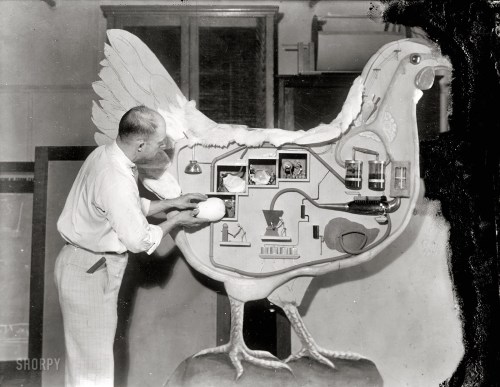
From Critical Exposure, By empowering young people to develop skills as documentary photographers and advocates, we expose citizens and policymakers to the realities of our current two-tiered education system as seen through the eyes of the students who confront those realities each day...works to secure policy changes in order to ensure that all children have access to an excellent, equitable public education, fulfilling this nation's promise of providing all children with an opportunity to succeed. Click on the image to learn more.

From Critical Exposure Click on the image to learn more about this great project teaching students to use photography to document and advocate.

There is a story in the Wisconsin State Journal on the stimulus money and education that covers some of the key issues but also perpetuates  the confusion surrounding how states and schools may and may not use this money.

To be fair, some of this confusion is understandable.  The stimulus package was put together quickly, portions of it are not very clear and much of the education portion reflects contradictory thinking.

However, much of the confusion is inexcusable, especially the omission of any explanation of the structural gap between costs and allowed revenues that is an essential part of the broken “three legged stool” of Wisconsin education funding.  Reporter Mark Pitsch should have read his former colleague Andy Hall’s “Squeezing Schools,” and incorporated some of that material.

Also difficult to understand is the repeated confusion about different aspects of the stimulus school funding and how they relate to the revenue caps.  More below, with clarifications

Before looking at the State Journal article and related issues, I want to make one basic truth clear (and get on my soapbox a little):  The money in the stimulus, for Title I (targeted for schools with high poverty concentrations), IDEA (money for special education) and even the general purpose money flowing through the states only temporarily makes underfunded mandates less underfunded.

The WSJ got this right with their headline: “Stimulus can’t solve schools’ shortfalls.”

School “shortfalls” are structural.  The continued underfunded mandates from the Federal and State governments, in Wisconsin a broken system that requires districts to cut programs and services by between 1% and 2% annually are structural faults.  Structural failures require structural solutions.  Sign on with the Wisconsin Alliance for Excellent Schools and the School Finance Network to work to fix this in Wisconsin.  Let your Senators and Representative know that educational opportunity should be a civil right and educational mandates need to be fully funded.

The stimulus money creates a “funding cliff.” Once the money is gone — absent Federal and State initiatives to fully fund education — schools are in danger of falling off the cliff.  This would mean massive program cuts and layoffs in a couple of years.  Like a nonrecurring referendum, this sort of education funding is not good policy.

Robert Manwaring at the Quick and Ed has a very good discussion of the complexities of deciding what to do with this one time funding.

Interestingly, the guidance goes out of its way to emphasize that this is short-term money, and that districts and states should use it for shorter-term investments, so there isn’t a “funding cliff”. But on the flip side, the guidance makes clear that the stimulus funds’ goals are to help create or maintain jobs. (Those two priorities seem in conflict, since hiring or keeping a teacher is more of a long-term investment.)

The guidance McNeil refers to was released by the Department of Education on March 7.  That is the same day the Pitsch’s State Journal story was published.  However, this time line does not explain the confusion in that story.

In discussing Title I funding, Pitsch writes:

The stimulus addition should allow the district to divert general fund money to other programs.

Both the Title I and IDEA funding continue the “supplement not supplant” policies in place for those programs, meaning that the funding cannot, except under very special cirumstances be used to replace general fund money.  Here is what the Department of Education says about the Title I Part A funds:

Fiscal Issues

  • Maintenance of effort: With prior approval from the secretary of education, a state or LEA may count expenditures of SFSF used for elementary or secondary education as non-federal funds for purposes of determining whether the state or LEA has met the Title I, Part A maintenance of effort requirement. This may reduce the incidence of LEAs failing to maintain fiscal effort and the need to seek a waiver from the Department.
  • Supplement, not supplant: the Department may not waive the Title I, Part A “supplement, not supplant” requirement. Note, however, that in certain circumstances, including cases of severe budget shortfalls, an LEA may be able to establish compliance with the “supplement, not supplant” requirement, even if it uses Title I, Part A funds to pay for allowable costs that were previously paid for with state or local funds. (For additional information, see Title I Fiscal Issues Non-Regulatory Guidance, available at: http://www.ed.gov/programs/titleiparta/fiscalguid.pdf [PDF, 256K].)

On related issues with IDEA, EdWeek’s Christina Samuels, who blogs  at On Special Education wrote

The maintenance of effort provisions that currently exist within the Individuals with Disabilities Education Act will apply to stimulus funds. That means that you can’t take all of your stimulus money and use that to pay for your current special education programs. There is SOME flexibility in the 2004 reauthorization of the IDEA to “supplement, not supplant” provisions, though. If the federal government allocates more money to a district from one year to the next, the district is allowed to take the difference between the two allocations, halve it, and use that figure to reduce their own funding requirements.

So some stimulus Title I  and IDEA money may be used to supplement, possibly allowing general fund money preciously used for Title I purposes (to make up for the underfunding) to be used elsewhere. This is very different than what Pitsch wrote.

Pitsch’s section on Governor Doyle is also full of misinformation and confusion:

Doyle said in an interview that most of the federal stimulus money wouldn’t be subject to state revenue caps for school districts. But he urged them to remain under the caps even as they spend the federal dollars. If they don’t, they’ll face big budget holes in future years and possibly anger homeowners if property taxes go up too much.

“School districts would be very, very well advised to take that money and keep their spending under the revenue caps,” said Doyle (emphasis added).

Doyle appears to be referring to the Title I, IDEA and other special purpose funds, which do not count against revenue caps (he also appears to be telling them to violate or take advantage of the loopholes in the “supplant not supplement” provisions).  However, most of the stimulus money schools will receive comes not from these funds, but from the State Fiscal Stabilization Fund.  This is the flow through money that Doyle used to supplant state money in his budget.  To the Governor’s credit, he went beyond the 81.8% required by the law to limit property tax increases and district budget cuts to more -or-less the usual, unacceptable levels.

Here is a chart from the Wisconsin Association of School Boards:

Federal Program

2008 Actual Allocation

American Recovery & Reinvestment Act (estimated amounts as of 2/19/09)

State Fiscal Stabilization Fund

——–

$876,940,096

Title I Grants to Local Educational Agencies

$199,030,396

$147,696,280 Individual District Estimates

Education
Technology Grants

$3,443,011

$9,170,493

IDEA, Part B:
Grants to States

$197,853,865

$208,200,108

IDEA, Part B:
Pre-school Grants

$9,322,204

$9,827,791

IDEA, Part C:
Grants for Infants & Families

$6,984,803

$6,999,614

The non revenue cap monies total about $381 million; of the $876 million in flow through, Doyle has called for $291 million to be spent on general aids in 2008-9, $277 million in 2009-10 and $221 million in 2010-11, for a total of $789 million.  $789 million is more than twice $381 million; more than twice as much stimulus money is under the caps than is not.

School finance can be confusing, but misrepresentations of simple facts and omissions of key contexts like those in the Wisconsin State Journal article render what is challenging almost impossible.  How is the public supposed to develop informed opinions when our reporters fail in their duties?  In the coming months, Boards of Education around Wisconsin will face difficult choices regarding the use of the non capped stimulus funds.  The public needs to be part of this process and in order that to happen in any productive way, the media needs to do much better in explaining the issues.

Thomas J. Mertz

Leave a comment

Filed under "education finance", Budget, education, finance, Gimme Some Truth, Local News, School Finance, Take Action, Uncategorized

Legislative Advocacy Action — Save the Dates

2009-041

Wednesday April 1, 20096:00 PM at  Wright Middle School — the Madison Metropolitan School District will be hosting a “Legislative Informational Community Session” to “provide updates on school funding and state budget issues that affect the MMSD” and “discuss and share strategies on how the community can get involved in advocating for our schools.”  For more on the MMSD Legislative Agenda, click on this link.

Tuesday April 21, 2009, 1:00 PM at Room 413 North in the Capitol — the Wisconsin Assembly Education Committee will be holding a public hearing on the School Finance Network education funding reform proposal.  It is important that we get a good crowd to demonstrate the importance  school funding reform.

Also, don’t forget the Wisconsin Council on Children and Families Advocacy Day at the Capitol on March 18.

Make you voice heard!

Thomas J. Mertz

Leave a comment

Filed under "education finance", Budget, education, finance, Local News, School Finance, Take Action, Uncategorized

The Charter Choice in Madison and the Nation

schoolbudgets

On Monday, March 9, 2008 The MMSD Board of Education will consider an application from the Nuestro Mundo community to begin the process of chartering a dual language immersion secondary school.

Although the application is very impressive and Nuestro Mundo appears to be a good and well run school, I urge the Board to turn away this effort to expand charters in Madison.  MMSD is initiating an elementary  non charter dual language immersion program and there is talk of a non charter dual language middle school also.  I believe that this is the the better path.

In an editorial today the Wisconsin State Journal puts forth self contradicting nonsense in favor of the charter proposal.  In a letter to that paper last week, Nuestro Mundo parent Judith Kujoth employed questionable and unsupported assertions of causality to advocate for the middle school proposal.  I’m just going to hit the low lights.

The editorial begins:

Madison needs to get past its outdated phobia of charter schools.

Charter schools are not a threat to public schools here or anywhere else in Wisconsin (emphasis added).

Later in the editorial they note the President Obama has pledged to double the Federal money for charters and note that the group hopes to get $1.1 million in Federal planning grants.  It doesn’t take a genius to figure out that Obama’s funding of charters, like that of George W. Bush, will divert money from traditional public schools.  That $1.1 million that they hope to get is $1.1 million that isn’t and won’t be available for our underfunded district schools.  Yes, charters are a threat.  An insidious threat, because regardless of the merits of a particular proposal or the drawbacks of charters as a policy choice, cash strapped state and local decision makers are easily seduced by the promise of this money.

The editorial continues:

They are an exciting addition and asset to public schools — a potential source of innovation, higher student achievement and millions in federal grants.

And when charter schools do succeed at something new, their formula for success can be replicated at traditional schools to help all students (emphases added).

This is exactly what has happened in Madison.  Nuestro Mundo pioneered dual language immersion, the district saw good things happening and they are now in the process of “replicating.”

Apparently the State Journal doesn’t really believe this because later they opine:

The School Board should reward their success by opening the door to a charter middle school. Instead, too many board members seem bent on keeping any dual-language middle school within the framework of a traditional school.

So it isn’t about what is best for the district and the students at all, it is about “rewarding” certain people.  This goes to the heart of one big problem with charters:  They divide; they Balkanize.

What is good for the district as a whole and most children can easily get lost when well organized charter groups advocate tirelessnessly for their “rewards.”  This is true at the state and national levels also.  This is another way that charters threaten public education.

Even the most optimistic charter advocates must recognize that there is no realistic scenario where most children will not be in traditional public schools.  The Board’s job is to do what is best for all children; in practice they must make the utilitarian calculations about what is best for most children and that means doing everything they can to strengthen the district schools most children will attend.  This may include limited charters for purposes of innovation and to address persistent problems, but it certainly does not include “rewarding” anyone at the expense of the district as a whole.

Kujoth covered  much of the same shakey ground as the State Journal, so I’m only going to touch on one paragraph in her letter that caught my attention.

Creating a charter school will have many benefits. The law affords charters greater flexibility to create curricula and measure progress. Students in these schools often have higher rates of achievement because educators have flexibility to design teaching methods that appeal to the needs of each student and to change modalities when they aren’t working without being constrained by traditional district practices (emphasis added).

Note the “often” before “higher rates of achievement. ”  In fact there is no consistent evidence that students in charters have any higher achievement, the best evidence is that achievement is about the same or slightly lower than in traditional schools.

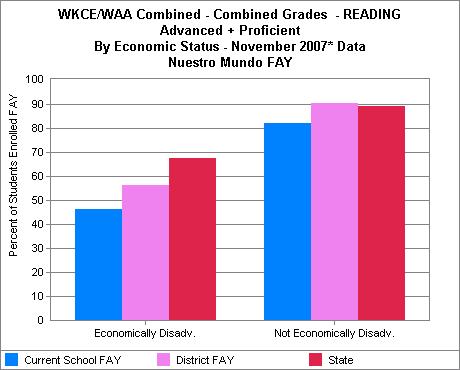
I’m skeptical of standardized tests as a measure of achievement, but it worth noting that Nuestro Mundo students have performed below the levels of students in other MMSD and Wisconsin schools and that this difference is more pronounced for low income students (chart from DPI)

ns-read-w-state-and-district-cft0308_1848031bb

In the next sentence, also with no evidence what so ever, she asserts the cause for this nonexistent achievement gain to be the “flexibility to design teaching methods that appeal to the needs of each student and to change modalities when they aren’t working.”  Since some charters, KIPP for instance,  are infamous for their inflexibility (and resultant push outs of students), this is a laughable generalization about charters.

The last line, the final assertion that “traditional district practices constrain flexibility is also counter to my experience as an MMSD parent.  The teachers my children have had — good and bad — have been very flexible in their teaching.  Even if my experience is not typical and the constraints on flexibility are a real problem isn’t the answer to work to free all teachers from these constraints, not set up a charter where only some children benefit from flexibility?

If these represent the best case for the new charter proposal, the Board should have an easy time rejecting it, unless political pressure holds sway.  I urge the Board to do what is right, not what might be popular.

In the spirit of honesty, I must state that my older son attends James C. Wright Middle School, a charter, if in name only.  At an earlier point in the history of the school, charter status may have been important.  In the years that I know about, Wright functions as a district specialty school, not a charter in any meaningful way.  I would a support a change in status for Wright to reflect this reality.

Thomas J. Mertz

2 Comments

Filed under "education finance", Accountability, Best Practices, education, Equity, Gimme Some Truth, Local News, Uncategorized

Education Tweak #9

Click on image for pdf.

Click on image for pdf.

All the Education Tweaks can be found at http://edtweak.org/.

Thomas J. Mertz

Leave a comment

Filed under Accountability, Best Practices, Gimme Some Truth, National News

“Do It Again?” Another Referendum for Salem

tantsisyixn_22096_lg

The Kinks, “Do It Again” (click to listen or download)

On Thursday, the Salem Board of Education voted to try again for an operating referendumOperating referenda for the district failed in June 2008, September 2008 and February of 2009.  The September referendum lost by a fairly large margin, but the June and February votes were 269 to 235 and 654 to 694.

Those working for the referenda must feel like Sisyphus forever rolling the stone up the hill, but never getting to the top, or Tantalus, with sustenance always just out of reach.  Unlike those mythological figures, the school supporters and the children of Salem have done nothing to deserve their cruel fate.

Their decision to go to referenda again indicates that they are unwilling to accept the devastating cuts in store for their schools.  I can’t blame them.

Whether this one passes or not, an inordinate amount of time and energy will have been spent trying to secure adequate funding for the district.  This is time that should have been spent educating the students.  That’s what happens when you live in a state with a broken system for funding education.  Sign on with the Wisconsin Alliance for Excellent Schools and the School Finance Network to work to fix this.

Back to Salem.  Advocates continue to make a strong case, reminding all that strong schools are essential for healthy communities.

Proponents of the board have said that increase is needed to save programs and staff, to provide opportunities for children, and ultimately to protect property values in the community. If the school system goes into decline, they argue, the whole community will ultimately be affected.

“I’m scared too, we took a huge pay cut in my family. My wife was out of work,” said Scottie Washington. But he believes families will leave the community and home values will decline if programs are cut. “If this referendum doesn’t pass this is going to be a ghost town,” he said.

The ask this time will be for a three-year non recurring referendum at $1.16 million a year.  The vote will be at a special election on April 28.  This looks like the same measure that was voted down in February.

I haven’t seen a new presentation of potential cuts yes, but the ones form the earlier campaign are probably still in play.

clcik on image for pdf

click on image for pdf

There is much more Salem referendum related material here, including the slideshow embedded below.

It should be noted that the major issue in Salem is and has been class size.  Smaller class sizes is one of the “best practices” that almost everyone agrees helps all children learn and almost every agrees is particularly important for children from poor or difficult backgrounds.  When we know what works, we should make sure that the resources are there to do what works.

I admire the tenacity of the Salem Board and wish them the best.  Let’s follow their example at the state level and “get’r done” on school funding reform (again, join WAES, join SFN).

Thomas J. Mertz

Leave a comment

Filed under "education finance", Best Practices, Budget, education, Elections, finance, Local News, Pope-Roberts/Breske Resolution, Referenda, referendum, School Finance, Take Action, Uncategorized

Out of the Loop or I Still Want My Agendas

moebius

Since the Madison Metropolitan School District has essentially stopped sending agendas to those who have requested them*, I try to make a habit of checking the “Current Agendas” and “Board of Education Calendar” pages. I usually do this on Friday, because that is when the agendas for the following week are generally posted.

I looked today and was surprised to see that there had been Strategic Planning Curriculum Action Team meeting yesterday (pdf of page as of 11:50 AM, 3-6-09). This meeting was not listed on the Calendar page (pdf of page as of 11:50AM, 3-6-09). Nor is it listed on the Strategic Planning page (pdf of page as of 11:59 AM, 3-6-09).

In fact there is no description of, membership list or other reference to the appointment of a “Strategic Planning Curriculum Action Team” anywhere that I can find on the MMSD site. We don’t know who picked the team or who is on the team.

It sounds as if the work is important, too important to take place outside the attention of the public.

The strategic priority addressed by the Curriculum Action Team is the identification of solutions that will revolutionize the educational model to engage and support all students in a comprehensive participatory educational experience defined by rigorous, culturally-relevant and accelerated learning opportunities where authentic assessment is paired with flexible instruction.

Prior to the November referendum we were told over and over again about how important, inclusive and open the Strategic Planning Process would be, how this was a key part of the “partnership” between the public and the district. It sounded real good.

I was in the loop then. Now, along with the almost everyone else, I’m out of the loop.

* Clarification – Whenever I have made specific requests to MMSD staff for information, they have been great about responding and providing that information (if possible) in a timely fashion.  This isn’t about that, it is about the list advertised at the top of the Current Agenda page “You can get BOE Agendas delivered directly to your e-mail inbox” and more generally about communication and openness.

Thomas J. Mertz

Leave a comment

Filed under Accountability, Best Practices, education, Local News, Uncategorized

James C. Wright Middle School African American History Celebration

mural2

On Friday, March 6, 2009 James C. Wright Middle School will hold their annual African American History Celebration, between 6:00 and 8:00 PM.  The event will feature an auction of student art work on African American themes, dinner, dance, poetry and more.  Tickets are $3.50 (children under 5, $1.00) for the benefit of the school.

Call 204-1340 for more information.

I attended in the past and strongly encourage all to be there.

Thomas J. Mertz

Leave a comment

Filed under education, Local News

Lunchtime Enlightenment

14526a1

Cap Times reporter Mary Ellen Gabriel does an extraordinarily thorough examination today of both the school lunch program and the efforts of University of Wisconsin-affiliated REAP program (Research, Education, Action and Policy on Food) to implement some changes in how we feed our children. It’s an issue I’ve had some involvement with for a number of years, including my current work with the Healthy Classrooms Foundation (more on this in a later post).

The piece, in part, examines the questions related to whether MMSD’s school lunch program is unhealthy for kids.

It depends who you ask. On one side is a well-trained food service department that manages to feed 19,000 kids under a bevy of guidelines on a slim budget. On the other is a growing number of parents and community advocates armed with research about the shortcomings of mass-produced food and race-to-the-finish mealtimes.

For critics there are a number of concerns.

A lack of fresh fruits and vegetables, high fat and salt content in items perceived as “processed” or “junk food,” little nutritional information on the Web site, too much plastic, too much waste and too little time to eat.

The piece is well worth a read in order to understand the challenges in trying to produce thousands of healthy and nutritious meals a day to students, more than half of whom qualify for free and reduced-price lunches, and to do it all with a shrinking budget. Groups have tried to step in and offer closer farmer to school efforts, a movement now in 22 states – but with some failures as well as successes. This is a noble project, still in its infancy in many ways, one that is trying to bring change to an important but constrained large institution. Let’s wish them well.

Robert Godfrey

2 Comments

Filed under AMPS, Best Practices, Budget, Gimme Some Truth, Local News

600 Conservationists, 500 Motorcylists…How Many Advocates for Children & Families?

frontpic2

A message about the Wisconsin Council on Children and Families Advocacy Day at the Capitol, March 18.  The Wisconsin Association of School Boards is having their Day at the Capitol on March 18 also.  It would be a good day to join the crowds “Raising Voices” for children.

Friends:
It’s that season again, when numerous organizations bring their members and supporters to the State Capitol, to meet with legislators on key issues in the state budget. Our friends at the Wisconsin League of Conservation Voters packed the Capitol last week with 600 conservationists. And the “motorcycle issue experts” brought eight (8!) busloads of bikers to the Capitol last Thursday.

The Wisconsin Council on Children & Families is also hosting a “lobby day” where concerned residents can learn more about how the state budget is likely to impact kids & families and get an opportunity to meet with their elected representatives.

WCCF’s 2009 “Advocacy Day at the Capitol” is the afternoon of Wednesday, March 18th.

We certainly hope that there are as many Wisconsin residents motivated to take just a few hours to come to the Capitol to advocate for kids & families (especially in these tough economic times) as are concerned about motorcyclists’ rights.

Given the nearly $6 billion state budget deficit, it’s more important than ever that advocates raise their voices to tell Wisconsin’s legislators that our state budget needs to prioritize and preserve programs and services that vulnerable children and families reply upon – especially quality child care, health care, safety net programs and access to skill training and education.

This free, fun event is a great way for you to network with other concerned residents from around Wisconsin, and to ensure that legislators hear loud & clear from YOU that issues that matter to kids and families should be at the top of their priority list during their budget deliberations.

We hope you’ll join us – and bring a car or busload of friends, colleagues or neighbors! for WCCF’s 2009 “Advocacy Afternoon in the Capitol” from 12:30-4:00 on Wednesday, March 18th.

Governor Doyle will be speaking, along with legislative leaders. Click here for more information or to register for this free event: http://www.wccf. org/event_ lobbyday_ 2009.php

Lets make sure that Wisconsin’s State Capitol is full to overflowing on the afternoon of March 18th with the voices of parents, teachers, child care & health care professionals, advocates, service providers and other residents from all across the state, all chiming in together to make sure that the state budget ensures the economic prosperity and well-being of all of our state’s kids and families.
Click here for a printable flier and to register: http://www.wccf. org/event_ lobbyday_ 2009.php
Questions? Need more information? Contact Vicky Selkowe at vselkowe@wccf. org or (608) 284-0580, ext. 326.

Visit www.wccf.org for more information about the state budget.

Thomas J. Mertz

Leave a comment

Filed under Best Practices, education, Local News, Take Action

WAES School-Funding Reform Update, March 2

waesgraphic

Table of Contents below, click here for the full update.

Update — The hearing on the School Finance Network plan highlighted below is still very important, but it is in the process of being rescheduled.  Watch AMPS for more info.

I want to highlight the first item.  Save the Date –March 24 — this is important.  The School Finance Network plan is a very good plan and enjoys broad support.  Attend the hearing and show the legislature you care about school funding.

Update — The hearing on the School Finance Network plan is still very important, but it is in the process of being rescheduled.  Watch AMPS for more info.

School-funding reform update, week of March 2

  • SFN reform plan subject of March 24 hearing at the Capitol
  • SFN plan continues to be in the news around Wisconsin
  • Evers, Fernandez meet in West Allis at state Superintendent debate
  • 2009-11 state budget appears to be on the fast track
  • WAES doing good work, but needs your financial support
  • Tax cuts cost state billions since mid-1990s, LFB report says
  • Four groups renew memberships in WAES
  • Oneida County Board petitions state for school-funding reform
  • Round-up of funding problems from around Wisconsin
  • Early childhood care and education key to economic development
  • Help WAES correct e-mail update glitch
  • School-funding reform calendar
  • The Wisconsin Alliance for Excellent Schools (WAES) is a statewide, independent, membership-based organization of educators, school board members, students, parents, community leaders, researchers, citizens, and community activists whose lone goal is the comprehensive reform of Wisconsin’s school-funding system. If you would like more information about the organization — or on becoming part of WAES — contact Tom Beebe at 920-650-0525 or tbeebe@excellentschools.org.

    Thomas J. Mertz

    Leave a comment

    Filed under "education finance", Budget, education, Elections, finance, Local News, Referenda, referendum, School Finance, Take Action, Uncategorized