Texas, what can I say?

The Barbarians, “Are You a Boy, or Are You a Girl?” (click to listen)

From the state that brought you the “Texas Miracle” that wasn’t (and led directly to the No Child Left Behind mess) comes a flashback to the worst of the 1960s or maybe the 1800s. The Needsville Texas school district has refused to admit a five-year-old boy because his hair is too long (hat tip to Region19 Gazette). “”I’m just afraid if the district gives in, other problems will occur in the future,” said Shelly Sullivan, a former Needville student.” Yeah, like fluoridation in the water, revolution in the streets and maybe respect for individual choices. Horrors.

That the child is Native American recalls the shameful forced assimilation policies of Native American boarding schools.

I know Texas has produced much of worth (especially in music, but can’t forget Governor Anne Richards and others).  Still, things like this make me wonder what goes on down there.

Thomas J. Mertz

Leave a comment

Filed under education, National News, nclb, No Child Left Behind, Uncategorized

Leading the Nation?

Charlie Feathers, “Bottle to the Baby” (click to listen or download)

There measures where you don’t want to be #1; Fetal Alcohol Syndrome (FASD) is certainly one of these. Unfortunately, the Oshkosh Northwestern reports that Wisconsin leads the nation in reported drinking among women of childbearing age and likely leads in FASD (hat tip to Madison NORML).

Each year as many as 200 Wisconsin newborns show the effects of prenatal alcohol exposure, according to the University of Wisconsin’s Fetal Alcohol Spectrum Disorders Treatment Outreach Project.

Dr. Georgiana Wilton, an associate scientist at the University of Wisconsin Department of Family Medicine in Madison, believes it’s likely the state leads the nation in that category, though such data is not kept by every state.

Prenatal alcohol exposure is a leading cause of mental retardation and learning disabilities nationwide. By that standard, Wisconsin babies are at greatest risk.

Wisconsin leads the nation in reported drinking among women of childbearing age. The state has the highest prevalence of frequent alcohol consumption among women ages 18 to 44, according to a 2006 risk-factor survey by the Centers for Disease Control and Prevention….

Exposure to alcohol puts a fetus at risk of a cluster of preventable developmental problems known collectively as fetal alcohol syndrome or the related fetal alcohol spectrum disorders — a term describing the range of effects that can occur in any individual whose mother drank alcohol during pregnancy.

Brain damage, facial deformities, growth deficits, heart, liver and kidney defects characterize fetal alcohol syndrome, as do difficulties with vision, hearing, learning, attention, memory and problem solving.

An individual with fetal alcohol syndrome can incur a lifetime health cost of more than $860,000, although the National Organization on Fetal Alcohol Syndrome says costs can be as high as $4.2 million. It costs the U.S. $5.4 billion annually in direct and indirect costs. Direct costs are estimated at $3.9 billion annually, which includes healthcare costs as well as costs associated with social services and incarceration.

Sixty percent of individuals with FASD will end up in an institution (mental health facility or prison). And it is estimated that almost 70 percent of the children in foster care are affected by prenatal alcohol exposure in varying degrees.

Not mentioned are the increased educational costs associated with FASD. Like lead paint exposure, this is preventable factor which adversely effects the future prospects of children, costs our schools time and money and contributes to inequality. It is also another example of why schools alone are not sufficient to address the needs of our children (and their parents) and why things like the “Broader, Bolder Approach to Education” make sense.

Thomas J. Mertz

1 Comment

Filed under Best Practices, education, Equity, Local News

“The Next Kind of Integration”

Excerpts from the recent New York Times article, “The Next Kind of Integration” (with links and emphases added).

In the last 40 years, Coleman’s findings, known informally as the Coleman Report, have been confirmed again and again. Most recently, in a 2006 study, Douglas Harris, an economist at the University of Wisconsin, found that when more than half the students were low-income, only 1.1 percent of schools consistently performed at a “high” level (defined as two years of scores in the top third of the U.S. Department of Education’s national achievement database in two grades and in two subjects: English and math). By contrast, 24.2 percent of schools that are majority middle-class met Harris’s standard.

There are, of course, determined urban educators who have proved that select schools filled with poor and minority students can thrive — in the right circumstances, with the right teachers and programs. But consistently good education at schools with such student bodies remains the rare exception. The powerful effect of the socioeconomic makeup of a student body on academic achievement has become “one of the most consistent findings in research on education,” Gary Orfield, a U.C.L.A. education professor, and Susan Eaton, a research director at Harvard Law, wrote in their 1996 book, “Dismantling Desegregation.”

Most researchers think that this result is brought about by the advantages that middle-class students bring with them. Richard Kahlenberg of the Century Foundation lays them out in his 2001 book, “All Together Now”: more high-level classes, more parent volunteers and peers who on average have twice the vocabulary and half the behavioral problems of poor students. And, especially, more good teachers. Harris, the economist, says that poor minority students still don’t have comparable access to effective teachers, measured by preparation and experience. The question, then, is whether a plan that integrates a district by class as well as by race will help win for all its schools the kind of teaching that tends to be linked to achievement. “The evidence indicates that it would,” Harris says.

Ronald Ferguson, an economist at the Kennedy School of Government at Harvard, is less persuaded. His research highlights the nagging persistence of a racial achievement gap in well-off suburbs. “What happens with the achievement gap in a place like Louisville,” he says, “will depend on how vigilant their leaders are to make sure high-quality instruction is delivered across the board.” Such teaching is more likely in a school with a critical mass of middle-class parents, he concedes. But he stresses that to reap the benefits, poor kids have to be evenly distributed among classrooms and not just grouped together in the lowest tracks. “To the degree a district takes the kids who struggle the most academically and spreads them across different classrooms, they’re making teachers’ work more doable,” he says. “And that may be the biggest effect.”

Whatever the exact answer, there is some support for the view that schools can handle a substantial fraction of poor students without sacrificing performance. In Wake County, test scores of middle-class students have risen since instituting income-based integration. Additionally, Kahlenberg points out that middle-class students are generally less influenced by a school’s environment because they tend to learn more at home, and that the achievement of white students has not declined in specific schools that experienced racial (and thus some class) desegregation.

Would schools need to track students by ability to protect middle-class students, who are more often higher-achieving than their low-income peers? Perhaps not. In a 2006 longitudinal study of an accelerated middle-school math program in Nassau County N.Y., which grouped students heterogeneously, the authors found that students at all achievement levels, as well as minority and low-income students, were more likely than the students in tracked classes to take advanced math in high school. In addition, the kids who came into the program as math whizzes performed as well as other top-achievers in homogenous classes.

This study underscores Ronald Ferguson’s point about the value of seating students of different backgrounds and abilities in class together, as opposed to tracking them. Still, it’s worth noting that less than 15 percent of the students studied in Nassau County were low-income. So the math study doesn’t tell us what happens to the high-achieving middle-class kids when close to half of their classmates aren’t as well off.

I’ve posted about the missed opportunities for Madison to be a leader in this new integration movements many times. Two examples are linked below. I do want to make clear — as I wrote in one of those posts — I believe that “[f]or the most part MMSD has done a very good, if relatively quiet and indirect job of addressing [all kinds of] diversity. ” I’m still asking for more.

Previously on AMPS:

(Not?) Talking about Diversity and Boundaries, 2008 Style.

(Now?) Talking about Boundaries and Diversity, 2008 Style.

Talking is essential, but so are policies and actions. It is not too late.

Thomas J. Mertz

4 Comments

Filed under AMPS, Best Practices, Equity, Local News, National News, Uncategorized

The high price of “eductaion”

During a segment this weekend, Fox News’ Brett Baier said that “the high price of gas may be costing your kids some of their education. We’ll explain here.” At the same time, though, the word education was misspelled on-screen as “eductaion.”

Robert Godfrey

Leave a comment

Filed under AMPS, National News

We Are Not Alone #22 (Referendum Roundup)

It must be that time of year, or more likely the “going out of business” state finance system continuing to take its toll on districts in Wisconsin. Five more districts have placed referenda Fall ballots. That brings the total to ten by my count, eight for operation and maintenance and two to issue debt for, renovating and upgrades.

I posted before on the September 9 Colby measures, one of the debt referenda. Interestingly like Colby’s, the other debt referendum — A November 4th vote in the Clinton Community School District — also includes an attempt to move toward energy efficiency and environmentally sound practices, in this case via a Geo-Thermal heating system (Milton is also looking at Geo-Thermal). With this and the other items, Clinton is trying to plan for the future in ways that our school funding system makes nearly impossible.

The district could wait to ask residents to pay for new projects, but [Board President Randy] Gracyalny said gambling on the economy improving and prices going down isn’t a move he wants to make.

“Where will we be three years from now?” he asked. “I don’t know. No one knows. We know where we are now.

“Yeah, we might not absolutely need this, this year. But if we put it off too long, it’s going to get to that point of making some tough cuts.”

It is a smart approach and I wish them the best (more here).

In the districts seeking to pay for operations and maintenance it is the usual recipe of costs rising faster than allowed revenues, with added seasoning of declining enrollments for some.

Taking them in chronological order, Wausaukee will vote on August 19th. This is the “do or (probably) die” referendum. You can read lots more about Wausaukee in previous posts. Sadly, our local media has had nothing to say about this. Nothing. Even the Chicago Tribune picked up the story, but not our Madison newsies. The district has posted a “Fact Sheet” on the referendum and — as they have to — are moving ahead with the dissolution planning. The linked story from the Peshtigo Times is worth reading, especially the lengthy statement Board member Dave Kipp offered before voting against dissolution. Rather than excerpt that, I offer excerpts from a letter to the editor by Gert Wilson, “Retired Teacher”:

Democracy has diminished and that is sad because children learn from adults and what they see is disrespect for others’ opinions and bossy individuals who control meetings to delay or stop procedures. Of course, all people are not guilty of such actions.

We have seen this also at Coleman, Crivitz and Wausaukee in regard to education. The Times has been overwhelmed with nasty discussions, critical items in the paper and parents discussing issues in irate voices along with school boards. As usual, the students pay the price. They probably will, if Wausaukee folds and students have to ride to Crivitz. When will they eat, sleep and do school work? (emphasis added)

Amberg, a few years ago, opted to join the Wausaukee School District. Was that an error? Now it is possible these student will ride to Crivitz. Teachers, school boards and parents, are you happy about all your adult complications? I give credit to all who try to make it right.

Small towns cannot survive peaceably when all this divides friends and parents and teaches some children to rebel, be bossy, be bullies, show disrespect and have drinking problems.

You tell ’em Gert. There is also a good commentary on the Wausaukee situation from Ken Krall at NewsoftheNorth.Net.

Deerfield, Neillsville, and Montello will all vote on September 9.

Deerfield is asking for a five-year nonrecurring, with annual amounts starting at $275,000 and going to $475,000 (another version of planning for the future). Deerfield appointed a Citizens Advisory Committee last year to work on the plan and surveyed the community before proceeding. They’ve also put together a very nice web page explaining the what the referendum is about. Madison could learn some things from our neighbors fifteen miles to the East.

Neillsville has been experiencing declining enrollment at a rate of 30 or more students a year and started out as a low spending district in 1993 when the revenue caps were put in place. This is a double whammy. District spending levels are still based on what they spent over 15 years ago; because the caps are set on per member basis, declining enrollment –especially in small districts — makes it increasingly hard to cover fixed costs such as heating and transportation and almost impossible to pay for diverse offerings that larger districts take for granted. As Superintendent John Gair said: “”We’re at the point now where departments are made up of one person in some cases. If we reduce (spending) any more, we’re going to lose programs for kids.” To meet these challenges, Neilsville is asking for a five-year, $300,000 a year increase in the amount of revenue they are allowed to collect.

According to District Administrator Jeff Holmes, Montello is one year away from joining Wausaukee in dissolution (or exploring consolidation). Last September two referenda were defeated; one operating and one to borrow for things like resurfacing the parking lot and replacing air conditioning. They cut for administrators last year and have not replaced retiring teachers. This time they are going to ask for a two-year non recurring $950,000 increase in their revenue limits. If it passes, two years isn’t very long. Unless the Governor and the Legislators do something quick, they will have to go back to the voters again.

Lafarge, Mercer, Seneca, and Pittsville all have November 4 referenda scheduled.

Some may remember that in 2000 disputed ballots in the Lafarge referendum went all the way to State Supreme Court, which after years of litigation upheld “the intent of the voter” precedents and a referendum victory (unfortunately that same year the US Supreme Court threw away precedent and the Constitution and gave the Presidency to George W. Bush). This time Lafarge is one of two districts (thus far) asking for a recurring referendum, in the amount of $250,000 annually.

In Mercer they’ve reached the final year of a three-year nonrecurring referendum and the wolf is at the door. A rigged state finance system and declining enrollment are threatening to blow the house down. They also convened a Task Force, which laid out the options:

  • Approve the new referendum to keep the school open.
  • Close the school and dissolve the district.
  • Consolidate with another district.

“Dissolving” was also mentioned. They are asking for four-year, $350,000 per year revenue cap relief.

Seneca is another small enrollment, rural district with declining enrollment. I’ve described above what this does to the ability to give students the education they deserve, the Institute for Wisconsin’s Future’s Atlas of School Finance goes into more detail. They are asking for $800,000 a year on a recurring basis.

Pittsville covers 440 square miles and serves 686 students. Wrap you mind around that and you will understand that districts like this are essential (consolidate into a district that serves 1,300 students spread over 1,000 square miles?) and do not enjoy the economies that larger, more compact districts have. Because of these these issues and projected declining enrollment, the plan in Pittsville is to decrease staff even if the three-year $175,000 nonrecurring referendum passes.

These posts are a lot of work, but they are also rewarding. I learn about the districts in Wisconsin, the good they are doing, their hopes and dreams. I urge you to visit a few of the district web sites linked here; look at the pictures, read the mission statements, find things like Pittsville’s “Why enroll your child at Pittsville?” and sense the pride and dedication. You will find it rewarding too.

On most of these web sites I also see the logo for “The New Wisconsin Promise,” and wonder if the slogan “A Quality Education for Every Child” is some kind of sick joke. Our schools — even those in dire financial straits — are still doing a fine job, but how much longer can they and we hang on?

Why can’t we put in place a way of investing in our children’s future that makes those words an accurate boast? Why not Governor Doyle? Why not Senators and Assembly members? Why not?

Take the five minutes to click the links and ask them. Maybe if enough of us do, something will change.

Thomas J. Mertz

Leave a comment

Filed under "education finance", Accountability, AMPS, Best Practices, Budget, Contracts, education, Elections, finance, Gimme Some Truth, Referenda, referendum, School Finance, Take Action, Uncategorized, We Are Not Alone

Education: A shared value and “recession-proof”

An interesting report out on the survey results of presidential pollster Cornell Belcher presented at the recent 8th Annual Quality Education Conference in Washington, DC, focused on the significance of education as a political issue in America. He concluded from his research, as reported by The National Access Network at Teachers College, Columbia University, that “education is a high priority issue for most Americans: it is a “shared value” which is largely “recession-proof”—remaining important even when the economy is down.”

Education has consistently ranked highly among Americans’ most important political concerns. Belcher reported that in 2004, Americans ranked terrorism and moral values among the most important issues, while in 2008, these had been replaced by gas prices. Economic issues and Iraq ranked among the top five issues in both years—not surprising given the economic down turn and problems faced by the military. But education also remained a constant, consistently ranking among the top five political issues regardless of economic circumstances or foreign policy concerns.

Beyond this “shared value,” Belcher also highlighted the different views Americans have of education, which he described as four clusters in the poll. Approximately 30 percent of Americans viewed education as a top priority and believed that structural changes in funding and resource distribution were necessary to improve the educational system. Another 30 percent also value education highly, but they believe the solutions are more individual—increased parental involvement and behavioral changes among students. Another 30 percent value education highly but are not willing to increase funding for it. Finally, less than 10 percent of Americans in the poll did not believe education was a top priority.

Belcher underscored his view that peoples’ core beliefs do not typically change. However, he emphasized a view that various political messages—including those in support of educational equity and opportunity—can be cast to appeal to these different groups.

It’s striking to observe the current discussions on the banking industry bailout and contrast that with the typical rhetoric when it comes to some other core needs of society such as public infrastructure renewal and education. It would appear from this survey that upwards of 60% of Americans are concerned about the public financing of schools to provide more support for our nation’s future, despite the off-the-radar nature of the current public discourse. I wonder what the different percentage categories Madison’s voters would fall into in such a survey. We certainly will have a reality check in an upcoming referendum this fall that will attempt to just keep us above water due to a broken school finance system.

Robert Godfrey

Leave a comment

Filed under AMPS, Gimme Some Truth, National News, School Finance

Dan Nerad Talks 4-Year old Kindergarten

From WISC-TV

One thing that needs to be corrected is this: “After the first year, the state kicks in two-thirds of the funding and covers the full cost after four years.”

What happens is that the district must absorb all costs the first year, the second year and beyond the students are added to the member count (on a prorated basis, since 4-K is not full time) and figured in the three-year rolling average calculations for the revenue cap. This would mean they would be counted at 1/3 for the second year. 2/3 for the third year and fully thereafter. Like all other students in Madison, the state share of costs would be based on relative property wealth.  In Madison this translates into about 40% state funding.

I’ve been trying to track down how Green Bay managed the start up costs. No luck yet, but I’ll find out and post here.

One answer is via a referendum.

Thomas J. Mertz

Leave a comment

Filed under "education finance", AMPS, Best Practices, Budget, finance, Local News, Referenda, referendum, School Finance

We Are Not Alone #21

As Madison prepares to discuss a school operating referendum, it is important to remember that we are not alone.

In the past two years districts in Wisconsin have held over 150 operating and maintenance referenda simply to continue the quality and diversity of educational programming that they have had in the past. This isn’t because of local mismanagement; these referenda are a product of a school finance system designed to fail. The referenda aren’t about adding back things have been cut or expanding the good schools do by adding things like 4-year-old kindergarten, elementary foreign languages, more teacher training in things like differentiation or classroom management, support for college prep work for students not yet on the college track…(I could go on and on). These referenda are about not losing ground, about stopping the cuts and staunching the bleeding.

Many districts, like Madison, are simultaneously struggling with the annual cuts dictated by the state finance system and needs or desires for new schools (based on either inadequate facilities or population growth in areas without sufficient capacity). In La Crosse, this combination is reaching critical point.

In April the voters of La Crosse passed a five-year nonrecurring $4,175,000 a year operating referendum (5,701-4,993), but defeated a $35 million renovating and building referendum (5,144-5,417). The $35 million would have paid for a new school, allowed the district to close two schools and upgrade the “HVAC, safety, and security systems” in others (including new energy efficient equipment to create long term savings). Some of these upgrades were termed “urgent.”

“Urgent” needs don’t go away. Now the La Crosse district is contemplating what to do next.

On Monday July 8, 2008 the Board of Education voted 6-3 to take the “no referendum” option off the table.

President Christine Clair said the vote will keep board conversations centered on the administration’s other options, which include asking for the capital improvements sought in the April referendum, only separated into two questions, and addressing only the facility needs.

Board member Neil Drusky voted against eliminating the “no referendum” option:

He suggested closing two schools, which would take two to three boilers off line and buy the school district more time while the community gets involved. He also said he didn’t recall knowing about the boilers until the referendum process. [Ed Note: Those energy efficiency issues again.]

The administration will report back to the Board on July 21, 2008. Eight options (or combinations of options) are being analyzed:

  • Eliminate SAGE
  • Close a school
    • Most agree a school has to be closed, but there is disagreement about which one. It is estimated that closing a school would save about $410,000.
  • Close two schools
    • This would “eliminate the cost of replacing two to three boilers and other building repairs” but require “massive redrawing of elementary boundaries.”
  • Build a new North Side elementary school
    • “Consolidating Franklin Elementary School and Roosevelt Elementary/Coulee Montessori in a new building at the Franklin site would provide an improved learning environment and bring together the North Side community.” Maintenance issues at two of the district’s oldest — and neediest — buildings would go away, and staffing costs would be reduced by $410,000 or more.

  • April referendum — lite
    • “This referendum proposal for $21.5 million in capital improvements would address the same facility needs the board put forth in its April package, but without a new school. Safety and security equipment would be installed in schools, as would new heating, ventilation and air conditioning systems. Facility needs such as bathroom and locker remodeling, window replacement, kitchen expansion, and classroom, elevator and stair tower additions also would be addressed.”

  • A scaled-back referendum
    • “Some board members have deemed a few items on the facility needs list to be not as urgent as others. A $15 million facility needs referendum would address three-fourths of the total package with a reduced effect on annual property taxes”
  • Dip into fund balance
    • “Some board members have suggested the district dip into its $33 million fund balance to fix a few of the more “urgent” needs. They asked administration Monday to report back July 21 on the feasibility of using from $5 million to $10 million for repairs to reduce the amount potentially sought by referendum.” [director of business services Janet] Rosseter said in May that the money only should be used for unforeseen expenditures or revenue shortfalls, and the district’s needs — although deemed “urgent” and “necessary” — don’t rise to that level. She stood by that statement Thursday. [Ed Note: This is Ms Rosseter’s opinion and it is her job to share that opinion with the Board, but it is the elected Board’s job to make these kind of judgments. The DPI page of guidance on Fund Balances does not oppose or support districts employing Fund Balances in the manner being contemplated.]
  • Use instructional dollars
    • “School board members have said that without passing a capital referendum, instructional dollars are at stake because the budget is too tight.Without a passed building referendum, board member Connie Troyanek said, the board will be forced to close at least one school and raise class sizes because “we don’t have any money” to make the necessary repairs.”

Much to contemplate. Hard decisions, no real good options.  Without a successful referendum, Madison will face similar choices…larger classes, closed schools, programs eliminated…

A few final words from La Crosse to add to the mix:

From Board Clerk Mary Larson:

“There is so much going for this district. If we could just get our basic systems in order,” the district would be more appealing to outside families who want to take advantage of open enrollment.

I think that should be “if the state would allow us to get our basic systems in order.

From Board Member Deb Suchla who spoke of a:

“bidding war” between the school board and the community. Each time, the board comes back to voters asking for a little less money,…“That’s not … public policy, and that’s not how you do good work,” Suchla said.

Suchla is right, it isn’t how you do good work, it isn’t [good] public policy, but it is how we fund education in Wisconsin.

Governor Doyle? State Legislators? Are you paying attention?

Thomas J. Mertz

Leave a comment

Filed under "education finance", AMPS, Best Practices, Budget, education, finance, Local News, Referenda, referendum, School Finance, Take Action, Uncategorized, We Are Not Alone

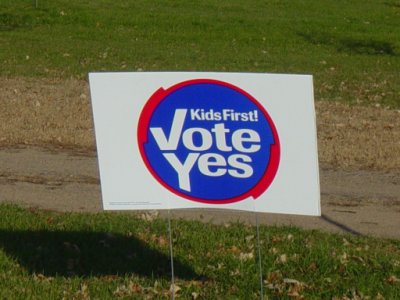
Talkin’ Referendum

Tav Falco and the Unapproachable Panther Burns – “Money Talks” (click to listen or download)

On July 28th the Madison Metropolitan School District Board of Education will begin discussing a possible operating referendum. This is what Board President Arlene Silveira had to say on The Daily Page:

You will start to hear talk of a referendum in November as there is a community group starting to form in support of this action. At this point in time, the Board has not had any discussions on a future referendum. We will have a meeting on July 28 to start the discussion on this topic. The budget gap for the 09/10 school year is projected to be approximately $9.2M. Dan Nerad has our business office reviewing numbers in preparation for our discussion. IF, after our discussions and public hearing, we vote to go to referendum in November, the question(s) are due to the clerk’s office in early September. There will be an opportunity for public input. There is quite a bit of discussion that will take place in a short period of time. If you have any questions/comments, please let me know.

Arlene Silveira Madison Board of Ed

There is also a new note on the front page of the Communities and Schools Together (CAST) site:

At their July 28, 2008 meeting the Board of Education will begin discussions of a possible referendum. If they go forward, a public hearing will be scheduled followed by deliberations on the details of the referendum. The Board needs to hear from us, they need to know a referendum would have support from the community and be aware of what their constituents think is important. Attend a meeting or contact the Board at comments@madison.k12.wi.us.

We need a referendum. The school finance system in Wisconsin is creates annual budget gaps of about 2.3% between the revenue that districts are allowed to collect and what it costs to continue the same level and quality of education. Each year districts must cut programs and services. The only alternative is to hold a referendum and ask the tax-payers for the authority to collect more revenue. Without a referendum there will be about $9.2 million in cuts in the 2009-10 MMSD budget .

In 15 years under this system, Madison schools have eliminated over 600 positions (including about 25 administrators), cut programs and services, and found more efficient ways of doing things. Any further cuts will affect what we value most about our schools. Our children, our schools and our community deserve better.

If a referendum is placed on the ballot, the timeline will likely be short. Communities and Schoools Together — along with other interested groups and individuals — has begun initial pre-campaign organizing. We will need help with big and small things. To get involved, please contact us at madisoncast@sbcglobal.net.

I want to emphasize that this may happen fairly quickly. That means that if there are things you would like to see funded (or not funded) by a referendum, the time to let the Board know that is short. It also means that if you want to volunteer to help pass a referendum it would be good to contact CAST as soon as possible.

Thomas J. Mertz

Leave a comment

Filed under "education finance", AMPS, Budget, education, Elections, finance, Local News, Referenda, referendum, School Finance, Take Action, Uncategorized

New Blog – Mica Pollock, schoolracetalk.org

Curtis Mayfield — “Mighty, Mighty (Spade and Whitey)” (click to listen or download)

I’ve highlighted Mica Pollock’s work on the importance of talking about race and other inequalities and ways to cultivate productive conversations here and here on AMPS. She has launched a new blog/site, www.schoolracetalk.org. I suggest you check it out. Here is her description:

I started schoolracetalk.org to create a virtual place where people can talk together about race issues in schools. We have to discuss these issues face to face with local people. But we also need places to go test ideas, and to learn some “gold nugget” ideas from others. We need to think together about how to handle racial inequality and what to “do with” difference and diversity.

Mica Pollock also had a very good guest post at eduwonkette recently.

I’ve said it before in a variety of ways, when those associated with our schools only indirectly address difficult matters of inequality, very little is gained. We might avoid or postpone some conflicts this way, but we don’t move forward toward better schools or a better society.

Thomas J. Mertz

Leave a comment

Filed under Best Practices, Equity, Gimme Some Truth, National News, Take Action, Uncategorized