Author Archives: Thomas J. Mertz

Updated — (Not) On the Agenda — MMSD Board of Education the Week of September 20th, 2010

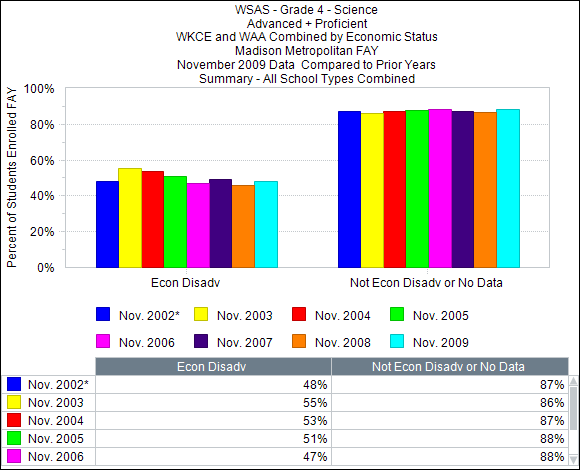
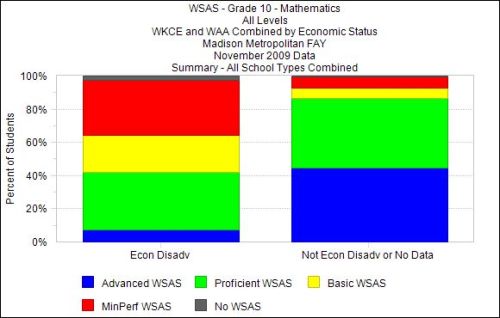
Note: For a while, I’m going to be illustrating the “On the Agenda” posts with various graphs documenting achievement gaps in MMSD as revealed by the admittedly flawed and limited WSAS/WKCE results. I think regular reminders may do some good.

Update: The Equity and Decision Making meeting has been canceled due to overlapping membership schedule conflicts and the weekly agenda has been posted (as of now — 12:54 pm — the agenda does not reflect the cancellation).

As of this writing, no agendas have been posted linked to the Madison Metropolitan School District Board of Education web page.  However, the Board Calendar shows three meetings today:

Special BOE Meeting-Closed, Start: Sep 20 2010 5:00 pm,  Doyle Administration Building, 545 W. Dayton St.,Room 103

Ad Hoc BOE Meeting-Five Year Budget Plan, Start: Sep 20 2010 6:30 pm, Doyle Administration Building, 545 W. Dayton St., Room 103

Ad Hoc BOE Meeting-Equity and Decision Making, Start: Sep 20 2010 6:30 pm, Doyle Administration Building, 545 W. Dayton St., Room 100A.

I’m assuming that the closed meeting is a continuation of the Superintendent Evaluation.

The other two are part of of the new Committee structure (Ed Hughes posted on this topic).

As with so much involving MMSD these days, I’m taking a wait and see attitude.  I will say that I am glad to see equity given attention and linked to decision making (doesn’t equity-driven decision making sound like a better idea than “data-driven” decision making).

Thomas J. Mertz

Leave a comment

Filed under Best Practices, Budget, education, Equity, Local News, Uncategorized

Quote of the Day — School Turnarounds

“The study suggests that people who say we know how to make failing schools into successful ones but merely lack the will to do so are selling snake oil. In fact, successful turnaround stories are marked by idiosyncratic circumstances. The science of turnarounds is weak and devoid of practical, effective strategies for educators to employ. Examples of largescale, system-wide turnarounds are nonexistent. A lot of work needs to be done before the odds of turning around failing schools begin to tip in a favorable direction.”

Intro to The 2009 Brown Center Report on American Education: How Well Are American Students Learning?

So much of the discussion of a “lack of will” devolves into blaming teachers, unions and “the Education Establishment” and is characterized by false promises of “the market” or unspecified “innovation” that reminders of the reality like those found in the Brown Report are drowned out in the blather.  The vast majority of public schools serve their communities well; the vast majority of those employed in education want students to be successful and do their best to make that happen.

Related and timely:

teacherken, “The problem with NBC’s Education Nation – where are the voices of parents and teachers?”

Leigh Dingerson, “”The Proving Grounds: School “Rheeform” in Washington, D.C..”

Rick Ayers, “An Inconvenient Superman: Davis Guggenheim’s New Film Hijacks School Reform.”

Diane Ravitch, “Why Civil Rights Groups Oppose the Obama Agenda.”

Thomas J. Mertz

Leave a comment

Filed under Arne Duncan, Best Practices, education, Equity, Gimme Some Truth, National News, Quote of the Day

Labor Day Mega Music Post

I need to find the time to do some serious blogging, but meanwhile some music for Labor Day.  Don’t forget to come to LaborFest on Monday (at the Labor Temple, Park  & Wingra, Noon to 5:30).  Good people, good music, good food.  Stop by the CAST table, say hey and sign the Penny for Kids petition.

The Dubliners, The Molly Maguires

Utah Phillips, There is Power In The Union

The Clash, Career Opportunities

Lee Dorsey, Working In The Coal Mine

Roy Orbison, Working For The Man

Dolly Parton, 9 To 5 (Live)

Bruce Springsteen & The Seeger Sessions Band, Pay Me My Money Down

The Gravedigger n the Teacher, Union Maid

Merle Haggard, Workin’ Man’s Blues

Thomas J. Mertz

Leave a comment

Filed under AMPS, Best Practices, Gimme Some Truth, Local News, National News, Pennies for Kids

Back to School Music

With the Madison Metropolitan School District set to open on Wednesday, time for a couple of back to school music videos.

Chuck Berry, “School Days.”

Fela Kuti, “Teacher Don’t teach Me No Nonsense.”

Thomas J. Mertz

Leave a comment

Filed under AMPS, education

On the Agenda: MMSD Board of Education, the Week of August 30, 2010

Note: For a while, I’m going to be illustrating the “On the Agenda” posts with various graphs documenting achievement gaps in MMSD as revealed by the admittedly flawed and limited WSAS/WKCE results. I think regular reminders may do some good.

Time for the Metropolitan School District Board of Education to get down to some serious work.  Past time.

I had high hopes that this would be a productive Summer for improving education and the governance of education in MMSD, but with 1/3 of their term complete this Board hasn’t given the public much to see.  I phrased that carefully because the one thing they have been working on is the Superintendent evaluation and all that has taken place behind closed doors, so the public hasn’t seen anything (yet, I hope).  More on the Superintendent evaluation below.

Two meetings this week; one open to the public and the other another closed session on the Superintendent evaluation.  The open meeting is 5:00 Monday, August 30 at the Lowell Center, 610 Langdon Street, Madison, WI, Room 118.   Note that this location means that there will be no broadcast or video record of the meeting via MMSD-TV.  The closed meeting is Tuesday at 5:00,  Room 103 or the Doyle Building.

The open meeting is billed as a “Workshop,” so no public testimony invited.

The first item is the approval of numerous minutes of previous meetings: October 23, October 26, 2009; February 22, March 15, April 5, May 10, June 1, June 21, June 23, and June 28, 2010.

Next comes:

Standing Committees of the School Board: Review of experience to date under the standing committee structure established by Board Policy 1031 and appointment of standing committee chairs and discuss various options.

The current structure — described in the linked policy —  was put in place at the request of Superintendent Dan Nerad.

This and other items on the agenda closely resemble the items on  the June 21 Workshop meeting.  That meeting was about goal setting for the year and also included a discussion of committee structure.

I attended that meeting, but lost my  notes in a hard drive failure.  My memory is that some progress was made on setting goals, but there was much work left to do.  My memory on the committee structure issue was that 5 of the 6 members with experience under the current structure desired changes, that there was interest in aligning the committees with the non-existent goals and that nothing was decided.

All this has been hanging there since June 21.  Without goals and a committees, the Summer has largely been wasted.

The next couple of items are also about Board duties and schedules:

3.Designating appointments/representatives and review of time commitments, expectations, roles/responsibilities in connection with:

a) The School Board Member liaisons to MMSD
schools/programs under Board Policy 1041;
b) School Board Member liaisons to community groups
implementing specific MMSD-supported initiatives; and
c) MMSD Board/School representation to various
organizations, associations, boards, committees, etc. as
described under Board Policy 1041

4.School Board and Board Committee meeting schedule and meeting structure through the first semester of the 2010-2011 school term, including identifying potential needs for public input/listening sessions, any ad hoc committees, etc.

I’m not clear on what all these committees, programs, organizations…are, or whether any of this is new (I like the idea of new, semi-formal relationships with community organizations).

As to the schedule (#4), there is only one subsequent meeting currently scheduled;  a September 13, Special Board meeting.

After these they will consider revisions of the ethics policy.  There was a draft circulated at some meeting and I have it on file (I may try to dig it up and scan), but having seen it I’m not at all clear what they are trying to accomplish or why this has become a priority.

Last up,  is  “Next Steps for Future Board Development Meetings and Topics.’  Board development is good and important, but with only 2/3 of the term left I hate to see too much time and energy devoted to Board Development.

I keep coming back to this.  Every year about 1/3 of the time and energy is devoted to budget matters, that leaves 2/3 to try to make things better.   Put it another way; it is September, budget season starts in January.  Past time to get to work.

This just leaves the closed meeting on the Superintendent evaluation.  Not much to add to what I wrote here.  My big point is that almost all of  this process should be public.  I will repost the links to things that are public:

Superintendent Goals from MMSD Board of Education Progress Report – January, 2010.

Process for Evaluation from July 20, 2009.

Revised Process for Evaluation, August 17, 2009.

Minutes of meetings where this was discussed:  November 28, 2009September 21, 2009; September 14, 2009.

That’s all folks…

Thomas J.  Mertz

3 Comments

Filed under Accountability, Best Practices, Budget, education, Uncategorized

On the Agenda, MMSD Board of Education the Week of August 9, 2010

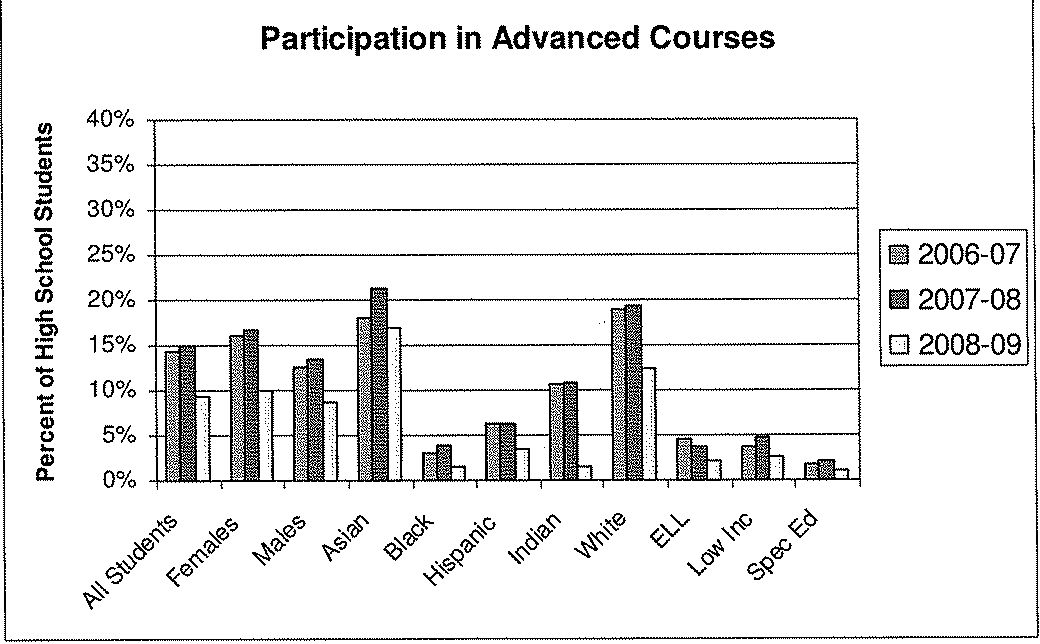
Note: For a while, I’m going to be illustrating the “On the Agenda” posts with various graphs documenting gaps in MMSD. This one is from the Equity Report, which is on the agenda.

After an unplanned break from blogging, I’m going to ease back in with a partial run down of  this week’s Board of Education agenda.

There are two meetings on Monday August 9, an Executive (closed) session at 5:00 PM in Doyle RM 103 and an open session in the Auditorium at 6:00 (plus an exchange of proposals on the Security Assistant contract on Friday).  The agendas for the first (and last) are here.  Unfortunately the link to the open meeting agenda is broken (fixed now).  A Board member scanned a copy for me and I’ve uploaded that (the hyperlinks don’t work, but you can get to the documents by pasting the appendix designation after http://boeweb.madison.k12.wi.us/files/boe/Appx, for example MM 2-8 becomes http://boeweb.madison.k12.wi.us/files/boe/Appx 2-8.pdf).

The big item of public interest on the closed session agenda is the Superintendent Evaluation.  It is perfectly legal to do this in a closed session, but I don’t think it is good policy.   Voters have only the Board to hold accountable and the Board has chosen to funnel most or all administrative accountability into the Superintendency.  The public can’t make an informed judgment on the Board when this process takes place behind closed doors.

In the two plus years Dan Nerad has headed MMSD, I haven’t seen a single document reflecting the Board’s assessment of his job performance and public discussions on this topic have been rare, indirect  and partial.

If you are interested in the terms and process of the evaluation, there are some public documents.

Superintendent Goals from MMSD Board of Education Progress Report – January, 2010.

Process for Evaluation from July 20, 2009.

Revised Process for Evaluation, August 17, 2009.

Minutes of meetings where this was discussed:  November 28, 2009September 21, 2009; September 14, 2009.

The approved Process requires that a summary document be made public.  I’ll be waiting for that.

I’ll close this section with a quote from Nerad:

Q: How do you receive feedback based on your performance?

A: One of the things that is in some ways unique… is that I report to the Board of Education. I have seven bosses, and they do an evaluation process of me… I’m a big believer in self-assessment, so part of my evaluation will be to self-assess. I’m also a believer in what’s called 360-degree feedback, where you get feedback from others involved in the organization, so part of it will involve that… So ultimately it does come down to the Board of Education with multiple kinds of inputs that evaluate my performance.

Sounds good, but having 360-degree visibility would be better.

I’m running late on this, so the only thing from the open meeting I want to highlight is the “Annual” Equity Report (annual is in quotes because the policy requiring an annual report was passed in June of 2008 and this is the first report — a previous atempt from earlier this year was sent back for revision — I wonder if any of this came up in the Superintendent Evaluation?).

You can read more about my hopes and wishes for the Report in this post and this one too.

In terms of information provided, this version is an improvement over the first attempt.   That said, there is still room for improvement (both with the report and in achieving equity) and there is at least one thing about the first version I like better.

What I liked about the first version was that it attempted to identify district initiatives that addressed the recommendations of the Equity Task Force.  This isn’t required, but it was nice and useful.

The current version uses selected equity-related  Strategic Plan measures more than the Equity Task Force work.  In this way it serves as a preview of what can be expected with the Strategic Plan reports.

I’m withholding most judgment until I have a chance to hear the presentation and the reactions of the Board, but there are some things I do want to note.

Might as well start with the graph at the top.  Pretty disturbing.  The Equity Task Force thought that expanded access to advance programs was of the highest importance and this indicates that the number of high school students taking advanced courses is declining and the diversity of those students is not markedly improving.

Two notes before going deeper on this.  First, “advanced courses” isn’t defined and second, the graph without data makes it very hard to know what is happening with the demographics.

What is worse is the Report simply says “the reason for the decline is unclear” and moves on.  That isn’t good enough.  The purpose of having this report is to raise red flags so that inequities and bad trends get attention and action.  Noting the lack of clarity of causality isn’t going to reverse this trend.

In light of the dismal data on the diversity of TAG participation, I’d also like to see data for all advanced programs, not just high school courses.

The other thing that really bothered me was the note that the Report isn’t “applicable” to “Budget Implications.”   This appears to be pro forma, but resource allocations are central to the concept of equity advanced by the Task Force and reflected in the district Policy.  Quoting from the Policy:

Achieving equity often requires an unequal distribution of resources and services in response to the unequal distribution of needs and educational barriers.

How can you have  report on Equity that reflects this assertion and has no budgetary application?

Other things to note:

  • More presentations of data by school would be good.
  • The extensive use of climate surveys is a good idea (these are broken down by school), but I’d like to see school level demographic breakdowns here.

I want to get this up, so I’m leaving it at this for now.

Thomas J.  Mertz

Leave a comment

Filed under Accountability, Best Practices, Budget, education, Equity, Local News, Uncategorized

Hearing on Edgewater TIF (yes, this is about schools)

See below for hearing information, background and talking points on the Edgewater TIF.  This directly impacts the schools by diverting property taxes.

Joint Review Board Hearing and the Edgewater Project

On Thursday, August 12, 2010 the TIF Joint Review Board will be holding a public hearing on amending Tax Incremental Finance District (TID) 32 in order to provide over $18 million in property tax based financing for the proposed luxury hotel plaza. The Board meets at 5:00 PM, 215 Martin Luther King, Jr. Blvd. Room 260 (Madison Municipal Building). Speakers will have three minutes to testify. A vote is anticipated in September.

If this goes through the closure of TID 32 will be delayed, meaning that for six years the benefits from that TIF investment will be used for the Edgewater instead of to fund schools, city and county services and MATC. With the schools and other local governments suffering from decreased state support and families having trouble with property tax increases this is a bad idea.

Below is some background information along with some suggested talking points. The Joint review Board needs to know that their constituents understand the issues and oppose the TID amendment. Please consider attending the hearing, testifying and/or contacting the Board and appointing authorities. It isn’t too late to stop this.

TIF Basics

The idea behind Tax Incremental Financing is that a government body promotes development and funds infrastructure in “blighted” areas by borrowing against anticipated property tax revenues and then designating the growth in revenue due to the development (the increment) to repay these loans and associated costs. Once the loan is repaid and the district is closed, the increment becomes part of the general tax base.

TID 32 and the Edgewater

TID 32, anchored by the University Square redevelopment has been extremely successful. It is generating about $3 million annually in increment and is projected to close in three years.

The increment for the Edgewater project only meets the requirements for a stand alone TIF of $3.3 million. In order to give the project over $18 million in financing (or $15 million more than it can support) it has been proposed to annex the project to TID 32 and use the success of that TID to finance the luxury hotel plaza. This delays the closure of the district and postpones the time when the success of TID 32 will ease the property tax burden on the rest of us. While the TID is open, all increases in assessments and revenues in the district – whether related to the project or not – will be diverted to pay for the luxury hotel plaza, further shifting the tax burden.

Projections indicate that the amended TID would close in nine years, or six more than without the amendment.

The Joint Review Board

Because diverting property taxes to developments via TIFs has an effect on all taxing entities, state law requires that TIFs be approved by a Joint Review Board where these bodies are represented. In considering the creation or amendment of a TID the Board must employ these criteria:

  • Whether the development expected in the TID would occur without the use of TIF (commonly referred to as the ‘but for test’).
  • Whether the economic benefits, as measured by increased employment, business and personal income and property value, are sufficient to compensate for the cost of the improvements.
  • Whether the benefits of the proposed plan outweigh the costs, in taxes on the value increment, to the overlying tax districts.

Although the “benefits” language in the third is somewhat open ended, considerations of the architectural or historic appropriateness of the project are largely outside the charge to the Board.

Of primary concern to the Board is whether temporarily diverting the projected tax revenues to support this project is in the best interest of the taxpayers and bodies they represent — Madison Metropolitan School District (MMSD), Madison Area Technical College (MATC) and Dane County.

Property Taxes, State Aid, Shared Revenue, the Economy and TIFs

The bulk of the City, the County, the school district and MATC budgets are funded by a combination of state aid (or shared revenue) and property taxes. The recent economic downturn and a continuing state structural deficit – projected at over $2.5 Billion for the next biennium – has shifted more of the responsibility to local property taxes. This has hit the school district particularly hard, with nearly 15% cuts in state aid the last two years and more of the same anticipated.

The economic downturn has also slowed the growth of the property tax base. The aggregate assessments of existing property has fallen slightly and growth due to new development is below previous years. Under these circumstances, increases in property tax revenues to make up for decreases in state aid require existing property tax payers to pay more.

All the taxing entities have sought cuts from same service budgets in order to ease the burden on tax payers. Again, the schools have been hit particularly hard, enacting more than $13 million in budget reductions for the 2010-11 school year.

Timely closure of TID 32 would ease this situation by adding the increment to the tax base; extending the life of TID 32 to fund the luxury hotel plaza would make it worse.

Talking Points

Based on the Above:

  • The Edgewater Project can’t support the TIF.
  • The taxpayers, the schools, MATC, the County and the City would all benefit from an early closure of TID 32.
  • Delaying the closure of TID 32 will result in at least a $15 million property tax increase over the next nine years.
  • The economic situation has already lead to property tax increases and cuts to programs and services; amending TID 32 will exacerbate this at a time when both families and governing bodies are struggling to make ends meet.

Other Things to Consider (most detailed in this briefing from CNI):

  • The ratio of private investment to TIF isn’t good policy.
  • The costs and benefits are not substantiated (The Joint Review Board has the power to request more information and a review of information they consider unsubstantiated)
  • These include project costs as well as job and property value projections.
  • Costs assigned to the TIF do not meet TIF requirements.
  • This project requires deviations from guidelines in self-support, 50% payback, equity participation and personal guaranty.
  • The operating agreement for the Plaza limits public access and works to the benefit of the hotel through catering and other requirements.

Contact Information

If you cannot attend the hearing, you can contact the Joint Review Board via email:

Dean Brasser
dbrasser@cityofmadison.com

Gary L. Poulson
GaryPoulson@gmail.com

Roger Price

rwprice@matcmadison.edu

Lucy Mathiak
lucym@charter.net

Dave Worzala

worzala@co.dane.wi.us

You can also contact the appointing bodies and ask them to advise their Member to vote against the amendment:

MATC Board

http://matcmadison.edu/email-district-board

Dane County Board

county_board_recipients@co.dane.wi.us

MMSD Board of Education

board@madison.k12.wi.us

Thomas J. Mertz and Jacque Pokorney

Co-Chairs, Progressive Dane

Leave a comment

Filed under "education finance", Best Practices, Budget, education, finance, Local News, School Finance, Take Action

How low can you go? Obama, EduJobs and Food Stamps

Eddie Bo, “Lets Limbo” (click to listen or download)

The latest on the Obama Administration’s ridiculous priorities, from an interview with Rep. David Obey:

We were told we have to offset every damn dime of [new teacher spending]. Well, it ain’t easy to find offsets, and with all due respect to the administration their first suggestion for offsets was to cut food stamps. Now they were careful not to make an official budget request, because they didn’t want to take the political heat for it, but that was the first trial balloon they sent down here. … Their line of argument was, well, the cost of food relative to what we thought it would be has come down, so people on food stamps are getting a pretty good deal in comparison to what we thought they were going to get. Well isn’t that nice. Some poor bastard is going to get a break for a change.

Can’t cut the military, can’t raise taxes on the rich and corporations, need to bail out Wall Street; Race to the Top’s destructive policies are popular with the Newt Gingrich’s we want to apeal to…let’s cut food stamps.

The answer to the titular question is “lower than a pregnant snake’s belly.”

Thomas J. Mertz

Leave a comment

Filed under "education finance", Accountability, Arne Duncan, Best Practices, Budget, Gimme Some Truth, National News, School Finance

Songs for Independence Day

Time for the annual Independence Day AMPS music post (previous years here and  here).

Elvis Presley, “American Trilogy”

Prince, “America”

T-Rex, “Children of the Revolution”

Thomas J.  Mertz

Leave a comment

Filed under AMPS, Gimme Some Truth, Local News, National News

Democrats the New Republicans? Education Policies and Much More

Let me preface this by saying that I am dues-paying member of the Democratic Party of Wisconsin (as well as Co-Chair of Progressive Dane) and don’t want to paint with too broad a brush.  Yet the trends and developments  I see everywhere (and have been seeing for sometime) are too disturbing to ignore.  Democrats are repeatedly championing destructive conservative policies in the service of economic elites while pushing aside both common sense and social justice.  The current GOP extremist obstructionism is beside the point, except that it enables the Democratic moves to the right because with the major parties the choice becomes one of very bad (Dems)  versus unbelievably insanely bad (GOP).

Let’s start with the “EduJobs” Bill.  I think last time I mentioned it, Senator Tom  Harkin and Rep. David Obey were pushing for $23 billion in aid to states to prevent teacher layoffs.  After it was killed, President Obama gave it a push.  This is a classic example of the kind of selective use of Presidential power that Glenn Greenwald has been documenting at Salon.  The progressive positions get the rhetoric, but the conservative policies get the muscle.

The deficit hawks managed to get the the allocation whittled down to $10 billion, but rather than pay for it via more progressive taxation or the kind of deficit spending that Keynesian economics has demonstrated  to be effective in these kind of economic times, there was insistence that cuts elsewhere in education be part of the package (makes me think of the Madison Metropolitan School District budget madness where cuts were justified because  “people are reluctant to pay higher taxes”).

The good news is that those cuts were to be taken from the Race to the Top education deform con game.  The bad news is that all the Education DINOs (Democrats in Name Only) and their allies, are up in arms protesting the cuts to their favored scheme of more Charter Schools, and more tests used for more things (and here and here and here).  This follows their typical union bashing over the distracting issues of which teachers are slated to lose their jobs.  What a spectacle, “Democrats” and self- proclaimed education reformers more interested in destroying organized labor and expanding Bushian policies than in keeping teachers in the classrooms.

Now the biggest Education DINO, President Obama, has threatened to veto the bill if the cuts to Race to the Top remain.

A little break for sanity.  This week the Journal of Education Controversy posted a new critique of the Obama/Arne Duncan education policies from the National Council of the Churches of Christ in the USA.  Here is an excerpt:

We reject the language of business for discussing public education.

Not only has the language of the marketplace entered discussions of school governance and management, but we also notice that the language of business accountability is used to talk about education, a human endeavor of caring. The primary mechanism of the No Child Left Behind Act has been annual standardized tests of reading and math for all children in grades 3-8, followed by punishments for the schools that cannot rapidly reach ever increasing test score production targets. We worry that our society has come to view what is good as what can be measured and compared. The relentless focus on testing basic skills has diminished our attention to the humanities, the social studies, the arts, and child and adolescent development. As people of faith we do not view our children as products to be tested and managed but instead as unique human beings, created in the image of God, to be nurtured and educated.

I want to point out that although comes from a perspective of faith, the values espoused are also in the humanist tradition.

A  side trip away from education to note that the White House and the  Democratic leadership choose to court Scott Brown (R. MA) and  other Republicans by making the financial regulation bill more Wall Street friendly and rejected Russ Feingold’s (D. WI) efforts enact legislation that the banks and the hedge fund managers didn’t like, losing his vote.  This same “leadership” has failed to enact an extension of unemployment benefits.

The links between Wall Street and Education DINOS are many.  Kenneth Libby has started a new site — Democrats for Education Reform (DFER) Watch —  to document these and other aspects of the deform effort.  Some of this has to do with an elitist, technocratic, market based worldview, a desire to tear down a non-market based system of public education that works very well for most American students and communities,  destroy organized labor and a related desire to inculcate students with these values.  Some of it also has to do with the profit motive.  As Juan Gonzalez has reported, the semi-privatization of education via Charters and Vouchers offers wealthy donors significant tax credits (leading to further starvation of the public sector).  Here is a clip from his appearance on Democracy Now explaining how it works.

I can’t leave this topic without checking in again on my favorite Education DINO poster boy, Whitney Tilson.  He’s a DFER leader who also manages investment funds.  The fees from this “work” support a lavish lifestyle, generous political contributions and his extensive education policy advocacy.  Unfortunately for his investors, his funds lose money.  Let’s go to the charts:


Since inception, the Tilson Dividend fund has done slightly better than the NASDAQ and the  Tilson Focus fund slightly worse; both have lost money.  After taxes and fees are accounted for, investors are out even more.  As I said before, you would have done better stashing your money in an old sock than giving it to Whitney Tilson to invest.   As I asked at the same time, why would anyone trust our education system and our children’s futures to the people responsible for the economic disaster, people who have wrought havoc on our society and can’t even show a profit for their clients in the free market they love so well? I don’t have an answer, but like so much else that is wrong with politics it might have something to do with those campaign donations.

I’ll close by noting that closer to home Tom Barrett — the leading Democratic Candidate for Governor — has expressed has more concern for property taxpayers than enthusiasm for fixing Wisconsin’s broken school funding system.

Thomas J. Mertz

Leave a comment

Filed under "education finance", Arne Duncan, Budget, Contracts, education, Elections, finance, Gimme Some Truth, Local News, National News, nclb, No Child Left Behind, School Finance, Uncategorized