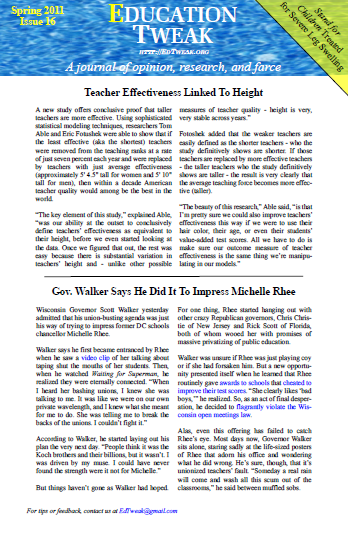
Click on image for pdf.
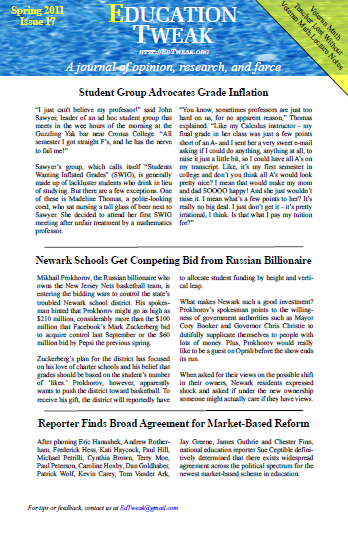
Click on image for pdf.
I am easing back into blogging and what better way to start than with not one, but two new issues from our friends at EdTweak.
Thomas J. Mertz
Click on image for pdf.
Click on image for pdf.
I am easing back into blogging and what better way to start than with not one, but two new issues from our friends at EdTweak.
Thomas J. Mertz

Wednesday April 20, 10:30 AM, “A Better Way” School Funding Alternatives Press Conference
FOR IMMEDIATE RELEASE: April 19, 2011
Parents, Religious and Education Leaders Call for Balanced Approach in Budgeting for Public Education.
MADISON, Wis. – A broad coalition of parents, student advocates, religious leaders and educators has come together to call on the Wisconsin Legislature to take a more balanced approach to the state budget process.
To make their voices heard, the group’s members will hold a press conference that will detail how the budget will impact people from a wide variety of perspectives. The event will be held in the Senate Parlor of the State Capitol Building. WHAT: Press conference featuring parents, students, teachers and advocates, who will speak about how the state budget will impact them and their local schools and students. The event will also outline options the Legislature and governor should consider before making massive cuts to education.
- WHEN: Wednesday, April 20, 2011, 10:30 a.m.
- WHERE: Senate Parlor, State Capitol Building, Madison
- WHO: The event will feature a number of speakers, including:
• MC: Julie Underwood is dean of the University of Wisconsin-
Madison School of Education• Nancy Holmlund is president of WISDOM, a network of 145
congregations representing 17 denominations across Wisconsin that
work together to promote fairness and the common good• Beth LaBell is a parent and member of the Paris Vote YES
Committee, a group that promotes the Paris School District• Terri Raatz is mom to three little boys, the oldest of whom, Patrick, is
seven years old and has autism• Jasmine Alinder is the founder of I Love My Public Schools, a group
of concerned Wisconsin parents who are fighting for the rights of
children to have a quality public education• Danielle Barbian is a senior at Hamilton High School in Sussex and
president of the Wisconsin Association of School Councils• Kim Hoffman is a music teacher at Stone Bank Elementary School in
Waukesha County and member of the Wisconsin National GuardWHY: The proposed state budget includes over $1.7 billion in cuts to education over the next two years, while increasing spending over $600 million for corporate tax breaks and transportation projects. The result will mean program cuts, fewer opportunities for students and increased class sizes.
“Road Map to a Better Way” from The Wisconsin Alliance for Excellent Schools (WAES).
Thursday April 21, Noon — On the Airwaves — WORT 89.9 FM.
I’ll be on A Public Affair with Allen Ruff discussing “the state of public education, the assault upon it and what we can do.” Listen and call in: 256-2001.
Thursday, April 28, 6:45-8:45: West High Roundtables Conversation
Thursday, April 28, 6:45-8:45, in the West High Cafenasium
Calling All Parents, Students, Teachers!
Excerpt from the April 2011 PTSO Regent Reporter article:
Our school, like every other school across our state, will
likely be confronted with some major changes in the near future. The
events of this school year at West have shown us the importance and
the power of joining together and sharing our voices, so that we can
all be heard.Now, in the face of potentially drastic cutbacks, it is more crucial
than ever that we identify the issues, concerns and decisions that we
need to explore as a community, and then establish the lines of
communication through which we can all effectively contribute to the
decision-making process, which helps to ensure inclusive input of all
affected stakeholders.These issues will be the focus of our West Roundtables gathering,
scheduled for Thursday, April 28th, 6:45 p.m. in the Cafenasium.We can be best prepared to protect the interest of our school by being
informed of the concerns and needs of all, and we can only accomplish
this if we have a system in place that facilitates a free exchange of
ideas.Please save the date Thursday, April 28th, to attend this important
event.Sponsored by West’s PTSO & the West Cares Group
Thomas J. Mertz
 Members of the Senate Education Committee
My name is Thomas J. Mertz. I have been active in Madison and statewide working for adequate educational funding and equitable educational policies. Like many I see much in Senate Bill 22 that will exacerbate the underfunding of the district schools which will continue to be the source of educational opportunities for the overwhelming majority of Wisconsin’s students, and much that will create greater inequities in access to opportunities. The future of our children and our state depend on investments in education. That this is happening after 17 years under a deeply flawed school funding system and at a time when districts face unprecedented cuts in both state funding and local revenue authority is particularly alarming.
However this is not where I want to focus attention here. I am also a historian of education. It is from this perspective, as well as the perspectives of a parent, citizen and activist that I urge you to reject those aspects of Senate Bill 22 which undermine Wisconsin’s long traditions of non-partisan local control
Our state Constitution states “The supervision of public instruction shall be vested in a state superintendent and such other officers as the legislature shall direct.” Our supreme court has ruled that other officers created by the legislature may not be given powers equal to or greater than the superintendent. The Constitution also specifies that the Superintendent be elected “at the same time and in the same manner as members of the supreme court.” This clause and statutes related to the election of the Superintendent and Boards of Education, as well as those covering those wonderful exercises in direct democracy, School Meetings, are part of a long and careful tradition of separating the governance of education from partisan politics. In 1885, In an an attempt to further separate the political sphere of school governance, Wisconsin went so far as to grant women a limited suffrage, confined to “school matters.”
The creation of a politically appointed Charter School Authorizing Board and Executive Director, with powers and responsibilities rivaling those of the State Superintendent is a heedless and needless break from these traditions. Schools are inherently political, yet Wisconsin’s Superintendents and Board of Education have an admirable record of finding common ground and advancing the common good. Handing control of K-12 schools to people chosen by party leaders introduces a great potential that in decision-making, other than the common good will become primary.
This Board also represents a break from the tradition of local control of education. It opens the door for “sponsors” and the “operators” they contract with to set up networks of schools with limited state oversight and answerable primarily to distant entities. It cannot be forgotten that the resources at the disposal of these entities will be resources not available to the local and locally elected school board.
Schools and school districts define communities; the charter networks enabled by SB 22 threaten local decision-making and the already precarious financial viability of districts. In urban, suburban, small town and rural Wisconsin he health and economic prospects of communities are tied to the strength of our schools.
Schools are also defined by their communities. Through their locally elected Boards of Education and in school meetings, citizens are collectively involved in choosing programs and personnel, in setting priorities and debating budgets, in building facilities and — these days much too often — closing schools.
These ties will be gone with networks of charter schools authorized by a partisan state board and operated by out-of-state corporations.
There are many other aspects of SB 22 that I would like to discuss, but I’ll close by reminding you that in Wisconsin we have some very good public schools and some that need improvement. We also have some very good charter schools and some that need improvement. Local control of charter authorizing is working. The best evidence is that charters are generally no better than district schools and often not as good. They are not in and of themselves “the answer” to our educational problems and in many ways are a distraction from improving the education for the 90%+ of students who will continue in district schools. Don’t let enthusiasm for “choice” and ill-defined “innovation” seduce you into abandoning our traditions, our communities and our schools.
Thomas J. Mertz
For more information, see Public Schools for the Public Good and the Facebook Group, “Stop the Charter School Bill.”

From the Wisconsin Alliance for Excellent Schools (WAES)
Governor’s budget plan for education
gets a bad grade on basic mathematicsAs long as the cost of education does not increase, the tools Governor Scott Walker “gave” districts to offset his devastating cuts to school aids might work, theoretically, for some communities. In the real world, however─where costs increase and children need opportunities to succeed, the coming years look pretty bleak.
That was the assessment following Tuesday’s credentialed media only press event behind locked doors where the Governor rolled out his version of the 2011-13 budget for public education. Not everyone was as optimistic as Walker.
Superintendent of Schools Tony Evers called the budget “a crushing challenge,” while the School Finance Network said the budget is “shortsighted and counterproductive” and “the simple fact is that (it) will result in cuts to programs and services and increases in class sizes.”
In general, the Governor’s budget that cuts aid and reduces districts’ revenue authority doesn’t take into account 18 years of cuts to programs and services and basic inflationary cost increases. WAES maintains that sooner or later, the result of the cuts─small, large, and cumulative─will be or already has jeopardized the future of Wisconsin’s children and communities.
Wisconsin’s School Administrator’s Alliance (SAA) said its members are united in their opposition to Governor Walker’s agenda of privatizing public education.” “According to John Forester, the group’s director of government relations, “The school aid cuts in the Governor’s proposed budget plan are of a magnitude not seen since the Great Depression.”
Find out what you can do to stop these devastating aid cuts to our public schools at http://www.excellentschools.org/events/2011/budget/toolkit.htm..
Read more:
- School Finance Network response … http://thewheelerreport.com/releases/March11/0317/0317sfn.pdf
- Milwaukee Journal Sentinel ….http://www.jsonline.com/news/education/118129759.html
- Milwaukee’s WISN … http://www.wisn.com/news/27221521/detail.html
- Wisconsin State Journal …. http://host.madison.com/wsj/news/local/govt-and-politics/article_be49f5a8-5045-11e0-86a0-001cc4c03286.html
- Department of Public Instruction …. http://dpi.state.wi.us/eis/pdf/dpinr2011_26.pdf
- Wispolitics.com …. http://www.wispolitics.com/index.iml?Article=230238
- Wisconsin School Administrators Alliance …. http://www.thewheelerreport.com/releases/March11/0316/0316saa.pdf
- Wausau Daily Herald …. http://www.wausaudailyherald.com/article/20110317/WDH0101/103170450/Local-government-officials-say-Walker-s-tools-will-not-work?odyssey=tab|topnews|text|FRONTPAGE
- ACLU of Wisconsin …. http://www.aclu-wi.org/
- MPS Superintendent Thornton reacts …. http://superintendentthornton.blogspot.com/2011/03/you-dont-have-to-be-invited.html
Thomas J. Mertz

There is so much good stuff out there on what has been happening in Madison and around the state this week that I really don’t have too much to add. I will point toward the CAST Statement I helped draft, Rep Mark Pocan’s “Scott Walker’s Top Ten Lies” for a good fact check and Alder Brian Solomon’s “Madison, WI: A Prelude for Economic Justice” for some questions and context. I’ve been energized and filled with hope by the the rallies and protests this week, but like Brian I have concerns about the limits of the agenda being put forward.
That is why I want to try to focus attention on what comes next, the other shoe waiting to drop, Governor Walker’s Biennial Budget. It is going to be a giant shoe and we need to be ready to catch it and throw that one back too.
Throughout this, Walker has made it clear that the so-called Budget Repair bill is only a prelude to the Biennial Budget. The GOP talking points have been that destroying public worker unions is a way to give local governmental units (counties, municipalities and school districts) the tools to deal with the budget cuts that radical slashes to state aid, shared revenue and unprecedented limits on local control of revenues — all anticipated in the Biennial Budget — will bring.
I’d be remiss if I didn’t point out that the way to actually help local governmental units and the people of Wisconsin is to provide sufficient revenues. For more, see the Institute for Wisconsin’s Future/Wisconsin Council on Children and Families Catalog of Tax Reform Options for Wisconsin and of course Penny for Kids.
Scott Walker and the GOP don’t want you to know what is in the budget bill, they especially don’t want this information out there while the people are in control of the Capitol and paying attention. So, instead of releasing the Budget on Tuesday February 22 as scheduled, they have moved it to March 1. Whether in the Capitol or elsewhere, we all need to be paying attention and we all need to mobilize on this too.
There have been some hints and leaks about what will be in the Budget and it ain’t good.
What do we know from all this?
Geez — Title I. This is beyond insane. For me this is the straw that breaks the camel’s back. Everything else — tax cuts, aid cuts, revenue limits, union busting…– is maddening and insane, but refusing Title I is so stupid and so offensive that as Marvin Gaye said “It makes me wanna Holler, ” and scream and organize.
AND ORGANIZE!
I know I’ll be marching in March and probably April, May and beyond (even though I should be campaigning for the District 13 seat on the Madison Common Council instead).
Who else will be organizing and marching isn’t clear at this point, but I’d guess if you contact/join the Wisconsin Alliance for Excellent Schools, The Institute for Wisconsin’s Future, Progressive Dane, The Wisconsin Wave, Madison Area Urban Ministry, and the Wisconsin Council on Children and Families, you’ll be in the loop and know when to lace up your marching boots.
Save the date.
Thomas J. (TJ) Mertz

“It is precisely because education is the road to equality and citizenship, that it has been made more elusive for Negroes than many other rights. The walling off of Negroes from equal education is part of the historical design to submerge him in second class status. Therefore, as Negroes have struggled to be free they have had to fight for the opportunity for a decent education.”
“The Negro has no room to make any substantial compromises because his store of advantages is too small. He must press unrelentingly for quality, integrated education or his whole drive for freedom will be undermined by the absence of a most vital and indispensable element — learning.”
“The function of education is to teach one to think intensively and to think critically… Intelligence plus character – that is the goal of true education.”
“Cowardice asks the question, ‘Is it safe?’ Expediency asks the question, ‘Is it politic?’ But conscience asks the question, ‘Is it right?’ And there comes a time when one must take a position that is neither safe, nor politic, nor popular but because conscience tells one it is right.”
Thomas J. Mertz

Photo WKOW
I’m running for Common Council and shouldn’t be spending time on this, but the issues are very important to me, so I’m doing it, but as short and sweet as I can.
The issues are the failure of the MMSD Administration to follow basic practices of open inclusive governance and the implementation of segregative policies.
Below (and here) is an open letter drafted and signed by 18 West High parents on Friday 1/7/2010. Understanding the letter requires some background and context. The background — along with the latest news and some final thoughts –follows.

Background:
On October 15 2010 hundreds of West Students protested proposed changes in our High Schools and their exclusion from the decision-making on these changes. Subsequently, the proposal was renamed “(Dual Pathways” is in the dustbin of history) and vague statements about a more open and inclusive process were made (AMPS posts on this here, here, here and here).
After a contentious parent meeting at West on these proposals, a group of parents who wanted to have some say in the reforms began meeting and emailing. It is important to note that the views of this group on the various aspect of the reforms are diverse, but all wanted to be part of an open process (I strongly favor some aspects and oppose others, see the links to AMPS posts above). Only some members of this group signed the letter.
Last Thursday these matters appeared on the Board of Education agenda for the first time. It was a workshop meeting — no public testimony — and nothing was slated for action. Not all supporting materials were linked to that agenda. I’m not going to do a blow-by-blow of the meeting.
The important development was that it was revealed that the changes in high school structures for English and Social Studies at West and Memorial — the changes the prompted the protest (uploaded here, I don’t believe this document has ever been posted by MMSD) would appear in the handbooks for 2011-12 that had to go to the printer on Tuesday January 11. Remember, this information was not public prior to the meeting and there was no way for the Board to act on it. This is what prompted the letter.
At the meeting some Board Members suggested delaying the implementation. Since the meeting there has been communication between Board Members and between Board Members and the Administration (note: I said “between” not “among,” which would be a clear violation of open meetings statutes).
Latest News:
I have been informed that the result of this “process” is that the planned changes, the segrative changes, will appear in the course catalog that is sent to the printer on Tuesday.
Final Thoughts:
This is no way to run a school district and it is certainly no way to institute a reform that to be successful requires the confidence and support of parents, students and teachers. If you don’t like this, let the Board and Supt Dan Nerad know (board@madison.k12.wi.us; dnerad@madison.k12.wi.us).
In conclusion, I want to reiterate that I support much of the reform package and believe in the sincerity of the motives of those behind it.
Thomas J. Mertz
Filed under Accountability, Best Practices, education, Gimme Some Truth, Local News, Uncategorized
 Sonny Boy Williamson “Don’t Start Me Talkin'” (click to listen or download)
[Note, no “On the Agenda” post this week, you can access the agendas here.]
I’ll be attending the November 9th Community Conversation on Education sponsored by the Madison Metropolitan School District, the United Way, UW-Madison School of Education, MTI and the Urban League. I have a lot of misgivings. To begin with, it is advertised as “sparked by “Waiting for Superman” and I have little desire to take part in anything that is “sparked” by such a dishonest endeavor (see also the Not Waiting for Superman site). It also strikes me as yet another instance of Madison being reactive, when we should be proactive in public education. Then there is the whole mysterioso aspect, where you sign up and then get the agenda.
Perhaps most importantly, I don’t see this leading anywhere, or at least I don’t see a plan for it to lead anywhere. After 200-300 people talk about education, what next? The recent local record isn’t good. Task Forces, strategic plans, advisory groups, budget hearings all bring people in, and then they are sent away. In many instances they are sent away with little evidence they have been listened to or had any influence (I’m thinking of the hundreds of people who testified on the budget in particular). Community Conversations are not community involvement and the latter has been sorely neglected recently.
Genuine community involvement takes a sustained effort and requires that those giving time and energy also be given influence and power. Maybe this is the start of that happening in Madison. I hope so. If it is, then I suggest that district officials check out some of the publications from the Annenberg Institute to learn about the next steps (more specifically, this series of publications).
Meanwhile, I’ll go and have my say (despite the song at the top, I won’t “tell everything I know”), listen, learn and hope.
Thomas J. Mertz
Filed under Best Practices, education, Local News

2012 Mayan Calendar
Gayle Worland Matthew DeFour in the Wisconsin Sate Journal has the story, there is a new timeline pushing implementation back to 2012-13, an extended input process, some backgorund, a more detailed rational and much more for the proposed Madison Metropolitan School District High School Curricular Reforms (now apparently officially dubbed Career and College Readiness).
The new document only indirectly presents the Dual Pathways proposal (Executive Summary here), but does refer to the initial roll-out as “difficult. It does assert (in boldface type):
Our Theory of Action, process and end goals have not changed, but how we articulate this work has become more explicit, transparent and responsive.
I don’t know how to read this. Obviously the process has changed (if nothing else it is longer). It is hard to know what to make of the idea that what went wrong was not the process, but that they didn’t “articulate” things in a manner that was sufficiently “explicit, transparent and responsive.” I understand the explicit, but if transparency and responsiveness are confined to articulation, I think they’ve missed the point and are stuck in the top-down mentality that is a death sentence for any education reform.
Here is the “Theory of Action” (from the Executive Summary):
 As indicated elsewhere in the new document, it appears that he ACT standards (and the EPAS), tthe AP requirements and the Common Core Standards will remain at the center of the reforms. There are a lot of “if/thens” in this, some of which I buy and some of which are difficult to accept. I’d like to see these all of these assertions of causality examined, but apparently that is not part of the plan.
As to the goals, you can’t argue with increased achievement for all students.
Despite my parsing here, I think there is much that is good here. The rationale (with data) is necessary (I’d like to see data going back some years, but that may be just me). The next steps include a variety of committees of district and school staff and despite the defensive assertion that the process hasn’t changed, these committees appear to have real potential for shaping the result.
I don’t see any direct role parents and community members except through the Parent Council and “A specially created business and community council that will meet on a quarterly basis to provide feedback.” As I have noted before, the Parent Council is too large to be a functioning deliberative body and I’m guessing the “business and community council” will be similarly designed for one-way “articulation” not meaningful policy input (I’m not even going to get started on what is wrong with privileging “business” in this manner).
There are no committees or Councils for students with the Student Senate only mentioned in the context of the previously held forum. Lessons not learned.
Perhaps to take care of this, the district has set up a feedback page. Use it, to offer your thoughts.
It also needs to be noted that none of this — not the Dual Pathways, not the new timeline and process — has ever appeared on a Board of Education agenda. Either the Board is out-of the-loop or the basic principles of open governance have been forgotten.
Here is the new timeline:
2010-2011 Including Summer: Planning Year
District-wide K-12 curricular alignment process to occur with the following results:
- Established k-12 scope and sequence in all four core content areas.
- Essential Understandings, knowledge and skills established K-12.
- High School curricular alignment completed in all four core content areas with established course offerings, sequences and essential understandings, knowledge and skills.
- Establish initial offerings for consistent accelerated courses to be offered 2011-12.
- Establish scaffolds and supports to be provided district-wide.
- Plan for Professional Development implementation developed for implementation 2011-12.Implement the EPAS EXPLORE Assessment with all 8th and 9th grade students.
2011-12: Readiness for Implementation
- Comprehensive budget aligned to the plan and recommended for approval, November 2011.
- Comprehensive professional development plan implemented for staff across all four comprehensive high schools to fully implement recommendations set forth by district committees from 2010-11.
- Implement initial accelerated offerings across all four comprehensive high schools.
- Finalize course offerings and descriptions for including in 2012-13 course catalogs.
Implement the EPAS EXPLORE and PLAN Assessment with all 8th, 9th and 10th grade students.
2012-13: Implementation
- Implement consistent course offerings in all four core content areas with options for both acceleration and scaffolding and supports.
I’m going to close by pasting something I put near the top of my first post on this:
Before I delve into the mess and the proposal, I think it is important to say that despite huge and inexcusable problems with the process, many unanswered questions and some real things of concern; there are some good things in the proposal. One part near the heart of the plan in particular is something I’ve been pushing for years: open access to advanced classes and programs with supports. In the language of the proposal:
Pathways open to all students. Students are originally identified by Advanced Placement requirements and other suggested guidelines such as EXPLORE /PLAN scores, GPA, past MS/HS performance and MS/HS Recommendation. however, all students would be able to enroll. Students not meeting suggested guidelines but wanting to enroll would receive additional supports (tutoring, skill development classes, AVID, etc.) to ensure success. (emphasis added and I would like to see it added in the implementation).
Right now there are great and at times irrational barriers in place. These need to go. I hope this does not get lost as the mess is cleaned up.
I still think those basic ideas of removing barriers of access and providing sufficient supports are essential. I fully support the extended process, more openness and responsiveness throughout the process, but would like to see those barriers come down and supports go up as soon as possible. There is no reason to wait another year on this portion.
Thomas J. Mertz
Filed under Accountability, Best Practices, education, Equity, Local News, Uncategorized
There are thousands of reasons to keep Russ Feingold in the Senate. Hundreds of these have to do with him being one of the few voices of sanity who has gone against the Washington consensus on top down Education Policy based on underfunded sham accountability and “market forces.”
Read what he had to say about NCLB reauthorization (excerpt):
“NCLB has hamstrung state and local decision-making by establishing a federal accountability system that measures and punishes our students and our schools based on, among other things, annual high-stakes standardized testing,” Feingold said. “This is the wrong approach, and the groundswell of opposition to the NCLB – from parents, educators, and administrators alike – shows just how flawed it is.”
Check the rest of his positions and actions on his Education page.
Then go to his campaign site and sign on to help help re-elect Russ. If you can’t fit volunteering into your schedule, hit the phone and email and Facebook and whatever else to contact everyone you know in Wisconsin and remind them how important it is to keep Russ Feingold in the Senate.
For inspiration, here is one more commercial from 1992 (amazing how little the issues have changed).
Thomas J. Mertz
 Fund a Classroom Project in Madison

