Category Archives: education

Where is the Money? SFN on “Here and Now”

Vodpod videos no longer available.

Over the weekend the Wisconsin Public Television program “Here and Now” devoted most  their broadcast to education, focusing on the Governor Jim Doyle’s announcements concerning Wisconsin’s application for Race to the Top (RttT) funding.  The only guest to address the questions about the viability of this application at a time when many school districts are struggling with the cuts in state funding in the 2009-11 state budget was Green Lake Superintendent Ken Bates, representing the School Finance Network.  You can watch what Ken had to say above and see all the segments here.

The issues Bates raises are more timely than ever.  In the Governor’s initial announcement that he wanted to buy a lottery ticket for the RttT prize, he included a vague mention of “Allow[ing] districts to increase their spending if they meet specific guidelines to improve education.”

In a release today, there is no mention of funding reform or relief.

Take a look around Governor and see what is happening with school budgets in our state.

Where’s the money?

Thomas J. Mertz

Leave a comment

Filed under "education finance", Arne Duncan, Budget, education, finance, Local News, School Finance, Uncategorized

Breaking News — MMSD Budget and Levy

At a fairly boring meeting (only one vote was not 7-0;  Beth Moss and Ed Hughes voted against option three, to forgo $3.08 million in maintenance  referendum authority and defer projects, Beth Moss discussed but did not introduce  an amendment halve this to $1.5 million) , the Madison Metropolitan School District Board of Education passed the 2009-10 Budget and tax levy (agenda with linked documents here).

Every option to minimize the property tax levy that was offered was enacted, plus one more from Lucy Mathiak.  The basic strategies were re-budgets to reflect past history and new efficiencies, rescheduling of debt payments, forgoing referendum authority and use of Fund Balance Equity.  Madison will not be taxing to the max.

More than one member offered accurate, detailed and impassioned words about the failure of the state of Wisconsin to meet its obligations for educational investment.  I give Arlene Silveira the points for detail and a tie between Arlene and Marj Passman for passion.  Arlene emphasized the need to hold our elected officials accountable in the coming months.  I’m with her on that…November 1010 elections aren’t that far off.

Probably more on the meeting later.

Here are the details of the budget and levy:

Total Levy — $234,240,964

Fund 10 –$ 218, 955, 521

Property Tax Charge-back — $85,945

Fund 38 – $65,250

Fund 39 – 0

Fund 41 – $6,835,765

Fund 80 – $8,298,483

Mil Rate 10.18 (an increase of .37 over 2008-9)

Impact on $250,000 home = $92.83 higher taxes.

Work on the 2010-11 budget will begin immediately.  It will be hard and it will not be good.

One last note, although I would have liked a more thorough consideration of Fund Balance practices prior to the pasages of this budget, it appears that that will happen before the next budget cycle really kicks in next Spring.

Thomas J. Mertz

Leave a comment

Filed under "education finance", Budget, education, finance, Local News, Referenda, referendum, School Finance, Take Action

Wisconsin School Budget and Tax Levy Roundup

mp_main_half_SchoolMoneySidewalk212Like Madison, many Wisconsin School Districts will be finalizing their 2009-10 budget and tax levies tonight (Monday, October 26, 2009).  Some have previously been highlighted on AMPS — most recently West Bend — , the struggles to deal with declining state funding has been documented in many posts, as has the trend of Not Taxing to the Max to keep property taxes as low as possible but it has been impossible to keep up with all the news.

That’s why I’m offering some linked recent school budget related headlines.  Just reading these gives a good idea of how hard things are for districts.  Click a few and get more of the sad details.

When you are done, click one more link and sent a note to Governor Jim Doyle, your State Senator and your State Representative.  If we don’t pull their heads out of the sand, next year will be even worse and the following years I don’t want to think about.

This is far from comprehensive and they are in no particular order.

Schools see decline in state aid

Rapids School Board approves 12 percent tax rate increase

Higher school property taxes stress Fox Valley homeowners in grips of recession

Despite cuts, West Salem school taxes going up

School superintendents share money woes during forum

Most area school districts lose state aid

District to consider nearly 19 percent levy increase at tonight’s budget hearing

State forces schools to raise taxes

Cuts in aid put more of the burden on taxpayers

Board retools school budget

State aid estimate lowered; tax levy raised

School aid loss hits Chippewa Falls taxpayers

School board reduces tax increase to 11.55 percent

Fewer state dollars blamed for EC school tax hike

Altoona taxpayers to pay more for schools

Osseo-Fairchild school taxes rising 6.2 percent

Portage school deficit goes up; expected millage rate goes down

Decrease in state aid challenges Marshfield-area school districts

Read’em and weep, then get active.

Thomas J. Mertz

Leave a comment

Filed under "education finance", Budget, education, finance, Local News, School Finance, Take Action, Uncategorized

Preventing Future Shocks? MMSD Budgets: Past, Present and Future

MTSparkler600

More from Tesla Downunder

Curtis Mayfield, “Future Shock” (click to listen or download).

On Monday, October 26, 2009 the Madison Metropolitan School District Board of Education will consider and pass budget amendments and finalize the tax levy.  Most of what is before the Board are good solutions to a situation — cuts in state aid combined with a lower than anticipated allowable revenue limit —  that has no great solutions.   I worry that if things aren’t handled correctly there will be future shocks.

Although some information has been made and discussed in public over the last couple of months, the final versions were only released on the afternoon of Friday, October 23.

I note this for two reasons.  First, these are big decisions and the lack of timely information makes it difficult for members of the public to have any effective voice in influencing the Board.  Second, I really haven’t taken as much time as I would like to in studying and considering.  That said, I do want to thank MMSD personnel (in particular Board President Arlene Silveira; Supt. Dan Nerad; Asst. Supt. Erik Kass; and Director of Budget, Planning and Accounting Donna Williams) for making sure that my questions were answered over the weekend.

It is also worth noting that the local news coverage continues to be dismal. The only recent story I can find is this report from WISC-TV.

All budgeting involves looking at what has happened in the past, trying to take care of present needs and desires, and preparing for the future.  The desired outcomes for the school district should be (in order) providing quality and equitable education in the year being budgeted, preparing as much as possible to continue providing quality and equitable education in the future, and keeping those taxes you are responsible for (property taxes) as reasonable as possible.  These are interrelated and arriving at a balance requires taking a long view.

As long as the state school funding is insufficient and uncertain,  it will be  impossible to do any of these — much less all three — as well as the Board of Education would like to.   My initial thoughts on the scenarios the Board will be considering Monday are that the  present educational and tax related needs and desires have been reasonably well met but there has been little public consideration of the longer view — both past and future — and that the future might be more uncertain than it could be.

My concerns about the future and the past are linked by the biggest shock of the budget documents: $12.5 million was added to the Fund Balance equity in the 2008-09 fiscal year, increasing the equity by about 1/3 to $41.4 million (pp, 27-8 of the pdf).  This comes after a $6.1 million increase in the combined Fund Balances in 2007-8.  The (general) Fund 10  increase in 2008-9 was $11.2 Million (with some reserved for carried over expenses, I think).  In terms of the past, parts of the May Preliminary Budget and of the October Amended Budget address some of the causes of this under spending (or over budgeting), but I’m not sure they go far enough (I’m not sure they don’t either…more below).  In terms of both the present and the future, this level of equity opens up possibilities that I don’t think have been fully explored or exploited in the choices before the board.

Before going into more depth I want to say a couple of kind of philosophical things about how I approach this.

I’m a tax and spend person.  That means that what is taxed should be spent.  It bugs me when money is collected for something I believe in — like public education — and it is not spent.  This is money that could have done much good in improving education in Madison, instead it collects interest.  In Fund 10 alone we are talking about over $15 million in two years!  I recognize that a healthy Fund Balance has some benefits, particularly in terms of bond rating, borrowing costs and limiting the need for short term borrowing; but I also know that in April of 20o7  — a time when the Fund Balances had been shrinking and were about half of what they are now —  MMSD was given a AAA rating and that a Fund Balance which is large enough to eliminate the need for borrowing is too big.  I don’t think there are any simple rules for deciding how big is too big and how small is too small, but I’d welcome a chance to learn more.

That is one reason I also believe that extensive, fully informed discussions of Fund Balances should be part of the budget process.  This really hasn’t happened in MMSD lately.  The last extensive discussion was in April of 2007 when  ill-informed and over zealous conservatism swung the pendulum too far, which played  a big part in that $15 million in education funding going unspent (more on this in here).  At that time what discussion there was concerned keeping the Fund Balances from shrinking further; there was no deliberate or deliberated decision to grow the Fund Balances (that was the year schools almost closed, local class size reduction was slashed, class and a half special were instituted, special education was restructured for savings…).

Note that there is a different but not contradictory version of this history from the administration on page 27 here.

Since then, there hasn’t been much discussion at all.  As the preliminary budget was passed this May there was no documentation or public discussion of anticipated 2008-9 Fund Balances or surpluses, despite a statutory requirement that the Budget released prior to the mandated Budget Hearing “shall also show for informational purposes by fund all anticipated unexpended or unappropriated balances, and surpluses.”  I understand that in May you are going to be working with rough estimates, but that is better than total ignorance and no discussion at all.  The first public information I heard was a passing mention in August that it looked to be in the $7 to $8 million range.

Now we have hard numbers.  Now they have a chance to include this information in the budgeting, now it is possible to make  deliberate and informed strategic decisions about what the Fund Balance practices should be, about how to use the past as a guide for the present and for the future.  I really hope that happens on Monday (and if not Monday, sometime very soon).  This is part of avoiding future shocks.

Most of the rest of what I have to say is in the spirit of avoiding future shocks.  As I write this I am thinking of something then Superintendent Art Rainwater said at the time the district budgeting was moving in a conservative direction.  He felt he had to defend the aggressive budgeting that had resulted in consecutive years of the fund balance shrinking.  He said some things along the lines of what I had to say about taxing and spending above.  He also said (paraphrasing) the he didn’t believe that the insanity of Wisconsin’s school funding system would go on as long as it had and the promise of better budgets in the near future had contributed to the aggressive budgeting.  Art was wrong; getting the state elected officials to recognize the insanity  and act to bring sanity to school funding has proved to be  a more lengthy and difficult process than he imagined.

You have to be careful what you push to future budgets and tax levies; how the Fund Balances are treated could be a big part of this.

There will be at least some discussion of some Fund Balances at the meeting, because the May preliminary Budget,  Budget Amendments and Levy Adoption and the Budget Options to Reduce the Property Tax Levy documents all involve extensive use of the Fund 80 (Community Services, mostly MSCR and outside the Revenue Caps) Fund Balances and some use of the balances from other funds, including Fund 10 (the general fund).

The presentation of what is on the table Monday is somewhat confusing.  There is the Budget Amendments and Levy Adoption along with an Overview and there is there is the Budget Options to Reduce the Property Tax Levy, with an Overview.  Although the documents clearly state that nothing has been decided, this division creates the impression that Budget Amendments are rather set and that the only options are the “Options.”   All these are interrelated and I think good governance would be served by highlighting the choices being made in the manner that the Options are highlighted.

Most years this isn’t a big deal, but this isn’t most years.  As Supt. Nerad wrote:

On May 6,2009 the Board of Education was presented a proposed budget, approved amendments and adopted the 2009-10 budget. At that time the budget was built on our best assumptions known to us in the spring. Since the approval in spring factors have been finalized which we can know recalculate into our budget. These factors include finalizing salary and fringe budgets, a decrease in the Equalization Aid by 15%, a decrease in the Per Pupil increase on the Revenue Limit from $275 to $200, change in our Open Enrollment Out and In, Refinancing of Debt, savings on Short-Term Borrowing Interest, a decrease in Interest Earnings and increase in student enrollment.

The district has also received numerous grants, donations, and spending authority approval by the Board of Education since May.

There is just a lot more to be “fixed” than usual.

As I said above, some of the factors contributing to the unprecedented growth in the fund balance have been addressed and I believe that future budgeting will be more accurate.  These include the reductions in unallocated positions in elementary and secondary education done in the May budget and the proposal to lower the substitute and secondary teacher allocations that is part of the amendments being considered Monday.  These seem like sound budgeting.

Because of the timing of the budgets, other than these there are few direct “cuts” since the May budget.  By-the-way the new MTI contract seems have been largely anticipated and doesn’t appear to be responsible for any big changes either.  No future shocks there.

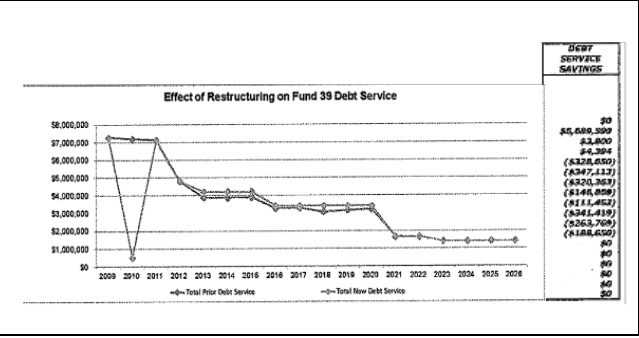
The biggest change (other than those related to reductions in anticipated revenue due to the  the state budget and the addition of targeted ARRA funding) is in the refinancing and rescheduling of debt.  The terms of this are already in place.  It was done to realize real long-term savings and to provide property tax relief in 2009-10 by reducing the debt service levy by almost $6.8 million.  If I read the document correctly, the real savings are $925,000 (maybe minus origination fees).  This means that almost $6 million in debt has been shifted to later years.  See this graph and part of a chart from the document.

debt chartThis is a case of the present desire/need to reduce property taxes being met at the cost of future budgets.

Decisions involving Fund Balances also weigh the present against the future.  The biggest move in the main amendments involves returning to the Partnership Plan idea of using almost $2 million of the Fund 80  balance to provide property tax relief.  At over $3 million, or about 1/4 of that total budget, the Fund 80 Balance is too high by most measures, this seems like a good idea.

If all of the initial amendments are enacted, the mil rate will be 10.40 an increase of .59 from 2008-9, translating into about $147 for a $250,000 home.  That’s a lot.

I can see why the Board wishes to explore options to further reduce the levy.  I hope as they do so they consider how these decisions may impact the years to come.

Past budgeting is ample evidence that you never know what the future will bring, but the last projections I’ve seen for 2010-11 were, in Erik Kass’s phrase, “ugly.”

How ugly? I’m guessing an budget gap between allowed revenues and cost-to-continue in the range of $3 to 6 million and the most recent projected mil rate was 10.91.  Big cuts and another big property tax raise spells trouble.  Beyond 2010-11 depends on state action (actually, if the WAES Pennies for Kids proposal is enacted, 2010-11 could be OK, state action again).

I think 2010-11 and beyond  need to be kept in mind as the Board considers options to further reduce the 2009-10 levy by eliminating transfers, contingency funds, the rest of the 2008-9 debt levy; deferring making up the taxes for the Walgreen’s reassessment and (this is the big one) forgoing collecting the maintenance referendum levy and the most of the maintenance that would fund.  Most of these involve pushing expenses to the future.  I’m skeptical about the wisdom of these options.

As I said above, the size of the Fund Balances offers some opportunities.  Of all the further options the one I like least is deferred maintenance, but I could support forgoing the levy if the projects were done using Fund Balance money and this decision was made as part of a longer term fiscal plan.

The Board should set some parameters for the proper size and uses of Fund Balance money.  They should at least be discussing if it is better to use that money now for property tax relief, reserve it to avoid future cuts and mitigate future taxes, designate it for special circumstances like Four-Year-Old Kindergarten start up costs, or leave it alone to keep the bond rating strong and the borrowing minimal.

As some of what is posted above indicates, I have opinions of much of this, but mostly I want conscious, informed, considered, public decisions to be made.  You can’t avoid all future shocks, but you can try.

[Note, this post is late, a bit incoherent and somewhat incomplete because a computer error led to much of a near final draft being lost.]

Thomas J. Mertz
Leave a comment

Filed under "education finance", Budget, education, finance, Local News, Pennies for Kids, School Finance, Uncategorized

West Bend School Budget Protest, “”Go ahead: Raise my taxes” and More

Vodpod videos no longer available.Video from WITI -Fox 6

You got to love it, students in conservative West Bend out marching against school budget cuts.  These kids are great; watch the video!

This is just one of many good things being done and said as that community deals with the impact of 15 years under a state school funding system designed to fail, capped off by a state budget that seems to have accelerating that failure as a goal.  The situation might be desperate, but the need for comprehensive reform message is making some progress.  The pieces are all there, all that is missing is directing the anger and frustration at the correct target — our state elected officials.

In September the estimates were that the revenue limit for West Bend would allow for a 12.1% property tax increase to partially make up for$2,4 million of cuts in state aid.  Over 700 people attended the annual meeting a week earlier (video at the link) —   the teabaggers were out again.

Local blogger Kristina had a great response, here is part of it.

To all the proud, No voters at the last school board meeting. How proud you must be. No band or orchestra in 6th grade, no band lessons in high school, higher athletic fees, loss of teachers and aides, cutting librarians, program support teachers, gifted and talented teacher cuts at all levels, increase in class sizes 35 – 40 and mandatory one additional class to be taught, getting rid of 1 east and west teacher and replace them with an aide. Wait let’s not forget counseling services, school social workers, athletic directors, dean of students at McLane, possibly eliminating a principal position at elementary level, all gone without a tax levy.

Hang on there’s more beautiful things the no’s I am sure are proud to stand behind. The elimination of business and technology departments and all classes go too. Middle school exploratories, world culture and tech ed. Elementary fitness, which the no’s can scream about childhood obesity and laziness of our youth but still use TV and video games as babysitters. Makes sense right? Sure, sarcasm was needed there….

Stop thinking about this as what this levy would do to you, and ask yourself what it would do to all the kids. Is $100.00 bucks or so a year worth under educating them? No! Take the 10 bucks a month you spend on fast food, coffee, case of soda, or something and set it aside at the end of the year you will be up $200.00 bucks.

The district did not set out secretly planning ways to ‘get’ the taxpayers. The district was put in this mess by the state cutting their funds without telling them before this year’s budget had to be completed. Pat Herdrich or any other school official is not trying to screw anyone or squeeze more money out of people to spend on extra candy vending machines or so the admin and teachers can give themselves all raises and fly to Europe for fun. They are asking for it so classes are not cut, teachers let go, and in the end, the students are the ones left with the consequences. This is defiantly a NEED not a WANT.

At an October 5th workshop meeting,  the Board approved $300,000 in cuts, which along with some new numbers from the state brought the proposed levy increase down to 9% with a mil rate of 7.44.

Some good community education happened at this meeting.

At least a couple residents looking on changed their views, saying no cuts were needed, after hearing the history, state limitations and politics involved.

“I changed my mind,” said Doug Rakowski at the end of the nearly 4-hour session that was closed to public comments. “I will get up at the next meeting and support this.”

He cited the state budget conditions that are expected to negatively affect the West Bend district in the future.

And from a later story:

To keep previous budgets in check during a time of state revenue caps, the district has made cuts for the past 15 years, often in areas such as maintenance and supplies, administrators say. Consequently, salaries have taken up a larger percentage of the budget.

With state aid projected to tighten in the next three years, the focus for the next round of cuts will be on programs and staff..

The top five prioritized cuts for 2010-2011: $300,000 in athletics by having one high school, $134,000 by closing the pool, $206,000 by eliminating 2.8 social workers, $50,000 by eliminating three elementary head custodians and $75,000 by reclassifying custodians.

The biggest cuts appear to off the table for now, but  like many other districts, 2010-11 is looking worse:

[West Bend School District Superintendent Pat] Herdrich said that the state aid formula and biennial budget that favors high-spending districts will have West Bend, with the lowest levy rate in Southeastern Wisconsin, facing double-digit increases in 2010-11. If the district is not near its revenue cap this year, it might face a 17 percent increase next year to maintain current programs, she said.

“How deep do you want the cuts to be next year?” she asked the seven board members. “Where you leave off is where you start for next year.”

The October 12 meeting also brought out the students in the video at the top and other school supporters, quoted in this report from TMJ4 – Milwaukee as saying “Go ahead: Raise my taxes.”

A Support West Bend Schools group is now active.

More new numbers from the state all but eliminated the progress toward a lower limit made at the October 6 meeting.

Now it appears the choices on Monday, October 26 final Budget and Levy meeting will range between a 9.0% increase and a 10.9% levy increases.  The 10.9 increase is the maximum allowed based on the final revenue limit calculations from the state.

Like many districts around Wisconsin, West Bend may not be taxing to the max this year.

A 9% increase would now mean $586,523 in new cuts.  The administration is recommending a 10.9% increase and a 7.47 mil rate.

The meeting has been moved to the Field House, which seats 3,400 and 90 minutes has been set aside for public testimony.  It should be an interesting meeting.

That’s great for those of us who study school politics and/or consider them a spectator sport.  It isn’t great for the community, the School Board or the students.

It is clear from what is happening in West Bend and elsewhere that comprehensive reform and balanced, sustainable revenues are needed.  The Wisconsin Alliance for Excellent Schools proposal for a Pennies for Kids small sales tax dedicated to education would get us out this revenue crisis and make reforms — such as those of the School Finance Network possible.

If the people of West Bend don’t want to go through this next year and the year after (and the year after…), they getting involved in these campaigns and work to convince their legislators that this can and must be done.

Thomas J. Mertz

1 Comment

Filed under "education finance", Budget, education, finance, Local News, Pennies for Kids, School Finance, Take Action, Uncategorized

Who are they kidding? “State Representatives Strive To Continue Wisconsin’s Legacy of Education”

Vodpod videos no longer available.

Video  and story from WSAW (sorry about the advertisement)

There has been a lot of hot air, half truths, spin and misinformation about education funding in the 2009-11 Wisconsin biennial budget, but this story from Wausau takes the prize (for a recent, local entry in this sweepstakes of dishonor, see this column by Madison Rep. Mark Pocan, page 16 of the pdf).  Democratic Rep.  Thomas Nelson and Republican Rep. Jerry Petrowski claim in this report that their parties are constant champions of education who have placed educational excellence on the Fall legislative agenda.

The editing by the reporter may have  skewed things, Nelson and Petrowski may be capable legislators; I really don’t know.  What I do know is that what appeared in this story needs some critical attention.

Time for some fact checking.

So far the only Republican initiative of note is a proposal from Sen. Alberta Darling and Rep.  Brett Davis on “merit pay” for teachers.  Right now the proposal is nothing but a press release.  It is worth noting that previous school reform plans (and here) by Brett Davis never made it past the press release stage.

The announced Democratic Fall agenda is silent on education; Governor Jim Doyle has some ideas, but not much to say about funding these ideas or even the quality of education that Wisconsin has boasted of in the recent past.

Nelson  touts tripling sparsity aid to some rural districts.  What isn’t mentioned is that the resulting $11.18 million for the biennium is a drop in the bucket and doesn’t come near to addressing the unique diseconomies of scale of Wisconsin’s “small but necessary” districts.  Nelson also doesn’t acknowledge that this increase in a categorical aid was accompanied by a much larger decrease in general aids resulting in a substantial  net loss for all (or almost all?) districts receiving sparsity payments (to get the picture compare this list of sparsity distribution estimates with this list of general aid estimates for all districts, or just read this wonderful editorial from Frank Murphy in Florence).  I’m all for an increase in sparsity aid, but that alone does not make for  adequate school funding.

Petrowski is correct when he said “In the last budget that Democrats passed, was a cut for local school districts… and I’m afraid these cuts will affect [property] tax payers.”  What he doesn’t say is that the GOP stance throughout the budget process was to claim taxes and spending were too high and that at no point did the Republicans attempt to increase state education funding.

Enough of the back-and-forth, the real howler is in the closing lines of the story:

But at the end of the day no matter what side of the isle [sic] State Representatives are on..

“Democrats and Republicans in good economic times and tough economic times have always made the consistent decision to fully fund our schools,” says Representative Nelson.

Amazing…after 16 years under our current school finance system, after a Governor’s Task Force, a Special Joint Committee, an independent task force, proposals from Republicans Democrats and advocacy organizations (and here) all agreeing that school finance is broken and needs to be fixed; after a biennial budget that cut state education investments by $535 million, increased the school levy credits — money that never goes near a classroom, but is counted by Wisconsin as “State Aid — by $352,852,200, a 26% increase bringing the total to $1,697,625,200 for the biennium… Nelson asserts a long term bi-partisan consensus for full funding of education.   Who is he kidding?  Who are they all kidding?

For a refreshing (and depressing) dose of  truth see this recent Milwaukee Journal Sentinel story: “”State aid drops to many school districts” (or just click around in the AMPS archives).

Thomas J. Mertz

1 Comment

Filed under "education finance", Budget, education, finance, Gimme Some Truth, Local News, School Finance, Uncategorized

Gerald Bracey Will be Missed

Sad news for anyone concerned with honesty and accuracy in education research and reporting, Jerry Bracey has died unexpectedly.

No news reports, but did get a confirmation from Susan Ohanian.

Jerry fought the good fight, with the Education Disinformation Detection and Reporting Agency (EDDRA), on the Huffington Post, in books, articles, columns, calls and notes to editors and reporters, anywhere and anytime that education research was being misused and abused or was simply badly done.

I never met Jerry, but I’ve been a participant in his EDDRA Yahoo Group and have exchanged private messages.  He was combative, friendly and good humored, with a passion for truth and the power of knowledge and education.

One thing that always impressed me was the depth and breadth of his knowledge.   He could always call up and cite relevant reports and articles, new and old,  with apparent ease.  That can’t be replaced.

He will be missed.

Some links to other blogs noting this loss.

DairyStateDad.

EdWonk.

Mike Klonsky’s Small Talk.

Education Notes OnLine.

Giving Jerry the last word (he always seemed to want it), his Nine Myths About Public Schools.

Nine Myths About Public Schools

None of this will likely strike you as particularly new, but it might be good to have a bunch of myths lined up and debunked all in one place.

  1. The schools were to blame for letting the Russians get into space first. Granddaddy of all slanders and a great illustration of the absolute nuttiness with which people talk about education.
    Sputnik, the first man-made satellite to orbit the earth, launched on October 4, 1957. On September 20, 1956, Werner von Braun’s Army Ballistic Missile Agency launched a 4-stage Jupiter C rocket from Cape Canaveral. After the first 3 stages fired, the rocket was 832 miles in the air and traveling at 13,000 miles an hour. The 4th stage could have easily bumped something into orbit. The 4th stage was filled with sand. There were a number of reasons for this including the fact that the Eisenhower administration was determined to keep its weapons rocket program and its space exploration project separate and von Braun’s rocket was clearly a weapon. Its primary intent was to incinerate Russian cities with nuclear warheads. Ike worried how the Russians might react. His Assistant Defense Secretary Donald Quarles actually said “the Russians did us a favor” because they established the precedent that deep space was free and international.Most US engineers in the space program in 1957 would have graduated high school in the 1930s, but in the media, the schools of the 1950s took the hit for Sputnik. Ike was quite puzzled by this.
  2. Schools alone can close the achievement gap. This is codified in the disaster known as No Child Left Behind. Most of the differences come from family and community variables and many out-of-school factors, especially summer loss. Some studies have found that poor children enter school behind their middle class peers, learn as much during the year and then lose it over the summer. They fall farther and farther behind and schools are blamed. Middle class and affluent kids do not show summer loss.
  3. Money doesn’t matter. Tell this to wealthy districts. Money clearly affects changes in achievement although levels of achievement are more influenced by the variables just mentioned. Most studies are short term and look only at test scores, a very foolish mistake. Economists David Card and Alan Krueger also found investments in school show a payoff in terms of long-term earnings of graduates.
  4. The United States is losing its competitive edge. China and India ARE Rising. As economies collapsed all around it, China’s economy grew a remarkable 7% last year. On just humanitarian grounds, we should not wish China and India to remain poor forever, but the more they grow the more money they have to buy stuff from us. As China and India prosper, we prosper. The World Economic Forum and the Institute for Management Development have consistently ranked the U. S. economy as the most competitive in the world. Education is only one part of multi-factor systems in rankings. WEF is especially keen on innovation. Our obsession with testing makes testing a great instrument for destroying creativity.
  5. The U. S. has a shortage of scientists, mathematicians and engineers. This was a myth started oddly enough by the National Science Foundation in the 1980s in a study with assumptions so absurd the study was never published, but the myth lingers on. In fact, Hal Salzman of the Urban Institute and Lindsay Lowell of Georgetown University found that we have three newly minted scientists and engineers who are permanent residents or native citizens for every newly minted job. Within 2 years, 65% of them were no longer in scientific or engineering fields. That proportion might have fallen during the current debacle when people are more likely to hang on to a job even if they hate it. An article in the September 18 Wall Street Journal reported that before the economy collapsed, 30% of the graduates of MIT–MIT–headed directly into finance.
  6. Merit pay for teachers will improve performance. Bebchuk & Fried Pay Without Performance. Adams, Heywood & Rothstein, Teachers, Performance Pay, and Accountability. Bonus pay is concentrated in finance, insurance, and real estate. In most of private sector hard to determine and often leads to corruption and gaming the system. Campbell’s Law: “The more any quantitative social indicator is used for social decision making, the more subject it will be to corruption pressures and the more apt it will be to distort the social processes it is intended to monitor.”
  7. The fastest growing jobs are all high-tech and require postsecondary education. “Postsecondary education” is a weasel word. A majority of the fastest growing jobs do, in fact, require some kind of postsecondary training. But, according to the Bureau of Labor Statistics, they account for very few jobs. It’s the Walmarts and Macdonald’s of America that generate the jobs. According to the BLS, the job of retail sales accounts for more jobs than the top ten fastest growing jobs combined.
  8. Test scores are related to economic competitiveness. We do well on international comparisons of reading, pretty good on one international comparison of math and science, and not so good on another math/science comparison. But these comparisons are based on the countries’ average scores and average scores don’t mean much. The Organization for Economic Cooperating and Development, the producer of the math science comparison in which we do worst has pointed out that in science the U. S. has 25% of all the highest scoring students in the entire world, at least the world as defined by the 60 countries that participate in the tests. Finland might have the highest scores, but that only gives them 2,000 warm bodies compared to the U. S. figure of 67,000. It’s the high scorers who are most likely to become leaders and innovators. Only four nations have a higher proportion of researchers per 1000 fulltime employees, Sweden, Finland, New Zealand and Japan. Only Finland is much above the U. S.  Consider Japan, the economic juggernaut of the 1980’s. It kids score well on tests and people made a causal link between scores and Japan’s economy. But Japan’s economy has been in the doldrums for almost a whole generation. Its kids still ace tests.
  9. Education itself produces jobs. President Obama and Secretary of Education Duncan have both linked any economic recovery to school improvement. This is nonsense. There are parts of India where thousands of educated people compete for a single relatively low-level white-collar job. Some of you might recall that in the 1970’s many sociologists and commentators worried that America was becoming TOO educated, that they would be bored by the work available

Thomas J. Mertz

1 Comment

Filed under Accountability, Best Practices, education, Gimme Some Truth, National News

Headline of the Day — “School budget decreases, tax levy increases”

down-and-up-arrows

Parilament, “Up for the Down Stroke” (click to listen or download)..

This headline from the the Beaver Dam Daily Citizen succinctly captures what is happening all over Wisconsin, including Madison.  This is what the Wisconsin Alliance for Excellent Schools and the School Finance Network are talking about here.  This is why we need Pennies for Kids to meet the unfolding crisis and why we need comprehensive reform to assure a strong and prosperous future for our state.  This is why you need to get involved.

Here are excerpts from the story on the Waupun Area district:

School budget decreases, tax levy increases

…“It’s a concern Randy [Refsland, district administrator] and I have because next year’s budget might look even tougher,” Zeininger said. “The state of Wisconsin is in bad shape and I think it’s going to take longer than just this year to turn things around.”

…“With economics the way they are, I have real sympathy for the tax payers,” Lori Lemmenes, school board president, said. “We also need to look to the future.”

Really, the headline says it all.

Thomas J. Mertz

Leave a comment

Filed under "education finance", Budget, education, finance, Local News, Pennies for Kids, School Finance, Take Action

Doyle Races for the Top and One Reaction (and one more, updated)

Wisconsin Governor Jim Doyle held events around the state today to tout the work being done on the Race to the Top application.  You can read the press release here and reports here and here (more on AMPS in the coming days).

The Wisconsin Alliance for Excellent Schools was first out of the blocks with a reaction. WAES notes that this set of proposal comes at a time when districts around the state are raising property taxes and cutting programs.

Governor Jim Doyle has introduced a plan to exempt from revenue limits school districts that meet specific criteria. The plan does recognize the need for change in the funding system, but it fails to address the crisis our schools find themselves in and doesn’t start the fundamental restructuring of our school finance laws that is so badly needed.

“While we appreciate the governor’s efforts to address the problems, the plan just doesn’t get the job done and continues the trend of shifting the responsibility for funding schools onto local property taxpayers,” said Kim Suhr, co-founder of GrassRoots of Waukesha County and a member of the board of directors of the Wisconsin Alliance for Excellent Schools (WAES).

“The fact is that the way we fund schools is broken. Wholesale reform of school funding is needed now─reform that benefits both children and their communities.”

First, however, Wisconsin needs to quickly reverse the trend of declining public school aid started in the 2009-11 state budget. In total, 336 school districts lost over $175 million in general aid, a cut of over 15 percent for many communities and 10 percent or more for 181 districts.

“After 15 years of cuts to programs and services under the present funding system, that is unacceptable,” Suhr said. “The best way out of our current economic downturn is to graduate the best trained and educated young people possible from our schools. Decreasing that investment in public education is heading in the wrong direction.”

As a matter of fact, in his announcement today, the Governor had many good arguments for a longer school year, longer school days, and many other suggestions for better educating children. We need to have discussions about the educational merits of those proposals, but in many case such changes will require additional funding.

The WAES statement points to confusing fact that the programs proposed in this scramble for approximately $80 million in one-time federal funds cost money, money that districts do not have because the recent state budget included lower revenue caps, a cut in state funding of $535 million over two years, and increased the school levey credit by $352 million (the levy credit is called “state aid” by Wisconsin, but not a penny goes to schools).  The first step toward educational excellence has to be getting state support to the level it should be.

WAES also has an idea for that, a Penny for Kids dedicated sales tax.

To address the crisis by getting needed revenue back into schools as soon as possible, WAES has proposed “Pennies for Kids,” a plan to increase Wisconsin’s sales tax─one of the lowest in the country─by one-cent. Suhr said that will raise about $850 million a year that could be used to educate children and lower property taxes in every community in the state (2009 Wisconsin Act 28, 2009-11 State Budget; Summary Tables and Charts, July 22, 2009).

A discussion of the Governors proposals could be good for education in Wisconsin.  Whatever reforms are eventually enacted and whatever the result of Wisconsin’s Race to the Top application; if there aren’t provisions for adequate, equitable and sustainable investments, all the good ideas in the world won’t make a bit of difference (see what is happening with SAGE for an example).  A Penny for Kids could make  a big difference.  Pennies add up.

For an AMPS post on an earlier version of the Governor’s proposal, see here.

Update

The School Finance Network has  issued a statement.  SFN also zeroes in on the lack of attention to needed educational investments.

Earlier today, Governor Jim Doyle proposed exempting school districts that meet specific criteria from revenue limits. While the governor’s proposal reflects Wisconsin school districts’ need for greater flexibility, it falls well short of the fundamental restructuring of our school finance laws that is so badly needed.

“While we appreciate the governor’s efforts to address the problems with school funding in this state, his proposal simply papers over holes in the current funding plan and continues the trend of shifting the responsibility for funding schools onto local property tax payers,” said Jill Gaskell, Legislative Liaison, Wisconsin PTA. “Wholesale reform of school funding is needed now – reform that benefits both children and their communities.”

….It is important to note that revenue limits were brought in as part of the state’s commitment to funding two-thirds of the costs of schools. Over the years, that support has decreased considerably, creating a situation where the cost of schools has been increasingly shouldered by local taxpayers.

“The state continues to pass the school funding buck to local property tax payers,” said Gaskell. “The governor’s plan simply speeds that process up.”

Allowing for greater property tax increases is not only bad in theory, in practice very few districts will be able to take advantage of the offer. With the recent shift in education investments from state aid to local property taxes, more and more districts are already unable to reach their revenue limits. This situation has become so pronounced that Assembly Bill 461 has been introduced to make sure that districts that go under the limit are not punished with lower limits in future years.

SFN closes by pointing to the advantages of their proposals

Instead of piecemeal reform and the continued burdening of taxpayers, a statewide coalition of educational and community-oriented organizations, known as the School Finance Network (SFN), is suggesting that structural reform of school financing should be made now.

The School Finance Network has identified flaws in the current system and its plan bolsters efforts to comply with the Vincent v. Voight court ruling, which requires the state to take into account districts with disproportionate numbers of disabled students, economically disadvantaged students, and students with limited English language skills.

SFN has determined that overall annual increases in allowable funding fail to keep pace with real world costs over which school districts have little to no control, such as utilities and transportation. By crafting proposals to fix these flaws, the SFN proposal will allow school districts around the state to maintain coursework in art, music, foreign language, business, and vocational training, all of which are now being cut, providing children with high quality education for which this state has a proud tradition.

More in the coming days and weeks.

Thomas J. Mertz

Leave a comment

Filed under "education finance", Arne Duncan, Best Practices, Budget, education, finance, Local News, Pennies for Kids, School Finance, Uncategorized

Looking to the Future: The Crystal Ball on 2010-11

alexander_the_mentalist_crystal_seer_poster-p228218383358690222qzz0_400There is much appropriate attention on how Wisconsin school districts are dealing with the decreases in state aid and well below cost-to-continue revenue limit increases in their 2009-10 budgets.    More attention needs to be given to 2010-11.

The state budget came too late for many districts to make extensive cuts in programs and services (although Oshkosh closed two schools and districts around the state have scaled back), instead districts are spending down fund balances, refinancing to shift the costs to the future and raising property taxes to get through the year.

They are also planning for cuts in 2010-11.  Here is a sample of what school district officials from around the state have been saying recently about their budgets in the future.

Next year could be even worse for property taxpayers. The district projects a jump of $192.50 in taxes on a $250,000 home.

“These (numbers) are ugly,” said Kass. “What I try to do is always show what I believe to be the worst-case scenario. We have 12 months to figure out what areas of flexibility we have. We’ve done a lot of stuff this year. The problem is, when you come up with ways to address those concerns, they’re not there every single year. Areas like decreasing our debt service, which we’re able to do through some refinancing – that’s not going to be there in the future.”

Madison Asst. Superintendent Erik Kass, quoted in the Wisconsin State Journal.

Even with the 8% increase, it is anticipated that deep budget cuts of over $1 million will be necessary for the 2010-11 school year.

River Falls Superintendent, Tom Westerhaus.

While the district finalizes the 2009-10 budget, officials are already preparing for foreseen difficulties in the 2010-11 budget, for which stimulus money would not likely be available and which may further be hampered by changes in state law.

HalesCornersNow on the Whitnall School District.

School Board member Dave Szychlinski said it was a tough budget to prepare in light of the recession, especially given many residents’ own financial battles.

“We know that people are struggling, many people in our community have lost their jobs, and yet we have an obligation to prepare our young people for their futures,” he said.

The district was forced to make some tough decisions because of losses in state aid, and officials made about $833,500 in cuts, he said.

Next year will likely bring more cuts, Szychlinski added (emphasis added).

Franklin Board of Education Member Dave Szychlinski quoted in FranklinNow.

Despite last year’s surplus, [Reedsburg School District Business Manager Pat] Ruddy anticipates major deficits in the future if enrollment holds steady — as much as $1.2 million in 2010-11.

Reedsburg School District Business Manager Pat Ruddy quoted in the Reedsburg Times Press.

With the recent repeal of the state’s qualified economic law aimed at limiting teacher salaries and a shortfall in state aid, the district’s budget woes promise to only get worse, [Greenfield Superintendent Conrad] Farner said (emphasis added). School officials say the 15.1 percent drop in state aid was the main reason for the tax levy increase.

Farner and other school officials urged the public to contact their state representatives to voice concern over school funding mechanisms.

Greenfield School District Superintendent Conrad Farner in GreenfieldNow.

The projection for the 2010-2011 school year includes further reductions of teaching and support positions as the district continues to meet the challenges caused by declining resident enrollment.

MequonNow on the Mequon-Thiensville School District.

[Menomonee Falls School District Director of Business Service Jeffrey] Gross is projecting a $1.6 million deficit in the 2010-11 school and a $2 million deficit the year after that.

Menomonee Falls School District Director of Business Service Jeffrey Gross in MenomoneeFallsNow.

Neenah faces a $2.8 million budget deficit in 2010-11 after its $6 million in referendum money runs out. The shortfall represents about 3 percent of the proposed 2009-10 budget of $84.1 million.

The Northwestern on the Neenah School District.

He [Randy Fredrikson, district administrator for Two Rivers Public Schools] said the district will face similar financial circumstances next year.

“It’s not a one-year ‘we’ll get through’ (situation),” he said. “This is going to be the way it is in school budgets for a while.”

Randy Fredrikson, District Administrator for Two Rivers Public Schools in the Northwestern.

School boards across Wisconsin are developing their budgets for the 2010-11 school year, and the early calculations aren’t looking good for property taxpayers.

Appleton Post Crescent editorial “Blame school tax hikes on state budget.”

Something needs to be done for both the long and short term.  The long term answer is comprehensive school funding reform along the lines proposed by the Wisconsin Alliance for Excellent Schools (WAES), the School Finance Network and others.

The short term must come first and the answer is the Pennies for Kids dedicated sales tax for education proposal WAES is working on.

The prognostications quoted above are only about the 2010-11 budget; looking  beyond next year, the future of our state and our children are at risk if action is not taken to head off these scenarios.

Thomas J. Mertz

Leave a comment

Filed under "education finance", Best Practices, Budget, education, finance, Local News, Pennies for Kids, School Finance, Uncategorized, We Are Not Alone