Category Archives: Equity

On the Agenda, MMSD Board of Education the Week of August 9, 2010

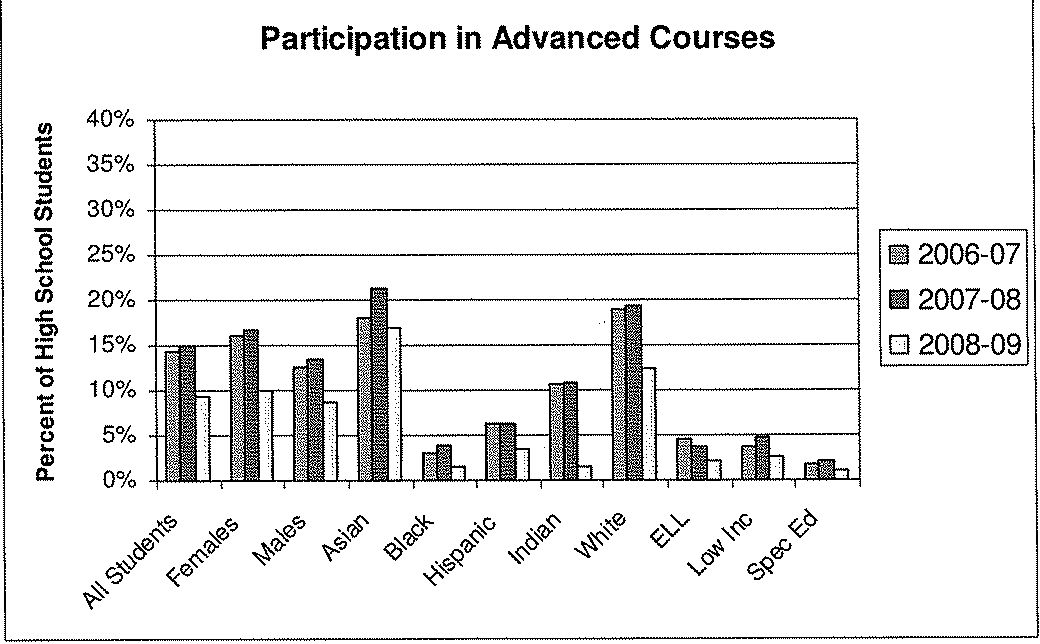
Note: For a while, I’m going to be illustrating the “On the Agenda” posts with various graphs documenting gaps in MMSD. This one is from the Equity Report, which is on the agenda.

After an unplanned break from blogging, I’m going to ease back in with a partial run down of  this week’s Board of Education agenda.

There are two meetings on Monday August 9, an Executive (closed) session at 5:00 PM in Doyle RM 103 and an open session in the Auditorium at 6:00 (plus an exchange of proposals on the Security Assistant contract on Friday).  The agendas for the first (and last) are here.  Unfortunately the link to the open meeting agenda is broken (fixed now).  A Board member scanned a copy for me and I’ve uploaded that (the hyperlinks don’t work, but you can get to the documents by pasting the appendix designation after http://boeweb.madison.k12.wi.us/files/boe/Appx, for example MM 2-8 becomes http://boeweb.madison.k12.wi.us/files/boe/Appx 2-8.pdf).

The big item of public interest on the closed session agenda is the Superintendent Evaluation.  It is perfectly legal to do this in a closed session, but I don’t think it is good policy.   Voters have only the Board to hold accountable and the Board has chosen to funnel most or all administrative accountability into the Superintendency.  The public can’t make an informed judgment on the Board when this process takes place behind closed doors.

In the two plus years Dan Nerad has headed MMSD, I haven’t seen a single document reflecting the Board’s assessment of his job performance and public discussions on this topic have been rare, indirect  and partial.

If you are interested in the terms and process of the evaluation, there are some public documents.

Superintendent Goals from MMSD Board of Education Progress Report – January, 2010.

Process for Evaluation from July 20, 2009.

Revised Process for Evaluation, August 17, 2009.

Minutes of meetings where this was discussed:  November 28, 2009September 21, 2009; September 14, 2009.

The approved Process requires that a summary document be made public.  I’ll be waiting for that.

I’ll close this section with a quote from Nerad:

Q: How do you receive feedback based on your performance?

A: One of the things that is in some ways unique… is that I report to the Board of Education. I have seven bosses, and they do an evaluation process of me… I’m a big believer in self-assessment, so part of my evaluation will be to self-assess. I’m also a believer in what’s called 360-degree feedback, where you get feedback from others involved in the organization, so part of it will involve that… So ultimately it does come down to the Board of Education with multiple kinds of inputs that evaluate my performance.

Sounds good, but having 360-degree visibility would be better.

I’m running late on this, so the only thing from the open meeting I want to highlight is the “Annual” Equity Report (annual is in quotes because the policy requiring an annual report was passed in June of 2008 and this is the first report — a previous atempt from earlier this year was sent back for revision — I wonder if any of this came up in the Superintendent Evaluation?).

You can read more about my hopes and wishes for the Report in this post and this one too.

In terms of information provided, this version is an improvement over the first attempt.   That said, there is still room for improvement (both with the report and in achieving equity) and there is at least one thing about the first version I like better.

What I liked about the first version was that it attempted to identify district initiatives that addressed the recommendations of the Equity Task Force.  This isn’t required, but it was nice and useful.

The current version uses selected equity-related  Strategic Plan measures more than the Equity Task Force work.  In this way it serves as a preview of what can be expected with the Strategic Plan reports.

I’m withholding most judgment until I have a chance to hear the presentation and the reactions of the Board, but there are some things I do want to note.

Might as well start with the graph at the top.  Pretty disturbing.  The Equity Task Force thought that expanded access to advance programs was of the highest importance and this indicates that the number of high school students taking advanced courses is declining and the diversity of those students is not markedly improving.

Two notes before going deeper on this.  First, “advanced courses” isn’t defined and second, the graph without data makes it very hard to know what is happening with the demographics.

What is worse is the Report simply says “the reason for the decline is unclear” and moves on.  That isn’t good enough.  The purpose of having this report is to raise red flags so that inequities and bad trends get attention and action.  Noting the lack of clarity of causality isn’t going to reverse this trend.

In light of the dismal data on the diversity of TAG participation, I’d also like to see data for all advanced programs, not just high school courses.

The other thing that really bothered me was the note that the Report isn’t “applicable” to “Budget Implications.”   This appears to be pro forma, but resource allocations are central to the concept of equity advanced by the Task Force and reflected in the district Policy.  Quoting from the Policy:

Achieving equity often requires an unequal distribution of resources and services in response to the unequal distribution of needs and educational barriers.

How can you have  report on Equity that reflects this assertion and has no budgetary application?

Other things to note:

  • More presentations of data by school would be good.
  • The extensive use of climate surveys is a good idea (these are broken down by school), but I’d like to see school level demographic breakdowns here.

I want to get this up, so I’m leaving it at this for now.

Thomas J.  Mertz

Leave a comment

Filed under Accountability, Best Practices, Budget, education, Equity, Local News, Uncategorized

On the Agenda, MMSD Board of Education the Week of June 7, 2010

The 2010-11 budget is mostly finished and the work of governing the schools begins again.  I have a couple of “in the works”  posts on budget things that may never get posted.   The short version is the process is in great need of reform and that when you don’t use over $13 million  of the revenue authority authorized by the state and voters many, many things get much harder (and I can’t think of one thing that gets easier).  The old Pogo phrase “We have met the enemy and he is us” keeps going through my head.  Leaving the budget stuff with  a big thank you to all who testified or contacted the Board.

On to this week’s Board of Education Committee meetings.  They commence at 5:00 PM, Doyle Administration Bldg, Room 103 and should be carried by MMSD-TV.

Student Achievement and Performance Monitoring Committee is first.  After Public Appearances comes a report on High School Initiatives including,

1. Individual Relationships/Engagement/Learning (REaL) School Action Plans for 2009-10
2. REaL District Action for 2009-10
3. American College Testing (ACT) Educational Planning and Assessment (EPAS) Overview and Implementation Plan
4. Advancement Via Individualized Determination (AVID) Overview
5. Individual Learning Plan (ILP) Overview and Implementation Plan

There is so much in the REaL plans that it is hard to grasp and I would think hard to evaluate what works and what doesn’t.  On the ACT, I’m just glad to see something other than the WKCE prominent in the mix.  AVID is  a great program in the Rigor for All, with supports mode.   In theory, I like the Individual Learning Plans, but I’m skeptical about how much individualization can happen when Counselor case loads are so high (300, if I remember correctly).  I fear that this will end up being current practices repackaged and not much of a change.

Student Code of Conduct and Expulsion Process reforms are next.  These are being presented as a greater alignment with Positive Behavior Support principles.  The current Code is here; Expulsions and Suspensions here.  You can compare for yourself.  A proposal to eliminate the Expulsion Navigator position was floated during the budget process.  The administration advised that the $83,000 budget line was needed for the proposed reforms.  The cost of the new expulsion process is $183,732.  This means that one week after the budget vote, there is a request for an amending vote.    There has to be a better way to do budget things.

SAGE options are next.  This is another item that has a potential big budget impact and should have been dealt with as part of the big budget song and dance.   To review, legislation was passed last session allowing SAGE class sizes to increase from 15/1 to 18/1, allowing for unlimited new SAGE contracts in  30%+ poverty schools and eliminating waivers that had been given.  MMSD has/had four schools where there were waivers for SAGE Block (small class sizes in Math and Literacy only).  I believe these waivers were unique and a remnant from when MMSD had extensive locally funded class size reductions.

SAGE block requires less general operating funding than 18/1 and much less than 15/1.  This means that all the options — except increasing class sizes — will cost more.   With no public discussion, the SAGE Block classrooms were allocated at 18/1 in the budget just passed.  No discussion.

The administration is recommending that the current SAGE Block schools go to 18/1 (really an accomplished fact, requiring 5 votes to change)  and that the current full SAGE 15/1 schools be allocated with “flexibility” between 15/1 and 17/1.  It isn’t clear if that was also part of the allocation assumptions in the budget just passed.  There are figures, but no discussion concerning expanding SAGE at any allocation level to those 30%+ schools currently allocated between 22/1 and 26/1.  These figures do not include current allocations.  A document sent to the Board earlier this year has a little more.

Class size has consistently been something community members care about.  maybe that’s why they are doing this after the budget-related public attention has waned.

Internet Access, Student Records and Evaluation of Learning Materials are also on the agenda.

Operational Support is next.

The Monthly Financial Statements (first on the agenda) again include millions of dollars in ARRA projects where the “budgeted” money has not been spent.  I’m not clear if the ARRA money is being treated as “outside the budget” or if it buried in the 2009-10 and 2010-11 budgets.   It is bad policy and probably illegal to not include it as part of the regular budget.  I hope that’s not the case (it was to at least some degree last year, where ARRA was not part of the Spring budget).  I’m also very confused about what “budgeted” means in this context and why this money has not been used, why these projects have been approved but not implemented.

Also on this agenda are lots of contract approvals, including the Global Academy and Human Resources Transactions.   Some of the effects of the Reorganization (and perhaps other things) can be seen in the recommendations for administrative non-renewals for Career and Tech Ed Coordinator, Asst. Director of Equity and Parent Involvement, Expulsions and Truancy Coordinator, Library Media Services Coordinator, Fine Arts Coordinator,  Public Communication Director and Legislative Liaison.  I hope that the last doesn’t mean that in the future MMSD does not have  a lobbyist.  I can see redefining the position, but government relations should remain part of the mix.  MMSD’s voice needs to be heard on a regular basis in the halls of power.

Also in the HR Report (but not in the MMSD Today story on retirements) is the sad news that one of my favorite MMSD teachers — Barb Rubin – is retiring.  Barb is just a great teacher who cared about her students and about equity.  Here are some links to her Classroom Action Research projects.  Congratulations on a fine career.  She’ll be missed.  I also want to express my thanks to another fine educator who is retiring.  Kathy Lyngass staffed the Equity Task Force and earned my respect and affection.  She too will be missed.

The last Committee is Planning and Development.  The only item is a Strategic Plan update.  This includes more on progress than the version distributed prior to the recent Strategic Plan meeting and little or nothing about “narrowing” the goals.

That’s all I have time for…

Thomas J. Mertz

Leave a comment

Filed under "education finance", Best Practices, Budget, education, Equity, finance, Local News, School Finance, Uncategorized

Not Gonna Fly

The Madison Metropolitan School District Board of Education will likely leave over $13 million in revenue authority unused in the district’s 2010-11 budget.

If they prioritize property tax relief over education in this manner, if they do not reallocate a significant portion of this amount to improving our schools, for at least the next year pleading a lack of resources for maintenance as Board Member Lucy Mathiak recently did,  isn’t going to fly.  Citing “resource constraints” as a reason to lower the ambitions for the strategic plan, as Superintendent Dan Nerad recently did, isn’t going to fly.

Any and all resource-based explanations for the relative failure to narrow shameful achievement gaps aren’t going to fly.  Any and all resource-based explanations for lapses in student and staff safety aren’t going to fly.  Any and all resource-based explanations for lacks in curricular breadth and depth, aren’t going to fly.

Finally, any and all appeals to state officials to prioritize investments in education over tax relief, aren’t going to fly.  If you want to talk the talk, you have to walk the walk.

It was failures by state officials that shifted too much of the cost of education to local property taxpayers; failure to reform the school funding system and failure to reform revenue to maintain previous levels of state support.  Madison was hit particularly hard by these failures, leaving the Board with difficult choices (get involved with the Wisconsin Alliance for Excellent Schools and their Penny for Kids campaign to change things at the state level).

Although they have protected core programs and services from cuts, thus far they have not acted as true “guardians of the schools.”  On Tuesday June 1, 2010, they have one last chance to change that.  That same day you have one last chance to let them know that you want want them to change that.

Madison School Budget Hearing
June 1, 2010, 5:00 PM
Doyle Administration Building Auditorium

Show up and testify (suggested talking points here).

Thomas J. Mertz

Leave a comment

Filed under "education finance", Accountability, Best Practices, Budget, education, Equity, finance, Gimme Some Truth, Local News, School Finance, Take Action, Uncategorized

Testify

Eleventh Dream Day, “Testify” (live) — click to listen or download.

Via Progressive Dane (I am Co-Chair and education Task Force Chair, so this is via me too):

6/1 — Call for Action, MMSD School Budget Hearing

At the General membership Meeting last night PD voted support for the call for action below. Although the odds of great changes this school budget cycle are low, it is important that the voices of school supporters — those who think that some of the $13 million slated for property tax relief be used to make out schools better — be heard. As one person who testified earlier put it, the Board of Education needs to be reminded that they were elected to be the “guardians of the schools…not the guardians of the taxpayers.”

Please join me Tuesday. The meeting begins at 5:00, so you can stop by on your way to the Immigration Rally.

Distribute Widely!

Madison School Budget Hearing
Call to Action
June 1, 2010, 5:00 PM
Doyle Administration Building Auditorium

On June 1, the Madison Metropolitan School District (MMSD) Board of Education will hold their fourth and final hearing on the 2010-11 Budget. After the hearing they will finalize and vote on a preliminary budget (the final budget comes in October, after student counts and state aid are certified). This is your last chance to stand up for schools and education and make your voice heard.

The Talking Points

General

  • Tax increases are better than cuts to school budgets; Invest in Education, Raise My Taxes.
  • School Budgets have been cut for 16 years; it is time to stop this trend.
  • The trend in taxes paid by property owners for schools has been down for the last 15 years; levying to the full authority would return the mil rate to about the 2004-5 level.
  • The 2008 Operating Referendum passed with 69% of the vote.
  • Madison schools are very good, but there is much that needs improvement.
  • For the benefit of all students, the Strategic Plan needs to be implemented, not “narrowed.”
  • The achievement gaps of over 30% points between low income and other students on standardized tests in every subject and in every tested grade are not going to be helped by budget cuts.

It is doubtful that any of the cuts that have already been initially approved will be rescinded, but there are places where some of the savings might be reallocated.

  • Specifics
  • I’ve proposed two budget amendments, one on information for decision making and the other on Equity.
    • Budget $250,000 for improved data collection analysis and reporting as required in the Strategic Plan, TAG Plan, and Equity Policy, Literacy Education Evaluation and elsewhere. This should include the creation of a position working with the Board of Education to determine and meet their informational needs.
    • Budget $2.0 million in Supplemental Allocations to high need schools via the Equity Resource Formula (or similar criteria) and aligned with purposes identified in School Improvement Plans and consistent with the Strategic Plan and Equity Policy. Since SAGE and Title I do provide resources to high need elementary schools, it may be advisable to disproportionately target secondary schools with these funds.
    • You can read more about these on the MadisonAmps blog.
  • Create a fund for Strategic Plan Initiatives that can be approved by the Board throughout the year.
  • Create a fund for Equity Initiatives that can be approved by the Board throughout the year.
  • Fund much-needed Facilities Maintenance.
  • Rescind the decision to seek pay freezes for some of the lowest paid employees.

Background

Due to Wisconsin’s broken school funding system and cuts in state aid to schools, at the start of the budget process maintaining educational offering and quality would have required an estimated $28.2 million increase in locally generated revenue. This comes after over a decade when the trend ahs been reduced school property taxes for homeowners. After examining and voting on over 200 options for cuts and efficiencies, the Board has reduced this amount by about $13.5 million.

In 2008 over 68% of the voters approved a referendum to avoid cuts and bring about improvements. At that time the anticipated budget cuts for 2010-11 without a referenda were $9 million; now they are cutting $13.5 million from the levy despite the successful referendum.

Efficiencies are almost always good and most of the cuts will not have a significant effect on the breadth or quality of educational offerings. In many ways the Board has done a good job under difficult circumstances.

What they haven’t done is looked for ways that they could use some or all of that $13.5 million to improve our schools. Instead it has been designated for property tax relief.

There is much room for improvement. 17 years of cuts due to the state finance system have limited opportunities and support for all students. The achievement gaps remain a source of shame. On the most recent WKCE tests the gaps between low income and non low income students scoring proficient was over 30% in every grade for every subject.. African American and Hispanic students are more likely to drop out than participate in programs for the “talented and gifted.”

A big part of the 2008 referendum was the promise of a strategic plan to improve education in Madison. A plan is in place, but these self-imposed cuts have placed the improvements in jeopardy. Superintendent Dan Nerad recently cited “resource constraints” as the source of a “need” to “narrow the priorities within the [strategic] plan.” They have the resources to make big improvements, but would rather give tax breaks.

If you think, improving education and the futures of our children and community are more important than tax breaks, come to the June 1 hearing and show support or write the Board of Education at board@madison.k12.wi.us.

For more information on the Madison Budget, visit the district Budget Page: http://drupal.madison.k12.wi.us/node/6001

To get involved in fixing things at the state level, join the Wisconsin Alliance for Excellent Schools (www.excellentschools.org) and sign the Penny for Kids petition (www.apennyforkids.org).

I’d really like for the Board to hear from at least a dozen or two school supporters on June 1.  If they don’t hear from you, they can pretend you don’t exist.

Thomas J. Mertz

Leave a comment

Filed under "education finance", Best Practices, Budget, Contracts, education, Equity, finance, Local News, Pennies for Kids, Referenda, referendum, School Finance, Take Action, Uncategorized

MMSD Budget, an Open Letter

On Monday May 17 (6:00 PM) and Tuesday June 1 (5:00 PM), the Madison Metropolitan School Board will hold public hearings and meetings on the 2010-11 Budget.  On June 1st they will vote to finalize the Preliminary Budget Both meetings are in the Doyle Building Auditorium and will be carried by MMSD-TV.

Many relevant documents can be found on the district Budget Page.  Among those missing are the Amended Preliminary Budget (reflecting actions through May 4)  and the Cost-to-Continue Budget partially incorporating the Reorganization.

In this penultimate phase of the budget process I will be proposing two budget amendments for the Board’s consideration (the ultimate phase comes in October when student counts, state aid and the property tax levy are all certified).  I am asking other concerned community members to join me in supporting these, either by testifying at the hearings or contacting the Board (board@madison.k12.wi.us).  The amendments and the thoughts behind them are explained in the open letter to the Board below.

Members of the MMSD Board of Education

These last months I’ve watched as you’ve struggled with the 2010-22 budget.

The seeming inability of our state officials to reform education funding combined with a cuts in state education aid by those same officials, left you in a difficult position, with no clear, easy choices.

I’ve listened to hundreds of community members asking you to not cut particular items and many of these ask you to not cut at all.  The clear message from those who came before you was that tax increases are better than further cuts to our district.

This is the same spirit that animated 87,329 voters (over 68 %) to support the 2008 referendum.  Now you are poised to enact cuts much greater than the $9 million anticipated had the referendum failed.

I have also witnessed your consistent efforts to act on the best information possible in order to maintain successful initiatives, leave core programs untouched, preserve jobs and avoid greater inequities.   Although there is much about the process and the results (thus far) that I don’t like, you — along with administrators and staff —  have earned respect and even a little applause for having evaluated almost $30 million in cuts, efficiencies and savings and arrived at over $13 million that could be trimmed with relatively minimal impact on the things that matter most.  We shouldn’t fool ourselves or anyone else, there will be a negative impacts from the changes detailed in the Preliminary Budget.

Reflecting on this process three other things stood out.  First and most generally,  the idea of progress —  moving forward, improving educational opportunities and governance —  seemed to be lost in the efforts to maintain and preserve.   Second, the Board throughout this budget (and at other times) has been hampered by inadequate information.  Last, I continually heard “Equity” invoked as a rationale to keep budget items and occasionally heard it as a justification for cutting programs (as if the answer to inequity was to eliminate instead of moving or expanding something that was benefiting students); I never heard anyone talk about doing something positive to increase Equity.

These are the thoughts behind my proposals.   I find it almost criminal that people like you who are committed to public education can enact cuts at this level and not at minimum consider reallocating from some of those cuts in ways that have great potential to improve our schools.  I know I can’t sit by silently and allow that to happen.

I am proposing that you consider using $2.25 Million of the  approximately $13 Million in revenue authority  currently designated for property tax relief be used in the following manner.

  • Budget $.25 million for improved data collection analysis and reporting as required in the Strategic Plan, TAG Plan, and  Equity Policy, Literacy Education Evaluation and elsewhere. This should include the creation of a position working with the Board of Education to determine and meet their informational needs.
  • Budget $2.0 million in Supplemental Allocations to high need schools via the Equity Resource Formula (or a similar criteria) and aligned with purposes identified in School Improvement Plans and consistent with the Strategic Plan and Equity Policy. Since SAGE and Title I do provide resources to high need elementary schools, it may be advisable to disproportionately target secondary schools with these funds.

A little more background and details on each of these.

Observers of and participants in this budget process have repeatedly expressed frustration with the quality of information available to base decisions on. The Strategic Plan, the Equity Policy, the Literacy Evaluation Initiative, the Talented and Gifted (TAG) Plan, the Culturally Relevant Education Program and much more all include evaluation and reporting components. These are all critical to bringing improvement to the district. Because of budget pressures the staff are being asked to do more with less.  Reviewing not only the budget process, but also the State of the District Report and the draft Equity Report, it is clear that there is much room for improvement.   This is an area where a small investment could have great effect.

I want to make it clear that by data, I include qualitative assessments of programs and practices.  I would also encourage the use of some of this money to move forward with assessments other than the WKCE.  the limits of that tool are well known.  More generally, a word of caution about the utility of any and all assessments and analysis is in order.  Data should not and cannot drive policy, but good information, well presented should serve to guide decisions.   I have included the recommendation for a position working with the Board for two reasons.  First, I think that the Board knows best what information they would find useful and should be able to have a clear means of getting that information.  Second, in too many instances those directly involved in programs have been the sole source of information and evaluations resulting in a lack of perspective, objectivity and the very real possibility of conflicts of interest.

Much of my involvement in education advocacy stems from my 2005 appointment to the MMSD Equity Task Force.   This is an issue that is close to my heart and central to my advocacy at the local, state and national levels.

After much work, in 2008 the Board of Education enacted a policy based partially on the recommendations of that Task Force. Both the Task Force and the policy recommend where appropriate “unequal distribution of resources and services in response to the unequal distribution of needs and educational barriers.”  This is how schools can seek to combat societal inequality instead of reproducing it.

Before being decimated by budget cuts, MMSD used to do this through what were called “supplemental allocations,” which provided extra resources to our highest need schools.  Instead we rely on the limited and inadequate state and federal SAGE, Title I, IDEA, ELL and the like for limited and inadequate Equity based allocations.

We do nothing or next to nothing beyond what is required by law with general funds (as you know, the legal mandates for Special Education students and English Language Learners can only be met by supplementing with general funds); Title I and SAGE do nothing for students in our Middle and High Schools.

Little progress is being made in the achievement gap.  African American and Hispanic students are almost twice as likely to drop out as they are to participate in programs for the “Talented and Gifted.”  166 African American or Hispanic drop outs/90 receiving any attention from the TAG staff.   All parts of that statistic are ugly.  There is much room for improvement here and in other areas of concern for Equity.

Bringing back some form of Equity directed supplemental allocations would be an important step forward.  I am asking that you to consider taking this step.

In closing I think it is important to recall that for 16 years the state imposed revenue caps have forced painful cuts and made progress and improvements difficult.  As one of you said “We’ve given up on dreaming.”   Too much time and energy has gone into deciding what to cut and not cut and too little into making things better.  Recent state actions and inaction left the Board with difficult choices involving further cuts and significantly increased property taxes.  More time and energy spent deciding what to cut or not cut and how much to tax; very little spent trying to make our schools the best they can be.  Without the initiatives I’ve proposed  others like them, the district is projected to levy about$13 million less than is allowed by the state.  In the service of dreams and Equity, it is imperative that some of that authority be used to move forward, to improve, not just maintain and preserve.

Sincerely

Thomas J. Mertz

Leave a comment

Filed under "education finance", Accountability, Best Practices, Budget, education, Equity, finance, Local News, Referenda, referendum, School Finance, Take Action, Uncategorized

Stand Up for Schools – MMSD Budget Hearing Monday, March 22

Progressive Dane has been working with others to coordinate some of the Madison school supporters for this Monday’s Budget Hearing and the rest of the process.  Here’s the message from PD:

MONDAY: Stand Up for Schools!

Help Keep Our Schools Strong!

We all know that what affects the city, impacts the schools and what affects the schools, impacts the city and our neighborhoods. Their fate is tied together. With the looming $30M hole in the school budget, now is the time to let the School Board know what we need to keep our schools, our city and our future strong. Unfortunately, the School Board has been handed terrible news from the State and are left to try to pick up the pieces. We need to find a way to manage this mess without decimating the schools and affecting our kids’ futures. Saving $300 on taxes is important to many in these economic times, but we can’t let our teachers have all their resources taken away and expect to be able to give every child the attention they need to succeed. Without support, our achievement gap will grow and more people will choose to leave the district. To keep the district strong, we need to support the teachers and make sure they have the infrastructure they need to be successful with our kids. We can’t let this short term economic downturn impact the future of our schools.

What can you do?

1. Email the school board members and let them know we need to keep the schools strong. This address will go to all school board members, board@madison.k12.wi.us. Contact information for individual members is here.

2. Show up on Monday night.

Monday, March 22, 6 p.m.
UW Space Place in Villager Mall – 2300 S. Park St.

Bring your kids cuz if you can’t stay for long, you can still stand in support of initial speakers that will ask to keep our schools strong. When you register write the statement “Invest to Keep our Schools, City and Future Strong” or something similar on your registration statement.

3. Stay and speak if you have time.

4. Join the Facebook group.

Monday night is important, because it is the first and only public hearing before the budget amendments are due. The last public hearing is after the amendments have been made and things are on the chopping block. If you need more information on the budget, it can be found here. The information about what could be cut is found here, but it’s a bit overwhelming. While closing schools is likely off the table, there is still much there to look at that will have a big impact on our children’s education.

Hope to see you Monday night!

TJ Mertz, Co-chair and Education Chair
Brenda Konkel, Policy Chair

Make your voices heard!

Thomas J. Mertz

Leave a comment

Filed under "education finance", Best Practices, Budget, education, Equity, Local News, School Finance, Take Action, Uncategorized

MMSD Board of Education Wrap Up — March 8, 2010

Well, Brenda Konkel, Gayle Worland in the State Journal and WKOW all beat me to parts of this.  I’m not sure if that makes my job easier or harder.  It does create the need for some clarifications.

Again, to review, the way things work now is that most items come to the Board as they sit in Committee (agenda and wrap up posts of March 1 Committee meetings linked) and then votes are taken or further discussion occurs when the meet the following week as “The Board” (March 8 Board agenda preview here).  This was a Board week.

The three public appearances all concerned the ongoing struggles of Latino parents at La Follette to secure a replacement for a bilingual staff member who resigned and (I think this is separate) the creation of a bilingual social worker position.  Two parents and Alex Gillis of the Immigrant Workers Union spoke eloquently of the importance of this position, the difficulties immigrant students and families face, their commitment to education and how in five months they have heard repeated assurances and seeming concern  from the district but have seen the position go unfilled and their children getting lost in the system.  One parent also mentioned the importance of having all notices available in Spanish, prompting me to realize that I have not seen any translations of the Budget materials.  In an exchange carefully framed to avoid discussing a non-Agenda item, Johnny Winston Jr. elicited confirmation that this position has been unfilled for too long and there was some difficulty involved with the posting or hiring.

The first major item on the agenda was the Budget options presentation.  Not much new here.  The public hearing dates (6:00 PM on March 22 at the UW Space Place in Villager Mall and April 18 at 1:00 PM,  Warner Park.) were confirmed and there was much back-and forth about the process and the need for clarity and consistency with the information communicated to the Board and the public.

Board members asked for and received assurances that Q&As would be promptly posted on the web and that things would be made more user friendly by grouping the impact statements by Tier.  It was also confirmed that a full, initial “Budget Book” will be out late this week or early next week.  This is essential to give context for the options.

One thing that caught my attention was that all items on the agenda for the workshop meetings would be starred for action.  I understand that the Board wants to do this so that they can take things off the table or decide on procedures and not have to revisit later, but it also means that at least some things may be decided prior to the first public hearing.

The Superintendent Communications Plan (revised) was up next.  The version linked on Friday did not have the “Presentation Format” portion, nor were there hard copies of the revised version at the meeting.  Communication breakdown.  I like the presentation format but like all these things, a good template increases the odds of a good report, but does not guarantee quality.

One correction to Brenda’s post:  It was Ed Hughes and not the administration who asked for a way to have the Superintendent acting with the Board President to scale back or refuse information requests.  This was rejected and the current policy will  be continued.

Maya Cole had some good suggestions for further refinement that were apparently communicated in more detail via email.  These may be revisited.

As I said before, it is good to have an understanding on these matters, but not a good sign of the state of things when all parties agree that there is a need to formalize some very basic practices.

The Madison School & Community Recreation (MSCR) After School Programs(written report) was briefly discussed and it was affirmed that at some future date consideration will be given to having MSCR run all after school programing.

The Recommendations to Increase Usage of the Infinite Campus Student Information System passed 7-0.  Board members questioned the impact of budget options on this plan, particularly in staff training and how it relates to the time-line which will require Infinite Campus use by all High School and Middle School teachers in 2011-12.  It was confirmed that — as with so much else — budget cuts would make it harder if not impossible.

The Renewal of DPI Waiver for Days of Instruction for Sixth and Ninth Grade First-Day Transitions passed 7-0.

The Five-Year Education for Employment Plan also passed 7-0 after an amendment requiring the addition of sections dealing with biotechnology, agriculture and students with disabilities be drafted by December 2010.  These are good additions.

There was something kind of strange about this item in that it has appeared repeatedly on the agenda since February 1 but I think this is the first time it has been discussed and I also got the impression it was the first time that some Board members had read it.  The problem is partially structural…too much stuff to deal with, so things get put off.

Also some good discussion of what has been lost with the East Agriculture program and what is being done to regain at least parts of that.  Ahh, budget cuts.

The Plan to Align the Work of the Administration to the District’s Mission and Strategic Plan – the Reorganization Plan, (PART 1, PART 2, PART 3) was the only item to not be passed by a 7-0 vote; Lucy Mathiak and Maya Cole dissenting.

Concerns included the many unanswered questions about what large parts of this will mean in practice, the sustainability of funding the new structures (although there are real savings associated in the long run — as well as the illusory “savings” of using fund equity to pay for the last contract year in positions being eliminated), the salary and job description for the Chief Learning Officer and how this relates to revised duties for the Superintendent, the process of implementation and filling positions…lots of questions.

I think the discussion and the vote revealed a fairly wide range of positions among the Board on how much deference should be given to the administration on this and other matters; more varied than the 5-2 vote indicates.  I tend to side with those who lean away from deference and toward direction from the Board, but these are delicate maters and both direction and deference are appropriate in different situations.  In this case, I think the administration should have had more in place prior to asking for formal approval.

Badger Rock Charter School Planning Grant Application, passed 70, with a reminder that financials may need to be redone due to possible budget cuts that will change the allocations that served as the basis.

Lindbergh Elementary Community Garden Proposal, passed 7-0 with an amendment allowing the Board to review and sunset.

Five-Year Financial Outlook to include Projected Budget Gaps and Tax Impacts.  Nothing new

MSCR Proposed Budget Reductions and Efficiencies for 2010-11. Some interesting back-and forth here, prompted by Johnny Winston and revealing that there doesn’t seem to be anything in the works on different options related to MSCR budget cuts. My guess is there will be soon.  Also talk of advertising revenue as a possibility.  On the Fee Increases there was a request for comparative information from other providers.  I’m not clear if this meant things like the YMCA, the Princeton Club, or other public entities in other locales.

In general, the MSCR things need a lot of attention in the Budget Process.  I see many places where the proposed cuts would have a significantly adverse impact on education and other things that are important to our community and the Equity implications of some of this are staggering.

The Approval of the “Resolution Authorizing the Issuance and Sale of $28,590,000 Taxable General Obligation Refunding Bonds” (here, here and here) brought good news that the rate was lower than expected (5.09), meaning more savings.  It was also nice to hear that the City of Madison was among the buyers.

As the budget goes forth with one option on the table being refinancing to put off about $4 million in payments  — Budget Option 188, (Tier 1) — , and others such as the Reorg  involving spending fund equity, I think it is essential that early on there be a full discussion of the advantages and disadvantages of these approaches in the long and short term, including a review of what has and has not been done in recent years in these areas.  I asked for this last year too and it hasn’t happened.

Consent Agenda passed with little discussion.

Wisconsin Alliance foir Excellent Schools membership passed 7-0.  Now go to Penny for Kids and show your support too!

Brenda Konkel has the Edgewater stuff covered in more detail than I”d do, so I’m leaving that alone, except to provide a clarification.  Beth Moss’ comment about “avoiding what happened last time” isn’t really relevant to current matters, or is only relevant indirectly.  The early closures of TIDs in 2008 provided an outside the Revenue Limits windfall to the district.  However, the way that revenue was treated under state law in calculations for state aid prompted an aid reduction for 2009-10.  These days, revenue limits are less important and (I think) that MMSD will be hit with the maximum in state aid reductions no matters what (I may be wrong, the TIF/TID thing might push us beyond the 15%).  The one way this could come into play is if the TID is not expanded to include the Edgewater and closes early…it would be good to have clarification on how that plays out in relation to state aid prior to the vote by the Board on the project.

That’s it.  Late, but more thorough than the “competition.”

Thomas J. Mertz

1 Comment

Filed under "education finance", Budget, education, Equity, Local News, Pennies for Kids, School Finance, Uncategorized

MMSD Board of Education Wrap Up (3/1/2010)

Christo, "Package," 1963, fabric, twine, wire in painted wooden box

Only time for a quick wrap up of the Board of Education meeting.  See here for what was “On the Agenda.”

The big and good news — from my perspective — is that the Board asked that portions of the Equity Report be redone, along the lines of and for reasons similar to those decribed here.   They were nicer about it than I was, but at times those of us on the outside need to be direct and passionate in order to get attention and communicate how strongly we feel.  The revamped report is due in June.  The High School Initiatives has been moved to June (post-budget) also.  I still plan to post on some Equity Report related things in the very near future.

At one point Marj Passman termed the weak portions of the report “Data, data, data and no conclusions.”  I’d differ a little and say that one big problem was selected data points, no full data sets and no conclusions/analysis.   This was true with both the achievement measures and most of the resource distribution information (with the notable exception of the programmatic resources).

Two other good things came out of the discussion.  First, Lucy Mathiak asked that administrative proposals have attached in addition to a fiscal note some Equity assessment.  The Equity Task Force had talked about “Equity Impact Statements” being required, but did not use that language.  Instead we included this:

Concluding Statement

Abide by these equity guidelines when considering new and evaluating or implementing existing policies and programs.

and some related things.  This didn’t make it directly into the policy, but for the last couple of years it has been done informally via Board questions and discussions.  Now it will be more formalized.  This led Maya Cole to ask that the administration prepare a template for proposals and reports incorporating this and other ideas that have continually been of concern.  Apparently that is already in the works.  Progress both in terms of efficiency (answer the questions before asked) and the culture of governance.

Two of the other two items that got the most attention were budget related:  The Five-Year Financial Outlook to include Projected Budget Gaps and Tax Impacts and MSCR Proposed Budget Reductions and Efficiencies for 2010-11; (the third is the Reorganization, which is also indirectly budget related).

Much of the discussion of the Budget gaps was Board members clarifying their understandings of the nature and sources of the budget shortfall.  The discussion ended with Board President Arlene Silviera asking for an explanation in three sentences or less and using the word “gap” only once.  Susan Troller has a piece in the Cap Times where Supt. Nerad and others give it a shot (much more than three sentences and I counted seven “gaps” in the body).   “Tax Gap” seems to be one possible short hand.  Here is an excerpt:

What’s commonly been defined as the district’s budget gap in the past — the difference between the cost to continue existing programs and salaries and what the district is allowed to tax under state revenue caps — is actually $1.2 million. That’s the amount the district would still have to cut if the board were willing to tax to the maximum amount allowed under the state revenue limits. But if you add in the drop in revenue from the state — about $17 million for the 2010-2011 budget — it’s a loss of $18.2 million.

It’s fair to ask then, what makes up the other $11.6 million that the administration calls the $29.8 million 2010-2011 budget gap? In a rather unorthodox manner, Nerad and company are including two other figures: $4 million in levying authority the district was granted through the 2008 referendum and $7.6 million in levying authority within the revenue limit formula.

Confused? You’re not alone. It’s got many folks scratching their heads. But the bottom line is this: Although the district has the authority to raise property taxes up to $312 on an average $250,000 home, it’s unlikely the board would want to reap that amount of revenue ($11.6 million) from increased taxes. Large property tax hikes — never popular — are particularly painful in the current economy.

Pretty good job.  I’ll post my versions —  long (all the gory details) and short (three sentences, one “gap”) —  later this week.  I’ve put pieces of this up before in different contexts, for three examples see:  No to the Max: The New Trend in School District Tax Levies? from last September, February 16, 2010 Wisconsin Referendum Votes, and parts of Buzzsaw Time — Wisconsin School Budget Roundup.  By-the-way, it would be good if AMPS readers could add some facts and sanity to the comments on the Cap Times story!

The MSCR proposal did not get a good reception.  There was a sense from some that much of what was included was there in an attempt to scare the Board off from any MSCR cuts.   There were also differences among the Board members on what the district’s responsibilities are in terms of recreational and adult activities and how these relate to overall budget priorities, with most Board Members uncertain as to their position.  Part of the distaste for the proposed cuts was that many of these cuts were in areas that are closest to the educational work of the district.  The Equity issues were certainly present, particularly in regard to cuts to programing at high poverty schools and fee raises for Youth programs.

This was an initial set of proposals and the Board asked for a redo here also.  New MSCR cuts and efficiencies will come back  during the budget process and will be finalized along with the rest of the budget in the next two months.  My impression is that many of the efficiencies (staff changes mostly) will remain, as will most of the Youth Fee increases and waiver cuts, that some programs will be restored and that adult Fees will be increased more in the revision.  That was my read of the room.

This is good time for a reminder about the Budget time-line.  Board members will get about $30 million in cut options from the Administration on Thursday and then the fun really gets rolling.  Here is the full time-line again:

I urge the district to make all information — cut options, Board questions, administrative responses, new projections, … — publicly accessible on the website in as close to real time as possible.  In other words, if the Board gets the options this Thursday, so should the public; if the Board gets an answer to a question on Saturday, so should the public.

There was lots of time devoted to the Reorganization (memo, revised appendix one, appendix two) and to be honest after all that discussion, I’m still not clear on many things. I’ll admit to not being clear on how many things work now, I know that many of the “how will this look/work?” questions can only be answered after implementation, but it is clear that there are many aspects where decisions have not been made yet and the vision isn’t clear.  If you want to spin that nice, call it flexibility.

My impression is that this is driven by a combination of big concepts (most good, some not so good), slotting existing staff where they will be better, budget savings (which apparently were not part of the original concept but are now) and change for the sake of change.  All of these are reasonable (I don’t like the last, but it isn’t unreasonable).  The result is something less than elegant.

The financial, contractual and job posting aspects got much attention in the Q&A.  The “savings” are as described here, some of the issues around the new “Teacher Leaders” have not been resolved but only two positions changes will require new job postings.

There was much concern about the relationship between existing professional development personnel and resources and the new structure.  It seems departmental/disciplinary budget lines will remain, but the new structure will coordinate among them via the “Clusters” and other means.  It seems.  July is the planned start of the changes.

On the big concepts, Supt. Nerad cited Atlanta and the University of Washington numerous times, so I’m going to close this part with some links to that work.

Atlanta’s Hall Says ‘Flipping the Script’ Has Transformed the Schools.

School Reform Teams and Flipping the Script in the Atlanta Public Schools: Creating a Customer-focused Culture in the Delivery of Services from the Central Office to the Schools.

A Marathon, Not a Sprint: Ten Years of Reform and Growth in Atlanta Public Schools.

Honig, M.I. (2009). No small thing: School district central office bureaucracies and the implementation of New Small Autonomous Schools Initiatives. American Educational Research Journal 46(2), 387-422.

Start at the Top: How Central Office Reform Is Improving Student Achievement (webcast).

Honig, M.I. (2008). District central offices as learning organizations: How sociocultural and organizational learning theories elaborate district central office administrators’ participation in teaching and learning improvement efforts. American Journal of Education, 114, 627-664.

Probably more on this later as I dig into the linked material and follow the trails.

I almost forgot the Badger Rock Charter School Planning Grant Application.  Some new financial information was presented.  This is a very together group.  Impressive.  They will certainly get Board approval for the planning grant application, but some issues do remain.  The grant approval is not the same approval for the school.  I’d say the odds are in favor of that too, but you never know.

Thomas J. Mertz

Leave a comment

Filed under "education finance", Accountability, Best Practices, Budget, Contracts, education, Equity, finance, Local News, School Finance, Uncategorized

On the Agenda (#1) — MMSD, Week of March 1, 2010 (Updated)

Update: The High School Report and the Infinite Campus proposal to increase usage are off the agenda due to time considerations.  There is also a new Re-Organization Budget (appendix A) updated with corrected calculations showing different “savings” figures.

Another very busy week with Madison Metropolitan School District governance matters.  So busy that I’m doing a once over “lightly” (can’t really call something this long light) with this post and time permitting intend to post in more detail on some of the items such as the much-delayed and unacceptable Equity Report,  and maybe the budget matters (five year analysis here , MSCR cuts and effciencies here and  time-line here), the Reorganization proposal (memo, appendix one, appendix two) and perhaps others.  You can access the entire week’s notice of meetings here.

The week starts bright and early with a Monday, 8:00 AM visit from the Madison Legislative delegation to Falk Elementary School.  This is something Board Member Maya Cole has been pushing.  The idea is to bring those in control of school funding into the schools to witness and here about the difficulties their actions and inaction have created.  Beyond actually getting the legislators there and listening, the key to success is to find the right balance between “we are doing a good job” and “the children’s education is suffering.”  Professional educators have a lot of trouble with the latter.   Here is a guide to a similar exercise from the Illinois Education Association, the key point they make is to stay on message.

This is a Committee meeting week.  Most items are first presented this week to the Board — meeting as Committees — for discussion and then return next week to the Board — meeting as the Board — for votes.   The Committee meetings are consecutive and commence at 5:00 PM in Doyle Administration Bldg., 545 W. Dayton Street, Room 103.  Like almost all Board meetings, these will be carried by MMSD-TV.  Public appearances for all items and committees are at the start of the first meeting.

This week, the first Committee is Planning and DevelopmentHere is the agenda.

The big item is the Reorganization (memo, appendix one, appendix two).  This is the first public look and it is listed as an action item for the March 8 meeting (the Board previously discussed some version or some aspects in closed session, the big problem with closed sessions is you don’t know what happened).   There is a lot here and I have not had time to look closely, but will offer some initial observations.

  • The big idea is to align the structure with the Strategic Plan.
  • The “side by side” is nice, but comparative organizational charts would be useful too.  You really can’t tell the players without a scorecard.
  • What might be the biggest change is the adding Chief Learning Officer to the title of Deputy Superintendent and changing the duties and structure accordingly.  I say might, because it is difficult to see how this will not continue to be a primarily administrative (as opposed to educational) position.  Steve Hartley who holds the position now is retiring.  I’ve heard nothing about who might be filling the revamped position next year.
  • The other big change involves what is now Teaching and Learning.  A  new Department of Professional Development is being created, moving this out from under Teaching and Learning.
  • Teaching and Learning will be re-dubbed Curriculum and Assessment.
  • TAG moves to the Elementary and Secondary departments (I’m not clear on waht that means or who they will report to).
  • The Special Asst. for Race and Equity becomes the Assistant Director of Equity and Parent Involvement, in the Curriculum and  Assessment Department, with Cultural Relevance Resource Teachers and Minority Service Coordinators in the new division.  The emphasis on Parent Involvement in the new name doesn’t jibe with the new organizational home.  Come to think of it, it also doesn’t jibe with the definition of Equity in the district Policy (curriculum and assessment are only two parts of that and not — in my opinion or as reflected in the policy — the most important parts.
  • In a related matter, the Affirmative Action officer will be moved Superintendents officer with duties involving Community Partnerships.
  • Although Community Partnerships are being moved, the Public Information Department becomes the Public Information and Community Engagement Department.  Partnerships to the left, engagement to the right?
  • There are things going on with a “Cluster Program” that I’m not clear about.  It appears to be about delivering central office support services via quadrants or clusters, but also appears to be headed by the a principal of Shabazz, with support by principals from small elementary schools and I’m not sure how that will work in practice.  I think I’m missing something.
  • As part of a related restructuring, Alternatives becomes Alternative and Innovative Programs, with some new duties for the director and day-to-day responsibilities for the students and staff of the programs housed in Marquette and Lapham devolving to those principals.  This is another one that doesn’t feel right.
  • MSCR will report to Asst. Sup for Business and Finance.  I think this is to get control of things.
  • The Lead Elementary Principal postilion has been axed, replaced by Director of Early and Extended Learning (4K, after-school, Summer…).
  • The net cut is (I think) five administrative positions.
  • Savings are in the $550,000 range (which as far as I can tell is the same range as the administrative raises recently given without a fiscal analysis or any discussion and not including the raise recently given to Supt. Nerad, also without a public discussion).
  • The savings figure ($556,439.50) includes positions that have been eliminated but due to continuing contracts the personnel involved will remain on the payroll in temporary positions and the proposal calls for Fund Balance money to be used for their salaries and benefits.  This totals $337,538.3, leaving a little under $220 Grand in savings for the 2010-11 budget.  As the Board looks at the 2010-11 Budget, these kind of deceptive labels need to stop.
  • A lot of people are being asked to do more, some with less to work with.
  • Much, much more on rationales, leadership councils, renamed departments and positions…I get some of it, but am not clear on the what, or why with much.

Next on the agenda is the Badger Rock Charter School Planning Grant Application.  This looks unchanged from the last time it was before the Board.

This Committee closes with the Lindbergh Elementary Community Garden Proposal.  This looks great.   More on school/community gardens here (with music!).

Operational Support is next (agenda linked).

Any good feelings lingering from the garden proposal won’t last long as the Board takes up the Five-Year Financial Outlook to include Projected Budget Gaps and Tax Impacts.  No smiles here.

Lets’ start with the projected deficits (the gap between allowed revenues and cost-to-continue):

These are with 4K.  That’s about $19.5 million in savings, efficiencies, program and service cuts over four years (on top of whatever is saved/cut in 2010-11).  Yow.

The projected levy and tax impact numbers are another “yow.”  Some of these come in with 4K and without 4K versions.  These don’t reproduce well, so some just selected parts, figures and notes.

One interesting thing is that they are based on an assumption of no property wealth growth.  My guess is that property wealth in Madison will continue to grow slowly (easing the burden on individual taxpayers), but will grow faster than the rest of the state (leading to cuts in state aid).  How this balances out, I don’t know except that recent history inclines me to believe that Madisonians will be hurt more than helped.

In the “with 4K” projections, if the district taxes to the max and the deficits are met with Fund Balance spending and not cuts etc, the district goes broke in 2014 (no “without 4K version on this one).  Our younger son would be in Middle School that year.

Here is what the tax-to-the max mill rates and taxes look like for 2011-12 through 2014-15(with and without):

The current mil rate is 10.18 (on page nine of the linked document there is a fuller chart, with projections for homeowners that did not reproduce well enough to post).  These are huge tax increases.    Talk about unsustainable.

Insert obligatory Wisconsin Alliance for Excellent Schools and Penny for Kids links along with discretionary School Finance Network link.

Next up is MSCR Proposed Budget Reductions and Efficiencies for 2010-11.  There is much here.; position cuts, schedule changes to save overtime, program cuts, fee increases…much.

MSCR is an orphan.  Some with the school district believe that it is outside the “core mission” and this is true if you look at the strategic plan.  It isn’t true if you look wider and note that MMSD has accepted the taxation authority and responsibility for providing recreational programing.  I wish there was a Parks & Recreation Department in Madison (not necessarily under Kevin Briski), but there isn’t.  There is a hodge-podge and some of it is the the responsibility of the district.   Quality of life in Madison depends in part on a wide variety of recreational activities accessible to all  and like other quality of life matters this means that it is proper for tax dollars to be used to create and to some degree subsidize these activities.   There are a couple of places in the document with asides like (paraphrased)  “based on fees, more like the YMCA” or “maybe the Boys & Girls Club will do something.”  To me this is shirking responsibility.  Maybe not in every case, but as an attitude.

My impression is that there are real savings and efficiencies to be found, some justifiable cuts and fee increases, but a real need to keep opportunities and keep them affordable for all.

The total savings is $1,838,928.  Some big items (dollars and impact, no order):

  • Discontinue after-school contract for low income at Red Caboose and YMCA (my note:  the variety of after-school programs and varied costs of these needs to be addressed).
  • Reduce School Year and Summer Transportation (my note:  all good, except many parts of the city have no or almost no MSCR programing, I’d like to see this addressed also).
  • Increase staff to student ratio by 2.5%.
  • Shift Safe Haven Fee Waivers to Dane County Childcare Assistance (does the County know? Robbing Peter to pay Paul?).
  • Reduce Fee Waivers (adult and youth).
  • Raise Program Fees (some big and OK, some small, some seem too big).
  • Reduce Programing (Middle School, Summer, Penn Park, after-school enrichment, adult…)
  • Discontinue Safe Haven at Lindbergh (this isn’t sitting well with that neighborhood).
  • Much, much more.

Take  a look yourself, but do keep in mind that if we want Madison to be a rich and attractive place to live, part of the price is public support for the things MSCR provides.

Next, Proposal for a Lease and Contract to Permit the Construction of a Cellular/Communications Tower on Gompers/Black Hawk Property.

Then it is time for Approval of the “Resolution Authorizing the Issuance and Sale of $28,590,000 Taxable General Obligation Refunding Bonds”.  This is the retirement refinance/4K finance voted on here.

The last big item for this Committee is the budget time-line.  Feast your eyes:

It looks like an intense and unpleasant couple of months.

Everything else is Bills, Purchases and Contracts, Other Financial Transactions as well as the Human Resources update, (with lots of retirements, including Debra Stanko who did more than right in recognizing and addressing our older son’s talents and needs at JC Wright).

Among these, the Formative Classroom Assessment Tool Development and Data Sharing Agreement caught my attention and not in a good way.  The contract is with UW to pay a Grad Student to develop an I-Pod Touch assessment app.  Do we need this; do we want this?

The only reason that I can see to have an assessment app on a handheld device is to be able to assess while teaching, to enter assessment data while walking around the classroom.  I want my teachers in the moment, teaching.  This is the current obsession with data over teaching in a nutshell.  If this is the future, I don’t like it.

The last meeting is the Student Achievement and Performance Monitoring Committee.

The first item is a Madison School & Community Recreation (MSCR) After School Programs report.  This and other reports on MSCR should inform considerations of the proposed changes discussed above.

Then it is time for the long awaited (well over a year and a half late) Annual Equity Report.  A full consideration of this will appear in a subsequent post.  My initial impression is that there is one part part I think is based on a very good concept, but overall it is more than a day late and more than a dollar short.

The lateness and shortness are related significant failures.  The idea was to measure progress or document the lack of progress and the not only has much time been lost in setting the benchmarks, but the shortness has to do with the reports failure to provide those very benchmarks.

First the part I like conceptually.  The final portion of the report takes strategies recommended by the Equity Task Force and links them to things the district is doing, “Programmatic Resources.” . This is very interesting and useful.  I’ve got some doubts about some of the links and there is a certain impression of “we’ve got this covered” that can lead to complacency where urgency is needed.  Still I like the idea and much of the execution.

The Board Equity Policy includes this reporting requirement:

Administration will report on an annual basis to the Board of Education the extent of progress on specific measures in eliminating gaps in access, opportunities and achievement.

Obviously with the first report, progress will be difficult to report (that timing issue again); because of the lack of specific measures it will also be difficult with next year’s (the shortness).

At this time I’m not going to question the measures chosen for achievement, but rather criticize the presentation of the data related to these measures.   There is no raw data, no analysis (statistical or otherwise). Instead we are given selected factoids (the State of the District presentation which serves as the basis for much of the report suffered from a similar lack of information and rigor).

For now a couple of examples will suffice.

Is there any possible way to use this to measure progress or lack of progress?  Remember, this isn’t the analysis of the data presented, this is totality of the data.  They aren’t all that bad; this one is more typical:

At least here there are some numbers.

The other reporting requirement reads:

Administration will develop an annual report that will provide data on the distribution of staff, financial, and programmatic resources across all schools.

As I said above, the programmatic portion is a positive thing.  The staff and financial parts are another story.  Instead of looking at the staffing at particular schools (as was done for middle schools in 2006)  or reports on diversity in various jobs or schools (there was a Human Resources Report about 6 months ago that did the former, I’ll link to it when I get a chance) we get this:

There is no there, there.  Factoids.  Nothing to work with.

In terms of resources, we are given explanations of the Equity Resource Formula and Title I, but no “data” on how these are distributed  “across all schools.”  Information is similarly lacking in other areas:  the goals of the Technology Plan are presented with an Equity framework (good), there is no information on the technology in or slated for particular schools and how that related to Equity (bad); The School Improvement Process is sketched and funds are mentioned (good), but there is no accounting of those funds (bad); Professional Development and Indigent Bus Passes are also mentioned.   More than a dollar short.

As I noted, I’ll be returning to what is and is not here in a subsequent post (see here for an earlier related post).

In closing this topic, I was recently reminded that the Board accepting a report is not the same as approving it.  I understand that, but think that this report should not be accepted.  It is unacceptable.  It does not meet the requirements of the Policy by any stretch of the imagination and does not provide a basis for assessing the future success or failure of the district’s Equity work.  We’ve waited long enough and can wait longer if we must; there is no excuse for not doing this right.

The High School Initiatives agenda item has much of interest on the REal work, the ACT/Eplore initiative, AVID, and the Individual Learning Plan implementation.  I’m not sure how much is new here and don’t have time to dig tonight.

The action items are Recommendations to Increase Usage of the Infinite Campus Student Information System, Renewal of DPI Waiver for Days of Instruction for Sixth and Ninth Grade First-Day Transitions, and Five-Year Education for Employment Plan (precursor to the first and the last were covered in previous “On the Agenda” posts).  Consent items are Learning Materials purchases, 57 High School Diplomas and the enrollment of students in Equivalency programs.

The other meetings this week are the Common Council/BOE Liaison Committee, Wednesday 5:30 PM at the City/County Building and the Superintendent’s Human Relations Advisory Committee, Thursday, 1:15, Doyle Building room 103 (agendas on the Weekly Notice).

Thomas J. Mertz

Leave a comment

Filed under "education finance", Best Practices, Budget, education, Equity, finance, Gimme Some Truth, Local News, Pennies for Kids, School Finance, Uncategorized

On the Agenda — MMSD Board of Education, February 1, 2010

Taking my cue from Brenda Konkel, I’m going to try an experiment in posting the Madison Metropolitan School District meeting agenda items, with some comments, observations and questions.   I can’t promise to do this every week, but will try.

The Weekly Notice of Meetings is here and occasions my first comment.  I’m really glad to see the La Follette Area Long Range Planning Group (LFALRPG) and the Superintendent’s Human Relations Advisory Committee noticed for a change.  The first has been meeting since November 2009 (according to this from elsewhere on the agendas) and the second has been in existence for close to a decade (maybe longer).  This is the first time that I know of that they have been noticed.   It is my semi-informed opinion that because the Board has been only indirectly involved with them, they fall into a legal gray area with open meetings statutes (see the note at the bottom of this post for more).  I’m glad the district has moved to respect the spirit of the law.  Still some room to go though, there are no linked materials for either and the materials for the LFALRPG posted elsewhere are woefully incomplete (more on that below).

The post-Superintendent Dan Nerad changes in governance have the Board meeting as committees one week and the as the Board the next week.  In theory the discussions from the first week inform revisions and votes on action items the next week.  Things that don’t require action seem to get fit in here and there with little rhyme or reason.  The good thing about this is that action items are introduced and available to the public at least a week before the final vote.  The bad things include  long meetings and exhausted Board members because of the expectation that all Board be part of all steps of all items.  Items late in the agendas often receive little or no scrutiny.  For example, I don’t think there was any substantive discussion of the Strategic Plan Core Measures at either the last committee meeting or the last Board meeting where they were on agendas.

This is a Committee Meeting week.  The will begin meeting at 5:00 Pm, Monday February 1, 2010, Doyle Administration Bldg. 545 W. Dayton Street Madison, WI 53703 Room 103.  There will be public appearances at the beginning of the first Committee meeting.   Like almost all Board meetings, these will be carried by MMSD-TV.

Student Achievement and Performance Monitoring Committee is first up.  The format for this experiment is agenda items in bold, linked to materials, followed by comments (where I have comments).  Those that I think are most important are in italics.

Student Achievement Data: Value Added Analysis (Report Only).

This is a big waste.  A waste of time and effort by the people who did the work, a waste of money for the people who paid for it (you and me), a waste of the Board’s time to listen to the presentation and a waste of my time in having gone through the report.

I’ve written about the problems and limits of Value Added Analysis (VAA) before and nothing here improves my assessment of the utility of this tool, especially in Madison where differences among schools are small and the whole approach obscures the achievement gaps we all know should be given attention.  To change my mind about VAA, I would need evidence that it is making reasonable and effective contributions to policy and resource decisions; the only reasonable and effective decisions this supports is dumping Value Added and reallocating the resources.

This isn’t the time or place for a full treatment of the issues, so just an introduction.  First some general things.

The first general thing is the old “garbage in, garbage out.”  This analysis is based on the WKCE and no matter how you tart the test results up with fancy number crunching, they are still (close to) rotten at the core.

The second is that a claimed “strength” of the version of Value Added MMSD  uses is the  renorming of expected achievement gains based on demographics in order to better compare how the schools are doing with children from very different backgrounds.  These are good numbers to have, but this approach also serves to hide achievement gaps and to some degree institutionalizes low expectations.  For example, if you dig down into the report for the coefficients used to renorm (page 19 for example), you can see that for purposes of the analysis an African American 4th grade student, receiving free lunch is expected to gain 10.22 fewer points  per year on the WKCE than a non African American, non free lunch student.  Two points: 1.  The gaps should be highlighted, not obscured; 2. It might be useful to know if these disparities are similar at all of our schools, a matter that the report is silent on (although in schools with small numbers of a particular demographic the confidence intervals would be so large that the analysis would likely be of little use).

This second is of particular interest because the big take away from the report is that Madison’s schools are all doing about the same according to the average renormed student gains.  In the 2006-8 reading analysis on 7 elementary schools have 95% confidence intervals where any portion falls outside of a narrow +/- 5 point range; the middle schools’ confidence intervals are all comfortably within that range.   If I read correctly these are WKCE scale score points and looking over the DPI material on that topic (and here), this range is narrow.  To confuse matters more, there are no clear trends that I can see from the 2005-7 to the 2006-8.  This means that it is hard to say that one school is (according to these measures) doing consistently better than others.

Let’s pretend that there were significant differences (which there aren’t) and that these differences persisted over time (which they don’t appear to have).  For this observation to be of use in formulating policy, you would need to be able to make a confident assertion of causality.  With the multitude of variables at play in each and every classroom and school, this is almost impossible.  School X got a new principal and a grant for Cultural Relevance — the VAA scores went down — is it the principal or the grant programs? or something else? School Y has an active PTO and a four new teachers — the VAA scores went up — thanks to the PTO?, the new teachers?, or something else?  You get the idea.

I’m glad to know that by these VAA measures our schools are relatively consistent but am highly skeptical that this “insight” is worth the time, effort and money it took to gain it.  Last word is that sadly, President Obabma, Secretary of Education Arne Duncan and State Superintendent Tony Evers do not publicly share my skepticism and have enshrined Value Added type things at the center of the Race to the Top, especially for teacher compensation (where the teacher contact numbers are smaller and the confidence interval larger).

Update on Fine Arts Task Force Recommendations (Report Only)

(See below for the finances) Not much here, some incremental progress on items identified for incremental progress.  The two big things that were part of this Task Force’s ask were better and more remunerative  community partnerships and a long range commitment for district funding.  A little on the partnerships here, nothing  much on h0w remunerative they are and the long term local district funding commitment ain’t gonna happen as long as state aid keeps getting slashed and Wisconsin’s broken school finance system isn’t fixed.  Insert obligatory Wisconsin Alliance for Excellent Schools and Penny for Kids links.

Summer School Report and Recommendations.

Looks like some good work done in the past will continue with some tweaking.  The minority and low income percentages are astounding.  There is certainly a need there, but it should be recognized that recommendations to participate in the remediation programs come very late in the year when many non-low income families have already placed deposits for other activities.  One interesting note is that last Summer’s 8th to 9th grade transition program did not happen due to lack of enrollment.

Usage of the Infinite Campus Electronic Student Information System.

My take away is that use of this potentially valuable communication tool varies widely from teacher to teacher and by school, isn’t anywhere near as high as it could be and declined with the Middle School shift to Standards Based reporting.  Parent use is also relatively small and there are big racial and income related disparities in use.  Same is true (if less so) with student users.

Evaluation of District Reading Programs.

This is in response to the discussion that occurred with the Reading Recovery Report.   Looks generally fine, but I question hiring the Hanover Research Council to do a preliminary glorified literature/research  review (unless we are already a member in which case we’ve already paid for it, there is no cost listed) and would like to see a target price range for the actual evaluation at this point, rather than when the RFP is being drafted.

I also think it is again appropriate to post these 1949  words from the Madison Superintendent Phillip Falk

There is no one “best” method of teaching children to read. Almost every known method, technique, or device is utilized as needed – experience, phonetic, word, sentence, story, meaningful drill or practice – not in isolation, but in an approach to a particular problem of a particular group or of a particular child.

Five-Year Education for Employment Report.

This plan affirms the commitment to and the actions of school communities to: prepare elementary and secondary students for future employment; ensure technological literacy; promote lifelong learning; encourage good citizenship; advance collaboration among business, industry, labor, post-secondary schools, and school districts; and establish a role for public schools in the workforce and economic development of Wisconsin.

This is required by the state every 5 years.

Consent Items.

The only thing of interest here is the Evaluation of Learning Materials Committee purchasing adoptions.  One of these days I have to figure out the allocations and cycle on this because every time I review one of these it seems like one school is getting huge amounts and the others very little.  There may be equity related issues with these purchase patterns.  This week’s big buyer is Hawthorne.  It is also interesting to see what is being purchased.  The highlight this time is 2 “Feels Real Baby Dolls” for Falk.

On to the Planning and Development Committee.

MMSD Strategic Plan Mid-Year Report.

Some progress.  I like the Core Measures, especially the attention given to the demographics of students in advanced programs.  I also worry that the community appears to no longer be involved and all the work is being done by staff.  This leads directly to my continuing dissatisfaction with the Community Engagement measures (I have been told by an administrator that they see a need to improve these also).  It doesn’t look there will be much budget guidance this year from the Strategic Plan process, except in the most abstract ways.

La Follette Area Schools Long Range Planning Recommendations to address the Facility/Enrollment and Programmatic Needs of these Schools.

With previous similar work there have been open, public processes with multiple options laid out for all to consider.  This group has been meeting since November and this is the first time I’ve seen anything; what I’ve seeing isn’t much.  Combined with the disappearance of the community from the Strategic Planning work  it makes me wonder how much of Superintendent Dan Nerad’s talk of transparency and community involvement is just lip service.  Some recent things (like the meeting notices mentioned at the top) are a good sign, but the record in whole isn’t very good.

I should note that “Community Meetings” are mentioned in the document, but when they happened (before or after the appointment of the group) isn’t clear.

There is only minimal information about enrollment projections (more can be found here) next to nothing about transport costs and it appears that only one plan involving changing attendance areas is being considered at this point.  It is labeled “Plan 15,” so I assume there were others at some point.  You could say that it is early in the process (I think it is, but am not sure), but to me that means there should more information and more options, not less and fewer.

“Income Disparity Among the Schools” is one of the three “Issues to Address” in the charge, but neither Plan 15 nor anything else in this document seems to address this issue.  Here is the analysis of Plan 15 (there are no analyses for the other “options”:

Note that under this option income disparity is in some ways worse.  Not responsive to the charge at all.

For earlier posts on the need for proactive policies on socio-economic diversity see here, here,  and here and this not on AMPS, but linked in an post here.  A brief summation of my position is that overwhelming research shows that poor children do better in schools where the percentage in poverty is neither too high nor too low and that an essential part of the mission of public education is bringing people together.

Proposal for Naming Book Room at Stephens Elementary School under Board Policy 6701.

It sounds like Angie Zimmerman was well deserving of this honor.

Attachment of Three Parcels of Property located off of Sugar Maple Lane to the MMSD under Wis. Stat. §117.13.

From Middleton-Cross Plains, near Olsen School.

Two Committees down, one to go.  Much done, much left to do.  Put yourself in the place of a Board Member and think about how productive you would be for the remaining work.

Time for the Operational Support Committee.

2010-11 Projected Budget Gap, Tax Impact, and Efficiencies to Address the Gap and a later agenda item 2010-2011 MMSD Budget Development Timeline and Process (these are separated on the agenda because the latter is an “action item” and the former is not).

The big change with the Timeline is that the Preliminary Budget and statutorily required Public Hearing are pushed to July.  I can certainly see some advantages with this, give all the state uncertainties and the fact that the old timeline put new Board members right into their most difficult tasks.  I do worry that July is not a good time for public attention or involvement.  Perhaps countering that is another good sign that the administration is getting more real about public engagement, throughout March and April there are Public Hearings scheduled.

The Projections document is confusing.  It references a financial forecast prepared with PMA, but no copy of that is included.  It promises departmentally identified efficiencies, but most are listed as TBA.  In the title the “Tax Impact” is metioned, but there is no real information about the tax impact, only a promise to provide information about the “tax impact” of the “budget gap….no later than Monday’s Board of Education Committee Meeting.”

The problem with this is that most of the tax impact is not due to the “budget gap” but the lack of state support.   To put it another way, the budget gap is one symptom of a broken state finance system that requires most districts to find some combination of cuts and efficiencies each and every year; the tax impact is another symptom of this broken system that has been aggravated by the cuts in state support.

Insert obligatory Wisconsin Alliance for Excellent Schools and Penny for Kids links along with discretionary School Finance Network link.

What is here is the first estimate of the size of cuts and efficiencies needed:  $2,825,693.  Not chicken change, but it could be worse.  On the tax impact, I’m hearing that if MMSD taxes to the max it could mean over $300 and perhaps as much as $400 more  for the average home owner.  That’s what happens when state aid is cut by 15%.

Here are those links again: Wisconsin Alliance for Excellent Schools, Penny for Kids, School Finance Network and the AMPS “Take Action” page.

I also don’t see any real discussion of how the Fund Balances might be used in this budgeting.  Back in October, the discussion and development of a Fund Balance Policy was promised for January 2010 and it has not happened (more on this here).  This leads directly to the next items.

Structuring the borrowing of funds in connection with the refinancing of the district’s WRS unfunded pension liability and, potentially, to assist with funding the implementation of Four-Year-Old Kindergarten and Authorizing the Assistant Superintendent of Business Services, on behalf of the Board, to grant written permission to allow Robert W. Baird & Co. to both: (1) serve as financial advisor to the District in connection with district borrowing via notes, bonds, or other obligations; and (2) submit competitive bids seeking to purchase such notes, bonds, or other obligations, with said authority to expire on the earlier of the date of future Board action or June 30, 2011.

I’ll readily admit that I don’t understand the 4 year Old Kindergarten financing as well as a I’d like to.  I’ve also missed some of the presentations and discussions, so some of my questions and concerns may have already been raised and addressed.

Here is how I think it is supposed to work.  Because of the three year rolling average of student numbers that is used to determine the revenue limits, the first two years require substantial support from outside the regular revenue sources (or cuts elsewhere).  In Madison, the combination of the Community Plan and the high per pupil revenue limit lead to a projected future where 4K generates more in the way of revenue potential than it uses (lots of assumptions about state revenue limit growth there and ultimate costs and the escalation of those costs, but that’s what they are saying).

Based on this the administration is recommending that the district use the WRS liability refinance to in effect borrow the start up costs and then pay them back from projected excess future revenue authority.  I want to start by saying  yes , in general the refinance of the WRS liability is a good idea but how the savings of that refinance should be used I am less clear on.  If the only choices are those in the document, the “Fully Combined” option seems best, but I’m not satisfied that these should be the only options.

The whole borrowing bothers me because borrowed money has to be paid back  (it may not technically be borrowing because it is being done as a refinance, but the reality is that using this for 4K means that debt payments in the future will be higher — unless I’ve read this all wrong).  For the 2009-10 budget, MMSD shifted almost $6 million in debt to future budgets.  This is a pattern I don’t like, especially at a time when the district Fund Balances are higher than they have been in years.  I would like to see the a full discussion of the costs and benefits of using the Fund Balances vs borrowing before this plan is approved.  That was supposed to happen, but it doesn’t look like it will.

I’m also not clear why — when we have a state system that does not provide resources for cost to continue budgets in most areas — we are not talking about using the projected 4K excess to limit future cuts in other programs.   If the Fund Balance were used, this would be possible.

I want to repeat that I’m not clear on much of this and acknowledge that my ideas about using the Fund Balances might not make financial sense, but it seems to me that those options should be on the table.

Proposal for a Welcome Center and Educational Credit Union Branch at La Follette High School.

I can see good things about this, but have three worries: 1)Doing this in one or two high schools doesn’t seem right — all or none; 2)We are giving a business access to our students; 3)It looks like it will cost the district about $100,000.  I would like to hear these issues raised.

It is recommended that the Board approve all three applications pursuant to the terms of the Administrators’ Retirement Plan.

Principals Howard Fried (Crestwood), Maty Hyde (Lindbergh) and Linda Kailin (Muir) along with a reminder that Asst. Sup Steve Hartley is also retiring.  I don’t know  the others but will miss Steve’s professionalism and friendliness.   I also worry about the district’s ability to fill senior positions, last I checked too many were still “interim.”

Consideration of approval of a one-year extension of Daniel Nerad’s employment contract as Superintendent of Schools as contemplated under Section 2.02 of the Contract, said extension to result in a new two-year contract commencing on July 1, 2010 and expiring on June 30, 2012.

In Wisconsin, administrators are limited to two-year contracts, which means rolling renewals.  After 18 months, I think Supt Nerad has more than earned a renewal; I’m not so sure about a raise at this time, the symbolism of  a freeze would send a good message at a time when family and district budgets are tight.

Approval of Bills.

Purchases and Contracts.

Playground sign, Cooperative Gymnastics and Hockey Teams, Server Upgrade and some items that deserve a little attention.

The allocations for the Desktop Instructional Technology Purchases (about $200,000) are not detailed in the posted materials.  Like all resource allocations there are equity implications and I would like to see these made part of the proposal and the discussion.

With the Scholastic System 44 Pilot Project we appear to be doing a new reading remediation in advance of  the study discussed above which is intended to guide future initiatives.  With the study pending, it seems wrong to commit to a new initiative.

Fine Arts Task Force budget amendment.

(See above for the Report) Some changes  from the original plans for the $100,000.  I do like the “Arts Equity Purchase” aspect (just two week’s ago I enjoyed a concert at my son’s school featuring instruments purchased by the PTO, other PTOs cannot afford things like that).  I’m not sure how this will sit with the Task Force members and would like to hear their thoughts (not that I’d necassirly agree with them, but good to hear).

Other Financial Transactions

Grants and donations and more evidence that grants and donations create inequities.  With that observation, a few words of praise for the Foundation for Madison Public Schools are in order.  That organization seeks to structure their work in a way that minimizes inequities.

Human Resource Transactions

New hires and shifts.

Whew, that was exhausting.  Again, think about the Board Members and the prep time they put in and the need to balance all these issues in one lengthy meeting.

For those who found something worth paying attention to here, attend or watch the meeting, drop the Board a note (board@madison.k12.wi.us) and remember that votes on “action items” will not occur until February 8.

Thomas J. Mertz

Leave a comment

Filed under "education finance", Accountability, Best Practices, Budget, education, Equity, finance, Gimme Some Truth, Local News, Pennies for Kids, School Finance, Take Action, Uncategorized