

Click on image for pdf.
Previous EdTweaks can be found here and on AMPs.
Thomas J. Mertz
I had not recently thought about what was said by Madison Metropolitan Board of Education members as they passed their initial budget in May, but the happenings in Washburn brought them to mind and reminded me that the struggle to recognize that investments in education are a state responsibility requiring a state solution isn’t over in Madison.
As we now know the state budget produced multiple financial problems for MMSD (we know this, but you wouldn’t know it by going to the MMSD budget page or the news releases, or the “recently in the news” — they missed this from Board President Arlene Silviera and everything else that has happened since January). As a result, the entire Board of Education has been in one way or another looking to the state for long and short term help.
Back in May, that was not the case. One member got things right; most were too happy with what then seemed like a positive budget to bring up the long term state issues; one got things wrong in an offensive and dangerous manner
Johnny Winston Jr. is the one who got it right.
He revealed the truth, school finance is a state and federal problem and requires at the very least a state solution. Recent developments at the state finance level have moved us further from that solution.
For a variety of reasons (listed below), until the latest state budget Madison had enjoyed relatively painless budgeting in the most recent years. At the same time, the state school funding system remains broken, any of the varied nips and tucks that have been made at the local level have only provided limited relief, they’ve only been partial remediations – and temporary. The real fix has to come at the state level, it must be comprehensive and it must be sustainable.
Lucy Mathiak is the one who got it wrong.
In addition to her misguided championing of local solutions to a state created problem (see here for MMSD’s official and correct position), Mathiak mostly misidentified and wrongly interpreted the main factors that contributed to the recent lack of major harmful budget cuts in Madison.
Here is my list, in approximate order of importance:
Right and wrong, partial and temporary, these factors are all about played out. The party is over and the bills must be paid.
As Asst. Superintendent Erik Kass said, 2010-11 is looking “ugly,” and I’ll add that this ugliness has nothing to do with mythical local mismanagement (in fact the recent surpluses and the harm caused by the cuts and conflicts that created those surpluses reveal that the very Board members Mathiak praises had pushed the district too far on issues of budgeting and were the ones closest to mismanaging) and the solution will not be found via equally mythical miraculous local administration and governance.
The new state budget has brought back to MMSD the hard choices needed to make the cuts that do the least harm and to find the fiscal strategies that can be sustained. The Title I and IDEA stimulus money will soften the blows, but that is yet another partial and temporary band-aid.
The self-serving myths Mathiak mouthed back in May are dangerous because they make it harder to convince people that school finance reform must be a priority. I’m glad I remembered what she said, because these falsehoods must be countered at every opportunity.
Join the movement for real education funding reform. Check out the School Finance Network; become a member of the Wisconsin Alliance for Excellent Schools.
If you do these things, you will be going a long way towards righting some very significant wrongs.
Thomas J. Mertz
Vodpod videos no longer available.
On August 10, 2009 the Madison Metropolitan School District had their first public discussion about how they might address the the multiple fiscal messes handed them by our state budget-makers. AMPS previewed this meeting that day. No professional media saw fit to do likewise. The issues on the table involve tens of millions of dollars and the the future of the children of Madison.
I attended the meeting and can report that there was not a professional journalist in the room.
Five days later, WISC-TV broadcast the story that appears at the top of this post. Yesterday morning, the Wisconsin State Journal front page, headline, above-the-fold article was on the MMSD budget and what was presented and discussed at that meeting almost a month ago. I want to note that there is nothing in the WISC-TV report or the State Journal story that was not before the public back at the start of August. I have not seen any other stories on the MMSD budget. Both stories are “competent,” neither was timely and there are some important things that our local media missed. So new(s)?
Because they were not in the room and apparently did not bother to view the video of the meeting, both reporters missed some fairly big news. That evening Asst. Superintendent Erik Kass revealed that for the 2008-9 school year MMSD will likely run a $5 million to $7 million surplus. That’s a lot of money and directly effects the current options before the district. This surplus follows a $4.3 million surplus in 2007-8 (also largely or completely ignored by the media, despite the fact that MMSD almost closed schools that year and did make major cuts that now appear to have been unnecessary). The rebudgeting of teacher and substitute allocations being proposed by the administration is based on these surpluses (there was also some cuts that weren’t called cuts back when the preliminary budget was passed and they appear to have been based on similar rebudgeting).
This sad state of journalism is hardly breaking news. To cite three recent treatments, Robert Godfrey previously posted on the death throws of education reporting; Andy Hall — a great education reporter — saw the handwriting on the wall and moved on; Brenda Konkel has been noting the dearth of good local journalism and how this diminishes the basis for engaged citizenship; and my old friend Bill Wyman gets a lot right in his “Why Newspapers are failing” post. I want to add my voice to these and fill in some of the of the other gaps left by our so-called reporters. Here goes.
If you accept the lowered standards of television news in 2009, the WISC-TV report is actually pretty good. It gets the basic facts right, gives at least minimal context and even includes multiple sources (two to be exact — Supt. Dan Nerad and MTI Union President Steve Pike). I’d like more on the wider context of a broken state finance system, the dilemmas of other districts and maybe some reactions form Governor Doyle and the legislative leaders who thought the choices they made were good policy (hello Mark Pocan, hello Mark Miller…we won’t forget who is responsible for this mess). Even the presentation of the financial information is relatively clear and relatively complete (at least in comparison with the State Journal), something which is not easy to do in a television news report. My biggest complaint on this one is the lack of timeliness
If you don’t know the topic, The State Journal article reads like a competent by-the-book, fill-in-the-blanks, news piece. The problem is that journalists are supposed to know more about their topics than most readers. When they don’t, they miss things that the public should know. Gayle Worland, State Journal, misses some things.
I want to be clear that this is not about Ms Worland’s failings; I understand that the pathetic business model of local reporting doesn’t allow for, value or reward the development of expertise or the kind of digging beyond the quotes from easily accessible sources that real quality journalism is based on. I also want to offer a special tip of the hat to Ms Worland for at least doing the leg work to get Andy Reschovsky’s perspective. In this day and age even a little thing like that shows some professional pride.
One reason the WISC-TV story gets higher marks is that it gives passing mention to an option being floated by the district to refinance debts and use this opportunity to avoid paying $6.69 million in debt service in 2009-10, a development that does not appear in the State Journal.
I have some questions about this idea and how much is being saved in the long term, whether is best to both refinance the debt and pay some or all of the debt service in 2009-10, and perhaps most significantly are we getting a second opinion on this move; because the proposal was designed in consultation with the Robert W. Baird company, who will profit from refinancing and whose current Managing Director of public finance in Wisconsin is David W. Noack, who, in his last job, sold Wisconsin school districts some “dubious securities,” which have since collapsed (there has been no publicly released documentation on the debt refinance proposal yet). Lots of questions, none of which are even hinted at in either news story.
Given the centrality of taxation to both stories (especially the State Journal’s) I have to wonder why neither story saw fit to mention that under MMSD’s current plan the property tax levy will be about $7 million dollars less than is allowed under state law.
Again, this is big news. and the reporters didn’t get it.
Among other things it means that the authority granted by the November, 2008 referendum will not be employed (technically, the referendum authority will likely be used and other authority won’t be used but the dollars and cents come out the same). It also means that for the first time in recent memory (ever?) Madison will not be providing the maximum possible financial effort on behalf of our children. That gives me pause.
I’m guessing that some of the blame for missing this fact should be allotted to incompetent public relations and spin by the district. We’ve been hearing about the “Partnership Plan” ad nauseum but now that there is a real action on the table which will mitigate potential local property taxes and can be expressed in dollars and cents, they miss the opportunity to shine the light where it would be most impressive. You need big screaming headlines: MMSD REFUSES TO TAX TO THE MAX: TAXPAYERS SAVE $7 MILLION. Instead this fact isn’t even part of either story.
A side note: Regular readers will know that I believe a big part of comprehensive school finance reform has to reverse the trend of increased reliance on property taxes, so I have some sympathy with the anti-property tax rhetoric. However, I do think that much of the what we have been hearing since Superintendent Nerad arrived is subtly counter-productive for comprehensive reform. Two big parts of the Partnership Plan were that “Mitigating property taxes is good” and that “We can continue to cut and not harm education.” The anti-property tax message sounds a whole lot like a general anti-tax message unless presented very carefully. When there are cuts in services and allocations we are being told either that there are no cuts or that the cuts will have no impact on the education being offered. This invites people to say “keep on cutting” and to forget that there have been cuts for 16 years. Nerad has made a good case for supporting education and comprehensive reform in other contexts, but the result of these mixed messages is cognitive dissonance.
Back to the State Journal story for two last, quick items. First, other than the Reschovsky quote, there is little in the way of context or the state finance system or even the local context of 16 years of cuts. Last, the quote from Erik Kass on the 2010-11 budget near the end is true and needs to be heard:
“These (numbers) are ugly.”
Local news sources have an essential role into play in keeping local institutions and government vital and honest. To fulfill this role requires that reporters develop expertise and have the time and space to cover stories in some depth. If the reporters don’t tell the public what is going on, most people won’t bother to seek out the information themselves and will consequently neglect opportunities for involvement and vote from ignorance. This is what is happening in Madison.
I read school related news from around the state and in the local weeklies and I find a much higher level of coverage of local news than we see in Madison. These papers serve their communities.
As Bill Wyman notes in the essay linked above, one reason that newspapers are failing financially is that they aren’t providing news. So, as the Wisconsin State Journal and Capital Times parent company touts their revamped (and ugly and hard to navigate) madison.com, perhaps offering timely and well-informed stories about local matters could be given some consideration too.
Thomas J. Mertz
Filed under Accountability, Arne Duncan, education, Gimme Some Truth, National News

United States Office for Emergency Management. - 1941
A hopeful voice emerged today in an editorial in the Wisconsin State Journal, a venue that wasn’t always convinced in the past of the need for education finance reform.
School finance reform should be at the top of Gov. Jim Doyle’s to-do list before he leaves office.
Reform won’t be easy.
Yet fixing the state’s broken system of paying for public education has always been a monumental task. That’s why so many politicians — Democrats and Republicans — have largely ignored it for so long.
Doyle, who announced Monday he won’t seek a third term, has advantages in pressing for major change now, even if he’s viewed as a lame duck.
The Democratic governor won’t have to fear the political repercussions of reform because he’s leaving anyway. And his fellow Democrats who control the Legislature might be happy to let Doyle take ownership of the thorny and complicated issue. Then Doyle can be the fall guy if special and local interests balk at difficult yet necessary state decisions.
Without reform, school districts will only face more pressure to scale back, threatening the quality of public education that’s so vital to a strong economy.
Doyle and the Democrats lifted state-imposed limits on teacher raises earlier this year. That means the biggest expense for schools — employee compensation — is about to jump.
At the same time, Doyle and the Legislature cut state aid to schools while maintaining school revenue caps. That leaves schools with less money to pay its climbing expenses. And the vise will only get tighter.
We hope Doyle was serious Monday when he pledged to “move forward” with school finance reform despite his looming departure.
Doyle told the State Journal editorial board in February that he would unveil far-reaching changes to state policy on school finance this fall. Without a lot of detail, Doyle suggested he would require savings on health benefits for teachers. He also would allow districts more revenue if they agreed to a list of best practices to improve student performance with accountability for results.
The effect on property taxpayers is unclear.
Doyle has talked about fixing school finances for years. He’s made a few tweaks but never finished the job.
As Doyle said to his staff at Monday’s press conference: “Let’s get to work.”
I myself remain skeptical, but hopeful, Governor Doyle will “finish the job.” We’ll keep you posted of any new developments.
Robert Godfrey
Filed under "education finance", AMPS, finance, Gimme Some Truth, Quote of the Day, School Finance

Thomas J. Mertz highlighted some inherent problems with the “Cluster Grouping” scheme envisioned in MMSD’s Talented and Gifted Plan. Given the swift policy creation the board is starting to enact, it is useful to highlight some of the potential downsides to ability grouping.
A dichotomous and discouraging set of statistics, one with the focus both on TAG education and the special education, should give one pause to think further about the school board’s current rush to implementation of the TAG plan without establishing the terms for an evaluation.
The Education for Change site has highlighted the under-representation of children of color in gifted education classes and programs.
* In 1997, African-Americans made up 17.2% of the total student population, but only 8.40% of those assigned to gifted and talented classes or programs.
* Latina/o students comprised 15.6% of the student population, but 8.6% of the students designated for gifted and talented classes or programs.
* King, Kozleski and Landsdowne (2009) reported that in California in 2007, 7.2% of the students enrolled in public education were African-American, yet only 4.13% of those enrolled in gifted and talented educational program were African-American.
The National Research Council Committee on Minority Representation in Special Education reported that Asian/Pacific Islanders are 1/3 more likely than white students to be in gifted programs, while African-American and Latina/o students are less than half as likely to be enrolled in gifted and talented educational classes and programs as Caucasian students.
It is not much of stretch to conclude that many of the problems with the assignment of students to gifted education programs are due in large part to the lack of agreement and an overall subjectivity around defining what giftedness actually means. Therefore, the potential for discrimination here is more evident and explicit.
At the same time, when we look at these same sort of comparisons for assessment evaluations of children in special education, we find some similar and disturbing numbers. Consider the disproportionate number of students of color classified as special needs students. The Twenty-Second Annual Report to Congress on the Implementation of the Individuals with Disabilities Education Act (2000) documents the extent and seriousness of the problem:
* African-American youth, ages 6 through 21, account for 14.8 percent of the general population. Yet, they account for 20.2 percent of the special education population.
* In 10 of the 13 disability categories, the percentage of African-American students equals or exceeds the resident population percentage.
* The representation of African-American students in the mental retardation and developmental delay categories is more than twice their national population estimates.
The same National Research Council panel cited above has also noted that in 1998, African-American students were 59% more likely to be identified as emotionally disturbed than Caucasian students. According to a NAACP study, “contrary to the expectations, is the finding that the risk for being labeled ‘mentally retarded’ increases for blacks attending schools in districts serving mostly middle-class or wealthy white students” (p. 18). In fact, as Losen and Orfield (2002) have noted, African-American children, and especially males, are at increased risk for mental retardation and emotional disturbance identification as the white population of a district increases.
These numbers tell us caution and careful study is the wisest course of action whenever we embark on an effort to pigeonhole children. It always done with the best of intentions (mostly), but a rush to implementing a program so rife with labeling is indeed a worrying one.
Robert Godfrey
Filed under AMPS, Best Practices, education, Equity, Gimme Some Truth, No Child Left Behind
 Governor Jim Doyle (or his reps) , Mayor Tom Barrett (or his reps), and others (maybe Arne Duncan’s reps) are holding secret meetings to hijack the MPS Innovation and Improvement Advisory Committee for a Mayoral Control proposal. MPS Board President Michael Bonds has resigned from the Committee in Protest.
Lisa Kaiser has the full story, including excerpts from Bonds’ letter and reactions from the Mayor’s office. Milwaukee Talkee is looking for action to stop this and there is an online petition here.
Jim Doyle likes his secret meetings, Arne Duncan likes his Mayoral control, lots of elections to be considered with the expectation that an MPS shakeup would buy Doyle and Barrett some time; the Race to the Top beauty contest is part of this too.
Notice how none of this has to do with educating the students. Notice also that allowing Doyle and Barrett to say, “give the reforms a chance” and the Race to the Top funding are only short term remedies. At some point the chickens do come home to roost.
In a related note, The New Teacher Project gave Wisconsin’s chances for Race to the Top funding a very low rating. Mayoral control could change that. That said, I’m more than wary of making big changes in order to buy a lottery ticket in what is likely a rigged game (that goes for the use of bad student tests for teacher compensation decisions too).
Update: The Journal-Sentinel has more this morning, including an endorsement of the Doyle/Barrett plan from State Superintendent Tony Evers. Mayoral control was not included in the “Milwaukee Public Schools – An Agenda for Transformation” Evers campaigned on; his opponent — Rose Fernandez — pushed for dissolving the Milwaukee Board of Education and replacing it with a team appointed by the Mayor, the County Executive and the State Superintendent.
Thomas J. Mertz
Overall, our results consistently indicate that the increased focus on individual teacher performance caused a sizable and statistically significant decline in student achievement. This decline in achievement is also much more pronounced in the case of national exams with an e ffect of up to 40% of a standard deviation. As in the different effects in terms of internal and external results, our triple-difference evidence also documents a significant increase of grade inflation. In addition, in support of a causal interpretation of our results, we also find that in almost all specifications and dependent variables there are no significant differences between the treatment and control groups over time before the introduction of merit-pay. Finally, the inclusion of different control variables or the consideration of different subsets of the data makes only very minor differences to the size of our estimates, as would be the case if assignment to treatment were random.
Graph and quote from Pedro S. Martins, “Individual Teacher Incentives, Student Achievement and Grade Inflation,” Institute for the Study of Labor (2009).
In 2007 Portugal instituted a merit pay plan. Azores and Madeira (the graph above) and private schools were excluded. Using these as a control, the quoted study found that this merit pay plan resulted in a decline is student achievement.
Arne Duncan and Barack Obama have made incentive pay plans a centerpiece of their “Race to the Top” scheme. It may be a path to the bottom.
More on the “Race to the Top” later this week.
Thomas J. Mertz

From the Wisconsin Department of Public Instruction (click on image for pdf). 2009-10 will look even worse.
It has been a long time since there has been a “we are not alone” post, reminding Madison readers that school finance is a state issue and needs a state solution.
It has been so long that there are many, many stories of school cuts and layoffs in Wisconsin from the last few months that I never got around to noting.
I want to begin with one of these older items — a story from before the state budget was passed — and then move on to more recent post state budget things. As districts struggle with the difficulties that budget has produced it is essential that these be understood in the context of 16 years of struggles under our broken school funding system.
The story is from Appleton and the headline says much about the erosion of education in Wisconsin: “Award bittersweet for laid -off Appleton teacher.” Here are some excerpts:
Appleton North High School teacher Kevin Deering will remember the last day of the school year with equal parts pleasure and pain.
On one hand, students surprised him Thursday by voting him North’s
Educator of the Year. On the other, it was Deering’s final day on the job after
district cost cutting forced layoffs of dozens of teachers for next school year….“It’s kind of an emotional thing,” he said afterward. “It’s a bittersweet ending
to get voted Educator of the Year and not being able to come back. When I
came to North I never thought I’d be leaving two years later.”Deering, 27, is in his fourth year of teaching, two of those in Appleton. He
teaches physical science, genetics, and biology. He is an advisor for Link
Crew, a program that eases freshmen into high school life, and has coached
girls track at Appleton East, football at North and boys track at North.“He will be missed,” said North Principal James Huggins…
The layoffs are the result of budget cuts that became necessary after a
failed referendum in February and account for more than half of the district’s
$3 million deficit for 2009-10 that was projected in March.With the state budget in deeper trouble than first thought, that figure could go higher.
Unlike last year, when most laid-off teachers, including Deering, were called
back, the number who will not return is substantial.
Due to the finalized state budget, we can now say it is all but certain the 43 teachers laid off earlier in Appleton — and the 40 teachers laid off by Oshkosh in March and all those laid off previously in other districts because the school funding system has been broken for 16 years — will not be called back. From bad to worse.
Oshkosh is now looking at more layoffs.
In the state budget Oshkosh was hit with a 3.76%, $2.3 million cut in general aid, as well the minimal revenue limit raise and categorical aid cut all districts must address, creating a $3.2 million hole to be filled (see here for an initial compilation of the impact on of the general aid changes to all individual districts).
As I write this the Board of Education is considering a depressing list of options which includes layoffs to paraprofessionals, counselors, interpreters, administrators and teachers (art, physical education and technology have been identified as possibilities); eliminating programs such as marketing; raising class sizes; raising taxes; and closing schools.
Update: WBAY and NBC26 report that the Board voted to close Green Meadow and Lincoln Elementary Schools. They also rejected the option of not filling open positions.
Yes, closing schools, in July. Video here from WLUK-TV of parent reactions to the news that their childrens’ schools are on the chopping block less than two months before the start of classes.
As the Northwestern reports, the families are angry. They are pitting one neighborhood against another, saying that different schools should be closed and saying the “”Oshkosh Area School District’s administrators and board members unfairly targeted Green Meadow.”
The anger is understandable and even good, but it needs to be redirected to the state officials who put the district in this impossible situation.
A few paragraphs from one of the Northwestern news story:
Administrators feel trapped by the unexpected revenue shortfall – the state has never before cut aid to schools in the 16-year history of the existing funding formula – because employment contracts have already been set. Reduction options are now limited to vacant positions and staff who were handed initial layoff notices in February but not let go in the first $2.2 million in budget cuts approved in May.
That means the proposed staffing reductions are based on limited options rather than student needs or interests, Lang said.
“All of our choices have a negative impact one way or another,” she said. Staff cuts hurt immediately, while reductions to site budgets or maintenance services could haunt the district in future years.
“We’re already living with the long term detriments from cuts made 10 years ago,” she said, referring to the district’s deferred maintenance problem….
On one end of the debate sits Board President Ben Schneider II, who said he would struggle to support a plan that raises taxes more than 3 percent.
“I don’t want to shock the system by shifting it all onto the tax payers,” he said. “I’m of the opinion that during a terrible economy we should be reducing taxes.”
Board member Karen Bowen, on the other hand, said she’d prefer a double-digit tax increase to cutting any more teachers or programs.
“I don’t think people really understand what our district will look like if we have to cut much deeper,” she said.
Bowen is right that people don’t understand. Otherwise you wouldn’t have powerful people like new Wisconsin Democratic Party Chair Mike Tate making ridiculous and insulting claims that the state budget “strengthened” education. Districts need to educate their residents about the state of school finance in Wisconsin and then we all need to educate our state leaders and get them to act.
Bad news in Northeastern Wisconsin also, especially Door County. Because of vacation homes, Door County is a high property value area In combination with declining enrollment this has meant real problems for these districts under Wisconsin’s school finance system. Since the full time residents who vote in referenda are not wealthy, they have also had great difficulties applying those temporary band aids. The decline in relative state funding in the recent state budget aggravated the existing problems (click here for details of how the similar “The Lake Effect” combination has hit Northern Tier districts). Here is what the Press Gazette reports some Door County districts (and others) are facing:
Bad all over.
A few more.
Wausau Daily Herald, “Everest, Merrill school districts face shortfalls.”
Reedsburg Times Press, “School will resort to tax hike.”
Racine Journal Times, “”Unified prepares for budget task ahead.”
Kenosha News, “Lower state aid might force cuts in Salem schools” (AMPS readers might recall the referendum struggles in Salem).
LaCrosse Tribune, “Tax hike ahead? La Crosse school officials point out ‘worst-case scenario.’”
And one last reminder that despite what Governor Jim Doyle has tried to get you to believe, at the local level ARRA Title I and IDEA stimulus funds mostly cannot be used not make up for the short falls.
Stay tuned for more (sadly).
If you want less, you have to get involved in the reform efforts. Click here for a guide to organizations to join, links to contacting the media and state officials and more.
If we all sit back and shake our heads at how bad things are but do nothing more, this will never get better. Get involved.
Thomas J. Mertz

Bernard Zakheim WPA Mural (click for more information)
The School Finance Network (SFN) and the Madison Board of Education released reactions to the education provisions of the recent state budget today. Both are worth reading.
The SFN release seeks “Truth in Budgeting” by presenting some “not-so-well-known facts.” The first should be familiar to AMPS readers:
Not-so-well-known Fact #1: The ongoing difficulty of school boards and administrators in making ends meet is not the result of a lack of oversight or innovativeness. Quite the contrary is true. Most schools are in trouble due to 16 years of revenue controls that have curtailed their ability to adequately deal with basic costs, such as fuel, textbooks, technology and utilities.
After 16 years of state-imposed budgetary controls and stagnant or declining state support, boards and administrators have had to make significant budget cuts. School boards are now in the position of having to eliminate critical educational programs, lay off more staff, and further defer necessary school maintenance projects in order to balance their books. These cuts will have long term negative consequences for our schools and our students, and for the state as a whole.
#2 delineates the combined effects of the 3.1% cut in state aid and the reduction in revenue cap growth.
The last three bring to light a little understood aspect of school finance in Wisconsin: The designation of state funding for property tax relief as school funding. I’m going to quote these in full:
Not-so-well known Fact #3: While most Wisconsinites take great pride in our state’s schools, in the last 15 years Wisconsin’s national rank for per-pupil expenditures has declined from 11th to 19th. This is partly because $800 million dollars that is distributed as state tax credits is categorized as spending for education, but it isn’t actually spent on education. So, while many think the state is picking up two-thirds of the costs of our schools, the level of state support has steadily declined, and today our schools actually receive only a little more than one-half of their support from the state. As a result,greater responsibility for funding our schools is being shouldered by local property taxpayers.
No-so-well-known Fact #4: If $900 million in property tax relief credits included as spending for public education were actually allotted to Wisconsin’s 864,000 school children, per-pupil expenditures would be $1,040 more than they are today, and the state would be ranked 12th nationally in per-pupil expenditures, rather than 19th.
Not-so-well-known Fact #5: To make matters worse, the most recently passed state budget added monies to a “poverty aid program” for schools, but schools do not get an additional dime from this, since the program is actually a tax relief program for residents in districts with low-income students.
More on the levy credits from the Legislative Fiscal Bureau here.
The Madison release is a letter to legislators, seeking understanding and aid for the situation the Madison Metropolitan School District must address due to the recent state budget. Here is their summation:
We are hard-pressed to find the silver-lining of the dark cloud of a budget that presents itself. A cut in the allowable revenue limit increase from $275 per pupil to $200 is a loss of nearly $2 million in resources for Madison classrooms. Additionally, the district will lose nearly $1 million in categorical aid.
More problematic is the $9.23 million loss in general school aids – a cut of over 15% when compared to 2008-09. A loss of this magnitude only re-emphasizes our call for comprehensive reform of school funding in Wisconsin.
The district has cut over $60 million in programs and services for students since the inception of state-imposed revenue limits. While we continue to examine all aspects of our local budget for efficiencies and improvements, the loss of nearly $12 million in resources from the state can not be made up by improving bus routes.
Our options are to eviscerate programs, eliminate more opportunities for students and untenably large classes, or use the local property tax levy to fill the gaping hole left by the state. Regardless of what we choose to do, in the final analysis, more cuts must be made.
Digging further into the details of the Madison situation reveals that the biggest problem under the current system is that Madison is a high spending, high property wealth district at a time when state investments in education are falling further behind costs. Because of this combination, the current system and funding levels hit Madison hard.
I believe in the concept of equalization, but the concept must start with a commitment by the state to provide a foundation of adequate resources for all districts and schools (not necessarily a “foundation plan,” but the equivalent in support; Wisconsin’s system has been called a “backwards foundation plan“).
Both the timing and the size of the adjustments Madison must make are difficult, to say the least.
SFN and the Madison Board close with calls for a comprehensive fix.
SFN:
Throughout the state, there is a growing sense that something needs to be done to fix Wisconsin’s broken school funding system. We could start by getting the facts straight on school spending, including how much of that spending is supported by the state.
In these difficult economic times, it is more important than ever that our students receive a quality education, one that prepares them for their future jobs, and the opportunities and challenges that lie ahead. The failure to provide our children with a quality education threatens not only their future, but the future well-being and prosperity of our entire state.
MMSD Board of Education:
Two years ago, every member of our delegation (and nearly every Democrat in the Legislature) supported Assembly Joint Resolution 35, which called for changes to the state funding formula by July 1, 2009. While the deadline has passed, the goals of AJR 35 remain laudable. We stand ready to work with you and other members of the education community to move our state’s K-
12 system forward.
As I said earlier this week, “time to get to work.”
Thomas J. Mertz
 Fund a Classroom Project in Madison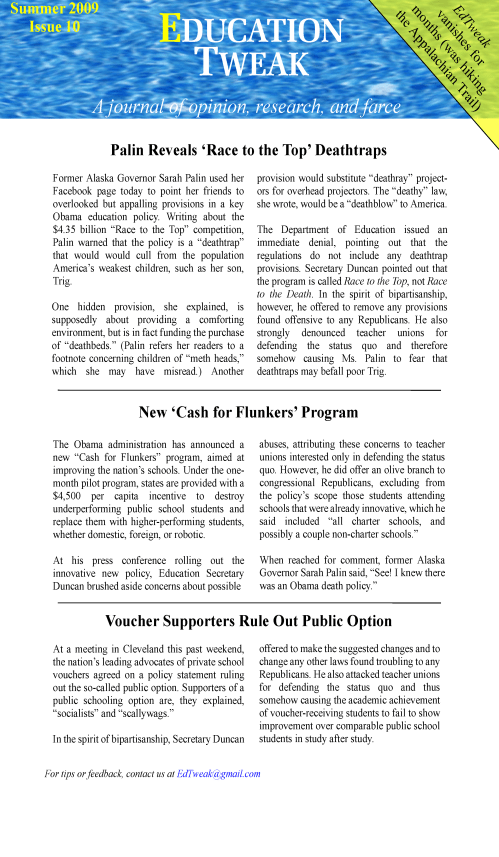

 AMPS
AMPS 