Category Archives: Quote of the Day

Truth and Spin (Quotes of the Day)

spinning_top

The three-legged stool is now down to one leg.

Will that leave either schools or taxpayers wobbly? Will the last leg fall, too?

In any case, Wisconsin’s old order for how to fund schools is coming to an end, and what comes next remains to be decided, perhaps two years from now when the next state budget is adopted. Pressure for an overhaul is growing, even as economic realities are providing strong pressure to hold down budgets.

School funding getting precarious” Alan J. Borsuk and Amy Hetzner, Milwaukee Journal Sentinel

Now the spin:

With this budget package, Democrats have strengthened K-12…education.

Democratic Party of Wisconsin (DPW) Chair Mike Tate.

Since this was in a press release, there is no report  whether Tate managed to keep a straight face while forming these words.

Thomas J. Mertz

Leave a comment

Filed under "education finance", Budget, education, Elections, finance, Gimme Some Truth, Local News, Quote of the Day, School Finance

The Wrong Direction – Quotes of the Day

060721_filled_arrows_1

“I’m certainly concerned from the perspective that we passed a referendum in Madison that I think was predicated on the state doing its share,” says Matt Calvert, whose children will attend O’Keeffe Middle School and Marquette Elementary this fall. “Until we have financial reform, something that will keep up with needs, it seems like now things are going the other direction.”

…[TJ] Mertz believes this budget, regardless of its final form, “moves us further from what the goals of that reform should be in a number of ways.” And he believes impending cuts will mean tough times for school districts across the state.

From Lynn Welch, “Madison schools brace for state budget,” in the Isthmus

(OK, I know it isn’t the best thing to use yourself as a source for a “Quote of the Day, ” but I liked the way what Matt and I were saying fit together.  read the whole story.)

Thomas J. Mertz

Leave a comment

Filed under "education finance", AMPS, Budget, education, finance, Local News, Quote of the Day, Referenda, referendum, School Finance

A Lesson for Jim Doyle (and others)

classroom1I saw clip last night of Wisconsin Governor Jim Doyle blithely dismissing complaints about the secrecy of the the Democratic-controlled budget process.  I think this quote is from the same media opportunity:

“Everything is totally transparent. Everybody knows what the bills were that were passed by the two houses and they know what the issues of debate are, the differences between the two houses. So there aren’t any secrets here,” Doyle said.

I don’t know if Doyle is so insulated that he doesn’t get it or if he is clumsily poking at a straw man, but either way here are some lessons Doyle and the rest of the Democratic “leadership” should heed.

The electorate wants to know what the the people we voted into office are doing and saying as they make decisions about  the revenues and the allocations (and some policy).  We want to know who supports what; we want to know how hard they fight for what they have promised to fight for (or even if they fight for it at all).; we want to know where they stand when they aren’t  running for office.  We want to know, because in less than two years we will have to decide if they have earned our votes.

Knowing the issues and the end product are part of it, but knowing the behavior of the people who represent me is also part of “open government.”  As long as they insist on keeping the doors closed, I am going to assume they aren’t very proud of their actions (from what I have seen of their products, I can’t blame them).

The rest of today’s Civics lesson comes from the 2008 Democratic Party of Wisconsin Platform:

Government must be an open institution that people trust.”

A couple of other notes.

First, anyone who knows my politics (life-long, left-wing Democrat, currently active locally with Progressive Dane) knows how painful it was to link (in agreement) above to Charles Sykes quoting the McIver Institute.

This brings home something that I’ve noted before; while the GOP and the right-wing have been very vocal about both the budget process and products, the left in Wisconsin has been relatively silent (with Ed Garvey being the one prominent exception).

I find this strange.  Maybe it is because I am from Illinois, where it is understood that loyal Democrats on the left will criticize Democratic centrists, moderates, backroom dealers and the like.  I think this sort of criticism is healthy for the party.  I also believe that in the long run it helps advance the causes I work on, such as public education and open government.

The second note is that more regular AMPS blogging will resume in the next few days.  Check back.

Thomas J. Mertz

1 Comment

Filed under Accountability, Budget, education, Elections, Gimme Some Truth, Local News, Quote of the Day, Uncategorized

Education Reporting: A Suicide Watch?

Declining-Newspaper-Readership

It is not a news flash to say that the decline in the health of American journalism is currently close to a death spiral. In a wonderfully succinct review of the current state of play for the industry in Frank Rich’s column today, he noted the many challenges that have been faced by the varied mediums throughout the 20th century, right up to the present. It’s well worth a read. But unlike the entertainment media who have had their successes at reviving their fortunes with the introduction of new technologies – and failures, he noted, “with all due respect to show business, it’s only journalism that’s essential to a functioning democracy. And it’s not just because — as we keep being tediously reminded — Thomas Jefferson said so.”

Rich goes on to write:

Yes, journalists have made tons of mistakes and always will. But without their enterprise, to take a few representative recent examples, we would not have known about the wretched conditions for our veterans at Walter Reed, the government’s warrantless wiretapping, the scams at Enron or steroids in baseball.

Such news gathering is not to be confused with opinion writing or bloviating — including that practiced here. Opinions can be stimulating and, for the audiences at Fox News and MSNBC, cathartic. We can spend hours surfing the posts of bloggers we like or despise, some of them gems, even as we might be moved to write our own blogs about local restaurants or the government documents we obsessively study online.

But opinions, however insightful or provocative and whether expressed online or in print or in prime time, are cheap. Reporting the news can be expensive. Some of it — monitoring the local school board, say — can and is being done by voluntary “citizen journalists” with time on their hands, integrity and a Web site.

I guess he would be referring to me, but not sure about the time issue.

He goes on to say that opinion is still no substitute for reporting, such as what is happening in Pakistan, Washington or Wall Street — and our local school board. I noted earlier that there was no reporting on the school finance hearing that recently took place at the capital. Nor was there any local newspaper reporting on our recent school budget decisions for next year. I’ve been told that a short TV piece aired on a 10 o’clock broadcast (update: WKOW, includes video, h/t JW) — hardly a sufficient exercise in enfranchising our community with the knowledge of how one of the largest portions of their tax money is being spent. In fact, at the moment, the Board of Education web site is even down, ironically. The latest lack of coverage by our local media about the budget deliberations, especially print, with it’s ability to dig a little deeper on issues, is a sad development. With newspaper management fixated on moving around reporters to new beats on a regular basis (from a long out-of-date model), just has they have gotten up to speed on a complex subject such as education, is indeed beyond stupid. Just because conflict has been and remains a driver of much American journalism, it does not mean that there isn’t some important education reporting that needs to be done at the moment.

Blogs, such as this one, are a woefully inadequate substitute to good reporting, one in which telephone calls to sources are made, meetings attended and then a report distributed in a medium large enough to reach a mass audience. Count me as another person who is concerned about these latest developments. What is the current thinking of the editors at the WSJ and the Cap Times?

Robert Godfrey

1 Comment

Filed under Accountability, AMPS, Best Practices, Budget, education, Gimme Some Truth, Local News, Quote of the Day, School Finance, Take Action

What’s at stake with the standards movement?: “[T]he kind of individuals we are developing and the kind of nation we wish to be”

The titular quote is from a new book by William A. Proefriedt, High Expectations: The Cultural Roots of Standards Reform in American Education; the video is from a review of that book in the Teachers College Record.

Proefriedt reminds us that the quest for quick and easy (or quick and dirty) standards and accountability has steamrolled a long tradition in America of striving for mass education that cultivates democratic ideals and full individual development while working against  “individual economic rapaciousness” as a danger to the Republic.  This is a tradition we don’t want to lose.

All the “business model” reformers and champions of “consumer interest” as a tool of reform (and that includes Sec. Arne Duncan and President Barack Obama) would do well to read Proefriedt and heed the wisdom of those he has written about.

See also: William A. Proefriedt, “Reading Emerson.”

Thomas J. Mertz

1 Comment

Filed under Accountability, Arne Duncan, Best Practices, education, National News, nclb, No Child Left Behind, Quote of the Day

Quote of the Day — Promises to Keep

logo_dpw_whiteonblue

From the 2008 Platform of the Democratic Party of Wisconsin:

Education, Labor, and Economics

Quality public education for all is critical to a healthy democracy and economy. Public funding for private schools diverts resources from and adversely impacts public schools. Increased governmental funding and financial aid is essential for all levels of public education. Nobody should be denied a quality education because of a personal lack of financial resources. The benefits of a quality education always outweigh the costs.

We believe that students have the right to receive their education in a safe, respectful, and nurturing environment, free from harassment or discrimination by teachers, staff, parents, or other students. We support fair and equitable funding for all elements of the curriculum, including art, music and physical education. A strong Wisconsin public education system builds a strong Wisconsin.

Wisconsin‘s current educational funding system has failed. The law allowing a limited qualified economic offer has caused diminishing compensation for teachers. Teacher compensation must keep pace with costs of benefits and inflation. Public school teachers must not be taken for granted. They deserve tremendous respect for their work educating our youth under challenging circumstances.

Revenue caps on school districts and other local governments must be eliminated. State or federal governments must fully fund their mandates (emphasis added).

The Democratic Party now controls the Assembly, the Senate and the Governor’s office in Wisconsin.  Time to keep the promises they made in order to gain that control.

Thomas J. Mertz

Leave a comment

Filed under "education finance", Accountability, Budget, education, Elections, finance, Gimme Some Truth, Local News, Quote of the Day, School Finance, Take Action

Quote of the Day — Stunning Illogic and False Hope from the New York Times

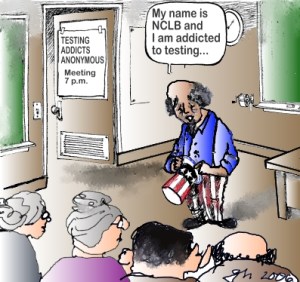
Click the image for more NCLB cartoons.

Click the image for more NCLB cartoons.

The Bush administration allowed states to phony-up statistics on everything from graduation rates to student achievement to teacher training and state education standards. As a result, the country has yet to reach not only the goals that were clearly laid out in the law but also farsighted education reforms dating to the mid-1990s. (emphasis added)

New York Times, “A New Day for School Reform,” editorial, February 21, 2009.

There may be some truth to the cause and effect on teacher training, but the implied idea that the failures of No Child Left Behind are due to  setting standards (curricular and Adequate Yearly Progress) too low is illogical and reinforces multiple flaws in the NCLB.

Some asides at this point.  I want to be clear that communicating high expectations to students in all contexts while giving them the support they need to meet those expectations is good policy.  Changing state standards and cut scores at best comprises a very, very small part of this concept and at worst leads to shaming and other counterproductive punishments.  Better — not necessarily higher — curricular standards do have a place in reform.

First, standards in practice mean standardized tests and standardized tests are very limited as assessments and even more limited as a means of improving education.  To be fair, there is some language in the stimulus package (the subject of the quoted editorial) that may induce a move away from standardized tests (see below).

Second, and most importantly, the whole notion that lax standards are the biggest problem in education defies logic and the historical record.

In terms of logic, just ask yourself if the way to improve archery scores is to use smaller targets.  If they can’t hit the larger target, how will they hit a smaller target?

As to the history, here is the data for Wisconsin under the current system:

Year # Schools Failed AYP # Districts Failed AYP
2007-8 153 4
2006-7 92 2
2005-6 87 1
2004-5 49 1

This graphic tells us about the history and projected future (more here).
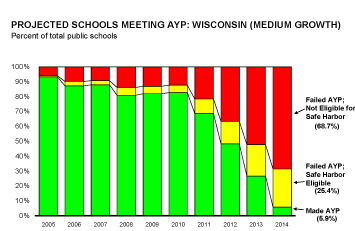
From “The Impact of the Adequate Yearly Progress Requirement of the Federal No Child Left Behind Act on the Great Lakes Region,” a study released by the Great Lakes Center for Educational Research and the Education Policy Studies Laboratory at Arizona State University.

The current standards have resulted in clear trend of increasing failure to meet those standards, a trend that is projected to increase with current standards.

Some quotes from “How Feasible is Adequate Yearly Progress (AYP)? Simulations of School AYP “Uniform Averaging” and “Safe Harbor” under the No Child Left Behind Act” by Jaekyung Lee may help clarify.

It does not appear to be feasible for many schools across the nation to meet the current AYP target within its given 12-year timeline. It is not realistic to expect schools to make unreasonably large achievement gains compared with what they did in the past. Many schools are doomed to fail unless drastic actions are taken to modify the course of the NCLB AYP policy or slow its pace. (emphasis added)

When a majority of schools fail, there will not be enough model sites for benchmarking nor enough resources for capacity building and interventions. This situation can raise a challenging question to the policymakers: is it school or policy that is really failing? There is a potential threat to the validity of the NCLB school accountability policy ultimately if such prevailing school failure occurs as an artifact of policy mandates with unrealistically high expectations that were not based on scientific research and empirical evidence. (emphasis added)

An identified problem with NCLB is that standards are unrealistically high, the New York Times’ solution, raise the standards.  Stunning illogic.

This is the kind of “harder is better” mentality reflected in the Pangloss Index and expected from people like the Walton and Bradley Foundation funded  Thomas B. Fordham Institute, not “the paper of record.”

Later in the editorial, the assessment reform potential of the stimulus bill is touted:

States will also be required to improve academic standards as well as the notoriously weak tests now used to measure achievement — replacing, for instance, the pervasive fill-in-the-bubble tests with advanced assessments that better measure writing and thinking.

This seems to be a gross overstatement.  Here are the relevant parts of the stimulus bill:

(4) STANDARDS AND ASSESSMENTS.-The State-
(A) will enhance the quality of the academic assessments
it administers pursuant to section 1111(b)(3) of the
ESEA (20 U.S.C. 6311(b)(3)) through activities such as
those described in section 6112(a) of such Act (20 U.S.C.
7301a(a));
(B) will comply with the requirements of paragraphs
(3)(C)(ix) and (6) of section 1111(b) of the ESEA (20 U.S.C.
6311(b)) and section 612(a)(16) of the IDEA (20 U.S.C.
1412(a)(16)) related to the inclusion of children with disabilities
and limited English proficient students in State
assessments, the development of valid and reliable assessments
for those students, and the provision of accommodations
that enable their participation in State assessments;
and
(C) will take steps to improve State academic content
standards and student academic achievement standards
consistent with section 6401(e)(1)(9)(A)(ii) of the America
COMPETES Act.

A and C  send us to the two prior acts, with vague “such as” language in A.  Here is the section cited in A:

(1) To enable States (or consortia of States) to collaborate with institutions of higher education, other research institutions, or other organizations to improve the quality, validity, and reliability of State academic assessments beyond the requirements for such assessments described in section 1111(b)(3).

(2) To measure student academic achievement using multiple measures of student academic achievement from multiple sources.

(3) To chart student progress over time.

(4) To evaluate student academic achievement through the development of comprehensive academic assessment instruments, such as performance and technology-based academic assessments.

and the section cited in C:

(ii) identifying and making changes that need to
be made to a State’s secondary school graduation
requirements, academic content standards, academic
achievement standards, and assessments preceding
graduation from secondary school in order to align
the requirements, standards, and assessments with
the knowledge and skills necessary for success in academic
credit-bearing coursework in postsecondary education,
in the 21st century workforce, and in the Armed
Forces without the need for remediation;

I certainly don’t see a requirement to end “fill-in-the-bubble tests” here.  I see some good but weak language opening the door to multiple assessments, some possibility of better assessments in general and buzz words about the “21st century workforce.”  I also have not seen anything in Wisconsin’s plans for the stimulus money that indicates that the WKCE will be gone anytime soon (since the contract requires two-year notice be given, I don’t see that long awaited day being pushed up).

This editorial is unfortunately typical of the confusion on education policy in our media and consequently in our society.  Education policy can be confusing.  This makes the role of the press even more critical and the failures of logic and accuracy like those in the Times editorial more damaging.

Thomas J. Mertz
2 Comments

Filed under Accountability, Best Practices, education, Gimme Some Truth, National News, nclb, No Child Left Behind, Quote of the Day, Uncategorized

Jim Doyle, a Governor for 1984?

doylefestivus

“Not getting cut is the new increase in this budget.”

Wisconsin Governor Jim Doyle speaking to the Wiscosnin Association of School Boards Convention.

1984, David Bowie (click to listen or download)

There were lots of rumors about Doyle seeking a position in the Obama administration.  Since that didn’t happen it appears that he is angling for a gig with the Ministry of Truth, who gave us such slogans as “War is Peace” and “Ignorance is Strength” in George Orwell’s 1984.

Thomas J. Mertz

Leave a comment

Filed under "education finance", Budget, education, Elections, finance, Gimme Some Truth, Local News, Quote of the Day, School Finance

Quote of the Day – “A better approach”

mind-the-gap

A better approach for state leaders is to concentrate on closing the gap between what the state requires school boards to spend and the amount the state allows school boards to collect in revenue.

Wisconsin Sate Journal, editorial January 6, 2009.

The larger point of the editorial — that those considering getting rid of the QEO without providing a means for additionally  revenue are  irresponsible — is correct also.

Thomas J. Mertz

Leave a comment

Filed under "education finance", Best Practices, Budget, education, finance, Local News, Quote of the Day, School Finance

Quote of the Day — “Most Powerful” Data

“I am not a number,” from The Prisoner.

It’s one reason why the most impressive data we used at the schools I’m most familiar with were the results of interviews with alumnae conducted years after they left us. But even that only helps us if we’re open to hearing what they say. For the possibility—however unlikely—that we may be wrong about this or that has to be uncomfortably confronted—over and over. Sometimes it’s small things and sometimes it’s the big ones. It’s this that I hope good schools do for both their kids and their staff—because this habit of what I call “skepticism” is what democracy rests on. The “data” that are the most powerful are not all the proxy data—like test scores—which we have been inundated with. What we need to be listening to are the real experiences of our students and our graduates, and over time their impact upon the larger world as well.

Deborah Meier, (hat tip, Jim Horn – Schools Matter)

Thomas J. Mertz

Leave a comment

Filed under Accountability, Best Practices, education, National News, nclb, No Child Left Behind, Quote of the Day