Category Archives: Take Action

(Not?) Talking about Diversity and Boundaries, 2008 Style

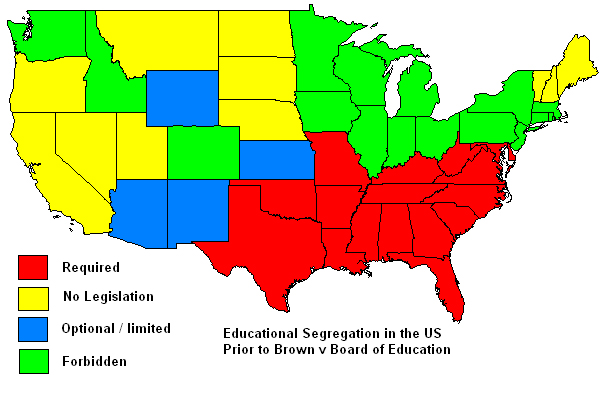
educational_seperation_in_the_us_prior_to_brown_map-copy.jpg

tends3.jpg

low-income.jpg

With the new school opening on the West side, Madison again must confront the competing interests and ideals involved in redrawing school attendance boundaries. The district has produced four plans (more may be in the works, or the existing ones may be tweaked). At a long and unusually non-confrontational meeting Monday (1/28/2008), concerned community members presented their views.

The guidelines used to create these plans include seven non-prioritized criteria, only one of which addresses diversity:

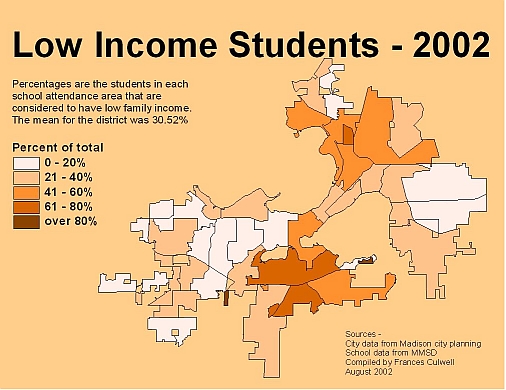
Every attempt will be made to avoid creating schools with high concentrations of low-income families.

It should be noted that this gives no guidance about schools with high concentrations of high-income families.

The Equity Task Force asked the Board to consider having racial, linguistic and/or economic diversity figure more prominently in this and related processes. The Board has taken no action on this.

What role race and linguistic considerations can play in drawing school boundaries is an open constitutional question. In the recent Louisville and Seattle case, Justice Joseph Kennedy’s partial concurrence rejected the plurality’s contention that these could not play any direct role:

School boards may pursue the goal of bringing together students of diverse backgrounds and races through other means, including strategic site selection of new schools; drawing attendance zones with general recognition of the demographics of neighborhoods; allocating resources for special programs; recruiting students and faculty in a targeted fashion; and tracking enrollments, performance, and other statistics by race.

Many consider Kennedy’s to be the “controlling opinion” in that without his vote the court would have been evenly split.

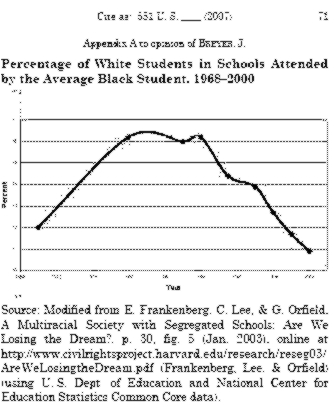
Nationally the trend toward re-segregation (however you measure it) continues. This trend can be seen in the graph above (from Justice Breyer’s dissent in the same case). A recent article in the Christian Science Monitor documents and explores the continued growth of what Gary Orfield calls “apartheid schools” (those with 90% or more minority enrollment). As the article notes, some do not have a problem with this happening, others are less sanguine:

“I don’t think that the education that you get hinges on the color of the person sitting next to you in the classroom,” [Roger] Clegg [president of the (Bradley Foundation funded) Center for Equal Opportunity in Falls Church, Va.] says. “What educators should focus on is improving schools.”

That sounds great in theory, say some experts, but the fact is that segregated schools tend to be highly correlated with such things as school performance and the ability to attract teachers.

“Once you separate kids spacially from more privileged kids, they tend to not get the same things,” says Amy Stuart Wells, an education professor at Columbia University’s Teachers College in New York. “And we need to start thinking about how a school that’s racially isolated can be preparing students for this global society we live in.”

I agree with Wells, both in terms of resource allocations and in terms of the lessons being taught or not taught by segregated learning environments.

Things aren’t that bad in most of Madison, but without a conscious effort to directly confront the issues they will be. As a friend reminded me today. the attention given to test performance data — measures that highly correlate with economic status — have induced some families to judge schools by simplistic measures and avoid those that aren’t “performing.” Often the schools being shunned are good schools with high percentages of students who are poor. In terms of resources, MMSD does what it can to direct resources to those schools with high needs, but the school finance system in general and the underfunding of Title I, Special Education, Bi-Lingual Education, SAGE and a host of other programs make this more difficult each year.

When I start to talk like this, to suggest being more proactive on issues of diversity, many are quick to remind me of the dangers of “becoming like Milwaukee,” meaning a district or city that has been largely abandoned by the middle and upper classes because they believe the schools no longer serve their children. There is no question that the growth in low income and minority students will keep some people from sending thie children to Madison Schools and that under the revenue caps this will have an adverse effect on the all the children in the district. There is also no question that prioritizing the needs of our neediest will exacerbate this. I think that is a price we should be willing to pay.

I am also well aware that dealing with these matters quietly and indirectly is easier for school officials, elected and appointed. Avoiding controversy and pretending differences (of status and opinion) don’t exist is always easier. For the most part MMSD has done a very good, if relatively quiet and indirect job of addressing diversity. I don’t think that is sufficient. I think being loud and direct at times is important.

In a recent Education Week there was a review of a new book, Everyday Antiracism: Getting Real About Race in School, by Mica Pollock. The book offers 65 essays by scholars “who offer advice for educators on recognizing when everyday classroom practices exacerbate racial inequalities and on becoming more constructively conscious and open about race.” In an earlier book, Pollock had coined the term “Colormuteness,” to denote the reluctance to talk about race directly. What Pollack is championing for the classroom, I am urging for the wider public sphere and not just for color or race, but other dimensions of inequality as well.

I was at a meeting last night where the talk turned to the responsibility of communities like Madison to demonstrate that diverse public schools (along with other progressive social policies) can and do work. The idea is that we need to serve as a counter example for those who would throw up their hands and say segregation and inequality are too intractable, or want to privatize schools and services because they have given up on public institutions. Madison has the resources and the communal will to do this and I believe many of us, quietly and indirectly, try. Quietly and indirectly isn’t good enough to meet this responsibility. Quietly and indirectly sends the message that we aren’t confident that we are right and able. We need to be loud and proud, we need to confront and demand and be relentless.

Kind of a long trip from the current West side boundary discussion. To bring it back around, in that context I would like MMSD to say, “yes we do seek diverse schools because we believe that in 1,000 ways diverse schools help combat inequality and segregated schools reinforce inequality. Creating opportunities and combating inequality are central to our mission.” More generally, I would like all associated with the schools to enact policies (including those proposed by the Equity Task Force) and follow practices (including those proposed by the Equity Task Force) that are proudly proactive on matters of racial, linguistic, economic and other inequalities. Last, I’d like us all to talk about this, not around it.

Thomas J. Mertz
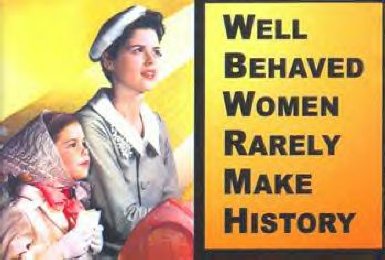
wellbehavedwomenseldom.jpg

1 Comment

Filed under AMPS, Best Practices, Equity, Local News, Take Action, Uncategorized

Hope For the Future of our Schools

by John Smart

Two things happened recently that raised my hopes for the future:

The first was an assembly held at the Menasha High School on November 14th dedicated to learning about the ongoing genocide in Darfur, that region of Sudan where nomadic Arab militias covertly sponsored by the Sudanese dictator, Omar Hassan al-Bashir, are ravaging the countryside, murdering, raping, burning villages and driving the indigenous people from their land.

Students in teacher Dean Boyer’s social studies classes were asked to select an international issue to study, and they chose the situation in Darfur. They researched the story thoroughly, and in the process became involved with the Darfur Action Coalition of Wisconsin, an organization working to support efforts to help the victims of this bloody conflict — and to end it. The students are selling tee-shirts and raising funds to send to the Coalition.

They also asked the Coalition for someone to come and speak to a student assembly at their high school about the Darfur crisis, and I volunteered to do so. They weren’t sure how many students would choose to attend, and we were all surprised when the handsome Menasha High School Auditorium filled almost to capacity – over 700 students!

The conversation — for that is what it was — lasted for an hour, and the students were attentive and involved, they asked informed questions and related serious concerns. They exhibited genuine empathy for the unfortunate people in that far-off, African land.

I was so exhilarated from spending time with those wonderful kids that I felt airborne to my next destination! If they are representative of the youth of our state and nation, and I hope and believe they are, the future of the state and nation is indeed in capable, caring hands.

I then went from Menasha to Madison, where, the next morning, I was one of sixty plus citizens who testified at a hearing of the State Senate Committee on Education.

The November 15th public hearing had to be moved to a larger room in the Capitol to accommodate the ever-increasing crowd, and they still had to have an overflow room with a television monitor so that attendees could follow the proceedings. The turnout clearly demonstrated growing public interest in doing something constructive to support our schools.

The purpose of the hearing was to examine Senate Joint Resolution 27, co-sponsored by Assembly Representative Sondy Pope-Roberts, of Middleton, Senator Roger Breske, of Eland, 14 other senators and 43 other assembly representatives. All but one of the people testifying were in support of the resolution.

The resolution calls for the legislature to recognize that the system we’re using to pay for our schools is not fair and equitable, and simply does not work — that it underfunds our schools while throwing too much of the burden on the backs of property taxpayers, who are understandably rebelling. The resolution refers to a number of new funding formulas that all deserve consideration, and it sets a deadline for the legislature to examine these, and any others, and pass a new compromise plan for school funding reform by a deadline date of July 1, 2009.

Several members of the committee, notably Senators Glen Grothman, of West Bend, and Mary Lazich, of New Berlin, insisted on attempting to debate the merits of one or another of the plans, asking how much they would cost and where the money was going to come from. They had to be reminded repeatedly that this resolution only sets a deadline and doesn’t endorse any specific plan.

What lifted my spirits was the enthusiasm of the people attending and the seriousness with which the senators responded. Many of us have struggled for a long time to get the legislature to recognize the problems that the current funding system is causing for our schools, and finally, it is beginning to look like that light at the end of the tunnel may not be an oncoming train!

The fight isn’t over though, not at all. It is probable that the resolution will pass the committee and the senate, but it is still a question as to whether or not the Speaker of the Assembly, Mike Huebsch, will allow this resolution to even come to the floor of that body for debate.

As usual, it is important for citizens to voice their opinions. Letters and phone calls to our legislators actually do have an effect. It is the voice of their constituents that has brought legislators back to this issue again, and more are needed. Please be a part of that “squeeky wheel!”

The students of Wisconsin, like those remarkable young people at the Menasha High School, deserve the best education that we can provide for them. It’s a question of priorities, and to my mind, they are on top of the list.

John Smart serves on the Park Falls School Board, is a member of the Wisconsin Governor’s Commission on the United Nations, the UN Association of the USA and Citizens for Global Solutions. He was a Peace Corps volunteer in Uzbekistan from 1995 through 1998 and chairs the Democratic Party of Price County.

Leave a comment

Filed under Accountability, AMPS, Gimme Some Truth, Pope-Roberts/Breske Resolution, School Finance, Take Action, We Are Not Alone

Pope-Roberts/Breske Resolution Hearing Report

Pope-Roberts and Breske
Rep. Sondy Pope-Roberts, Middleton, and Sen. Roger Breske, Eland, testified before a packed house, Nov. 15, on Senate Joint Resolution 27.

From the Wisconsin Alliance for Excellent Schools
Message delivered to Legislature: Change the school-funding system

On Thursday, Nov. 15, comprehensive school-funding reform was before the Senate Education Committee. In 6-1/2 hours of testimony, 50 speakers from across the state urged the committee to back a, resolution — authored by Rep. Sondy Pope-Roberts, of Middleton, and Sen. Roger Breske, of Eland — to throw out the present funding system and replace it by July 1, 2009.

An additional 62 people registered their support at the meeting for Senate Joint Resolution 27. In their demands for reform, they joined 60 members of the Senate and Assembly who signed on as co-sponsors.

Testimony by Sen. Kathleen Vinehout, of Alma, not a member of the Committee, highlighted the troubles the small schools in her district have under the current state financing formula. She said there is “a fundamental disconnect” between what drives spending and what drives revenue.

Vinehout framed the resolution as a “get‘er done” order for the State Legislature, not a specific plan. The Senator called it a needed first step.

Rep. Pope-Roberts said that “we have the opportunity to get it right, something we failed to do in 1993” when the Legislature approved the present formula that places limits on how much revenue school districts can raise. Several testifiers reiterated the point that the revenue limits have failed to keep pace with districts’ rising expenses.

Testifiers at last Thursday’s hearing came from urban, suburban, and rural districts. Speakers cited shortages of books and desks; crumbling buildings; and too few courses, librarians and counselors, sports, and after-school programs. Many said these problems have been compounded by increasing class sizes. Those districts hardest hit are the ones with declining enrollments, six out of every 10 school districts in the state.

“Instead of prescribing how the school-finance system should be changed, the resolution calls for a finance system that meets four criteria. It must be based on:

  • The actual cost of educating children;
  • Sufficient resources have to be provided to meet state and federal mandates;
  • Additional help to students and districts who have special needs; and
  • The equitable collection of and distribution of funds
  • Ruth Page Jones, president of a parent group called Project ABC-Waukesha, said “it’s time to trash this going-out-of-business plan.” Jones said the present system pits neighbor against neighbor as communities are forced to go to referendum in order to stop program losses.

    Talking to that point, Tony Evers, deputy superintendent of the Wisconsin Department of Public Instruction, said half of all referendums have failed in recent years. He said, basically, that geographic location is now the prime indicator of how good an education a child will receive.

    Page Jones observed that “districts have already fired administrators, delayed maintenance, slowed text-book adoption . . . and now in the last few years all that is left to cut are teachers.”

    Upcoming, the Senate Education Committee will determine whether to forward the resolution to the full Senate. No hearings have been scheduled in the Assembly. You can weigh in on both accounts. Click on the following links to:

    »Find out what you can do.

    »Read the testimony of those appearing on behalf of WAES, and others

    »Watch the entire hearing on SJR27 on Wisconsin Eye

    »Read the media coverage of the hearing:

    Milwaukee Journal-Sentinel
    Wisconsin State Journal
    WISC-TV, Madison
    Wisconsin Radio Network
    Waukesha Freeman
    Wisconsin Public Radio
    WEAC Website

    Links to additional coverage:

    From a local blogger and sometime AMPS contributer: Democracy in Action.

    From Jennifer Morales of the MPS Board: Democracy is Sexy.

    And of course all the related posts on AMPS (including videos!)

    Thomas J. Mertz

    Leave a comment

    Filed under AMPS, Best Practices, Budget, Elections, Local News, Pope-Roberts/Breske Resolution, School Finance, Take Action, We Are Not Alone

    Senate Hearing Video

    Randy Kunch

    The testimony at the Senate Education Committee Hearing on the Pope-Roberts/Breske Resolution was beyond compelling. At times I was moved to tears. There was some anger too, but as I noted previously, the dominant theme was optimism, a belief that we (meaning the people of Wisconsin and our elected officials) can and will fix the shameful mess that is school funding in Wisconsin.

    In the coming days and weeks I am going to be posting video excerpts from the hearing(video from Wisconsin Eye — the full November 15 hearing can be accessed here — , excerpts posted via YouTube, playlist of all hearing videos posted thus far, here). I chose Randy Kunch from the Phillips School District as the first post (click here to watch). Please take the five or so minutes to watch and listen to Randy and then sit down to write your elected officials or your local paper and tell them that someting needs to be done and the time is now!

    Thomas J. Mertz

    Leave a comment

    Filed under AMPS, Best Practices, Budget, Elections, Local News, Pope-Roberts/Breske Resolution, School Finance, Take Action, We Are Not Alone

    Simple Majority Declares Victory for Kids and Schools…Let’s Do the Same!

    In the Election Roundup I wrote that the Simple Majority campaign in Washington State had lost. With more complete returns, victory has been snatched from the jaws of defeat. Congratulations to the League of Education Voters and the people of Washington!

    I attended the Senate Education Committee hearing on the Pope-Roberts/Breske resolution today (more on that later), and I think there is a lesson from Washington for the Wisconsin legislature and the people of Wisconsin. In Washington, they fought against great odds and achieved a major and positive change is state school finance.

    Everyone I heard testify today agreed Wisconsin’s system is broken and that each year we move further away from providing the education our children deserve. Most of those testifying were passionate and optimistic — they believe we can fix this and are committed to doing just that. However, some (not all) of the Senators seemed to be primarily interested in the difficulties and obstacles and 1,000 reasons why we can’t do better. This is the wrong attitude and they need to know that if they’d rather make excuses than do the job the Constitution gives them and the people demand of them, we will elect those who can and will.

    The resolution itself, like the voters and advocates in Washington, rejects this kind of thinking. It simply asks for a commitment to try to do what almost everyone agrees is the right thing.

    Is this too much to ask?

    Thomas J. Mertz

    Leave a comment

    Filed under AMPS, Elections, Local News, National News, Pope-Roberts/Breske Resolution, School Finance, Take Action

    Another Principal for a Day

    Anjuman Ali of the Wisconsin State Journal was another Foundation for Madison Public Schools principal for a day (see here for Dave Zweifel’s report). Ali was at JC Wright Middle School, where our older son attends.

    Where Zweifel ended with the most important message, Ali begins with it:

    Madison’s schools are doing a remarkable job of educating children despite challenges posed by changing demographics and shrinking budgets.

    But schools need our help to keep giving kids the skills and knowledge they need to succeed in life.

    Ali’s words of praise for the Wright staff also ring true:

    At Wright, I interacted with an extraordinary group of educators and staff, including Principal Nancy Evans.

    As a parent, I can’t say enough good things about Nancy Evans and the entire staff at Wright.

    The column highlights the insufficient resources we provide to schools:

    There is a looming crisis in K-12 education not just in Madison, but also in other Wisconsin municipalities. And lawmakers, school officials and others have to recognize the magnitude of this crisis and act now.

    Much of the budgetary crunch is due to Wisconsin’s school funding formula, which is seriously outdated. The revenue limits do not allow property taxes and state aid to keep up with rising costs. Lawmakers need to examine and change this system. Meanwhile, school districts have no option but to continue to find ways to become leaner

    Ali calls for more volunteerism, more help from businesses and individuals and a plea to do what you can to make sure our children have the schools they deserve.

    The city and the state’s healthy future depends on children getting a quality education and life skills. Please consider contributing to their success by supporting Madison’s public schools.

    I agree with all of this, although I’d put a little more emphasis on enacting a school finance system that would make private contributions a bonus and not a necessity.

    Thomas J. Mertz

    .

    Leave a comment

    Filed under AMPS, Best Practices, Budget, Local News, School Finance, Take Action

    We are not alone #17

    Things have been bad in Park Falls for a long time. A $850,000 referendum failed in April. After that they announced an unbelievable set of cuts:

  • Reduce staff by one full-time staff member in the district offices.
  • Reduce staff by one half-time staff member in the elementary school office and one half-time staff member in the high school office.
  • Reduce by one maintenance position.
  • Reduce by one transportation position.
  • Reduce by 1-1/2 food service positions.
  • Reduce by one high school history teacher, one elementary and middle school guidance counselor, one high school technical education teacher, one half-time middle school consumer education teacher, one elementary alone.gifmusic teacher, one half-time high school physical education teacher, one half-time high school English teacher, one elementary school teacher, one .6-time middle school music teacher, and one special education aide. Further reduction includes five positions due to attrition/retirements.
  • Eliminate the position of middle and high school disciplinary assistant.
  • Eliminate all middle school [grades six to eight] athletics and other extracurricular activities — club or volunteer activities only.
  • Eliminate the following sports: cheerleading, hockey, gymnastics and golf.
  • There will be varsity and junior varsity sports only, no freshman or “C” teams.
  • Two coaches only per sport, varsity and junior varsity — any others must be volunteers.
  • Only authorized WIAA programs will be funded.
  • Eliminate the summer marching band program.
  • Reduce the FBLA program by disallowing national competition, unless other funding can be found.
  • Eliminate the forensics program.
  • Cut participation in any music competitions beyond the solo and ensemble competitions.
  • Reduce district’s technology budget by $30,000.
  • Reduce building administrators’ budgets by $55,000.
  • Reduce overall maintenance budget by $25,000 – $30,000.
  • Close the swimming pool.
  • It is further recommended that all athletic coaches and extra-curricular advisors be laid off at the end of the 2006-2007 season, including the position of grades seven-12 athletic director. These positions will all be re-evaluated, posted and rehired as necessary, as per collective bargaining agreement, with first consideration being given to employees of the school district.
  • It is also recommended that a system of fees and charges be established for school activities and events to raise additional revenue. A committee has been established to determine fair fees and charges. Such fees and charges would be for all athletic and music events, for use of the building by any profit-making activity [such as drivers’ education, karate, etc.], for special course textbooks and materials, for any non-class-related school computer usage, and for anything else the committee deems appropriate.
  • They are currently working on a consolidation with Butternut (another struggling district). Apparently the consolidation will produce some temporary savings but in the long run the combination of a basic state funding system that is designed to fail, declining enrollments and “sparsity” will take them right back where they are now (unless of course our lawmakers enact real reform).

    Sparsity is used to describe the special issues faced by large geographic districts with small enrollments, for example the need to staff a French or chemistry class for only a handful of students. These sorts of diseconomies of scale along with the need to maintain schools within a couple hour drive of student’s homes create real challenges and our funding system denies districts the resources they need to meet these challenges.

    Meanwhile, (according to the Park Falls Herald) “Impacts of cuts in school district felt

    This is the part that got to me:

    Elementary School Principal Michael Plemon addressed the board during his administrative report about the “desperate need for a guidance counselor” at the elementary school.

    “I believe strongly that we need this at the elementary level,” Plemon said. “We have got a kindergarten class and a first-grade class, I’m not exaggerating when I say this, where I could already be in a situation of suspending kids from school. We’ve got a few kids in that situation that need guidance. These are children that need help and discussion, and a place for them to go and get some guidance.”

    Plemon said he is able to handle the situations and discipline on a day-to-day basis, but that those students aren’t getting the help they need to change the behaviors, and that the concerns include the other students.

    “Children today come with a lot more social issues than they once did,” Plemon said, noting the need for assistance with issues including grief, loss, self-control and other social skills, especially anger management. “You’re looking at five to maybe 10 kids in the elementary, but they have this anger management issue every day. Other kids are getting hurt because of this.”

    “It is an area I believe is vital for our elementary school,” he said.

    Waller said a good rule of thumb is one guidance counselor for each principal. The district currently has one guidance counselor, working in the high school and middle school. Waller said the item would be on the agenda for the October meeting, but many board members felt the need was important and asked if it could be placed on the agenda for the meeting scheduled for tonight, Thursday, Sept. 27.

    In response to a question from board member Jean Gottwald, Schuchardt said the position was not in the 2007-08 budget but could be added.

    How long can this insanity go on? Make some noise! Call, write, visit any and all legislators and don’t let Governor Doyle off the hook. Come November, let’s work statewide to elect people who will fix this.

    Thomas J. Mertz

    Leave a comment

    Filed under AMPS, Budget, Elections, Referenda, School Finance, Take Action, We Are Not Alone

    Beware!

    Smiling faces sometimes pretend to be your friend
    Smiling faces show no traces of the evil that lurks within
    Smiling faces, smiling faces sometimes
    They don’t tell the truth uh
    Smiling faces, smiling faces
    Tell lies and I got proof…

    Beware, beware of the handshake
    That hides the snake…I’m telling you beware
    Beware of the pat on the back
    It just might hold you back

    “Smiling Faces Sometimes ”

    by Norman Whitfield and Barrett Strong
    Performed by the Undisputed Truth (listen here)

    On Monday October 1st the MMSD Board of Education will vote on “support” for the Wisconsin Way Initiative. My advice is, beware. Every indication is that behind the smiling public face of populist civic virtue lurks the hand holding snakes of powerful vested interests.

    Funded and sponsored by the Wisconsin Realtor’s Association (WRA), the Wisconsin Education Association Council (WEAC), the Wisconsin Transportation Builder’s Association (WTBA), the Wisconsin Counties Association (WCA) and Wood Communications Group, Wisconsin Way is self-described as “a non-partisan, grassroots effort to reduce property taxes by creating a more fair and equitable funding system that promotes excellence in education and public service.” More specifically, the initiative has identified “make[ing] Wisconsin taxes fairer and reduce[ing] the property tax burden;” providing “a first-rate educational system” to create “a 21st century work force;” and “up-grade[ing] and maintain[ing] our current infrastructure” as the most pressing issues. According to their materials, the chief obstacles to meeting these needs are demographic (mostly an aging population and “economic realities”) and “a fiercely partisan political environment.” They will be hosting a series of public forums “to engage Wisconsin citizens in a constructive, solution-oriented conversation.”

    It should go without saying that the issues and problems identified are real and deserving of attention (although far from comprehensive – where’s healthcare, inequalities in education and income, environmental concerns… – and are not presented as I would). Public forums are hard to argue with and although I have my doubts about any new solutions emerging they can be an effective tool for educating the public and cultivating a climate for reform.

    The smiling face of the Wisconsin Way is very attractive. If all was as they would like you to believe, then I would applaud their work, urge MMSD to give support and eagerly await the results. However, the whole project is so rife with misrepresentations that I think some truth telling healthy skepticism are needed.

    The Wisconsin Way “who we are” statement is a good place to start. They claim to be “a non-partisan, grassroots effort.” I’ll grant them “non-partisan (although bi-partisan would be a better description and keeping in mind that the phrase is so devoid of meaning in this context that Wisconsin Manufactures and Commerce is technically “non-partisan”). Grassroots is too much of a stretch. The current entry in Wikipedia (not a perfect source, but sufficient) defines a “Grassroots movement” as “one driven by the constituents of a community. The term implies that the creation of the movement and the group supporting it is natural and spontaneous, highlighting the differences between this and a movement that is orchestrated by traditional power structures.” I know grassroots efforts, I work on grassroots efforts, gentlemen, you are no grass roots effort.

    In modern politics, an attempt by public relations professionals to disguise an interest driven agenda with the trappings of a populist grassroots campaign is called “astroturfing.” Think the bait-and-switch phony signatories of TV4US’s (read AT&T and friends) video franchise give away campaign. Think the corrupt and ambitious Edward Arnold sponsoring the “John Doe” clubs in Frank Capra’s “Meet John Doe.” This seems to describe the Wisconsin Way.

    Wood Communications principal James Wood (by most accounts the driving force behind Wisconsin Way) is a public relations professional. His highly successful (and connected) firm boasts of their government relations’ services “positioning your issues and engaging in the process that drives policy making.” Wood himself has described the reliance on opinion polling to frame the initiative as well as the lengthy and difficult birth of the Wisconsin Way, so he admits there is nothing spontaneous. Ed Garvey (one of the few voices that has been questioning the Wisconsin Way) mentions a rumored $1 million price tag. I’ve heard reports of the carrot for taking part in training sessions (and maybe the forums themselves for selected groups) includes a very generous per diem stipend.

    The fun really starts when you look at the other sponsors who ask us to believe they want overturn the status quo of “a fiercely partisan political environment.” It is abundantly clear that the simplest way they could contribute to this worthy goal would be by ending their own participation; firing their lobbyists and using their political endorsements and contributions in a more productive manner.

    At this point it is probably worth saying that Wood and the WCA may be sincere in their civic mindedness. I am less charitably inclined toward the others.

    WRA, WEAC, WTBA and WCA spent a combined $843,784 in lobbying between January and June of 2007. WEAC ($314,899) and WTBA ($230,028) rank #3 (corrected, the #1 that appeared earlier was a typo) and #8 in dollars spent. By any definition they are all part of “traditional power structures.”

    Although the WRA lags in lobbying ($116,599 is hardly chump change), they more than make up for this with their targeted political spending through RPAC. Their January continuing campaign finance report includes $105,000 in contributions to a much uglier astrotruf outfit called “Coalition for America’s Families.” Headed by former Wisconsin GOP chair Steve King, this group helped fund this exercise in homophobia that helped pass the anti Gay Marriage and Civil Unions amendment. Their website features, along with pleas for vouchers, guns and lower taxes, an ad saying that Governor Doyle wants to raise your taxes in order to pay for free health care for gay couples. Once you get over your disgust, you have to admire their ability to link their social and economic agendas. These are the people directly responsible for the poison political atmosphere the Wisconsin Way presents itself as an alternative to. It took me a long time get over the disgust and when I did I also came to the conclusion that I don’t want to be even indirectly associated with these people. I hope the Board of Education agrees.

    The WRA, the WTBA and WEAC all have well defined agendas based on the interests of their constituents. It is hardly surprising that the issues identified by the Wisconsin Way are aligned with these interests. The Realtors want lower residential property taxes, so does the Wisconsin Way. The road builders want spending on roads, the Wisconsin Way calls this “infrastructure.” WEAC represents teachers and education spending is on the Wisconsin Way list (although it should be noted that most of the supporting materials are about higher ed and there is very little about the insanity of the current k-12 education finance system). Although the word “inclusive” appears often in Wisconsin Way materials, the reality is that at some level this is about the interests of the funders. Pretty much business as usual.

    There is lovely little passage in their White Paper playing the old “fair and balanced” game of setting up two groups or positions as deserving equal consideration, when one is demonstrably wrong:

    “Two major political positions emerged. One held that Wisconsin taxpayers were already overtaxed and that taxes should be frozen or reduced. This side argued that schools, the UW System and local units of government could manage the lack of new money by operating more efficiently and/or cutting unnecessary services. The other held that while some Wisconsin taxpayers might be overtaxed, there were plenty of taxpayers (corporate and individual) who were not paying their fair share and that failure to support education and other local services would do serious damage to the state’s infrastructure and the ability of local governments to serve their constituencies.”

    By Wisconsin Way’s own account, Wisconsin needs to better fund infrastructure and education, so the money has to come from somewhere. This is the only mention of corporate taxation and I don’t recall any mention of sales taxes. Maybe the Wisconsin Way will end with a proposal for more corporate taxation, an expanded sales tax and fairer property taxes (with fewer exemptions for businesses). I’d like that, but I’m not holding my breath.

    The White Paper also reveals how rigged this exercise is. First they hold the public forums, but the real business will occur behind closed doors and the only people sitting at the table will be the sponsors:

    “At the conclusion of this first round of public forums, Wisconsin Way partners will summarize the major conclusions and proposals offered by the citizens and
    ask a variety of academic and policy experts to review and comment on them. After that review is complete, the Wisconsin Way will draft a preliminary “Wisconsin Way Agenda” that will be presented at six to eight regional public forums in early 2008. Based upon the public reaction to, and comments on, the preliminary document, a final “Wisconsin Way Agenda” will be developed to serve as the basis for an on-going
    discussion with elected officials and opinion leaders.”

    Don’t be fooled by that last round of public forums, this is known as test marketing, like a preview for a movie.

    If MMSD wants to support the Wisconsin Way it should request in exchange a seat at that table. Otherwise they will end up like those citizens and lawmakers who found their innocent queries about video competition presented to lawmakers and the public as support for a specific piece of legislation.

    Beware!

    Thomas J. Mertz
    (please note the opinions expressed here are mine and do not represent the position of any group I am associated with)

    7 Comments

    Filed under AMPS, Gimme Some Truth, Local News, School Finance, Take Action

    Young Lobbyists

    2

    I’ve been too busy to post a follow up on the September 18th visit to the Capitol to advocate for state school finance reform. Sorry for the delay.

    Let me start by thanking all those who participated. We had a good crowd, about thirty total in three groups, most under age twelve. As you can imagine it was a bit chaotic, but the energy was great. Next time we’ll try to be better organized…there will be next time and a time after that and beyond.

    The kids were great and I loved the signs they brought. The parents were great too. I was impressed by how well informed their comments and questions were and how they pushed the legislators and staff to get past the canned talking points.

    When I was thinking about it later it came to me that one of the things I like about Madison is that many people believe that they can make a difference, that they can create positive change. That was the spirit I saw in our group and the lesson I saw our children learning. How wonderful.

    On one hand we know that a handful of parents and children is not going to undo the damage done by the $366,674 that Wisconsin Manufactures and Commerce spent lobbying from January to June of 2007. On the other hand we know that if we refuse to be ignored, we can do some good. It is the William Lloyd GarrisonI will be heard” attitude. Keep it up!

    We will be doing more of this, stay tuned for details. For now I want ask for a couple more things. First, for those who joined us at the Capitol a quick note to the offices you visited — thanking them for their time and reiterating the purpose of our effort — would be a good idea. All the legislators are listed here. The notes, letters and calls from those who couldn’t make it are always good too. I would especially push Brett Davis on the timeline of his proposal and for a better, less political explanation of why he refuses to give the Pope-Roberts resolution a hearing. The second request has to do with the Wisconsin Alliance for Excellent Schools (disclosure, I’m a Board member of WAES). WAES has been doing the best work on state education finance reform for years. Recently it became clear that we will not be able to depend on foundation funding in the future and would need to find an alternate way to keep going. We are in the midst of transitioning to a dues structure. On October 1, Tom Beebe (of WAES) will be doing a presentation to the MMSD Board of Education Communications Committee, explaining the changes and beginning the process of asking that our district become a dues paying partner. There will be public comment that evening and your support would be appreciated.

    Thanks to all again, especially those who got this started and the kids.

    Thomas J. Mertz

    Leave a comment

    Filed under AMPS, Budget, Local News, Pope-Roberts/Breske Resolution, School Finance, Take Action

    Superintendent Leadership Profile(s)

    Many of us will be participating in the development of a leadership profile for the superintendent search this week. This is an exciting and important opportunity. It is my understanding that the profile will be used to draft advertisements, guide “head-hunting” contacts and screen candidates.

    I thought others might be interested in seeing what a leadership profile looks like; how our contributions will be presented to the board and used by the consultants. With that in mind, I’ve scoured the net and located the following profiles prepared by Hazard, Young and Attea & Associates, Ltd.

    Walnut Creek.

    Indian Prairie and here.

    Riverland Central.

    Brandywine School District.

    Birmingham(MI).

    I also found this one, Winnetka (IL) — from a diferent consultant — interesting.

    Lots of thought provoking reading. One thing that caught my attention is how little weight was given to experience in these profiles. I rank that pretty high…Madison does not need a “learn on the job” type.

    Thomas J. Mertz

    Leave a comment

    Filed under AMPS, Contracts, Local News, Take Action