
Category Archives: Uncategorized

A Broader, Bolder Approach to Education

As promised, a task force associated with the Economic Policy Institute has released a framework for improving education. Here are the highlights from the press release:

1. Continued school improvement efforts. To close achievement gaps, we need to reduce class sizes in early grades for disadvantaged children; attract high-quality teachers in hard-to-staff schools; improve teacher and school leadership training; make college preparatory curriculum accessible to all; and pay special attention to recent immigrants.

2. Developmentally appropriate and high-quality early childhood, pre-school and kindergarten care and education. These programs must not only help low-income children academically, but provide support in developing appropriate social, economic and behavioral skills.

3. Routine pediatric, dental, hearing and vision care for all infants, toddlers and schoolchildren. In particular, full-service school clinics can fill the health gaps created by the absence of primary care physicians in low-income areas, and by poor parents’ inability to miss work for children’s routine health services.

4. Improving the quality of students’ out-of-school time
. Low-income students learn rapidly in school, but often lose ground after school and during summers. Policymakers should increase investments in areas such as longer school days, after-school and summer programs, and school-to-work programs with demonstrated track records.

It reminds me of the video from the Educator Roundtable, in this post and this write up by eduwonkette of an American Education Research Association session, “Research on Neighborhoods and Communities: Implications for Research Methods on Social Contexts.”

It should go without saying that the this expansive view of inequality and education and what should be done about it is not “throwing in the towel,” making excuses for schools or conceding that inequality of educational outcomes is intractable (unlike the genetic determinists on the right). The broader, bolder approach realistically recognizes that educational inequality begins with childrens’ environment, living conditions and resources and seeks to address these inside and outside of school. Makes sense to me.

Become a co-signer to the statement. Work locally to make these things happen.

Thomas J. Mertz

BTW, this is post #300 on AMPS!
2 Comments

Filed under Accountability, AMPS, Best Practices, education, Equity, National News, nclb, Take Action, Uncategorized

Too Late the Truth?

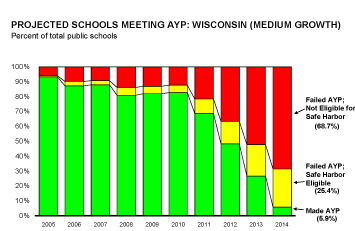
From “The Impact of the Adequate Yearly Progress Requirement of the Federal No Child Left Behind Act on the Great Lakes Region,” a study released by the Great Lakes Center for Educational Research and the Education Policy Studies Laboratory at Arizona State University.

From “The Impact of the Adequate Yearly Progress Requirement of. the Federal “No Child Left Behind” Act on Schools in the Great Lakes Region,” a study released by the Great Lakes Center for Educational Research and the Education Policy Studies Laboratory at Arizona State University.  See also “Many States Have Taken a “Backloaded” Approach to No Child Left Behind Goal of All Students Scoring ‘Proficient'” from the Center on Education Policy.

On June 24, The Department of Public Instruction will release the preliminary Adequate Yearly Progress Reports on schools and districts in Wisconsin, as required by the No Child Left Behind Act. My guess is that MMSD will have a higher number of “failing schools” this year. Think of Madison as being “ahead of the curve.”

AYP is not the best gauge of the work our district is doing; NCLB isn’t a good law and AYP is ridiculous yardstick.

If the flaws in and political manipulation behind NCLB weren’t obvious already, an interview with former Assistant Secretary for Elementary and Secondary Education Susan Neuman in the new Time magazine confirms what we already knew. Excerpts below.

There was always something slightly insane about No Child Left Behind (NCLB), the ambitious education law often described as the Bush Administration’s signature domestic achievement. For one thing, in the view of many educators, the law’s 2014 goal — which calls for all public school students in grades 4 through 8 to be achieving on grade level in reading and math — is something no educational system anywhere on earth has ever accomplished. Even more unrealistic: every kid (except for 3% with serious handicaps or other issues) is supposed to be achieving on grade level every year, climbing in lockstep up an ever more challenging ladder. This flies in the face of all sorts of research showing that children start off in different places academically and grow at different rates.

Add to the mix the fact that much of the promised funding failed to materialize and many early critics insisted that No Child Left Behind was nothing more than a cynical plan to destroy American faith in public education and open the way to vouchers and school choice.

Now a former official in Bush’s Education department is giving at least some support to that notion…

[T]here were others in the department, according to Neuman, who saw NCLB as a Trojan horse for the choice agenda — a way to expose the failure of public education and “blow it up a bit,” she says. “There were a number of people pushing hard for market forces and privatization.”

Neuman also regrets the Administration’s use of humiliation and shame as a lever for school reform. Failure to meet NCLB’s inflexible goals meant schools would be publicly labeled as failures. Neuman now sees this as a mistake: “Vilifying teachers and saying we are going to shame them was not the right approach.”

The combination of inflexibility and public humiliation for those not meeting federal goals ignited so much frustration among educators that NCLB now appears to be an irreparably damaged brand. “The problems lingered long enough and there’s so much anger that it may not be fixable,” says Neuman. While the American Federation of Teachers was once on board with the NCLB goals, she notes, the union has turned against it. “Teachers hate NCLB because they feel like they’ve been picked on.”

Is there a way out of the mess? Neuman still supports school accountability and the much-maligned annual tests mandated by the law. But she now believes that the nation has to look beyond the schoolroom, if it wishes to leave no child behind. Along with 59 other top educators, policymakers and health officials, she’s put her name to a nonpartisan document to be released on Tuesday by the Economic Policy Institute, a Washington think tank. Titled “A Broader, Bolder Approach to Education,” it lays out an expansive vision for leveling the playing field for low-income kids, one that looks toward new policies on child health and support for parents and communities. Neuman says that money she’s seen wasted on current programs should be reallocated accordingly. “Pinning all our hopes on schools will never change the odds for kids.”

The right wing attack machine turned on Scott McClellan when he belatedly told the truth. We can expect the same treatment for Neuman.

Thomas J. Mertz

1 Comment

Filed under Accountability, AMPS, Best Practices, education, finance, Gimme Some Truth, Local News, National News, nclb, No Child Left Behind, Uncategorized

Talkin’ Dropouts

James Brown, “Don’t Be a Dropout.”

Lots of news about dropouts and graduation rates recently.

Education Week just published their Diplomas Count report. It is pretty alarmist. Graduation rate scholars Jim Heckman, Paul LaFontaine, Larry Mishel, and Joydeep Roy raised some issues with how Education Week counted (hat tip to eduwonkette, one of my new favorite education bloggers):

In our examination of the data and methodologies available to estimate high school graduation rates we have found that insights can be gained from household surveys and from administrative data on student enrollment and diplomas granted. However, we find the measures of graduation rates in Education Week’s Diploma Counts project, computed from diploma and enrollment data, to be exceedingly inaccurate. The main problem is the assumption that the number of students enrolled in 9th grade is the same as the number of students entering high school. This assumption artificially lowers the estimates of current graduation rates, especially for minorities who are more likely to be retained (repeat 9th grade). This measure also artificially reduces the growth of the graduation rate over time because the practice of grade retention has grown over time, again, especially among minorities.

The resulting errors are sufficiently large to artificially lower the graduation rate by 9 percentage points overall and by 14 percentage points for minorities. Grade retention also differs sharply across states and localities, distorting geographic comparisons. Last, these measures do not reflect the ultimate graduation rates of a cohort of students because the data do not capture diplomas provided by adult education and other sources than schools.

Paper from Heckman and Lafontaine, here; Paper from Mishel and Roy, here.

The Wisconsin State Journal editorialized in favor of adopting the graduation rate measure endorsed by the National Governor’s Association (NGA) as a single national standard (Leslie Anne Howard of the Dane County United Way had an op. ed., mostly in support of this position). There is much to be said in favor of national statistical standardization, but if the adopted standard is flawed, you open the door to a new set of problems. The NGA measure is largely based on the one used by Florida. Sherman Dorn notes some “troubling issues” with the Florida rate calculations:

  • The inclusion of alternatives to standard diplomas in the graduation numbers, with no public disaggregation
  • The exclusion of alleged transfers and movers from the base (creating an adjusted cohort) without any data quality checks to ensure that transfers really show up at a private school or in another state
  • The exclusion from the base (adjusted cohort) of students who drop out and immediately enroll in GED programs (as transfers to adult programs)

He also has some nice general thoughts on what to look for in graduation rate calculations here and here (lots more on his site, browse around or do a search; his posts are very accessible for those of us who are not steeped in the swamp of grad rate measures).

Information on how Wisconsin calculates dropout and completion rates. Many of the issues noted in the critiques of the various measures are present with Wisconsin’s. MMSD posted am 81.8% “regular diploma” completion rate in 2006-7, but there are great disparities among the rates for white students (90.4%), African American students (61.6%) and Hispanic students (60.8). The 2006-7 dropout rate was 2.699%, also with pronounced racial disparities (data can be accessed here).

Finally, this story in the Cap Times on Operation Fresh Start, (which has a GED component). By the way, I think this is a fine use of Wal-Mart’s money, but I still wish our legislators would get them to pay their fair share of taxes (some recent progress, but a long way to go).

Thomas J. Mertz

Leave a comment

Filed under "education finance", Accountability, AMPS, Best Practices, education, Equity, Local News, National News, nclb, No Child Left Behind, School Finance, Uncategorized

Equity Policies — Learning from Others

I’m still working through what did and did not happen with Equity at Monday’s MMSD Board of Education meeting (video here, starting at about the 2 hour and 25 minute mark) and how and why things did and did not happen. The very short version is that the Board passed a policy that did not include the “Considerations” or any implementation regulation or guidance, but thanks to an amendment by Maya Cole does improve upon the draft version’s reporting clause (for more information and my pre-meeting thoughts, see this post).

One of the canards that was part of the discussion was that (Equity) policies can or should not include implementation guidelines or regulations. Policies and implementation plans come in many forms; there is no one right way. For that reason, I’m going do a series of posts on what other districts are doing in this area.

My opinion is that Madison is doing much and isn’t doing enough. Madison is doing much because many of the programs and procedures in place embody equity ideals. Madison isn’t doing enough because there is not a systematic focus on equity related issues and much of what goes on is simply “current practice” and note the result of any clear commitment. Focus and commitment could be derived from a policy or (like in Brookline, MA) a specific initiative. Whatever you think is best, it is always good to know what other districts are doing as a basis for comparison.

Today’s post is from Charlotte-Mecklenburg, NC School District. Like MMSD, CMS is a founding member of the Minority Student Achievement Network.

Here is the entirety of CMS’s “Equitable Educational Opportunities” policy:

The Board of Education is committed to providing equal access to excellent educational opportunities for all its students in all its schools.

The provision of such opportunities for all students is expected to require providing additional resources and implementing innovative strategies to schools serving students with additional educational needs, particularly students at risk of academic failure. Such resources and strategies may include, but are not limited to: differentiated staffing; smaller class sizes; increased instructional supplies and materials; expanded and renovated facilities; innovative family and community involvement initiatives; upgraded technology; comprehensive co-curricular activities; supplemental guidance and counseling; enhanced professional development; and preschool educational opportunities.

In determining whether all students are being provided with such opportunities, the Board of Education shall adopt baseline standards in the following areas: educational opportunities; student achievement; instructional materials and supplies; media equipment and resources; technology; facilities; faculty; teacher/student ratio; and family and community involvement.

On an annual basis, aligned with the annual budget process, the Superintendent shall present to the Board of Education the following: recommendations related to the baseline standards in the areas listed above; assessment of whether all students are being provided equal access to excellent educational opportunities; strategies for ensuring that all students are provided such opportunities; determination of the amounts of funding and resources needed to provide such opportunities; and recommended allocation and reallocation of the funds and resources needed to provide those opportunities.

On an annual basis, aligned with the annual budget process, the Board of Education shall do the following: comprehensively review and revise the baseline standards in the areas listed above; assess whether all students are being provided equal access to excellent educational opportunities; direct the Superintendent to develop strategies for ensuring that those opportunities are being provided; determine the amounts of funding and resources needed to provide such opportunities; seek and direct the Superintendent to seek the funds and resources needed to provide such opportunities; and allocate, reallocate and direct the Superintendent to allocate and reallocate the funds and resources needed to provide those opportunities.

The Board and Superintendent shall appoint a committee to help facilitate the annual analysis of the provision of equal access to excellent educational opportunities for all its students in all its schools. The Superintendent shall establish and implement regulations and strategies designed to accomplish the requirements of this policy.

This is much, much more specific in implementation and reporting than what Madison has adopted. I like it.

For more equity related policies from CMS, click here.

For more on the equity work in CMS, click here, 2006 PowerPoint here.

Thomas J. Mertz

1 Comment

Filed under "education finance", AMPS, Best Practices, Budget, education, Equity, Local News, Uncategorized, We Are Not Alone

Quotes of the day

From Milwaukee Public Schools, 2006-7 School Report Card (click to see full report card). When value added is implemented in MMSD, we can expect similar reporting. Note that the gray areas are \

From Milwaukee Public Schools, 2006-7 School Report Card (click to see full report card). When value added is implemented in MMSD, we can expect similar reporting. Note that the gray areas are “error bands,” indicating 95% confidence intervals.

From an email sent by a DPI employee to Peter Sobol of the Monona Grove Board of Education.

… The WKCE is a large-scale assessment designed to provide a snapshot of how well a district or school is doing at helping all students reach proficiency on state standards, with a focus on school and district-level accountability. A large-scale, summative assessment such as the WKCE is not designed to provide diagnostic information about individual students. Those assessments are best done at the local level, where immediate results can be obtained. Schools should not rely on only WKCE data to gauge progress of individual students or to determine effectiveness of programs or curriculum.

From the WCER Value Added Research Center (contracted with MMSD and MPS).

Benefits of Value-Added Methods

Value-added methods “get the story right” by correcting for errors in the test scales, identifying and adjusting for bias in the administration of the test, in student participation, or in classroom treatments. In addition, one of the overriding goals of the work is to be transparent and fair. It is in everyone’s interest for schools to be as productive as possible for all students.

All teachers should be able to deeply understand and discuss the impact of changes in practice and curriculum for themselves and their students. Leaders should be able to make resource allocation decisions (money, staffing, etc.) informed by the best available data. Value-added methods can both showcase high levels of achievement as well as reward those who have mastered the art of improvement.

The MMSD value added analysis will rely on WKCE tests.

Anyone see a problem?

I’ve been working on a long post about the basics, benefits and limits of Value Added Analysis. Still a lot of work to do on that. Till then, here are two recent stories from Education Week (registration may be required).

New Uses Explored for ‘Value Added’ Data

Scrutiny Heightens for ‘Value Added’ Research Methods

Thomas J. Mertz

1 Comment

Filed under Accountability, AMPS, Best Practices, education, Local News, Quote of the Day, Uncategorized

Part of the story on property taxes

The Cap Times picked up an A.P story on a Legislative Fiscal Bureau report on property taxes. The article says in part:

Taxes paid to schools are by far the largest chunk of a homeowner’s tax bill. They increased 7.4 percent this year.

The biggest thing missing here is that the delay in the state budget resulted in $79.3 million in school funding being shifted from state general revenues to local property taxes. As the report notes:

If the 2007-8 school taxes are reduced by the $79.3 million in additional school levy tax credit funding, a net school tax levy increase of $199.5 million (5.3%) would result.

So 5.3% not 7.4%. This shift was a one time thing (we hope).

Real increases for 2007-8 in combined state and local school spending are about 3.7%, or half of the quoted 7.4%, The 2007-9 budget deal also included a $264 (2.8%) increase in per member revenues, and increases in some categorical aids; but moved further away from the 2/3 state funding leg of the “three legged stool, leading to a more permanent increase in the percentage of school revenues dependent on local property taxes. Instead of 66.6% support, this year the state will provide about 63.0% and next year (without the school tax levy credit games) 64.9% (calculations based on this LFB paper). These are aggregate estimates and the ratios for individual school districts vary greatly. Madison gets about 41% of of our revenues from the state.

Some other things of note in the report released today.

  • Residential taxpayers paid 71% of property taxes (same as last year)
  • The share of property taxes paid by the manufacturing sector dropped from 3.4% to 3.3%. This share is already lower than the real property value because of the “manufacturing and equipment exemption.”
  • The total value of taxable property in Wisconsin increased 6.2%; net tax levies increased 6.0%; gross tax levies by 6.3%.

As Paul Harvey would say “Now you know the rest of the story.” I just wish the wire services and papers would do better on this.

Thomas J. Mertz

Leave a comment

Filed under Elections, Uncategorized, We Are Not Alone

James C. Wright Middle School by the Numbers

Curtis Mayfield and the Impressions — We’re a Winner (listen)

The Wisconsin Knowledge and Concepts test results for November 2007 have been released (this lag of over six months make the results nearly worthless as a formative assessment for timely targeting at the school, class or individual level). I’ll have more to say about Madison’s results in the coming week or weeks (see here for the District analysis, here for the Cap Times story, and here for the Wisconsin State Journal’s).

Right now I just want to brag on my son’s school, James C. Wright Middle School.

In almost every category and on almost every test, Wright Students scored very well. For me most importantly, with very few exceptions the economically disadvantaged and English Language Learner students out performed their peers in Madison and in Wisconsin. This is a school with an 85%+ poverty rate, 90% minority population, beating the odds and achieving success for (almost) all.

Here is the chart for reading by economic status.

And reading by English Proficiency (something strange with the terminology when 63% of students labeled Limited English Proficient score advanced or proficient in reading).

The obvious question is “what is Wright doing right?” My answer is many things, most of which would not turn up in a Value Added Analysis and if they did would be difficult to reproduce. Chief among these are Leadership, staff and community. Principal Nancy Evans does a great job (as recognized by Wisconsin Urban Schools Leadership Project). The staff works hard and smart and works together (the last is partially a product of leadership). There is a school community and it is a community school; The staff, parents, students and much of the central Southside have a sense of ownership with Wright (this is in part a product of history, but it is a legacy that has been nurtured).

Other factors that may be reproducible are that Wright is a small school and it has the least ability grouping or tracking of any of the middle schools in Madison.

It is also a charter school, but as anyone familiar with Wright knows, it really functions more as a magnet/specialty school.

Congratulations to the Wright community for job well done (not mission accomplished, the work goes on). Panther Pride!

(Note that to access fuller data go to the WINSS site. Because of the way the site handles cookies, linking is difficult).

Thomas J. Mertz

Leave a comment

Filed under Accountability, AMPS, Best Practices, education, Equity, Local News, Uncategorized

Equity: What happened?

Click the image for more on this excellent book. It can be found in the Madison Public Library.

The Board of Education will consider and vote on a new equity policy on Monday. There will be public appearances.

In my opinion the draft policy is a huge step backward, from the work of the Task Force, from the direction the Board had been going and from the current policy.

The key is “what does the Board do with the policy.” At the prior meeting on Equity the Board worked with a document that included “considerations for determining whether equity is or will be provided” . These were the answers to that question, they moved from words to action.

The minutes of the April 21 Board of Education meeting (the last time equity was on the agenda) read:

“It was moved by Johnny Winston, Jr. and seconded by Lucy Mathiak to keep the Definition, Assumptions, and Goals and to ask the Superintendent for formulate a policy that incorporates the Considerations and bring it back to the Board. Motion unanimously carried.

The “draft policy” for Monday doesn’t “incorporate” the “Considerations,” it simply eliminates them.

I’ll add that the reporting measures in the draft policy are very, very thin (thinner than the current, really nothing more than NCLB and State laws require in terms of reporting) and that there are no actions contemplated at all in the policy.

I don’t know what happened, why there are no “Considerations” or contemplated actions in the draft. Maybe the work on the “Considerations” and other things will go forward in a different way at a different time, but I think that it is a very bad move to enact such a “do nothing” policy. Join me Monday at the meeting to find out what’s going on and stop this before it is too late (there will be public appearances).

While I’m on my soap box, I want to add that there are some things — like the socio-economic diversity, open access to advanced programming, support for heterogeneous classrooms, early childhood/4k — where we recommended specific policies and actions and the Board has never in any form discussed, considered or addressed the recommendations (note, despite what some think, the Task Force never expected to “restrict” the Board’s “exercise of independent judgment” or “tell” any Board member “what to do,” but we did expect the Board to give our recommendations thorough exploration and apply their collective judgment This still seems like a reasonable expectation). Even with the ‘Considerations,” there is more work to be done.

I hate to see all the work of the Task Force, the Board of Education and the Administration end with a policy that is next to useless.

There is a certain strangeness that a member of the Task Force (me) which has been mischaracterized as being overly concerned with words is now protesting a draft policy because it is little more than words in a policy book. Of course if this policy is passed, then the critique will be correct, but the fault will not lay with the Task Force.

Thomas J. Mertz

Leave a comment

Filed under Accountability, AMPS, Best Practices, education, Equity, Local News, Take Action, Uncategorized

Board Member Budget Amendments Posted

The MMSD website just posted the proposed budget amendments of Board of Education members (and one from the administration). The Board will consider and vote on the budget on Monday, May 12. It looked like there might be some action (click for video) on class size and specials classes and some other things, but that didn’t happen.

Instead, just one amendment from the administration concerning what seems to be Fund 80 housecleaning on contributions to the Wisconsin Retirement system and the tax levy (anyone know if this is a new issue or how the retirement contributions were handled in prior years?); one from Beth Moss funding the replacement of 143 Windows 98 computers via a reduction in the reserve for contingency; and one from Marjorie Passman employing $60,000 of the Fund 80 levy (contingent on other funding?) to help continue the Madison Family Literacy/Even Start Literacy program at Lakeview/Northport. All seem reasonable to me. That’s it. Relative budget peace.

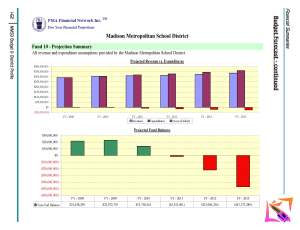
It is important to realize that this peace is the product of a one time distribution of excess Tax Incremental Finance District collections. Next year, we are back to dealing with the “going out of business” system of funding education in Wisconsin. Without a referendum, these are the budget projections (for Fund 10).

Lots of red ink ahead. Time to get to work on a referendum.

Thomas J. Mertz

1 Comment

Filed under "education finance", AMPS, Best Practices, Budget, education, finance, Referenda, School Finance, Uncategorized

Primary Sources

My students have an exercise based on primary sources due soon. It seemed like a good idea to post some here.

It is hereby declared to be the policy of the commonwealth to encourage all school committees to adopt as educational objectives the promotion of racial balance and the correction of existing racial imbalance in the public schools. The prevention or elimination of racial imbalance shall be an objective in all decisions involving the drawing or altering of school attendance lines and the selection of new school sites.

An Act providing for the Elimination of Racial Imbalance in the Public Schools, Massachusetts, 1965

George Wallace 1968 television ad, from The Living Room Candidate.

Richard Nixon 1972 television ad, from The Living Room Candidate.

.

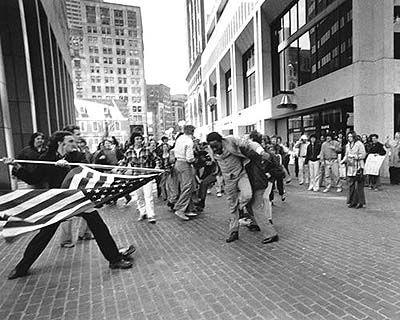
“Soiling Old Glory” Louis P. Masur (Boston anti-busing protest, 1976)

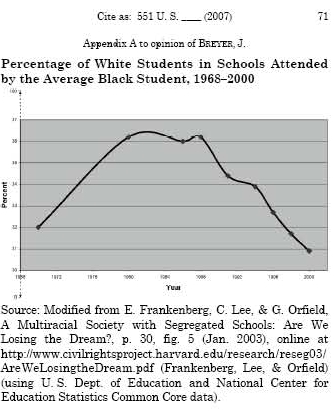
From Justice Stephen Breyer’s dissent in Parents Involved in Community Schools v Seattle School District (2007).

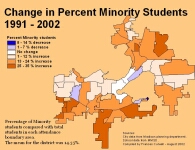
From MMSD, click image for power point (I wish they would update these).

And bonus links to recent blog entries on school desegregation from Sherman Dorn and Eduwonkette

Thomas J. Mertz

Leave a comment

Filed under AMPS, Best Practices, education, Equity, National News, Uncategorized