Johnny Winston Jr. Not Seeking Re-Election; Thanks for the Service

10126_153650965844_594950844_3930753_8149935_nMadison Board of Education Member Johnny Winston Jr. has announced that he is not seeking re-election (the announcement is below).

Johnny is a friend and has been a friend of public education.  We haven’t always agreed but he has stood up for things that matter,  on many occasions when it wasn’t popular.

At one point I did an analysis of Board and Committee votes over a ten month period.  In that time there 10 votes that weren’t unanimous.   Johnny was on the losing side of 7 of these votes; in my opinion he was on the correct side of all these.

My point is among the many ways he will be missed is as an occasional voice of dissent on the Board.

On behalf of myself, Progressive Dane (who proudly supported Johnny in each of his elections) and many others who care about inequities in our schools, thanks for serving Johnny.

Dear Friends:

This message is to inform you that I will not be seeking re-election for a third term on the Madison School Board, Seat #4.

For six years, it has been my honor to serve our community as an elected member of the Madison Board of Education. Thank you for your confidence in electing me in 2004 and 2007.

During my tenure on the board, I had the pleasure of serving as the President, Vice President, Treasurer and Clerk. I also served on many committees including Long Range Planning, Partnerships, Finance and Operations and currently Student Achievement and Performance Monitoring. Serving in these roles and on these committees gave me a well rounded outlook on the district and helped shape a collective vision that assisted me in my decision making.

In addition to serving within the capacities of the school board, I was able to reach out to our community and listen to their views. With your help, we were able to build a new school to alleviate overcrowding, develop strong partnerships and complete many district maintenance projects. Lastly, being elected to the school board afforded me the opportunity to listen to parents, students and community members and assist them in identifying an appropriate district staff member or service that would help meet their needs.

Despite less than desirable financial constraints, I believe the MMSD’s future is brighter because of the development of a 4 year old kindergarten program, implementation of the district’s new strategic plan and school board members that work in collaboration with each other, the superintendent, the district staff, and its stakeholders. I thank all of my school board colleagues both current and former, for their knowledge, skills and their service.

Although, I leave the Madison School Board, I will continue to be actively involved in our community as a member of organizations such as the 100 Black Men of Madison’s Backpacks for Success event, Sable Flames, Inc. Scholarship Committee and other community groups that help make Madison a better place to live for everyone. I am also the proud parent of a current kindergartener so I will continue to be a proud supporter of the Madison Metropolitan School District and public education for many years to come.

Again, thank you for giving me the honor of serving our community.

Johnny Winston, Jr.

Thomas J. Mertz

1 Comment

Filed under education, Elections, Local News

The Cost of Commitment

Commitment

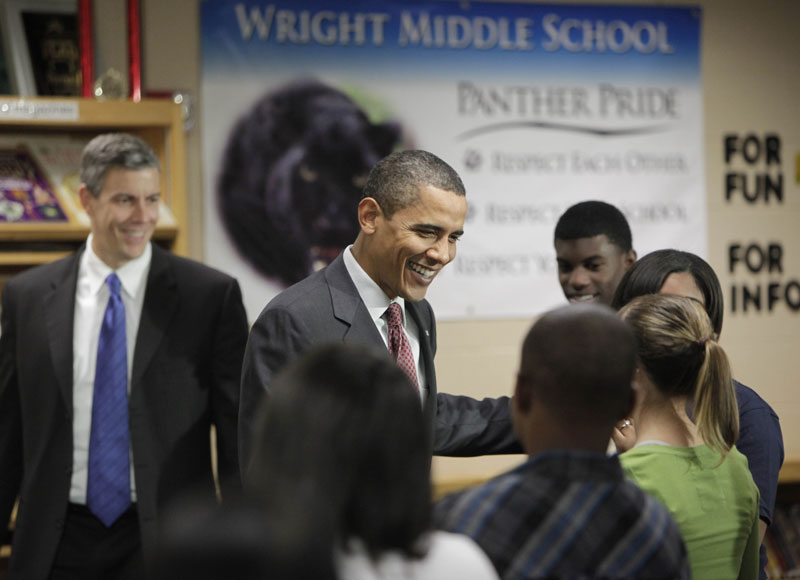
President Obama gave a speech at Wright Middle School in Madison today (text here) outlining his education reform initiative for the nation’s schools, called “Race to the Top,” sometimes referred to by some of his critics as the “Race off the Cliff.”

As Thomas Mertz has pointed out earlier, the amount of funds being discussed here for Wisconsin are relatively meager.

Make no mistake that this is cake, a treat, not life-sustaining bread.  The amount being discussed for Wisconsin is $80 million and this relative pittance would all be targeted for specific programs and when the $80 million is gone, Wisconsin would be stuck with more things that we can no longer afford.

So what type of reform would we be getting in this initiative, along with the modest dollars to come our way, and what would we be giving up in return? That was the crux of a letter sent yesterday by State Senator Mark Miller, chair of the Joint Committee on Finance, to Secretary Arne Duncan. He is worried like others in similar policy positions, that with all the current economic challenges out there blowing huge holes in states’ budgets across the country, that:

We do not have the fiscal resilience to sustain another long-term financial commitment based on the mere possibility that we may be awarded one-time federal dollars in the future. Once these proposed educational policy and fiscal changes are enacted into law, Wisconsin legislators and taxpayers will be responsible for the accompanying financial commitment regardless of the outcome of Wisconsin’s Race to the Top application. This promise to fund new requirements without the promise of federal dollars puts at risk other social safety net programs that rely on adequate state funding to operate.

He cited the example of costs associated with the implementation of a “Children’s Zone” in Wisconsin based upon a model developed for Harlem that could ultimately have ongoing costs to Wisconsin of more than $400 million. If you make such financial and policy commitments you must be able to have some good assurances that you can continue to pay for them. He likens the exercise in not knowing how the grant dollars will be allocated and for how long, to a gambler “trying to draw to an inside straight.”

The National Academy of Sciences recently issued a report offering recommendations on how to revise the funding guidelines and regulations of Obama/Duncan’s $4.35 billion “Race to the Top” grant program, and is well worth a read. Interestingly, the report all but neglects to mention charter schools, which are a major component of RTtT. You can read something I wrote on that subject the other day, here.

In a press release for the Academy’s study, they applauded the step of encouraging states to create systems of linking data on student achievement to teachers, since, as they noted, it is essential to conducting research about the best ways of evaluating teachers.

One way of evaluating teachers, currently the subject of intense interest and research, are value-added approaches, which typically compare a student’s scores going into a grade with his or her scores coming out of it, in order to assess how much “value” a year with a particular teacher added to the student’s educational experience.  The report expresses concern that the department’s proposed regulations place excessive emphasis on value-added approaches.  Too little research has been done on these methods’ validity to base high-stakes decisions about teachers on them.  A student’s scores may be affected by many factors other than a teacher — his or her motivation, for example, or the amount of parental support — and value-added techniques have not yet found a good way to account for these other elements.

The report also cautioned against the use of the National Assessment of Educational Progress (NAEP), a federal assessment instrument. While effective at monitoring broad trends, it will not be able to detect the type of specific effects of the targeted interventions that the RTtT hopes to fund. This infatuation with data can lead reformers, philanthropists (case in point, Bill Gates’ team up with RTtT-type initiatives) and bureaucrats to become unquestioning supporters of using test scores as indicators of real learning and teaching. As the study pointed out:

The choice of appropriate assessments for use in instructional improvement systems is critical. Because of the extensive focus on large-scale, high-stakes, summative tests, policy makers and educators sometimes mistakenly believe that such tests are appropriate to use to provide rapid feedback to guide instruction. This is not the case.

The report also urged caution when trying to apply such a blunt instrument towards making international comparisons.

We note that the difficulties that arise in comparing test results from different states apply even more strongly for comparing test results from different countries.

They conclude the report with a reiterated point, “careful evaluation of this spending should not be seen as optional; it is likely to be the only way that this substantial investment in educational innovation can have a lasting impact on the U.S. education system.”

And in another side note related to federal education financing, the Obama administration’s latest and most detailed information yet on the jobs created by the stimulus, noted that of the 640,239 jobs recipients claimed to have created or saved so far, more than half — 325,000 — were in education. Most were teachers’ jobs that states said were saved when stimulus money averted a need for layoffs.

Robert Godfrey

Leave a comment

Filed under "education finance", Accountability, AMPS, Arne Duncan, Best Practices, finance, Gimme Some Truth, National News, No Child Left Behind, Uncategorized, We Are Not Alone

Obama at JC Wright, Quick Take

c1e82cf6-c97e-11de-a2ef-001cc4c03286.image

I spent the early part of the day at the Books not Bombs action with about 250 others and then went home to watch President Obama’s  speech at James C. Wright Middle School in Madison on television (transcript, here).  Here are some reactions.

The inspirational message, especially the words directed at students and parents was very good.   He was utterly right about the need to seize opportunities, value and support leaning and the importance teachers and parents working to have children internalize pride in academic achievement.  One of the best teachers my children have had  moved our son from racing to get his work done as fast as possible to completing assignments in a way that he could be proud of. Thanks Mr. Waters and thanks President Obama for this message.

He was also very good about the need to make education central to our national agenda.  A little too much about the economic aspects and too little about building an engaged citizenry for my taste, but good to hear.

As many speakers at the Books not Bombs made clear, this is not happening and as I observed in an earlier post the desperation of states for Race to the Top funds is ample evidence that we are not investing in education as we should.

This raises a basic contradiction between the rhetoric in the policies:  If education is as essential to our nation’s present strength and future well being as President Obama says it is, why must states compete for one-time grants to fund only a portion of the needed investments?  What about the states that don’t get grants, are their futures less crucial, are their children less deserving of educational opportunities.?

If we can spend $4 billion a week to keep the military in distant countries we should be able to fully fund the education of every child in every state.  When we spend billions on bombs, we shouldn’t have to ask for Pennies for Kids.

There were also some contradictions within the four core ideas behind Race to the Top that the President delineated.  Again, he was absolutely correct about the need for better assessments (I have doubts about the role of national standards in this process, but that is another issue), however Race to the Top is built expanded use of the inadequate assessments we have now.  Linking teacher pay to flawed tests doesn’t make sense.  Let’s work to create real, balanced and useful assessments first and then discuss what we should do with them.  Prioritizing data collection has similar problems.  We can have the best system for collecting and analyzing data, but if the data is bad to begin with, what is the point?  The old computer programmer phrase comes to mind: Garbage In, Garbage Out.  Obama is right that our current state assessments are near garbage; I just don’t understand how he can know that and still want to expand their use as the basis for decision-making.

It also bothered me that the President seemed to paint a picture of teacher’s currently making no use of assessments or feedback in shaping their teaching.  Every teacher uses many forms of feedback everyday; they see the looks on children’s faces and change their mode of explanation or offer words of encouragement; they grade homework and know what they did well and what they need to do differently; they evaluate exams and decide how to move forward.  This is basic to teaching and happened long before there was any talk of standardized tests and longitudinal data systems and will continue to happen whether the Race to the Top agenda is enacted or not.

President Obama is also correct about the need to attract to and keep the best in our classrooms.  My opinion is that the way to do this is to respect them as professionals, listen to them and not dictate reforms from above.  Recognize that perhaps the teacher who spends hours with students every day might have a better grasp of what is needed and a deeper understanding student progress than anything that will show up in a Value Added Analysis.   It isn’t that I think the data and analysis is useless, it is that I fear that by elevating data above humans we will shut our ears to those whose voices need to be heard and we will make teaching a less attractive vocation.  I’m looking for a better balance.

In his confident words about expanding the use of data and other things, I believe that President Obama grossly overstated and in places mis-stated what the research indicates.  A good example of this is the idea of school turnarounds.  In Chicago, now Secretary of Education Arne Duncan pursued an aggressive school shutdown and turnaround policy.  Through Race to the Top he is trying to nationalize it.  Well, the first research is in and it doesn’t look good.  Here is what the New York Times said:

Secretary of Education Arne Duncan presided over the closing of dozens of failing schools when he was chief executive of the Chicago public schools from 2001 until last December. In his new post, he has drawn on those experiences, putting school turnaround efforts at the center of the nation’s education reform agenda.

Now a study by researchers at the University of Chicago concludes that most students in schools that closed in the first five years of Mr. Duncan’s tenure in Chicago saw little benefit.

“Most students who transferred out of closing schools re-enrolled in schools that were academically weak,” says the report, which was done by the university’s Consortium on Chicago School Research.

Furthermore, the disruptions of routines in schools scheduled to be closed appeared to hurt student learning in the months after the closing was announced, the researchers found.

There is much more of interest on “turnarounds” in this week’s National Journal experts blog.

On this and many other aspects of Race to the Top,  from linking teacher pay to test scores to charter school expansion, solid research often contradicts the claims of this administration.  At best the jury is still out on the reforms they are pushing; at worst the evidence is that enacting much of their program will make things worse.

I share the President’s desire for every child to have access to full and rich educational opportunities, to move the United States toward a culture that values teaching and learning.  I worry his plan for making this happen will move us  further from realizing these ideals.

Time to go help our younger son with his homework.

Thomas J. Mertz

2 Comments

Filed under "education finance", Accountability, Arne Duncan, Best Practices, Budget, education, Local News, National News, School Finance, Uncategorized

The Losing Hand — Madison Schools and the State Budget

how-to-play-omaha-poker-1Susan Troller has a story — “Madison schools — the biggest loser” — on state and local school finance in today’s Capital Times.  I’m off to the “Books not Bombs” action being held in conjunction with President Obama’s visit this morning, so no time for extensive commentary.  Just some lengthy excerpts and a quick observation that although I miss the days when there were two daily newspapers and two reporters on the schools beat, I am glad to see the Cap Times doing some longer and bigger picture stories.  Read the whole thing.

When property tax bills go out in December, taxpayers will be hit with a $92 increase in property taxes on a $250,000 home, far higher than the modest $2.50 increase the board had predicted in May. Next year looks even worse, with a budget gap now predicted to be somewhere between $23 million and $25 million for the Madison school district, said Erik Kass, the assistant superintendent for business services. With the prospect of steep cuts in education as well as the potential for a new round of tax increases, the road ahead looks rocky.

What happened? How did a formula designed to “equalize” resources among disparate school districts in Wisconsin create some of the unkindest cuts for Madison, the state’s second-largest urban school district, with nearly half of its students qualifying for free or reduced lunch? And where was the help from powerful Democrats in state government who had championed school funding reform when they were the minority party in the Legislature?

The swift turnabout in Madison has left Madison School Board members bitter and exasperated. They’re deeply frustrated with the arcane shared-revenue formula that hits Madison especially hard and with 15 years of revenue caps that have forced school districts to pass budgets that couldn’t keep up with the rising costs.

As Arlene Silveira, Madison School Board president, puts it: “We’ve been talking for years about how this system is horribly broken, yet no one seems able to really step forward to change it.”

Madison, with 24,496 students, 47 percent of whom qualify for free or reduced lunch, will this year get just over $51.5 million in general state aid. The district got hit especially hard this time around because, unlike much of the rest of the state, its property values remained relatively stable despite the slump in the housing market. It did have some company in this regard. The Middleton-Cross Plains School District in Dane County, property-rich districts around northern Wisconsin lakes, and suburban areas in the greater Milwaukee area were also socked with the maximum 15 percent reduction in state aid because of their high property values.

But unlike many suburban districts with high property values, Madison has other challenges, including a significant population of low-income students, English language learners and children with disabilities. The cost to educate these children is high, partly because of state and federal mandates that describe in detail what’s required to provide an adequate education.

Unfortunately for Madison, the state general aid formula doesn’t account for these high-needs students when calculating who gets what. Meanwhile, the percentage of funding available from government through “categorical” aids targeted at these students has been steadily dropping for more than a decade.

Madison School Board members are feeling particularly stung by this year’s budget cuts because, the economy notwithstanding, they thought this year might be different. After years of Republican control of the Statehouse, not only were Democrats in control of the Legislature and governor’s office, but Madison-area lawmakers were in charge of the budget process. As co-chairs of the Joint Finance Committee, the Legislature’s powerful budget-writing panel, Sen. Mark Miller and Rep. Mark Pocan were arguably in the most powerful positions to influence the process.

But board members say they got little help from Democratic leaders, both on the specific problems surrounding the 2009-2010 budget and on broader questions about fixing the state’s long-term school funding.

“I understand that the economy is terrible, but for years we heard that the reason we had this school funding mess was because we had Republicans in charge who were basically content with the status quo,” says board member Marj Passman. “I had expected so much change and leadership on school funding issues with a Democratic governor and a Democratic Legislature. Honestly, we’ve got Rep. Pocan and Sen. Miller as co-chairs of the Joint Finance Committee and Democratic majorities in both houses! Frankly, it’s been a huge disappointment. I’d love to see that little beer tax raised and have it go to education.”

Adds Silveira: “There’s been a great deal of talk about the importance of education and improving the system but very little real action that really helps us do a better job of meeting both student needs and taxpayer needs.”

She says all local municipal officials bear a particularly heavy burden, forced to cut budgets and services and go back on their promises to hold the line on property taxes.

“By the time we found out about what a huge hit we were taking in aid from the state, we were already close to the end of our fiscal year and were locked into most contracts and programs for the school year. Basically, our hands were tied,” Silveira says. “The trouble with the politicians is that they tell us that they won’t raise taxes, but that we can. It puts us in a horrible position with our own community, which has been so supportive of our schools. It doesn’t seem fair.”

Although Pocan is sympathetic to the frustrations of Madison School Board members, he says he and other legislators must balance the needs of the entire state. He agrees with Silveira and others that the funding system needs a “complete overhaul” but says that kind of change would likely come with a huge price tag, which some school funding experts suggest could reach a billion dollars.

“Given the current economy, that’s not feasible,” he says. “I’d love to do something that helps Madison, but the system is so complex with 20 or 30 threads all together that if you just pull one, something else unravels.”

But when it comes to changing the law, little of substance has happened, reflecting the political difficulties of bridging deep divisions between what various school districts and communities want, as well as between various school stakeholders, from the teachers union to school board members to taxpayer groups.

Pope-Roberts has been involved with education issues, including funding reform, since she was elected to the Assembly in 2002.

She says Wisconsin’s current dismal economy constrains even those who are most committed to education and most dedicated to exploring a range of ideas.

“It’s very bad out there in the state. I think there may actually be some school districts that simply won’t have enough money to operate after this year.”

But Pocan and Pope-Roberts say they see glimmers of hope in some new, broad-based coalitions that are coming together to work on school funding reform.

For example, the School Finance Network includes representatives from the Wisconsin Association of School District Administrators, the Wisconsin Education Association Council, the Wisconsin Parent Teacher Association and the Wisconsin Alliance for Excellent Schools, among others.

Despite political differences that often put them at fierce odds in the past, as a group they agree that the current funding system is divisive, unsustainable and the reason many school districts lurch from budget to budget, with expenses rising faster than allowable tax increases.

In its literature, the network notes that education has a profound long-term impact on Wisconsin’s economy and, that, if current conditions continue, it won’t be long before a number of school districts will be insolvent.

Thomas Mertz, spokesman for the Wisconsin Alliance for Excellent Schools, says the state funding system also has the unintended consequence of dividing communities instead of bringing them together through their schools. “Under the current system, the state shifts much of the tax burden and the blame to the local level,” he says. “Yeah, it’s difficult for anyone to raise taxes in this economy but the current system is broken.”

Mertz, who teaches at Edgewood College and is a Madison district parent and longtime observer of public school issues, says his group of parents and concerned citizens is advocating for a sales tax increase – a program it describes as Pennies for Kids. While the proposal is not in a final form, he says he is hopeful the state Legislature will consider a 1 percent hike in the state sales tax.

“A penny boost in the sales tax would bring us in line with surrounding states and would provide $830 million a year in aid for education,” Mertz says.

The extra pennies would surely be welcomed in the coming years. With approval of the 2009-2010 budget under its belt, the Madison School Board is already beginning to focus on ways to address the larger shortfalls predicted for the following year.

And so are other districts around the state. The Milwaukee Journal Sentinel recently reported that some suburban districts in the Milwaukee area are already hearing from residents unhappy about double-digit increases in local tax levies, and are considering potential program changes like combining athletic teams.

Thomas J. Mertz

Leave a comment

Filed under "education finance", Budget, education, finance, Local News, Pennies for Kids, Pope-Roberts/Breske Resolution, School Finance, Uncategorized

President Obama at James C. Wright Middle School — What Will He Say?

Obama QI don’t have any inside information about what President Obama will say when he visits James C. Wright Middle School in Madison on Wednesday, November 4, but I do have some thoughts about what he shouldn’t say, what I would like to hear him say  and some other things concerning his visit.

All indications are that Obama and Secretary  of Education are here to push Governor Jim Doyle’s Race to the Top (RttT) lottery ticket purchase plan.  This is wrong.  If  that’s what is going on then Obama and Duncan should be speaking to the legislature and not using the students and staff at Wright as props to lobby for their misguided reform incentive package.

I’d like to see the President come to Madison and announce a redirection of national priorities centered on full funding of education.  I’d like to see this President reallocate from militarism and Wall Street bailouts to investing directly in preparing the our children to build a better future.

If you’d like this too, I hope you can join us in a “Books not Bombs” action to be held outside the school at the intersection of Fish Hatchery and Wingra during the President’s visit, 10:00 AM to 12:00 Noon.  Details here.

The whole RttT lottery is evidence of how far we are from full funding and making education the priority it should be.

The history of underfunded Federal mandates in Special Education, Title I poverty programs and programs for English Language Learners is well known.  As Robert Godfrey recently noted on this site, the stimulus package required state funding be only at 2006 levels, resulting in flat or shrinking general education funding levels made up in part by one-time federal dollars and in many places steep property tax hikes.   The state stabilization funding was accompanied by welcome  new Title I and IDEA money, but this too is a one-time deal and the regular funding levels remain woefully inadequate.

States are struggling to limit cuts to levels that won’t be disastrous and have all but lost sight of sustainable full funding.  Schools aren’t starving (yet) but they are mighty hungry.

With the Race to the Top lottery Arne Duncan and President Obama are waving a small piece of cake before these hungry schools and saying “if you jump through these hoops we may give some of you one bite each.”

Make no mistake that this is cake, a treat, not life-sustaining bread.  The amount being discussed for Wisconsin is $80 million and this relative pittance would all be targeted for specific programs and when the $80 million is gone, Wisconsin would be stuck with more things that we can no longer afford.

Yet Wisconsin and other states are running toward those hoops Duncan is holding, shouting “how high should we jump,” because they are desperate for any education funding, no matter how small, how misdirected or how ephemeral.  As I write this, the Assembly Education Committee is fast tracking the legislation to get Wisconsin through those hoops.  Only in times this desperate could the chance at so little leverage so much.

I hate to see the staff and students at Wright being used in this cynical game.  I’d much rather they heard Obama at his best, inspiring hope and aspirations; speaking of the power and joy of teaching and learning, reminding one and all that  our public schools are basic to the promises of equality of opportunity; praising our educators and students for their accomplishments; and most of all congratulating the Wright community for their good work and telling the world in some detail how these things are happening at James C. Wright Middle School, despite the odds.

Sadly, I doubt we will get much of this.  The Doyle, Duncan, Obama education agenda is tangential, irrelevant or counter to what makes Wright a school we should be proud of.

Our older son finished 8th grade at Wright last year and I participated in the School Improvement Process as a “friendly observer” so I write from experience and with Panther Pride.  Some background on Wright first.

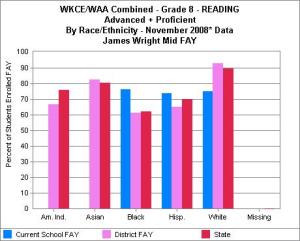
Wright is a small school, with relatively small (if limited in their offerings) classes and  a “Social Action” focus.  86% of the students qualify for free or reduced lunches, 39% are classified as English Language Learners; the racial and ethnic demographics are 1% Native American, 38% African American,  37% Hispanic, 12% Asian and  13% White.

As measured by state standardized tests (with the notation that this is a very limited measure of teaching, learning and school quality) Wright does well by most students and better than most schools for poor and minority students.  here are some graphs:

CFT1103_1356442D7

From the Wisconsin Department of Public Instruction, click for WINSS site.
 

CFT1103_13565637

From the Wisconsin Department of Public Instruction, click for WINSS site.

There are still gaps in achievement and the test scores in other subjects are not as strong, but the general picture is of a relatively successful school.

In other areas, where data is of even more limited utility, Wright is a very successful school.  There is a sense of community and an atmosphere of caring that transcends (but does not obliterate) racial, ethnic and economic differences.  The staff function as a professional, collaborative team much of the time.  In general there is pride, Panther Pride that encourages all to do their best and encourages all to aspire to do even better.  Through the social action focus, Wright seeks to bring this “we can do better” message to the wider community.  I can’t write this without once again crediting Principal Nancy Evans and the entire staff for these accomplishments and thanking them for all they do.

Reviewing the Doyle, Duncan, Obama agenda, I don’t see much that would help Wright get better and I see some things that will make it harder for Wright to maintain the quality and qualities they have achieved.

Due to the cuts in education funding in the recent state budget, Madison — like so many other districts — is looking at a very difficult budget in 2010-11.  Doyle, Duncan and Obama aren’t offering any help at all with this.  A difficult budget will likely mean that small class sizes, particularly those at Wright where they are below the norm for the district, will be targeted.

The support staff at Wright is already minimal, with psychologists, social workers, librarians and others only in the school a day or two or three a week.  That too could get worse (see here for a report of what is happening in Minnesota).

The demographics of the school highlight the importance of funding for students in poverty and English language Learners.  The state of Wisconsin provides no poverty aid beyond the limited SAGE program for the early grades, state reimbursements for English Language Learners as a percentage of costs have been falling for over a decade and the Federal money in both these areas remains small.  None of the current proposals from Doyle (or Duncan and Obama) do anything to fix this.

Much of the agenda they are pushing has to do with more data and more uses of data.  It is hard to be against better assessments, better collection of data and better coordination in the use of data; but most of this is a distraction and is linked in their agenda to misguided noti0ns of national standards and expanded use of flawed test data to make decisions about almost everything, including teacher compensation (Doyle’s legislation on the last, here).

One at a time on data issues, mostly in the “for further reading” mode.

On National standards, I recommend reading what what Deborah Meir wrote here and checking out what William A. Proefriedt has to say to understand how the standards movement is working to undermine the engaged democratic ideals at the base of Wright’s social action mission.  This recent report that the development of standards development is being shaped by profit motives of the participants is also worth a look.

On the limits of data and data analysis and their potential for abuse, the recent letter to Secretary Duncan from the Board on Testing and Assessment of the  National Research Council is a must read.

Linking teacher compensation to test scores is wrong in so many ways.  Just three things for now; it prioritizes test scores in selected subjects as the be-all-and-end-all of education, shunting aside all those things Wright that make it not just a “relatively successful school” but a great school; it has great potential to undermine collaboration and professional relationships; and it doesn’t appear to work, even by the crude measures of standardized tests.

Duncan, Obama and now Doyle like charter schools and Wright is technically a charter school.  Technically is the key word.  There is nothing about the governance of Wright that is any different than any other school in Madison.  The charter status is a historical artifact.   If they want to use Wright to make the case for charter expansion, they picked the wrong example.  Expanding charters won’t help Wright and it probably won’t help create more Wrights.

While on the topic of charters, it is also worth noting that the pedagogy and curriculum of one of Duncan’s favorite charter groups — KIPP — is the exact opposite of the engaged, questioning, challenging lessons that Wright teaches as the basis for social action.  Jim Horn has posted on this aspect of KIPP many times, see here, here and here for examples.

A few last words on Mayoral control and some other ways that the Doyle, Duncan, Obama agenda is working against the ideal of an engaged citizenry having a voice in public education, how what they are pushing and how they are pushing it undermines the social action ideas of Reverend James C. Wright and the school that bears his name.

Mayoral control and the pending legislation for State Superintendent takeovers of districts “in need of improvement” (no further requirements spelled out. just that the State Superintendent says they need improvement) if implemented will make it more difficult for activists to be involved in their schools.  School Board campaigns are local, grassroots efforts.  Mayoral and State-wide campaigns are mostly about money and advertising.  In the first, candidates meet people and listen.  In the latter they craft messages based on polling.

Once in office,  School Board members are relatively accessible; Mayors and State Superintendents are busy and difficult to reach.  In practice, the public has an opportunity to testify at most Board meetings.  Mayors tend to listen to power brokers and though I like Tony Evers (and even met with him once), I don’t believe he has held any public “listening sessions.”

These proposals won’t completely shut the public out, but they will mute the voices of the grass roots.

The voices of the grass roots have also been muted in the way the RttT legislation is being handled in Wisconsin.  Governor Doyle  issued general outlines a couple of weeks ago with few of the all-important details.  The first batch of legislation was introduced Friday 10/29 and the first hearing was scheduled for today (Monday, 11/2).  As of this morning there weren’t even Legislative Fiscal Bureau notes attached. Full floor votes in both houses may be scheduled before the end of next week (the session is scheduled to end Friday, but will likely be extended).

This isn’t enough time to analyze, much less organize and mobilize.

I’d like to hear President Obama and Governor Doyle explain to the students at Wright how this accelerated schedule serves the democratic process and why it is necessary to make it so difficult for students and others concerned with the future of education in Wisconsin to have their voices heard.

This is no more likely than the promise of new priorities and pledge of  full educational funding I wished for at the top of this post.

So in closing, I’ll express my hope for one thing that I think may actually happen:  President Obama, please be sure to spend some time with “Mother” Jacqueline Wright and share some of the stories of Mother and Reverend Wright’s activism with the world.  If, as you do this  you are reminded of why it is so important that voices from the outside be heard in the halls of power and have some second thoughts about the rest of the agenda for your visit, please heed those thoughts.

Thomas J. Mertz

1 Comment

Filed under "education finance", Arne Duncan, Best Practices, Budget, education, finance, Local News, National News, School Finance, Take Action, Uncategorized

Reform Is In The Air

reform1832

Mike Rose at Truthdig has noted that following the extensive and unprecedented federal reach of No Child Left Behind, the Obama administration is attempting to extend this iniative further by putting some some serious money behind a number of education initiatives that invite states and districts to compete for federal dollars. In the K-12 education world, they want, in part, to stimulate better state standards and tests, including the better measurement of teacher effectiveness, while turning around failing schools. One way they want to accomplish this is through an increase in the number of charter schools. At the same time, a third initiative wants to spark innovation and scale up the best of local academic programs.

As Mr. Rose acknowledges, this is a moment of real promise for American education, from kindergarten through college. But he also sounds a note of caution.

Reform is in the air. But within many of these reforms are the seeds of their undoing.

He pointed out that the Education Department has put a lot of stock in charter schools as “engines of innovation,” while noting, importantly, that DOE will not consider a state’s funding proposal if that state has a cap on charters.

Yet a number of research studies — the most recent from Stanford — demonstrate that charter schools, on average, are no better or worse than the regular public schools around them. To be sure, some charters are sites of fresh ideas and robust education, but so are magnet schools, and, lest we forget, so are our regular public schools, ones with strong leadership and a critical mass of good teachers. For the “reformers’” however, charter schools are the recipients of the highest accolades, the rest – not so much.

The Stanford University study shattered the myth of charter school superiority. According to Stanford’s Center for Research on Education Outcomes, students at only 17 percent of charter schools do better on math and reading tests than their demographic peers in regular public schools. Thirty-seven percent do worse, while 46 percent of charter school kids, almost half, perform at approximately the same level as their traditional public school counterparts.

The author of the report concludes:

This study shows that we’ve got a 2-to-1 margin of bad charters to good charters.

The results are especially significant, given that charter schools have built-in advantages – starting with parents that are engaged enough in their children’s education to put them there, in the first place. Yet the actual outcomes, in most cases, fail to live up to the hype.

President Obama and his administration are committed to charter schools. In no small part this policy is driven by Education Secretary Arne Duncan, who was a cheerleader for charters when he ran the Chicago school system, and has threatened to withhold federal education money from the 10 states that don’t yet have charter schools and the 26 other states that put limits on enrollment in charters. Such raw coercion, especially given the results of the Stanford study, seems strongly misguided. This comes in spite of the acknowledgement of the Stanford study on the part of Sec. Duncan, which, he suggests, merely points to the need for greater vigilance. “Charter authorizers need to do a better job of holding schools accountable.”

This administration has said that charter schools are key to educational “reform,” and provide “competition” for traditional schools. But that’s utter nonsense if the educational outcomes are no better, and in many cases worse, than in the regular public schools.

Speaking of “holding [charter] schools accountable,” one would of thought that that was a central argument for the need for charter schools in the first place, an institution free of those ill-principled and wretched teacher unions. Unionized teachers are blamed for much of the ills of education; it’s not a reasoned argument, but a matter of faith – and political prejudice. Charter schools are not private (at least not entirely, if you consider they are chartered by the state), but they are the privatizers’ foot in the door, a wedge issue to demonize unions. And that third leg of the reform movement, so to speak, measurement of teacher effectiveness, is also front and center (see the latest continued plea from the Wisconsin State Journal).

One approach being piloted in a number of education systems around the country is by the non-profit Hope Street Group, and developed by a team of teachers across the U.S., who have proposed recommendations for a smarter evaluation system, imploying more ‘objective’ measures of student achievement, ones that aim to attract and retain teachers, and put America’s schools back on top internationally.

“Policy 2.0: Using Open Innovation to Reform Teacher Evaluation Systems” suggests that in K-12 education, any teacher evaluation system should have the input of teachers and administrators and not solely come from researchers and policymakers. Their specific recommendations include the suggestion that evaluation systems should be frequently revised, that teaching advocates need to be involved in this process, and that any in-class observations for assessment must be done by teachers with sufficient experience.

Lets hope the coming “seeds of change” are not broadcasted, with great hope, onto marginal soil. There is too much at stake for education in this new century.

Robert Godfrey

Leave a comment

Filed under Accountability, AMPS, Arne Duncan, Best Practices, Gimme Some Truth, nclb, No Child Left Behind, Uncategorized, We Are Not Alone

WAES School Funding Reform Update, the Week of October 26, 2009

waesgraphicFrom the Wisconsin Alliance for Excellent Schools. Table of contents below, with related material on AMPS linked to some items.  Click here for the full update.

  • WAES, others groups criticize Governor’s “funding plan”
  • Electors saying no to levy hikes resulting from state budget (and here and here and here)
  • Public, media understand the source of school funding problems
  • State of Washington wants pennies for its kids, too
  • Business leaders back expansion of early childhood education
  • WAES needs renewals, new members to continue work
  • Other states get it … what’s wrong with Wisconsin?
  • Colorado Supreme Court will hear adequacy challenge
  • WAES members take case on funding reform to the public
  • It’s time for America to pay attention to its schools again
  • Help WAES correct e-mail update glitch
  • School-funding reform calendar
  • The Wisconsin Alliance for Excellent Schools (WAES) is a statewide, independent, membership-based organization of educators, school board members, students, parents, community leaders, researchers, citizens, and community activists whose lone goal is the comprehensive reform of Wisconsin’s school-funding system. If you would like more information about the organization — or on becoming part of WAES — contact Tom Beebe at 920-650-0525 or tbeebe@excellentschools.org.

Thomas J. Mertz

Leave a comment

Filed under "education finance", Best Practices, Budget, education, finance, Local News, Pennies for Kids, School Finance, Take Action, Uncategorized, We Are Not Alone

Where is the Money? SFN on “Here and Now”

Vodpod videos no longer available.

Over the weekend the Wisconsin Public Television program “Here and Now” devoted most  their broadcast to education, focusing on the Governor Jim Doyle’s announcements concerning Wisconsin’s application for Race to the Top (RttT) funding.  The only guest to address the questions about the viability of this application at a time when many school districts are struggling with the cuts in state funding in the 2009-11 state budget was Green Lake Superintendent Ken Bates, representing the School Finance Network.  You can watch what Ken had to say above and see all the segments here.

The issues Bates raises are more timely than ever.  In the Governor’s initial announcement that he wanted to buy a lottery ticket for the RttT prize, he included a vague mention of “Allow[ing] districts to increase their spending if they meet specific guidelines to improve education.”

In a release today, there is no mention of funding reform or relief.

Take a look around Governor and see what is happening with school budgets in our state.

Where’s the money?

Thomas J. Mertz

Leave a comment

Filed under "education finance", Arne Duncan, Budget, education, finance, Local News, School Finance, Uncategorized

Breaking News — MMSD Budget and Levy

At a fairly boring meeting (only one vote was not 7-0;  Beth Moss and Ed Hughes voted against option three, to forgo $3.08 million in maintenance  referendum authority and defer projects, Beth Moss discussed but did not introduce  an amendment halve this to $1.5 million) , the Madison Metropolitan School District Board of Education passed the 2009-10 Budget and tax levy (agenda with linked documents here).

Every option to minimize the property tax levy that was offered was enacted, plus one more from Lucy Mathiak.  The basic strategies were re-budgets to reflect past history and new efficiencies, rescheduling of debt payments, forgoing referendum authority and use of Fund Balance Equity.  Madison will not be taxing to the max.

More than one member offered accurate, detailed and impassioned words about the failure of the state of Wisconsin to meet its obligations for educational investment.  I give Arlene Silveira the points for detail and a tie between Arlene and Marj Passman for passion.  Arlene emphasized the need to hold our elected officials accountable in the coming months.  I’m with her on that…November 1010 elections aren’t that far off.

Probably more on the meeting later.

Here are the details of the budget and levy:

Total Levy — $234,240,964

Fund 10 –$ 218, 955, 521

Property Tax Charge-back — $85,945

Fund 38 – $65,250

Fund 39 – 0

Fund 41 – $6,835,765

Fund 80 – $8,298,483

Mil Rate 10.18 (an increase of .37 over 2008-9)

Impact on $250,000 home = $92.83 higher taxes.

Work on the 2010-11 budget will begin immediately.  It will be hard and it will not be good.

One last note, although I would have liked a more thorough consideration of Fund Balance practices prior to the pasages of this budget, it appears that that will happen before the next budget cycle really kicks in next Spring.

Thomas J. Mertz

Leave a comment

Filed under "education finance", Budget, education, finance, Local News, Referenda, referendum, School Finance, Take Action

Wisconsin School Budget and Tax Levy Roundup

mp_main_half_SchoolMoneySidewalk212Like Madison, many Wisconsin School Districts will be finalizing their 2009-10 budget and tax levies tonight (Monday, October 26, 2009).  Some have previously been highlighted on AMPS — most recently West Bend — , the struggles to deal with declining state funding has been documented in many posts, as has the trend of Not Taxing to the Max to keep property taxes as low as possible but it has been impossible to keep up with all the news.

That’s why I’m offering some linked recent school budget related headlines.  Just reading these gives a good idea of how hard things are for districts.  Click a few and get more of the sad details.

When you are done, click one more link and sent a note to Governor Jim Doyle, your State Senator and your State Representative.  If we don’t pull their heads out of the sand, next year will be even worse and the following years I don’t want to think about.

This is far from comprehensive and they are in no particular order.

Schools see decline in state aid

Rapids School Board approves 12 percent tax rate increase

Higher school property taxes stress Fox Valley homeowners in grips of recession

Despite cuts, West Salem school taxes going up

School superintendents share money woes during forum

Most area school districts lose state aid

District to consider nearly 19 percent levy increase at tonight’s budget hearing

State forces schools to raise taxes

Cuts in aid put more of the burden on taxpayers

Board retools school budget

State aid estimate lowered; tax levy raised

School aid loss hits Chippewa Falls taxpayers

School board reduces tax increase to 11.55 percent

Fewer state dollars blamed for EC school tax hike

Altoona taxpayers to pay more for schools

Osseo-Fairchild school taxes rising 6.2 percent

Portage school deficit goes up; expected millage rate goes down

Decrease in state aid challenges Marshfield-area school districts

Read’em and weep, then get active.

Thomas J. Mertz

Leave a comment

Filed under "education finance", Budget, education, finance, Local News, School Finance, Take Action, Uncategorized