May Day in Madison

Click on image for pdf.

Click on image for pdf.

The Chi-Lites, “(For God’s Sake) You’ve Got to Give More Power to the People” (Click to listen).

Among the demands of the Madison May Day March is “Real funding for public schools.”  I’m scheduled to speak on that topic.  That may change, but no matter what, I’ll be there to show support for this and other needed actions.  Join me and hundreds or thousands of others working for positive progressive change.

Here is the schedule (more details by clicking the above links).

11:00 a.m. Gathering at Brittingham Park
11:45 p.m. Depart Park to the Capitol
12:00 p.m. Capitol event, to state and federal demands
12:30 p.m. Depart Capitol to City-County Building
12:45 p.m. City-County event, to address city and county demands

Any Madison Metropolitan School District students planning to attend should provide written permission for their absences prior to Friday.

Thomas J. Mertz

Leave a comment

Filed under "education finance", education, Local News, School Finance, Take Action

Schools, Prisons and Accountability

a_supermax_0205

Since last week’s Assembly Education Committee hearing on the School Finance Network plan (video here, more on AMPS here), I’ve been thinking about schools, prisons and accountability.

Early in the hearing, Chair Sondy Pope-Roberts reminded the committee and the hundreds who packed the hearing room about the comparative direct costs of education and imprisonment. I believe she cited a figure of $30,000 per year to imprison an individual. The current cost of education per student is in the $10,000 per year range; the SFN proposals and other plans to preserve, expand and improve educational opportunities in Wisconsin would add at absolute most $1,500 per student, per year (I’ll argue from this high figure rather than quibble). Indirect costs and benefits should also be considered. As Madison Superintendent Dan Nerad has often said (paraphrase), “We need to consider what it actually costs to educate students and we need to consider what is costs to not educate students.” See also this letter from the Eau Claire Leader-Telegram about jail construction costs and school budgets and the work of the Center for Benefit-Cost Studies of Education at Teachers College, Columbia University

Later in the hearing, the representatives of the School Finance Network were pushed hard on “accountability.” The SFN proposal includes some good guidelines to work toward a better accountability system and calls for a five-year review (pp. 11-12).

There was some confusion at the hearing about the confidence in the “what works/best practices” models that served as a basis for the SFN calculations and the reluctance to guarantee results. SFN attempts to direct resources to where they are most needed and will do the most good; it isn’t just a matter of “more money” it is sufficient money to preserve and extend “best practices.” Will this lead to predictable improvements on various benchmarks? Yes and no.

Very simply, there are no guarantees in education or social science research and implementation. You’d have to be a fool to ask for or promise a rise of x points on any standardized test or other measure.

We have good research and data on many things that have improved outcomes in the past; we have good research and data on many things that have harmed outcomes in the past; we have less good data on many things in both categories; we have no “this will work 100% of the time” guarantees.

The SFN team is confident that if the plan is implemented data will show improvements in many ways and welcomes a five-year review. This is as much as can be expected given the state of knowledge.

[Sherman Dorn’s recent post, “Margins for error in policy” hits some related ideas.]

There was also some talk at the hearing of five years being too long to wait for “accountability.” I don’t know how to respond to that, except to say that I believe five years is too short (see below for a little more).

As part of the budget process the Wisconsin Legislature is also considering changes in early prisoner release laws to save money. A recent report pegs the growth of incarceration spending in Wisconsin at $500 million in the last decade and attributes much of this to “truth in sentencing” laws .

All this got me thinking about some questions:

  • Why don’t we require “accountability” when we build a new jail, supermax prison or change sentencing laws?
  • What would that accountability include; how would you figure the costs and benefits?
  • How do you quantify “feeling safer” or even crime rates in dollars and cents?
  • How do you “cost out” the family disruptions and pain caused by incarceration in your calculations?
  • How do “cost out” the fact that prisoners are not contributing economically or otherwise to society?
  • How does recidivism fit in the analysis?

You get the idea. One more:

  • Why don’t we require “accountability” for every tax break, road construction dollar, loophole, economic development initiative, …war…like our elected officials always seem to want from educational investments?

I actually have one answer for the last. Elections are the accountability mechanism for most of these.

Too bad our state officials won’t take that responsibility with educational investment, just like they won’t take the responsibility to fix the broken school funding system they created; nor are they willing to give that responsibility to local elected school boards by lifting the revenue caps.

Last thought. I said above that five years is too short. Let’s implement the SFN plan and make incarceration rates in five years and 10 years and fifteen years and twenty years part of the “accountability” analysis. Let’s also reassert things like “democratic ideals and full individual development countering ‘individual economic rapaciousness’” in our educational goals and make those part of the “accountability” too.

Thomas J. Mertz

Leave a comment

Filed under "education finance", Accountability, Best Practices, education, Elections, finance, Local News, Pope-Roberts/Breske Resolution, School Finance

What’s at stake with the standards movement?: “[T]he kind of individuals we are developing and the kind of nation we wish to be”

The titular quote is from a new book by William A. Proefriedt, High Expectations: The Cultural Roots of Standards Reform in American Education; the video is from a review of that book in the Teachers College Record.

Proefriedt reminds us that the quest for quick and easy (or quick and dirty) standards and accountability has steamrolled a long tradition in America of striving for mass education that cultivates democratic ideals and full individual development while working against  “individual economic rapaciousness” as a danger to the Republic.  This is a tradition we don’t want to lose.

All the “business model” reformers and champions of “consumer interest” as a tool of reform (and that includes Sec. Arne Duncan and President Barack Obama) would do well to read Proefriedt and heed the wisdom of those he has written about.

See also: William A. Proefriedt, “Reading Emerson.”

Thomas J. Mertz

1 Comment

Filed under Accountability, Arne Duncan, Best Practices, education, National News, nclb, No Child Left Behind, Quote of the Day

A Slice of Two-Thirds

Credit: TeckPoh

Credit: TeckPoh

Following several hours of impassioned testimony from administrators, parents, and staff from school districts throughout the state, both large and small, at this week’s School Finance Network Assembly Hearing, it ended, unfortunately, on what could be charitably characterized as a flat note. Despite the hard work of disparate leaders of education groups meeting constantly for the past couple of years to come up with a thoroughly conceptualized school finance reform plan to present to the legislature, a committee composed of organizations in the School Finance Network who have often been traditionally at odds with each other in the past (for example WEAC and WASB ), came to the hearing armed with numbers vetted by both economists at the UW-Madison and the state Legislative Fiscal Bureau, including a number of suggestions for how to pay for this reform. However, the Committee on Education made it clear they were not going to take any action on this plan for the upcoming budget legislation hearings for the 2009-2011 budget. And most discouragingly there was, as far as I’m aware, no newspaper coverage of this event. I saw only one Madison tv crew present. They covered some of the personal testimony at the beginning but were not around to hear the actual presentation of the plan itself, which came late in the proceedings, too late to make it into the evening broadcast.

There are several political issues at play here, and with the funding reform process seemingly ended as soon as it was given its first oxygen to breathe, I think we may be headed towards even more dangerous waters. We will try and cover what rocky shores we may be encountering in future posts (such as the Governor’s push to repeal the QEO without other fundamental reforms). I want to draw your attention to one of them that, frankly, I missed in some of our earlier discussion on AMPS here about the use of federal stimulus money for school budgeting. In the Summary of Governor’s Budget Recommendations, Thomas Mertz pointed out his confusion with the school district’s use of their increase in their federal Title I and Individuals with Disabilities Education Act (IDEA) funding to reduce their levies and the potential bad effects this may have on district’s budgets in subsequent years. I, along with Mr. Mertz, remain quite confused about the Governor’s and the Legislative Fiscal Bureau’s thinking on the added stimulus money to IDEA and Title I as a way to keep within the Fed guidlines of “supplement not supplant.” It would appear that the Governor is planning to scale back his professed desire for the state to provide 2/3’s funding for education and instead reduce it to a level between 62.0% and 63.2% in 2010-11 and the shortfall made up with increased short-term Fed dollars. As an editorial in the New York Times noted the other day:

The education portion of the federal stimulus package gives a $13 billion boost to Title I, the federal program that is meant to provide extra help to disadvantaged schoolchildren. And the Department of Education has issued new guidelines, requiring states to give a clearer accounting of how education dollars are spent. But the federal money won’t get to the students for whom it is intended unless the department bird dogs this issue.

As envisioned by Congress, Title I is supposed to serve as an additional layer of financing for high-poverty schools that already are provided with budgets comparable to other schools in the same system. In reality, states and localities have often shortchanged schools that served the poor and used federal money to make up the difference in their basic budgets.

They further added:

The states and localities will resist the reporting requirement, which could easily unmask unethical financing gaps and even evasions of federal education law. But Arne Duncan, the education secretary, needs to hold them to the rules. The new reporting requirement is absolutely essential to school reform in general and fairness for impoverished children in particular.

But in yesterday’s State Journal report showing that MMSD would be receiving $11.7 million over two years from the stimulus bill, the Governor was quoted as warning school districts against “creating “funding cliffs”: using the short-term dollars to start new programs that would have to be sustained later by other funding.” But isn’t that what he is doing in his budget, promising something and then pretending he’s actually paying for it with two funds that are meant to supplement and not supplant state funding?

The Governor is further quoted, “This money can really protect our property taxpayers, and it also can add real quality to our schools if used correctly,” Doyle said.

Indeed. We’ll wait to see what the Obama administration has to say about this old street hustle 3-cups-and-a-ball routine.

Robert Godfrey

Leave a comment

Filed under "education finance", Accountability, AMPS, Best Practices, Budget, Equity, finance, Gimme Some Truth, Local News, National News, School Finance

Data _____Decision Making — MMSD Math Task Force Action

WKCE Mathematics Perecentages from DPI

WKCE Mathematics Percentages from DPI

In an earlier post I wrote about the dangerous, counterproductive, if casual racism of the Math Task Force Report and in another I wrote about the almost complete lack of assessment of MMSD Middle School Math teacher knowledge and skills to back up the assertion that “the adequacy of teacher preparation is a significant problem” and the linked recommendation that there be a “substantial investment in mathematics content-based professional development and a change in hiring priorities at the district level.”

On Monday April 20, the Board of Education will likely act on this recommendation, to the tune of $392,500 through 2011-12 1nd a continuing cost of $159,00 annually, thereafter. Before that happens, I think it is appropriate to revisit and expand on the earlier post concerning the treatment of middle school teacher preparation as “the problem” by the Math Task Force.

Before doing that I want to say a few things about the “Data ____ Decision Making” in the title. I’ve always believed in “data informed decision making,” or “data guided decision making” and have rejected the “data driven decision making” because it gives too much power to the in all ways limited data we have to work with, pretends to a false objectivity, when the data itself, and how it is presented, are the products of biases and choices, ignores what cannot be quantified, and marginalizes human feelings and judgment as somehow illegitimate. [For previous related posts, see here, here and here; for similar ideas see Deborah Meier, “‘Data Informed,’ Not ‘Data Driven.’”] Some in MMSD administration and governance (and at least rhetorically the Math Task Force) espouse the “data driven” ideal. In the case of this recommendation, the Emperor has no (or few) clothes, where there should be data to inform or guide, there is a blank, a hole.

I mapped part of that hole in the previous post and I’m not going to do over the details again. Here is the short version. The Task Force was asked to provide (among other things), “A discussion of how to improve MMSD student achievement.” As explored in the earlier post, nationally there has been a lot of heat and some light around the idea that inadequately trained Middle School math teachers are a major problem. They then lazily applied this analysis to Madison.

Finding out if this is a problem in Madison would have been a good thing for the Task Force to do. Instead, they did a very cursory survey of how many middle school Math teachers had a credential that the report itself says needs to be changed and then jumped on the “middle school teachers are the problem” bandwagon. Now the MMSD administration has joined them and the Board is poised to board the same wagon, bringing our tax dollars with them.

As I recommended in the previous post, the first (now next step) should be assessing the knowledge of our teachers via “the materials being developed by the Learning Mathematics for Teaching Project at the University of Michigan or a similar inventory.” Certainly before we commit $392,500 to fixing a problem we should have some idea if there is a problem.

There is another way to see if Middle School Mathematics instruction is the problem and that is by looking at student achievement. Although the report devotes 83 pages to WKCE data analysis, the question of whether the test scores in any way reveal a problem with Middle School instruction is never addressed. From what I can tell, they don’t.

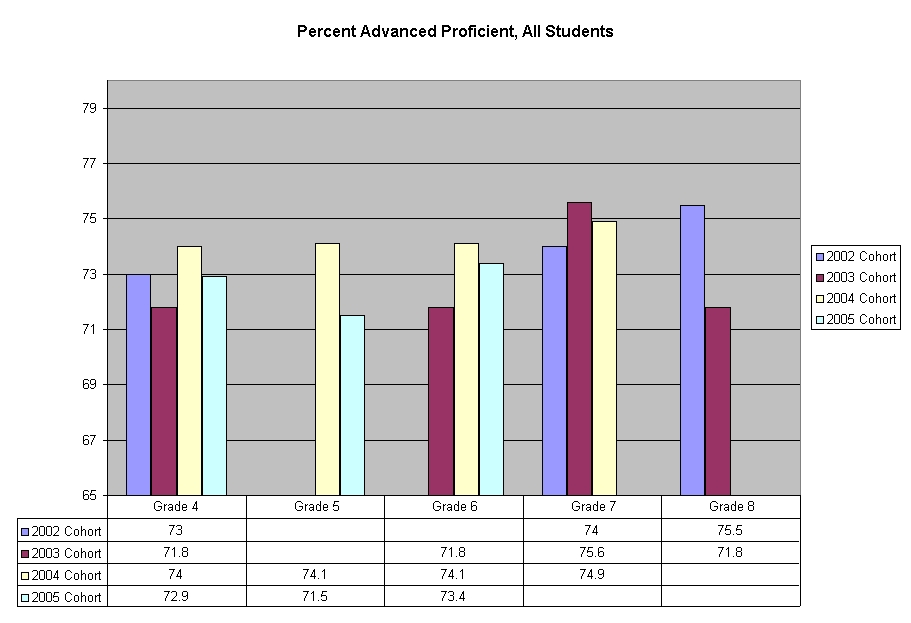
I don’t have access to the scale scores or the grant money or the expertise time the Task Force had, but I did take a look and there were no red flags identifying the Middle School years as being the locus of achievement problems. The chart at the top (and below for your convenience) is the product of my exploration.
WKCE Mathematics Perecentages from DPI

WKCE Mathematics Percentages from DPI

What I did was try to identify trends by looking at cohorts, starting with the class that was in 4th grade in 2002 (the WKCE changed that year and use of prior years for comparisons is not recommended). This chart shows the percentage of students who scored in the advanced or proficient range as they moved from 4th grade to 8th grade. The scores aren’t there for each grade for each year, but this is what we have to work with (informed, guided, not driven). Call it a poor man’s “value added.”

The most striking thing is that things don’t change much from year to year, or cohort or between the cohort. The range of variation is small; from 71.5% to 75.6%.

When we look at the cohorts, the 4th, 5th and 6th grade scores are mostly a baseline and any identification of failures in Middle school would be in the 7th and 8th grade scores. The data is minimal, but in all three data points for 7th grade there is improvement over the previous data point for that cohort and one 8th grade cohort shows continued improvement while the other shows a good sized drop off.

What does this tell us? Not much. What might that mean? To me it means we should know more before we commit to investing in improving Middle School teacher preparation.

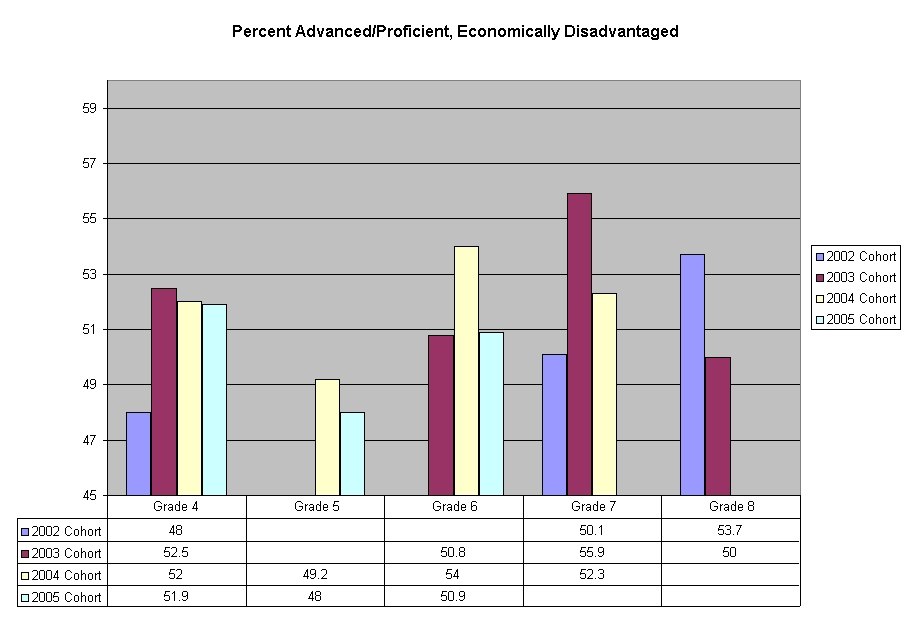
One more chart, because I think we always need to keep inequalities in mind.
ap-econ-dis

WKCE Mathematics Percentages from DPI

Same idea as the other chart, but this time only looking at “Economically Disadvantaged” students. The first thing I notice is how low the percentages are and see yet more evidence that we have a long way to go to eliminate gaps in achievement based on wealth. That this may never happen is no reason to stop trying. Next, again a narrow range, this time between 48% and 55.9%.

Some up and down but I don’t see anything compelling pointing to the Middle School years as the problem.

I did find the 2003 cohort up and down here and for all students intriguing, so I looked at state trends for those years, What I found was a similar if less extreme pattern, which may indicate that it is a product of the test and not a measure of the students. Statewide the 6th grade advanced/proficient percentage (A/S) for that all students (AS) in that cohort was 73%; for Economically Disadvantaged students (ED) it was 53.9%. In seventh grade the A/S rose to 79.1% and the ED to 61.5%. The 8th grade drops were to 75.3% AS and 56.8 ED. [I’d do a full chart, but I don’t have time, maybe in an update later). Data guided or informed, not driven or blank.

One last related note. A good thing about the new governance system in MMSD is that action items are supposed to come before committees a week before the Board acts. No more release of recommendations late Friday for action on Monday. This one didn’t. Last Monday the Board of Education agenda included a 10 page, 13 point “Summary Response” that gave an outline, but few details (Recommendation 3, here). I think a commitment of $392,500 deserves to go through the process.

As the above should make clear, I have serious doubts about whether the commitment of these resources is a good idea and have no doubt that the case that has been made so far, recommending this commitment, is less than weak. I ask that the Board and the administration step back and begin by clearly demonstrating there is a problem that needs to be addressed, and again recommend that part of this be a real assessment of the knowledge and skills of our Mathematics teachers. What will be before the board on Monday is an expensive solution in search of a problem.

Thomas J. Mertz

Leave a comment

Filed under Accountability, Best Practices, Budget, education, Local News, Uncategorized

School Finance Network Assembly Hearing, Tuesday April 21, Be There!

sfn_logo_option_b

The hearing is on the School Finance Network plan, but it is more generally an important opportunity to show support for comprehensive school finance reform.  The lawmakers need to know we care.  Be there if you can!

Details here and below.  The Basics: Tuesday April 21 at 1:00 PM at the Wisconsin State Capitol in room 413 north.

School Finance Network Reform Plan Subject of April 21st Hearing at the Capitol

Statewide coalition of more than 100,000 members announces support for changes to public school funding

Members of the Assembly Education Committee have scheduled a hearing for April 21st at 1 p.m., to consider the School Finance Network’s funding reform plan.

The meeting will be held at the Wisconsin State Capitol in room 413 north, and is open to the public. In addition to members of the SFN coalition, parents, students, educators, and taxpayers from around the state will speak.

The School Finance Network is a statewide coalition of educational, religious, and community-oriented organizations, committed to strengthening the funding system for our public schools.

The School Finance Network plan details how public school districts statewide would benefit through changes that help children with special needs, disabilities and from low income families. It also includes updates to the funding formula for rural districts and those with declining enrollment. The plan also helps maintain classes that help young people to learn skills that can benefit their communities.

The School Finance Network is made up of the following groups: AFT–Wisconsin, the Fair Aid Coalition, the School Administrators Alliance, the South-eastern Wisconsin Schools Alliance, the Wisconsin Alliance for Excellent Schools, the Wisconsin Association of School Boards, the Wisconsin Association of School District Administrators, the Wisconsin Education Association Council, and the Wisconsin PTA

What: Assembly Education Committee hearing on the School Finance Network plan.

When: April 21st at 1 p.m.

Where: Wisconsin State Capitol, Room 413 North.

Thomas J. Mertz

Leave a comment

Filed under "education finance", Best Practices, Budget, education, finance, Local News, Pope-Roberts/Breske Resolution, Referenda, referendum, School Finance, Take Action, Uncategorized

Another District Heading for Dissolution? Give Paris One More Chance

parispantherlogomelt1

Jonathan Richman, “Give Paris One More Chance” (click to listen or download).

Last year it was Wausaukee and Milwaukee, before that Florence; now the Paris District is talking and voting on dissolution (and here).

You can’t say this is a surprise.  The whole way Wisconsin funds education has been accurately called a “going out of business” plan (video here); Prior to the overwhelming defeat of a referendum on April 7, Administrator Roger Gahart warned that a no vote could lead to dissolving the district.

Here is how the situation was explained.

A combination of factors have led Paris into financial difficulty.

The district is considered property-rich under state funding formulas, and has had declines in student enrollment, both factors leading to a steady reduction in state aid. At the same time, state law limits the amount of money districts can collect under the revenue cap, and its expenses have grown faster than revenues.

Paris has cut its budget over the past year, eliminating some staff positions and reducing costs. But the district, with just one classroom per grade level, has little room left to cut…

The dissolution vote is only the first step of  a long process that most often does not end in a dissolution.

Paris is a very small K-8 district, serving less than 200 students.  A case can be made that consolidating with another district would be  best.  Certainly economics should play a role in this decision, yet when you look closely  it is clear that dissolution/consolidation won’t fix many of the problems.

There will be some economies of scale, but the recent cuts in Paris indicate that this potential is limited.

• Reductions in staff for 2008-2009 school year saved $100,240.
• Reductions in staff for 2009-2010 school year projected to be $60,000 to $70,000.
• Total current expenses reduced $121,966 from Fall Budget report.
• 26.5% reduction in supply expenses from 2007-2008 school year to 2008-2009.
• 52% reduction in supply expenses from
2008-2009 school year to 2009-2010.
• Improved energy conservation and building maintenance practices.
• Taking advantage of used, refurbished, and donated materials and equipment.

The district mentioned as possible new homes for the Paris students are Kenosha Unified, Bristol, Union Grove or Brighton.  They all have there problems.

Kenosha is dealing with the aftermath of an ill-advised investment strategy (inspired by the need to do something to try to deal with the broken state finance system), the budget pressures were a major issue in the recent School Board elections, they are phasing out the Music Department and not too long ago faced protests against “excessive budget cuts.”

I can’t find anything on the Bristol or Brighton budgets.  Not much on Union Grove either, except an incumbent Board Member seeking re-eletion saying “school funding” is “the most important issue facing the board.”

If dissolution/consolidation is only a partial and temporary fix, the School Finance Network (SFN) has a proposal that will help all districts in Wisconsin achieve sustainable funding for excellent education.  There will be a hearing on the SFN plan on Tuesday April 21 at 1:00 PM at the Wisconsin State Capitol in room 413 north (more details here).  It is important that there be a good crowd supporting comprehensive reform.  Be there!

Meanwhile, contact your elected officials, the media and get involved (see here for “how to’).

Thomas J. Mertz

Leave a comment

Filed under "education finance", Budget, education, finance, Local News, Referenda, referendum, School Finance, Take Action, Uncategorized

Hit Again (again and again…)

3_21_captain_america

Wisconsin may have dodged the bullet of privatizers in our State Superintendent election, but at the national level the for profit, not the public crowd are going forth with guns blazing.  President Obama, Arne Duncan and their crew are showing themselves to be,  in the words of  Diane Ravitch, “Margaret Spellings in Drag.”

Their latest hire fits the profile.  Education Week is reporting and the the Department of Education site confirms the Broad trained,  former edu-preneur with LearnNow, most recently Bill “Money Talks” Gates bag man, James Shelton III (scroll here for a bio)  is the new head of the Office of Innovation and Improvement.

I guess for at least the next four years “innovation” will continue to mean privatization and profit-seeking and improvement will continue to defined by the Ministry of Truth.

In history, one school of thought holds that industrialists and capitalists came to welcome expanded government when they realized they could “capture” the boards and departments and use them for their own ends.   Think of the fox guarding the hen house.  The Obama crew are not liberators, just a changing of the guard.

As Deborah Meir recently wrote about the mindset that is at work in the corridors of power:

Some combination of Harvard and Wall Street smarts are seen as all-purpose disinterested expertise, fit for any purpose. The master key. While disregard of educators has a long history, and demonizing of teacher organizations is hardly new, it has reached new heights. A mere 20 years ago one could not imagine school systems would be run by people who never practiced or studied schooling or education. The assumption that “smarts” based on hands-on knowledge is valuable has lost its historic place in our view of reality. Law and business and finance smarts have ruled the day for this generation. At a cost. And not just in schools….

Our schools and our economy—and, above all, our democracy—require us to restore the balance.

The Obama permanent campaign will be holding listening sessions in Wisconsin.  It might be worth trying to get in a good word for public education by and for the people, not profit.

Thomas J. Mertz

Leave a comment

Filed under Accountability, Arne Duncan, Best Practices, education, Gimme Some Truth, Local News, National News, nclb, No Child Left Behind, Take Action, Uncategorized

Fragrant Delusions

reality-check

In another episode of feigned outrage, the new adjunct to a scorned Republican Party searching for new identity – leaderless and jumbled up with 30 years of rhetoric that, surprisingly, in just a wink of an eye, seems immensely trite, dated even – tone deaf to the body politic; behold a specimen of Wisconsin politics that can easily serve as specimen A of this “did we really talk and think like that before” mentality. We present to you – Steve Nass.

In short, the Cap Times editorial, responding in part to this, pretty much says it all. It can only be redundant to pile on with citations of this piece. Suffice to say, this crazed, destroy it all juju, is merely a taste of the Trojan Horse “Sturm und Drang” that would have awaited us if the Rose Fernandez candidacy had been successful. To cite more positive rhetoric of Wisconsin’s history, Forward!

Robert Godfrey

Leave a comment

Filed under "education finance", Accountability, AMPS, Best Practices, Gimme Some Truth, School Finance, We Are Not Alone

MMSD (Preliminary) Budget Released

mmsd-budget

All the information is here; the Wisconsin State Journal has a story also.

More to follow in the coming weeks.

Thomas J. Mertz

Leave a comment

Filed under "education finance", Budget, education, finance, Local News