
National Center for Fair and Open Testing.
Hat tip to Jim Horn at Schools Matter.
Thomas J. Mertz
Filed under Accountability, Local News, National News, nclb, No Child Left Behind

Click on the image for a very cool interactive version from the Wisconsin Department of Natural Resourses.
Ray Charles, Greenback Dollar (click to listen or download).
In many, many ways the Wisconsin school finance system is-in-and-of-itself penny wise and pound foolish. Beyond the general truths that a lack of investment in the education of our children weakens our future competitiveness, depresses the earning (and taxpaying) potential of the coming generations and lead to increases in social service and criminal justice spending (see the work of The Center for Benefit-Cost Studies of Education), our school finance system also precludes many districts from making the kind of investments that in the relatively short term will create great savings. Because of endless cycle of annual same service budget cuts created by the revenue limits, districts are rarely able to look even one or two years ahead for savings to be realized. Energy efficiency is a prime example of this.
Lt. Governor Babara Lawton has spearheaded an Energy Star School Challenge initiative (MMSD has accepted this challenge). This is good program, but there are no funds attached to participation and without funds even the program’s modest goal of a 10% increase in efficiency is beyond the means of many of our cash strapped school districts.
Some districts have taken matters in their own hands and have gone to the voters with referendums to fund energy efficiency investments. In April of 2007, the voters of the Rice Lake District approved $3.88 million for an upgrade of an 1980s era system. Superintendent Paul Vine said, “We use the savings to try to maintain and support other student educational programs.” A failed boiler at Waterloo High School led to school officials to investigate an upgrade. In February of 2008, voters in the Waterloo District approved $1.5 million to replace a 50 year-old boiler that was 60% efficient with a new 98% efficient system. As a news story noted:
Without voter approval to exceed the state-imposed revenue caps, the board would have had to cut educational programs to pay for a new boiler. Revenue caps limit the amount of money a school district can raise through the property tax levy. The project is nothing the district can do within its budget officials have said.
The Colby district is going forward with a similar referendum. The current system operates at 50% efficiency, the upgrade would be 95% efficient. The financial numbers are good, in the longer term:
A district-wide upgrade of heating, ventilating and air conditioning systems would cost about $841,000, but it would pay for itself in a little more than nine years and save the district over $92,000 annually, according to the study.
Like Waterloo, Colby can’t make the investment required to realize these saving without going to referendum. meanwhile, Colby struggles to with annual same service cuts like most other districts in Wisconsin. Two failed operating referenda in 2006 have already led to the closure of a school and an early learning center, and cuts to “classes like agriculture, foreign languages, business, consumer ed, music, and art” are now being contemplated (thanks to Terri Wiersma of the Marshfield News Herald for information and a local perspective).
The Colby referendum will also seek to refinance existing debts at a lower the interest rate. High interest rate debts and obligations, particularly those associated retirement benefits, are a growing problem for many Wisconsin districts. the inability of districts to do the fiscally responsible thing by refinancing is yet another example of the “penny wise and pound foolish” choices our school finance system creates. I’ll probably be posting more on this in the future.
Efficient word burning, like that sought by Colby, is also more sustainable than fossil based fuel consumption. A study by the Biomass Energy Resource Center concluded that:
Biomass heating in schools holds great promise to advance renewable energy policy, stabilize and reduce school heating costs, benefit the local economy, support the forest products industry, and reduce greenhouse gas emissions.
So we can add global energy and greenhouse gas issues to the growing list of benefits that our state school finance system makes it difficult to realize. While I’m at it, I want to point out that the long bus rides caused by school closures, mergers, consolidations and dissolutions forced on districts by the state finance system aren’t helping the environment or energy consumption.
Currently about eleven districts on Wisconsin are using wood heat. There is a nice report on the Barron system here. Barron saves an estimated $100,000 a year via efficient wood heating and cooling. That’s money that is instead being used to educate students.
What a great idea, too bad our state finance system puts short term property tax cuts ahead of education.
Penny wise and pound foolish.
Thomas J. Mertz
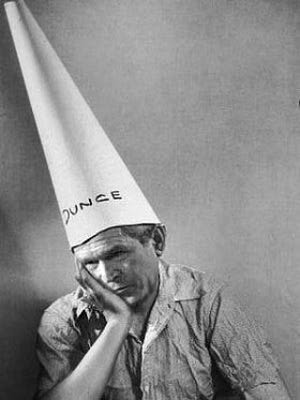
re: Civics [Kathryn Jean Lopez]
A totally crazy Saturday-morning thought: Wouldn’t George W. Bush make an awesome high-school government teacher? Wouldn’t it be something if his post-presidential life would up being that kind of post-service service? How’s that for a model? Who needs Harvard visiting chairs and high-end lectures? How about Crawford High? (Or wherever?) Reach out and touch the young before they are jaded, or break them of the cynicism pop culture and possibly their parents have passed down to them. Whatever you think of President Bush, he’s a likable guy in love with his country with some history and experience to share.
Like I said, crazy. Saturday. Have a good one.
Yes, crazy.
Who would want a man who doesn’t understand separation of powers as a basic constitutional concept teaching our young about government?
Thomas J. Mertz
Filed under education, National News
Some patriotic videos for the holiday.
Cyril Neville, “This is My Country” (written by Curtis Mayfield).
Woody Guthrie, “This Land is Your Land.”
David Bowie, “Young Americans.”
Jefferson Airplane, “Volunteers.”
Chuck Berry, “Back in the USA.”
Thomas J. Mertz
Filed under AMPS, National News

Tom Beebe of the Wisconsin Alliance for Excellent Schools and John Smart of the Park Falls School Board, the Policies & Resolutions Committee of the Wisconsin Association of School Boards and the Board of Directors of the Wisconsin Alliance for Excellent Schools. were on WORT‘s “In our Back Yard” today discussing the Wausaukee situation and the sad state of school funding in Wisconsin.
Click here to listen or download.
Support community-sponsored radio on WORT.
More on the possible Wausaukee School District dissolution here, here and here.
Thomas J. Mertz

You’d better hold on to what you’ve got
You’d better hold on to what you’ve got
Cause if you think nobody wants it
Just throw it away and you will see
Someone will have it before you can count 1, 2, 3
Yes they will, yes they will
Joe Tex, “Hold On to What You Got” (click to listen)
[Updates at the bottom. Update number 2 is a clarification from District Administrator Jan Dooley. Scroll down.]
WBAY is reporting that the Wausaukee Board of Education has instructed staff to draft another referendum. The Board will vote Thursday (July 3) to decide whether this will be placed before the electorate. The details are sketchy. WBAY reports that:
The school board decided Tuesday night on a $675,000 referendum. For the average $100,000 home, that’s an added $102 in property taxes for the next ten years.
An attorney will now draft the proposal for approval by the board on Thursday. It would then go before residents for a vote in 45 days.
If a third referendum fails, the Wausaukee School District is prepared to close. It’s nearly $200,000 in debt.
This sounds like a ten year nonrecurring referendum, but it is hard to tell. More on AMPS as the story develops.
A February four year nonrecurring referendum (at $1,250,000 the first year and $1,000,000 the subsequent years) failed by a vote of 1,334 to 394; on June 24 a one year nonrecurring $575,000 referendum failed by a vote of 563-544.
More on AMPS here and commentary from John Smart here.
Stay tuned.
Update #1
This video report from WLUK-TV gives more details, but adds to the confusion. According to the story, they are considering what sounds like a 2 1/2 year nonrecurring referendum. I’m not sure that is possible.
Keep checking back, I’ll post more as it becomes available.
Update #2
I received this very informative email from District Administrator Jan Dooley:
After receiving over 640 taxpayer signatures in support of another referendum, the board voted, at last night’s meeting (July 1), to authorize me to work with legal counsel to draft the resolutions for a third referendum. The referendum will be to exceed our revenue limit by $675,000 per year for ten years. The board will be voting on the resolutions at Thursday night’s meeting.
During the meeting last evening, our school board president, Dennis Taylor, indicated that the yearly school tax increase for this referendum amount on a $100,000 home would be approximately $102 per year. This amount is based on a zero percent increase in equalized value. If equalized value of property in the district increases, the actual impact for the referendum amount will be less per year.
Where the confusion may enter in is that Mr. Taylor indicated that in 2 ½ years our building debt will be paid off. Our current annual payment for our building debt is $675,000; thus, when our building is paid off, the school tax increase from the referendum will be offset by the decrease in school taxes from the pay off of the building debt. Thus, the increase from the referendum will be felt by taxpayers for the next three years, and then the school tax will revert to near existing levels. I trust that is the basis for the reporting of an increase of $102 per year for 2 ½ years on a $100,000 home.
With anticipated declining enrollment, our district will continue to realize a natural increase in our tax rate because of a drop in state aid.
As I have said before and will say again, “Educating our children should not be this difficult.” Our children deserve a solid education, and there should be sufficient revenue with which to provide such an education. A major problem that our district faces is our shrinking state aid. Since state aid is based on property wealth per student, and we are faced with high property values and declining enrollment, you understand the end result. Currently, our district is aided at 14.93%; thus, our taxpayers are already paying over 85% of our total revenue limit. This fact makes passing a referendum exceedingly difficult, at best. The sobering reality is that nearly 50% of our student population receives free and reduced lunches. Our district may be property rich, but many families are income poor.
So, we’re caught in a vice grip. Our state constitution guarantees a fair and equitable education for every child in the state. We have reduced our programming to a level where we believe any further cuts will greatly harm our children. We need additional revenue to provide this level of education for our children. Our taxpayers feel overtaxed with the state picking up only 14.93% of the cost. When our board of education reluctantly voted on June 26 to consider dissolving our school district, in the wake of our failed referendum on June 24, the board members were taking a stand for children.
Moving to this third referendum will not halt the dissolution process. The two processes will run parallel with one another. Since we do not know whether the referendum will pass in August, the board is scheduled to take action on ordering the dissolution of the school district on July 8. Should our referendum pass and our district receive additional money for operational costs, this factor will be weighed by the state in deciding the future of our district.
If you have any additional questions or need further clarification, please feel free to contact me at any time.
Jan Dooley, District Administrator
School District of Wausaukee
So it is a ten year nonrecurring referendum proposal, but the retirement of debt from a building project will lessen the apparent property tax impact after 2 1/2 years.
I wish Ms Dooley, all the staff, parents, students, Board and community members in Wausaukee the best. The most important way we can way to help them is to keep the pressure on the Governor and the Legislature.
Thomas J. Mertz
My daughter read this book in her middle school this past spring. I later watched the film with her, and while I was surprised by some of its rawness, it was a true story of transformative change of kids from an impoverished neighborhood who go on to attain college degrees. It was very inspirational.
The facts are these for this Indiana school. The book was in the library. The principal gave permission to use the book. Parents signed off on the book. The biggest problem going against this teacher was that the School Board appears to have had some 18 months of turmoil that started when a majority of board members ousted the School Superintendent. Sides were taken, tempers flared, and 10 folks ran for 3 spots on the School Board with the election just 2 months ago in May. The teacher decided to take her stand up against a new board & School Superintendent, who, perhaps, felt they had a mandate from the Perry Township citizens. Bad timing.
Robert Godfrey
Filed under Best Practices, National News

Hieronymus Bosch
During a speech to the National Association of Latino Elected & Appointed Officials the other day, John McCain launched into a discussion of NCLB and education funding, holding up New York City (with awful – and similar funding issues to Wisconsin) and New Orleans (oy!) as examples of Republican success stories in education. Charter schools, according to him, can be our silver bullet. Pardon me, but we all need a national conversation to start now. However for Mr. McCain, it would seem his mind is made up.
“I mean, they also re-authorized No Child Left Behind, with the lessons we learned in the intervening years since we passed it, in a bi-partisan fashion, I would fully fund those programs that have never been fully funded. But let me also say to you: choice and competition. I believe that every family in America should have the same choice that Cindy and I did. We chose to send our children to a Catholic school. That was because we were able to do so. So I believe that charter schools work. I believe that they’re not much better than public education, but they provide competition. There are two examples I’d like to mention very briefly: New York City and New Orleans. If you missed it, there is now a dramatic uptick in the performance of school children in New York City, a place where a lot of experts thought there would never be improvement. We ought to go up there and see what Mr. Klein and Mayor Bloomberg and others have done and dedicated educators have done in New York City. New Orleans, they had to start at square one, as you know. There are now 30 charter schools in the city of New Orleans. Anyone will tell you that they’re starting to see a dramatic improvement in the quality of education in the city of New Orleans. My friends, choice and competition, reward the teachers, God bless them, find bad teachers another line of work. Choice and competition.”
I’ll bet Mr. “Choice and Competition” has never seen this documentary. He won’t – but you can. Educate yourself. See what magic an unregulated post-Katrina education industry has brought to New Orleans and shades of things to come if some mainstream thinking about reforming education comes to fruition.
Robert Godfrey
Filed under AMPS, Equity, Gimme Some Truth, nclb, No Child Left Behind, School Finance, We Are Not Alone

Prince Buster, “Dont Throw Stones” (click to listen)
John Smart — of the Park Falls School Board, the Policies & Resolutions Committee of the Wisconsin Association of School Boards and the Board of Directors of the Wisconsin Alliance for Excellent Schools — provides some more big picture context and good advice related to the vote by the Wausaukee School District to dissolve.
Our schools are in danger, and some are just throwing stones
by John SmartIt was just announced that the Wausaukee School Board has voted to dissolve their school district. They have had two failed referenda asking to allow them to exceed the state-imposed revenue caps, the last one losing by 19 votes, and the Board felt it had run out of options. Board President Dennis Taylor said, “The choice is not ours. The choice is the taxpayers of this community.”
If the dissolution goes through, the 500 or so students in the district will be distributed to surrounding schools in Wabeno, Marinette or maybe Crivitz or Pembine.
So many of our school districts are having financial problems that I should have thought that everyone would have some genuine understanding of the situation by now, but apparently that’s not so. There are still “experts” in the woods who think they have all the answers.
There have been 88 school referenda in Wisconsin so far this year in attempts to override the state’s unrealistic revenue caps, and exactly half of them failed, like Wausaukee’s. That means that school districts like Washburn, Rhinelander, Chetek, Durand, Hartford and so many others are in the process of making drastic cuts in curricular and co-curricular programs, thus depriving our next generation of the wherewithall to compete in the 21st Century global economic sweepstakes. Others may be contemplating the drastic measure that Wausaukee has taken.
It’s easy to level blame on the school boards and administrators for not doing their duty, but school boards are just local citizens who are willing to take on the job because it’s so important. It’s really everyone’s responsibility to study the issues and take part in the solutions. How many local citizens attend your district’s school board meetings? Ten or twenty? More? Less? Do you?
It’s also too easy to blame teachers and their unions. Our teachers are dedicated professionals who are working overtime to educate our kids. They’ve put themselves through a minimum of four years of higher education and must continue to take classes in order to maintain their licenses. Their compensation should be compared to other professionals, like doctors, dentists and lawyers, and in that company they’re hardly overpaid. Plus – I challenge anyone who thinks that teaching in 2008 is easy to spend a day in a classroom! I have.
Enrollments are declining in most of our districts. In Park Falls, we just graduated a class of 85, but our kindergarten class was 53, which doesn’t bode well for the future.
We’re trying to consolidate with the Glidden district in order to boost our combined numbers. Even though there are always snags in such attempts, we’re hoping that we can combine our strengths and build a great new school district.
But, considering declining enrollments and the failure of the state funding formula, consolidations are far from the ultimate answer, as those of us in the trenches know only too well.
The state school funding formula is based on student numbers, so that is not working in our favor, and will continue to get worse unless major reforms are instituted.
State aids are also based on equalized property evaluations, and ours in the Park Falls School District have risen, from $303,606,538 in 1997-8 to $648,752,692 in 2007-8, thanks in large part to expensive “cottages” built on our beautiful lakes and rivers by seasonal visitors and retirees. To the state formula, which is based on property values rather than income, this makes it look like we’re more than twice as wealthy as we were ten years ago, and consequently our school aids have been reduced.
In Park Falls, we received $3,923,263 from the state ten years ago and $2,578,690 this past school year. Our enrollment may have dropped, but the expenses of running a school haven’t dropped! Everything from teachers’ salaries to energy costs have gone up, and the difference must, of necessity, be raised from local property taxpayers. In Park Falls, our tax levy has risen from $1,820,324 ten years ago to $3,844,298 this past school year.
The current state school funding formula was passed as a temporary, stop-gap measure in 1993, but is still in place. It sets the QEO, a limit to the compensation teachers can be given, and the revenue cap, a limit to how much the school districts can levy from property taxes. But it left a gap between the two that assured a fiscal nightmare, which is now upon us. It should also be pointed out that teachers are the only public employees who are limited by law in raises to their compensation packages, and school districts are the only municipal governmental units limited by caps in tax levies.
The legislature has been incapable of dealing with this issue. The “No New Taxes” people in the Assembly are determined to hold firm, resisting the clear need for sales tax and corporate tax reforms, which would put more revenue into the general fund and allow more adequate school aids.
There are good plans for school funding reform on drawing boards all over the state [and nation], and they are all hinged to the realization that there is nothing a society does that is more important than educating its young. The Wisconsin Alliance for Excellent Schools has some terrific ideas [www.excellentschools.org] – please check them out.
There is an election in November, and with it the opportunity to change the do-nothing legislature. Please make sure that your candidates understand how critical the school funding issue is, and vote accordingly.
The future demands nothing less. Please let’s make Wausaukee the last school closing in Wisconsin.
Thomas J. Mertz

19 votes.
That was the margin by which the June 24, 2008 non-recurring, one year $575,000 school operating referendum lost in Wausaukee. 19 votes out of 1107 cast (number from the DPI site, the linked Peshtigo Times story appears to be wrong). Now according to the Eagle-Herald, the Wausaukee Board of Education feels that the best thing to do is to dissolve the district.
[In a story from WBAY (Green Bay)] School Board President Dennis Taylor says, “the choice is not ours. The choice is the taxpayers of this community. The community has to decide if they’re willing to spend an extra $180, in some cases $150 a year to keep a school open in this community.”
Blaming those who voted against a referendum, although accurate because they are the proximate cause, misses the bigger picture, the role of the state school finance system.
District Administrator Jan Dooley provided some of this:
She feels hopes for a state “bail out” are in vain. She said there are many districts in almost the same financial position as Wausaukee, and if the state lets one it will have to help them all. “I don’t see the state intervening by offering assistance to Wausaukee over and above what is offered ot all districts in the state, because then the floodgates would open. The only chance would be a change in the state aid formula.”
“We have cut, and we have cut to a level that we feel we cannot risk cutting more staffing without losing kids,” Dooley declared. “I think everyone in the district should be asking, ‘What do we want for the children of our district, and what do we need to do to bring that about?’ Our children don’t deserve to have more programs cut on them,” she declared. “This is about children and their futures! I am an educator at the core of my being and this resonates deep within me. Right now it’s the children that are at the forefront in my mind.”
She said Wausaukee is at a point where “We’re caught in what I call the death spiral. We have established what we believe is a sound education for our children. If we cut more, parents will say I want more, so they will take their children and put them into another district. If we cut more, we risk losing more students, which means we lose more aids, and have to cut still more programs. it’s a downward spiral that won’t end.”
“The children in the School District of Wausaukee deserve an education that is no less than any other children in the state,” she declared.
The failure of a referendum in February inspired a thorough discussion of the roll of state finance system in this sad turn of events. After that vote, people on both sides of the issue looked to our elected state officials for change.
[Gerry] Gerbers described the proposed referendum as, “Ill designed and ill conceived,” in that it offered no long-term solutions…
Gerbers cited figures showing that the district is property rich and income poor. Wausaukee School District residents have family and individual incomes below the state average. More than 10 percent of the population is at or below the poverty level. He and Kipp said residents cannot afford more tax increases.
Village President Clark Caine argued that the state kicks in and pays property taxes for poor households under the Homestead property Tax Relief law, “so that is really not an issue.” [Editor’s Note: In theory this is correct, but the Homestead Credit formula has not been adjusted for inflation, so many people who should qualify, don’t. — TJM}
Gerbers reviewed a bit of the state aid formula. Wausaukee, because of huge amounts of recreational properties which are rapidly rising in value, gets only 14.93 percent of its expenses reimbursed by the state. Peshtigo gets five times more aid per student than Wausaukee.
Gerbers is calling attention to the problems of the many high property value, high cost, low income districts in the state. These are described further in the Atlas of School Finance from the Institute for Wisconsin’s Future. Some believe that the current “Sparsity Aid” — ironically featured on the front page of the DPI website today (snap shot, here) — sufficiently addresses the needs of the districts. It doesn’t. Gerbers is right about this, but he was wrong to oppose the referendum because it isn’t a long term solution. referendum supporters had the right idea:
Ann Hartnell asked why not call for approval of this referendum, and use that approval anyway to buy time for the changes they plan to propose. She said the school board would not be obligated to levy the full amount authorized by the referendum.
Caine also urged approving the referendum, then pushing for change….
Trustee Hilbert Radtke said people in Madison and Milwaukee do not realize the difficulties faced by rural districts under existing funding formulas, and we don’t have enough votes here to change it.
A suggestion from the floor was to enlist the help of non-resident property owners, since they also pay taxes in the district. Get them to contact their legislators from parts of the state where there are enough votes.
Hartnell agreed, but said even a concerted campaign from all of Marinette County might make a huge difference.
I hope that despite the disappointment these plans go forward and that this situation catches the attention of the Governor and the Legislature.
What next for Wausaukee? Some people are already working for yet another referendum.
Resident Gerald Schimidt says, “the community has the potential to basically shrivel up, die, go away. We don’t want to see that.”
John May says, “it will be a shame for a small community like this to lose a big school like that.” His son Cody goes to school here, but the way things are going he may not be for much longer.
The school is now considering shutting down. It’s nearly $200,000 in debt and the board says it can’t cut costs anymore.
School board member Dave Kipp says, “the level of frustration is very high. We have done everything we can to cut costs to the bone without sacrificing a quality education for our kids. That’s the key point.”
The only way to potentially save the school is for taxpayers to step up. Which is exactly what John Guarisco is doing at this barbeque, collecting signatures to ask the school board for yet another referendum and another chance for taxpayers to save their school district.
Meanwhile the planning for a July 2009 closure has begun. If this happens, the students will be disbursed to five neighboring school districts — Crivitz, Pembine, Marinette, Wabeno, or Goodman-Armstrong Creek — all of which face similar difficulties under our state school finance system, a system designed not to educate, but to keep property taxes low and politics safe.
Please join the Wisconsin Alliance for Excellent Schools and others in working to enact a way of funding schools that puts education first. Please contact your Legislators and Governor Doyle and tell them this has gone on too long.
Thomas J. Mertz
 Fund a Classroom Project in Madison
 AMPS
AMPS 