Category Archives: Arne Duncan

(Updated) MMSD Board of Education Agenda — Lost & Found (and comments)

Update:  Board President Arlene Silveira sent me a copy of an amended agenda and the Wisconsin Association of School Boards resolutions are now an action item for the Students Achievement and Performance Monitoring Committee (committee agenda here).  The “Weekly Notice” link has also been fixed (over the weekend…that’s impressive).

On the WASB matter, I’ve had lots of talks with Board members in Madison and elsewhere about how to get schools the resources they need.  One idea that has some support is adding a dedicated statewide sales tax to the school finance mix.  It is clear that the continued shift to property taxes cannot be sustained, that the current sources of state revenues are not sufficient or sustainable and that the resultant program and service cuts in schools around the state are forcing districts to endanger our proud tradition of quality public education for all.  A sales tax won’t fix everything, but it will help.  Board members (in Madison and elsewhere) have been supportive but the idea may have come together too late  to become part of the WASB resolution process this year.   We’ll see.

(Original Post, see comments also)

It was a more than little difficult finding the agendas for the Madison Metropolitan School District Board of Education Committee meetings scheduled for Monday, September 14.

First, it looks like MMSD is again neglecting to send notices to those who subscribed to their “send notices” list.  Since no notice had arrived, I began checking the “Weekly Notice of Meetings” link on the Board page periodically.  Early on Friday the link gave last week’s notice; at some point it began giving a “page not found error” (pdf of this from 7:45 PM 9/11/09).

I assumed the page was being updated and kept trying.  Finally, at about 6:00 PM I realized that there would be no update and started searching.  Sure enough, a search for “weekly notice” and September 2009 led me to this page which led me to the agenda linked above.

I wouldn’t make a big deal of this, except that this is an organization that has not updated their budget page with the state budget bad news from June; an organization with apparently nothing to post on “State and Federal budget issues” at the same time their Board of Education is writing op eds on the topic ; an organization whose “Recently in the News” page is stuck in January of 2009; an organization that has not issued a news release since June (at least according to their web site)…Communication is clearly a problem.

We’ve been hearing about communication problems for years.  I have two pieces of advice.  First, it is important to begin by getting the little things right.  Second, if the people in charge of communications, the web page, public relations and all that are not doing their jobs well, find new people.

Now the obligatory but heartfelt clarification.  There are many people at MMSD who have been consistently helpful with my requests for information.  I know that if instead of periodically  clicking today I had dropped the Board Secretary a note, I would have had the agenda in my in box and the link would have been fixed (instead I assumed an update was in process and took my son to the beach till it was too late to drop that note).   I do appreciate the efforts that have been made.

Enough of my trials and tribulations, time for some notes on the agendas.  First I want to note three things that are not there.

There is nothing about the budget reconciliation.  Looking at the Board calendar, that means the earliest there will be a public discussion of what are major decisions about taxation, budgeting, spending and borrowing will be the October 5 committee meetings (things now go to committee before they go to the Board), or three weeks prior to the final approval of the tax levy and budget.  State statues dictate that the budget be presented to the public one month prior to a public budget hearing.  That was done in the Spring, but much as changed due to the miserable state budget.   I think that an effort to make the local changes in a manner respectful of the spirit of public knowledge and input on the budget is in order (more on the budget revisions here and here).  This is another little thing — or given the magnitude of the changes, big thing —  in the realm of public engagement that is not being done correctly.

Second, and germane to the state created budget mess, I expected that there would be some discussion of resolutions to be proposed to the Wisconsin Association of School Boards.  From the discussion at the August 17 meeting I was under the impression that these would be finalized at a public meeting prior to the September 15 deadline.  Apparently these are being done outside the public eye, with no formal discussion or vote.   Not good.

Last, there is an agenda item for an update on the “class and a half” specials fix, but no documentation.  Id hope this isn’t another case like “Ready, Set, Goals” where the good intentions produced no tangible result.

No time to comment on what is on the agendas (maybe on Monday), except to say the item on short term borrowing highlights yet another way that Wisconsin’s school finance system is broken and if the people pushing value added really believe that reports like the one included are adding much of use in policy decisions, they need to stop drinking the Kool Aid (same goes for all the data fetishists in Arne Duncan’s gang).

Thomas J. Mertz

2 Comments

Filed under Accountability, Arne Duncan, Best Practices, education, Local News, Uncategorized

Speechifying on Education

freetospeakgraphicmed

On Tuesday , September 8th, at 12:00 PM (EDT) the President will talk directly to students across the country on the importance of taking responsibility for their education, challenging them to set goals and do everything they can to succeed.  The President’s message will be streamed live on WhiteHouse.gov/live, and broadcast live on C-Span.

In the Sept. 8 speech, Education Secretary Arne Duncan, in a letter to principals, said Obama will challenge students to work hard and take responsibility for their learning.

“He (President Obama) will also call for a shared responsibility and commitment on the part of students, parents and educators to ensure that every child in every school receives the best education possible so they can compete in the global economy for good jobs and live rewarding and productive lives as American citizens,” Duncan said in a press release.

The Education Department is encouraging teachers to create lesson plans around the speech, using materials provided on the department website. And to foster student involvement, the U.S. Department of Education is launching the “I Am What I Learn” video contest. On September 8th, students will be invited to respond to the president’s challenge by creating videos, up to two minutes in length, describing the steps they will take to improve their education and the role education will play in fulfilling their dreams.

The Education Department is inviting all students, ages 13 and older, to create and upload their videos to YouTube by October 8. Submissions can be in the form of video blogs, public service announcements (PSAs), music videos, or documentaries. Students are encouraged to have fun and be creative with this project. The general public will then vote on their favorites which will determine the top 20 finalists. These 20 videos will be reviewed by a panel of judges, including U.S. Secretary of Education Arne Duncan. The panel will choose three winners, each of whom will receive a $1,000 cash prize.  Starting this Friday, you can visit www.ed.gov/iamwhatilearn to find out more.

However, in a short file report today on Madison.com, an issue has been raised by some concerning President Obama’s speech.

The speech on the importance of education has raised concerns among some parents who view it as nothing more than political advertising within public schools.

Officials with both the Green Bay and Madison school districts say they’ve heard from a handful of parents with questions about whether the video will be shown next week. A spokesman for Republican state Rep. Steve Nass from Whitewater says their office has also fielded calls from concerned parents.

Madison schools is working on guidelines about how to handle the speech.

Some conservative talk show hosts are already suggesting that parents keep their children home from school to protest the speech.

President Obama is a powerful role model for many youth today.  I applaud his efforts to encourage students to work hard at school as way to achieve their dreams. This sends a needed message to our youth that hard work and perseverance pays off and that education is a priority in our culture.  I for one am glad that my children will be watching this video and I look forward to the discussion that we will have about it over the kitchen table Tuesday.  In my day, the saying was “Knowledge is Power.” I applaud President Obama for again reminding our nation of the power of knowledge.

Jackie Woodruff

Leave a comment

Filed under AMPS, Arne Duncan, education, Local News

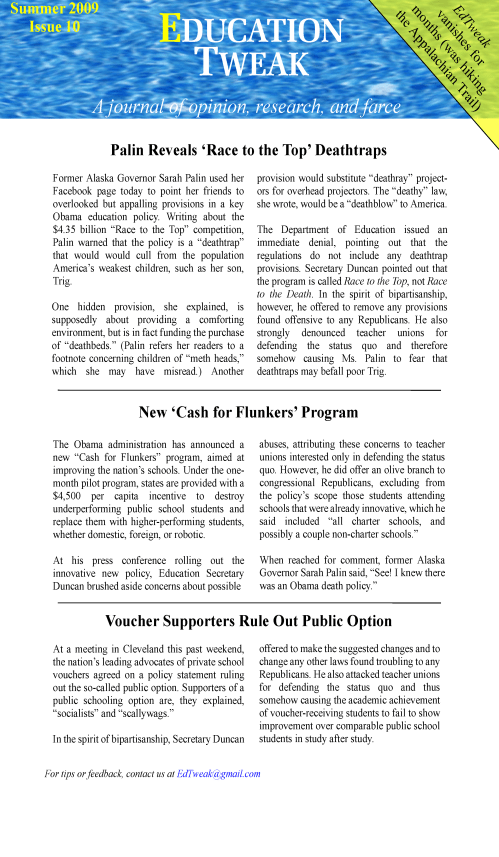
Education Tweak #10

Click on image for pdf

Click on image for pdf

All Ed Tweaks can be found at:  http://edtweak.org/.

Thomas J. Mertz

Leave a comment

Filed under Accountability, Arne Duncan, education, Gimme Some Truth, National News

How Long, How Long Blues

Leroy Carr. “How Long, How Long Blues, Pt. 1” (click to listen or download)

There was an interesting quote from my State Representative, Mark Pocan, in the Wisconsin State Journal story on the prospects of Governor Jim Doyle’s agenda as a lame duck.

But Pocan acknowledged fundamental reforms of school financing would be difficult to achieve soon given that they would likely cost money that the state doesn’t have.

“The real comprehensive change of how we fund schools is going to be difficult to do over the next eighteen months,” Pocan said.

“Difficult,” does not mean impossible.  Unfortunately, this sounds like yet another lowering of expectations.

One sure thing  is that we’ll never know how difficult if Pocan and his colleagues don’t try.

Another sure thing is that there has been no public attempt at comprehensive school funding reform in the months since the Democrats won control of both houses under a Democratic Governor (and no, Doyle’s stitched-together attempts to win favor from Arne Duncan do not count).    Please try.

Reading Pocan’s remarks I was reminded of FDR’s first hundred days and what could be accomplished with political will.  Here is a list:

First Hundred Days Legislation

March 9 – June 16, 1933

March 9 Emergency Banking Act

March 20 Government Economy Act

March 22 Beer-Wine Revenue Act

March 31 Creation of Civilian Conservation Corps

April 19 Abandonment of Gold Standard

May 12 Federal Emergency Relief Act

May 12 Agricultural Adjustment Act

May 12 Emergency Farm Mortgage Act

May 18 Tennessee Valley Authority Act

May 27 Securities Act

June 5 Abrogation of Gold Payment Clause

June 13 Home Owners Loan Act

June 16 Glass-Steagall Banking Act

June 16 National Industrial Recovery Act

June 16 Emergency Railroad Transportation Act

June 16 Farm Credit Act

Doyle has about 540 days left.  If he or members  of the Senate and House want to fulfill the promises they have made over and over again, if they want to redeem themselves for what they did to education in the most recent budget, if they want to have something positive to run on in 2010, if they want to invest in our state’s future, if they want to leave a legacy they can be proud of…comprehensive school finance reform is a must and they have to get to work now.

Please try.

Thomas J. Mertz

1 Comment

Filed under "education finance", Arne Duncan, Budget, education, Elections, finance, Local News, School Finance, Uncategorized

Sherman Dorn Asks THE QUESTION and Offers Some Answers

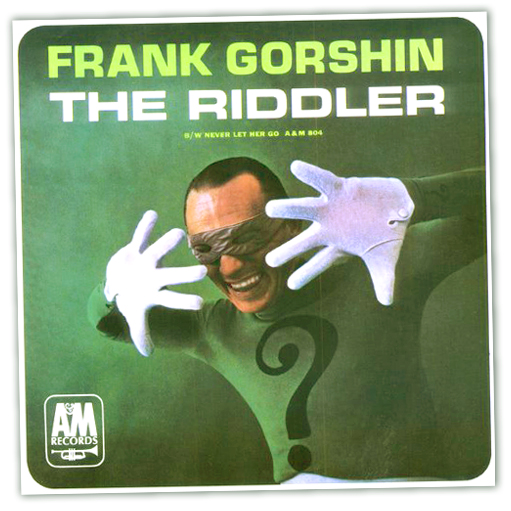
riddler45cover1Longtime readers should know that Sherman Dorn is one of my favorite people in the edusphere. His  recent “How can we use bad measures in decisionmaking?” is a fine example of why I value his contributions so much.

His titular question is THE QUESTION at the heart of so much ed policy action these days.  Nobody who isn’t seeking profits or losing their mind likes the tests being used — not Arne Duncan, not Barack Obama, not the people in Madison poised to build a Gifted Education house of cards on them — but almost nobody wants to give up on the tests and many want to expand their use (Arne Duncan, Barack Obama, those house of card builders in Madison).

Everyone talks of better tests, multimodal assessments, new ways of looking at data….  All this can be good, however we aren’t there yet and the simple-minded attraction of letting the flawed data “drive” education policy is strong (the current draft of the MMSD Strategic Plan has both reasonable  data ” inform[ed]”  and frightening “data driven” language).    Additionally, at least three truths often get lost when better assessments and data are discussed (Dorn hits most of all of these).

  1. All assessments and data are of limited utility.  They are snapshots at best; they are only designed to measure specific things; standard deviations and confidence intervals recognize some of the limits, but are rarely part of “accountability” discussions.  the temptation to use assessments for things they are not designed for is always there.
  2. Because better assessments should mean assessing more things in more ways,fulfilling this promise will result in more time and resources devoted to assessment and analysis and less to teaching and learning.
  3. Employing multiple assessments or sophisticated data analysis (ie Value Added) moves away from transparency in accountability. It already clear that few policy makers, much less members of the public, understand the nature of current assessments and accountability practices.  When you employ Value Added techniques all but the most statistically adept are shut out (some Value Added methods are proprietary and even those who commission the analysis are kept in the dark about the nature of that analysis; others are open, but beyond the understanding of most people).   Combining multiple assessments, including qualitative approaches, produces similar issues.   The MMSD Gifted plan is a perfect illustration.  They promise to identify potential and achievement with referrals and multiple assessments over five domains (academic, creative, leadership, visual and performing arts) and then decide who gets the extra services based on “percentile scores.”  Does anyone think that the promised “transparency” of this exercise will be meaningful to parents and Board members?

This was supposed to be about Sherman Dorn’s post, so back to that (although I think the above — especially the local stuff — is a salient context for what Dorn wrote).

After much good introductory material (including a link to the relatively recent, must read Broader, Bolder Approach Accountability Paper), Dorn explores a variety of positions relative to the problems  of “data that cover too little,” and “data of questionable trustworthiness.”  His presentation of their strengths and weaknesses is insightful and informative.

Dorn himself rejects both the “don’t worry” and “toss” extremes and seeks to extend (begin?) the conversation in pragmatic directions.  Here is how he closes:

Even if you haven’t read Accountability Frankenstein or other entries on this blog, you have probably already sussed out my view that both “don’t worry” and “toss” are poor choices in addressing messy data. All other options should be on the table, usable for different circumstances and in different ways. Least explored? The last idea, modeling trustworthiness problems as formal uncertainty. I’m going to part from measurement researchers and say that the modeling should go beyond standard errors and measurement errors, or rather head in a different direction. There is no way to use standard errors or measurement errors to address issues of trustworthiness that go beyond sampling and reliability issues, or to structure a process to balance the inherently value-laden and political issues involved here.

The difficulty in looking coldly at messy and mediocre data generally revolve around the human tendency to prefer impressions of confidence and certainty over uncertainty, even when a rational examination and background knowledge should lead one to recognize the problems in trusting a set of data. One side of that coin is an emphasis on point estimates and firmly-drawn classification lines. The other side is to decide that one should entirely ignore messy and mediocre data because of the flaws. Neither is an appropriate response to the problem.

I probably don’t do justice to his post.  Read the whole thing.

The reality is that bad data is being used and that the uses are expanding.  I am not as sanguine as Sherman Dorn about the potential for better data and better ways of using it (I’m guessing he’d object to the word sanguine here, and he’d be right because it does not capture where I think he is coming from.  Take it not as an absolute but only as a comparison with me), but I do know that explicit discussions of the issues involved like Dorn’s post are necessary to progress.

Thanks Sherman for the questions and answers.

Thomas J. Mertz

Leave a comment

Filed under Accountability, Arne Duncan, Best Practices, education, Local News, National News, nclb, No Child Left Behind, Uncategorized

Big News out of Milwaukee (Updated)

Mural Milwaukee SkylineGovernor Jim Doyle (or his reps) , Mayor Tom Barrett (or his reps), and others (maybe Arne Duncan’s reps) are holding secret meetings to hijack the MPS Innovation and Improvement Advisory Committee for a Mayoral Control proposal.  MPS Board President Michael Bonds has resigned from the Committee in Protest.

Lisa Kaiser has the full story, including excerpts from Bonds’ letter and reactions from the Mayor’s office.  Milwaukee Talkee is looking for action to stop this and there is an online petition here.

Jim Doyle likes his secret meetings, Arne Duncan likes his Mayoral control, lots of elections to be considered with the expectation that an MPS shakeup would buy Doyle and Barrett some time; the Race to the Top beauty contest is part of this too.

Notice how none of this has to do with educating the students.  Notice also that allowing Doyle and Barrett to say, “give the reforms a chance” and the Race to the Top funding are only short term remedies.  At some point the chickens do come home to roost.

In a related note, The New Teacher Project gave Wisconsin’s chances for Race to the Top funding a very low rating.  Mayoral control could change that.  That said, I’m more than wary of making big changes in order to buy a lottery ticket in what is likely a rigged game (that goes for the use of bad student tests for teacher compensation decisions too).

Update:  The Journal-Sentinel has more this morning, including an endorsement of the Doyle/Barrett plan from State Superintendent Tony Evers.  Mayoral control was not included in the “Milwaukee Public Schools – An Agenda for Transformation” Evers campaigned on; his opponent — Rose Fernandez — pushed for dissolving the Milwaukee Board of Education and replacing it with a team appointed by the Mayor, the County Executive and the State Superintendent.

Thomas J. Mertz

2 Comments

Filed under "education finance", Accountability, Arne Duncan, Budget, education, Elections, finance, Gimme Some Truth, Local News, School Finance, Take Action

Race to the Bottom? – Quote of the Day

declineOverall, our results consistently indicate that the increased focus on individual teacher performance caused a sizable and statistically significant decline in student achievement. This decline in achievement is also much more pronounced in the case of national exams with an e ffect of up to 40% of a standard deviation. As in the different effects in terms of internal and external results, our triple-difference evidence also documents a significant increase of grade inflation. In addition, in support of a causal interpretation of our results, we also find that in almost all specifications and dependent variables there are no significant differences between the treatment and control groups over time before the introduction of merit-pay. Finally, the inclusion of different control variables or the consideration of different subsets of the data makes only very minor differences to the size of our estimates, as would be the case if assignment to treatment were random.

Graph and quote from Pedro S.  Martins, “Individual Teacher Incentives, Student Achievement and Grade Inflation,” Institute for the Study of Labor (2009).

In 2007 Portugal instituted a merit pay plan.  Azores and Madeira (the graph above) and private schools were excluded.   Using these as a control, the quoted study found that this merit pay plan resulted in a decline is student achievement.

Arne Duncan and Barack Obama have made incentive pay plans a centerpiece of their “Race to the Top” scheme.  It may be a path to the bottom.

More on the “Race to the Top” later this week.

Thomas J. Mertz

Leave a comment

Filed under Accountability, Arne Duncan, Best Practices, Contracts, education, Gimme Some Truth, National News, nclb, No Child Left Behind, Uncategorized

The Stick — NCLB Sanctions for MMSD

it02It is now official, 7 Madison schools are among the 79 Wisconsin schools that have been “Identified for Improvement” under the No Child Left Behind Act and are now subject to new sanctions and requirements.

Here is the list.

Madison Metropolitan School District Cherokee Heights Middle
Madison Metropolitan School District East High
Madison Metropolitan School District LaFollette High
Madison Metropolitan School District Leopold Elementary
Madison Metropolitan School District Lincoln Elementary
Madison Metropolitan School District Toki Middle
Madison Metropolitan School District West High

One thing about NCLB is that it is all stick and no carrot.  The requirements and restrictions pile up, but the only benefits are maintaining the woefully inadequate level of federal support for federal mandates.

The Madison schools Title I schools (Lincoln and Leopold) will now face new requirements; a more forceful stick.  I can’t find a Wisconsin version of the details of what this means, but here is one from Michigan (Wisconsin page on Adequate Yearly Progress (AYP), here).

I know one thing will be that all students at these schools will be offered transfers with the district paying for transport and pay for supplemental services.

Some things about NCLB bear repeating.

The standardized tests that are the basis of Adequate Yearly Progress  are of extremely limited value in assessing learning and school quality.

Eventually all schools will fail to make AYP.

The standards and data approach that President Obama and Secretary Duncan are so eager to continue will not lead to the kind of education we need.

As I’ve said before, performance on the WKCE should be one tool in assessing schools and students to flag successes and failures fro more attention.  It should not be used to make isolated judgments and it should not be the basis for sanctions.

The Wisconsin State Journal has more.

Thomas J. Mertz

1 Comment

Filed under Accountability, Arne Duncan, Best Practices, education, Local News, National News, nclb, Uncategorized

Obama, Duncan, Gingrich, Bloomberg and Sharpton

sthumb_mega_vomit

First there was “Obama Echoes Bush on Education Ideas,” then “Is Arne Duncan Really Margaret Spellings in Drag?,” followed by a very factually challenged major education speech by the President, reach out from Arne Duncan to Green Dot charter school honcho Steve Barr, the appointment of edu-preneur and Bill Gates bag man James Shelton III as head of the Office of Innovation and Improvement, now comes the news that Obama and Duncan are consulting with Newt “Blame the Unions” Gingrich, Michael “Cook the Books” Bloomberg and Al “Where’s My Check?” Sharpton on education policy (hat tip Peter Rickman, via Facebook).

Education takes some hits in the proposed Federal budget too (DOE Budget Page here).

The image above expresses my feelings better than any words can.

Thomas J. Mertz

Leave a comment

Filed under Arne Duncan, education, Gimme Some Truth, National News, nclb, No Child Left Behind, Uncategorized

What’s at stake with the standards movement?: “[T]he kind of individuals we are developing and the kind of nation we wish to be”

The titular quote is from a new book by William A. Proefriedt, High Expectations: The Cultural Roots of Standards Reform in American Education; the video is from a review of that book in the Teachers College Record.

Proefriedt reminds us that the quest for quick and easy (or quick and dirty) standards and accountability has steamrolled a long tradition in America of striving for mass education that cultivates democratic ideals and full individual development while working against  “individual economic rapaciousness” as a danger to the Republic.  This is a tradition we don’t want to lose.

All the “business model” reformers and champions of “consumer interest” as a tool of reform (and that includes Sec. Arne Duncan and President Barack Obama) would do well to read Proefriedt and heed the wisdom of those he has written about.

See also: William A. Proefriedt, “Reading Emerson.”

Thomas J. Mertz

1 Comment

Filed under Accountability, Arne Duncan, Best Practices, education, National News, nclb, No Child Left Behind, Quote of the Day