Category Archives: education

Madison Common Council Supports “Walk on the Child’s Side” Rally

Mayor Dave and kids

The Madison Common Council voted this evening to support the “Walk on the Child’s Side” rally slated for June 16th. The resolution read as follows:

WHEREAS, investment in education is essential to the quality of life and future prosperity of Madison and the State of Wisconsin; and
WHEREAS, for 15 years the school funding system of the State of Wisconsin has produced annual shortfalls between costs and allowed revenues, resulting in annual program cuts of between 1% and 2% for most school districts; and WHEREAS, the school funding system of the State of Wisconsin produces inequities in taxation and educational opportunities and does not adequately provide for the distribution of resources based on the diverse circumstances of students and districts; and WHEREAS, the school funding system of the State of Wisconsin’s over reliance on property taxes places school districts in harmful competition with Counties and Municipalities; and WHEREAS, achieving adequate, equitable and sustainable investment in education requires action by state government; and

WHEREAS, on June 7, 1999 the Price County Citizens Who CARE and their allies began a 240 mile “Walk on the Child’s Side” to carry the message of the need for education finance reform to the Wisconsin State Capitol, arriving in Madison on June 17, 1999; and have repeated this walk in subsequent years and have continued working for education finance reform; and WHEREAS, these efforts have been instrumental in bringing public attention to the need for education finance reform; and WHEREAS, On June 16, 2009 at 11:00 the Price County Citizens Who Care will host a 10th Anniversary “Walk on the Child’s Side” Rally and March in Madison, Wisconsin; and WHEREAS, the Mayor and Common Council of the City of Madison Wisconsin recognizes the need to support our local school districts and that fundamental changes in Wisconsin’s school funding system are necessary;

and WHEREAS, the Mayor and Common Council of the City Madison supports efforts to call public attention to this need and seeks to build coalitions to bring about education finance reform. NOW, THEREFORE BE IT RESOLVED, the Mayor and Common Council of the City of Madison Wisconsin extends support to the “Walk on the Child’s Side” 10th Anniversary Rally and March and encourages the citizens of Madison to support and participate in the “Walk on the Child’s Side” 10th Anniversary Rally and March.

Robert Godfrey

Leave a comment

Filed under "education finance", Accountability, AMPS, Budget, education, Gimme Some Truth, Local News, School Finance, Take Action, We Are Not Alone

2,497,139 More Reasons to Join the Walk on the Child’s Side

sign3b

At this evening’s MMSD Board of Education meeting a sheet was distributed estimating that based on the budget passed by the Committee on Joint Finance,  Madison Schools will have cut (or reallocate) an additional $2,497,139 from the 2009-10 budget.  $1,857,450 is estimated to come from the revenue limit cut and $639,689 due to cuts in categorical aid.  These are very preliminary figures.

Many, many more reasons to join the June 16, 2009 Madison  Walk on the Child’s Side 10th Anniversary March and Rally for comprehensive school finance reform (details at the link).  The action begins at 11:00 AM at Library Mall and ends on the steps at the Capitol with a Noon rally.

Of course the best 873,586 reasons are the students enrolled in Wisconsin’s Schools who are depending on us to make the state  live up to the promise of  “A Quality Education for Every Child.”

Spread the word.  Be there.

Thomas J. Mertz

Leave a comment

Filed under "education finance", Budget, education, finance, Local News, School Finance, Take Action, Uncategorized

Wisconsin State Budget = Cuts to Education (special video edition)

As Governor Jim Doyle golfs and collects big checks from donors, school districts all around Wisconsin are working hard to find ways implement the cuts Doyle and the Committee on Joint Finance sent their way, while doing their best to preserve the quality of education.  Here are some video news reports.

Doyle Says Local Funding Problems Could be Worse (from WQOW, Eau Claire)

There was a time when the leaders of our state worked for progress, trying to improve conditions.  Now we are stuck with the message that things are “not as bad as they could have been” and the only thing our leaders seem interested in improving are their golf swings and campaign coffers.

State Cuts Force School Districts To Trim More In Budgets (WISC-TV, Madison)

Both Madison Superintendent Dan Nerad and John Matthews of Madison Teachers Incorporated have very worthwhile things to say about comprehensive school finance reform in this clip.  Watch it.

La Crosse Schools Brace For Deeper Than Expected Budget Cuts (WKBT La Crosse)

As Superintendent Jerry Kember points out, budget woes are nothing new to Wisconsin’s schools.

State’s Budget Plan Leaves Madison School District Unhappy (WSAW, Wausau)

More bad news closer to home for the  Wausau area (no video):

Raises, jobs on line in Merrill Area Public Schools amid budget crisis.

D.C. Everest School Board approves $1.5 million in cuts.

And more from elsewhere in the sate:

State budget plan cuts $1.5M to Green Bay schools: Proposal follows $6M already slashed by district,

Wisconsin passes budget problem on to local governments: Critics say tax system fundamentally flawed.

Even before the latest news from the state, it was impossible to keep up with all of the cuts and layoffs in districts throughout Wisconsin.

This has to end.  Be part of putting a stop to this short-sighted madness, join the June 16 Walk on the Child’s Side 10th Anniversary March and Rally in Madison!

Thomas J. Mertz

Leave a comment

Filed under "education finance", Best Practices, Budget, education, finance, Local News, School Finance, Take Action, Uncategorized

A Different Slice for Governor Jim Doyle

doyle_golfThe Green Bay Press Gazette reports that after cutting state support for education, social services, shared revenues and almost everything else, Wisconsin Governor Jim Doyle will be hosting a golf fundraiser today.  While you can can witness his budget cuts for free, it will cost you $1,250 to see Doyle slice on the links.

Thomas J. Mertz

Leave a comment

Filed under "education finance", Budget, education, Elections, finance, Local News, School Finance

Voices of Dissent — The Wisconsin State Budget

By Milton Glaser, for more information click the image.

By Milton Glaser, for more information click the image.

A couple more voices of dissent on the Wisconsin State Budget deal (joining those previously noted, Ed Garvey, the Wisconsin Council on Children and Families and me).

Dustin Beilke had this to say on the Isthmus/Daily Page:

How unfortunate, then, that so many of the thoughts running through my mind during the 4 hours and 43 minutes I spent plodding along the course had to do with the state budget and the recent announcement that state leaders were agreeing to more state employee layoffs and “furloughs,” and across-the-board spending cuts. These reductions will mean less aid to the poor and the elderly, larger classes and fewer course offerings for public school children, less financial aid for college students whose parents aren’t rich, fewer books in libraries-a lower quality of life for all of us, a dimmer future for the youngest among us, and desperation for those losing their jobs or their last shreds of dignity.

The small handful of commentators who still track state government mostly praised the governor and the Joint Finance Committee for making these “tough choices.”

I disagree. The tough choice would have been the one that most commentators no longer even seem to consider: raising taxes. Among the state’s editorialists, columnists, bloggers and radio commentators Ed Garvey is the only one I found making this obvious suggestion (The Republicans in the Legislature are saying the Democrats are raising taxes even though they aren’t, but I don’t think that counts.)

Other states are increasing taxes during these times when the circumstances so obviously demand it. The New York Times editorial page is encouraging states to do the right thing rather than further denigrate our economy and our future with draconian cuts and layoffs.

The logic behind cutting budgets during an economic downturn like the one we are in is faulty at best. It says that taxpayers cannot afford higher taxes when they are already losing their jobs and having their homes repossessed. But the unemployed do not pay income taxes. And when one level of government shortchanges us, like the state, the burden falls to another level of government or upon our most vulnerable fellow citizens.

But economic logic is not what takes tax increases off the table. It is the political logic that says it is harder to raise campaign money and win re-election if your opponent can say you raised taxes. It is mostly wrong: Incumbents almost always win no matter what they do. But the campaign professionals who generate the political logic don’t specialize in taking risks and are not in the business of serving the public interest.

John Smart’s post on Fighting Bob is about the education cuts in the budget.

Spare our schools

The new state budget realities might lend credence to the notion of cutting funding for our public schools, but as a former school board members I am here to say that is exactly the wrong answer. We must fully support our schools as the surest method to grow the economy out of this economic hole.

Who could possibly think that we can solve our nation’s very serious economic problems with a less-than-well educated work force?

Please, Governor Doyle and legislators, don’t cut school aids, not even by a single dollar. Please allow local revenue limits to increase as much as possible under the law. Please don’t hamstring school boards by repealing the QEO. Please don’t change the rules for contract arbitration. And please do not throw the fiscal responsibility for our schools out to
referendum and onto the backs of local property-taxpayers.

I know, I know – the first comment will be, “So – where will the money come from?” Well, there are ways and there are means.

A recent study showed that a 1 percent increase in the state sales tax would, if dedicated to education, basically solve all of our problems. That would bring us to 6 percent, at the same level as Michigan, and still lower than Illinois and Minnesota. Another suggestion is to reduce the list of tax-exempted products and services, thus bringing in more revenue and making the system more fair at the same time.

There are other revenue plans under consideration in Madison, such as treating capital gains as income – and the combined reporting proposal (an attempt to close the “Las Vegas Loophole” that allows interstate corporations to avoid paying taxes on profits made in Wisconsin by lumping them in with profits made in other states) and, of course, a long overdue increase in the beer tax to $10 per barrel.

If you are not familiar with the Institute for
Wisconsin’s Future
, I encourage you to check them out. The IWF was established in 1994 to research our economic policies and make suggestions and corrections. It is a non-profit, non-partisan organization, and is “rooted in the belief that an educated, engaged citizenry is key to improving individual outcomes.”

Take a look at their suggestions, which are well analyzed and supported by thorough vetting.

Although I failed in my recent bid to be elected to the board of the new Chequamegon School District in Glidden and Park Falls, that doesn’t mean that I am no longer concerned about our schools and our kids.

Everyone who knows me knows that. I am contacting my state legislators and the governor’s office asking them to support our schools. Will you do so, too? The future of our state depends on it.

You can register your own dissent by contacting elected officials, writing letters to the editor (details here) and joining the Walk on the Child’s Side on June 16.

Thomas J. Mertz

5 Comments

Filed under "education finance", Budget, Contracts, education, Elections, finance, Gimme Some Truth, Local News, Referenda, referendum, School Finance, Take Action

State Budget Passes JFC – Vote With Your Feet

carpetbaggerThe Committee on Joint Finance voting along party lines,  passed the budget bill at 5:30 this morning (Friday May 29, 2009).  It now goes to the Senate and Assembly, where passage along party lines is also anticipated.

The WisPolitics Budget Blog has all the details.

The text is here, it looks little changed from the deal reached earlier this week.

News reports from the Milwaukee Journal Sentinel and the Wisconsin State Journal are linked here.

The Journal Sentinel also has a good  editorial on the lack of openness in the process.

My quick guesstimate is that the budget deal will mean nearly $3 million less in revenue for the Madison Metropolitan School District.  Cuts are coming, here and elsewhere.

What to do?

State elections are not till November 2010, but you can show your displeasure with the education portions of the budget by voting with your feet, joining the Walk on the Child’s Side on June 16.  The march begins at Library Mall at 11:00 AM and the rally on the steps of the Capitol will be at Noon.

Be there.

Thomas J. Mertz

Leave a comment

Filed under "education finance", education, Elections, finance, Local News, School Finance, Take Action

Wisconsin Budget “Fix” — The Saws Come Out

Two Lumbermen with Saw, from the Wisconsin Historical Imgages Collection

Two Lumbermen with Saw, from the Wisconsin Historical Images Collection

Albert  King, “Crosscut Saw” (click to listen or download).

Such large cuts to education in the Wisconsin state budget “fix” just released (budget papers references in the text can be found here), that the axes are temporarily going up on the shelf and the saws have come out .

No time for a full analysis, just listing some of the low lights:

  • Delete sate general school aids increase, $21,945,700.
  • Reduce General School Aids Funding, “$147,001,900 GPR annually in funding for general school aids, which would represent a reduction of approximately 3.1% from base level funding of $4,799,501,900.”
  • Undo the previous use of Stimulus money to fill 2008-9 gap. [see comments]
  • Reduce per pupil Revenue Limit increase from $277 to $200 for 2009-10 and set adjustment at $275 for 2010-11.
  • A “hold harmless” provision for Revenue Limit adjustments if the Consumer Price Index is negative (something good).
  • Delete SAGE increases.
  • Modify the effective date of the QEO repeal to July 1, 2010. “For school
    district collective bargaining agreements that begin on or after July 1,2009, and that are not settled on the effective date of the bill, provide that until July 1, 2010, interest arbitration on unresolved economic issues would only be permitted if consented to by both the school district employer and the collective bargaining representative. In addition adopt Alternative B1 in Paper #330.”
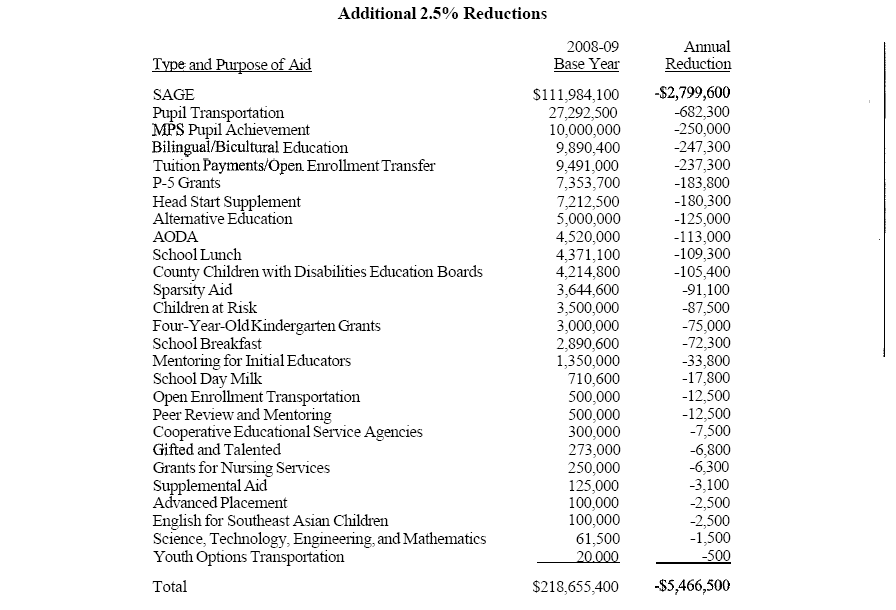
  • 2.5% reductions in categorical aids, see below for the ugly impact

cutsUgly, ugly ugly.  It is all ugly and will get uglier as the implementation of these cuts is debated in districts around the state.

More later, including a fact check to see if total education revenues actually ” increase by approximately 5% on a biennial basis.

Thomas J.  Mertz

7 Comments

Filed under "education finance", Budget, Contracts, education, Local News, School Finance, Uncategorized

Rumors and Deals — Wisconsin State Budget Update

whispering

Legislative “leaders” met behind closed doors for nine hours yesterday, May 27, 2009.  The Committe on Joint Finance is expected to “finish their work” in a public session starting at Noon today.  The agenda is here.

s_handshake3

Because they are meeting outside of the light of public scrutiny and the Legislative Fiscal Bureau has not posted budget papers on the education portion of the “fix,” we have to rely on rumors and memos from interested parties to learn what is happening.  Fortunately, the team at the WisPolitics Budget Blog has been doing a fine job reporting what little is rumored or known.

The big three education developments are some numbers on the Allowable Revenue Limit increase, a suggested compromise/delay on ending the Qualified Economic Offer from WEAC and the first inklings of a compromise proposal on Milwaukee voucher schools from State Senator Lena Taylor.

On the Revenue Caps, the word is that the new allowable increase for 2009-10 will be between $200 and $210 per pupil, instead of the $277 in the Governor’s initial budget.  By my calculations, that means about a $1.7 million to $1.8 million cut for the Madison Metropolitan School District.  No word on further cuts to categorical aid (yet).

The QEO compromise issue is complicated (I am not sure I understand it), but the general idea is that the proposed elimination of the QEO and the changes in arbitration rules would be delayed and temporary reforms would be put in place.  The proposal from WEC also includes things like allowing four year contracts and combining bargaining units.  You can read the WEAC memo here.  I haven’t seen a reaction yet from the Wisconsin Association of School Boards.

Without more details, it is hard to get a handle on Senator Taylor’s proposal on voucher schools.  here is what WisPolitics is reporting:

In February, Doyle called for a series of changes to the program that would require choice schools to meet many of the standards now imposed on public schools. That includes requiring the same number of instruction hours each year as public schools, administering standardized tests, and requiring all teachers and administrators to have a bachelor’s degree.

“What I’ve offered as a modification is really in many ways more stringent than what the governor has done,” Taylor said.

Taylor said today the compromise package had not been drafted yet.

But some key changes to the governor’s proposal include:

*Removing a requirement that schools must be accredited prior to accepting MPCP students, which Taylor said would be problematic for newly formed schools. Accreditation agencies require schools to be operating before they can be accredited. In its place, the compromise would require schools not yet accredited and wishing to enter the choice program to be screened by the Department of Public Instruction to determine whether they have the financial wherewithal to properly operate and have their educational plan and curriculum approved by a pre-accreditation agency. Furthermore, schools would have to undergo yearly academic audits by the accrediting agency.

*Requiring teacher’s aides to have at least a high school diploma, an area the governor’s proposal does not address.

*Giving schools two years before having to administer the Wisconsin Knowledge and Concepts Examination to students, whereas the governor’s proposal would require that to happen within one year.

See more in Milwaukee Notes.

And as the Joint Finance Committee does their work, school districts await the bad news and prepare for more cuts in educational opportunities.

Menasha just got through cutting $1.27 million and agreeing to use over $200,000 from their Fund Balance to avoid further cuts (including maintaining SAGE).  What comes out of the JFC, the Legislature and the Governor’s office will likely lead them to reexamine these decisions look for additional cuts.

The Waupun Area School District has already cut $1.1 million from their 2009-10 budget and anticipate the latest hit from the state will require laying off 12-15 staff members, larger class sizes and fewer opportunities.

Whatever the Governor and his people tell you, the cuts are real.

Stay tuned.

Thomas J. mertz

Leave a comment

Filed under "education finance", Budget, Contracts, education, finance, Local News, School Finance, Uncategorized

Back in Stride — Walk On the Child’s Side Update

From the Wisconsin Alliance for Excellent Schools:

What: 10th anniversary Walk on the Child’s Side

Who: All Wisconsinites who care about their public schools

Where: Walk from the UW-Madison Library Mall to the steps of the State Capitol

When: 11 a.m. on Tuesday, June 16

Make a statement for school-funding reform

* Your legislators will be invited to walk with us. Make sure they are there representing, you, your community, and your children.

* Speakers at the Capitol will include Randy Braun, Walk on the Child’s Side veteran and superintendent of the Cameron School District; Randy Kunsch, CARE member and Walk veteran; Mary Bell, WEAC president; Art Rainwater, former Madison school district superintendent and Walk veteran; and Jennifer Morales, Walk veteran and former Milwaukee school board member. Other speakers, including students, will be added.

* Off-site parking will be available with shuttle buses running to and from the event.

* Bring and sign or banner telling who you are and where you are from. Event organizers will have materials to make signs at the last minute.

* Wear your original Walk on the Child’s Side shirt. Some will be available on a first-come, first-served basis.

A decade after the first Walk on the Child’s Side and 15 years since the state’s school-funding system was passed into law, not much has changed except that the funding crisis has deepened among Wisconsin’s public school children and schools. If you come to Madison for the anniversary Walk, you will make an important statement on behalf of those children, their schools, and all of our futures.

The Walk on the Child’s Side will begin at the University of Wisconsin-Madison Library Mall at 11 a.m. and end at the Capitol. Several speakers will talk about the history of school-funding reform and call for legislative action. Walkers will end the day visiting with their elected officials to ask them to work together for comprehensive reform. What’s new since the last update Sponsors of the 10th anniversary Walk on the Child’s Side are Price County Citizens Who CARE, Northern Tier Uniserv, and the Wisconsin Alliance for Excellent Schools. If this isn’t the biggest and best Walk, legislators and the Governor won’t get the message.

Download a flier here.  Save the date and spread the word!

Thomas J. Mertz

Leave a comment

Filed under "education finance", Best Practices, Budget, education, finance, Local News, School Finance, Take Action, Uncategorized, We Are Not Alone

MMSD Equity Report Due

Logo for the 2008 Minority Student Achievement Network (MSAN) Conference, for more on MSAN click the image.

Logo for the 2008 Minority Student Achievement Network (MSAN) Conference, for more on MSAN click the image.

On June 2, 2008 The Madison Metropolitan School District Board of Education adopted a new Equity Policy (policy here, minutes here, video here). This policy requires a two-part annual report on equity, described as follows:

Reporting

Administration will report on an annual basis to the Board of Education the extent of progress on specific measures in eliminating gaps in access, opportunities and achievement.

Administration will develop an annual report that will provide data on the distribution of staff, financial, and programmatic resources across all schools.

In six days, a year will have passed since this policy was adopted. By the end of that six days, the annual equity report is due.

After all of the work of the Equity Task Force and all of the disappointments — with the Board of Education never even discussing important portions of the Task Force work (and here), and with the Board’s confused and inattentive dropping of the implementation portion of the draft policy (and here) — the only clear victory for the Task Force and Equity was the annual report requirement.

It is essential that this report be issued, be substantive, and be given a thorough examination by the Board and the public.

Although it was an open secret and a common complaint that the previous Equity Policy was never followed, I’m going to take it on faith (for now) that the required report will be issued. I can’t control how the Board treats this report, but I will do my best to raise public awareness and facilitate an examination. That leaves the substance of the report and I have some ideas I would like to share.

In part, as a response to NCLB and state laws, The MMSD administration already issues reports on achievement and achievement gaps. A report on access and opportunities would be something new, and would get to the heart of some of the concepts of Equity put forth by the Task Force and adopted by the Board:

Goals

  1. The district will eliminate gaps in access, opportunities, and achievement by recognizing and addressing historic and contemporary inequalities.
  2. The district will recognize and eliminate inequitable policies and practices at the district level.

Ideally, the first annual report would provide a baseline to assess if progress is being made in access and opportunities.

I would suggest that this portion of the report be as comprehensive as possible, broken down by school and demographics, and place a particular emphasis on access and opportunities for advanced programs or individual work. Evidence of disproportionality is the key. Under state statutes, the district already reports on disproportionality in special education referrals and placements (link to the  PowerPoint presentation because unfortunately I can’t find an actual report on line). This could serve as a model.

The report should include both opportunities (by school) and participation in fine arts programing, world languages, technical and vocational education, remedial and other support opportunities — did you know that at least three elementary schools have no Reading Recovery –, honors, Talented and Gifted (TAG, including In Step referrals and outcomes), accelerated programs, AP, really anything and everything that is outside of the core, basic curriculum. All of this should cover curricular, co-curricular and extra-curricular opportunities and access.

I said above that special attention needs to be given to advanced opportunities. I was twice recently reminded of how important this issue is. The first time was the complete absence of African American and Hispanic students taking the qualifying test for West High School Accerelated Biology. The second time was in an Capital City Hues interview with long-time Madison educator Tenia Jenkins. Ms Jenkins had this to say:

So you set up a mechanism that targets one group and the other groups obviously benefit from it. But there are some groups where that doesn’t happen, for example, the gifted and talented classes in the district. They’ve been around for 20-25 years. And most Black children are still not benefiting from them, only a few here and a few there. So what we are simply asking is for the district to set up the same kind of thing for Black children that they are doing for White students in terms of gifted and talented classes.

The perception and reality is that TAG is (mostly) for “White students.” This must change. One way to start is by forcing the administration, the Board, and the public, to confront the stark data on disproportionate access, opportunities and participation.

The other part of the report involves resources. There is one breakdown of resources in the annual budget, but I don’t believe that this is sufficient for Equity purposes.

There are three things I would like to see incorporated into the resources analysis: an assessment of needs, staffing descriptions, dollar and FTE allocations.

The first would involve some version of the Equity Resource Index/Educational Needs Index developed by previously by the district to distribute resources based on factors that have been demonstrated to negatively impact academic success.

The second should be along the lines of this being a user friendly look at school staffing prepared on Middle Schools in 2006 (link corrected, previous linked document here — TJM, 5/28/09).

Last, budgetary resources need to be considered in terms of both Full Time Equivalent (FTE) and dollars per student. One the most important recent lessons on Equity is that experienced teachers tend to be in lower needs schools, dollar figures for staffing capture some of this inequity because more experienced and better trained teachers rise higher on the pay scale. An example of the latter from 2006 can be accessed here.

These differing versions of looking at resources need to be presented in a manner that makes the relationships among them transparent.

There are other things I would like to see in an Equity Report — such as demographic breakdowns of classroom assignments by school, demographics of requests for inter and intra district transfers and transfers granted — but these fall outside of the report requirements in the policy. You take what you can get.

I’m looking forward to the Equity Report, the discussion it prompts, and (I hope) the actions that come from that discussion.

One last note. I know that much faith has been placed in the current Strategic Planning process, but it would be a mistake if that process supplanted, not supplemented the good work on Equity (and other things) that came before.

Thomas J. Mertz
Leave a comment

Filed under "education finance", Budget, education, Equity, Local News, School Finance, Uncategorized