Category Archives: Uncategorized

Letters to the Editor — School Finance (and the QEO)

image-letter-to-the-editor-stampMany good letters to the editor in response to a recentWisconsin State Journal editorial.

QEO repeal alone would make situation worse

In 1993, Wisconsin adopted a “temporary” formula for funding public schools based on revenue caps, the QEO and a promise of two-thirds funding for education from the state.

Revenue caps and the QEO were set at levels that did not foresee today’s health care and energy costs, or the increasing percentages of students needing services such as special education. State funding falls farther behind the two-thirds goal every year. And under the current budget proposal, we would lose the QEO as well. Revenue caps left alone will not support schools. It will crush them.

It’s time for state government, which created this situation, to take responsibility for solving it. We need a sustainable education system, one that balances the needs of students, teachers and taxpayers.

Simply repealing the QEO will make the situation worse, not better.

— Sherri Swartz, Madison

Today’s schools funded using obsolete system

When I retired in 2006 after a total of over 33 years teaching, 26 of them here, I was earning $47,092, with a master’s degree plus 16 graduate credits, on a pay scale which went no higher than 13 years of experience.

This represents a small annual increase during those 26 years over the equivalent pay scale when I started in 1980 ($18,675).

In what other profession requiring a master’s degree would you expect people to work at those salary rates?

The QEO mandates 3.8 percent. But double digit inflationary increases in health insurance costs eat up most of that.

School districts can’t keep up by financing education mainly with property tax increases. We are trying to pay for education with a horse-and-buggy system. In the 21st century, this simply won’t work. Boomer-aged teachers are retiring, and few young people wanting to survive financially would consider entering such a poorly paid profession.

If you want good teachers, revamp the whole system and control health costs.

— Kay Ziegahn, Richland Center

QEO and revenue caps bad way to fund schools

The QEO does not rise with the cost of living, so teachers are being paid less and less every year. This is unfair, especially for those who have been teaching the longest.

And the revenue caps have caused a lot of damage as well. Several towns have closed schools because they no longer have enough money to run them. Other towns have cut out their sports programs.

And here in Madison, teachers have retired early so younger teachers won’t have to lose their jobs. Programs and courses have been cut, and there is less money for supplies. Computers cannot be upgraded, so they are too slow in some schools.

If we are to keep up with schools around the world, we must eliminate the QEO and the revenue caps. We must fund our schools.

— Genie Ogden, Madison

Reconsider America’s public school concept

As an educator in the public schools, I wonder why it seems like this is a panic. The QEO has been in place since 1993, and this is Gov. Jim Doyle’s second term. There should have been plenty of time to evaluate the QEO and the revenue caps, as well as comparing these to other states.

Wisconsin is not alone in struggling to fund public schools. You can blame it on our “rich” health care benefits, although I’ve never heard GHC referred to as “rich.” Maybe addressing the portion of health care would be reasonable. But Wisconsin cannot expect to attract and keep good teachers if wage increases don’t even come close to the rate of inflation.

People should be reminded that educators not only have a minimum of one degree but must also pay for six credits to maintain the five-year license that we pay for.

It may also be time for states and the Department of Education to revisit the notion of public schools and how to best prepare tomorrow’s workforce. Cutting programs, increased class sizes, fewer technological resources and closed schools is not the answer to funding education.

— Dawn Nonn, Madison

Isn’t it amazing how concerned citizens can so clearly see the need for comprehensive school finance reform, yet our elected leaders seem to be wearing blinders.

Thomas J. Mertz

Leave a comment

Filed under "education finance", Best Practices, Budget, Contracts, education, Elections, Gimme Some Truth, Local News, School Finance, Uncategorized

A Message to State Officials — My Budget Letter

Madison May Day Rally 2009, photo Dace Zeps, click on image for more information.

Madison May Day Rally 2009, photo Dace Zeps, click on image for more information.

There are lots of ways to get a message to elected officials.  You can march and rally, like many of us did on May Day in support of a variety of causes and many more of us will on June 16 to call for long-overdue school funding reform.  You can testify at a hearing like the supporters of the School Finance Network did recently.  You can visit their offices and you can always send a letter.

Here is the letter I sent today.

Governor James Doyle

State Senator Fred Risser

State Representative Mark Pocan

State Capitol
Madison, WI 53708

Dear Sirs

As work on Wisconsin’s biennial budget moves forward, you and your colleagues face increasingly difficult choices.  The current economic crisis and the difficulties you face demand real leadership.

This crisis — in the public and private sectors, at the national, state and local levels – is the product of too many years of looking for quick and easy fixes and savings.  The gimmicks have been exhausted, the savings have been proven illusionary, and the short term view has wrought extensive damage.

It is time to champion a new vision.  Wisconsin needs you to lead the state in a recommitment to a sustainable and progressive system of revenues sufficient to provide the investments in education, social services, health care, and infrastructure necessary for Wisconsin to grow stronger, more prosperous and more equitable.

The Wisconsin Council on Children and Families and the Institute for Wisconsin’s Future have produced a Catalog of Tax Reform Options for Wisconsin.  This document offers many ideas for fair and sustainable revenue policies.  I urge you to put these ideas at the center of your continuing work on the budget.

I am an active citizen, member and supporter of the Democratic Party of Wisconsin.  I have volunteered and donated and even hosted a “Take Back the Assembly” fundraiser in the last election cycle.  I’ve done this because I believed in the Democratic platform planks promising “fair taxation,” full funding of educational mandates, and “access to affordable health care,” and more.  These are the ideas that put you into office.  Now, more than ever you need to put these ideas into action.

As we all look forward to the next election cycle, it may be helpful to think about how difficult it will be to hold on to majorities and offices if all you have to offer is “We survived the economic crisis without too much harm and no fundamental changes in our approach to governance.”  Propping up the status quo also contains risks, but it offers few rewards for the citizens or the Democratic Party.  Change was the watchword last November and the increasingly apparent failures of the old way of doing things have only made the demand for change more pressing.

You are in a position to lead that change.  Please be part of building the future our state needs.

Thomas J. Mertz

Send your own letter (info here, feel free to post it in the comments); join the march and rally on June 16!  Take action!

Thomas J. Mertz

Leave a comment

Filed under "education finance", Best Practices, Budget, education, Elections, finance, Local News, School Finance, Take Action, Uncategorized

School Budget Talk — Gov. Doyle and Sup. Nerad and Others

From WKOW, Channel 27, Madison.

Nobody seems to be saying much about what was discussed, but the little that is being said doesn’t sound good.  In fact, it sounds like Governor Doyle is looking for some cover for his previously expressed opinion that “cuts to education..will be necessary.”

Governor Doyle is wrong.  Cuts instead of investments are both unwise and unnecessary.  In these times of economic crisis, Wisconsin needs bold leadership in order to set a new path toward growth.  It would be a huge mistake to continue along the unsustainable “quick fix,” “no new taxes,” road that brought our state and our nation to the edge of collapse and puts our children’s future at risk.

Let your elected officials know that you would support moving Wisconsin in a new and better direction.

Thomas J. Mertz

2 Comments

Filed under "education finance", Budget, education, finance, Local News, School Finance, Take Action, Uncategorized

The Wisconsin State Budget Question: Who Has a Backbone?

Clockwise: Chironex Fleckeri, Governor Jim Doyle, State Senator Mark Miller, State Representative Mark Pocan.

Clockwise: Chironex Fleckeri, Governor Jim Doyle, State Senator Mark Miller, State Representative Mark Pocan.

Things have been tough with Wisconsin budget and are even tougher after revenue estimates came up about $1.5 billion short.

The talk from Governor Jim Doyle is now of more cuts, layoffs, pay cuts, and furloughs.

Like George H. W. Bush, Doyle suckered himself into a “no new taxes” pledge years ago. Unlike Bush Sr, Doyle hasn’t had the wisdom or the courage to back away from that position. There are a couple of small exceptions like cigarettes and a slight income tax bump in his most recent biennial budget proposal (you know, the one that uses the stimulus money for a big chunk of the school funding and shifts almost all of the revenue cap increase to property taxes), but Doyle has consistently resisted even things like extending the sales tax to personal services. Doyle also seems perfectly satisfied in ignoring the pledges of the Democratic Party of Wisconsin to “fully fund” educational mandates. This isn’t backbone, it is boneheaded.

Charity Eleson of the Wisconsin Council on Children and Families (WCCF) has the right idea:

“We recognize that the shortfall has become massive and that painful cuts are necessary,” said WCCF Executive Director Charity Eleson. “However, the enormity of the deficit demands that we take a balanced approach to filling the gap. It would be a serious mistake not to include revenue increases in the plan.”

….“We therefore call on policymakers to include revenue increases in the mix as they work to address the budget shortfall. Options such as reducing the tax break on capital gains—currently the most generous in the nation—and reinstating the estate tax, to name just a couple, would help minimize the devastating impact of the state’s revenue problems on the children and families least able to weather the bad economy.”

We’ve had too many years of failed policies; too many years of looking for short term gains and savings instead of seeking a balanced approach to sustainable taxation and investment. This economic crisis should be a wake up call. Trying to cut our way out of this crisis will only extend the failure; Wisconsin needs to begin building for the future again.

The WCCF has joined with the Institute for Wisconsin’s Future to research and publish a Catalog of Tax Reform Options for Wisconsin. Urge your state officials to give consideration to these ideas for moving Wisconsin toward fairer, more sustainable revenue sources to fund the investments our state needs.

Two of the key players are Joint Finance Co-Chairs, Representative Mark Pocan of Madison and Senator Mark Miller of Monona. There is a small glimmer of hope, a hint of some backbone, in their recent statements.

The Capital Times recently reported:

Budget committee co-chairman Rep. Mark Pocan, D-Madison, said he wouldn’t rule out any measure to close the shortfall, including the measures proposed by Doyle and possible additional tax increases.

WisPolitics.com quotes Miller saying similar things:

Miller said that there’s only so deep you can cut to programs at a time state residents are struggling and that all avenues should be open, “including the need to look at perhaps revenue increases.”

Miller also said he would “like to look at closing more tax loopholes that remain.” Unfortunately, “he does not anticipate Dem lawmakers proposing an across-the-board sales tax increase.” If you think this or other revenue options are viable ideas, let Pocan and Miller and all the state officials know how you feel.

The WisPolitics.com story also quotes GOP Representative Robin Vos, as saying “he doesn’t think Democrats ‘have the wherewithal’ to make the tough choices necessary to cut spending and balance the budget without raising taxes.”

Vos gets it wrong. In this political climate, it doesn’t take much backbone to cut programs and layoff workers. What takes real courage is to change the conversation and the dynamic, to proudly raise the taxes that need raising, compassionately provide for the people who are suffering and wisely invest in the things like education which will assure a prosperous future for Wisconsin. That takes backbone and heart.

I hope our state officials find that backbone and that heart. You can help by reminding them of what needs to be done. Only they can answer the quiz at the top.

Thomas J. Mertz

1 Comment

Filed under "education finance", Accountability, Best Practices, Budget, education, Local News, School Finance, Take Action, Uncategorized

Obama, Duncan, Gingrich, Bloomberg and Sharpton

sthumb_mega_vomit

First there was “Obama Echoes Bush on Education Ideas,” then “Is Arne Duncan Really Margaret Spellings in Drag?,” followed by a very factually challenged major education speech by the President, reach out from Arne Duncan to Green Dot charter school honcho Steve Barr, the appointment of edu-preneur and Bill Gates bag man James Shelton III as head of the Office of Innovation and Improvement, now comes the news that Obama and Duncan are consulting with Newt “Blame the Unions” Gingrich, Michael “Cook the Books” Bloomberg and Al “Where’s My Check?” Sharpton on education policy (hat tip Peter Rickman, via Facebook).

Education takes some hits in the proposed Federal budget too (DOE Budget Page here).

The image above expresses my feelings better than any words can.

Thomas J. Mertz

Leave a comment

Filed under Arne Duncan, education, Gimme Some Truth, National News, nclb, No Child Left Behind, Uncategorized

Not a Gift Horse; Not Satisfied — The MMSD Budget

mred7vj1

Look me in the eye
Then, tell me that I’m satisfied
Was you satisfied?
Look me in the eye
Then, tell me that I’m satisfied
Hey, are you satisfied?

The Replacements, “Unsatisfied” (click to listen or download).

The Madison Metropolitan School District budget is not a gift horse, it is the product of a state-mandated process by which our elected and appointed school officials — with required input from taxpayers and other community members — arrive at taxing and spending decisions that fulfill their fiduciary duties to provide the best education possible for our children, while being good stewards of the funds in their charge. This year, those mandates and duties are being expanded to include some pledges that were made during this past November’s successful referendum campaign.

It is indeed proper to look very thoroughly into the mouth of this budget, to look at how well it meets it’s mandates, fulfills it’s duties and honors the pledges that were made previously. When I do that, I’m relatively pleased, but I’m not satisfied.

Without dissatisfaction there is complacency and little motivation for improvement. When you aren’t satisfied, you keep dreaming and reaching.

The Partnership Plan and a Broken Promise

As part of the basic proposal of the Partnership Plan, the Board and administration asked the voters to approve a recurring referendum, one that provided less revenue than would be needed to meet the annual budget gaps created by Wisconsin’s broken state school finance system. In return, they promised to find both efficiencies and non- or minimally harmful cuts, to make up the $1 million of the $3 million difference in the budget shortfall. At the time that the Partnership Plan was proposed, the projected budget gap unmet by referendum authorization was about $3 million. By this Spring, other factors had raised this number to $3.9 million. At the same time, a new bus contract saved close to $800,000, so we are back to about $3 million. As part of the Partnership Plan, $2 million in Fund Balance spending (referred to as Fund 10) was promised to “address the remaining” budget gap. Money from the Fund 80 Fund Balance was pledged to minimize tax increases. Initiating a strategic planning project was also part of the mix. This included the creation of the Fund 41, known as the Capital Expansion Fund, that was meant to increase state aid via amortization. It was presented as part of this plan, but since it made sense with or without a referendum, I never thought it belonged; the same might be said for the strategic planning.

All of these concepts, except one, were intact in the initial budget proposal from the administration. The pledge of $2 million from the Fund Balance in the 2009-10 budget was missing. Some further changes in the budget came about due to things like new inter-district transfer estimates. Normal stuff. But quite curiously, the $2 million in Fund Balance money to be used on the education of our children was totally abandoned.

You can interpret this pledge made during the referendum in at least three or four ways. You could believe that the pledge was made to reduce the projected budget gap by $2 million from the Fund Balance.

You could consider it a pledge to limit “same service cuts” up to $2 million in Fund Balance spending. You could consider it a pledge to spend the $2 million, whatever projections and budgeting indicated a “same service” budget would be. You could say that the pledge was maintain the quality of education to the degree made possible by up to $2 million in Fund Balance spending.

By all of these interpretations, excerpt perhaps the last, the pledge was broken. I say perhaps, because the district administration has said that they were able to maintain the quality of education without the money from the Fund Balance; by their own calculations they were not able to meet “cost to continue” without it, but I’m not 100% satisfied this is true (more on this below under “Is the Quality of Education Being Maintained”).

At this point, I want to note that there are good fiscal reasons to maintain or grow a Fund Balance. But it must be further noted that those reasons also existed when the Partnership Plan was proposed. And in the context of that plan, one would have thought that a higher standard would have to be met in order to champion a fiscal position that could trump the pledges made earlier in a referendum campaign.

The Partnership Plan represented an attempt to balance the desires of those of us who would have liked a bigger and better referendum and those who wanted something smaller or no referendum at all.

At the time I thought the compromise tilted too far toward the “small/no” position. The proposal to not use the Fund Balance money tilts it even further in that direction and breaks the trust. Broken trust is difficult to repair. I supported the referendum and worked to pass it. I solicited the endorsements and volunteer efforts of others. The $2 million in Fund Balance spending had a large influence in my commitment; without that pledge I would have supported the referendum from the sidelines.

Last week the Board and administration moved to restore some of that pledge, in a manner that seems to reflect, at least partially, the “spend the $2 million, whatever projections and budgeting indicate about “same service” interpretation.

Some of the Promise to be Restored: “Class and Half Specials,” and “Ready, Set, Go” Conference

At the April 3, 2009 Madison Board of Education meeting they “moved forward” a budget amendment which will put an end to the failed experiment in class and half specials (Art, Music, Phys. Ed.) in nine schools, beginning in the 2009-10 school year (some background here, video of the meeting here, this amendment budget Q & As here). the $1.2 million needed for this fix will come from a combination of the Fund Balance ($500,000) and anticipated revenues from TIF closures ($700,00). This is a very good thing. I’m very glad they are doing this, but I’m not satisfied.

At that meeting the Board also “moved forward” an amendment to restore the “Ready, Set, Go” conferences. The discussion of how to pay for that was not concluded. The initial proposal from Lucy Mathiak to “find the money” by cutting expenses paid for via purchasing cards was ill-conceived. Budgeting should not be done by looking at how things are paid for (p-cards, purchase orders, etc.,), but rather what is needed and what is affordable. Still I am very glad that it appears “Ready Set Go” conferences will be back, but I’m not satisfied. [As of this writing, I cannot find copy of this amendment on the district web site.]

Some people might say that it is proper to say “good work” and “thank you” and leave it at that. I don’t agree. I’m not satisfied.

I strongly support this use of the money to address the Specials mess (and to fund “Ready, Set Go” conferences if it comes to that) and further believe that this budget should include $1.5 million more in Fund Balance spending. This spending could be used to avoid cuts, restore previously cut programs or practices, expand current programs or practices, or initiate new things (see this post and this list for what has been lost over the years).

Is the Quality of Education Being Maintained?

If the definition of maintain is a lack of dramatic, direct cuts to programs and policies, the answer is certainly yes. It is clear that the combination of the successful referendum and adept management have produced a budget that will maintain the same general breadth and quality of education. This deserves respect and applause.

However, the budget does contain some significant cuts from “same service” calculations. Some of these may constitute erosion. Although there are reductions in unallocated positions in elementary and secondary education, these don’t bother me much because of the reduced enrollment projections and the fact that many unallocated positions are maintained. The ones that do bother me are in Education Services (Special Education and English Language Learners – ELL). I’m also not satisfied the “cost to continue” calculation for Vocational Education “Other Expenses” is not a cut in disguise.

By the district budgeting, there is a reduction of 31 positions and $1.8 million dollars in the Education Services budget. That’s a big hit, especially for a department that has taken some big hits in the recent past. One of these positions and $132,000 is through getting rid of a temporary administrative post. That still leaves 30 “unallocated” positions and almost $1.7 million (unallocated means that these are not part of the initial staffing estimates). The administration says “this has no effect on existing programs and services.” I’m not so sure, I’m not satisfied that this will be the case.

To be fair, even with the reductions, the department will gain a net 11.3 FTE. At the budget press conference, there was talk of looking at the initial “cost to continue” request and finding that it was too large and that the reductions in the budget preserved “same service.” I’d like to know more, but a reduction of 30 positions does concern me.

I looked at some old budget material and found that in 2005-6, all of the unallocated special education positions were used (this came in response to a question about cutting 10 positions in 2006-7). In 2005-6 the ratio between Special Education staff FTE and Special Education students was 4.42/1. In 2008-9 that ratio 4.89/1. If the student count remains the same next year, it will be 4.78/1.

I also looked at staffing ratios in ELL. In 2005-6 it was 16.26/1; 2006-7, 17.93/1; 2007-8, 20.51/1; 2008-0, 18.38/1. Again, assuming a constant number of students, the 2009-10 ratio will be 18.50/1. We also know that in 2009-10 the district will have to add one FTE specialist in Arabic and another in French.

Maybe same service in Educational Services, maybe “more with less,” and maybe also a department where we could add something back, as we did with “Class and Half” and “Ready, Set, Go.” At very least, we need more of an explanation than was given in the budget document (none), or at the press conference (little), would be nice.

The possible cut in Vocational Education, “Other Expenses,” is different. On page 93, here you can see that although non staffing expenses for Vocational Education was $481,000 this year and about the same previous years, the “cost to continue” figure for 2009-10 is $299,000. Is this a $182,000 cut? I don’t know, I’ve asked the appropriate people and still don’t know. There may be other anomalies like this that I haven’t noticed.

I don’t know how I feel about the “maintain quality” issue in general. I’m not satisfied either way and when I think about the $2 million that was pledged to do real “same service,” “cost to continue” maintenance of quality, I think that some consideration should be given to chopping that 30 FTE’s down to 15.

Some Concerns about Process

I said at the top that the budget proccess is state mandated. In Chapter 65.90 it is spelled out. One important idea is that the budget must be presented to the public 15 days in advance and that there must be a public hearing before the budget is passed. At subsequent times, the budget may be altered by a super-majority, 5 votes in the case of Madison, and no hearing is required.

As I understand it, public participation is considered to be so important that it is required. The hearing on the MMSD budget is 6:00 PM, May 6 at the Doyle Building (and may be continued on May 10).

65.90 also describes what must be in the budget presented prior to the hearing. It read in part:

(2) Such budget shall list all existing indebtedness and all anticipated revenue from all sources during the ensuing year and shall likewise list all proposed appropriations for each department, activity and reserve account during the said ensuing year. Such budget shall also show actual revenues and expenditures for the preceding year, actual revenues and expenditures for not less than the first 6 months of the current year and estimated revenues and expenditures for the balance of the current year. Such budget shall also show for informational purposes by fund all anticipated unexpended or unappropriated balances, and surpluses.

For some reasons that I understand and for others that I don’t, the MMSD budget does not list all “anticipated revenues” nor “all anticipated unexpended or unappropriated balances, and surpluses.”

As a side note, I also didn’t like the “non binding” budget votes on April 30.

The biggest anticipated revenues are Title I and IDEA monies from the stimulus package. The Federal Department of Education issued estimates of distributions in March, well prior to the publication of the preliminary MMSD budget (remember that this entire budget is predicated on estimates of what the State will do with their budget, what property values will be, how many students we will have, how contract will be settled, etc.,). Madison will get $11.7 million over two years, with, I believe, a bit under half coming in the 2009-10 fiscal year. That’s over $5 million in anticipated revenues that are not part of the budget.

There are good reasons for this. First, it takes time to work this into the budget and figure how to use the money wisely. Second there will be further clarification on the strings attached in the coming weeks (although once the Budget is set and if the “maintain quality” assertions are true, “Supplement not Supplant” issues become moot, it will be by definition supplementary…maybe that’s the point). What is lost is the chance to see the entire budget picture, to see how things fit together within the mandated process. Perhaps a delay to have time to put the pieces together prior to beginning the public process would have been better.

The $700,000 in TIF money is also an anticipated revenue that was not part of the initial preliminary budget (although from what I can gather the district was only made aware of this after the preliminary budget was issued).

The Budget issued also does not contain a clear statement of the projected status of the Fund Balances, whether at the close of the 2008-9 fiscal year or the close of the 2009-10 fiscal year (the latter may be pieced together from the line-by-lines, I believe). As I noted above, there are many factors that could influence all parts of the budget and that certainly includes the bottom line of Fund Balances.

That said, although I am not sure about the legal requirements, I know that this information is required by principles of good governance and due diligence. I’ll add that this information is very much part of the Budget process in districts around the state and was included in budgets Erik Kass prepared in Waukesha.

Without this information, the Board and the Public cannot know how they are managing their assets. They don’t know if they are squandering their savings and risking lower bond ratings and higher interest rates. They don’t know if they are making progress saving for that big purchase (4K anyone?). They don’t know if there is money sitting there doing little or nothing while needs and desires go unmet. The bottom line, the projected Fund Balances should be part of the discussion.

Green Bay, where Superintendent Dan Nerad was in charge, before coming to Madison, avoided many of these difficulties by doing the formal budget process and hearing in the Fall, right before the levy is certified. In Madison we do it in the Spring and then make adjustments to the levy (and other things) in the Fall.

Not 100% satisfied with the process.

Some Other Budget Observations

There are many things in the budget I like, for example two more Social Worker/Psychologists and one more Nurse, are good moves, but I’m not satisfied.

MMSD will be spending about $26,000 to test all 1st graders in order to identify Gifted and Talented students. I don’t like more testing and it isn’t clear what will be done once they are identified. Not satisfied that this is a good idea.

If my calculations, based on the projected decrease in state SAGE aid are correct, next year MMSD will have about 100 fewer SAGE aid eligible students in SAGE funded reduced class size classrooms. Not satisfied with this at all.

The set asides to begin implementation of the Fine Arts Task Force work, the Math Task Force work and the Strategic Planning are fine, although I have my doubts that there is little useful policy recommendations in the Math Task Force Report that will ultimately be implemented.

Closing Thoughts

Dissatisfaction reveals a faith that improvement is possible and is a first step in working toward that improvement. Some may see this as too negative and others may see it as nit picking. That this takes place within a general context of happiness that there are no glaring harmful cuts in this budget should not be lost; that there are only what some may see as nits to pick is in itself evidence that educational quality is not being seriously threatened in the budget.

The opportunity to scrutinize is built into the process, the uncertainty and lack of satisfaction that came as a result of this scrutiny can be healthy, especially if it leads to certainty and improvement.

I don’t expect anything major to change prior to the budget being passed, but I’m still glad I took a close look in that horse’s mouth and reported some of what I saw; I’m glad to communicate that at least some aren’t satisfied.

Thomas J. Mertz
Leave a comment

Filed under Accountability, Best Practices, Budget, education, finance, Local News, Referenda, referendum, Uncategorized

Data _____Decision Making — MMSD Math Task Force Action

WKCE Mathematics Perecentages from DPI

WKCE Mathematics Percentages from DPI

In an earlier post I wrote about the dangerous, counterproductive, if casual racism of the Math Task Force Report and in another I wrote about the almost complete lack of assessment of MMSD Middle School Math teacher knowledge and skills to back up the assertion that “the adequacy of teacher preparation is a significant problem” and the linked recommendation that there be a “substantial investment in mathematics content-based professional development and a change in hiring priorities at the district level.”

On Monday April 20, the Board of Education will likely act on this recommendation, to the tune of $392,500 through 2011-12 1nd a continuing cost of $159,00 annually, thereafter. Before that happens, I think it is appropriate to revisit and expand on the earlier post concerning the treatment of middle school teacher preparation as “the problem” by the Math Task Force.

Before doing that I want to say a few things about the “Data ____ Decision Making” in the title. I’ve always believed in “data informed decision making,” or “data guided decision making” and have rejected the “data driven decision making” because it gives too much power to the in all ways limited data we have to work with, pretends to a false objectivity, when the data itself, and how it is presented, are the products of biases and choices, ignores what cannot be quantified, and marginalizes human feelings and judgment as somehow illegitimate. [For previous related posts, see here, here and here; for similar ideas see Deborah Meier, “‘Data Informed,’ Not ‘Data Driven.’”] Some in MMSD administration and governance (and at least rhetorically the Math Task Force) espouse the “data driven” ideal. In the case of this recommendation, the Emperor has no (or few) clothes, where there should be data to inform or guide, there is a blank, a hole.

I mapped part of that hole in the previous post and I’m not going to do over the details again. Here is the short version. The Task Force was asked to provide (among other things), “A discussion of how to improve MMSD student achievement.” As explored in the earlier post, nationally there has been a lot of heat and some light around the idea that inadequately trained Middle School math teachers are a major problem. They then lazily applied this analysis to Madison.

Finding out if this is a problem in Madison would have been a good thing for the Task Force to do. Instead, they did a very cursory survey of how many middle school Math teachers had a credential that the report itself says needs to be changed and then jumped on the “middle school teachers are the problem” bandwagon. Now the MMSD administration has joined them and the Board is poised to board the same wagon, bringing our tax dollars with them.

As I recommended in the previous post, the first (now next step) should be assessing the knowledge of our teachers via “the materials being developed by the Learning Mathematics for Teaching Project at the University of Michigan or a similar inventory.” Certainly before we commit $392,500 to fixing a problem we should have some idea if there is a problem.

There is another way to see if Middle School Mathematics instruction is the problem and that is by looking at student achievement. Although the report devotes 83 pages to WKCE data analysis, the question of whether the test scores in any way reveal a problem with Middle School instruction is never addressed. From what I can tell, they don’t.

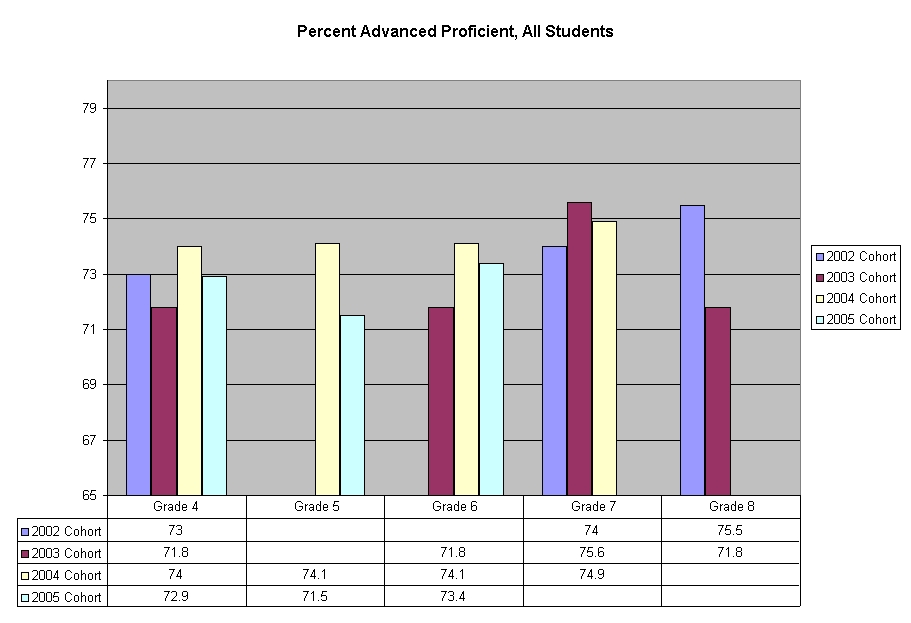
I don’t have access to the scale scores or the grant money or the expertise time the Task Force had, but I did take a look and there were no red flags identifying the Middle School years as being the locus of achievement problems. The chart at the top (and below for your convenience) is the product of my exploration.

WKCE Mathematics Perecentages from DPI

WKCE Mathematics Percentages from DPI

What I did was try to identify trends by looking at cohorts, starting with the class that was in 4th grade in 2002 (the WKCE changed that year and use of prior years for comparisons is not recommended). This chart shows the percentage of students who scored in the advanced or proficient range as they moved from 4th grade to 8th grade. The scores aren’t there for each grade for each year, but this is what we have to work with (informed, guided, not driven). Call it a poor man’s “value added.”

The most striking thing is that things don’t change much from year to year, or cohort or between the cohort. The range of variation is small; from 71.5% to 75.6%.

When we look at the cohorts, the 4th, 5th and 6th grade scores are mostly a baseline and any identification of failures in Middle school would be in the 7th and 8th grade scores. The data is minimal, but in all three data points for 7th grade there is improvement over the previous data point for that cohort and one 8th grade cohort shows continued improvement while the other shows a good sized drop off.

What does this tell us? Not much. What might that mean? To me it means we should know more before we commit to investing in improving Middle School teacher preparation.

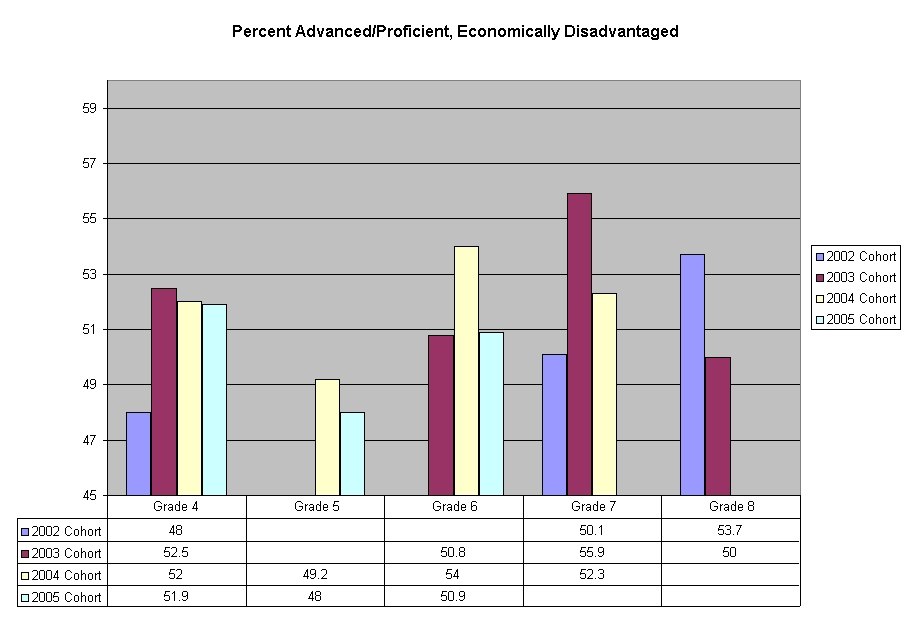
One more chart, because I think we always need to keep inequalities in mind.

ap-econ-dis

WKCE Mathematics Percentages from DPI

Same idea as the other chart, but this time only looking at “Economically Disadvantaged” students. The first thing I notice is how low the percentages are and see yet more evidence that we have a long way to go to eliminate gaps in achievement based on wealth. That this may never happen is no reason to stop trying. Next, again a narrow range, this time between 48% and 55.9%.

Some up and down but I don’t see anything compelling pointing to the Middle School years as the problem.

I did find the 2003 cohort up and down here and for all students intriguing, so I looked at state trends for those years, What I found was a similar if less extreme pattern, which may indicate that it is a product of the test and not a measure of the students. Statewide the 6th grade advanced/proficient percentage (A/S) for that all students (AS) in that cohort was 73%; for Economically Disadvantaged students (ED) it was 53.9%. In seventh grade the A/S rose to 79.1% and the ED to 61.5%. The 8th grade drops were to 75.3% AS and 56.8 ED. [I’d do a full chart, but I don’t have time, maybe in an update later). Data guided or informed, not driven or blank.

One last related note. A good thing about the new governance system in MMSD is that action items are supposed to come before committees a week before the Board acts. No more release of recommendations late Friday for action on Monday. This one didn’t. Last Monday the Board of Education agenda included a 10 page, 13 point “Summary Response” that gave an outline, but few details (Recommendation 3, here). I think a commitment of $392,500 deserves to go through the process.

As the above should make clear, I have serious doubts about whether the commitment of these resources is a good idea and have no doubt that the case that has been made so far, recommending this commitment, is less than weak. I ask that the Board and the administration step back and begin by clearly demonstrating there is a problem that needs to be addressed, and again recommend that part of this be a real assessment of the knowledge and skills of our Mathematics teachers. What will be before the board on Monday is an expensive solution in search of a problem.

Thomas J. Mertz

Leave a comment

Filed under Accountability, Best Practices, Budget, education, Local News, Uncategorized

School Finance Network Assembly Hearing, Tuesday April 21, Be There!

sfn_logo_option_b

The hearing is on the School Finance Network plan, but it is more generally an important opportunity to show support for comprehensive school finance reform.  The lawmakers need to know we care.  Be there if you can!

Details here and below.  The Basics: Tuesday April 21 at 1:00 PM at the Wisconsin State Capitol in room 413 north.

School Finance Network Reform Plan Subject of April 21st Hearing at the Capitol

Statewide coalition of more than 100,000 members announces support for changes to public school funding

Members of the Assembly Education Committee have scheduled a hearing for April 21st at 1 p.m., to consider the School Finance Network’s funding reform plan.

The meeting will be held at the Wisconsin State Capitol in room 413 north, and is open to the public. In addition to members of the SFN coalition, parents, students, educators, and taxpayers from around the state will speak.

The School Finance Network is a statewide coalition of educational, religious, and community-oriented organizations, committed to strengthening the funding system for our public schools.

The School Finance Network plan details how public school districts statewide would benefit through changes that help children with special needs, disabilities and from low income families. It also includes updates to the funding formula for rural districts and those with declining enrollment. The plan also helps maintain classes that help young people to learn skills that can benefit their communities.

The School Finance Network is made up of the following groups: AFT–Wisconsin, the Fair Aid Coalition, the School Administrators Alliance, the South-eastern Wisconsin Schools Alliance, the Wisconsin Alliance for Excellent Schools, the Wisconsin Association of School Boards, the Wisconsin Association of School District Administrators, the Wisconsin Education Association Council, and the Wisconsin PTA

What: Assembly Education Committee hearing on the School Finance Network plan.

When: April 21st at 1 p.m.

Where: Wisconsin State Capitol, Room 413 North.

Thomas J. Mertz

Leave a comment

Filed under "education finance", Best Practices, Budget, education, finance, Local News, Pope-Roberts/Breske Resolution, Referenda, referendum, School Finance, Take Action, Uncategorized

Another District Heading for Dissolution? Give Paris One More Chance

parispantherlogomelt1

Jonathan Richman, “Give Paris One More Chance” (click to listen or download).

Last year it was Wausaukee and Milwaukee, before that Florence; now the Paris District is talking and voting on dissolution (and here).

You can’t say this is a surprise.  The whole way Wisconsin funds education has been accurately called a “going out of business” plan (video here); Prior to the overwhelming defeat of a referendum on April 7, Administrator Roger Gahart warned that a no vote could lead to dissolving the district.

Here is how the situation was explained.

A combination of factors have led Paris into financial difficulty.

The district is considered property-rich under state funding formulas, and has had declines in student enrollment, both factors leading to a steady reduction in state aid. At the same time, state law limits the amount of money districts can collect under the revenue cap, and its expenses have grown faster than revenues.

Paris has cut its budget over the past year, eliminating some staff positions and reducing costs. But the district, with just one classroom per grade level, has little room left to cut…

The dissolution vote is only the first step of  a long process that most often does not end in a dissolution.

Paris is a very small K-8 district, serving less than 200 students.  A case can be made that consolidating with another district would be  best.  Certainly economics should play a role in this decision, yet when you look closely  it is clear that dissolution/consolidation won’t fix many of the problems.

There will be some economies of scale, but the recent cuts in Paris indicate that this potential is limited.

• Reductions in staff for 2008-2009 school year saved $100,240.
• Reductions in staff for 2009-2010 school year projected to be $60,000 to $70,000.
• Total current expenses reduced $121,966 from Fall Budget report.
• 26.5% reduction in supply expenses from 2007-2008 school year to 2008-2009.
• 52% reduction in supply expenses from
2008-2009 school year to 2009-2010.
• Improved energy conservation and building maintenance practices.
• Taking advantage of used, refurbished, and donated materials and equipment.

The district mentioned as possible new homes for the Paris students are Kenosha Unified, Bristol, Union Grove or Brighton.  They all have there problems.

Kenosha is dealing with the aftermath of an ill-advised investment strategy (inspired by the need to do something to try to deal with the broken state finance system), the budget pressures were a major issue in the recent School Board elections, they are phasing out the Music Department and not too long ago faced protests against “excessive budget cuts.”

I can’t find anything on the Bristol or Brighton budgets.  Not much on Union Grove either, except an incumbent Board Member seeking re-eletion saying “school funding” is “the most important issue facing the board.”

If dissolution/consolidation is only a partial and temporary fix, the School Finance Network (SFN) has a proposal that will help all districts in Wisconsin achieve sustainable funding for excellent education.  There will be a hearing on the SFN plan on Tuesday April 21 at 1:00 PM at the Wisconsin State Capitol in room 413 north (more details here).  It is important that there be a good crowd supporting comprehensive reform.  Be there!

Meanwhile, contact your elected officials, the media and get involved (see here for “how to’).

Thomas J. Mertz

Leave a comment

Filed under "education finance", Budget, education, finance, Local News, Referenda, referendum, School Finance, Take Action, Uncategorized

Hit Again (again and again…)

3_21_captain_america

Wisconsin may have dodged the bullet of privatizers in our State Superintendent election, but at the national level the for profit, not the public crowd are going forth with guns blazing.  President Obama, Arne Duncan and their crew are showing themselves to be,  in the words of  Diane Ravitch, “Margaret Spellings in Drag.”

Their latest hire fits the profile.  Education Week is reporting and the the Department of Education site confirms the Broad trained,  former edu-preneur with LearnNow, most recently Bill “Money Talks” Gates bag man, James Shelton III (scroll here for a bio)  is the new head of the Office of Innovation and Improvement.

I guess for at least the next four years “innovation” will continue to mean privatization and profit-seeking and improvement will continue to defined by the Ministry of Truth.

In history, one school of thought holds that industrialists and capitalists came to welcome expanded government when they realized they could “capture” the boards and departments and use them for their own ends.   Think of the fox guarding the hen house.  The Obama crew are not liberators, just a changing of the guard.

As Deborah Meir recently wrote about the mindset that is at work in the corridors of power:

Some combination of Harvard and Wall Street smarts are seen as all-purpose disinterested expertise, fit for any purpose. The master key. While disregard of educators has a long history, and demonizing of teacher organizations is hardly new, it has reached new heights. A mere 20 years ago one could not imagine school systems would be run by people who never practiced or studied schooling or education. The assumption that “smarts” based on hands-on knowledge is valuable has lost its historic place in our view of reality. Law and business and finance smarts have ruled the day for this generation. At a cost. And not just in schools….

Our schools and our economy—and, above all, our democracy—require us to restore the balance.

The Obama permanent campaign will be holding listening sessions in Wisconsin.  It might be worth trying to get in a good word for public education by and for the people, not profit.

Thomas J. Mertz

Leave a comment

Filed under Accountability, Arne Duncan, Best Practices, education, Gimme Some Truth, Local News, National News, nclb, No Child Left Behind, Take Action, Uncategorized