How low can you go? Obama, EduJobs and Food Stamps

Eddie Bo, “Lets Limbo” (click to listen or download)

The latest on the Obama Administration’s ridiculous priorities, from an interview with Rep. David Obey:

We were told we have to offset every damn dime of [new teacher spending]. Well, it ain’t easy to find offsets, and with all due respect to the administration their first suggestion for offsets was to cut food stamps. Now they were careful not to make an official budget request, because they didn’t want to take the political heat for it, but that was the first trial balloon they sent down here. … Their line of argument was, well, the cost of food relative to what we thought it would be has come down, so people on food stamps are getting a pretty good deal in comparison to what we thought they were going to get. Well isn’t that nice. Some poor bastard is going to get a break for a change.

Can’t cut the military, can’t raise taxes on the rich and corporations, need to bail out Wall Street; Race to the Top’s destructive policies are popular with the Newt Gingrich’s we want to apeal to…let’s cut food stamps.

The answer to the titular question is “lower than a pregnant snake’s belly.”

Thomas J. Mertz

Leave a comment

Filed under "education finance", Accountability, Arne Duncan, Best Practices, Budget, Gimme Some Truth, National News, School Finance

Songs for Independence Day

Time for the annual Independence Day AMPS music post (previous years here and  here).

Elvis Presley, “American Trilogy”

Prince, “America”

T-Rex, “Children of the Revolution”

Thomas J.  Mertz

Leave a comment

Filed under AMPS, Gimme Some Truth, Local News, National News

Democrats the New Republicans? Education Policies and Much More

Let me preface this by saying that I am dues-paying member of the Democratic Party of Wisconsin (as well as Co-Chair of Progressive Dane) and don’t want to paint with too broad a brush.  Yet the trends and developments  I see everywhere (and have been seeing for sometime) are too disturbing to ignore.  Democrats are repeatedly championing destructive conservative policies in the service of economic elites while pushing aside both common sense and social justice.  The current GOP extremist obstructionism is beside the point, except that it enables the Democratic moves to the right because with the major parties the choice becomes one of very bad (Dems)  versus unbelievably insanely bad (GOP).

Let’s start with the “EduJobs” Bill.  I think last time I mentioned it, Senator Tom  Harkin and Rep. David Obey were pushing for $23 billion in aid to states to prevent teacher layoffs.  After it was killed, President Obama gave it a push.  This is a classic example of the kind of selective use of Presidential power that Glenn Greenwald has been documenting at Salon.  The progressive positions get the rhetoric, but the conservative policies get the muscle.

The deficit hawks managed to get the the allocation whittled down to $10 billion, but rather than pay for it via more progressive taxation or the kind of deficit spending that Keynesian economics has demonstrated  to be effective in these kind of economic times, there was insistence that cuts elsewhere in education be part of the package (makes me think of the Madison Metropolitan School District budget madness where cuts were justified because  “people are reluctant to pay higher taxes”).

The good news is that those cuts were to be taken from the Race to the Top education deform con game.  The bad news is that all the Education DINOs (Democrats in Name Only) and their allies, are up in arms protesting the cuts to their favored scheme of more Charter Schools, and more tests used for more things (and here and here and here).  This follows their typical union bashing over the distracting issues of which teachers are slated to lose their jobs.  What a spectacle, “Democrats” and self- proclaimed education reformers more interested in destroying organized labor and expanding Bushian policies than in keeping teachers in the classrooms.

Now the biggest Education DINO, President Obama, has threatened to veto the bill if the cuts to Race to the Top remain.

A little break for sanity.  This week the Journal of Education Controversy posted a new critique of the Obama/Arne Duncan education policies from the National Council of the Churches of Christ in the USA.  Here is an excerpt:

We reject the language of business for discussing public education.

Not only has the language of the marketplace entered discussions of school governance and management, but we also notice that the language of business accountability is used to talk about education, a human endeavor of caring. The primary mechanism of the No Child Left Behind Act has been annual standardized tests of reading and math for all children in grades 3-8, followed by punishments for the schools that cannot rapidly reach ever increasing test score production targets. We worry that our society has come to view what is good as what can be measured and compared. The relentless focus on testing basic skills has diminished our attention to the humanities, the social studies, the arts, and child and adolescent development. As people of faith we do not view our children as products to be tested and managed but instead as unique human beings, created in the image of God, to be nurtured and educated.

I want to point out that although comes from a perspective of faith, the values espoused are also in the humanist tradition.

A  side trip away from education to note that the White House and the  Democratic leadership choose to court Scott Brown (R. MA) and  other Republicans by making the financial regulation bill more Wall Street friendly and rejected Russ Feingold’s (D. WI) efforts enact legislation that the banks and the hedge fund managers didn’t like, losing his vote.  This same “leadership” has failed to enact an extension of unemployment benefits.

The links between Wall Street and Education DINOS are many.  Kenneth Libby has started a new site — Democrats for Education Reform (DFER) Watch —  to document these and other aspects of the deform effort.  Some of this has to do with an elitist, technocratic, market based worldview, a desire to tear down a non-market based system of public education that works very well for most American students and communities,  destroy organized labor and a related desire to inculcate students with these values.  Some of it also has to do with the profit motive.  As Juan Gonzalez has reported, the semi-privatization of education via Charters and Vouchers offers wealthy donors significant tax credits (leading to further starvation of the public sector).  Here is a clip from his appearance on Democracy Now explaining how it works.

I can’t leave this topic without checking in again on my favorite Education DINO poster boy, Whitney Tilson.  He’s a DFER leader who also manages investment funds.  The fees from this “work” support a lavish lifestyle, generous political contributions and his extensive education policy advocacy.  Unfortunately for his investors, his funds lose money.  Let’s go to the charts:


Since inception, the Tilson Dividend fund has done slightly better than the NASDAQ and the  Tilson Focus fund slightly worse; both have lost money.  After taxes and fees are accounted for, investors are out even more.  As I said before, you would have done better stashing your money in an old sock than giving it to Whitney Tilson to invest.   As I asked at the same time, why would anyone trust our education system and our children’s futures to the people responsible for the economic disaster, people who have wrought havoc on our society and can’t even show a profit for their clients in the free market they love so well? I don’t have an answer, but like so much else that is wrong with politics it might have something to do with those campaign donations.

I’ll close by noting that closer to home Tom Barrett — the leading Democratic Candidate for Governor — has expressed has more concern for property taxpayers than enthusiasm for fixing Wisconsin’s broken school funding system.

Thomas J. Mertz

Leave a comment

Filed under "education finance", Arne Duncan, Budget, Contracts, education, Elections, finance, Gimme Some Truth, Local News, National News, nclb, No Child Left Behind, School Finance, Uncategorized

On the Agenda — MMSD the week of June 28, 2010

Note: For a while, I’m going to be illustrating the “On the Agenda” posts with various graphs documenting achievement gaps in MMSD as revealed by the admittedly flawed and limited WSAS/WKCE results. I think regular reminders may do some good. Note also the 37% gap here between children in poverty and those more economically secure.

Only two Madison Metropolitan School District Board of Education related meetings this week.

The first is the 4-Year old Kindergarten Advisory Committee meeting 9:00 A, Monday June 28 at 4C (Community Coordinated Child Care) 5 Odana Court.  The agenda consists primarily of updates from the sub committees.  The biggest news on this front (other than all signs continue to point to a 2011-12 start-up) is that a revised  RFP for Community Providers has been issued.

The other meeting is the Ad Hoc Board Committee on Ethics, Noon, Monday June 28, Doyle Administration Bldg., Room 103.  I’ve talked with Board members, heard a short discussion of this at last Monday’s Board meeting, have read the memo from legal counsel distributed at that meeting (but not a draft of  the proposed revisions, if those were distributed I missed them), and am still not clear on what the intent is.

That’s it for this week.  A few notes on related matters.  As of now the Board schedule for July is:

July 6, Ad Hoc Board Meeting (likely more on Ethics).

July 12, Special Board Meeting and Regular Board Meeting.

July 19, Special Board Meeting.

At the June 21 organizational session no decision was reached on committee structures, so for the time being all meetings will be of the full Board, meeting as the full Board.

I hope to use this semi break to catch up with posts on what happened at the last two Board meetings and some other district developments, including a retrospective post on the budget process.

Meanwhile, there is a Board of Education Progress Report out.  Note that as of the date it was distributed (June 21), the statement on SAGE:  “The Board is considering how to handle this change in state funding,” was already out of date.  At the June 14 meeting the Board decided to move the SAGE Block schools to an 18/1 ratio and allocate the remaining SAGE schools with “flexibility” between 15/1 and 17/1.

Thomas J. Mertz

Leave a comment

Filed under education, Local News, Uncategorized

State Superintendent Tony Evers’ Framework for School Funding Reform

Wisconsin State Superintendent of Public Instruction Tony Evers has released a “framework for school funding reform” called “Fair Funding for Our Future” (press release here, DPI page here).  I’m glad that Evers is showing some leadership and it looks like it may be a good framework, but with so few details it is hard to tell.

The one thing I like best is the stated goal of   “a fresh look at school funding and to ensure[ing]that candidates for elected office address school finance in real and substantial terms in their campaigns this fall.”  Evers clearly understands the need for reform and that if legislators and the Gubernatorial candidates don’t make commitments during their campaigns there is no chance that they will take positive action once in office (he probably also understands that even with campaign commitments  there is no guarantee).

The lack of detail works fine for this purpose (lots of detail would work too).  Still, I do think it is worth spending a little time looking at what is and isn’t there and how filling in the specifics could move this in good and bad directions.

Here are the bullet points (there is very little but bullet points):

Creates a Fair and Sustainable School Funding System that:

  • Prioritizes funding for ALL students.
    Provide a minimum level of state aid for every student in Wisconsin, regardless of where they live.
  • Accounts for family income and poverty.
    Use student poverty – not just property value – as a factor in a portion of state aid to schools.
  • Provides predictable growth in state support for schools.
    Increase state school aids and local revenue limits by a predictable percentage each year.
  • Supports rural schools.
    Expand sparsity aid and transportation funding.

Brings Transparency and Accountability for Results to School Funding by:

  • Ensuring state education dollars are spent educating children.
    Allocate the nearly $900 million School Levy Tax Credit into general school aids – a move that does not increase net property taxes statewide, but ensures that significant state financial assistance goes to kids and classrooms.
  • Investing in innovation and programs that show results.
    Consolidate and target categorical aids in ways that encourage innovation and focus on increasing student achievement, turning around struggling schools, and improving graduation outcomes.
  • Protecting Wisconsin students and taxpayers.
    Ensure that no school district faces a drastic reduction in state school aid in any given year.

Before looking at these each in turn it is important to remember that all these moving parts interact and that this is especially important if the total investments are not increased or are increased only minimally.  If the same sized pie is being sliced differently there will likely be winners and losers.    The levy credit move kind of increases the state’s contribution to the pie (or at least moves the state’s contribution from tax relief to education) but doesn’t increase the size of the total funding pie.

Prioritizes funding for ALL students.
Provide a minimum level of state aid for every student in Wisconsin, regardless of where they live.

The first sounds good but is pretty meaningless; the second really depends on what the minimum is.  Under the current system there is a $1,000 per pupil  minimum called Primary Equalization aid.

Accounts for family income and poverty.
Use student poverty – not just property value – as a factor in a portion of state aid to schools.

This could be a big change, depending on the weights given to income and property wealth and depending on whether “family income” for the district as a whole is used or “student poverty” is the measure.  [ Added 8:50 AM, 6-25-10From the press conference reports it is clear that student poverty would be used.  I’m keeping the discussion of using district income because it helps illustrate the complexity of assessing changes to the system] Madison is a high property wealth, high income district with high student poverty.  Last session there was  proposed legislation to move to a solely district income based equalization formula, which  according to this LFB analysis would have resulted in an over  60% 68% loss in aid for MMSD.  In contrast, one based on on student poverty should help MMSD significantly (I haven’t seen anyone run the numbers).

Just a little background on this.  For years the big push to incorporate income in equalization has come from high property wealth districts with many vacation homes but relatively low incomes among year round residents (sometimes called the Lake Districts).  Others, including the Wisconsin Alliance for Excellent Schools and the School Finance Network have concentrated more on including student poverty either in a foundation formula or as a categorical aid.    Further complicating things is the possibility that in some of the Lake Districts, the relatively low incomes might not translate fully into high student poverty as measured by free and reduced lunch counts (and the under-counting of poverty by that measure, especially with secondary students,  is always a factor too).   Many moving parts.

Provides predictable growth in state support for schools.
Increase state school aids and local revenue limits by a predictable percentage each year.

Predictable is good.  But like the 2/3 state funding commitment (however calculated — see the levy credit stuff below), what the legislature  gives, the legislature can take away.

I’m also intrigued by the “predictable percentage each year” phrasing.  Any growth based on income measures, educational costs, cost-of-living…wouldn’t be predictable.  This instead sounds like a call for a guaranteed minimum percent.  If that’s the case, what the percent is and how it relates to costs are the big questions.

Supports rural schools.
Expand sparsity aid and transportation funding.

As a superintendent I know in a struggling, small rural district has been quoting lately “show me the money.”  Inadequate sparsity aid (such as that in place the last few years) only relives a little pressure.  Without some real fixes we will see districts dissolve in the next couple of years.  Taken as a whole, the reforms Evers proposes may stop that from happening, or they may not (too few details, too many moving parts to tell).  I hope they do.

Ensuring state education dollars are spent educating children.
Allocate the nearly $900 million School Levy Tax Credit into general school aids – a move that does not increase net property taxes statewide, but ensures that significant state financial assistance goes to kids and classrooms.

For background on this read Professor Andrew Reschovky’s important paper, “A Critical Review of Property Tax Relief in Wisconsin: The School Levy Credit and the First Dollar Credit.”

If you read the press release or look at the charts posted by DPI (such as the one below), this appears to the centerpiece of the Framework.
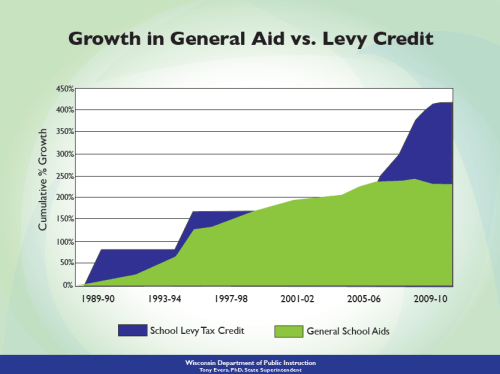
Note the steep increase in the last two state budgets.  As I’ve said before, this gives lie to the assertions by state lawmakers that it is difficult to change the school funding system; these represent significant changes and were easily accomplished.  Few people noticed (Evers was pretty much silent on this and other school funding matters during the  last budget period).

This was so far off the radar that even districts like Madison that benefited from the change did not include the benefits in their budget discussions or explanations (I tried to get them to and if they had figured in the recent credits of about 1.5% for most taxpayers, this may have given them the courage to not under-levy so extremely).

As policy it is kind of  a no-brainer that money called education aid should go to education and not tax relief, but that hasn’t been the case in Wisconsin because tax credits were counted as part of the 2/3 funding when that % was statutorily required and continue to be counted as such in most calculations (including the maintenance of effort calculations in the ARRA and Race to the Top  paperwork it is worth noting).  So I like the policy change of using “education funding” to fund education.

It is also a no-brainer that state education tax relief should not be skewed to the most wealthy districts or individuals.  This is what the levy credit did.

How this money should be distributed is more complicated.

A good case can be made to reallocate to an expanded Homestead Credit and stop calling it education aid.  I’m not going to make that case here, but it is worth thinking about.

Evers is committed to using this as part of a revamped equalization formula.  I think this is in part because it looks like “free money,” in that it allows him to ask to put more state money into schools without asking for new revenue sources via tax reform or something like Penny for Kids. It is worth noting that with many districts under-levying (like Madison) what looks like a lot more money statewide might not end up being that much more money locally (or any more money at all) if when the impact of losing the tax credits is understood districts react by passing levies well below the authorized amount.  A couple of people also pointed out to me that in districts with higher property wealth (and maybe others) this will make passing referenda harder.

[Added 5:15 PM, 6-24-10] Note that Evers’ plan says  no “net” increase in property taxes.  Higher value property owners and higher value districts will see increases or at least the districts will see levy authority to increase if they choose.  Lower value owners and districts will see decreases.   What this does is increase the Robin Hood factor of equalization.  Good in theory, but the primary, secondary and tertiary aid formulas as they now exist (also in theory) take into account some level tax relief via credits.  The formulas also assume something like 2/3 state funding, so maybe none of this matters because they have essentially been junked anyway).  Whatever matters or doesn’t in theory, this change if done in isolation would necessitate sizable property tax increases in Madison (in 2008-9 the levy credits totaled $1,636 per student for Madison, some of this would be offset by the increase in the equalization pool and one would hope a student poverty factor).

How this and everything else plays out depend on all the pieces and how they fit together.  The biggest piece here is the incorporation of some poverty measure in the equalization calculations.

Investing in innovation and programs that show results.
Consolidate and target categorical aids in ways that encourage innovation and focus on increasing student achievement, turning around struggling schools, and improving graduation outcomes.

Buzz, buzz, buzz.  Buzzwords.  All good, but what these innovations are and how results are assessed matter.

On categorical aids, I’m a bit confused by the desire to consolidate and the related decision to push for poverty as a factor in equalization instead of as a new categorical.  I can appreciate the desire to streamline and simplify, but unless you go to a Foundation plan the Wisconsin school funding system will remain a Rube Goldberg machine.

I prefer a Foundation plan, but if that isn’t going to happen, I think more and better categoricals are the best way to get resources where they are most needed and will do the most good.  I get skeptical about proposals that are based the idea that you can better target by using fewer tools to aim.

Protecting Wisconsin students and taxpayers.
Ensure that no school district faces a drastic reduction in state school aid in any given year.

Sounds good, but again depends on what “drastic” means.  Right now the figure is a 15% cut (btw see Ed Hughes’ post today on why that 15% cap on cuts is important when funding is decreasing).  Obviously there has to be some “hold harmless” for any reform proposal to be viable.  Others I’ve seen are literally “hold harmless,” it worries me that even as a Framework this one is “hold from drastic harm.”

Maybe I worry too much.  As more details are put forward we’ll find out if I’m being chicken little.   I hope I am.  I hope that this all fits together in a way that puts our state back on track.  I know that is what Superintendent Evers wants too.  I certainly share and support that desire and appreciate his efforts.

Some links:

Wisconsin State Journal Story

School Finance Network reaction.

Tom Barrett, Scott Walker, and Mark Neumann responses.

Thomas J. Mertz

2 Comments

Filed under "education finance", Budget, education, finance, Local News, Pennies for Kids, Referenda, referendum, School Finance, Uncategorized

A New Blog from Board Member Ed Hughes

Madison Metropolitan School Board Member Ed Hughes has a new blog up and if you care about accuracy in discussions of the district it is a must read (unfortunately many don’t care).

The majority of the initial entries are on the maintenance issues raised in Susan Troller’s recent Cap Times article and the reactions to that article.  There is also a nice piece on the disappearance of the traditional special section in the State Journal recognizing the top area scholars (a section I too enjoyed but also viewed as an annual reminder of our achievement gaps) and a post that notes how the use of the mythical $250,000 house as the basis for property tax comparisons obscures the fact that despite consecutive annual cuts in state aid of 15%, the district-wide tax increase is only 5.76 (as compared to MATC’s 8.94% increase).

This a really good start and I’m glad Ed Hughes is doing this.

Two pieces of  unsolicited advice:  First, give us more links, especially when referencing district documents; number two is harder and something I struggle with, but be careful about assuming what your readership knows and when in doubt err on the side of providing more background.

Welcome and thanks.

Thomas J. Mertz.

Leave a comment

Filed under "education finance", Accountability, Best Practices, Budget, education, Gimme Some Truth, Local News, School Finance

On the Agenda — MMSD Board of Education, Week of June 20, 2010

Note: For a while, I’m going to be illustrating the “On the Agenda” posts with various graphs documenting achievement gaps in MMSD as revealed by the admittedly flawed and limited WSAS/WKCE results. I think regular reminders may do some good. Note also that despite recent progress, 32 point gap remains between children in poverty and those more economically secure.

A busy and important week for the Madison Metropolitan School District Board of Education (all meetings listed here, the only agenda document posted).

The important meeting is tonight’s (June 21).  This has been called a “retreat” and an organizational meeting. Apparently this calls for a change of venue; they will be meeting at 5:00 PM, Lowell Center, 610 Langdon Street, Room 118.  Among other things, this almost certainly means that meeting will not e carried by MMSD-TV.  There are  no public appearances.

Four items on the agenda and no linked documents in the original.

1. Presentation on Parliamentary Procedure

2. Goal-setting workshop surrounding best practices on the work of effective school boards, establishing MMSD-specific goals and mutual expectations to guide the processes by which the School Board accomplishes its work; and identifying specific areas of focus and priorities for the work of the School Board in 2010-2011.

3. Draft Board Ethics Policies (draft revisions to Board Policies 1540 and 9000)

4. Next Steps for Future Board Development Meetings and Topics

What this is all about is what the Board wants to do in the next year and how they intend to go about doing it.  I’ve heard rumors a Five Year Budget project (with a Committee of Board members being formed), a Committee Restructuring, desires to reform the annual Budget Process (Yeah!), and Ethics policies designed limit conflict in public meetings.

I really hate that matters of such import will discussed and perhaps decided without any direct input from the public.  Maybe,  just maybe “stakeholders” would have something to contribute to setting the goals for the Board and the district and maybe interested citizens might have some ideas about how things could be better accomplished.   When things are done in this manner it is hard to take seriously the Board and district’s expressed desires for community engagement.

Other meetings This week:

Tuesday, June 22 MMSD Building Services, 4711 Pflaum Road, Large Conference Room
1:00 p.m.
Collective Bargaining – Exchange of Proposals
Initial exchange of proposals and supporting rationale for such proposals in regard to collective bargaining negotiations regarding the Local 60-Custodial Collective Bargaining Unit, held as a public meeting pursuant to Wis. Stat. §111.70(4)(cm).

Wednesday, June 23, Doyle Administration Bldg.,545 W. Dayton St., Room 103
5:00 p.m.
Special Board of Education Meeting (agenda items 1 and 2 in Open Session)
1. Approval of Minutes dated June 7, 2010
2. Proposed contracts between Google, Inc. and MMSD for the provision of “Google Apps” education edition, including but not limited to “Google Docs” and “Gmail” electronic mail system functionality and services, and for the provision of email archiving functionality and services
Special Board of Education Meeting Continued in Closed Session
3. Review of and Receipt of Advice from Counsel regarding Disciplinary Proceedings and Decisions involving Individual Students, Including a Request for Reconsideration of a School Board Disciplinary Order, pursuant to Wis. Stat. §§19.85(1)(a), (f), and (g); and 118.125 and/or
120.13(1)(e)
4. Employment Matter (the closed session agenda items noticed under this heading shall be begin and be taken up by the Board no earlier than 6 p.m.):

a.Consideration of proposals, if any, to resolve a pending personnel matter involving the contract of an individual employee within a bargaining unit, pursuant to Wis. Stat. §§ 19.82(1) and 19.85(1)(c)
b.  A private conference concerning the renewal or nonrenewal of a teaching contract, pursuant to Wis. Stat. §§ 19.85(1)(b) and (c); 19.82(1); and 118.22(3)

c. Deliberations and determination of action to be taken with respect to the renewal or nonrenewal of a teaching contract, pursuant to Wis. Stat. §§ 19.85(1)(b) and (c); and 118.22(2)

5.  Adjournment or, if necessary, motion to continue the meeting in open session for the purpose specified under item 6, below.
Special Meeting of the Board of Education Continued in Open Session (if necessary) immediately following the conclusion of the closed session agenda
6. Determination of action to be taken with respect to the renewal or nonrenewal of a teaching contract.
7.Adjournment

Thomas J. Mertz

Leave a comment

Filed under Accountability, Best Practices, Contracts, education, Local News, Uncategorized

On the Agenda, MMSD Board of Education, Week of June 14, 2010

Note:  For a while, I’m going to be illustrating the “On the Agenda” posts with various graphs documenting achievement gaps in MMSD as revealed by the admittedly flawed and limited WSAS/WKCE results.  I think regular reminders may do some good.

Last week was Madison Metropolitan School District Board of Education Committee meetings; this week they meet as a full Board and (among other things) take votes on action items.  Prior to the open meeting there will be a closed session to discuss among other things a contract for Google apps (to replace district email with Gmail, this is also on the open meeting agenda with  a price tag, so I don’t know why it is part of  the closed session), the Superintendent Salary (I thought that had been done in closed and open sessions as part of the Budget) and the negotiation strategy for the budgeted pay freeze for support employees.

The open meeting is scheduled to begin at 6:00 PM, in the Doyle Building Auditorium.  It will be carried by MMSD-TV.

Most of the agenda items were before the Committees last week (video here).  I attended most, but not all of that meeting and rather than repeat what I wrote in the preview of that meeting will be just adding a few things.

The meeting kicks off with announcements and recognition of awards and service (full agenda here).  These include the recognition of Sarah Maslin at the end of her service and the installation of new Student Rep.  Wyatt Jackson.

The first policy item is dealing with the SAGE reconfiguration (an unposted document with more info can be found here) necessitated by recent legislation eliminating the waivers for SAGE Block (small classes for math and literacy only).  As I noted before, this has budget implications and should have been done as part of the budget process.  Because of time constraints, this was not discussed last week.

The administration recommendation is to go to 18/1 class sizes in the current SAGE Block schools (Crestwood, Gompers, Huegel and Muir) and make SAGE in the other schools “flexible” with allocations ranging from 17/1 to 15/1.  The allocations used for the recently passed preliminary budget included allocations based on the first, despite the fact that this was never addressed directly in any of the budget documents or open budget meetings.

I’m not 100% clear what “flexible” will mean in practice, but my guess is that initial allocations will be made at 15/1 but instead of new classes being added when September student counts go to 16/1, they will be added only if they go above 17/1.

I don’t like the 18/1 and I don’t like the flexibility.  I’ll add that I don’t like the lack of any consideration of expanding SAGE at any ratio to the three 30%+ poverty schools that do not have it (as allowed under the same legislation that eliminated the waivers).

MMSD can’t plead poverty as a reason to raise class sizes, not  after they left $13.5 million on the table; I’d like to see anyone with a straight face say that this would be a “do no harm efficiency.”  Some great comments on this on the WEAC site, where the Union’s positive spin was rejected by teachers and others.  I hope MMSD also rejects the spin and the changes.

Changes to Internet Access and Student records policies are next.

Then the Superintendent will present a “Protocol for the Evaluation of MMSD Programs.”  This is a step in the right direction.   A couple of things I really like are the collaborative work on research questions and design up front, with extensive Board involvement and that there instead of a promise of quick answers and fixes there is no expectation of any significant changes being implemented till year four of a six year cycle.   If done correctly this could be meaningful, useful and not just an exercise in “See, we are using data” public relations.   I know the Research and Evaluation team would like to do this correctly, let’s hope they are given the resources (along with outside partners), corporations and freedom form political exigencies to do so.

Speaking of public relations, it looks like Supt. Dan Nerad may have enlisted spinmeister James Woods (of Wisconsin Way infamy) to raise money for and draft a communications and engagement plan.  No question that Woods is good at this kind of thing, he has been able to keep a straight face for years while telling the people of Wisconsin that the likes the Realtors, WEAC and the Road Builders are civic-minded,disinterested parties selflessly seeking to change the political culture of Wisconsin for the benefit of all state residents, all the while these same parties have continued to expend obscene amounts of money to advance their vested interests, continued to be the sources of the corruption the Wisconsin Way pretends to want to change.  Yeah, he’s good.

I’d stay as far away from him as possible.   I know PR is PR, but education needs trust, not spin; transparency, not manipulation; honesty above all.  Speaking of honesty, I don’t want to hear anyone say MMSD can’t afford to hire a communications consultant.  They left over $13 million on the table; it was a choice they made not one they were forced into.

The High School Initiatives Report from the Committee meeting is next.  The reports from the individual schools were very positive and inspiring.  Many, many good things going on and more in the works.  Collaboration was a big theme.   The one thing I like the most is the expansion of AVID and the methods used by AVID.  The high school versions of the achievement gap at the top won’t change until “rigor for all” with supports is in place and AVID offers much along those lines.

Student Code of Conduct and Expulsions revisions follow.  There is some new material here on the Code of Conduct, a comparison grid (distributed at the meeting last week) here and a new appendix on expulsions here.  Based on the discussion last week and the new materials much of the discussion will focus on whether bullying is adequately and correctly addressed in the Code of Conduct.   The expulsion plan is based on offering educational services and transition help for students in the expulsion process.

The Annual Strategic Plan Review is next.   This is worth a look, especially for the progress that has and has not been made.   I had some more comments last week.  I want to add that I like there being continued community involvement, but an annual meeting is pretty minimal.  In Green Bay, under Dan Nerad, for a long time after the plan had been approved, there were monthly “strategic plan “work sessions.”

Last week I raised some questions about the budgeted but unspent ARRA items in the Monthly Financial Statements (next on the agenda).  Asst. Supt Erik Kass provided some informal answers.  I did read correctly, there are around $5 million in approved ARRA projects form 2009-10 that have not been implemented, so the money has not “flowed through.’  There are about another $5 million in projects slated for 2010-11 (much of it designated as the second year of a a two year budget).  These look to be good projects and the district needs to get moving on them.  In answer to my other question, it appears that the ARRA things are considered like special grants and are therefore outside the budget process.  I don’t like that and think you could make a very good case that it is a violation of the state statutes governing the budget.  I’m not going to push that case — all this was done in public I don’t think it is worth fighting that fight — but when the budget process spends time on things like food for receptions, I believe these substantial funds and significant initiatives should be included in the discussion.

Lots of bills, contracts, RFPs and the like come next.  Some are consent items, some aren’t.

There is also a revised Human Resources report.  I didn’t take the time identify the revisions.   I think I forgot to note previously that this confirms John Harper as permanent head of Education Services.  The recommendations for administrative non-renewals for Career and Tech Ed Coordinator, Asst. Director of Equity and Parent Involvement, Expulsions and Truancy Coordinator, Library Media Services Coordinator, Fine Arts Coordinator,  Public Communication Director and Legislative Liaison remain.  The budget-related pay freeze is also listed.  In a related matter, a one month extension of departing General Legal Counsel Dan Malin’s employment is recommended, because there is no replacement in place.

I started looking for job ads related to all this.  The General Legal Counsel is here (with a May 31 deadline), the Equity Director is here, Director of Building Services is here, I couldn’t find the new Chief Learning Officer posted (I hope that means that the search is well along), but I did see that the Talented and Gifted Coordinator search has been reopened.

Reports for the Student Senate and Common Council/Board come next.

Next up is the Legislative Liaison on stalled Education Jobs Act (which President Obama gave a belated push to this weekend).  To get involved in the effort, join the Speak Up for Education and Kids Facebook group and current education related Wisconsin legislative studies. I guess our elected officials have to look busy while they ignore the funding crisis they created and proposed remedies like Penny for Kids.

The Google thing/switch to Gmail is last

Thomas J. Mertz

2 Comments

Filed under "education finance", Accountability, Best Practices, Budget, education, Local News, Pennies for Kids, School Finance, Uncategorized

On the Agenda, MMSD Board of Education the Week of June 7, 2010

The 2010-11 budget is mostly finished and the work of governing the schools begins again.  I have a couple of “in the works”  posts on budget things that may never get posted.   The short version is the process is in great need of reform and that when you don’t use over $13 million  of the revenue authority authorized by the state and voters many, many things get much harder (and I can’t think of one thing that gets easier).  The old Pogo phrase “We have met the enemy and he is us” keeps going through my head.  Leaving the budget stuff with  a big thank you to all who testified or contacted the Board.

On to this week’s Board of Education Committee meetings.  They commence at 5:00 PM, Doyle Administration Bldg, Room 103 and should be carried by MMSD-TV.

Student Achievement and Performance Monitoring Committee is first.  After Public Appearances comes a report on High School Initiatives including,

1. Individual Relationships/Engagement/Learning (REaL) School Action Plans for 2009-10
2. REaL District Action for 2009-10
3. American College Testing (ACT) Educational Planning and Assessment (EPAS) Overview and Implementation Plan
4. Advancement Via Individualized Determination (AVID) Overview
5. Individual Learning Plan (ILP) Overview and Implementation Plan

There is so much in the REaL plans that it is hard to grasp and I would think hard to evaluate what works and what doesn’t.  On the ACT, I’m just glad to see something other than the WKCE prominent in the mix.  AVID is  a great program in the Rigor for All, with supports mode.   In theory, I like the Individual Learning Plans, but I’m skeptical about how much individualization can happen when Counselor case loads are so high (300, if I remember correctly).  I fear that this will end up being current practices repackaged and not much of a change.

Student Code of Conduct and Expulsion Process reforms are next.  These are being presented as a greater alignment with Positive Behavior Support principles.  The current Code is here; Expulsions and Suspensions here.  You can compare for yourself.  A proposal to eliminate the Expulsion Navigator position was floated during the budget process.  The administration advised that the $83,000 budget line was needed for the proposed reforms.  The cost of the new expulsion process is $183,732.  This means that one week after the budget vote, there is a request for an amending vote.    There has to be a better way to do budget things.

SAGE options are next.  This is another item that has a potential big budget impact and should have been dealt with as part of the big budget song and dance.   To review, legislation was passed last session allowing SAGE class sizes to increase from 15/1 to 18/1, allowing for unlimited new SAGE contracts in  30%+ poverty schools and eliminating waivers that had been given.  MMSD has/had four schools where there were waivers for SAGE Block (small class sizes in Math and Literacy only).  I believe these waivers were unique and a remnant from when MMSD had extensive locally funded class size reductions.

SAGE block requires less general operating funding than 18/1 and much less than 15/1.  This means that all the options — except increasing class sizes — will cost more.   With no public discussion, the SAGE Block classrooms were allocated at 18/1 in the budget just passed.  No discussion.

The administration is recommending that the current SAGE Block schools go to 18/1 (really an accomplished fact, requiring 5 votes to change)  and that the current full SAGE 15/1 schools be allocated with “flexibility” between 15/1 and 17/1.  It isn’t clear if that was also part of the allocation assumptions in the budget just passed.  There are figures, but no discussion concerning expanding SAGE at any allocation level to those 30%+ schools currently allocated between 22/1 and 26/1.  These figures do not include current allocations.  A document sent to the Board earlier this year has a little more.

Class size has consistently been something community members care about.  maybe that’s why they are doing this after the budget-related public attention has waned.

Internet Access, Student Records and Evaluation of Learning Materials are also on the agenda.

Operational Support is next.

The Monthly Financial Statements (first on the agenda) again include millions of dollars in ARRA projects where the “budgeted” money has not been spent.  I’m not clear if the ARRA money is being treated as “outside the budget” or if it buried in the 2009-10 and 2010-11 budgets.   It is bad policy and probably illegal to not include it as part of the regular budget.  I hope that’s not the case (it was to at least some degree last year, where ARRA was not part of the Spring budget).  I’m also very confused about what “budgeted” means in this context and why this money has not been used, why these projects have been approved but not implemented.

Also on this agenda are lots of contract approvals, including the Global Academy and Human Resources Transactions.   Some of the effects of the Reorganization (and perhaps other things) can be seen in the recommendations for administrative non-renewals for Career and Tech Ed Coordinator, Asst. Director of Equity and Parent Involvement, Expulsions and Truancy Coordinator, Library Media Services Coordinator, Fine Arts Coordinator,  Public Communication Director and Legislative Liaison.  I hope that the last doesn’t mean that in the future MMSD does not have  a lobbyist.  I can see redefining the position, but government relations should remain part of the mix.  MMSD’s voice needs to be heard on a regular basis in the halls of power.

Also in the HR Report (but not in the MMSD Today story on retirements) is the sad news that one of my favorite MMSD teachers — Barb Rubin – is retiring.  Barb is just a great teacher who cared about her students and about equity.  Here are some links to her Classroom Action Research projects.  Congratulations on a fine career.  She’ll be missed.  I also want to express my thanks to another fine educator who is retiring.  Kathy Lyngass staffed the Equity Task Force and earned my respect and affection.  She too will be missed.

The last Committee is Planning and Development.  The only item is a Strategic Plan update.  This includes more on progress than the version distributed prior to the recent Strategic Plan meeting and little or nothing about “narrowing” the goals.

That’s all I have time for…

Thomas J. Mertz

Leave a comment

Filed under "education finance", Best Practices, Budget, education, Equity, finance, Local News, School Finance, Uncategorized

Not Gonna Fly

The Madison Metropolitan School District Board of Education will likely leave over $13 million in revenue authority unused in the district’s 2010-11 budget.

If they prioritize property tax relief over education in this manner, if they do not reallocate a significant portion of this amount to improving our schools, for at least the next year pleading a lack of resources for maintenance as Board Member Lucy Mathiak recently did,  isn’t going to fly.  Citing “resource constraints” as a reason to lower the ambitions for the strategic plan, as Superintendent Dan Nerad recently did, isn’t going to fly.

Any and all resource-based explanations for the relative failure to narrow shameful achievement gaps aren’t going to fly.  Any and all resource-based explanations for lapses in student and staff safety aren’t going to fly.  Any and all resource-based explanations for lacks in curricular breadth and depth, aren’t going to fly.

Finally, any and all appeals to state officials to prioritize investments in education over tax relief, aren’t going to fly.  If you want to talk the talk, you have to walk the walk.

It was failures by state officials that shifted too much of the cost of education to local property taxpayers; failure to reform the school funding system and failure to reform revenue to maintain previous levels of state support.  Madison was hit particularly hard by these failures, leaving the Board with difficult choices (get involved with the Wisconsin Alliance for Excellent Schools and their Penny for Kids campaign to change things at the state level).

Although they have protected core programs and services from cuts, thus far they have not acted as true “guardians of the schools.”  On Tuesday June 1, 2010, they have one last chance to change that.  That same day you have one last chance to let them know that you want want them to change that.

Madison School Budget Hearing
June 1, 2010, 5:00 PM
Doyle Administration Building Auditorium

Show up and testify (suggested talking points here).

Thomas J. Mertz

Leave a comment

Filed under "education finance", Accountability, Best Practices, Budget, education, Equity, finance, Gimme Some Truth, Local News, School Finance, Take Action, Uncategorized