Category Archives: Best Practices

FDR 1938 Speech to the NEA

Franklin Delano Roosevelt’s June 1938 speech to the National Education Association (hat tip, Crooks and Liars).

Full text here; some excerpts:

We have believed wholeheartedly in investing the money of all the people on the education of the people. That conviction, backed up by taxes and dollars, is no accident, for it is the logical application of our faith in democracy.


Here is where the whole problem of education ties in definitely with natural resources and the economic picture of the individual community or state. We all know that the best schools are, in most cases, located in those communities which can afford to spend the most money on them—the most money for adequate teachers’ salaries, for modern buildings and for modern equipment of all kinds. We know that the weakest educational link in the system lies in those communities which have the lowest taxable values, therefore, the smallest per capita tax receipts and, therefore, the lowest teachers’ salaries and most inadequate buildings and equipment. We do not blame these latter communities. They want better educational facilities, but simply have not enough money to pay the cost.

There is probably a wider divergence today in the standard of education between the richest communities and the poorest communities than there was one hundred years ago; and it is, therefore, our immediate task to seek to close that gap—not in any way by decreasing the facilities of the richer communities but by extending aid to those less fortunate. We all know that if we do not close this gap it will continue to widen, for the best brains in the poor communities will either have no chance to develop or will migrate to those places where their ability will stand a better chance.

Make them listen to this in Madison and in Washington.

Thomas J. Mertz


Leave a comment

Filed under "education finance", Accountability, Best Practices, Blast from the Past, Budget, education, Equity, finance, Gimme Some Truth, National News, School Finance, Take Action

Dodging the Bullet — What If Rose Fernandez Had Won

fa2handsome1

Looking for something else, I recently surfed to a page on the Florida Department of Education web site.  What I found there — taxpayer funded links to some of the most notorious right-wing, anti public education organizations — made realize how fortunate we are that Tony Evers defeated Rose Fernandez, that we dodged that bullet.

Here is a partial list of the organizations on the FDE site, with links to information from SourceWatch (SW) and/or Media Transparency (MT) and/or people for the American Way (PAW).

Alliance for School Choice, PAW, SW, MT

Center for Education Reform MT.

Heartland Institute, MT, SW.

Milton and Rose D. Friedman Foundation, MT.

Cato Institute, MT, SW, PAW.

Center for Civic Innovation at the Manhattan Institute, MT, PAW, SW.

The Heritage Foundation, SW, MT, PAW.

Other organizations being promoted by the Florida Department of Education include School Choice Wisconsin and those friends of Rose Fernandez,  the Florida Coalition of Virtual School Families, K12 inc, and Connections Academy (here and here for connections to Fernandez).

We should all be grateful to the voters of Wisconsin that our Department of Public Instruction will not end up fronting for this frightening network.

Thomas J. Mertz

3 Comments

Filed under Best Practices, education, Elections, Local News, National News

Young at Art at MMoCA

Hoi Ming Lee McVey, Quetzal Birds, 2009. Fluorescent tempera paint, permanent marker on brown paper.

Hoi Ming Lee McVey, Quetzal Birds, 2009. Fluorescent tempera paint, permanent marker on brown paper.

The piece above is from a very cool exhibition of art by Madison students at the Madison Musuem of Contemporary Art I saw today today with my sons.  It runs through May 17.  Check it out (details below).

Young at Art
March 15 -May 17 , 2009

Young at Art, presents works of art by Madison Metropolitan School District students in kindergarten through grade 12. Organized biennially, the exhibition is the result of a long-standing collaboration between MMoCA and the school district’s Fine Arts Department…

In preparing for the exhibition, each of Madison’s public school art teachers was invited to submit up to three works created by his or her students. As a group, the works represent a full range of technique, subject matter, and media, including drawing, painting, collage, photography, sculpture, jewelry, ceramics, fiber, and computer-generated art.

Young at Art underscores the value of early and continuing exposure to high-quality art education. The exhibition calls attention to children’s creative potential and problem-solving skills; to the scope and variety of individual expression; and to the excellence of art instruction in Madison’s public schools. All works on view in Young at Art demonstrate students’ imagination and talent, and reflect best-practices in art education.

Thomas J. Mertz

Leave a comment

Filed under Best Practices, education, Local News

April 7, 2009 Referenda Results

From Modern Mechanix (click image for more)

From Modern Mechanix (click image for more)

The results are in.  Good news with Tony Evers, Shirley Abrahamson and Arlene Siveira.  Very mixed results on the school referend in Wisconsin.  Not as bad as February, but many children’s educations will suffer as a result of the losses.

Information on the measures can be found in this previous post and the full report from DPI is here.

First the Non Recurring Operating Referenda where 10 passed and 14 failed.

DISTRICT

Referenda Type

Yes Votes

No Votes

RESULTS

Birchwood (0441)

NR – 2009 – 2011

360

386

Failed

Horicon (2576)

NR – 2009

505

822

Failed

Kiel Area (2828)

NR – 2009 – 2016

887

928

Failed

Loyal (3206)

NR – 2009 – 2012

439

514

Failed

Manawa (3276)

NR – 2009 – 2014

590

937

Failed

Oakfield (4025)

NR – 2010 – 2014

308

344

Failed

Oshkosh Area (4179)

NR – 2009 – 2014

6,872

6,930

Failed

Reedsburg (4753)

NR – 2009 – 2012

999

2,240

Failed

Ripon (4872)

NR – 2009 – 2012

854

1,112

Failed

Wheatland J1 (6412)

NR – 2009 – 2013

363

417

Failed

Albany (0063)

NR – 2009 – 2013

459

333

Passed

Benton (0427)

NR – 2009 – 2012

407

291

Passed

Bowler (0623)

NR – 2009 – 2012

223

216

Passed

Elcho (1582)

NR – 2009 – 2012

800

632

Passed

Herman #22 (2523)

NR – 2009 – 2014

142

137

Passed

Maple Dale-Indian Hill (1897)

NR – 2009 – 2019

809

632

Passed

Mineral Point (3633)

NR – 2009 – 2011

896

592

Passed

Northland Pines (1526)

NR – 2009 – 2012

1,963

1,767

Passed

Oshkosh Area (4179)

NR – 2009 – 2014

7,212

6,624

Passed

Phelps (4330)

NR – 2009 – 2012

378

144

Passed

Phelps (4330)

NR – 2009 – 2012

360

161

Passed

Ripon (4872)

NR – 2009 – 2015

1,077

898

Passed

Washington (6069)

NR – 2009

242

236

Passed

Wisconsin Heights (0469)

NR – 2009 – 2011

1,225

598

Passed

Lots of close votes (6 on Washington Island referendum!) and unfortunately, unless there is comprehensive reform (see below), even the districts where the referenda passed will soon be asking again or heading off the cliff.  Many of the ones that failed will return to the voters, sooner rather than later.

The results for Recurring Operating Referenda were not as good.  7 failed and only 2 passed.

DISTRICT

Referenda Type

Yes Votes

No Votes

RESULTS

Medford Area (3409)

RR – 2010

1,220

2,428

Failed

Merrill Area (3500)

RR – 2009

1,836

3,153

Failed

Middleton-Cross Plains (3549)

RR – 2009

4,963

5,726

Failed

Paris J1 (4235)

RR – 2009

165

512

Failed

Reedsburg (4753)

RR – 2009

1,349

1,907

Failed

Riverdale (3850)

RR – 2009

559

883

Failed

Siren (5376)

RR – 2009

234

418

Failed

North Lakeland (0616)

RR – 2009

839

732

Passed

Reedsville (4760)

RR – 2009

863

554

Passed

The votes don’t look to have been as close. Recurring referenda make much more sense in terms of planning, but for some reason the anti-forces have been very successful demagoguing the concept.

Last the Issue Debt Referenda (building, remodling, upgrading HVAC…).

DISTRICT

Referenda Type

Yes Votes

No Votes

RESULTS

Medford Area (3409)

Issue Debt

1,191

2,505

Failed

Middleton-Cross Plains (3549)

Issue Debt

4,766

5,677

Failed

Middleton-Cross Plains (3549)

Issue Debt

5,008

5,425

Failed

Oshkosh Area (4179)

Issue Debt

3,761

10,124

Failed

West Bend (6307)

Issue Debt

5,632

6,317

Failed

Albany (0063)

Issue Debt

539

257

Passed

Cudahy (1253)

Issue Debt

1,085

1,000

Passed

Elk Mound Area (1645)

Issue Debt

648

413

Passed

Maple Dale-Indian Hill (1897)

Issue Debt

972

465

Passed

Reedsville (4760)

Issue Debt

795

624

Passed

Ripon (4872)

Issue Debt

1,372

616

Passed

West Bend (6307)

Issue Debt

5,971

5,897

Passed

5 yes and 7 no, with mixed results in West Bend.

More votes in Salem and Cuba City later this month and elsewhere — especially where referenda failed —  the axe will continue to fall and AMPS will cover as many of the cuts as we can.

Now the” take action” boilerplate (literally cut-and-paste this time).

This growing reliance on regular referenda is perhaps the clearest evidence that the way our state funds education is broken.  Too much time and energy is being misdirected at securing basic funding instead of educating, too many communities are being split over these votes instead of united to give their children the opportunities to create a better future.

It is well past time to fix it.

Get involved in the effort by attending the April 21, 2009 Assembly Education Committee hearing on the School Finance Network proposal (info here), and joining the School Finance Network and the Wisconsin Alliance for Excellent Schools (it is just fine to do all of the above, I have or will).

Thomas J. Mertz

Leave a comment

Filed under "education finance", Best Practices, Budget, education, Elections, finance, Local News, Referenda, referendum, School Finance, Take Action, Uncategorized, We Are Not Alone

Mayors and CEOs (Chief Educational Officers), Oh My (Oh No)

From the American School Board Journal, circa 1900.

From the American School Board Journal, circa 1900.

Secretary of Education Arne Duncan has announced a new crusade to bring mayoral politics to all big city school districts.

His reasons are spelled out in this NY Post article:

He said mayoral control provides more accountability, stability and flexibility to implement reform.

Duncan — citing improved test scores and graduation rates, more school choice and curbing social promotion.

Currently only seven of the largest districts are under some form of mayoral control.  Not a very big sample size.  Mayoral was tried and abandoned in Detroit and Washington in the recent past and in the distant past it was common.

Never play poker with anyone who lived or worked in Mayor Richard M. Daley’s Chicago — as Duncan did — and can keep a straight face while discussing “mayoral accountability.”  The “Mayor for Life” is accountable to no one.

Yes,  that gives him more stability and flexibility.  The appeals to accountability and stability are contradictory.

In other cities, the mayor may not enjoy Richie Daley’s infinite tenure.  In those places, educational accountability may function but stability goes out the window.  Educational accountability is also present in Board of Education elections and Superintendent contracts and in these cases it is the sole issue; with mayors people vote based on everything from patronage jobs to garbage pick-up.

The record on test-scores and graduation rates is limited and mixed.  Social promotion, I have no idea.

That leaves “school choice.”  Yes, the mayoral educational Czars have liked their charter schools, as does our misguided President and his Secretary Duncan.  I have trouble believing that the core of this is about charter schools, but I may be wrong.

What is clear is that Duncan enjoyed his barely fettered reign in Chicago and doesn’t think any meddling Board members should interfere with the plans of his fellow CEO “reformers.”

That’s one  reason to favor keeping elected Boards in charge.  Inefficiency is part of democracy.

For more see:

Anne L. Bryant, “School board relations: collaboration instead of mayoral takeover is best for urban school districts.”

Harvard Educational Review, Summer 2006, Special Issue on Mayoral Leadership in Education.

Kenneth K. Wong, Francis X. Shen, Dorothea Anagnostopoulos, Stacey Rutledge, The Education Mayor: Improving America’s Schools.

[I’d like to do more with this, but my Internet connection has been in and out, so I’m going to post as is, while it is working.]

Thomas J. Mertz

Leave a comment

Filed under Accountability, Arne Duncan, Best Practices, education, National News

New Links (on the Resources Page)

soo-rings72

From the Magicgallery.com, click on image for more.

Most of the links to blogs and other things are on the AMPS Resources page. I just added some new things that I have found interesting or useful.  Here are the links and some descriptions.

Under Wisconsin (for all state and local things) you can now find, the School Finance Network, the Wisconsin Department of Public Instruction,  the Wisconsin Parent Teacher AssociationWisPoliticsProgressive Dane,  the Wisconsin Council on Children and Families,  and the Institute for One Wisconsin.

The new Wisconsin blogs are MMSD Board Member Maya Cole’s blog and a local Math teacher’s Wit and Wisdom.

New national blogs are Education Notes Online (described as “The education/political scene in New York City and beyond, focusing on the UFT and the NYC Department of Education”); education disinformation de-bunker Gerald Bracey at the Huffington Post, “Education, NCLB, Politics and Humor”  from the Frustrated Teacher; frequent commentator and now occasional blogger John Thompson at This Week in Education; the name says it all for Schools, Society, and the Pursuit of Equity in Education in the U.S;  for the last, three from Education Week, Deborah Meier and Diane Ravitch’s Bridging Differences is always enlightening;  NCLB Act II and Politics K-12 are essential for keeping up on the news.

Under the general resources, I’ve added Gerald Bracey’s Education Disinformation Detection and Reporting Agency and the Coalition of  Essential Schools.

Click around, and feel free to make suggestions via the comments.

Thomas J. Mertz

Leave a comment

Filed under Best Practices, education, Gimme Some Truth, Local News, National News, nclb, No Child Left Behind, School Finance, Uncategorized

MMSD State Budget Advocacy Forum, April 1

Click on image for pdf flier.

Click on image for pdf flier to print and post.

Here are the details in plain text:

State Budget Advocacy Forum

Wednesday, April 1st, 6:00 pm

Wright Middle School LMC
1717 Fish Hatchery Road

Faced with an unprecedented $5.7 billion deficit, the state budget cuts programs all across state government. Come to the session to:

  • Learn how the state budget affects Madison Schools
  • Find out how to advocate for school resources at the Capitol
  • Learn about future prospects for comprehensive school funding reform
  • This brief session will provide you with the tools to advocate for our schools and children.

For more information about the K-12 provisions in the state budget, click here.

Thomas J. Mertz

Leave a comment

Filed under "education finance", Best Practices, Budget, education, finance, Local News, School Finance, Take Action

Dane County Board of Education Candidates

vp052a

From the Cleveland Municipal School District Visions of Democracy - Digital Gallery. Click on image for more.

April 7, 2009 will be a big day for school votes in Wisconsin.  There is the State Superintendent race (I’m backing Tony Evers, for reasons that I hope to have a chance to post on at some length), 41 school referenda in 29 school districts are on the ballot (those posts are in the works, see here for a summary of the measures) and around the state voters will elect their representatives to school boards.  The League of Women Voters of Dane County election guide has been published and posted, with answers from many of the candidates and descriptions of local referenda.

I spent some time going through the candidates answers and was struck by the combination of widespread concerns about the ability to provide necessary and desired educational opportunities under the pressures of budget constraints and by how few pointed to the broken state school finance system as the source of this ongoing situation.

The biggest exception is MMSD Board president Arlene Silveira.  This is what she wrote about the “the major issues confronting your school district, and, if elected, how will you deal with them?”

Equitable school funding system. Unless changed, all school districts will be forced to make devastating cuts detrimental to all students. I will initiate community-based advocacy efforts to work toward changing the funding. Enhancement of minority achievement efforts by improving efforts in schools to raise instruction quality; expanding availability of schooling opportunities and working with community to develop policies that enable all children to begin/attend school on a more even playing field. Ensure we are providing students with skills needed to compete in the 21st century, irrespective of their path. Continue efforts focused on redesign of our high schools. (Emphasis added.)

This is one reason I’m supporting Arlene.  Click on her name above to join me.

Her opponent, Donald Gors is more typical in his non specific reference to financial issues and lack of expressed committment to work for change at the state level:

One large looming issue facing Madison’s School District is MONEY!

True, but not very helpful.

The same is true for most other Dane County candidates who discussed the issue (many did not discuss finances at all or had almost nothing to say — these responses have not been included).  Here is what other Dane County candidates said about school finances.

CHUCK POIRIER incumbent, Deefield:

Expenditures continue to raise and outpace funding. The board and administration need to review funding formula and actual costs per student and determine if the tax payers would incur a tax savings or a tax loss by allowing transfer students from outside our community to enroll in the District.

VICTOR GONZALEZ, Edgerton:

The Edgerton School District will soon be replacing a principal and its superintendent; it will also be facing a significant decrease in its high school enrollment and will have to tackle large maintenance expenses with a tight budget.

JEFF ZIEGLER incumbent, Marshall:

Crafting a budget that meets the needs of our students and allows us to continue to improve the education we provide continues to be a significant challenge. This is especially difficult with state imposed revenue controls. The key to meeting this challenge is to make sure that all of the board’s decisions are made with the goal of providing the best educational experience that we can. The Marshall School District has done a good job of implementing needed changes and improving our educational programs during difficult economic times by keeping this key idea in mind.

Ziegler also refers to the importance of “full funding” for “”bilingual education for all children; b) music and art; c) civics; d) 4-year-old kindergarten; e) preparation for the work force.”

LEE WEINSTOCK incumbent, Marshall:

Tight budgets, academic performance and school safety are top issues facing many schools, including Marshall. I have been a good steward of the school district’s finances in my nine years on the board and will continue to make budget decisions in the interest of what is best for the success of students.

JASON McCUTCHIN, Monona Grove:

One of the major issues for this district is the budget shortage that is forecasted for the next couple of years. Because this is an issue that is likely going to be a recurring issue I would like to see the next board take a hard and fast look at this year’s deficit and see how the decisions that are made this year will affect upcoming years. Additionally, we need to be cognizant of any how any cuts will impact our building infrastructure and the quality of our children’s education.

LIONEL NORTON, Monona Grove:

As a nation we are facing tough economic times and the Monona Grove School District is not immune to this. Our biggest challenge in the next couple of years will be to prevent our district from cutting programs and activities that make our district special and from falling further into debt. I will listen without bias to all ideas and suggestions on the best way to achieve this with the least negative impact to our students and teachers. Neighborhood growth continues to be a challenge for our schools; we must proactively address this issue to prevent overcrowding at our schools.

STEVEN C. ZACH incumbent, Oregon:

Annually the Board must adopt a budget that balances the needs of students, fairly compensates employees, maintains facilities and does not burden taxpayers. We have done that during my Board tenure.

TINA HUNTER, Stoughton:

During this time of uncertain budgets and fluctuating enrollments, we need to maintain opportunities. We must find creative options to meet all District goals while also serving our students and community. School consolidations need to happen logically and painlessly. We must make wise decisions regarding staffing, transportation, and boundaries during this time of transitions.

TERRI WATKINS incumbent, Stoughton (this answer is almost as good as Arlene’s):

Increasing student achievement, recruiting and retaining quality staff and maintaining facilities are all priorities in SASD. The current state funding formula creates challenges to these priorities in districts like SASD with declining enrollment. School consolidation, bussing guideline updates, and enrollment-driven staff reductions will help in the short term. It is important to continue our collaborative work to encourage community growth, energy conservation and educate our community on school funding issues and solutions including pressure to bring legislative change that will provide more long-term financial relief. (Emphasis added.)

TERRY W. SHIMEK incumbent, Sun Prairie:

Property taxes are also an issue, especially for those on fixed income. I would support a solution for the fixed income hardship at the state level. Despite rising costs, my goal is stabilize or even reduce the property tax rate.

JOHN E. WHALEN incumbent, Sun Prairie:

The Sun Prairie Area School district has been both blessed and cursed with a rapidly growing student population. We don’t have to deal with the budget problems associated with declining enrollments, but growth has its own budget issues. Growth has required significant investment in infrastructure, and has required the District to work hard to meet the needs of our student population. I am a firm believer that all children are entitled to a quality education. If elected, I will continue to pursue all opportunities that support quality education for all students.

Two other observations.  First, it appears that incumbents are more likely to “get it” that the budget problems begin with the state system.  Second, despite the facts that about 250 referenda have been held in the last two years and about as many can be expected in the next two years, I don’t believe a single candidate directly mentioned referenda.

Don’t forget to come to the MMSD school funding forum on April 1 to learn more about state funding reform efforts and to get involved.

Thomas J. Mertz
2 Comments

Filed under "education finance", Best Practices, Budget, education, Elections, Equity, finance, Local News, Referenda, referendum, School Finance, Take Action, Uncategorized

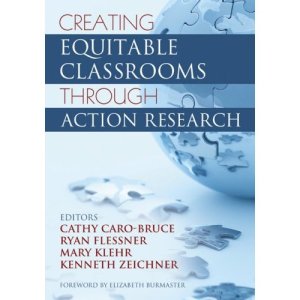
Grass Roots Teacher Devolpment — Let’s Put Classroom Action Research Into Action

Click on image to learn more about this collection of research by MMSD teachers.

Click on image to learn more about this collection of research by MMSD teachers.

Three articles in latest Teacher Magazine Professional Development Sourcebook reminded me of the great and underutilized Madison Metropolitan School District Classroom Action Research work.

One article,  “Putting Teachers in the Driver’s Seat,”  discusses strategies such as  Collaborative Teacher Research,  Critical Friends Groups,  Lesson Study,  Book Clubs,  and the National Board’s “Take One!.”  As the author, professional development coach Anthony Cody,  notes   “There is a great deal of research that shows the most powerful forms of professional development create opportunities for teachers to collaborate and reflect on student learning.”

In the second article, “Grassroots Professional Development,” 2004 Florida Teacher of the Year Dayle Timmons described the multiple forms of collaborative development in use at her Chets Creek Elementary School.  Many of these are similar to those described by Cody.  Reading about Timmons experiences two things stood out.:  First, the very creative use of technology, second, the absolute necessity of sufficient time for collaborative work and planning.

“Teacher-directed professional development” is also a theme of the article “Reinventing Professional Development in Tough Times.”  The article notes that although potentially more effective and less expensive than contracting with outsiders,  internal work isn’t free.   Teachers, whether as leaders or collaborators need release time from the classroom in order to prepare and follow up.

This brings us back to MMSD.  We have an incredibly talented staff, in most schools a climate of professional collaboration thrives, in the classroom action research the basis for great staff development is already in place (take a look yourself, you’ll be impressed).  What is needed is the initiative and funding to put this work to work, to put the action research into action (some of this may be happening, but I can’t find any record and haven’t heard anything).

Fortunately, my reading of the Title 1 guidelines for the stimulus package indicate that this would be an acceptable use of that funding and it also appears to be the kind of project that might be funded via Sec. Arne Duncan’s discretionary “Race to the Top” money.

Wouldn’t it be great to build on MMSD’s strengths these ways?

Thomas J. Mertz

Leave a comment

Filed under Best Practices, education, Local News, National News, Uncategorized

Historian and Citizen John Hope Franklin Dies at 94

jhfportrait

Historian John Hope Franklin died on March 25, 2009 at age 94. Franklin was a consummate scholar, a pioneer in African American history, an engaged citizen and a man of great warmth.  His honors include the Presidential Medal of Freedom,  a MacArthur “Genius”  Grant, The Presidencies of both the Organization of American Historians and the American Historical Association and many more.  I had the honor being mentored by one of his former students, Betty Balanoff,  and of meeting him through Betty.

As important as Franklin’s work has been in reshaping the discipline of history by placing African American history and the history of race at the center of scholarly understandings through such works as ,The Free Negro in North Carolina, 1790-1860The Militant South, 1800-1861Reconstruction After the Civil War, and the continually revised and now standard From Slavery to Freedom ; it is his legacy as a citizen scholar and activist scholar that I want to say a little about.

Actually, I want to start by having Professor Franklin say a few words:

Those in a position to speak for the country and to outline its current mission insist that we citizens are undertaking to share with the world the blessings of a free and prosperous society and to spread democracy throughout the world. Under the most favorable circumstances, this would be a remarkable mission; and it is not too much to argue that these are not the most ideal times for such an undertaking. Before we enter upon such an ambitious mission it is well to remember that we ourselves are still in the process of becoming democratic, and it has taken us more than two hundred years to arrive at this stage.

Franklin’s scholarship is a reminder of our nation’s struggles and triumphs in the process of “becoming democratic” and of the distance that remains.  This scholarship was informed by his own struggles and his own belief in the ideals of freedom and democracy.  The scholarship was also inseparable from his work  as a citizen to move our nation toward true democracy and freedom.  History was a tool for social change.

Franklin wielded the tool of history in many arenas beyond the class and seminar rooms.  He worked with the NAACP legal team on the Brown v. Board of Education case;  he publicly and privately supported Rev. Martin Luther King, W.E.B DuBois, Rev. Jesse Jackson and others in the struggles for racial justice,  testified against the nomination of Robert Bork to the Supreme Court, served as part of the United States delegation to UNESCO and on the National Council of the Humanities, and headed One America (President Bill Clinton’s initiative on race).

The traditions of activist scholarship and scholarly activism that Franklin exemplified are in danger of being lost.  Teaching at all levels is increasingly dominated by the consumerist pressures of vocationalism and entertainment.    Scholarship is increasingly informed almost exclusively by the pressures of tenure where narrow debates within the academy matter more than contributions to furthering social justice.  In the public sphere, simplistic sound bytes take precedence over informed analysis.   Both the academy and the public sphere are poorer because of these developments.

As John Hope Franklin demonstrated, scholarship in general and history in particular have great contributions to make to advancing social justice.   I believe that his life also demontsrates that enagement with contemporary social action enriches scholarship.

On the first day of each class I teach, after covering the official scope and goals of the course, I lay the syllabus aside and confess to students that in my own head and heart, the most important goal is to use the knowledge of history to make them better and more engaged citizens.  When I do this I think of the Betty Balanoff and how her activism, scholarship and teaching advanced the legacy of John Hope Franklin and how I,  in turn am honored to advance Betty’s legacy.

Thomas J. Mertz

Some more links:

Mirror to America:  The Autobiography of John Hope Franklin video at the Library of Congress.

Mirror to America: The Autobigraphy of John Hope Franklin.

UNC-TV Biographical Conversations.

Washington Post obituary.

John Hope Franklin Collection at Duke University.

Leave a comment

Filed under Best Practices, education, National News, Take Action, Uncategorized