Category Archives: Take Action

Chop Chop — Early Cuts Come to Neenah

The Sweet, “Chop Chop” (click to listen or download).

In Neenah, they are getting an early start on cutting programs, services and personnel (read the students’ educational opportunities).  According to the Appleton Post Crescent the Board has enacted over 50 program cuts and fee increases to address an anticipated $2.8 million gap between allowed revenues and projected costs in the 2010-11 school year.  These cuts total $2.7 million, so there are more to come.  Probably much more,because if the legislators don’t address revenue shortfalls (think Penny for Kids), I don’t see anyway that there won’t be a state “budget reconciliation” in April or May, with either lower revenue limits, reduced state aid or (most likely) both.

Let’s look at what got lopped off this round (full administrative analysis here):

  • $628,000 by deferring textbook purchases
  • $240,000 by cutting four teachers at Shattuck Middle School as part of a streamlined house structure
  • $200,000 by cutting five educational assistants for special education
  • $168,000 by cutting three educational assistants and one administrative assistant
  • $162,400 by limiting eighth-graders to one fine arts class and one practical arts class
  • $150,000 by cutting two counselors
  • $100,000 by reducing staff and support for co-curricular activities
  • $80,000 by reducing overtime for hourly employees
  • $70,000 by cutting a bookkeeper at the central office
  • $60,000 by cutting a teacher from the gifted and talented program
  • $60,000 by cutting an academic support teacher
  • $42,000 by eliminating the third-grade strings program from the school day
  • Here are some other figures of interest. 

    If Wisconsin wins a Race to the Top grant and if that grant is funded at the requested level, Neenah will receive $412,938 in funding that can only be spent on programs approved by the Federal Department of Education.

    For the 2009-10 school year, to make up from cuts in state education investment, raised their tax levy $2,184,046 or by 6.8% (calculated from here and here).

    In Madison, a 15% cut in state aid is anticipated for 2010-11 (absent a “budget reconciliation”) and cuts in educational opportunities will likely be $3 million to $4 million range.  Madison has adopted a budget time line, but has not brought the axes out yet.

    There are only one group of people who can reverse the trends playing out in Neenah, in Madison and around the state:  our elected officials in the State Legislature.  There is only one proposal that has any kind of chance at all of making this happen: the Penny for Kids dedicated sales tax for education.  Go to the site and sign the petitionWrite your legislatorsWrite your local paper. Keep in touch with the Penny for Kids campaign on Facebook and Twitter (I’ll confess that I don’t “tweet”).

    Neenah’s early; many, many more cuts in many, many more districts will follow if nothing is done.

    Thomas J. Mertz

    1 Comment

    Filed under "education finance", Budget, education, finance, Local News, Pennies for Kids, School Finance, Take Action, Uncategorized

    (Essentially Nothing) Is This the Best They Can Do?

    Billy Preston, “Nothing from Nothing” (click to listen or Download

    I just read State Representative Kim Hixson’s press release on the passage by the Assembly Education Committee of Assembly Bill 150, creating a state level tax deduction of up to $500.00 for educators who purchase supplies for their students.  This is a fine idea, but really nothing to brag about.

    The logic as I see it is,  A)Public support of education is on the decline (they know this because they passed the budgets and left the “formula” and these are the sources of the decline); B)To make up for the decline educators are reaching in their own pockets to buy supplies (at an average annual rate of $1,752 according to this); C) Therefore we will change the tax code to slightly ease the burden on teachers.

    It get’s worse.  The legislation only applies if there isn’t a concurrent Federal deduction in place, like there has been in recent years and is expected to be in future years.  Thanks for nothing.

    I find it disgusting that this is the best they have done to adequately fund education in Wisconsin.  Nothing.

    Please, remind them they can do something.  The Penny for Kids campaign is the best thing going in this area.  Sign the petition, drop the legislators a note, write letter to your local paper.  Don’t do nothing.

    Thomas J. Mertz

    Leave a comment

    Filed under "education finance", Budget, education, finance, Gimme Some Truth, Local News, Pennies for Kids, School Finance, Take Action, Uncategorized

    Some Leadership in Madison on Penny For Kids!

    On Monday, January 11, 2010, both the Madison Metropolitan School District Board of Education and the Board of Madison Teachers Incorporated acted to support the Wisconsin Alliance for Excellent Schools (WAES) Penny for Kids dedicated sales tax for education campaign!  They showed leadership.

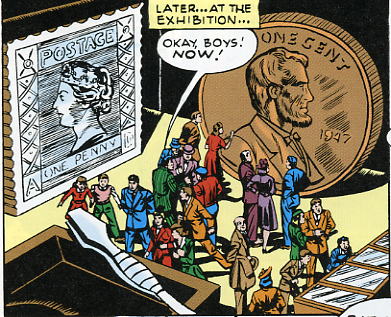
    The district and the union have great track records of being on the front lines of school finance reform advocacy.  Our community has been good too.  We can all be better.  As the comic panel above says “Now!”  If nothing is done, the 2010-11 budgets are going to be bad (a projected loss of 15% in state aid in Madison).

    There will be some opportunities to get more involved soon (stay tuned to AMPS), but for now the simple and almost  painless thing to do is visit the website, learn more, sign the petition and ask others to do the same.  You can also check in with WAES and the Penny for Kids effort on Facebook.  How much easier can it get?

    We now have some leadership; we still need more help at all levels.

    Thomas J. Mertz

    Leave a comment

    Filed under "education finance", Budget, education, finance, Local News, Pennies for Kids, School Finance, Take Action, Uncategorized

    Tax Talk — Are they listening?

    I just did a quick surf of recent news stories and opinion pieces from around Wisconsin and it should be clear to all that our State’s current system of raising revenues and  and funding of essential services (including, but not limited to education services) isn’t working and isn’t sustainable.  Yet nobody in power is talking about this and they don’t appear to be listening either.  Keeping their heads in the sand isn’t going to change the reality and fiddling with things like Race to the Top while the state catches fire is more of the same in terms of questionable short term patches where long-term structural work is needed.

    I’ll get to the clips below, but first a call to action.   The people we elected to state office promised to address these matters, but they haven’t and things just keep getting worse.  With tax collections down 12%, a state “budget reconciliation” is almost certain this Spring.  It will likely entail cuts in state services,  cuts in shared revenue to municipalities and Counties and cuts in state education aid.  Unless there is public pressure it will likely not include addressing the structural problems of an inadequate revenue system.  The only sustained and realistic work being done that puts the structural issues on the table is the Penny for Kids campaign to enact a dedicated sales tax for education.  If you are tired of the way things are going, learn more about the campaign and sign on as a supporter.  Penny for Kids is not the big fix, but it will stop some of the cuts and will move Wisconsin in the right direction.  If you are in Madison, the School Board will be considering a resolution in support on Monday (1/11/2010)  and it would be good to check in with them and let them know your thoughts.  For anyone in the state, contact your legislators and the Governor, write  a letter to the local paper…get active.

    Here is what is happening and what people are saying.

    In Oshkosh, “Crowd tells school board to raise taxes, not cut budget.”  Due to declining state revenues and an inadequate revenue cap, the Oshkosh  district must cut between $2 million and $3 million in programs and services form next year’s budget.  Because  even cuts of this size would require substantial property tax hikes, cuts in the $5 million range and not taxing to the maxare under consideration.  In a promising sign, the crowd was against these further cuts:

    Those attending Tuesday’s meeting spoke out against every one of those options, saying the cuts would dismantle the district’s efforts to improve its quality of education. Most had a special interest such as preserving their home school, keeping equity and stability for students with special needs, maintaining small class sizes. The common thread tying almost all speakers together was a preference for raising taxes over saving money.

    “We’ve been fighting to get the waste out of our schools for what, 10-15 years? There ain’t no more waste, folks,” said Oshkosh resident Thatcher Peterson, who has had two daughters graduate from the district.

    Heidi Supple, parent of a third grader at Lakeside Elementary, said, “I don’t know about your stocks or your IRAs, but everything is down right now. If I’m going to invest in anything, I’m going to invest in our children.”

    Madison and many others districts did not tax to the max last year.  This may become an annual controversy.  Without state level revenue reform it will spread.  Local School Boards are caught in the middle.

    Fewer details, but similar issues are playing out in Neenah.

    The Neenah school board faced a huge crowd Tuesday night after announcing nearly $3 million in budget cuts some parents fear are too steep.

    The cuts include 26 jobs — 16 of them are teaching positions — eliminates a popular elementary strings and band program, reduces funds for special education, and limits arts options for eighth-graders.

    The standing room only crowd on-hand was trying to persuade the school district not to make drastic cuts. Still, school board members say there’s just no money.

    Penny Paiser-Wilson’s elementary music class is on the front line of the budget deficit. It’s one of many cuts being proposed by the Neenah Joint School District for the Fall of 2010.

    And at the end of the story, this line:  “The school board president says the deficit is due to a drop in state funding.”  He got that right.  Statewide, state created problems call for statewide, state created solutions.  Raising local property taxes even more is not the answer.

    According to Jonathan Krause, the Wisconsin Covenant — a promise of a college education to all those who qualify — is $2 billion in the red.  First they break the “New Wisconsin Promise” of  “A Quality Education for Every Child” along with numerous campaign promises about education, services, tax fairness and sustainability, but this wasn’t enough.  They had to raise kids’  hopes, get them to sign  a pledge and then break that pledge.   Nice.

    It isn’t just education.  Library budgets are precarious as this letter from Stevens Point documentsChris Liebenthal reports on the decline in Milwaukee Co.  parks due to budget cuts here.   County budgets cut human services, cities struggle to plow the streets…and our state officials — the only ones who can do something about arresting this decline  — spend their time and our tax dollars making Cheese the official state snack.

    There is a good overview from the Milwaukee Public Policy Forum.  They share my sense of urgency:

    So what does this mean for state, county and municipal officials in Wisconsin? It means that the fundamental problems that have created persistent and growing structural deficits at the state, Milwaukee County and City of Milwaukee will not magically disappear and must be the subject of equally persistent focus in 2010.

    Are our elected officials paying attention?

    In closing, Dave Zweifel has a great column on the need for revenue reform.  I’m not sure I support all that is being proposed, but these ideas (and others, including Penny for Kids) deserve consideration — something there is no indication will happen unless the public pressure mounts.  Here is a long excerpt:

    Gary Bahr of Belleville should have been elected to the state Assembly when he ran for the western Dane County seat back in 1994.

    The retired small-town banker is one of the few who has consistently challenged our legislators to think outside the box about taxes. He rightfully insists that the state should completely scrap its present tax system and start over with one that makes sure everyone except the very poor pays a fair share of taxes.

    Instead, state government keeps the same broken system in place, tinkering on the edges every budget year and in these hard economic times unconscionably pushing a bigger burden down to the local level, where the regressive property tax is already chasing people out of their homes. In the end, everything stays the same, even the deficits. And now comes the news that legislators have cut back on reimbursing local governments for the services they provide state buildings — a move that puts another $4 million on the backs of Madison property taxpayers alone.

    For two decades now, Bahr has been urging the Legislature to take our public schools and county governments off the property tax. Taxes on property ought to be used strictly for municipal services like police, fire and garbage pickup. And everyone who benefits from the services, including churches and nonprofits, would pay property taxes, which he estimates would be about 85 percent less than they are now.

    If you care about the state, our children and the future;  get involved, do something to make our elected officials back up their words with real positive action.  If they won’t,  help elected people who will.

    Thomas J, Mertz.

    Leave a comment

    Filed under "education finance", Best Practices, Budget, education, finance, Local News, Pennies for Kids, School Finance, Take Action

    WAES School-funding Reform Update, January 5, 2010

    From the Wisconsin Alliance for Excellent Schools.  Table of contents below; pdf of full update here.

    * Sign petition urging legislators to consider “A Penny for Kids”
    * Governor’s school-funding reform … raise property taxes?
    * UW education dean wonders if a “Race to the Top” is what is needed
    * Neenah, Stevens Point deal with school budget deficits
    * School-funding formula is moving the pain around the state
    * New school but old funding problems for Greenfield
    * Greenfield joins WAES, but your help is needed
    * School-funding, education reform forum set in Middleton, Jan. 28
    * Rep. Mark Pocan talks funding reform in the Lions’ Den
    * Gazette surprised Wisconsin spends less than average on schools
    * IWF, WTA note drops in Wisconsin’s spending and taxing ranks
    * New report says better early education would benefit the economy
    * Correction to an earlier story
    * Help WAES correct e-mail update glitch
    * School-funding reform calendar

    You can now connect with WAES on Facebook!  If you haven’t yet, take a few minutes to learn about Penny for Kids and sign the Petition here.

    Thomas J. Mertz

    Leave a comment

    Filed under "education finance", Arne Duncan, Best Practices, Budget, education, finance, Local News, Pennies for Kids, School Finance, Take Action

    Mark Pocan in the Lions’ Den — Last Monday’s MMSD Board Meeting

    State Representative Mark Pocan met with the Madison Metropolitan School District Board of Education on Monday, November 30 to discuss “K-12 Funding in Wisconsin and the Impact of the State Budget on School District Finances.”  (State Senator Mark Miller, who was also expected, was ill, Liz Stevens from his office attended in his stead).  The short version of what transpired is that although Pocan brought Bob Lang and Dave Loppnow from the Legislative Fiscal Bureau as support, they were unable to “shut the lions’ mouths” and the Board got a few nips in.  Beyond that, Pocan explained the intent and context of the budget “fix,” emphasized the importance of addressing revenue issues, gave some thoughts on school finance reform, defended parts of his record and more-or-less split the blame for everything bad between Governor Jim Doyle and the economy.

    I have to give Pocan some credit and respect for facing the lions and for being very forthright and forthcoming.  I’ll even go beyond that and say that when he was talking about what can and should be done and why, he showed understanding and that he cared.  It was words, not actions, and I want action from my State Rep.. But at least he didn’t shut the door on action.  Let’s help him open that door (more on that below, but think Penny for Kids).

    You’ll have to rely on my memory and notes for the longer version, because as I anticipated, the meeting was not broadcast or recorded (Susan Troller, whose story inspired the meeting, was there for most of it, but I don’t think it is the kind of story that the Cap Times covers these days).  That’s too bad, because some interesting and maybe important things were said.

    Pocan began the meeting by asking to speak separately about the recent state budget and school funding in general (or what he refers to as “the formula”).  This division was mostly followed, but the two cannot be absolutely separated.  One big link between them, and an issue that came up again and again, was revenues.  The recently completed state budget was made tough because of a lack of revenues; positive school finance reform requires adequate, sustainable and equitable revenue sources.  Pocan said as much more than once.

    The 2009-11 State Budget and the “Fix”

    During the discussion of the state budget, most of the talk was about about the “fix” that came after the April revenue numbers called for further cuts.  The fix included $147 million in cuts to school aids. This was dampened partially through an attempt to share the bleeding, by including provisions to limit resulting cuts to 10% for any particular district.  Madison’s overall cuts came in at about 15% and people were not happy.  According to Pocan, the 10% figure only applied to the new cuts caused by the $147 million loss and not the aggregate cuts from the entire state budget.  Fair enough, and yes, some of the displeasure was due to a misunderstanding of this distinction.

    But really this was, and is, a distraction.  Most of the displeasure wasn’t about how the last round of cuts were handled.  It really was about how much total money was invested in education; capital provided at levels well below cost-t0-continue; and a cut in state aid, while, at the same time, big property tax increases were passed on to many school districts.

    On both the big picture and on the particulars of the “fix,” the issue is revenues.  Pocan talked a lot about revenues, tax fairness and tax reform.  He said good things.  He made the point multiple times that if the discussion of taxation and revenues had been left to the Grover Norquists of the world, then public education, and much of the other good that government does, would continue to die the death of a thousand cuts; the “beast” will be starved.  He’s right.  It is happening everyday.

    He also defended his record and the recent state budget by pointing to the tax increase on the highest earner bracket, the closing of the so called Las Vegas loophole, and some improvement on capital gains taxation legislation.  All good and Pocan does deserve credit.  Still, at the end of the day, our state was left with a budget that did not adequately fund education and other essential investments and is not sustainable. The thinness of the hopes Pocan expressed about the prospect of avoiding a budget reconciliation after the April 2010 tax collections — translate as more cuts — is sufficient evidence that he knows this isn’t sustainable.

    Doyle No Friend of Education

    It was on the topic of revenues that Pocan threw Governor Doyle under the bus, repeatedly.  Most of this happened in the context of the budget “fix.”  Because much of what Pocan described occurred in private conversations and the Caucus meeting where Pocan’s and Doyle’s position may have been discussed with other Democrats, and were closed to the public, we have only Pocan’s word to go on.  Pocan’s version does agree with the public record (as far as that goes) and also explains Doyle’s contemptuous dismissal of calls for a more public budget process.  I believe him, but continue to think that the more that public policy making occurs in public the better.  Voters shouldn’t be left with any doubts about things this important.

    The story, as Pocan told it, is that when the April, 2009 revenue shortfall happened, Doyle was in public and private talking about 5% or greater cuts in school aids (shared revenues for municipalities were also discussed,  but this is an education blog so I’m leaving that out).  Pocan said they (Miller, and maybe others implied, but Liz Stevens didn’t confirm that) met with Doyle and pushed to have new revenues as part of the fix.  Pocan seemed to favor the expansion of the sales tax to cover services (what I think of as the Erpenbach proposal from a few years ago) and more action on capitol gains, but he may have also had other things in mind.

    Shortly thereafter Doyle made a public statement that as far as he was concerned, revenues and tax reform were off the table as part of the solution.  Pocan says that, as Doyle was making the statement, he became so angry that he called the Governors office to cancel their next scheduled meeting.  Good for Pocan — at least in private he showed some backbone.  It would have been nice if he’d showed it in public at the time.

    As Pocan described it, the choices were limited.  The possibility of overriding a Gubernatorial veto was nonexistent, so all they could do was negotiate.   Apparently the 10% cut ceiling was part of these negotiations.  The “balance” between state aid and revenue limits was also part of the negotiations.

    Later, when asked by Board member Beth Moss about the lowering of the revenue limit increase — from $280 to $200 —  that was also part of the “fix,” Pocan revealed that in exchange for a higher revenue limit, Doyle demanded at least a 4% cut in state aid; the $200 limit increase came with with only a 2.5% cut in state aid.

    When Bob Lang joined the conversation to explain that the desire was to limit property taxes, Pocan stepped in to make a point that this was part of the Governor’s agenda, not the Democratic Party, and added, “The problem is when we take the Grover Norquist part of the debate we can’t talk about it …. tax fairness, … we need a civic debate about revenue.”

    Pocan ended the exchange saying “Schools did way better than if the Gov had sole control.”  Keep all this in mind next time Doyle prefaces his Race to the Top (RttT) inspired proposals with references to his record as a friend of education.

    School Finance and Reform

    From there it was on to a more general discussion of school finance.  Pocan hit all the usual notes about the complexity of the system, how tinkering can create unintended consequences, how any change may have winners and losers, and the political difficulties of that, and made generally discouraging noises about the difficulty of real positive change.  There wasn’t much new here, but there were some things I’d like to highlight.

    First and foremost is Pocan’s championing of tax reform and the need to talk about revenues.  This is great to hear.  I do think he gets it, and expect to hear more from him on this in the coming months. I have some small hope that the talk will be linked to action.

    Pocan spoke from the heart about the needs of students in poverty as well as the diverse needs of other students and displayed his understanding that any positive reforms must address these needs, either via categorical aid or a foundation plan.  The positive duty to address the needs of these students highlighted in the Vincent v. Voight decision also makes this is a Constitutional matter.  It is also the wise and right thing to do and it was good to be reminded that Representative Pocan knows that.   This of course requires investments and revenues.

    His repeated references to Andy Reschovsky were also heartening.  I like Andy and think he is one of the best experts on taxation and school finance that Wisconsin has.

    Pocan also expressed the view, held by many, that school finance reform needs to be done as a stand alone, not as part of the biennial budget process.  That means that now is the time to get moving.

    In response to Lucy Mathiak’s query about just that point — why isn’t there movement, if now is the time? — Pocan said that “The executive [Governor Doyle] has things stalled around the MPS restructuring.”  I tell you, Doyle’s RttT lottery ticket purchase proposal is the gift that just keeps on giving.

    School Board Members React

    At this point Superintendent Dan Nerad and the Board asked questions and made comments and engaged in some back-and-forth with the guests.  Before covering a little more of what was revealed, I’d like to offer some words from the Board to give the tone of their reactions.

    Beth Moss  — “This is difficult to swallow and really quite ridiculous.”

    Lucy Mathiak — “I didn’t ask about the Executive level, I asked about you…somebody has to start.”

    Marj Passman — “Show courage.”

    Maya Cole — “What kind of economy are we growing…we have to invest in the future.”

    Johnny Winston Jr. — “I’m disappointed, a couple of years ago when we were talking about closing schools, you sent us a letter and told us not to, that if the Democrats were to gain control you’d fix this … Madison is changing, has changed, and if we can’t afford to maintain schools and education it will keep changing till it is like Milwaukee … what do you tell a middle class family thinking about moving here when they ask about cuts to education?”

    As I said at the top, they got some nips in and maybe broke some skin.  Good for them.

    Equalization, Equity and Tertiary/Negative Aid

    There was a strange set of exchanges inspired by Ed Hughes’ complaint about tertiary/negative aid (whereby Madison and other high spending districts lose progressively more state aid the higher they spend).  What was strange to me was that everyone seemed hostile or confused about the basic concept that this is a way to equalize educational opportunity across the state, that it is important that kid’s futures are not determined (or less prescribed) by where they live.  I think how Wisconsin implements this policy could be improved, however, I retain my belief in the goals and ideals of this policy.  There have been complaints about this for years; the complaints may be louder this year because the cuts in state aids have further exacerbated this and other flaws in our school finance system.

    Of course, as Dave Loppnow pointed out, negative aid is also intended as a disincentive to raise property taxes. However, in practice, I’m not sure it works that way, because when a district like Madison goes to referendum, it includes these costs into their calculations and in fact asks for a higher amount, i.e. higher property taxes.  This makes it harder to pass referenda, but they do pass and at higher amounts.

    Loppnow also conjectured that because revenue caps already limit property taxes, this disincentive was not necessary.  That may be true. But it is also true that the combined disincentives have not equalized spending and opportunities around the State.  Something has to be in place to make sure the opportunities for kids in Whitefish Bay and Rhinelander are at least in the same ball park.  That means either much more state aid via a foundation guarantee or some form of negative equalization.

    Ed Hughes asserted that there was “no necessary connection between property value and willingness to spend.” I’m not sure this is true and intend to run some numbers — when I find the time —  the Lake Districts and some others obviously support this idea, but in the aggregate it might not be the case.

    Either Lang or Loppnow responded, in part, by saying that attempts had been made to use income instead of property wealth in equalization and that “it didn’t work.”

    I’ve heard this from others, but have to ask: What we are doing now doesn’t “work” either, so what do you mean when you say it doesn’t work?  Is this timidity and inertia or a real analysis?

    This and That

    A few more observations:

    A Penny for Kids — Prospects and Action

    Despite the relative silence on the topic, I left the meeting feeling a little better about the prospects of the Penny for Kids campaign (although not any better about the prospects of full comprehensive school funding reform in the near future).

    I heard one of the legislative leaders say repeatedly that revenue options need to be on the table and advocated for. Penny for Kids is a viable revenue option, it is gaining support and nobody else is talking revenues.  If Pocan was sincere, he has to give the proposal serious consideration and should give it his support.

    I heard one of the legislative leaders speaking about the need to fund the education of children in poverty.  Part of the Penny for Kids proposal creates and funds a categorical aid for low income students.  The proposal also increases aid to other high needs students.  If Pocan was sincere he should embrace these positive steps toward comprehensive reform.

    Mostly I heard a legislative leader who was frustrated and looking for a way to help the schools, to do something he believes in (he was a bit defensive at times as well).  Penny for Kids is a way to meet the crisis in education funding and move toward an equitable and sustainable educational investments.  If Mark Pocan is looking, I think Penny for Kids is the best thing he is going to find, at least in the short term.

    It isn’t easy to move elected officials from words to action.  One thing that helps is a show of public support.  You can do this in two ways (do both):  First go to the Penny for Kids website and sign the petition; second, send Mark Pocan a quick email saying you support Penny for Kids and he should too.  You don’t even have to explain why — he gets it.

    Thomas J. Mertz
    2 Comments

    Filed under "education finance", Best Practices, Budget, education, finance, Local News, Pennies for Kids, School Finance, Take Action, Uncategorized

    WAES School Funding Reform Update, Week of 11/30/2009

    From the Wisconsin Alliance for Excellent Schools.  Table of contents below — related items on AMPS linked –, full update here.

    If you haven’t gone to the Penny for Kids site and signed the petition yet, take a minute and do it!

    Thomas J. Mertz

    Leave a comment

    Filed under "education finance", Budget, education, finance, Local News, Pennies for Kids, School Finance, Take Action, Uncategorized

    It’s Time to Stand Up for Our Schools

    For over a decade, the state’s proportion of the cost of quality education in Wisconsin has declined leading to staff lay-offs, larger class sizes, cuts in programs and services, and rising property taxes. As part of the last biennial budget, things actually got worse when, in an unprecedented move, state aid was cut.

    Our school-funding system is in crisis, and that crisis is leading to less education in our schools and higher property taxes on our homes. It is time to say, “Enough is enough.” We need to reinvest in our public schools as soon as possible to stop the loss of revenue and then follow through on our promise of comprehensive change in the funding system.

    The Wisconsin Alliance for Excellent Schools (WAES) is asking State Government to raise Wisconsin’s sales tax by one penny. “A Penny for Kids” will put about $850 million a year toward saving programs and services in our schools and holding the line on property tax increases. It only makes sense.

    You can be involved in this important effort by going to the “A Penny for Kids” website and signing the petition to tell your elected officials you want them to do the right thing. Once you have signed, make sure you share this e-mail with as many organizations and groups as possible because the more people who sign, the more power we have to make sure lawmakers do the right thing for our children and our communities. Or, if your organization has its own website, Facebook page, or other networking site, make sure to include a link to www.apennyforkids.org.

    Robert Godfrey

    Leave a comment

    Filed under "education finance", Accountability, AMPS, Budget, Pennies for Kids, School Finance, Take Action

    President Obama at James C. Wright Middle School — What Will He Say?

    Obama QI don’t have any inside information about what President Obama will say when he visits James C. Wright Middle School in Madison on Wednesday, November 4, but I do have some thoughts about what he shouldn’t say, what I would like to hear him say  and some other things concerning his visit.

    All indications are that Obama and Secretary  of Education are here to push Governor Jim Doyle’s Race to the Top (RttT) lottery ticket purchase plan.  This is wrong.  If  that’s what is going on then Obama and Duncan should be speaking to the legislature and not using the students and staff at Wright as props to lobby for their misguided reform incentive package.

    I’d like to see the President come to Madison and announce a redirection of national priorities centered on full funding of education.  I’d like to see this President reallocate from militarism and Wall Street bailouts to investing directly in preparing the our children to build a better future.

    If you’d like this too, I hope you can join us in a “Books not Bombs” action to be held outside the school at the intersection of Fish Hatchery and Wingra during the President’s visit, 10:00 AM to 12:00 Noon.  Details here.

    The whole RttT lottery is evidence of how far we are from full funding and making education the priority it should be.

    The history of underfunded Federal mandates in Special Education, Title I poverty programs and programs for English Language Learners is well known.  As Robert Godfrey recently noted on this site, the stimulus package required state funding be only at 2006 levels, resulting in flat or shrinking general education funding levels made up in part by one-time federal dollars and in many places steep property tax hikes.   The state stabilization funding was accompanied by welcome  new Title I and IDEA money, but this too is a one-time deal and the regular funding levels remain woefully inadequate.

    States are struggling to limit cuts to levels that won’t be disastrous and have all but lost sight of sustainable full funding.  Schools aren’t starving (yet) but they are mighty hungry.

    With the Race to the Top lottery Arne Duncan and President Obama are waving a small piece of cake before these hungry schools and saying “if you jump through these hoops we may give some of you one bite each.”

    Make no mistake that this is cake, a treat, not life-sustaining bread.  The amount being discussed for Wisconsin is $80 million and this relative pittance would all be targeted for specific programs and when the $80 million is gone, Wisconsin would be stuck with more things that we can no longer afford.

    Yet Wisconsin and other states are running toward those hoops Duncan is holding, shouting “how high should we jump,” because they are desperate for any education funding, no matter how small, how misdirected or how ephemeral.  As I write this, the Assembly Education Committee is fast tracking the legislation to get Wisconsin through those hoops.  Only in times this desperate could the chance at so little leverage so much.

    I hate to see the staff and students at Wright being used in this cynical game.  I’d much rather they heard Obama at his best, inspiring hope and aspirations; speaking of the power and joy of teaching and learning, reminding one and all that  our public schools are basic to the promises of equality of opportunity; praising our educators and students for their accomplishments; and most of all congratulating the Wright community for their good work and telling the world in some detail how these things are happening at James C. Wright Middle School, despite the odds.

    Sadly, I doubt we will get much of this.  The Doyle, Duncan, Obama education agenda is tangential, irrelevant or counter to what makes Wright a school we should be proud of.

    Our older son finished 8th grade at Wright last year and I participated in the School Improvement Process as a “friendly observer” so I write from experience and with Panther Pride.  Some background on Wright first.

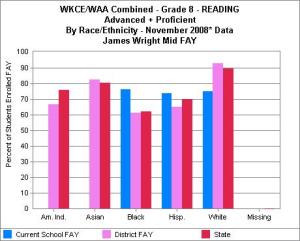
    Wright is a small school, with relatively small (if limited in their offerings) classes and  a “Social Action” focus.  86% of the students qualify for free or reduced lunches, 39% are classified as English Language Learners; the racial and ethnic demographics are 1% Native American, 38% African American,  37% Hispanic, 12% Asian and  13% White.

    As measured by state standardized tests (with the notation that this is a very limited measure of teaching, learning and school quality) Wright does well by most students and better than most schools for poor and minority students.  here are some graphs:

    CFT1103_1356442D7

    From the Wisconsin Department of Public Instruction, click for WINSS site.


    CFT1103_13565637

    From the Wisconsin Department of Public Instruction, click for WINSS site.

    There are still gaps in achievement and the test scores in other subjects are not as strong, but the general picture is of a relatively successful school.

    In other areas, where data is of even more limited utility, Wright is a very successful school.  There is a sense of community and an atmosphere of caring that transcends (but does not obliterate) racial, ethnic and economic differences.  The staff function as a professional, collaborative team much of the time.  In general there is pride, Panther Pride that encourages all to do their best and encourages all to aspire to do even better.  Through the social action focus, Wright seeks to bring this “we can do better” message to the wider community.  I can’t write this without once again crediting Principal Nancy Evans and the entire staff for these accomplishments and thanking them for all they do.

    Reviewing the Doyle, Duncan, Obama agenda, I don’t see much that would help Wright get better and I see some things that will make it harder for Wright to maintain the quality and qualities they have achieved.

    Due to the cuts in education funding in the recent state budget, Madison — like so many other districts — is looking at a very difficult budget in 2010-11.  Doyle, Duncan and Obama aren’t offering any help at all with this.  A difficult budget will likely mean that small class sizes, particularly those at Wright where they are below the norm for the district, will be targeted.

    The support staff at Wright is already minimal, with psychologists, social workers, librarians and others only in the school a day or two or three a week.  That too could get worse (see here for a report of what is happening in Minnesota).

    The demographics of the school highlight the importance of funding for students in poverty and English language Learners.  The state of Wisconsin provides no poverty aid beyond the limited SAGE program for the early grades, state reimbursements for English Language Learners as a percentage of costs have been falling for over a decade and the Federal money in both these areas remains small.  None of the current proposals from Doyle (or Duncan and Obama) do anything to fix this.

    Much of the agenda they are pushing has to do with more data and more uses of data.  It is hard to be against better assessments, better collection of data and better coordination in the use of data; but most of this is a distraction and is linked in their agenda to misguided noti0ns of national standards and expanded use of flawed test data to make decisions about almost everything, including teacher compensation (Doyle’s legislation on the last, here).

    One at a time on data issues, mostly in the “for further reading” mode.

    On National standards, I recommend reading what what Deborah Meir wrote here and checking out what William A. Proefriedt has to say to understand how the standards movement is working to undermine the engaged democratic ideals at the base of Wright’s social action mission.  This recent report that the development of standards development is being shaped by profit motives of the participants is also worth a look.

    On the limits of data and data analysis and their potential for abuse, the recent letter to Secretary Duncan from the Board on Testing and Assessment of the  National Research Council is a must read.

    Linking teacher compensation to test scores is wrong in so many ways.  Just three things for now; it prioritizes test scores in selected subjects as the be-all-and-end-all of education, shunting aside all those things Wright that make it not just a “relatively successful school” but a great school; it has great potential to undermine collaboration and professional relationships; and it doesn’t appear to work, even by the crude measures of standardized tests.

    Duncan, Obama and now Doyle like charter schools and Wright is technically a charter school.  Technically is the key word.  There is nothing about the governance of Wright that is any different than any other school in Madison.  The charter status is a historical artifact.   If they want to use Wright to make the case for charter expansion, they picked the wrong example.  Expanding charters won’t help Wright and it probably won’t help create more Wrights.

    While on the topic of charters, it is also worth noting that the pedagogy and curriculum of one of Duncan’s favorite charter groups — KIPP — is the exact opposite of the engaged, questioning, challenging lessons that Wright teaches as the basis for social action.  Jim Horn has posted on this aspect of KIPP many times, see here, here and here for examples.

    A few last words on Mayoral control and some other ways that the Doyle, Duncan, Obama agenda is working against the ideal of an engaged citizenry having a voice in public education, how what they are pushing and how they are pushing it undermines the social action ideas of Reverend James C. Wright and the school that bears his name.

    Mayoral control and the pending legislation for State Superintendent takeovers of districts “in need of improvement” (no further requirements spelled out. just that the State Superintendent says they need improvement) if implemented will make it more difficult for activists to be involved in their schools.  School Board campaigns are local, grassroots efforts.  Mayoral and State-wide campaigns are mostly about money and advertising.  In the first, candidates meet people and listen.  In the latter they craft messages based on polling.

    Once in office,  School Board members are relatively accessible; Mayors and State Superintendents are busy and difficult to reach.  In practice, the public has an opportunity to testify at most Board meetings.  Mayors tend to listen to power brokers and though I like Tony Evers (and even met with him once), I don’t believe he has held any public “listening sessions.”

    These proposals won’t completely shut the public out, but they will mute the voices of the grass roots.

    The voices of the grass roots have also been muted in the way the RttT legislation is being handled in Wisconsin.  Governor Doyle  issued general outlines a couple of weeks ago with few of the all-important details.  The first batch of legislation was introduced Friday 10/29 and the first hearing was scheduled for today (Monday, 11/2).  As of this morning there weren’t even Legislative Fiscal Bureau notes attached. Full floor votes in both houses may be scheduled before the end of next week (the session is scheduled to end Friday, but will likely be extended).

    This isn’t enough time to analyze, much less organize and mobilize.

    I’d like to hear President Obama and Governor Doyle explain to the students at Wright how this accelerated schedule serves the democratic process and why it is necessary to make it so difficult for students and others concerned with the future of education in Wisconsin to have their voices heard.

    This is no more likely than the promise of new priorities and pledge of  full educational funding I wished for at the top of this post.

    So in closing, I’ll express my hope for one thing that I think may actually happen:  President Obama, please be sure to spend some time with “Mother” Jacqueline Wright and share some of the stories of Mother and Reverend Wright’s activism with the world.  If, as you do this  you are reminded of why it is so important that voices from the outside be heard in the halls of power and have some second thoughts about the rest of the agenda for your visit, please heed those thoughts.

    Thomas J. Mertz

    1 Comment

    Filed under "education finance", Arne Duncan, Best Practices, Budget, education, finance, Local News, National News, School Finance, Take Action, Uncategorized

    WAES School Funding Reform Update, the Week of October 26, 2009

    waesgraphicFrom the Wisconsin Alliance for Excellent Schools. Table of contents below, with related material on AMPS linked to some items.  Click here for the full update.

    • WAES, others groups criticize Governor’s “funding plan”
    • Electors saying no to levy hikes resulting from state budget (and here and here and here)
    • Public, media understand the source of school funding problems
    • State of Washington wants pennies for its kids, too
    • Business leaders back expansion of early childhood education
    • WAES needs renewals, new members to continue work
    • Other states get it … what’s wrong with Wisconsin?
    • Colorado Supreme Court will hear adequacy challenge
    • WAES members take case on funding reform to the public
    • It’s time for America to pay attention to its schools again
    • Help WAES correct e-mail update glitch
    • School-funding reform calendar
    • The Wisconsin Alliance for Excellent Schools (WAES) is a statewide, independent, membership-based organization of educators, school board members, students, parents, community leaders, researchers, citizens, and community activists whose lone goal is the comprehensive reform of Wisconsin’s school-funding system. If you would like more information about the organization — or on becoming part of WAES — contact Tom Beebe at 920-650-0525 or tbeebe@excellentschools.org.

    Thomas J. Mertz

    Leave a comment

    Filed under "education finance", Best Practices, Budget, education, finance, Local News, Pennies for Kids, School Finance, Take Action, Uncategorized, We Are Not Alone